Chapter 20 – External Growth through Mergers
53. Synergy is
54. In planning mergers, there is a tendency to _____ synergistic benefits.
55. Which of the following is not a motive for selling by the stockholder’s of the acquired
company?
Chapter 20 – External Growth through Mergers
56. Which of the following type of merger decreases competition?
57. Which of the following is not a financial motive but rather an operating motive for merger
and consolidation?
58. An example of a horizontal merger would be
Chapter 20 – External Growth through Mergers
59. The elimination of overlapping functions and the meshing of two firms’ strong areas or
products creates the managerial incentive for mergers known as
60. Selling stockholders who are offered cash or another company’s stock in a merger may be
willing to part with the shares they hold because
61. Nonfinancial motives for mergers include:
Chapter 20 – External Growth through Mergers
62. Which of the following terms is not specifically related to an unfriendly buyout?
63. Aardvark Software, Inc. can purchase all the stock of Zebra Computer Services for
$1,200,000 in cash. Zebra is expected to generate net after-tax cash flows of $100,000 per
year for each of the next 12 years. Based solely on the cash flow analysis, Aardvark should
64. Which of the following is not a form of compensation that selling stockholders could
receive?
Chapter 20 – External Growth through Mergers
65. The Prad Corporation is considering a merger with the Stone Company which has 500,000
outstanding shares selling for $30. An investment banker has advised that to succeed in its
merger Prad Corp. would have to offer $45 per share for Stone’s stock. Prad Corp. stock is
selling for $25. How many shares of Prad Corp. stock would have to be exchanged to acquire
all of Stone’s stock?
66. Dilution in earnings per share occurs when a company with
Chapter 20 – External Growth through Mergers
67. In the event that Active Corp., which has a low P/E ratio, acquires Basic Corp., which has
a higher P/E ratio, we could be assured one of the following would occur.
68. The portfolio effect in a merger has to do with
69. White Knights
Chapter 20 – External Growth through Mergers
70. Which of the following is a tender offer that utilizes borrowed funds and the acquired
firm’s assets as collateral?
71. The price that a company has to pay to purchase another firm is usually
72. The typical merger premium is
Chapter 20 – External Growth through Mergers
73. The two step buy-out is a recent merger ploy that has which of the following
characteristics?
74. Under a two step buy-out procedure
75. In regard to two step buyouts,
Chapter 20 – External Growth through Mergers
76. All of the following are potential challenges or downsides to mergers except:
77. Under SFAS 141 and 142, the following occurred
78. All of the following are methods of avoiding takeovers except:
Chapter 20 – External Growth through Mergers
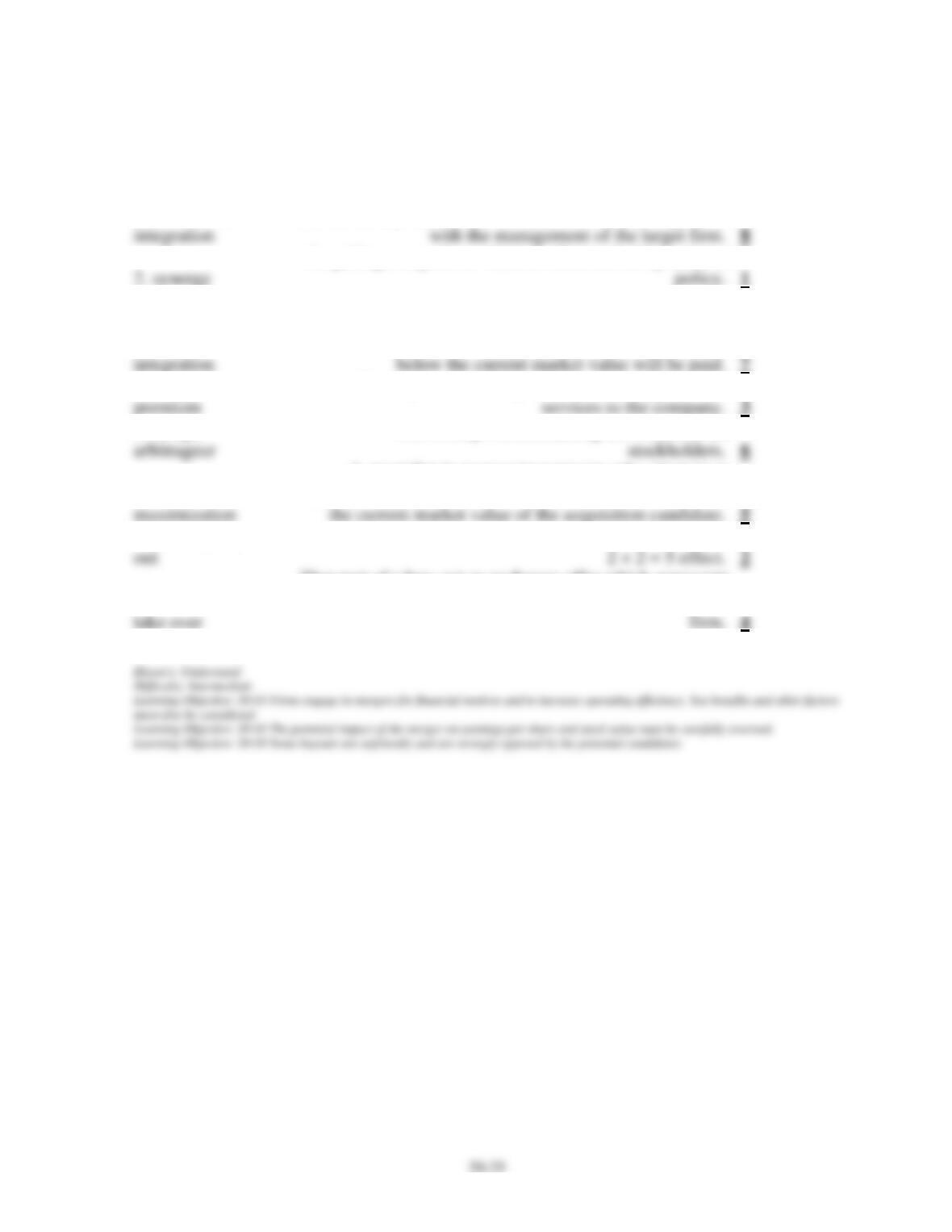
79. Match the following to the items below:
1. merger premium
4
A loss that can be extended for a number of years to
special
5
2. Saturday night
The combination of two or more firms to form an
3. White knight
8
The combination of two or more firms in which one
firm acquires the others, causing them to lose their
carryforward
7
4. tax-loss
The recognition that the whole may be equal to
5. consolidation
1
Value paid over the existing price of the acquired
6. terms of exchange
6
7. synergy
9
The buy-out ratio or terms of trade in a merger or an
8. merger
3
A third firm that management calls on to avoid the
9. two step buyout
The impact of a given investment on the overall
risk-return composition of the firm.
11
maximization
10
10. market value
The concept of maximizing the wealth of the
11. portfolio effect
2
A surprise offer made just before the market closes
for the weekend and takes the target company’s officers
Chapter 20 – External Growth through Mergers
80. Match the following to the items below:
1. horizontal
An unfriendly acquisition which is not initially negotiated
Acquiring competitors which is often curbed by antitrust
3. vertical
A type of takeover in which two offers are made: an
initial offer to buy 51% of the stock at a price above current
market value for a limited time only, after which a price
4. merger
The acquisition of buyers and sellers of goods and
5. merger
The concept of maximizing the wealth of the
6. market value
A specialist in merger investments who attempts to
capitalize on the difference between the value offered and
7. two step buy-
8. tender offer-
That part of a buy-out or exchange offer which represents
a value over and above the market value of the acquired
Chapter 20 – External Growth through Mergers
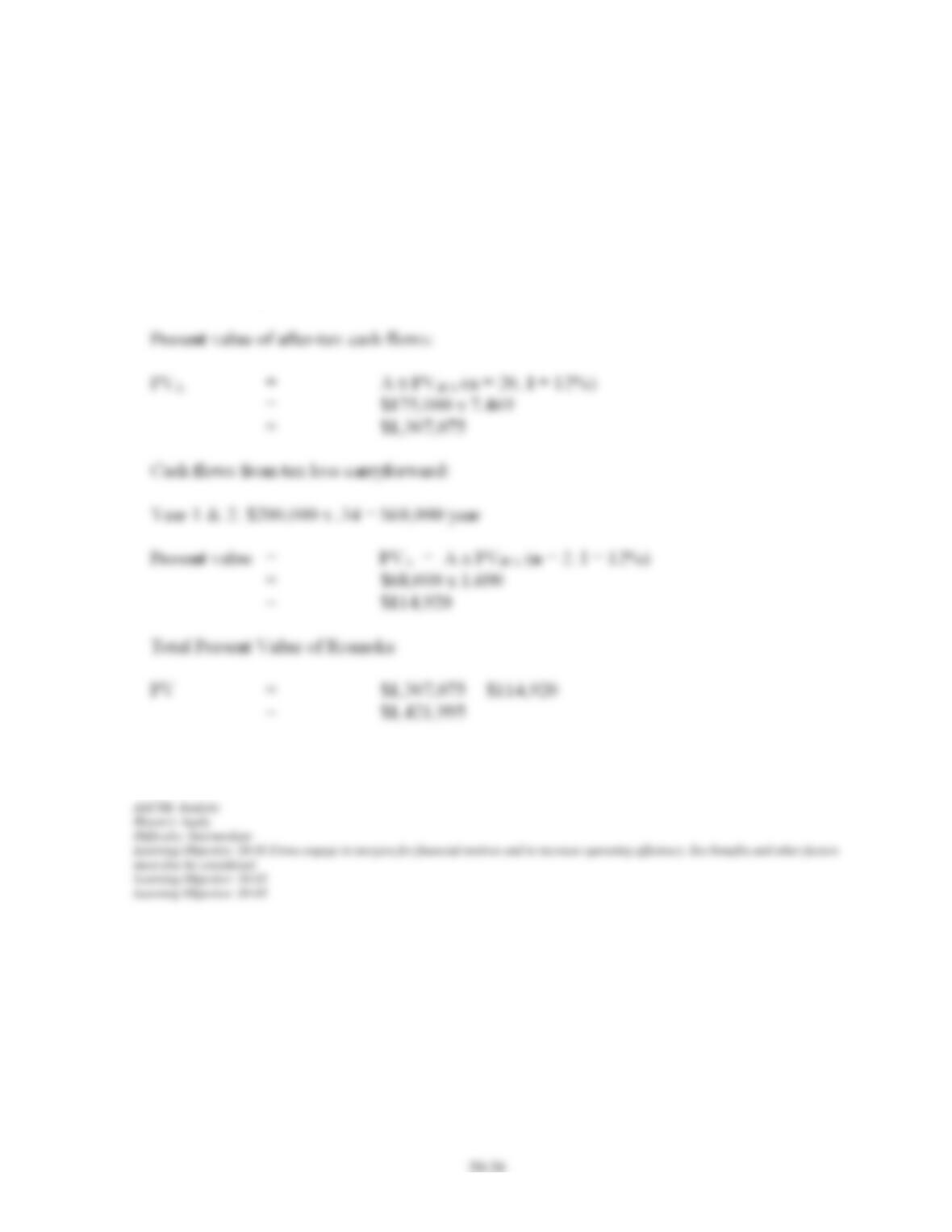
81. The King Solomon Mining Company is contemplating a cash tender offer for the
outstanding shares of Roanoke Coal Corporation. Roanoke Coal is expected to provide
$175,000 in after-tax cash flow (after-tax income plus depreciation) each year for the next 20
years. In addition, Roanoke has a $400,000 tax loss carryforward which King Solomon
Mining can use over the next two years ($200,000 per year).
If King Solomon Mining’s corporate tax rate is 34% and its cost of capital is 12%, what is the
cash price it should be willing to pay to acquire Roanoke based solely on it’s cash-flow benefit
over the next 20 years?
Chapter 20 – External Growth through Mergers
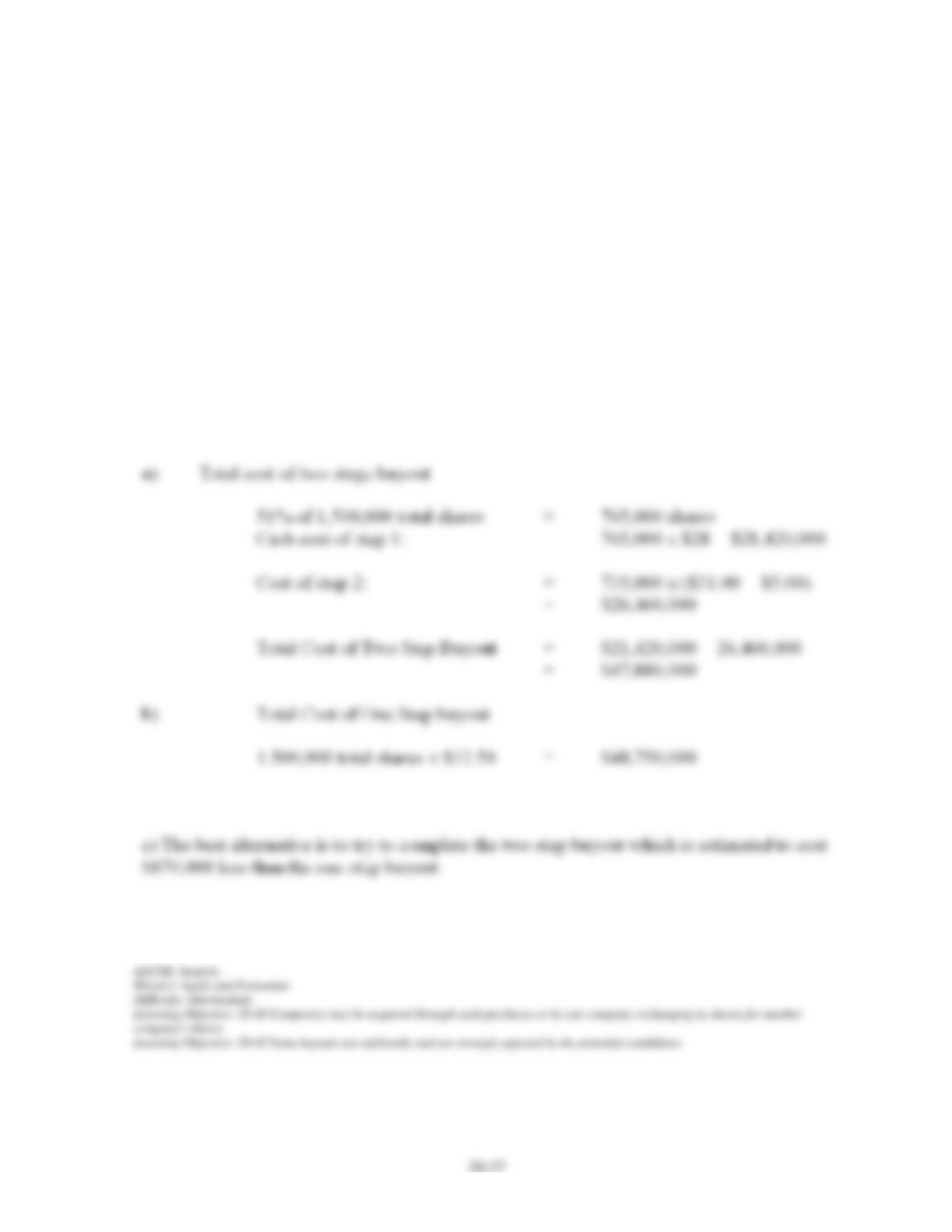
82. Simon Manufacturing Co. is planning to acquire Garfunkel Engineering in a two-step
buyout. Garfunkel has 1,500,000 shares of common stock currently outstanding, and the
market price is currently at $25 per share. The first step of the buyout would offer to purchase
51% of Garfunkel Engineering common stock for $28 per share. The second step would be to
exchange each remaining share of Garfunkel common for $5 in cash and a newly issued share
of Simon Manufacturing convertible preferred stock, valued at $31.00 per share.
Simon Manufacturing’s investment banker has suggested, as an alternative, a single-stage
buyout at $32.50 per share for all of Garfunkel’s common stock.
a) What is the total cost of the two-step buyout?
b) What is the total cost of the single step proposal?
c) If it wants to minimize the total cost of the acquisition, what should Simon Manufacturing
do?