59. You graduate from law school and can now begin charging clients fees for your time.
What impact will this have on your demand for money?
a. Your increased income will likely cause your demand for money to decrease
b. Your opportunity cost of making trips to the bank will decrease
c. Your increased income will likely cause your demand for money to increase
d. Your demand for money will not be affected
60. The only solution available to a country experiencing extremely high rates of inflation is to:
a. raise interest rates.
b. peg your currency to another country‘s currency.
c. reduce money growth.
d. revert to a gold standard.
61. Stable velocity as a contributing factor to successfully using money growth as a stabilizing
monetary policy tool, is more important in an environment where:
a. inflation is extremely high (e.g., over 100 percent).
b. inflation is low (e.g., less than 10 percent).
c. inflation occurs, the problems caused by a variable velocity are just as severe at low levels of
inflation as at high levels of inflation.
d. there is deflation.
62. For the Fed to use money growth as a direct monetary policy target, which of the following
needs to exist?
a. A highly variable deposit expansion multiplier
b. A stable link between the monetary base and the quantity of money
c. A predictable link between the quantity of money and the deposit expansion multiplier
d. A stable link between the monetary base and the quantity of money and a predictable
relationship between the quantity of money and the rate of inflation
63. To use money growth as a short-term monetary policy instrument, a central bank must:
a. believe there is a stable link between the monetary base and the rate of inflation.
b. believe that only money matters.
c. believe that there is an unpredictable relationship between money aggregates and inflation.
d. believe the deposit expansion multiplier is volatile and unpredictable.
64. Empirical research has shown that:
a. in the 1990s and 2000s, velocity was more sensitive to an increase in the opportunity cost
of holding money than in the 1980s.
b. in the 1990s and 2000s, velocity was less sensitive to an increase in the opportunity cost
of holding money than in the 1980s.
c. during the 1980s and 1990s, the velocity of money was not sensitive to changes in the
opportunity cost of holding money.
d. during the 1980s and 1990s, the velocity of money actually decreased as the opportunity cost
of holding money increased.
65. A cause of the decline in the velocity of money during the 2007-2009 financial crisis was a
22
result of:
a. the fiscal stimulus provided by the U.S. government.
b. the lowering of the discount rate by the Fed.
c. the use of unconventional policy tools by the Fed.
d. an increase in uncertainty.
66. To say that the relationship between the velocity of money and the opportunity cost of
holding money is not stable is the same as saying:
a. the supply of money is not stable.
b. the money market is always in disequilibrium.
c. money demand is stable.
d. money demand is not stable.
67. The relationship between the velocity of money and interest rates is:
a. positive but not stable.
b. negative but not stable.
c. positive and stable.
d. negative and stable.
68. A major contributing factor to the instability of money demand over the past 25 years is the:
a. introduction of financial instruments that pay higher returns than money but can be used as a
means of payment.
b. Fed has changed the way the money aggregates are defined.
c. failure of many savings and loans.
d. introduction of credit cards.
69. The Lucas critique focuses specifically on:
a. the relationship between Fed policy and the money supply.
b. the role that economic policymaking has on people’s economic behavior.
c. the inability to measure economic performance accurately.
d. the moving away from fixed exchange rates to flexible exchange rates.
70. Between 1970 and 2000, the Fed:
a. published their targets for money growth and often hit these targets.
b. never published targets or actual amounts for money growth.
c. published targets for money growth and rarely hit them.
d. published actual money growth but not targets.
71. Between 1970 and 2000, if the Fed had tried to hit the money growth targets:
a. the economy would have likely experienced very high inflation.
b. the federal funds rate would have changed often and by large amounts.
c. the interest rates would have likely been more stable.
d. the economy would have likely experienced very high inflation but the interest rates would
have likely been more stable.
72. Statistical analysis reveals that the long-run money velocity (for euro-area M3, which is
equivalent to U.S. M2):
a. is unstable in the euro similar to the instability that exists in the U.S.
b. is much more stable in the U.S. than in the euro area.
c. has increased in the euro area since 1980.
d. is more stable in the euro area than in the U.S.
73. Which of the following statements is true?
a. While the Fed emphasizes money growth more than the ECB, both central banks have chosen
interest rates as their operating target.
b. While the Fed emphasizes money growth less than the ECB, both central banks have chosen
interest rates as their operating target.
c. Because the Fed emphasizes money growth less than the ECB, the Fed uses interest rates as
their operating target while the ECB looks at growth in money aggregates.
d. Both the Fed and the ECB use growth in money aggregates as their operating target.
74. One cost that potentially could result from central banks targeting money growth is:
a. high inflation.
b. a slowdown in financial innovation.
c. volatile interest rates.
d. decreased independence.
75. For a three-year period from October 1979 to October 1982; the FOMC:
a. primarily targeted reserves.
b. primarily targeted the real federal funds interest rate.
c. primarily targeted M2.
d. gave up targeting reserves entirely.
76. During the period of October 1979 to October 1982; the FOMC’s primary operating target
resulted in:
a. the most stable period for the federal funds rate in history.
b. reserves being highly volatile.
c. the federal funds rate experiencing high volatility.
d. the federal funds rate dropping to 2 percent (an all-time low to that date) and not rising above
3 percent.
26
77. In the late 1970s into the early 1980s, interest rates were high and very volatile. During this
period:
a. the velocity of money should have been stable.
b. money demand as well as velocity should have also been shifting and volatile.
c. it should have been easy for the Fed to predict the velocity of money.
d. the Fed was actually targeting the short-term interest rate.
78. If the nominal interest rate decreases:
a. the cost of holding money decreases.
b. the cost of holding money increases.
c. the velocity of money should increase.
d. the cost of holding money increases and the velocity of money should decrease.
79. All other factors equal, if the costs of converting bonds and other financial securities to a
means of payment decrease:
a. the transactions demand for money should increase.
b. the transactions demand for money should decrease.
c. it shouldn’t impact the transactions demand for money.
d. nominal interest rates should decrease.
80. All other factors equal, as nominal interest rates increase, checking account balances
should:
a. increase.
b. decrease.
c. remain constant.
d. be converted to cash.
Short Answer Questions
81. Why does the Fed have to be concerned with money growth even though their main focus
seems to be on interest rates?
82. If velocity of money is constant; real growth in the output of the economy is +2.5%; and
inflation is 2.0%; what is the growth rate of money?
83. The equation of exchange which is MV = PY is an identity, which means it is true by
definition. If you think carefully, what variable in the equation by the way it is defined really
makes the equation of exchange an identity?
84. If the Fed wanted to target price stability, meaning zero inflation, why should it set a target
rate of inflation of around one percent?
85. The CPI is a commonly used and closely watched measure of inflation. However, it has
limitations. What are they?
86. If the price of money is determined by supply and demand, what impact should a decrease
in the supply of money (given steady money demand) have on the price of money and the rate
of inflation?
87. Assuming a constant nominal GDP, would the velocity of M1 equal the velocity of
M2? Explain.
88. Irving Fisher derived the quantity theory of money from the equation of exchange. What
two assumptions did he make to derive the theory and what is the basic assertion of the theory?
89. Professor Milton Friedman stated that “inflation is a monetary phenomenon.” What did
he mean by this statement and what is the basis for this assertion?
90. The empirical evidence on the velocity of money, specifically M2, shows it to be relatively
stable over the long run. Does this imply that monetary policymakers really should focus on the
growth rate of money for economic stability?
91. Is keeping money growth low when the central bank can accurately forecast real growth a
guarantee that short-run inflation will not occur? Explain
92. If the Fed wanted to keep inflation in check given the growth rate of the economy, how
should they have responded to the financial innovations of the mid to late 1970s and early 1980s
in terms of money growth?
93. How does money velocity contribute to the observation that in countries with high rates of
inflation the inflation rate exceeds the rate of money growth?
94. Economists are fond of calculating measures of elasticity. If we calculate the income
elasticity of money as the %ΔM / %ΔPY, where M is the quantity of money held and PY is
nominal income, would you suspect the coefficient to be positive, negative or zero? Will
the absolute value be greater or less than 1? Be sure to explain your choices.
95. Why do people hold money? Explain the reasons.
96. In what ways have financial innovations affected the demand for money?
97. What would the portfolio demand for money look like if it were graphed on a set of axes?
What would each axis represent?
98. If we consider the relationship between the opportunity cost of holding money and velocity
that existed in the 1980s, if the Fed followed the same policymaking in the 1990s and 2000s,
would they have achieved the desired results? Explain.
99. What factors can cause the portfolio demand for money to increase?
100. Is variability in velocity more of a problem in high or low inflation countries?
Explai
n.
101. Why did a decline in mortgage rates in the 1990s cause the velocity of M2 to fluctuate?
102. On what aspect of policymaking, according to Robert Lucas, have policymakers
been shortsighted in the past?
103. If monetary policymakers cannot accurately forecast shifts in money demand, what are
they really only left with for a short-term policy instrument and why?
104. Given that the velocity of money can be unstable in the short run, is this reason enough
to dismiss money growth as a policy target? Explain.
Essay Questions
105. If the correlation between the rate of inflation and the rate of money growth were closer to
-1 rather than +1 would the Fed care any more or less about the growth rate of money?
Explain your answer.
106. Is it a necessary condition that velocity is constant and that real output growth is assumed
to be zero to have Milton Friedman’s assertion that inflation is a monetary phenomenon be
true?
107. If we consider the quantity theory of money and Professor Irving Fisher,
who did a lot of his work in the early 20th century, why might Professor Fisher
feel less confident about predicting constant velocity of money today than when
he did his work?
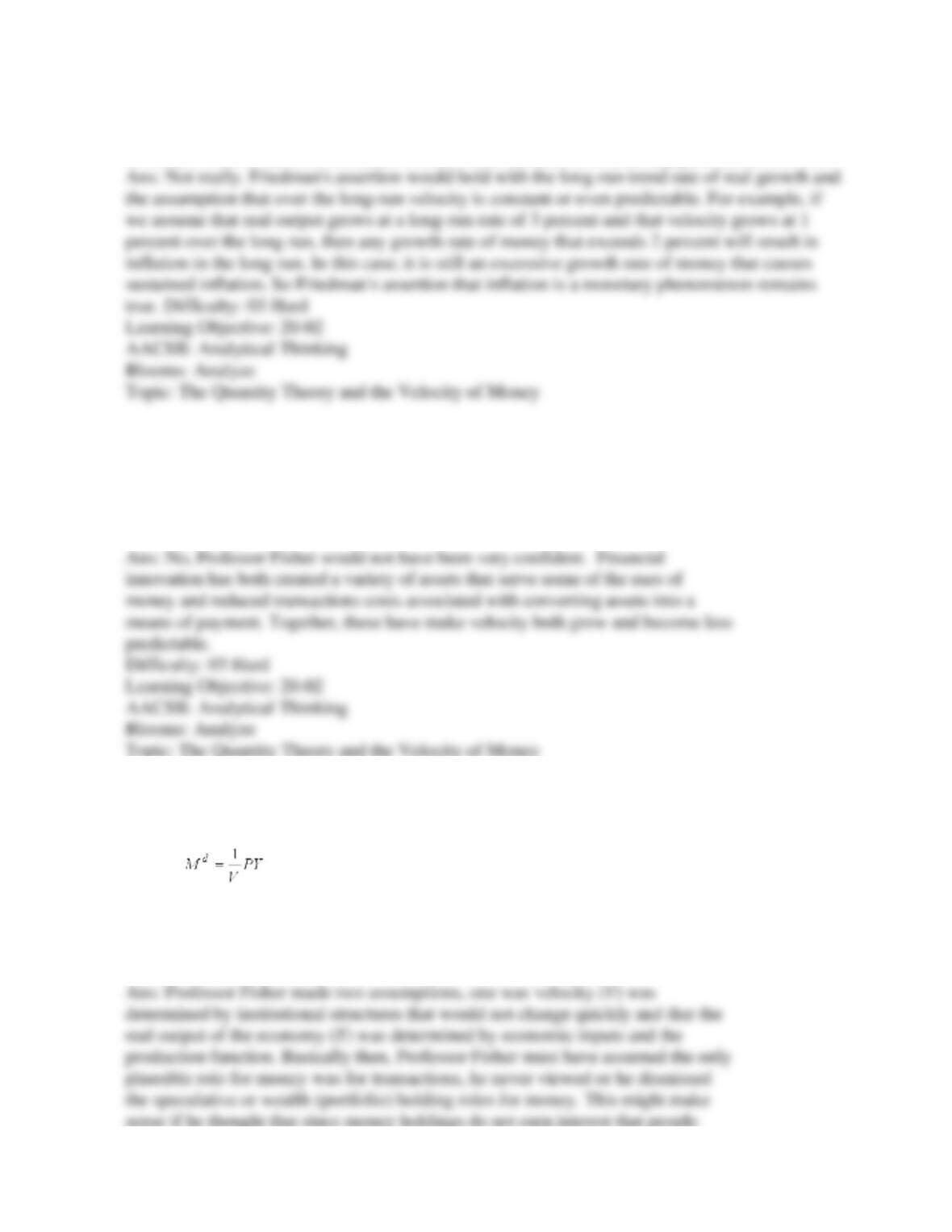
108. The equation for money demand expressed in the chapter that is derived
from the equation of exchange is:
We see that the equation does not explicitly address the interest rate. In fact,
Professor Fisher assumed that velocity is constant which means 1/V is also a
constant. Why do you
thi
nk P
rofe
ssor Fisher left the interest rate out of the
equation? Do you think he would if he were alive today? Explain.