Auditing, 12e (Arens)
Chapter 20 Auditor Reporting
20.1 State the requirements for a standard unqualified audit report
1) The most common type of audit report contains
A) an adverse opinion.
B) a disclaimer of opinion.
C) a qualified opinion.
D) an unqualified opinion.
2) According to CAS 700, the standard unqualified report’s title should be
A) Unqualified report of the auditor.
B) Audited financial statements.
C) Auditor’s report.
D) Independent auditor’s report.
3) Under the Canadian Auditing Standards, the introductory paragraph of the independent
auditor’s report indicates that the auditor has audited the balance sheet, the income statement, the
cash flow, a summary of accounting policies and notes and
A) the statements of retained earnings.
B) the statement of changes in equity.
C) management’s discussion and analysis letter.
D) the internal controls of the company.
4) The scope paragraph of the standard unqualified audit report in the auditor responsibility
section states that the audit is designed to
A) discover all errors and/or irregularities.
B) discover material errors and/or irregularities.
C) obtain reasonable assurance whether the statements are free of material misstatement.
D) conform to a generally accepted financial reporting framework.
5) Management has several responsibilities that are important to the auditor. One of these is that
management is responsible for
A) internal controls that prevent material misstatements either due to fraud or error.
B) maintaining control of evidence (such as confirmations) until assessed by the auditor.
C) evaluating evidence against acceptable criteria.
D) providing reasonable assurance that the financial statements are fairly stated.
6) In the scope paragraph of the audit report, the use of the term “reasonable assurance” is
intended to indicate that
A) no misstatements exist in the financial statements.
B) no material misstatements exist in the statements.
C) there is some possibility that material misstatements still exist in the financial statements.
D) there is a possibility that immaterial misstatements still exist in the financial statements.
7) The use of the term “reasonable assurance” is intended to indicate that an audit cannot be
expected to
A) completely eliminate the possibility that a material error or fraud exists.
B) consider or search for minor errors.
C) be compliant with the generally accepted accounting principles for every account.
D) provide assurance of no material errors or irregularities to investors who are using the
financial statements for investment decisions.
8) It is management’s responsibility to select the accounting policies that are used in the
preparation of the financial statements. What is the auditor’s responsibility with respect to these
accounting policies?
A) approve the accounting policies that are used, so that an opinion can be stated on the fairness
of the financial statements
B) evaluate the appropriateness of the accounting policies that are used and of the associated
estimates made
C) tell management which accounting policies should be selected, so that accurate estimates can
be made for year end adjustments
D) recalculate the estimates that are used for the accounting policies (such as bad debt allowance
and warranty expenses)
9) The independent auditor’s opinion explains how much evidence the auditor collects during the
independent audit. How much evidence is collected?
A) sufficient and appropriate to provide a basis for the audit opinion
B) sufficient to state that there are no material errors in the financial statements
C) appropriate to be able to evaluate the exact accuracy of the accounting estimates
D) sufficient and appropriate to conclude the financial statements present a true and fair view of
the economic events of the organization
10) The phrase “in our opinion” indicates that
A) the auditor performed the audit on a test basis.
B) the auditor’s judgment can be relied upon.
C) the auditor relied on their knowledge to perform the audit.
D) there may be some information risk associated with the financial statements.
11) One of the most controversial parts of the auditor’s report is the meaning of the term
“presents fairly.” What does the auditor’s opinion mean when these words are used? The
A) values in the financial statements represent the net realizable values of the assets of the entity.
B) financial statements are accurate and provide a true and fair representation of the entity’s
current financial position.
C) values in the financial statements represent the value of the entity now, if it were liquidated on
an open market.
D) financial statements are fairly presented in accordance with the financial reporting framework
described in the opinion paragraph.
12) Clark Kent is a PA partner at the firm of Kent, Lane and Lang, a limited liability partnership.
Kent’s firm has just completed the audit of a client with a March 31, 2012, year end. How should
the audit report be signed?
A) Clark Kent, PA
B) Kent, Lane and Lang, LLP
C) Clark Kent, LLP
D) Kent, Lane and Lang, PAs
13) The appropriate date for the audit report for a public company is the one on which the
A) client’s fiscal year ended.
B) auditor and client entered into a contract.
C) board of directors approved the financial statements.
D) auditor prepares and delivers the report to the client.
14) The audit report date is important to users because it indicates the last day
A) of the fiscal period.
B) on which the financial statements may be filed with the provincial securities commission.
C) on which users may institute a lawsuit against either client or auditor.
D) of the auditor’s responsibility for the review of significant events that occurred after the date
of the financial statements.
15) If the balance sheet of a company is dated December 31, 2012, the audit report is dated
March 6, 2013, and both are released to the public on March 15, 2013, this indicates that the
auditor has searched for material unrecorded transactions and events that occurred up to
A) December 31, 2012.
B) March 6, 2013.
C) March 15, 2013.
D) December 31, 2013.
16) Double dating a report is done when
A) the parent company and their subsidiaries have different year ends.
B) the auditor finishes his work later than planned.
C) a material event occurs after the date of the auditor’s report and affects the period that was
audited
D) a material event occurs after the date of the auditor’s report and before the date the report is
issued.
17) There are five conditions that must be met before an auditor can issue a standard unqualified
report. Discuss each of these five conditions.
18) Analyze the “Auditor Responsibility Section” of the standard Independent Auditor’s Report,
ie. explain the intended purpose of the sentences in this section.
20.2 Describe how the standard audit report is changed to provide additional information to
users
1) A deviation from the standard unqualified report will cause knowledgeable users of financial
statements to recognize that the
A) auditor intends to communicate additional or limiting information.
B) financial statements contain a material error.
C) financial statements contain an error.
D) Canadian Auditing Standards were not followed.
2) Three of the following conditions would, by themselves, require the auditor to issue a report
other than an unqualified report. Which one would permit a standard unqualified report?
A) The financial statements show a significant net loss for each of the last three years, including
the current fiscal period.
B) The financial statements have not been prepared in accordance with an acceptable financial
reporting framework and are misleading.
C) The auditor is not independent during the fiscal period under audit.
D) The scope of the auditor’s examination has been restricted, although the cause of the
restriction was not the client’s fault.
3) Bianca Jones was engaged to conduct the audit of Smilicor Company, a toy distributor, three
months after the year end date. Bianca was unable to conduct an audit of opening inventory, but
was able to satisfy herself with respect to the opening balances. She was also able to conduct
audit procedures for other opening balances, for example, by observing fixed assets. What type
of audit opinion would Smilicor receive?
A) Disclaimer
B) Adverse
C) Qualified
D) Unqualified
4) The “unqualified report with explanatory paragraph” or the “unqualified report with modified
wording”
A) arise as a result of an incomplete audit.
B) arise when the financial statements are not quite “presented fairly.”
C) meet the criteria of a complete audit with satisfactory results but further explanation is
required.
D) meet the criteria of a complete audit but with unsatisfactory results.
5) The ASPE (Accounting Standards for Private Enterprises) financial reporting framework
normally requires the auditor to report using the corresponding figures approach. This means that
the auditor reports on
A) the current year’s financial statements.
B) both periods under audit, the current and prior year.
C) three years, the current and prior year, and the effects of the prior year.
D) only the ending balances of the general ledger accounts.
6) Publicly listed organizations and those using IFRS (International Financial Reporting
Standards) must have audit reports that use the comparative financial statements approach. This
means that the auditor reports on
A) the current year’s financial statements.
B) both periods under audit, the current and prior year.
C) three years, the current and prior year, and the effects of the prior year.
D) only the ending balances of the general ledger accounts.
7) Your client has experienced a major data breach with lawsuits and fines pending of significant
and uncertain amounts. These events are disclosed in the client financial statements and clearly
explained in the notes. How do these events affect the independent auditors report? The auditor
would use
A) a standard unqualified auditor’s report.
B) an emphasis of matter paragraph titled “Data Breach” to highlight the events.
C) an other matters paragraph titled “Data Breach” to highlight the amounts.
D) a qualified audit opinion due to the size of the uncertainty.
8) Your client has two sets of financial statements. One set is in compliance with IFRS, while the
other set is in compliance with local tax legislation, and will be used only with the tax returns.
How do these events affect the independent auditors report? The auditor would use
A) an unqualified audit report for both financial statements, with an Emphasis of Matter
paragraph that describes to readers the nature of the other set of financial statements.
B) a standard unqualified auditor’s report for both financial statements, labeling the auditor’s
report “for IFRS only” and “for tax purposes only.”
C) an unqualified audit report for both financial statements, with an Other Matter paragraph that
describes to readers the nature of the other set of financial statements.
D) a qualified audit report would be issued as the client may not have two different sets of
financial statements.
9) Your client is not using either ASPE or IFRS. Instead, it is using current value accounting
with no use of historical cost, because your client is in a country with about 50% inflation per
year. Local legislation requires that all resident organizations use current value accounting. How
do these events affect the independent auditors report? The auditor would
A) issue a standard unqualified auditor’s report.
B) use an Emphasis of Matter paragraph to explain that the financial statements are prepared in
accordance with local legislation.
C) use an Other Matter paragraph to explain that the financial statements are prepared in
accordance with local legislation.
D) state in the opinion paragraph that the financial statements were prepared in accordance with
the local legislation.
10) Your client is a large financial institution in Canada. Canadian regulators require that such
financial statements have an audit report that provides an opinion on the consistency of
accounting policies. How do these events affect the independent auditors report? The auditor
would
A) add an Other Matter paragraph titled Report on Other Legal and Regulatory Requirements.
B) add an Emphasis of Matter paragraph titled Report on Other Legal and Regulatory
Requirements.
C) use a standard unqualified auditor’s report.
D) state in the opinion paragraph that the financial statements were prepared in accordance with
the legislation for financial institutions.
11) Beem & Lord, a PA firm, audited the financial statements of Frazer Inc. Since this was a first
time audit, Beem & Lord did not audit the comparative financial statements, as this was done by
the previous auditor. Beem & Lord should expand their report to include an explanation in
A) the scope paragraph.
B) the management responsibility paragraph.
C) the opinion paragraph.
D) a paragraph following the opinion paragraph.
12) A company has changed its method of inventory valuation from an unacceptable one to one
that complies with ASPE (Accounting Standards for Private Enterprises). The auditor’s report on
the financial statements of the year of the change should include
A) no reference to the item assuming that the change has been properly disclosed.
B) a reference to a change in accounting principle in the opinion paragraph.
C) an explanatory paragraph explaining the change.
D) a justification for making the change and the impact of the change on reported net income.
13) PA firm has been auditing Big Manufacturing Company (BMC) for several years. Last year,
BMC converted its inventory and purchasing systems to a new system effective December 31,
the date of the year end. To their horror, the PA firm discovered at the beginning of the current
error that there was a cut-off error in the accounts payable system of $25 million dollars LAST
YEAR. Neither the client nor the firm had detected that the purchases of December 31 had been
omitted from the old computer system transaction processing and had been recorded only in the
new computer system, understating last year’s expenses. Last year’s financial statements have
been restated and the error disclosed in the notes to both last year’s and this year’s financial
statements. What type of audit opinion will BMC receive this year?
A) Qualified
B) Disclaimer
C) Adverse
D) Unqualified
14) When a material uncertainty exists, the auditor must
A) disclose it in the audit report.
B) first determine the materiality of the item and whether adequate disclosure is included in the
financial statements.
C) issue a disclaimer of opinion.
D) issue a qualified opinion.
15) ProForce Inc. is facing a large lawsuit from its employees. The contingency is significant and
may lead to a going concern issue if ProForce is found guilty. ProForce took the adequate
measures, as prescribed by IFRS (International Financial Reporting Standards), to account,
disclose and present the contingency in the financial statements. The auditor should
A) add an emphasis-of-matter paragraph after the opinion paragraph.
B) issue a standard unqualified report.
C) issue a qualified report.
D) deny an audit opinion.
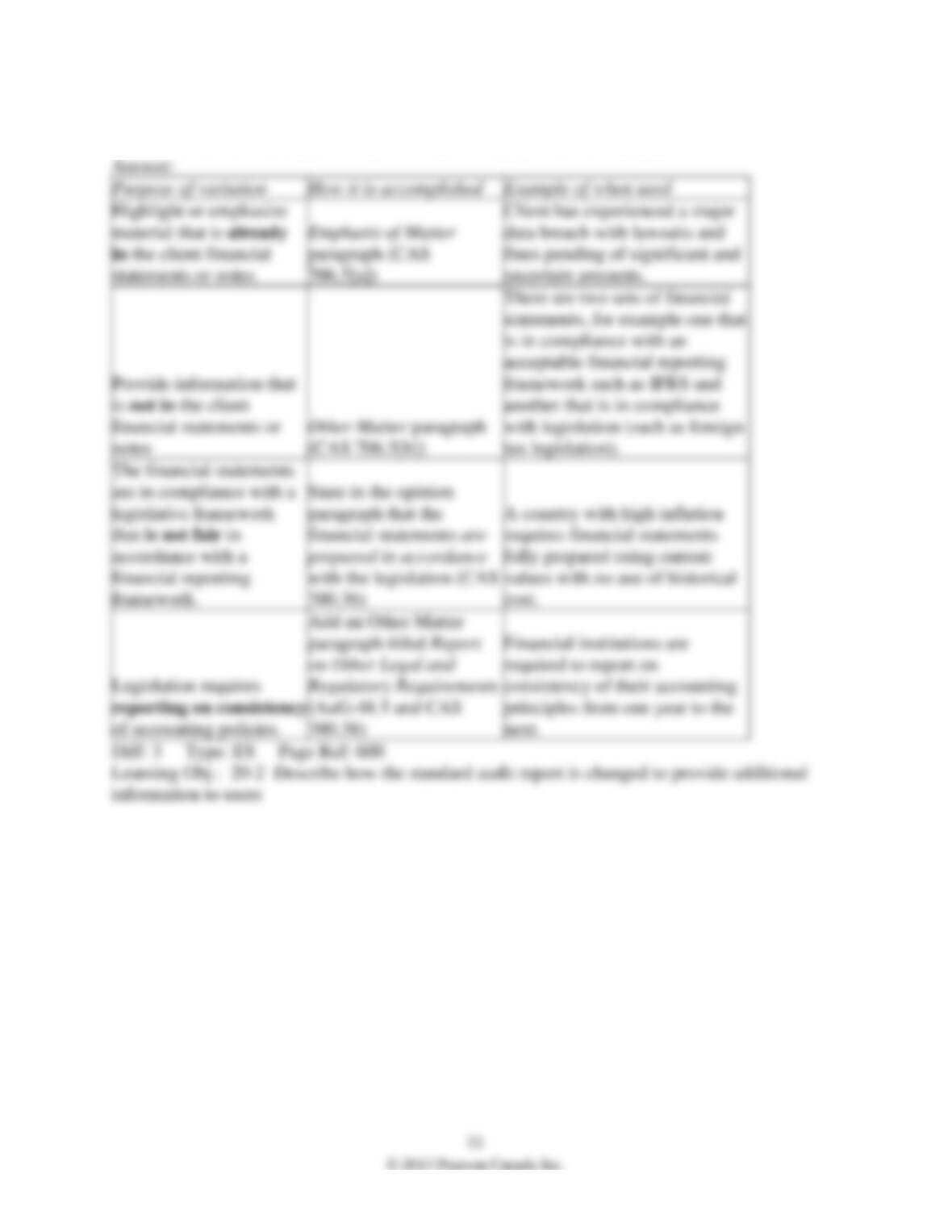
16) Explain four different variations that could occur in unqualified audit reports. For each
variation, state how the auditor’s report is affected and provide an example.
20.3 Describe the difference between an adverse opinion and a disclaimer of opinion
1) As a result of management’s refusal to permit the auditor to physically examine inventory, the
auditor has not accumulated sufficient evidence to conclude whether financial statements are
stated in accordance with ASPE (Accounting Standards for Private Enterprises). The auditor
must depart from the unqualified audit report because
A) the financial statements have not been prepared in accordance with GAAP.
B) the scope of the audit has been restricted by circumstances beyond either the client’s or
auditor’s control.
C) the auditor has lost independence.
D) the scope of the audit has been restricted by the client.
2) If a misstatement is immaterial relative to the financial statements of the entity for the current
period and is not expected to have a material effect in future periods, it is appropriate to issue
A) an unqualified opinion.
B) a qualified opinion.
C) an adverse opinion.
D) a disclaimer of opinion.
3) The auditor’s report of the Huge Mega Company indicates that the financial statement are
fairly presented except for the goodwill balance which does not comply with International
Financial Reporting Standards. The auditor’s report is
A) unqualified.
B) unqualified with explanatory paragraph.
C) qualified.
D) adverse.