Chapter 20: Hybrid Financing: Preferred Stock, Warrants, and Convertibles
1. The “preferred” feature of preferred stock means that it normally will provide a higher expected return than will
common stock.
a. True
b. False
2. Unlike bonds, the cost of preferred stock to the issuing firm is the same on a before-tax and after-tax basis. This is
because dividends on preferred stock are not tax deductible, whereas interest on bonds is deductible.
a. True
b. False
3. Many preferred stocks extend voting rights to preferred shareholders if the preferred dividend has been omitted for
some specified period, for example, 4 quarters.
a. True
b. False
Chapter 20: Hybrid Financing: Preferred Stock, Warrants, and Convertibles
4. Preferred stockholders have priority over common stockholders with respect to dividends, because dividends must be
paid on preferred stock before they can be paid on common stock. However, preferred and common stockholders
normally have equal priority with respect to liquidating proceeds in the event of bankruptcy.
a. True
b. False
5. Preferred stock typically has a par value, and the dividend is often stated as a percentage of par. The par value is also
important in the event of liquidation, as the preferred stockholders are generally entitled to receive the par value before
anything is given to the common stockholders.
a. True
b. False
6. Preferred stock can provide a financing alternative for some firms when market conditions are such that they cannot
issue either pure debt or common stock at any reasonable cost.
a. True
b. False
Chapter 20: Hybrid Financing: Preferred Stock, Warrants, and Convertibles
7. Corporations that invest surplus funds in floating-rate preferred stock benefit from getting a relatively stable price,
which is desirable for liquidity portfolios, and they also benefit from the 50% tax exemption on preferred dividends
received.
a. True
b. False
8. Which of the following statements is most CORRECT?
a. By law in most states, all preferred stock must be cumulative, meaning that the compounded total of all unpaid
preferred dividends must be paid before any dividends can be paid on the firm’s common stock.
b. From the issuer’s point of view, preferred stock is less risky than bonds.
c. Whereas common stock has an indefinite life, preferred stocks always have a specific maturity date, generally 25
years or less.
d. Unlike bonds, preferred stock cannot have a convertible feature.
e. Preferred stock generally has a higher component cost of capital to the firm than does common stock.
Chapter 20: Hybrid Financing: Preferred Stock, Warrants, and Convertibles
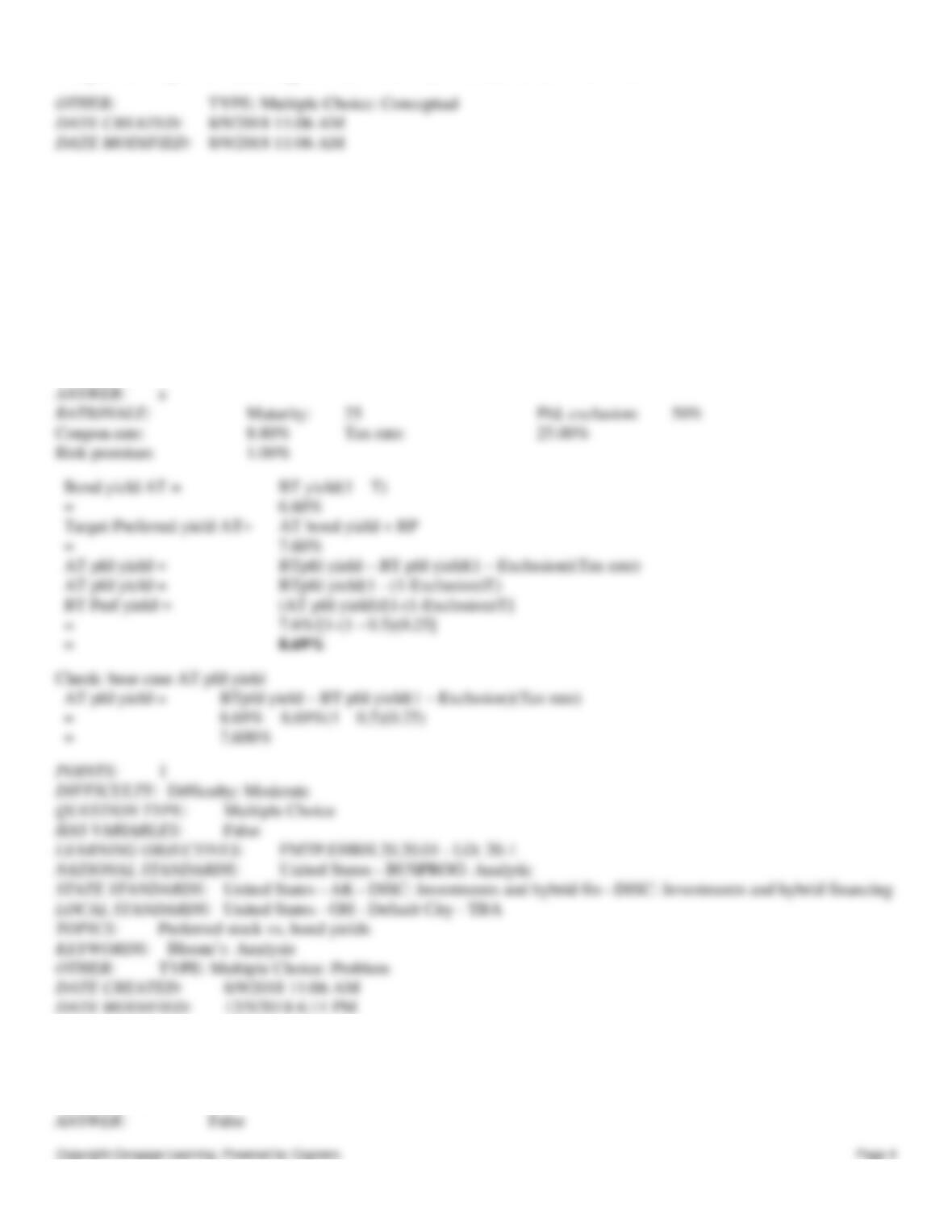
9. Mariano Manufacturing can issue a 25-year, 8.8% annual payment bond at par. Its investment bankers also stated that
the company can sell an issue of annual payment preferred stock to corporate investors who are in the 25% tax bracket.
The corporate investors require an after-tax return on the preferred that exceeds their after-tax return on the bonds by
1.0%, which would represent an after-tax risk premium. What coupon rate must be set on the preferred in order to issue it
at par?
a. 8.27%
b. 8.69%
c. 9.12%
d. 9.58%
e. 10.05%
10. A warrant is an option, and as such it cannot be used as a “sweetener.”
a. True
b. False

Chapter 20: Hybrid Financing: Preferred Stock, Warrants, and Convertibles
11. A warrant holder is not entitled to vote, but he or she does receive any cash dividends paid on the underlying stock.
a. True
b. False
12. The problem of dilution of stockholders’ earnings never results from the sale of call options, but it can arise if warrants
are used.
a. True
b. False
13. A detachable warrant is a warrant that can be detached and traded separately from the bond with which it was issued.
Most traded warrants are originally attached to bonds or preferred stocks.
a. True
Chapter 20: Hybrid Financing: Preferred Stock, Warrants, and Convertibles
b. False
14. Preissle Company, wants to sell some 20-year, annual interest, $1,000 par value bonds. Its stock sells for $42 per
share, and each bond would have 75 warrants attached to it, each exercisable into one share of stock at an exercise price of
$47. The firm’s straight bonds yield 10%. Each warrant is expected to have a market value of $2.00 given that the stock
sells for $42. What coupon interest rate must the company set on the bonds in order to sell the bonds-with-warrants at par?
a. 7.83%
b. 8.24%
c. 8.65%
d. 9.08%
e. 9.54%
15. McGovern Enterprises is interested in issuing bonds with warrants attached. The bonds will have a 30-year maturity
and annual interest payments. Each bond will come with 20 warrants that give the holder the right to purchase one share
of stock per warrant. The investment bankers estimate that each warrant will have a value of $10.00. A similar straight-
debt issue would require a 10% coupon. What coupon rate should be set on the bonds-with-warrants so that the package
would sell for $1,000?
Chapter 20: Hybrid Financing: Preferred Stock, Warrants, and Convertibles
a. 6.75%
b. 7.11%
c. 7.48%
d. 7.88%
e. 8.27%
16. Potter & Lopez Inc. just sold a bond with 50 warrants attached. The bonds have a 20-year maturity and an annual
coupon of 12%, and they were issued at their $1,000 par value. The current yield on similar straight bonds is 15%. What
is the implied value of each warrant?
a. $3.76
b. $3.94
c. $4.14
d. $4.35
e. $4.56

Chapter 20: Hybrid Financing: Preferred Stock, Warrants, and Convertibles
17. The owner of a convertible bond owns, in effect, both a bond and a call option.
a. True
b. False
18. A convertible debenture can never sell for more than its conversion value or less than its bond value.
a. True
b. False
19. Most convertible securities are bonds or preferred stocks that, under specified terms and conditions, can be exchanged
for common stock at the option of the holder.
a. True
b. False
Chapter 20: Hybrid Financing: Preferred Stock, Warrants, and Convertibles
20. Firms generally do not call their convertibles unless the conversion value is greater than the call price.
a. True
b. False
21. Which of the following statements about convertibles is most CORRECT?
a. One advantage of convertibles over warrants is that the issuer receives additional cash money when convertibles
are converted.
b. Investors are willing to accept a lower interest rate on a convertible than on otherwise similar straight debt
because convertibles are less risky than straight debt.
c. At the time it is issued, a convertible’s conversion (or exercise) price is generally set equal to or below the
underlying stock’s price.
d. For equilibrium to exist, the expected return on a convertible bond must normally be between the expected return
on the firm’s otherwise similar straight debt and the expected return on its common stock.
e. The coupon interest rate on a firm’s convertibles is generally set higher than the market yield on its otherwise
similar straight debt.
Chapter 20: Hybrid Financing: Preferred Stock, Warrants, and Convertibles
22. The common stock of Southern Airlines currently sells for $33, and its 8% convertible debentures (issued at par, or
$1,000) sell for $850. Each debenture can be converted into 25 shares of common stock at any time before 2025. What is
the conversion value of the bond?
a. $707.33
b. $744.56
c. $783.75
d. $825.00
e. $866.25
23. Convertible debentures for Kulik Corporation were issued at their $1,000 par value in 2012. At any time prior to
maturity on February 1, 2032, a debenture holder can exchange a bond for 25 shares of common stock. What is the
conversion price, Pc?
a. $40.00
b. $42.00
c. $44.10
d. $46.31
e. $48.62
Chapter 20: Hybrid Financing: Preferred Stock, Warrants, and Convertibles
24. Mikkleson Mining stock is selling for $40 per share and has an expected dividend in the coming year of $2.00, and has
an expected constant growth rate of 5.00%. The company is considering issuing a 10-year convertible bond that would be
priced at its $1,000 par value. The bonds would have an 8.00% annual coupon, and each bond could be converted into 20
shares of common stock. The required rate of return on an otherwise similar nonconvertible bond is 10.00%. What is the
estimated floor price of the convertible at the end of Year 3?
a. $794.01
b. $835.81
c. $879.80
d. $926.10
e. $972.41
Neuman Corporation Convertible Bonds
The following data apply to Neuman Corporation’s convertible bonds:
Maturity: 10 Stock price: $30.00
Par value: $1,000.00 Conversion price: $35.00
Annual coupon: 5.00% Straight-debt yield: 8.00%
25. Refer to the data for the Neuman Corporation’s convertible bonds. What is the bond’s conversion ratio?
a. 27.14
b. 28.57
c. 30.00
d. 31.50
e. 33.08

Chapter 20: Hybrid Financing: Preferred Stock, Warrants, and Convertibles
26. Refer to the data for the Neuman Corporation’s convertible bonds. What is the bond’s conversion value?
a. $698.15
b. $734.89
c. $773.57
d. $814.29
e. $857.14
27. Refer to the data for the Neuman Corporation’s convertible bonds. What is the bond’s straight-debt value?
a. $684.78
b. $720.82
c. $758.76
d. $798.70
e. $838.63

Chapter 20: Hybrid Financing: Preferred Stock, Warrants, and Convertibles
28. Refer to the data for the Neuman Corporation’s convertible bonds. What is the minimum price (or “floor” price) at
which the Neuman’s bonds should sell?
a. $698.15
b. $734.89
c. $773.57
d. $814.29
e. $857.14
29. Which of the following statements concerning warrants is correct?
a. Warrants are long-term put options that have value because holders can sell the firm’s common stock at the
exercise price regardless of how low the market price drops.
b. Warrants are long-term call options that have value because holders can buy the firm’s common stock at the
exercise price regardless of how high the stock’s price has risen.
c. A firm’s investors would generally prefer to see it issue bonds with warrants than straight bonds because the
warrants dilute the value of new shareholders, and that value is transferred to existing shareholders.
d. A drawback to using warrants is that if the firm is very successful, investors will be less likely to exercise the
warrants, and this will deprive the firm of receiving any new capital.

Chapter 20: Hybrid Financing: Preferred Stock, Warrants, and Convertibles
e. Bonds with warrants and convertible bonds both have option features that their holders can exercise if the
underlying stock’s price increases. However, if the option is exercised, the issuing company’s debt declines if warrants
were used but remains the same if it used convertibles.
30. Which of the following statements is most CORRECT?
a. One important difference between warrants and convertibles is that convertibles bring in additional funds when
they are converted, but exercising warrants does not bring in any additional funds.
b. The coupon rate on convertible debt is normally set below the coupon rate that would be set on otherwise similar
straight debt even though investing in convertibles is more risky than investing in straight debt.
c. The value of a warrant to buy a safe, stable stock should exceed the value of a warrant to buy a risky, volatile
stock, other things held constant.
d. Warrants can sometimes be detached and traded separately from the debt with which they were issued, but this is
unusual.
e. Warrants have an option feature but convertibles do not.