
Test Bank Questions, Chapter 2
1. The time value of money is best defined as:
a. The compensation provided for investing money for a given period.
b. The concept that investing is always superior to consumption.
c. The concept that the value of the exchange rate varies over time.
d. The compensation provided for carefully timing one’s investments.
e. None of the above.
2. You are given the choice between receiving $100,000 today or $100,000 in one
year. Which of the following statements is accurate?
a. You would prefer to receive $100,000 today, as you could invest the
money and in one year have much more than the original $100,000.
b. You would prefer to receive $100,000 today, as the present value of
receiving $100,000 in one year is much less than $100,000.
c. You would prefer to receive $100,000 today due to the time value of
money.
d. All of the above statements are accurate.
e. None of the above statements are accurate.
3. If the value of the principal today is $25,000 and the interest rate is 22.5%, what
is the value of the principal at the end of one year?
a. $5,625
b. $30,250
c. $5,825
d. $30,625
e. None of the above.
4. If the value of the principal today is $10,250 and the interest rate is 1.5%, what is
the value of the principal at the end of three years?
a. $10,540.45
b. $10,718.20
c. $10,900.35

d. $12,245.45
e. $12,234.43
5. If the value of the principal today is $12,000 and the interest rate is 10.5%, what
is the total compounding contribution at the end of two years?
a. $125.25
b. $100.56
c. $132.30
d. $450.50
e. None of the above.
6. If the value of the principal today is $25,250 and the interest rate is 2.25%, what
is the total compounding contribution at the end of one year?
a. $225.25
b. $120.56
c. $2.13
d. $43.54
e. $0
7. If the value of the principal today is $1,560,250 and the interest rate is 11.25%,
what is the total compounding contribution at the end of ten years?
a. $1,215,472.15
b. $1,560,250
c. $0
d. $2,430,966.30
e. None of the above.
8. If the value of the principal today is $2000 and the interest rate is 12.33%, what is
the total simple interest income at the end of three years?
a. $2,739.80
b. $739.80

c. $2,657.30
d. $787.21
e. None of the above.
9. If the value of the principal today is $17,567 and the interest rate is 0.93%, what
is the total simple interest income at the end of fifteen years?
a. $17,567
b. $2,540.60
c. $82,765.65
d. $300.56
e. None of the above.
10. If the value of the principal today is $10,000 and the interest rate is 21.22%, what
is the total compound interest income at the end of six years?
a. $21,728.22
b. $25,567.43
c. $20,000.54
d. $45,067.22
e. None of the above.
11. If the value of the principal today is $230 and the interest rate is 1.33%, what is
the total compound interest income at the end of 2 years?
a. $45.67
b. $22.54
c. $6.16
d. $5.78
e. None of the above.
12. The present value of a sum is:
a. The value of the sum at the end of a given period of time.
b. The value of the sum at the beginning of a given period of time.

c. The value of investing the sum at the beginning of the given period of time
rather than at the end.
d. The value of investing the sum at the end of the given period of time
rather than at the beginning.
e. None of the above.
13. The formula for present value is:
a. PV = FV(1+i)n
b. PV = FV(1+n)i
c. PV = FV / (1+n)i
d. PV = FV / (1+i)n
e. None of the above.
14. What is the present value of $100,500 to be received 23 years from now if the
interest rate is 7.5 percent?
a. $19,044.58
b. $163,565.44
c. $16,447.34
d. $26,200.30
e. None of the above.
15. What is the present value of $25,250,300 to be received 73 years from now if the
interest rate is 22.5 percent?
a. $10,454,550.25
b. $9.30
c. $12,566.60
d. $8,987,000.45
e. $8,500,000.25
16. The future value of a sum is a function of:
a. The amount invested at the beginning of the period.

b. The interest rate.
c. The number of compounding periods.
d. All of the above.
e. None of the above.
17. The formula for future value is:
a. FV = PV(1+
i
)n
b. FV = PV / (1+
i
)n
c. FV = PV(1 / (1+
i
)n)
d. FV = (1 / PV)(1+
i
)n
e. None of the above.
18. What is the future value of $25,000 invested today for the next 22 years if the
interest rate is 17.5 percent?
a. $200,200.87
b. $868,506.50
c. $1,200,000.45
d. $1,250,000.54
e. None of the above.
19. What is the future value of $200 invested today for the next 3 years if the interest
rate is 1 percent?
a. $200
b. $216.06
c. $206.06
d. $212.06
e. None of the above.
20. What is the rule of 72?
a. Individuals over the age of 72 should invest in fixed-income securities
exclusively.
b. Investments double in value once every 72 compounding periods.

c. The time until investments double in value is equal to the annual interest
rate divided by 72.
d. The time until investments double in value is equal to 72 divided by the
annual interest rate.
e. None of the above.
21. Approximately how long will it take for an investment to double in value if the
interest rate is 10.5%?
a. 6.86 years.
b. 5.86 years
c. 5.36 years
d. 7.36 years.
e. 2.36 years.
22. What is the future value of $15,000 invested today for the next 7 years if the
interest rate is 17.5 percent, and the interest rate is compounded 12 times per
year?
a. 45,600.98
b. 50,612.76
c. 22,205.44
d. 120,980.30
e. None of the above.
23. The discount rate is:
a. The rate at which we bring future values back to the present.
b. Obtained by taking the rate of return offered in the market for a
comparable investment.
c. Sometimes called the present value interest factor.
d. Inversely related to the present value.
e. All of the above.
24. Paul has promised to pay Lucy $25,500 in seven years if she gives him $10,000
today. What discount rate is Paul using?

a. 12.45%
b. 13.54%
c. 14.31%
d. 15.45%
e. 10.43%
25. Consider an annuity that pays $45,768 at the end of very year for the next 12
years. What is the value of the annuity at the end of the 12 year period if the
discount rate is 2%?
a. $600,280.65
b. $612,637.43
c. $598,300.32
d. $200,250.23
e. $3,450,322.32
26. What is an annuity due?
a. An annuity where the payments are made at the end of each period.
b. An annuity where the payments are made at the beginning of each period.
c. An annuity where if a payment is missed, it must be paid within one
period or the investment is seized.
d. An annuity where if a payment is missed, it must be paid immediately or
the investment is seized.
e. None of the above.
27. A client has taken out a $300,000 loan, which must be repaid with equal annual
payments for the next 30 years. If the interest rate on the loan is 4.5%, what are
the annual payments?
a. $18,417.46
b. $19,455.46
c. $12,455.46
d. $17,417.46
e. None of the above.

28. What is a perpetual annuity?
a. A stream of investment payments that are funded through borrowing.
b. A stream of investment payments that are assumed to continue forever.
c. An annuity investment that is passed down as an inheritance.
d. All of the above.
e. None of the above.
29. If the interest rate is 10%, what is the present value of a stream of annual future
cash flows equal to $1,000, expected to be paid at the end of every year, forever?
a. $1,00,000.00
b. $10,000,000
c. $1,500,000
d. $10,000
e. None of the above.
30. What is the real return?
a. The after-tax return on assets.
b. The pre-tax return on assets.
c. The inflation-adjusted return on assets.
d. The interest-adjusted return on assets.
e. None of the above.
31. What is the internal rate of return?
a. The discount rate that makes the cash inflows equal to the cash outflows.
b. The discount rate that the firm uses to calculate the profit margin.
c. The discount rate after adjusting for inflation.
d. The difference between nominal and real returns.
e. None of the above.
32. The APR:
a. Adjusts for inflation.
b. Is always compounded multiple times per year.
c. Adjusts for items such as loan processing fees, mortgage insurance, and
points.
d. Is the rate associated with perpetual annuities.
e. None of the above.
33. What is the nominal return?
a. The return on assets based on the actual number of dollars received.
b. The return on assets based on the inflation-adjusted number of dollars
received.
c. The return on assets assuming compounding one time per year.
d. The return on assets based on the APR.
e. None of the above.
Essay questions:
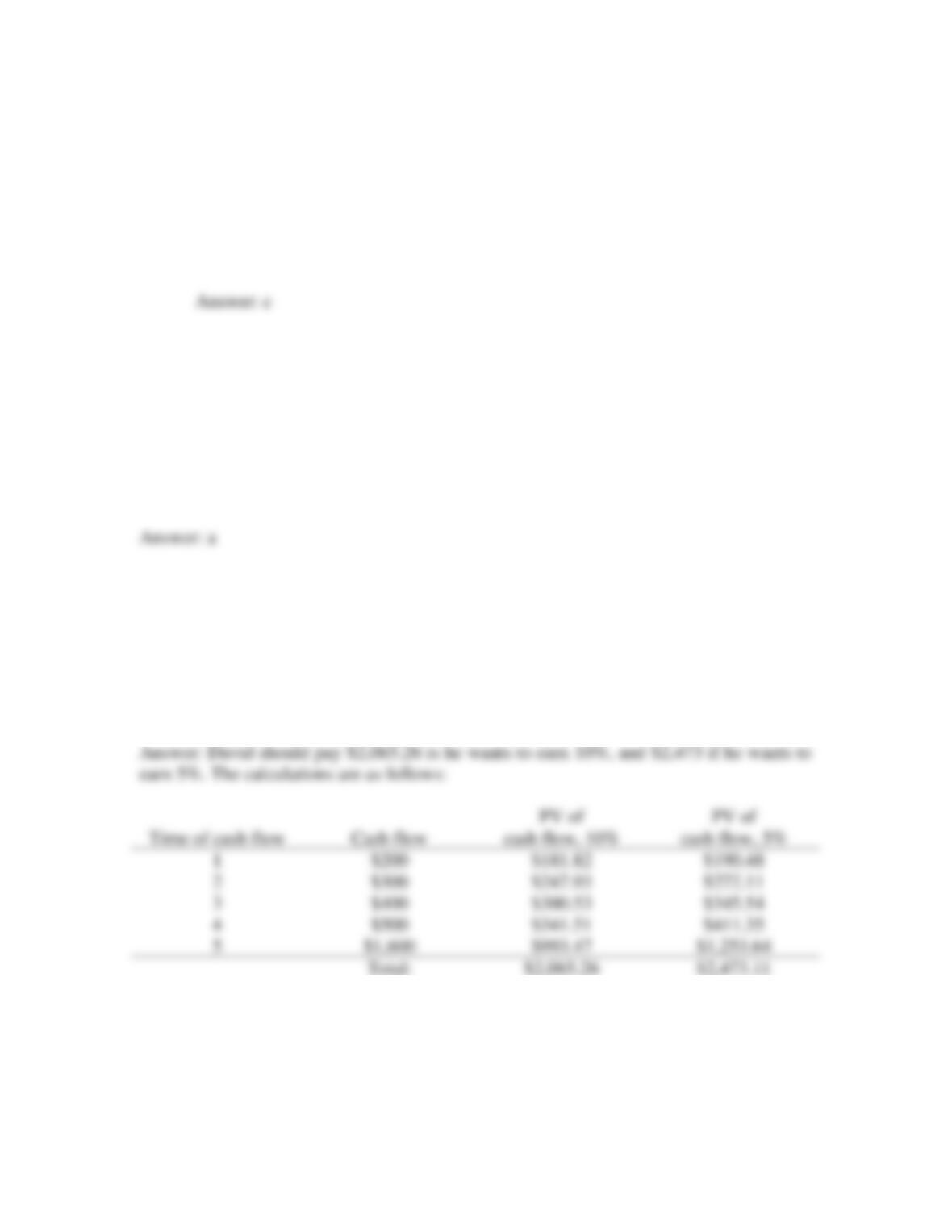
34. David is interested in an investment that would supply him with $200 at the end
of year 1, $300 at the end of year 2, $400 at the end of year 3, $500 at the end of
year 4, and $1,600 at the end of year 5. How much should David pay for this
investment if he wants to earn 10 percent on his investment? How does you
answer change if he wants to earn 5%?
35. You own savings of $400,000 that grows at a nominal rate of 6% annually. What are
the real and nominal dollars you will have today and at the end of each of the next seven
years if the inflation rate is 2.5%?
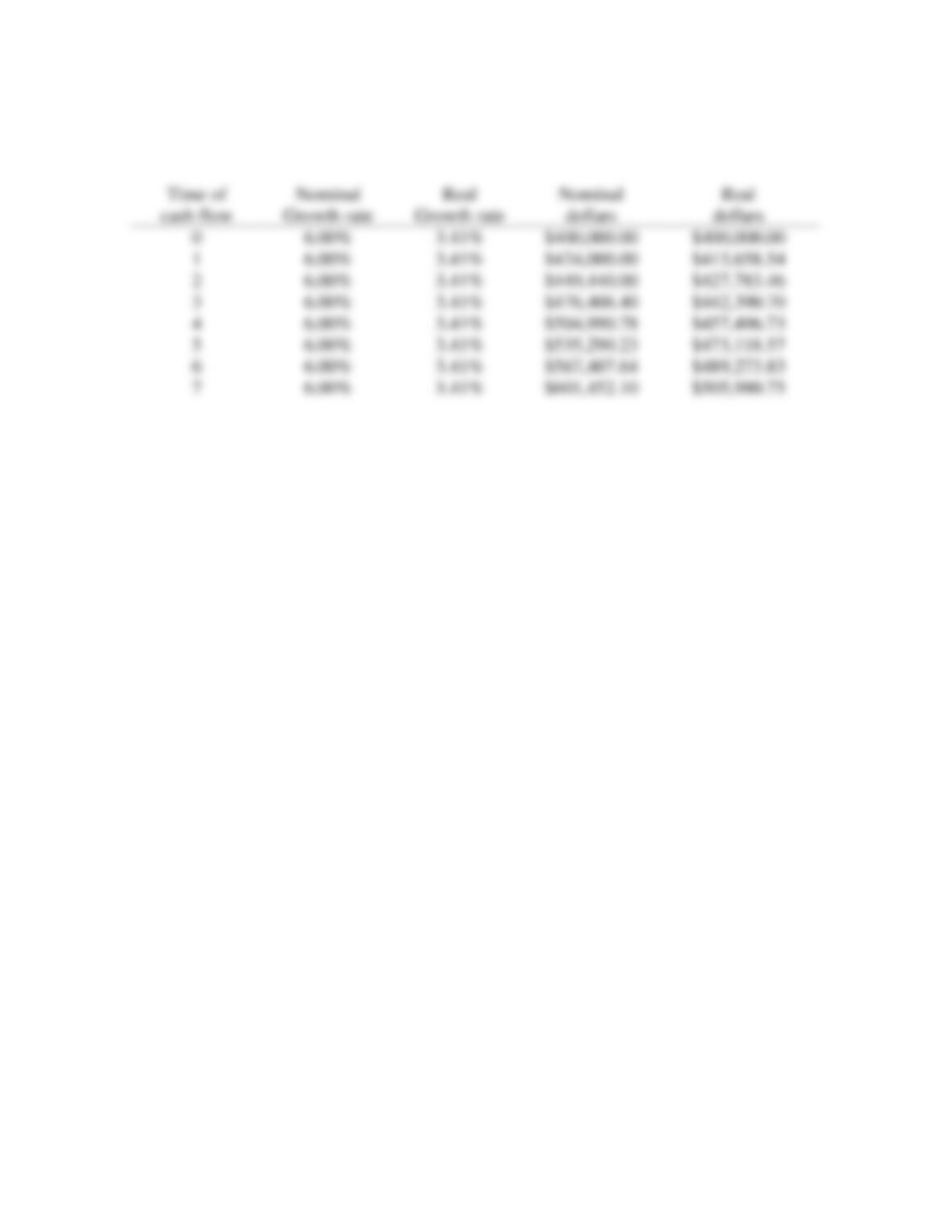
Answer: The real and nominal dollars that you have earn time period are as follows: