2.6 Financial Statement Analysis
Use the information for the question(s) below.
In November 2009, Perrigo Co. (PRGO) had a share price of $39.20. They had 91.33 million shares
outstanding, a market-to-book ratio of 3.76. In addition, PRGO had $845.01 million in outstanding debt,
$163.82 million in net income, and cash of $257.09 million.
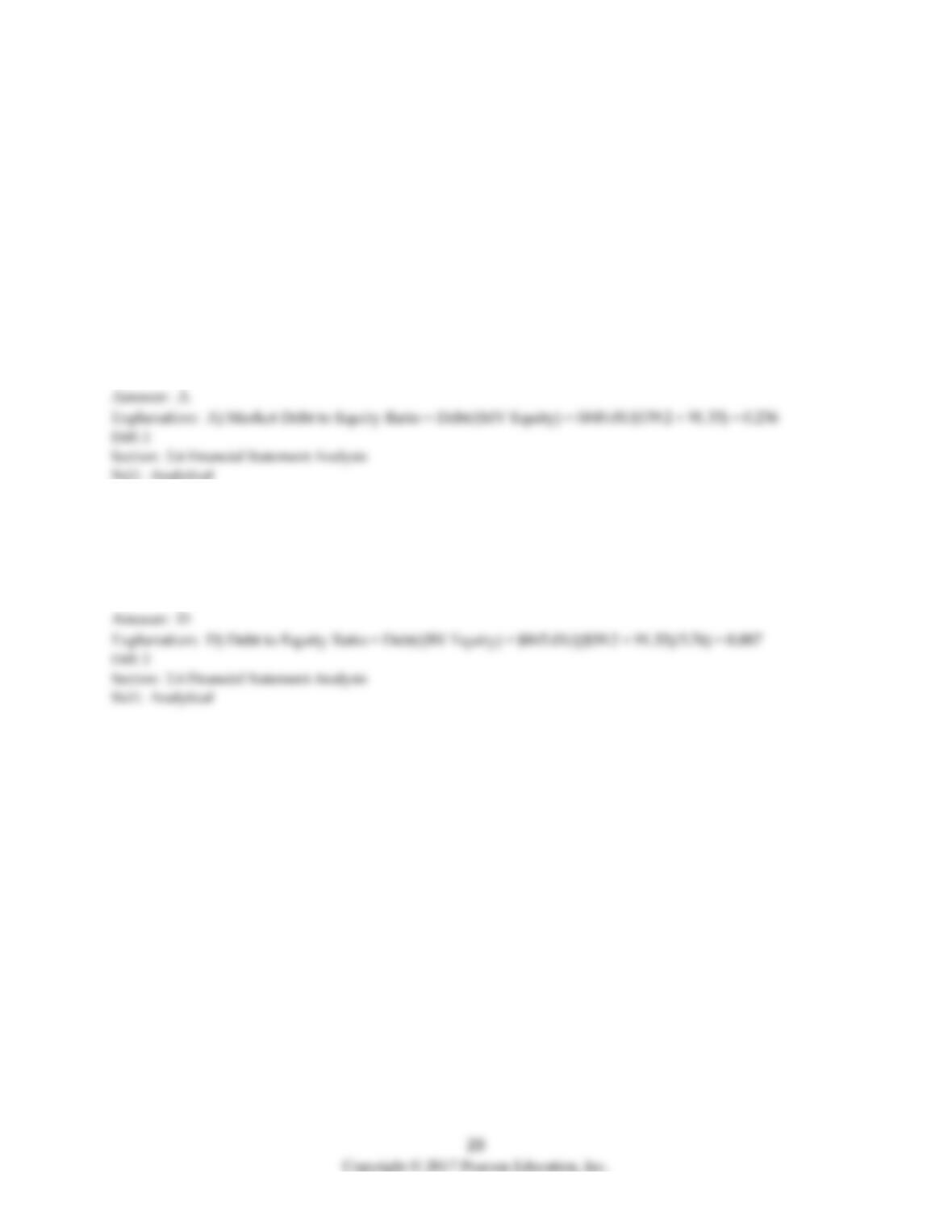
1) Perrigo’s market debt to equity ratio is closest to:
A) 0.24
B) 0.50
C) 0.75
D) 0.89
2) Perrigo’s debt to equity ratio is closest to:
A) 0.24
B) 0.50
C) 0.75
D) 0.89

Use the table for the question(s) below.
Consider the following balance sheet:
Luther Corporation
Consolidated Balance Sheet
December 31, 2009 and 2008 (in $ millions)
Assets
2009
2008
Liabilities and
Stockholders’ Equity
2009
2008
Current Assets
Current Liabilities
Cash
63.6
58.5
Accounts payable
87.6
73.5
Accounts receivable
55.5
39.6
Notes payable/
short-term debt
10.5
9.6
Inventories
45.9
42.9
Current maturities of long-
term debt
39.9
36.9
Other current assets
6.0
3.0
Other current liabilities
6.0
12.0
Total current assets
171.0
144.0
Total current liabilities
144.0
132.0
Long-Term Assets
Long-Term Liabilities
Land
66.6
62.1
Long-term debt
239.7
168.9
Buildings
109.5
91.5
Capital lease obligations
—
—
Equipment
119.1
99.6
Total Debt
239.7
168.9
Less accumulated
depreciation
(56.1)
(52.5)
Deferred taxes
22.8
22.2
Net property, plant, and
equipment
239.1
200.7
Other long-term liabilities
—
—
Goodwill
60.0
—
Total long-term liabilities
262.5
191.1
Other long-term assets
63.0
42.0
Total liabilities
406.5
323.1
Total long-term assets
362.1
242.7
Stockholders’ Equity
126.6
63.6
Total Assets
533.1
386.7
Total liabilities and
Stockholders’ Equity
533.1
386.7
3) When using the book value of equity, the debt to equity ratio for Luther in 2009 is closest to:
A) 0.43
B) 2.29
C) 2.98
D) 3.57
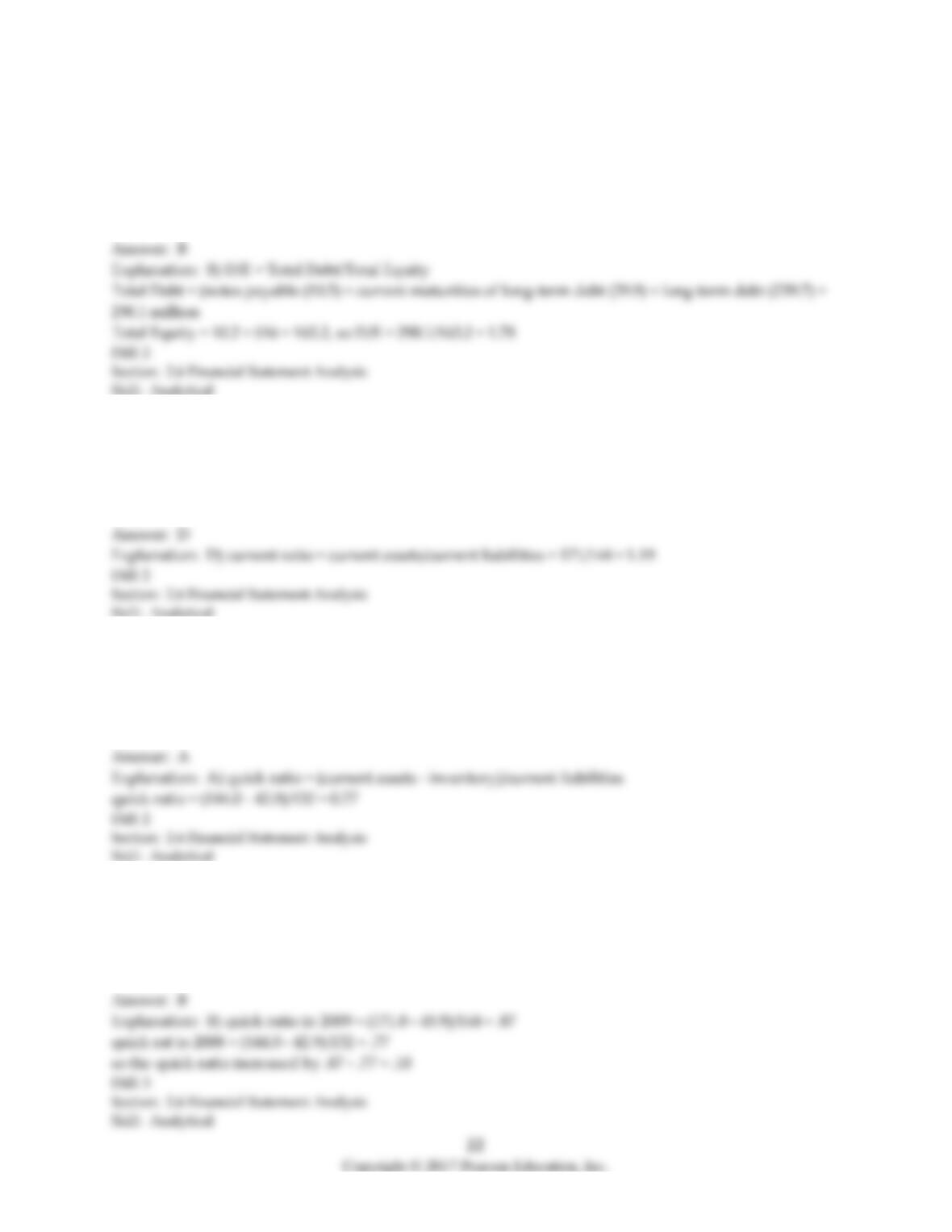
4) If in 2009 Luther has 10.2 million shares outstanding and these shares are trading at $16 per share,
then using the market value of equity, the debt to equity ratio for Luther in 2009 is closest to:
A) 1.47
B) 1.78
C) 2.31
D) 4.07
5) Luther’s current ratio for 2009 is closest to:
A) 0.84
B) 0.92
C) 1.09
D) 1.19
6) Luther’s quick ratio for 2008 is closest to:
A) 0.77
B) 0.87
C) 1.15
D) 1.30
7) The change in Luther’s quick ratio from 2008 to 2009 is closest to:
A) a decrease of .10
B) an increase of .10
C) a decrease of .15
D) an increase of .15
Use the following information for ECE incorporated:
Assets $200 million
Shareholder Equity $100 million
Sales $300 million
Net Income $15 million
Interest Expense $2 million
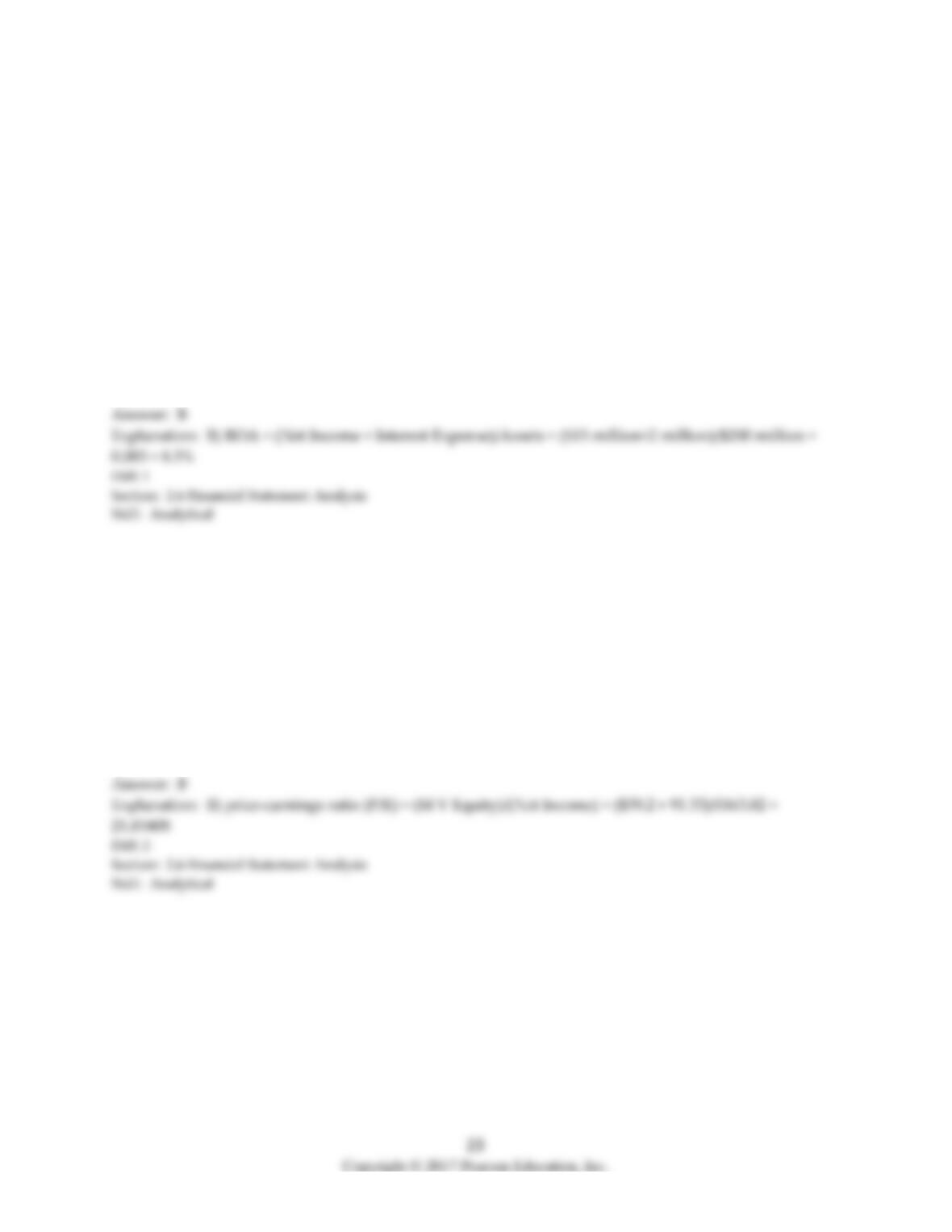
8) IECE’s Return on Assets (ROA) is:
A) 5.0%
B) 8.5%
C) 7.5%
D) 15.0%
Use the information for the question(s) below.
In November 2009, Perrigo Co. (PRGO) had a share price of $39.20. They had 91.33 million shares
outstanding, a market-to-book ratio of 3.76. In addition, PRGO had $845.01 million in outstanding debt,
$163.82 million in net income, and cash of $257.09 million.
9) Perrigo’s price-earnings ratio (P/E) is closest to:
A) 15.96
B) 21.85
C) 29.77
D) 35.64

Use the table for the question(s) below.
Consider the following income statement and other information:
Luther Corporation
Consolidated Income Statement
Year ended December 31 (in $ millions)
2009
2008
Total sales
610.1
578.3
Cost of sales
(500.2)
(481.9)
Gross profit
109.9
96.4
Selling, general, and
administrative expenses
(40.5)
(39.0)
Research and development
(24.6)
(22.8)
Depreciation and amortization
(3.6)
(3.3)
Operating income
41.2
31.3
Other income
—
—
Earnings before interest and taxes (EBIT)
41.2
31.3
Interest income (expense)
(25.1)
(15.8)
Pre-tax income
16.1
15.5
Taxes
(5.5)
(5.3)
Net income
10.6
10.2
Price per share
$16
$15
Shares outstanding (millions)
10.2
8.0
Stock options outstanding (millions)
0.3
0.2
Stockholders’ Equity
126.6
63.6
Total Liabilities and Stockholders’ Equity
533.1
386.7
10) Luther’s Operating Margin for the year ending December 31, 2008 is closest to:
A) 0.5%
B) 0.7%
C) 5.4%
D) 6.8%
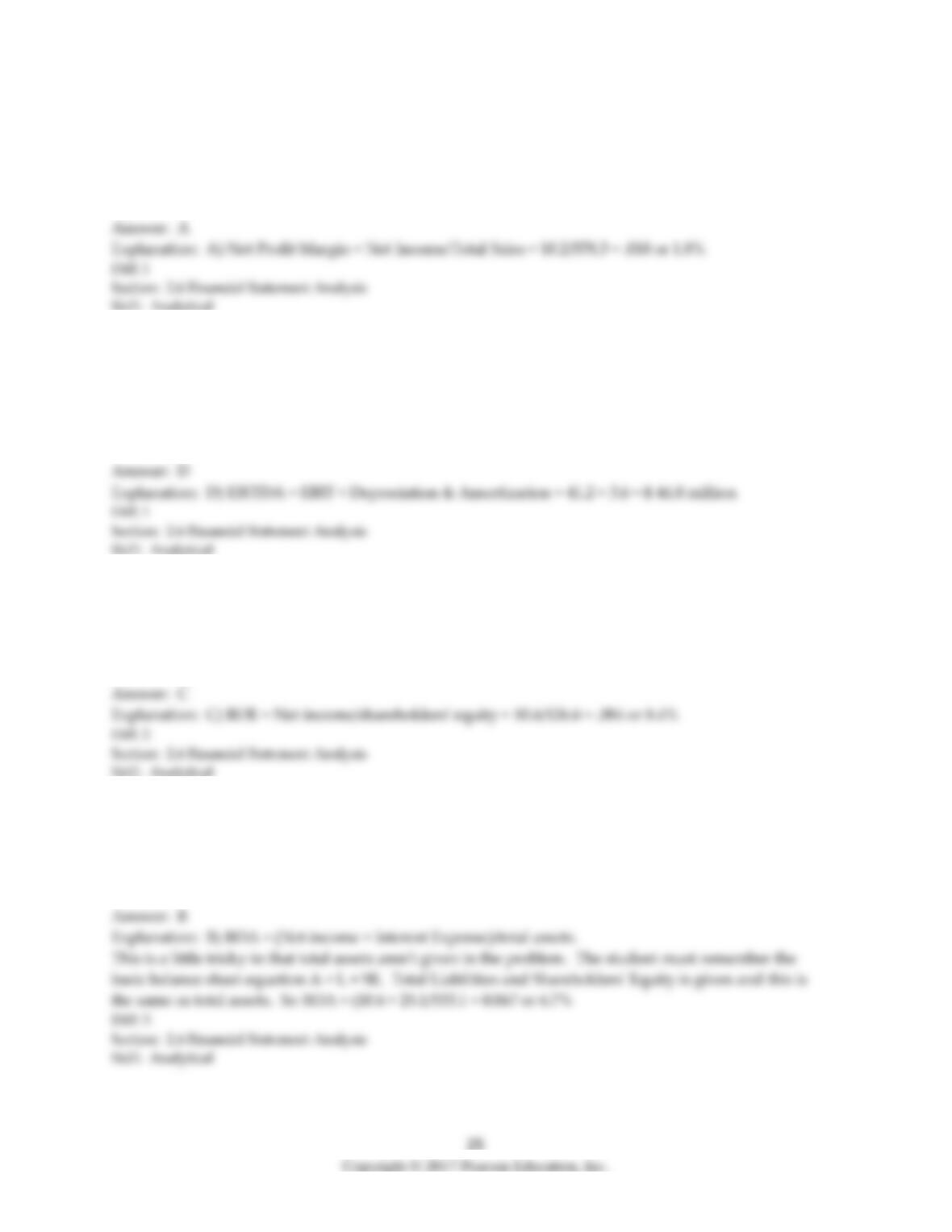
11) Luther’s Net Profit Margin for the year ending December 31, 2008 is closest to:
A) 1.8%
B) 2.7%
C) 5.4%
D) 16.7%
12) Luther’s earnings before interest, taxes, depreciation, and amortization (EBITDA) for the year
ending December 31, 2009 is closest to:
A) 19.7 million
B) 37.6 million
C) 41.2 million
D) 44.8 million
13) Luther’s return on equity (ROE) for the year ending December 31, 2009 is closest to:
A) 2.0%
B) 6.5%
C) 8.4%
D) 12.7%
14) Luther’s return on assets (ROA) for the year ending December 31, 2009 is closest to:
A) 1.6%
B) 6.7%
C) 2.3%
D) 2.6%
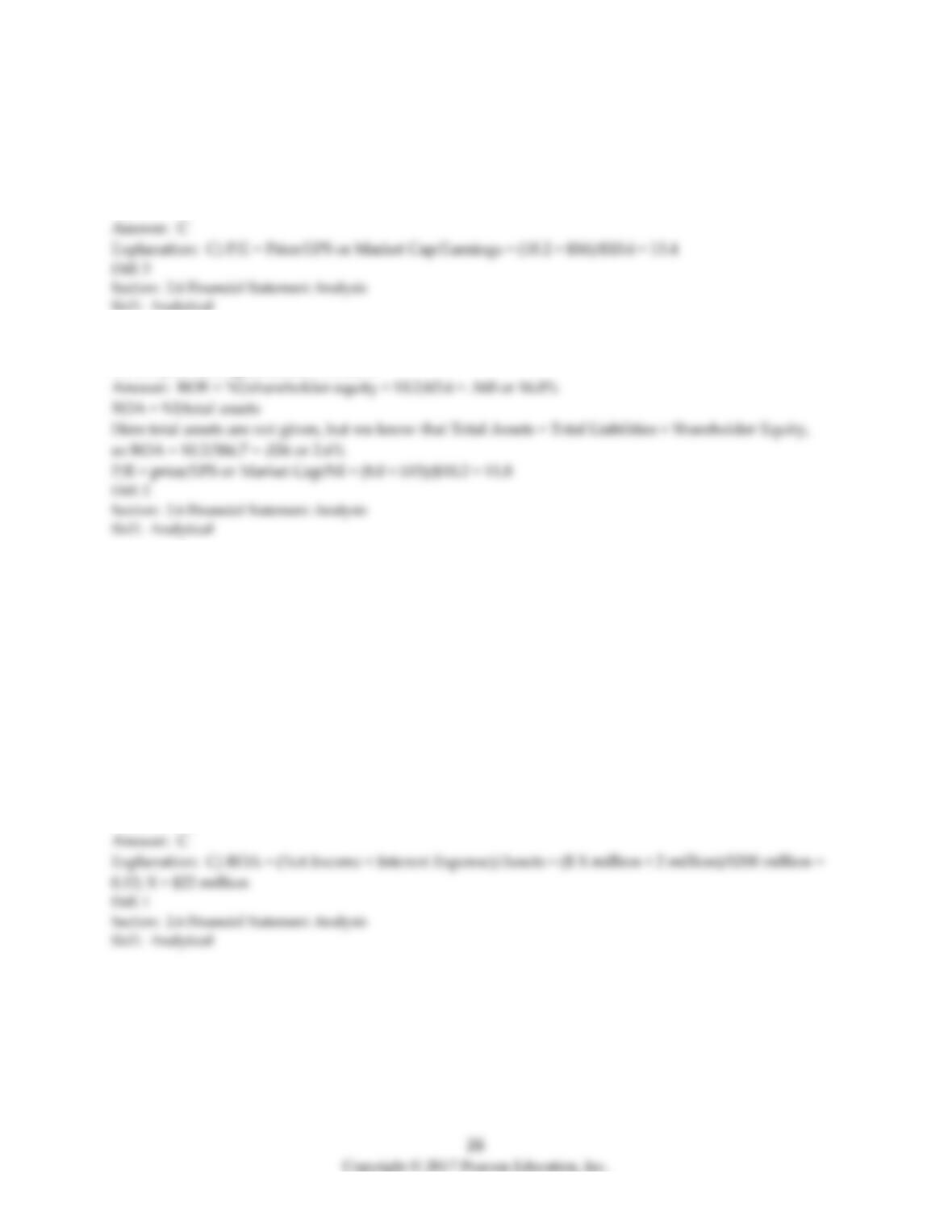
15) Luther’s price – earnings ratio (P/E) for the year ending December 31, 2009 is closest to:
A) 7.9
B) 10.1
C) 15.4
D) 16.0
16) Calculate Luther’s return of equity (ROE), return of assets (ROA), and price–to-earnings ratio (P/E)
for the year ending December 31, 2008.
Use the following information for ECE incorporated:
Assets $200 million
Shareholder Equity $100 million
Sales $300 million
Net Income $15 million
Interest Expense $2 million
17) If ECE’s return on assets (ROA) is 12%, then ECE’s net income is:
A) $6 million
B) $12 million
C) $22 million
D) $36 million

Use the table for the question(s) below.
Consider the following income statement and other information:
Luther Corporation
Consolidated Income Statement
Year ended December 31 (in $ millions)
2009
2008
Total sales
610.1
578.3
Cost of sales
(500.2)
(481.9)
Gross profit
109.9
96.4
Selling, general, and
administrative expenses
(40.5)
(39.0)
Research and development
(24.6)
(22.8)
Depreciation and amortization
(3.6)
(3.3)
Operating income
41.2
31.3
Other income
—
—
Earnings before interest and taxes (EBIT)
41.2
31.3
Interest income (expense)
(25.1)
(15.8)
Pre-tax income
16.1
15.5
Taxes
(5.5)
(5.3)
Net income
10.6
10.2
Price per share
$16
$15
Shares outstanding (millions)
10.2
8.0
Stock options outstanding (millions)
0.3
0.2
Stockholders’ Equity
126.6
63.6
Total Liabilities and Stockholders’ Equity
533.1
386.7
18) If Luther’s accounts receivable were $55.5 million in 2009, then calculate Luther’s accounts receivable
days for 2009.
19) Luther’s EBIT coverage ratio for the year ending December 31, 2008 is closest to:
A) 1.64
B) 1.78
C) 1.98
D) 2.19
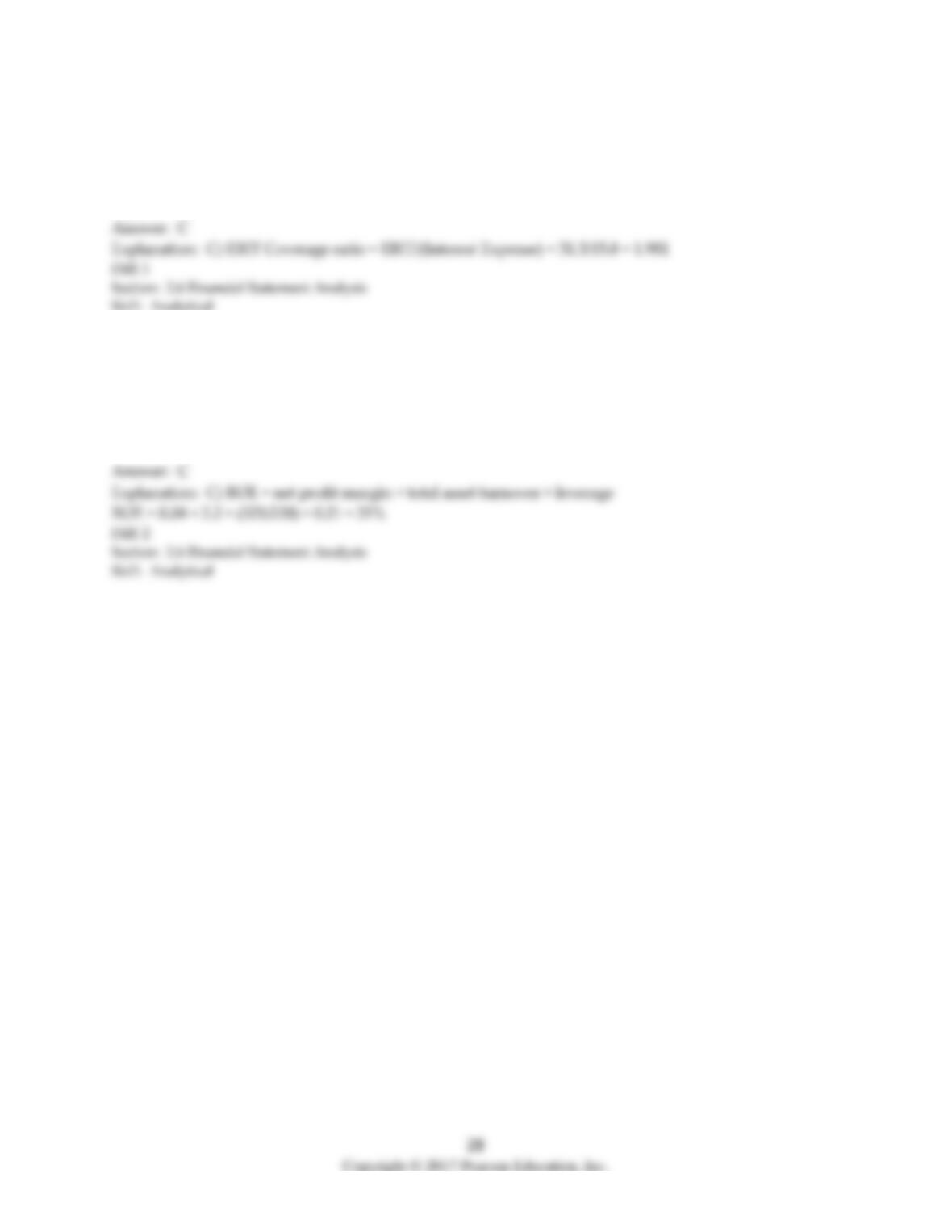
20) Luther’s EBIT coverage ratio for the year ending December 31, 2009 is closest to:
A) 1.64
B) 1.78
C) 1.98
D) 2.19
21) Wyatt Oil has a net profit margin of 4.0%, a total asset turnover of 2.2, total assets of $525 million,
and a book value of equity of $220 million. Wyatt Oil’s current return–on-equity (ROE) is closest to:
A) 8.8%
B) 9.5%
C) 21.0%
D) 22.8%

Use the table for the question(s) below.
Consider the following income statement and other information:
Luther Corporation
Consolidated Income Statement
Year ended December 31 (in $ millions)
2009
2008
Total sales
610.1
578.3
Cost of sales
(500.2)
(481.9)
Gross profit
109.9
96.4
Selling, general, and
administrative expenses
(40.5)
(39.0)
Research and development
(24.6)
(22.8)
Depreciation and amortization
(3.6)
(3.3)
Operating income
41.2
31.3
Other income
—
—
Earnings before interest and taxes (EBIT)
41.2
31.3
Interest income (expense)
(25.1)
(15.8)
Pre-tax income
16.1
15.5
Taxes
(5.5)
(5.3)
Net income
10.6
10.2
Price per share
$16
$15
Shares outstanding (millions)
10.2
8.0
Stock options outstanding (millions)
0.3
0.2
Stockholders’ Equity
126.6
63.6
Total Liabilities and Stockholders’ Equity
533.1
386.7
22) Luther’s EBITDA coverage ratio for the year ending December 31, 2009 is closest to:
A) 1.64
B) 1.78
C) 1.98
D) 2.19
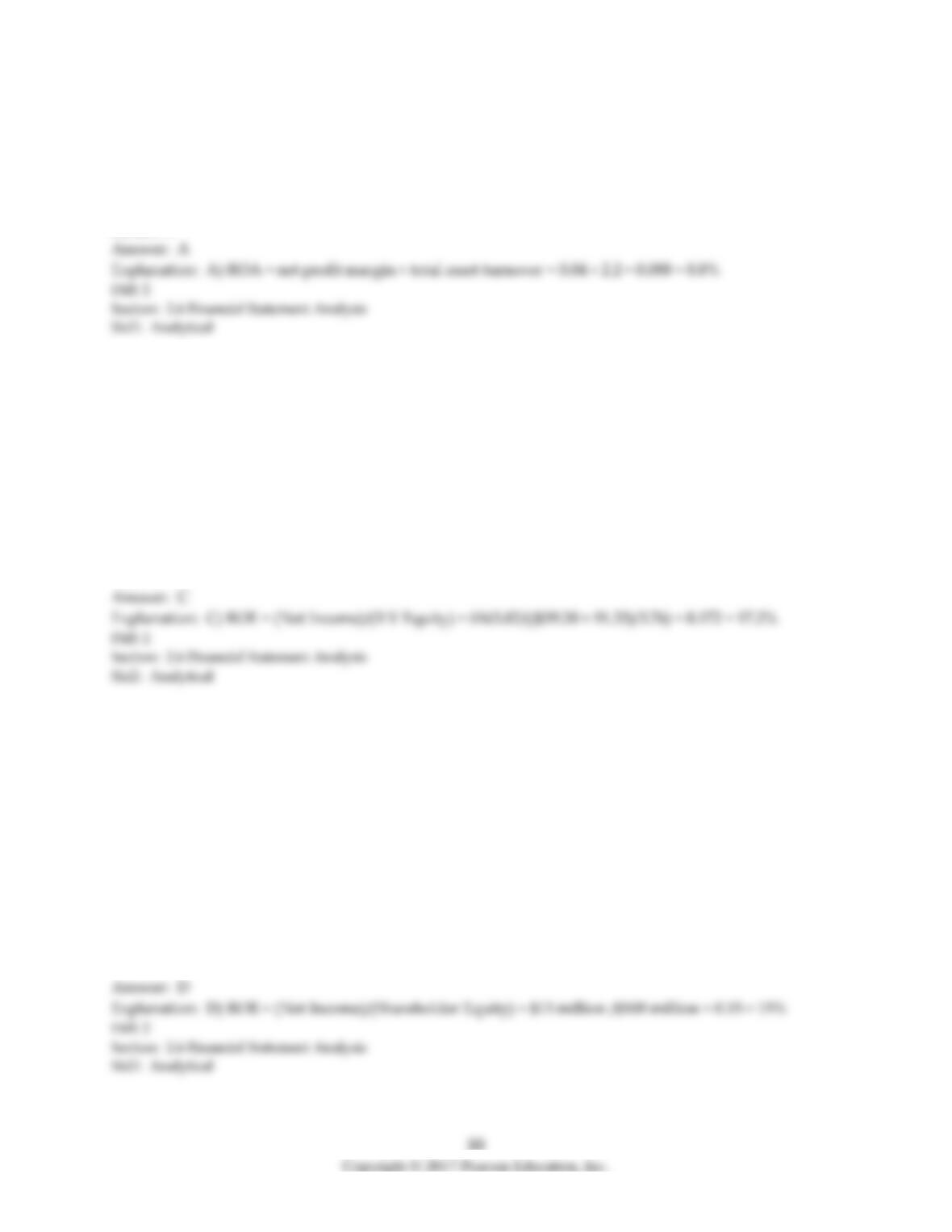
23) Wyatt Oil has a net profit margin of 4.0%, a total asset turnover of 2.2, total assets of $525 million,
and a book value of equity of $220 million. Wyatt Oil’s current return–on-assets (ROA) is closest to:
A) 8.8%
B) 9.5%
C) 21.0%
D) 22.8%
Use the information for the question(s) below.
In November 2009, Perrigo Co. (PRGO) had a share price of $39.20. They had 91.33 million shares
outstanding, a market-to-book ratio of 3.76. In addition, PRGO had $845.01 million in outstanding debt,
$163.82 million in net income, and cash of $257.09 million.
24) Perrigo’s return on equity (ROE) is closest to:
A) 4.6%
B) 9.1%
C) 17.2%
D) 27%
Use the following information for ECE incorporated:
Assets $200 million
Shareholder Equity $100 million
Sales $300 million
Net Income $15 million
Interest Expense $2 million
25) If ECE reported $15 million in net income, then ECE’s Return on Equity (ROE) is:
A) 5.0%
B) 7.5%
C) 10.0%
D) 15.0%
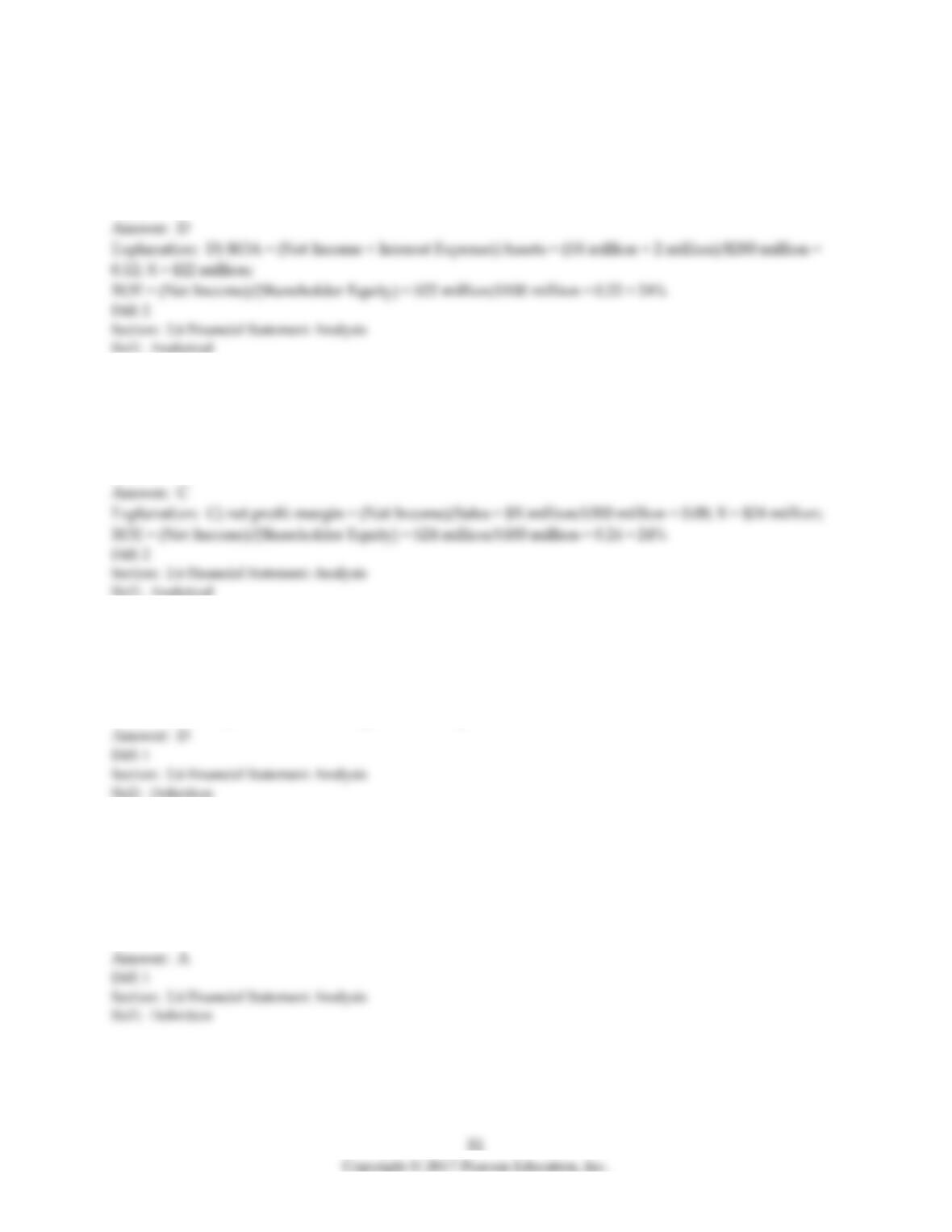
26) If ECE’s return on assets (ROA) is 12%, then ECE’s return on equity (ROE) is:
A) 10%
B) 12%
C) 18%
D) 22%
27) If ECE’s net profit margin is 8%, then ECE‘s return on equity (ROE) is:
A) 10%
B) 12%
C) 24%
D) 30%
28) The firm’s asset turnover measures:
A) the value of assets held per dollar of shareholder equity.
B) the return the firm has earned on its past investments.
C) the firm’s ability to sell a product for more than the cost of producing it.
D) how efficiently the firm is utilizing its assets to generate sales.
29) If Firm A and Firm B are in the same industry and use the same production method, and Firm A’s
asset turnover is higher than that of Firm B, then all else equal we can conclude:
A) Firm A is more efficient than Firm B.
B) Firm A has a lower dollar amount of assets than Firm B.
C) Firm A has higher sales than Firm B.
D) Firm A has a lower ROE than Firm B.

30) The firm’s equity multiplier measures:
A) the value of assets held per dollar of shareholder equity.
B) the return the firm has earned on its past investments.
C) the firm’s ability to sell a product for more than the cost of producing it.
D) how efficiently the firm is utilizing its assets to generate sales.
31) If Alex Corporation takes out a bank loan to purchase a machine used in production and everything
else stays the same, its equity multiplier will ________, and its ROE will ________.
A) increase; increase
B) decrease; decrease
C) increase; decrease
D) decrease; increase
32) The DuPont Identity expresses the firm’s ROE in terms of:
A) profitability, asset efficiency, and leverage.
B) valuation, leverage, and interest coverage.
C) profitability, margins, and valuation.
D) equity, assets, and liabilities.
33) Suppose Novak Company experienced a reduction in its ROE over the last year. This fall could be
attributed to:
A) an increase in net profit margin.
B) a decrease in asset turnover.
C) an increase in leverage.
D) a decrease in Equity.
34) If Moon Corporation has an increase in sales, which of the following would result in no change in its
EBIT margin?
A) A proportional increase in its net income
B) A proportional decrease in its EBIT
C) A proportional increase in its EBIT
D) An increase in its operating expenses
35) If Moon Corporation’s gross margin declined, which of the following is TRUE?
A) Its cost of goods sold increased.
B) Its cost of goods sold as a percent of sales increased.
C) Its sales increased.
D) Its net profit margin was unaffected by the decline.
36) The inventory days ratio measures:
A) the average length of time it takes a company to sell its inventory.
B) the average length of time it takes the company’s suppliers to deliver its inventory.
C) the level of sales required to keep a company’s average inventory on the books.
D) the percentage change in inventory over the past year.
37) If Moon Corporation has depreciation or amortization expense, which of the following is TRUE?
A) Its EBITDA /Interest Coverage ratio will be greater than its EBIT/Interest Coverage ratio.
B) Its EBITDA /Interest Coverage ratio will be less than its EBIT/Interest Coverage ratio.
C) Its EBITDA /Interest Coverage ratio will be equal to its EBIT/Interest Coverage ratio.
D) Not enough information to answer the question.

Use the table for the question(s) below.
Consider the following balance sheet:
Luther Corporation
Consolidated Balance Sheet
December 31, 2009 and 2008 (in $ millions)
Assets
2009
2008
Liabilities and
Stockholders’ Equity
2009
2008
Current Assets
Current Liabilities
Cash
63.6
58.5
Accounts payable
87.6
73.5
Accounts receivable
55.5
39.6
Notes payable/
short-term debt
10.5
9.6
Inventories
45.9
42.9
Current maturities of long-
term debt
39.9
36.9
Other current assets
6.0
3.0
Other current liabilities
6.0
12.0
Total current assets
171.0
144.0
Total current liabilities
144.0
132.0
Long-Term Assets
Long-Term Liabilities
Land
66.6
62.1
Long-term debt
239.7
168.9
Buildings
109.5
91.5
Capital lease obligations
—
—
Equipment
119.1
99.6
Total Debt
239.7
168.9
Less accumulated
depreciation
(56.1)
(52.5)
Deferred taxes
22.8
22.2
Net property, plant, and
equipment
239.1
200.7
Other long-term liabilities
—
—
Goodwill
60.0
—
Total long-term liabilities
262.5
191.1
Other long-term assets
63.0
42.0
Total liabilities
406.5
323.1
Total long-term assets
362.1
242.7
Stockholders’ Equity
126.6
63.6
Total Assets
533.1
386.7
Total liabilities and
Stockholders’ Equity
533.1
386.7
38) Luther Corporation’s cash ratio for 2009 is closest to:
A) 1.19
B) 10.6
C) 0.44
D) 0.41
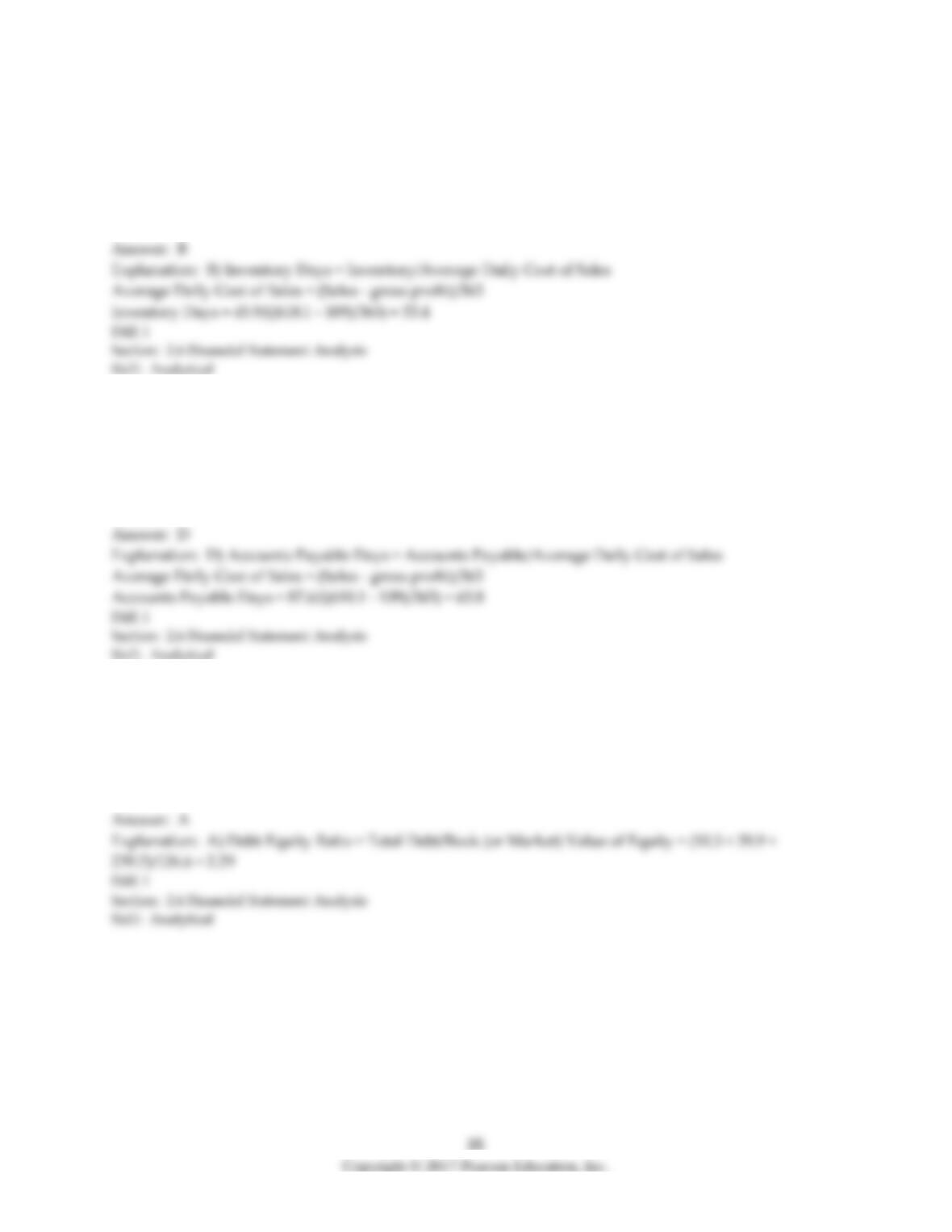
39) Luther Corporation’s total sales for 2009 were $610.1, and gross profit was $109.0. Inventory days
for 2009 is closest to:
A) 27.5
B) 33.4
C) 153.7
D) 10.9
40) Luther Corporation’s total sales for 2009 were $610.1, and gross profit was $109.0. Accounts payable
days for 2009 is closest to:
A) 27.5
B) 5.71
C) 52.4
D) 63.8
41) Luther Corporation’s stock price is $39 per share and the company has 20 million shares
outstanding. Its book value Debt -Equity Ratio for 2009 is closest to:
A) 2.29
B) 0.31
C) 1.89
D) 0.37
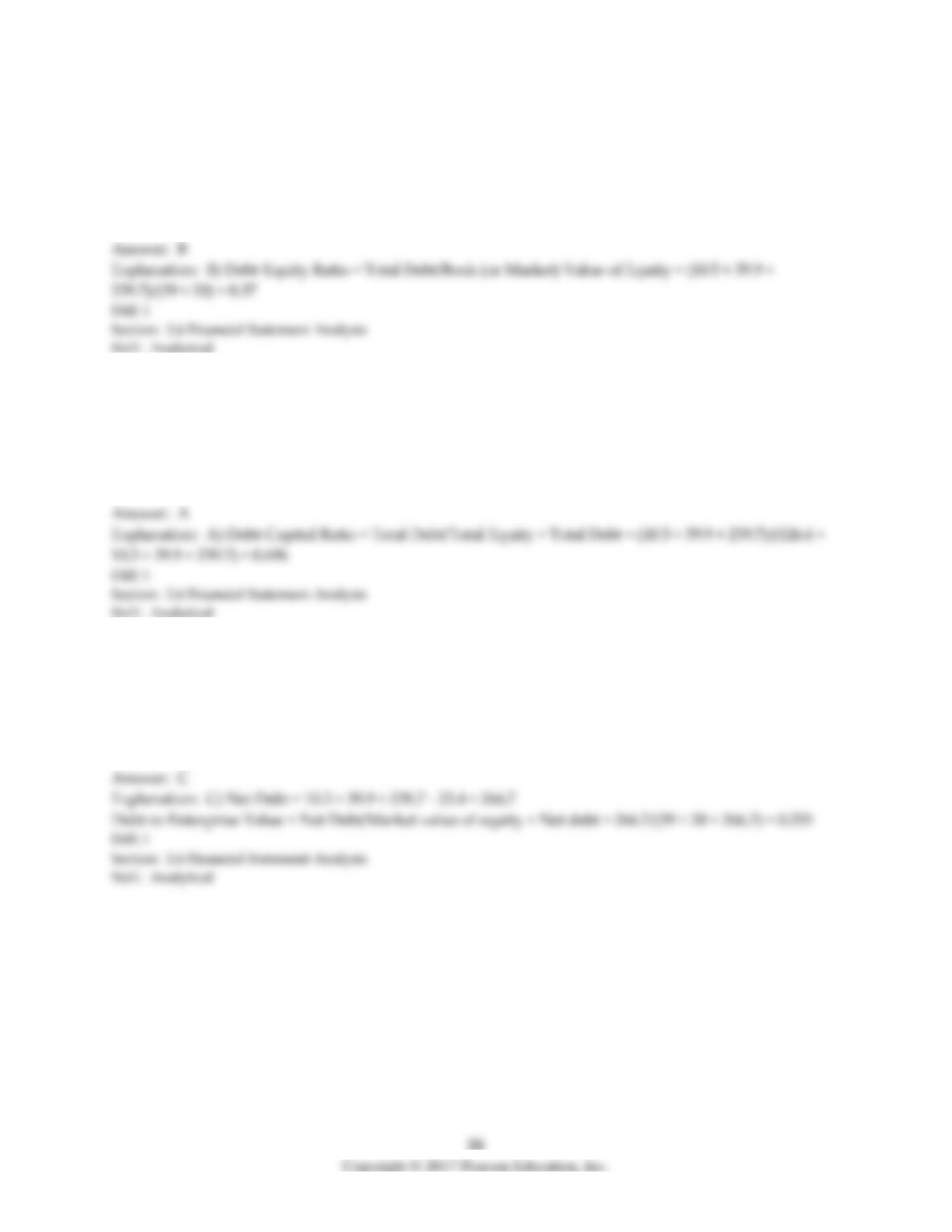
42) Luther Corporation’s stock price is $39 per share and the company has 20 million shares
outstanding. Its Market value Debt-Equity Ratio for 2009 is closest to:
A) 2.29
B) 0.37
C) 1.89
D) 0.31
43) Luther Corporation’s stock price is $39 per share and the company has 20 million shares
outstanding. Its Debt -Capital Ratio for 2009 is closest to:
A) 0.696
B) 0.37
C) 1.89
D) 0.654
44) Luther Corporation’s stock price is $39 per share and the company has 20 million shares
outstanding. Its excess cash in 2009 is $23.4. Its Debt–to-Enterprise Value Ratio in 2009 is closest to:
A) 0.696
B) 0.37
C) 0.255
D) 0.654
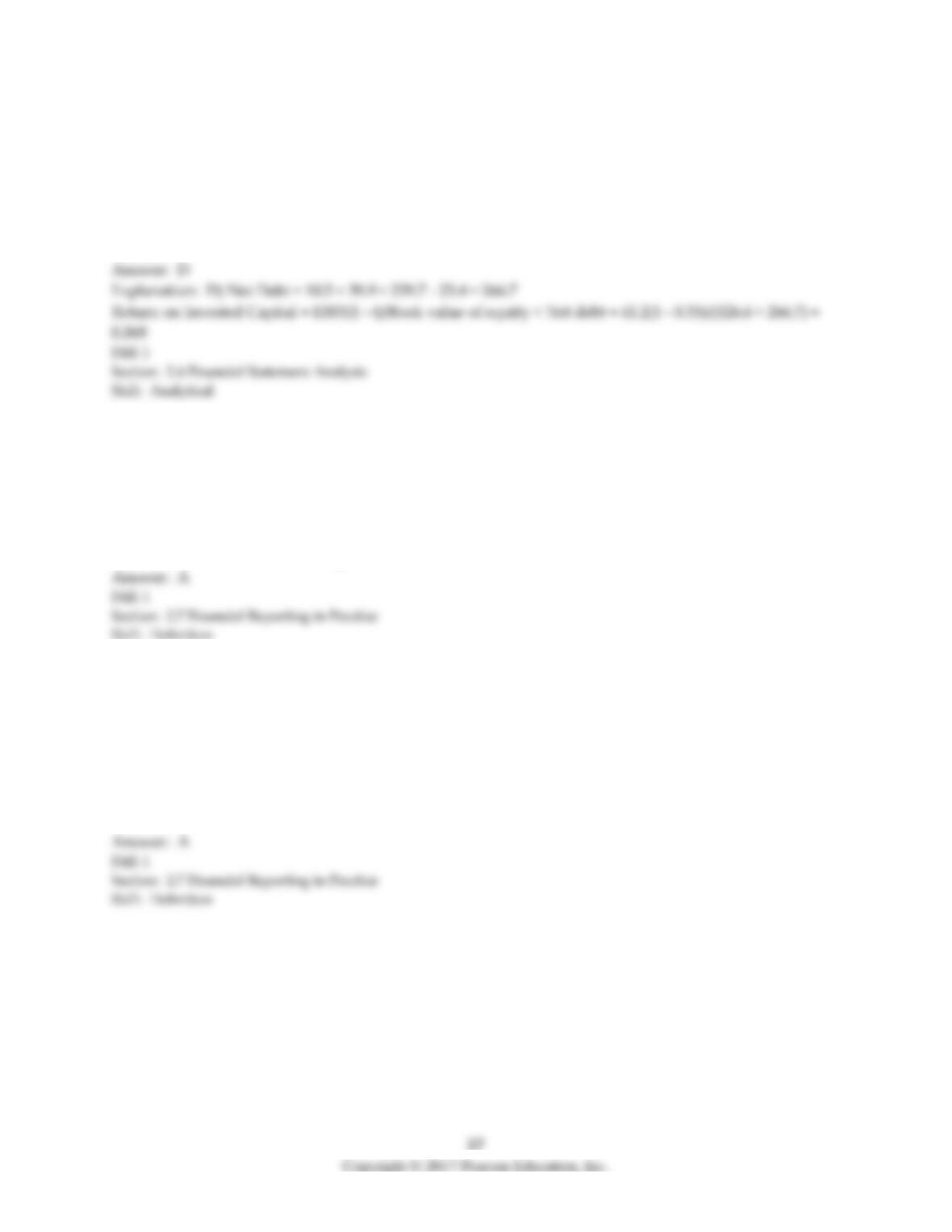
45) Luther Corporation’s stock price is $39 per share and the company has 20 million shares
outstanding. Its excess cash in 2009 is $23.4. If EBIT is 41.2 and tax rate is 35%, its Return on Invested
Capital in 2009 is closest to:
A) 0.104
B) 0.064
C) 0.038
D) 0.068
2.7 Financial Reporting in Practice
1) The Sarbanes-Oxley Act (SOX) was passed by Congress in 2002, in response to:
A) financial scandals, including WorldCom and Enron.
B) financial scandals, including Bernie Madoff and AIG.
C) financial scandals, including General Motors and Chrysler.
D) the Troubled Asset Relief Program (TARP).
2) The Sarbanes-Oxley Act (SOX) stiffened penalties for providing false information by:
A) requiring the CEO and CFO to return bonuses or profits from the sale of stock that are later shown to
be due to misstated financial reports.
B) imposing large compliance costs on small companies.
C) requiring auditing firms to have long-standing relationships with their clients and receive lucrative
auditing and consulting fees from them.
D) putting strict limits on the amount of non-audit fees (consulting or otherwise) that an accounting
firm can earn from a firm that it audits.
3) The Sarbanes-Oxley Act (SOX) overhauled incentives and the independence in the auditing process
by:
A) requiring the CEO and CFO to return bonuses or profits from the sale of stock that are later shown to
be due to misstated financial reports.
B) imposing large compliance costs on small companies.
C) requiring auditing firms to have long-standing relationships with their clients and receive lucrative
auditing and consulting fees from them.
D) putting strict limits on the amount of non-audit fees (consulting or otherwise) that an accounting
firm can earn from a firm that it audits.
4) The Sarbanes-Oxley Act (SOX) forced companies to validate their internal financial control processes
by:
A) putting strict limits on the amount of non-audit fees (consulting or otherwise) that an accounting
firm can earn from a firm that it audits.
B) requiring the CEO and CFO to return bonuses or profits from the sale of stock that are later shown to
be due to misstated financial reports.
C) requiring auditing firms to have long-standing relationships with their clients and receive lucrative
auditing and consulting fees from them.
D) requiring senior management and the boards of public companies to validate and certify the process
through which funds are allocated and controlled.
5) The Dodd-Frank Wall Street Reform and Consumer Protection Act does the following:
A) Exempts firms with less than $75 million in publicly traded shares from some provisions of SOX.
B) Requires the SEC to study ways to reduce the cost of SOX for firms with less than $250 million in
publicly traded shares.
C) Strengthens whistle-blower provisions of SOX.
D) All of the above.