16) Team Instructions: Divide the class into teams of three or four people. Each team member
should work the following problem separately outside of class. Then give the students time in
class to compare answers with their teammates and put together a final correct copy of the
problem. Each team should turn in only one copy of the problem for grading. All team members
will receive the same grade. Provide students with copies of real merchandising companies’
annual reports, or give students the Web addresses of real merchandising companies and ask
them to print out the annual reports. All team members should work with the same company’s
annual report.
Answer the following questions using the annual report assigned to your team. Turn in your
annual report along with your answers.
1
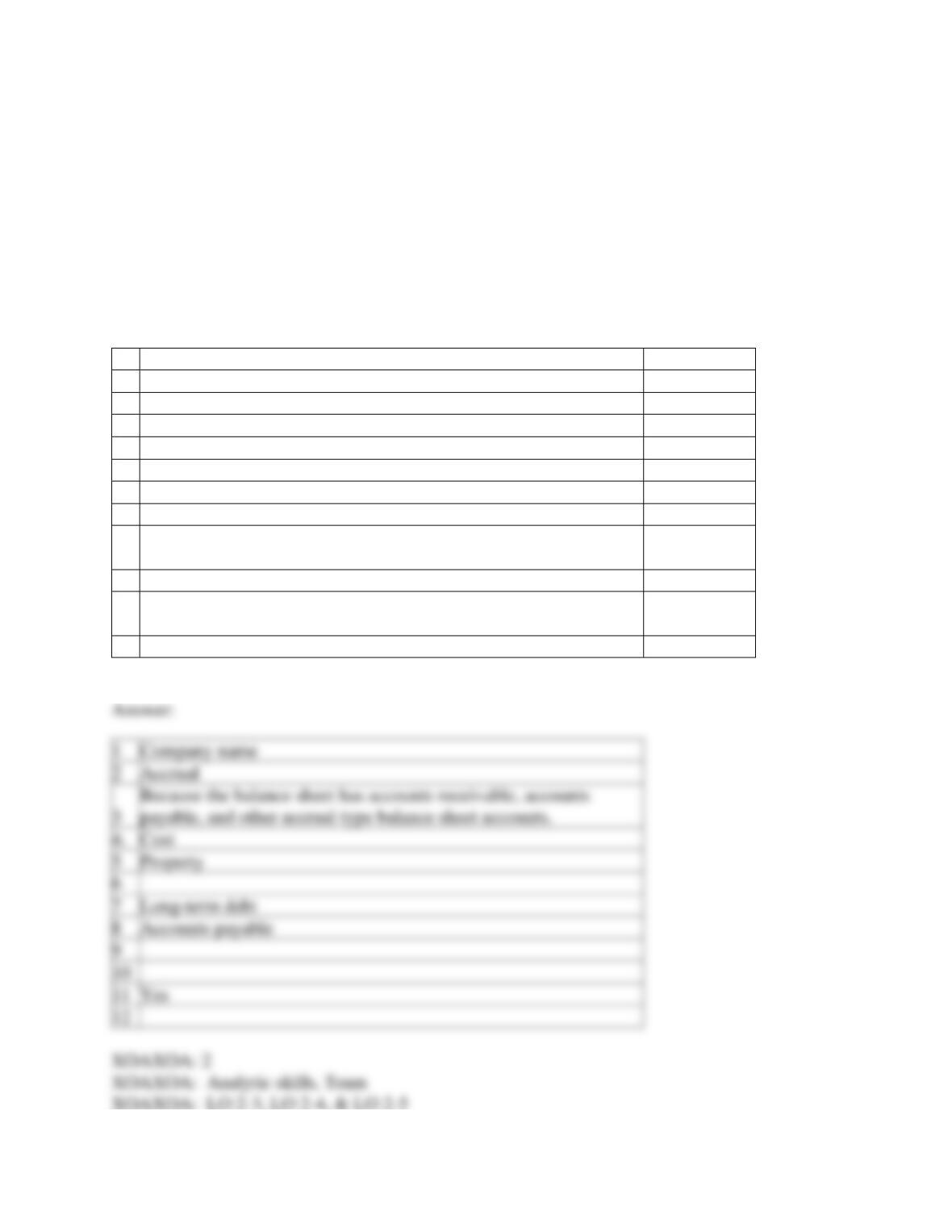
What is the name of your company?
2
Does the company use accrual or cash basis accounting?
3
How can you tell which basis of accounting it uses?
4
Do the property values represent cost or market values?
5
Name one asset that is not a current asset.
6
What is the amount of current assets at the most recent yearend?
$
7
Name one liability that is not a current liability.
8
Name one liability that is a current liability.
9
What is the amount of current liabilities at the most recent
yearend?
$
10
Calculate the current ratio for the most recent year.
11
Does the company have the ability to pay its bills when they come
due?
12
Is the current or prior year’s current ratio more favorable?
1
Company name
2
Accrual
3
Because the balance sheet has accounts receivable, accounts
payable, and other accrual type balance sheet accounts.
4.
Cost
5
Property
6
7
Long-term debt
8
Accounts payable
9
10
11
Yes
12
17) Team Instructions: Divide the class into teams of three or four people. Each team member
should work the following problem separately outside of class. Then give the students time in
class to compare answers with their teammates and put together a final correct copy of the
problem. Each team should turn in only one copy of the problem for grading. All team members
will receive the same grade.
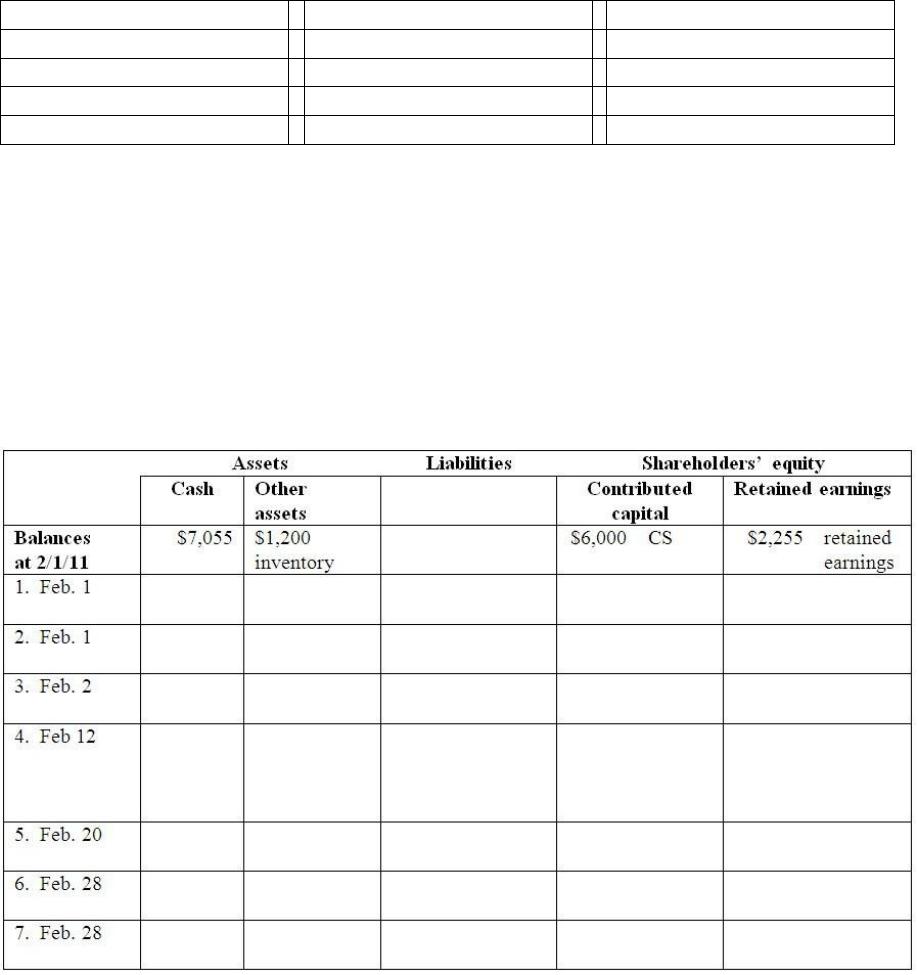
Part A: Record the transactions below by filling in the amount and the account title from the list
of accounts below (use the abbreviations given):
Account – abbreviation
Account – abbreviation
Account – abbreviation
Accounts payable – AP
Cost of goods sold – COGS
Net income – NI
Accounts receivable – AR
Dividends – Div
Prepaid insurance – PI
Cash
Inventory – Inv
Rent expense – Rent exp
Common stock – CS
Insurance expense – Ins exp
Sales revenue – Sales
1. February 1 Tim’s Tams paid $800 for February’s rent of a booth.
2. February 1 Tim’s Tams paid $600 cash for three months of insurance coverage that begins
February 1.
3. February 2 Tim’s Tams purchased 800 baseball caps that cost $6.00 each on account.
4. February 12 Tim’s Tams sold 600 baseball caps @ $10.00 each on account.
Record both a)the sale and b) the cost of the sale.
5. February 20 Tim’s Tams paid for $500 of the caps purchased on February 2.
6. February 28 Tim’s Tams declared and paid a $100 cash dividend to its shareholder.
7. February 28 Adjusted for insurance used during the month.
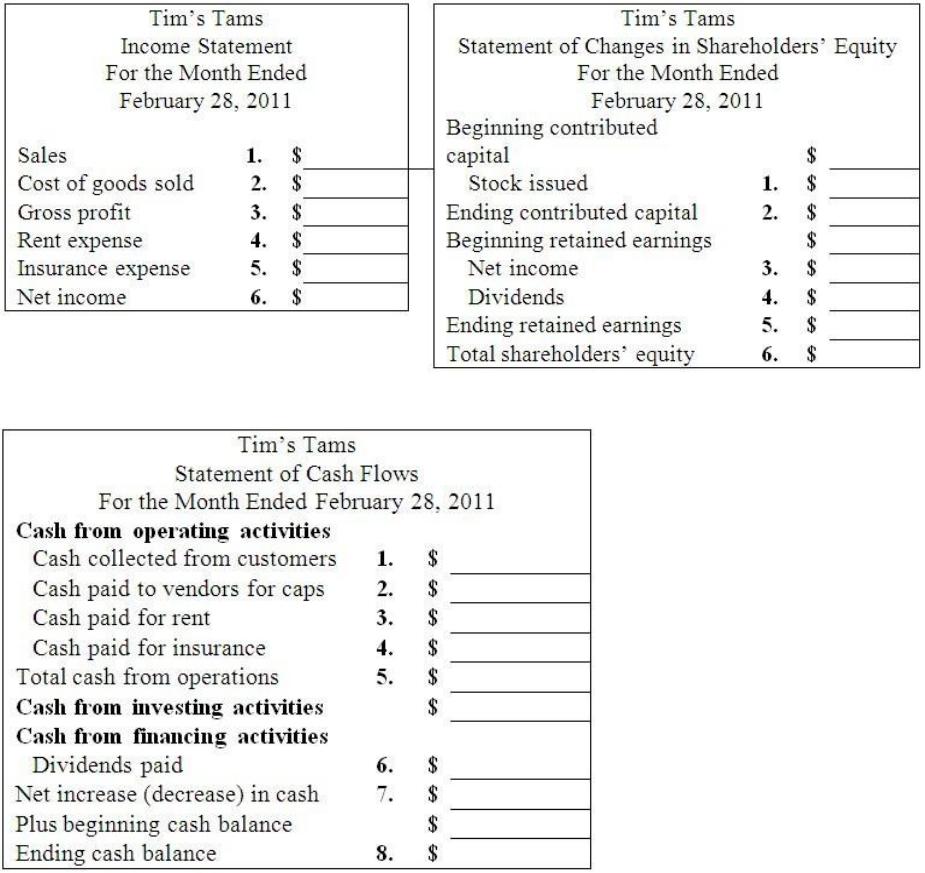
Parts B, C, D and E:
Complete the four financial statements:
Part B: Part C:
Part D:
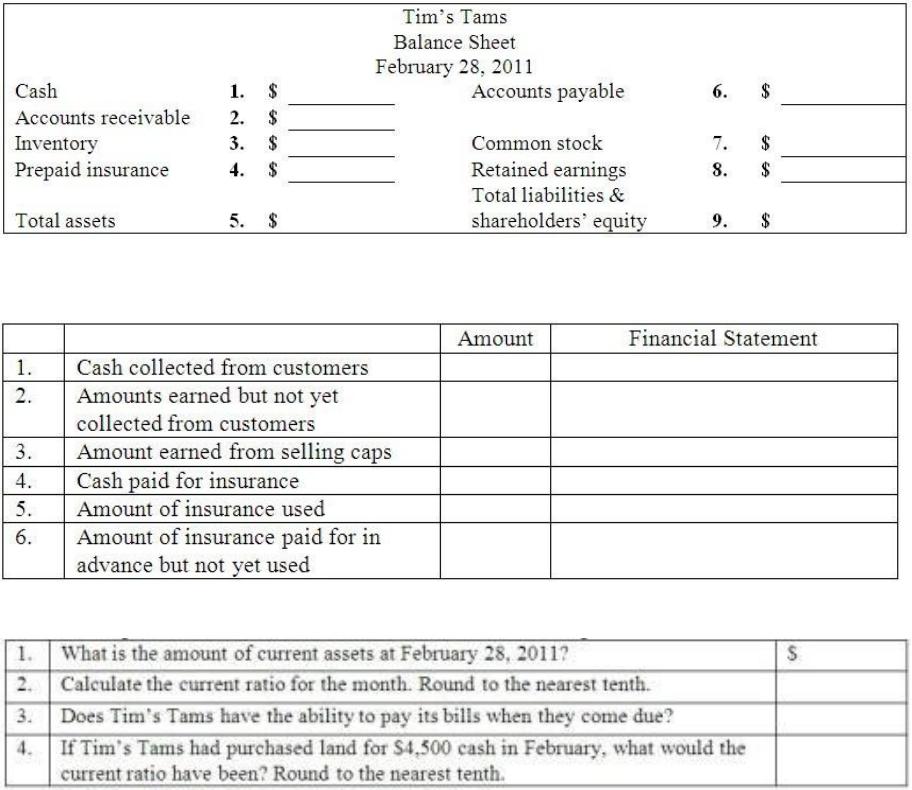
Part E:
Part F: For each description, write in the amount and show on which of the February financial
statements this information is found.
Part G: Using the financial statements above, answer the following:
Learning Objective 2-6
1) Internal controls are ________.
A) laws and regulations imposed by the IRS and SEC to ensure the accuracy of financial
statements
B) accounting procedures required by the FASB to ensure the accuracy and reliability of firms’
accounting records
C) policies and procedures the managers of a firm use to protect a firm’s assets and the accuracy
of its accounting records
D) rules required by creditors to ensure repayment of liabilities
2) Preventive controls include ________.
A) having the company’s accountant review the accounting records and make corrections each
month
B) limiting access to assets
C) bank reconciliations (comparing the company’s accounting records for cash to its bank
statement)
D) counting the money in the cash register and comparing it with the total sales entered in the
register
3) Detective controls include ________.
A) separating the duties of cash collection from the duties of recording cash transactions in the
books
B) bank reconciliations (comparing the company’s accounting records for cash to its bank
statement)
C) limiting access to assets
D) requiring passwords to access the computerized accounting records
4) Corrective controls include ________.
A) requiring authorization for certain transactions
B) limiting access to assets
C) requiring passwords to access the computerized accounting records
D) procedures for handling any errors that are detected
5) Preventive controls are ________.
A) designed to monitor business risks
B) designed to identify when an error or irregularity has occurred
C) designed to stop a problem before it starts
D) directed at recovering from an error
6) Detective controls are ________.
A) designed to monitor business risks
B) designed to identify when an error or irregularity has occurred
C) designed to stop a problem before it starts
D) directed at recovering from an error
7) Corrective controls are ________.
A) designed to monitor business risks
B) designed to identify when an error or irregularity has occurred
C) designed to stop a problem before it starts
D) directed at recovering from an error
8) Denying future credit to customers who are slow to pay their accounts is called a ________.
A) business control
B) detective control
C) corrective control
D) preventative control
9) An accountant discovered a bank error while reviewing the bank statement, and called the
bank to correct the mistake. This call is an example of a ________.
A) business control
B) detective control
C) corrective control
D) preventive control
10) The accountant called the bank after noticing that a $200 deposit made on July 21 did not
appear on the July 31 bank statement. This call is an example of a ________.
A) business control
B) detective control
C) corrective control
D) preventive control
11) Internal controls are the policies and procedures managers of a firm use to protect the firm’s
assets and to ensure the accuracy and reliability of the firm’s accounting records.
12) An example of a preventive control is requiring that all purchases over $1,000 be authorized
by upper management.
13) An example of a detective control is requiring that the cash drawer be compared with the
sales recorded by the register.
14) An example of a corrective control is requiring that on a regular basis management must
follow up on all errors and irregularities identified.
15) Preventive controls are designed to prevent an error or irregularity.
16) An example of a preventive control is to require passwords in order to limit access to the
information system.
17) For each of the following situations discuss whether the accounting treatment is proper and,
if not proper, what accounting principle is violated. Discuss the ethical and financial statement
implications of each of the improper treatments.
A. A service company records revenue when cash is collected in advance of performing the
service.
B. The owner used the cash received from a company bank loan to buy a car for his own
personal use. The car was recorded as a company asset.
C. A company records revenue when earned even when the cash has not yet been received.
D. Land purchased ten years ago for $20,000 is reported on the balance sheet at its current value
of $30,000. The company follows U.S. GAAP in preparing financial statements.
E. Inventory purchased last month and sold this month was deducted as an expense on this
month’s income statement.
18) Vestige, Inc. needs another loan from a bank in order to pay its bills. In order to improve its
chances of getting another loan, it reports its ten-month note payable as a long-term liability.
Discuss the treatment of this note payable including the financial statement presentation and the
effect on the current ratio. Discuss the ethical issue with Vestige’s treatment of this note payable.
19) Name one type of preventive control that would be useful in a computerized information
system.
20) Name one type of detective control that would be useful in a computerized information
system.
21) On July 1, the bank said it may lend money to Funny Books, Inc., but only after it prepares
an income statement for the month of July. Since the bank did not specify, Funny Books, Inc. did
not follow generally accepted accounting principles (GAAP). It reported net income of $12,000
for the month ended July 31. The revenue included $4,000 of cash collected in advance from
customers for services to be performed in August. The revenue also included a $3,000 increase
in the value of its land. The expenses excluded $2,000 Funny Books owed for July services it
received.
Part A: List the GAAP that were violated by Funny Books, Inc. and explain what the proper
accounting treatment would be.
Part B: Net income in accordance with GAAP should have been $________.
Part C: Do you think the management of Funny Books, Inc. was acting unethically?
Why or why not?
22) Describe internal controls and discuss why internal controls are necessary for a business.
23) Lisa Vogle has been running the Bird’s Nest Inn since the death of her husband. Common
sense tells Lisa that she should take some action to protect the assets of the business and the
financial records. Explain the basic concepts of internal control to Lisa.
24) Match each of the following terms with the appropriate definition. Use each term only once.
a. monetary-unit assumption
b. historical-cost principle
c. going-concern assumption
d revenue-recognition principle
e. matching principle
f. accrual accounting
g. accruals
h. deferrals
i. cash-basis accounting
j. detective controls
k. corrective controls
l. preventive controls
_____ 1. Procedures to find errors
_____ 2. Transactions in which the revenue is earned or the expense is incurred before the
exchange of cash
_____ 3. An accounting principle which requires that revenue should be recognized when it is
earned
_____ 4. An accounting assumption which requires that financial statement items be measured in
monetary units
_____ 5. An accounting method in which revenues are recognized when earned and expenses
recognized when incurred
_____ 6. Transactions in which the exchange of cash takes place before the revenue is earned or
the expense incurred.
_____ 7. An accounting principle which requires that financial statement items should be
reported at their costs at the time of the transaction
_____ 8. An accounting method in which revenues are recognized when cash is collected and
expenses are recognized when cash is disbursed
_____ 9. An accounting principle which requires that expenses should be recognized in the same
period as the revenue they helped generate
_____ 10. An accounting assumption which assumes that a company will continue to be in
business in the future
_____ 11. Controls designed to fix errors
_____ 12. Controls designed to prevent an error or irregularity