Chapter 2—Using Financial Statements and Budgets
118. Elena purchased a stamp collection for $5,000 thirty years ago. If it appreciated 8% annually, what is it worth today?
a. $17,000
b. $36,400
c. $50,313
d. $123,023
e. $150,000
119. Personal net worth is highest at about what age range?
a. 35–44 b. 45–54
c. 55–64 d. 65–74
e. 75 and older
120. Which of the following is not among the four categories accounting for almost three-quarters of consumer spending?
a. Utilities b. Food
c. Transportation d. Housing
e. Personal insurance and pensions
Chapter 2—Using Financial Statements and Budgets
121. Which of the following are not among the four categories accounting for three-quarters of consumer spending?
a. Utilities b. Clothing
c. Food d. a and b
e. a, b, and c
122. Which of the following is among the four categories accounting for almost three-quarters of consumer spending?
a. Personal insurance and pensions b. Clothing
c. Utilities d. Entertainment
INSTRUCTIONS: Choose the word or phrase in [ ] which will correctly complete the statement. Select A for the first
item, B for the second item, and C if neither item will correctly complete the statement.
123. A personal balance sheet provides a statement of your financial [position | performance].
124. The primary function of financial statements is to provide a picture of your [actual | projected] financial position.
Chapter 2—Using Financial Statements and Budgets
125. A [savings account | retirement account] would be an example of a liquid asset.
126. A [house | certificate of deposit] is an example of a tangible asset.
127. Investment assets are required to [earn a return | provide a service].
128. A(n) [auto loan balance | insurance premium] would be an example of a current liability.
129. Another term sometimes used for net worth is [collateral | equity].
Chapter 2—Using Financial Statements and Budgets
130. A liability would be listed on a personal balance sheet as the [amount originally borrowed | amount of the next loan
payment to be made | none of these].
131. When your liabilities exceed your assets, you are [solvent | insolvent].
132. When your assets exceed your liabilities, you are [saving | solvent].
133. If your expenses exceed your income, the bottom line of your income/expense statement will show a [surplus |
deficit].
Chapter 2—Using Financial Statements and Budgets
134. The total amount of salary you earn before taxes are deducted is called your [gross | net] pay.
135. You bought a $500 stereo on the installment plan and made two payments of $75 during the year. On your income
and expense statement for the year, you will show an expense of [$150 | $500].
136. [Medical expenses | Rent payments] would be more difficult to estimate for the coming year.
137. You originally paid $6,000 for your car, which has a current market value of $4,000, and the balance of the loan
against it is now $2,500. You will list this car in the assets section of your personal balance sheet at [$6,000 | $4,000].
Chapter 2—Using Financial Statements and Budgets
138. Your car has a market value of $10,000 while the balance of the loan against it is now $2,500. You will list this car in
the assets section of your personal balance sheet at [$7,500 | $10,000].
139. A deficit on your income and expense statement will have [an | no] effect on your personal balance sheet.
140. If you pay off your debt but make no changes in your assets, your net worth will [increase | decrease].
141. Total assets on your personal balance sheet are $6,000 and liabilities are $2,000. Your solvency ratio is [67% | 33%].
142. The liquidity ratio is designed to show the percentage of [your current debt obligations | next month’s credit
obligations] you could cover with your current assets.
Chapter 2—Using Financial Statements and Budgets
143. Your gross income was $32,000; your net income was $25,000; you saved $1,000. Your savings ratio was [3% | 4%].
144. The purpose of the debt service ratio is to show the amount of your income needed to pay your [current liabilities |
monthly loan payments].
145. Financial planning and budgeting [do | do not] mean the same thing.
146. A detailed short-term financial forecast used to monitor and control expenses is called a [budget | financial
statement].
Chapter 2—Using Financial Statements and Budgets
147. If your budget shows a deficit, one option is to increase [income | expenses] to regain balance.
148. Another word for take-home pay is [gross | disposable] income.
149. If you liquidate assets or borrow to make your budget balance, this will [increase | decrease] your net worth.
150. The most difficult approach to handling a budget deficit is to [increase income | liquidate investments].
Chapter 2—Using Financial Statements and Budgets
151. A budget will have value only if it is actually used and [records are kept of actual income and expenses | spending
never deviates from the budgeted amount].
152. [Borrowing money | Cutting low-priority expenses] is the preferable way to deal with a budget deficit.
153. [Present | Future] value is the value today of an amount to be received in the future.
154. Net worth is typically highest for those in the age bracket of [ages 65−74 | ages 75 and older].
155. Four categories, accounting for 75% of consumer spending, include [utilities | clothing].
Chapter 2—Using Financial Statements and Budgets
156. Four categories, accounting for 75% of consumer spending, include [clothing | housing].
157. Four categories, accounting for 75% of consumer spending, include [entertainment | food].
158. Jean and Jim have liquid assets of $3,600 and other assets of $42,800. Their total liabilities equal $26,000. What is
their net worth? (Show all work.)
159. Rosa and Jose have liquid assets of $5,000 and other assets of $50,000. Their total liabilities equal $26,000. What is
their net worth? (Show all work.)
Chapter 2—Using Financial Statements and Budgets
160. The Hart family spends 30 percent of their disposable income on housing, 5 percent on medical expenses, 25 percent
on food, 10 percent on clothing, 14 percent on loan repayments, and 8 percent on entertainment. How much of their
disposable income is available for savings and investment? (Show all work.)
161. Construct a personal balance sheet from the following information. Be sure the format is correct. (Show all work.)
Cash on hand $ 75
Bank credit card balance 1,200
Utility bill (over due) 100
Auto loan balance 3,500
Mortgage 75,000
Primary residence 105,000
Jewelry 2,000
Stocks 17,500
Coin collection 2,500
2001 Toyota 7,500
Chapter 2—Using Financial Statements and Budgets
162. Construct a personal balance sheet from the following information. Be sure the format is correct. (Show all work.)
Cash on hand $ 500
Bank credit card balance 750
Taxes due 500
Utility bills (over due) 120
Auto loan balance 6,000
Mortgage 45,000
Primary residence 60,000
Jewelry 1,200
Stocks 6,000
Coin collection 2,500
2001 Toyota 7,500
Auto payment 250
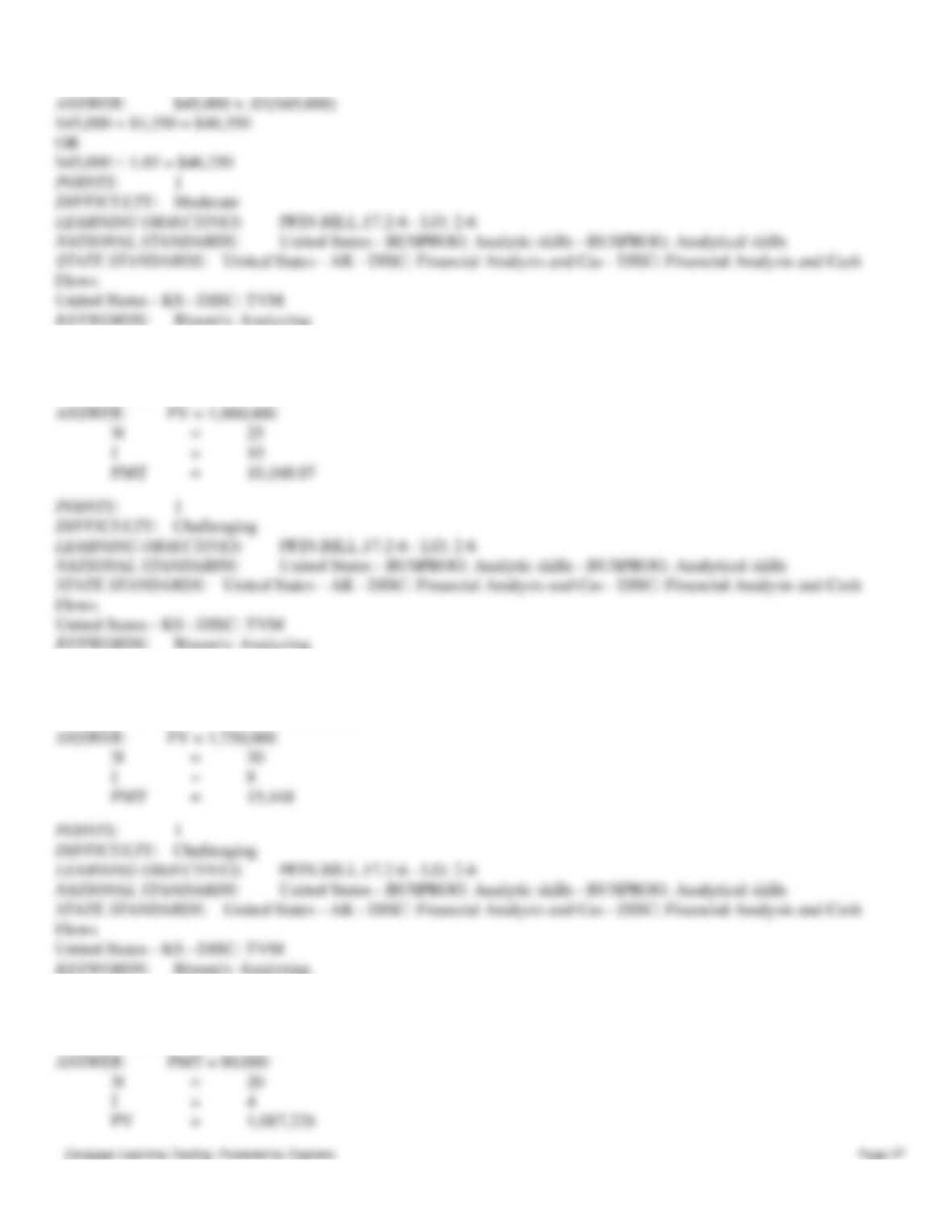
163. Inflation this coming year is expected to be 4 percent. If Mr. Gonza earned $37,000 this year, how much must he
earn the following year just to keep up with inflation and maintain the balance between his income and his increasing
expenditures? (Show all work.)
164. Inflation this coming year is expected to be 3 percent. If Mr. Gonza earned $45,000 this year, how much must he
earn the following year just to keep up with inflation and maintain the balance between his income and his increasing
expenditures? (Show all work.)
Chapter 2—Using Financial Statements and Budgets
165. Jamie wants to have $1,000,000 for her retirement in 25 years. How much should she save annually if she thinks she
can earn 10% on her investments?
166. The Hamptons want to have $1,750,000 for their retirement in 30 years. How much should they save annually if they
think they can earn 8% on their investments?
167. The Flemings will need $80,000 annually for 20 years during retirement. How much will they need at retirement if
they can earn a 4% rate of return?
Chapter 2—Using Financial Statements and Budgets