31) Apex Inc. issues a bond of $1,000 which pays interest semiannually at a coupon interest rate
of 8%. The maturity of the bond is 15 years. Where should this bond be traded?
A) forex market
B) money market
C) capital market
D) commodities market
2.4 Explain the root causes of the 2008 financial crisis and recession.
1) Securitization is the process of pooling mortgages or other types of loans and selling the
claims or securities against that pool in the secondary market.
2) Securitization made it harder for banks to lend money because they could not pass the risk on
to other investors.
3) Mortgage-backed securities are securities that represent claims on the cash flows generated by
a pool of mortgages.
4) Prior to the 2008 financial crisis, most investors viewed mortgage-backed securities as
relatively safe investments.
5) Subprime mortgages are mortgage loans made to borrowers with high incomes and better than
average credit histories.
6) Recessions associated with a banking crisis tend to be more severe than other recessions
because many businesses rely on credit to operate.
7) The process of pooling mortgages or other types of loans and selling the claims or securities
against that pool in the secondary market is called ________.
A) valuation
B) securitization
C) private placement
D) capital restructuring
8) The primary risk of mortgage-backed securities is ________.
A) that the prices of have high volatility
B) that the prices of housing will increase
C) that the government will not be able to meet the guarantees on the cash flows
D) that homeowners may not be able to, or choose not to, repay their loans
9) Which of the following is true of mortgage-backed securities?
A) Mortgage-backed securities assure a flat 15% return.
B) Mortgage-backed securities are guaranteed by the U.S. government.
C) Mortgage-backed securities can only be purchased by investment banks.
D) Mortgage-backed securities represent claims on the cash flows generated by a pool of
homeloans.
10) When home prices are falling, we would expect a(n) ________.
A) high mortgage default rates
B) low mortgage default rates
C) unchanged mortgage default rates
D) higher percentage of owner home equity
11) A crisis in the financial sector often spills over into other industries because when financial
institutions ________ borrowing, activity in most other industries ________.
A) increase; slows down
B) contract; slows down
C) increase; increases
D) contract; increases
1) The Glass-Steagall Act ________.
A) was intended to regulate the activities in the secondary market
B) created the Securities Exchange Commission
C) separated the activities of commercial and investment banks
D) was intended to regulate the activities in the primary market
2) The Securities Act of 1933 focuses on regulating the sale of securities in the primary market,
whereas the 1934 Act deals with the regulations governing the transactions in the secondary
market.
3) The Federal Deposit Insurance Corporation (FDIC) ________.
A) is an agency, created by the Glass-Steagall Act, that monitors banks on a regular basis to
ensure that they were safe and sound.
B) is an agency that monitors business combinations between commercial banks, investment
banks, and insurance companies
C) guarantees individuals will not lose any money held at any type of financial institution that
fails
D) guarantees individuals will not lose any money, up to a specified amount, held at any type of
financial institution that fails
4) The Gramm-Leach-Bliley Act ________.
A) is created to monitor banks on a regular basis to ensure that they were safe and sound.
B) allows business combinations between commercial banks and investment banks, but not
insurance companies
C) allows business combinations between commercial banks, investment banks, and insurance
companies
D) was signed during the Great Depression because of the financial crisis
5) Which of the following acts regulates the secondary market?
A) The Securities Act of 1933
B) The Gramm-Leach-Bliley Act
C) The Securities Exchange Act of 1934
D) The Glass-Steagall Act
6) Which of the following acts regulates the primary market in which securities are originally
issued to the public?
A) The Securities Act of 1933
B) The Gramm-Leach-Bliley Act
C) The Securities Exchange Act of 1934
D) The Glass-Steagall Act
1) The ordinary income of a corporation is income earned through the sale of goods or services
and is currently taxed subject to the individual income tax rates.
2) The marginal tax rate represents the rate at which the next dollar of income is taxed.
3) All dividend income received by a corporation is exempted from taxation.
4) The marginal tax rate paid on a firm’s ordinary income can be calculated by dividing its taxes
by its net income.
5) The average tax rate paid on the firm’s ordinary income can be calculated by dividing its taxes
by its taxable income.
6) Dividends received by a corporation on an investment in the common and preferred stock of
another corporation, where ownership in the dividend paying corporation is less than 20%, is
subject to 70 percent exclusion for tax purposes.
7) The tax deductibility of various expenses such as general and administrative expenses
________.
A) increases their pretax cost
B) reduces their after-tax cost
C) has no effect on their after-tax cost
D) has an unpredictable effect on their after-tax cost
8) The tax liability of a corporation with ordinary income of $105,000 is ________.
Range of taxable income Marginal rate
$0 to $50,000 15%
50,000 to 75,000 25
75,000 to 100,000 34
100,000 to 335,000 39
335,000 to 10,000,000 34
10,000,000 to 15,000,000 35
15,000,000 to 18,333,333 38
Over 18,333,333 35
A) $42,000
B) $35,700
C) $23,950
D) $24,200
9) The tax liability of a corporation with ordinary income of $1,500,000 is ________.
Range of taxable income Marginal rate
$0 to $50,000 15%
50,000 to 75,000 25
75,000 to 100,000 34
100,000 to 335,000 39
335,000 to 10,000,000 34
10,000,000 to 15,000,000 35
15,000,000 to 18,333,333 38
Over 18,333,333 35
A) $498,250
B) $510,000
C) $585,000
D) $690,000
10) The tax liability of a corporation with ordinary income of $1,100,000 is ________.
Range of taxable income Marginal rate
$0 to $50,000 15%
50,000 to 75,000 25
75,000 to 100,000 34
100,000 to 335,000 39
335,000 to 10,000,000 34
10,000,000 to 15,000,000 35
15,000,000 to 18,333,333 38
Over 18,333,333 35
A) $362,250
B) $340,000
C) $374,000
D) $390,000
11) Jennings, Inc. has a tax liability of $170,000 on pretax income of $500,000. What is the
average tax rate for Jennings, Inc.?
A) 34 percent
B) 46 percent
C) 25 percent
D) 40 percent
12) The average tax rate of a corporation with ordinary income of $105,000 and a tax liability of
$24,200 is ________.
A) 46 percent
B) 23 percent
C) 34 percent
D) 15 percent
13) If a corporation sells certain capital equipment for more than their initial purchase price, the
difference between the sale price and the purchase price is called a(n) ________.
A) ordinary gain
B) revenue gain
C) capital gain
D) abnormal gain
14) In general, most corporate capital gains are taxed at ________ tax rate.
A) a 46 percent
B) the regular corporate
C) a 28 percent
D) a 30 percent
15) Congress allows corporations to exclude from taxes 70 to 100 percent of dividends received
from other corporations. Congress did this to ________.
A) encourage corporations to invest in each other
B) avoid double taxation on dividends
C) eliminates most of the potential tax liability from the dividends received by the second and
any subsequent corporations
D) lower the cost of equity financing for corporations
16) Corporation X needs $1,000,000 and can raise this through debt at an annual rate of 10
percent, or preferred stock at an annual cost of 7 percent. If the corporation has a 40 percent tax
rate, the after-tax cost of each is ________.
A) debt: $100,000; preferred stock: $70,000
B) debt: $60,000; preferred stock: $42,000
C) debt: $60,000; preferred stock: $70,000
D) debt: $100,000; preferred stock: $42,000
17) Corporation A owns 15 percent of the stock of corporation B. Corporation B pays
corporation A $100,000 in dividends in 2002. Corporation A must pay tax on ________.
A) $100,000 of ordinary income
B) $ 30,000 of ordinary income
C) $ 70,000 of ordinary income
D) $ 70,000 of capital gain
18) The dividend exclusion for corporations receiving dividends from another corporation has
resulted in ________.
A) a lower cost of equity for the corporation paying the dividend
B) a higher relative cost of bond-financing for the corporation paying the dividend
C) stock investments being relatively less attractive, relative to bond investments made by one
corporation in another corporation
D) stock investments being relatively more attractive relative to bond investments made by one
corporation in another corporation
19) Which of the following is true?
A) The process of pooling mortgages or other types of loans and then selling claims or securities
against that pool in a secondary market is called depreciation.
B) Corporations pay taxes on all dividends received from other corporations, no matter their
share of ownership.
C) Corporations may pay taxes on only 30 percent of the dividends received from other
corporations, depending on their percentage of ownership.
D) Capital gains are treated separately from ordinary corporate income for tax purposes.
20) Meese Paper Distributors, Inc. has before-tax earnings of $1,900,000. Calculate the amount
of the total tax liability.
Range of taxable income Marginal rate
$0 to $50,000 15%
50,000 to 75,000 25
75,000 to 100,000 34
100,000 to 335,000 39
335,000 to 10,000,000 34
10,000,000 to 15,000,000 35
15,000,000 to 18,333,333 38
Over 18,333,333 35
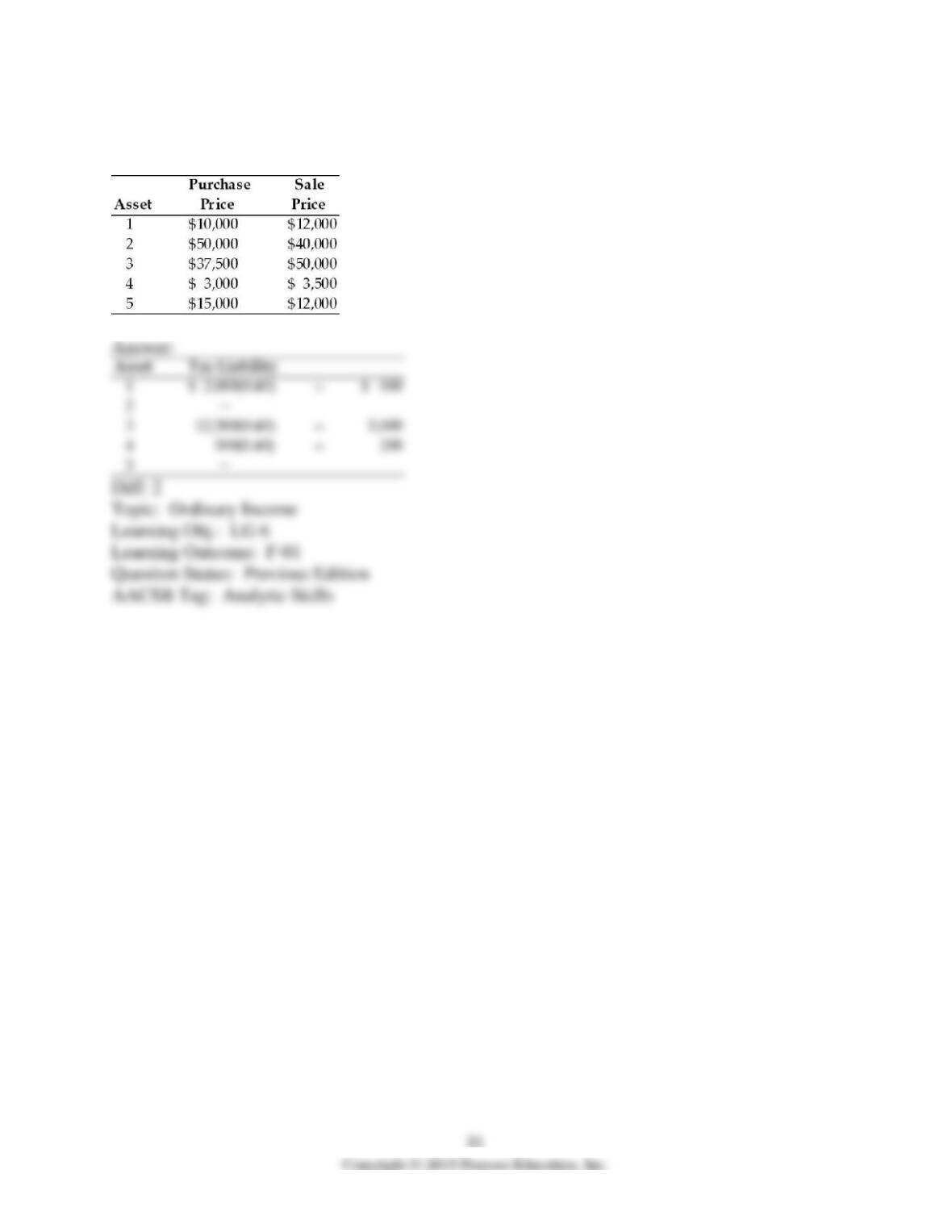
21) During 2002, a firm has sold 5 assets described below. Calculate the tax liability on the
assets. The firm pays a 40 percent tax rate on ordinary income.
22) Consider two firms, Go Debt corporation and No Debt corporation. Both firms are expected
to have earnings before interest and taxes of $100,000 during the coming year. In addition, Go
Debt is expected to incur $40,000 in interest expenses as a result of its borrowings whereas No
Debt will incur no interest expense because it does not use debt financing. However, No Debt
will have to pay stockholders $40,000 in dividend income. Both firms are in the 40 percent tax
bracket. Calculate the Earnings after tax for both firms. Which firm has the higher after-tax
earnings? Which firm appears to have the higher cash flow? How do you account for the
difference?