16) Referring to the Economic Stimulus Act of 2008, the expansionary effect of the government
stimulus was overwhelmed by the continuing deterioration in credit market conditions.
Everything else held constant and using the ISLM model, the net effect would cause the
________ curve to ________ and output will ________.
A) IS; shift left; decrease
B) IS; shift right; increase
C) LM; shift right; increase
D) LM shift left; decrease
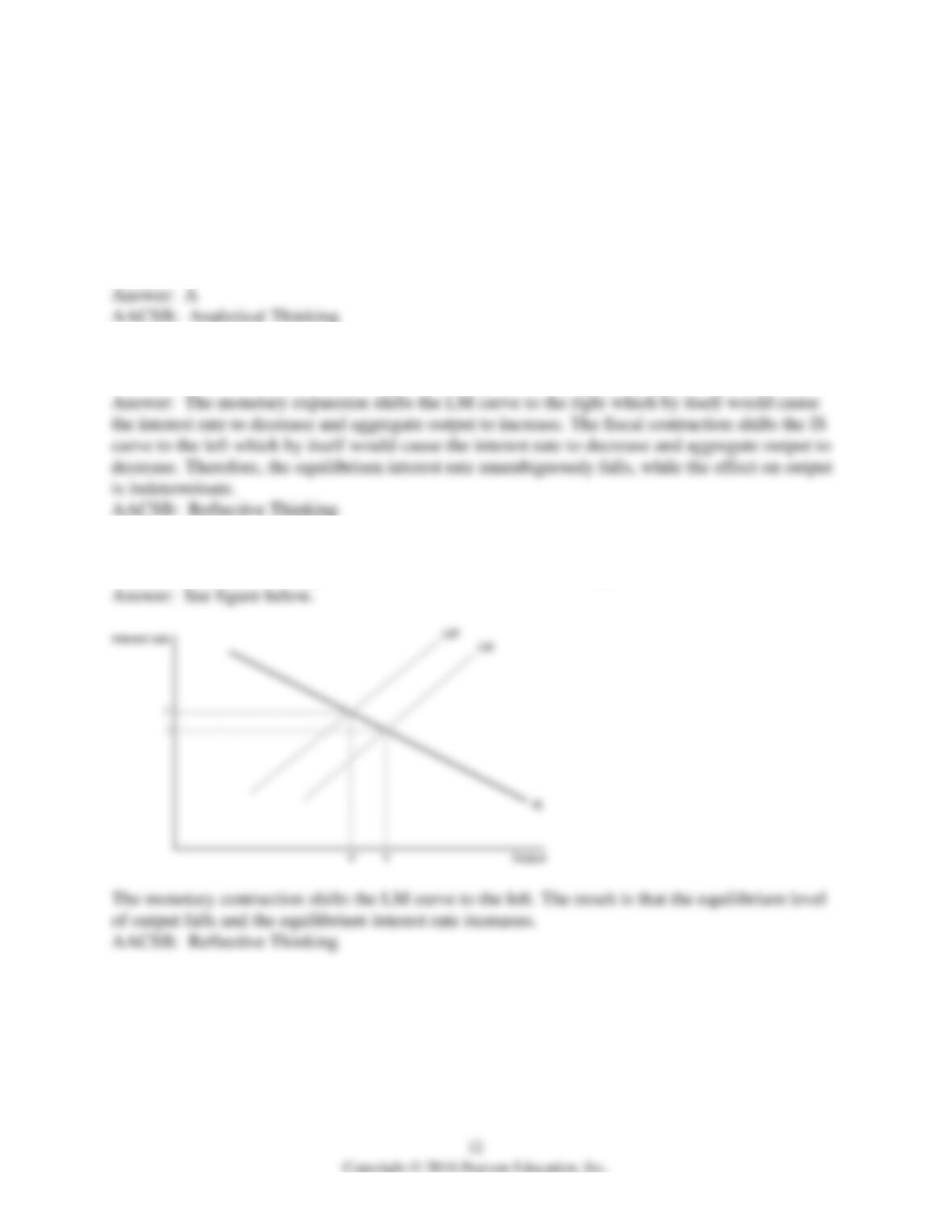
17) Using the ISLM model, explain the effects of a monetary expansion combined with a fiscal
contraction. How do the equilibrium level of output and interest rate change?
18) Using the ISLM model, show graphically and explain the effects of a monetary contraction.
What is the effect on the equilibrium interest rate and level of output?
1) If the quantity of money demanded is not affected by changes in the interest rate, the LM
curve is ________ and fiscal policy will be ________.
A) horizontal; very effective
B) horizontal; ineffective
C) vertical; ineffective
D) vertical; very effective
2) The LM curve will be vertical and fiscal policy ineffective when
A) the demand for money is unaffected by changes in the interest rate.
B) the demand for money is unaffected by changes in income.
C) investment is unaffected by changes in the interest rate.
D) investment is unaffected by changes in income.
3) The situation in which expansionary fiscal policy does not lead to a rise in aggregate output is
referred to as
A) fiscal neutrality.
B) a recession.
C) complete crowding out.
D) inflation.
4) Crowding out will be more pronounced the closer to vertical is the
A) IS curve.
B) LM curve.
C) consumption function.
D) aggregate demand function.
5) The less interest-sensitive is money demand, the
A) more effective is fiscal policy relative to monetary policy.
B) more effective is monetary policy relative to fiscal policy.
C) steeper is the IS curve.
D) flatter is the LM curve.
6) The more interest-sensitive is money demand, the
A) more effective is fiscal policy relative to monetary policy.
B) more effective is monetary policy relative to fiscal policy.
C) steeper is the IS curve.
D) steeper is the LM curve.
7) If the economy is characterized by a certain and stable LM curve, then ________ target
produces ________ fluctuations in aggregate output.
A) an interest rate; smaller
B) a money supply; smaller
C) a money supply; larger
D) an exchange rate; larger
8) If the economy is characterized by a stable IS curve and an unstable LM curve, then ________
target produces ________ fluctuations in aggregate output.
A) an interest rate; larger
B) a money supply; smaller
C) a money supply; larger
D) an exchange rate; smaller
9) If the ________ curve is relatively more unstable than the ________ curve, a money supply
target is preferred.
A) IS; IS
B) IS; LM
C) LM; IS
D) LM; LM
10) If the ________ curve is relatively more unstable than the ________ curve, an interest rate
target is preferred.
A) IS; IS
B) IS; LM
C) LM; IS
D) LM; LM
11) If the Fed adopts a policy of pegging the interest rate, a ________ in government spending
forces the Fed to increase the money supply to prevent interest rates from ________.
A) fall; increasing
B) fall; decreasing
C) rise; decreasing
D) rise; increasing
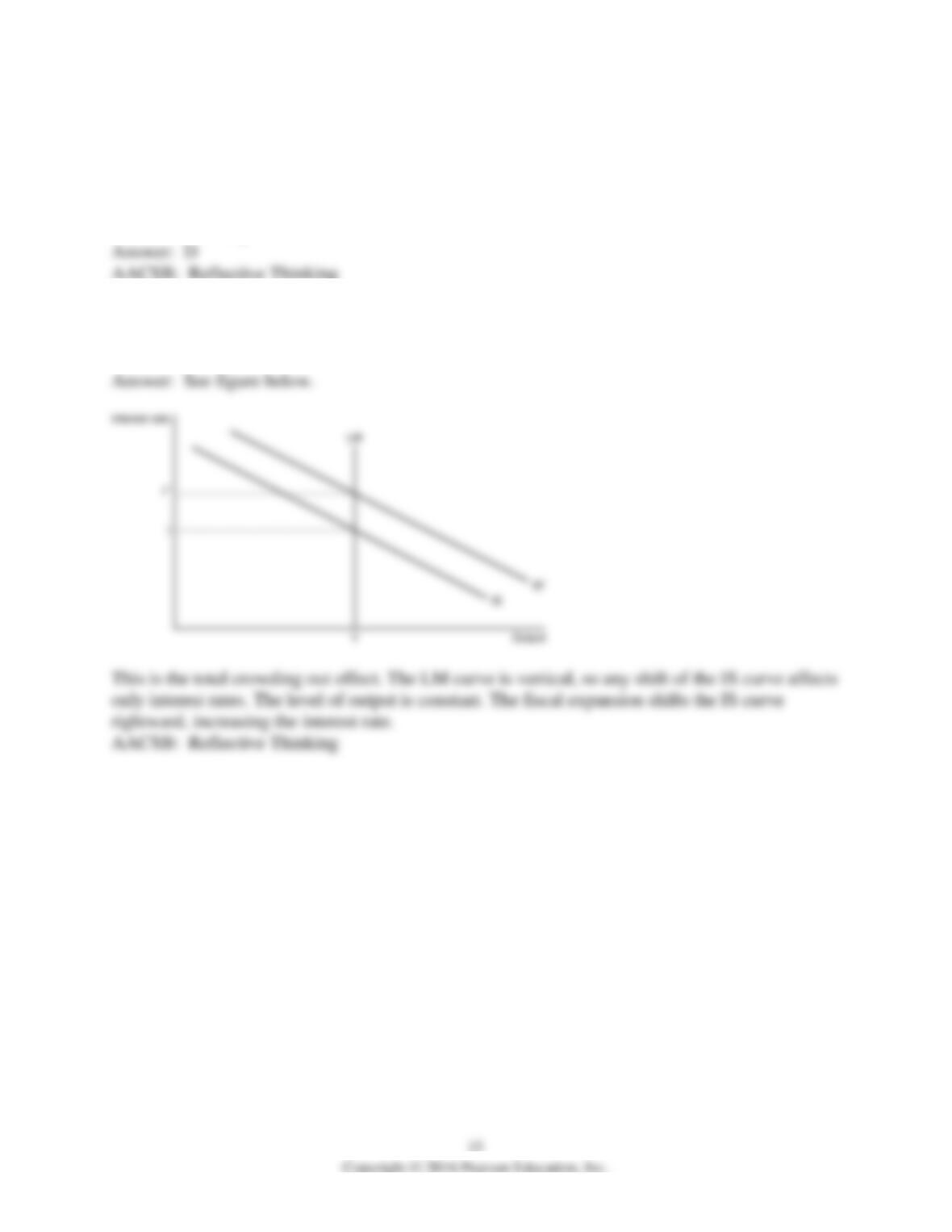
12) Using the ISLM model, explain and show graphically the effect of a fiscal expansion when
the demand for money is completely insensitive to changes in the interest rate. What is this effect
called?
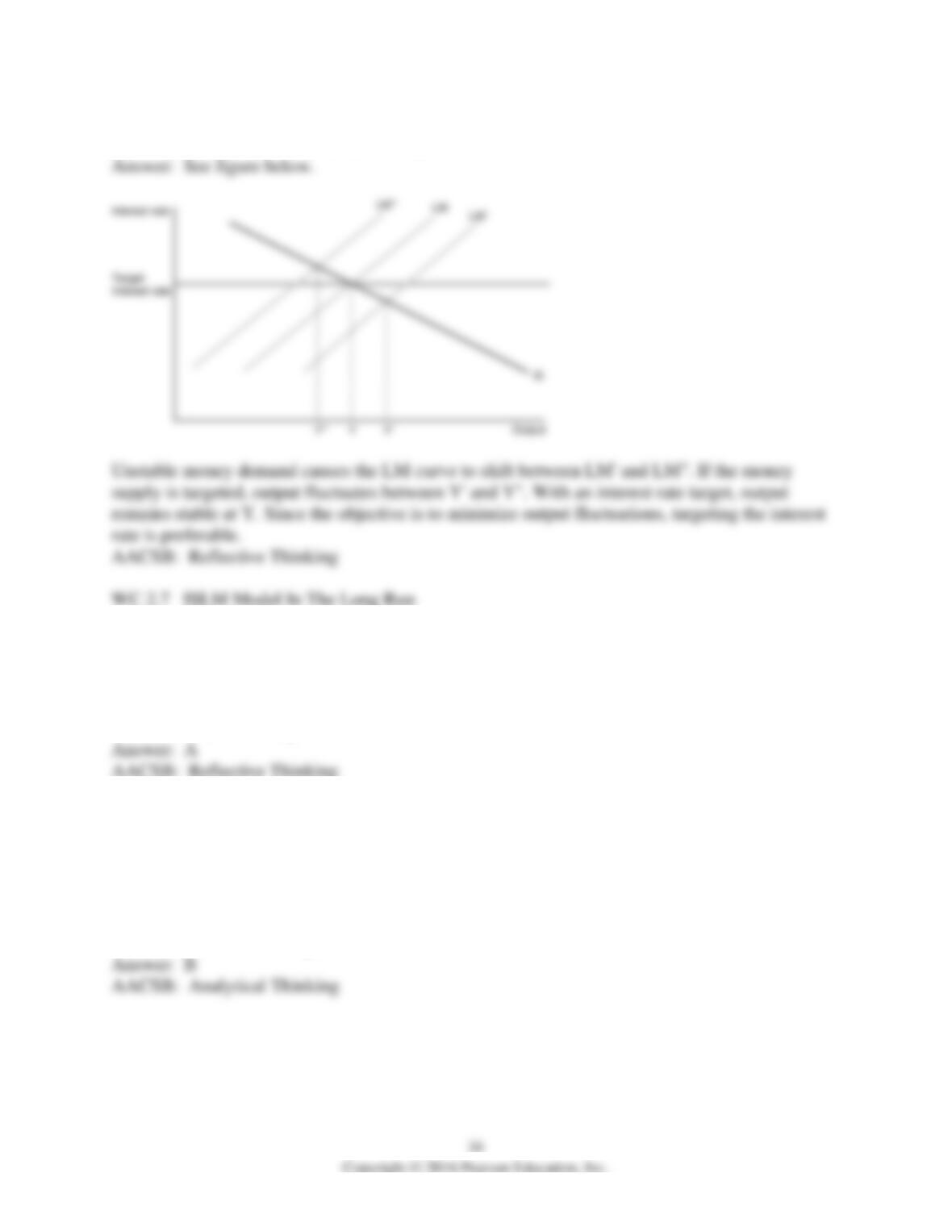
13) Show graphically and explain why targeting an interest rate is preferable when money
demand is unstable and the IS curve is stable.
1) The rate of output at which the price level has no tendency to rise or fall is called the
A) natural rate of output.
B) potential level of income.
C) bliss point.
D) efficient level of output.
2) In the long-run ISLM model and with everything else held constant, as long as the level of
output ________ the natural rate level, the price level will continue to ________, shifting the LM
curve to the ________, until finally output is back at the natural rate level.
A) exceeds; rise; right
B) exceeds; rise; left
C) remains below; fall; left
D) remains below; rise; right
3) In the long-run ISLM model and with everything else held constant, as long as the level of
output ________ the natural rate level, the price level will continue to ________, shifting the LM
curve to the ________, until finally output is back at the natural rate level.
A) exceeds; rise; right
B) exceeds; fall; left
C) remains below; fall; right
D) remains below; rise; left
4) In the long-run ISLM model and with everything else held constant, an increase in the money
supply leaves the level of output and interest rates unchanged, an outcome called
A) interest rate overshooting.
B) long-run money neutrality.
C) long-run crowding out.
D) the long-run Phillips curve.
5) In the long-run ISLM model and with everything else held constant, the long-run effect of an
expansionary monetary policy is to
A) increase real output and the interest rate.
B) not change either real output or the interest rate.
C) increase real output and leave the interest rate unchanged.
D) increase the interest rate and leave real output unchanged.
6) The long-run neutrality of money refers to the fact that in the long run, monetary policy
A) changes only real output.
B) changes only the real interest rate.
C) changes both real output and the real interest rate.
D) has no effect on either real output or the real interest rate.
7) In the long-run ISLM model and with everything else held constant, the long-run effect of an
expansionary fiscal policy is to ________ real output and ________ the interest rate.
A) increase; increase
B) not change; not change
C) increase; not change
D) not change; increase
8) In the long-run ISLM model and with everything else held constant, the long-run effect of a
contractionary fiscal policy is to ________ real output and ________ the interest rate.
A) not change; not change
B) decrease; decrease
C) decrease; not change
D) not change; decrease
9) In the long-run ISLM model and with everything else held constant, the long-run effect of a
cut in government spending is to ________ real output and ________ the interest rate.
A) increase; increase
B) increase; not change
C) not change; increase
D) not change; decrease
10) In the long-run ISLM model and with everything else held constant, the long-run effect of a
tax cut is to ________ real output and ________ the interest rate.
A) increase; increase
B) increase; not change
C) not change; increase
D) not change; decrease
11) In the long-run ISLM model and with everything else held constant, the long-run effect of an
autonomous increase in investment is to ________ real output and ________ the interest rate.
A) increase; increase
B) increase; not change
C) not change; increase
D) not change; decrease
12) In the long-run ISLM model and with everything else held constant, the long-run effect of a
fall in net exports is to ________ real output and ________ the interest rate.
A) increase; increase
B) increase; not change
C) not change; increase
D) not change; decrease
13) In the long-run ISLM model and with everything else held constant, the long-run effect of an
autonomous fall in consumption expenditure is to ________ real output and ________ the
interest rate.
A) increase; increase
B) increase; not change
C) not change; increase
D) not change; decrease
14) In the long-run the ISLM model predicts that ________ can change real output.
A) only monetary policy
B) only fiscal policy
C) both monetary and fiscal policy
D) neither monetary nor fiscal policy
15) If the price level increases, everything else held constant, the ________ curve shifts to the
________.
A) IS; right
B) IS; left
C) LM; left
D) LM; right
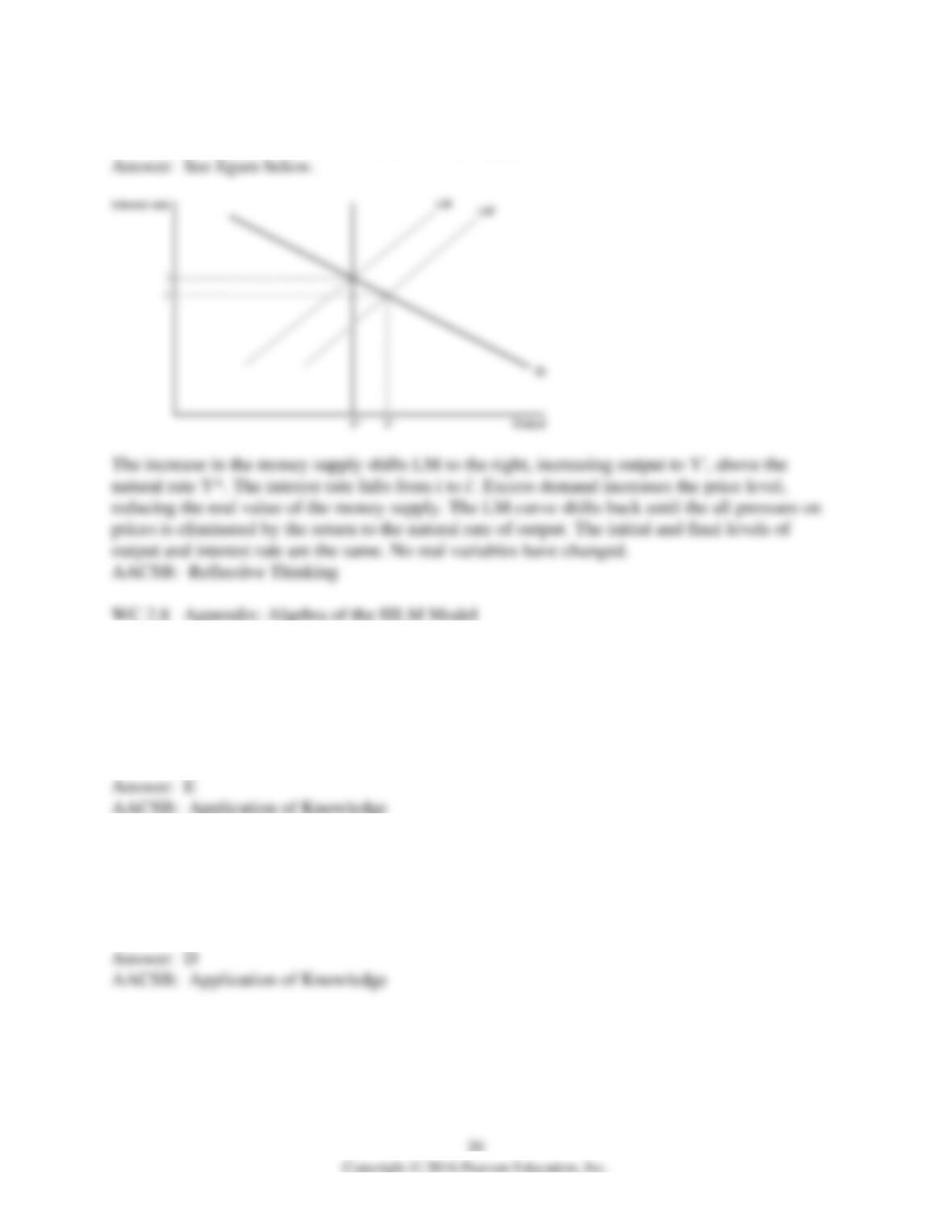
16) Using the long-run ISLM model, explain and demonstrate graphically the neutrality of
money, for the case of an increase in the money supply.
1) In the basic closed-economy ISLM model, the goods market can be described by the
A) consumption function.
B) investment function.
C) government spending and tax.
D) goods market equilibrium condition.
E) all of the above.
2) In the basic closed-economy ISLM model, the money market can be described by the
A) money demand function.
B) money supply.
C) money market equilibrium condition.
D) all of the above.
3) Which of the followings does NOT describe the goods market in the ISLM model?
A) consumption function
B) investment function
C) government spending and tax
D) money demand function
4) Which of the followings does NOT describe the goods market in the ISLM model?
A) consumption function
B) investment function
C) government spending and tax
D) money supply
5) Which of the followings does NOT describe the money market in the ISLM model?
A) money demand function
B) investment function
C) money market equilibrium condition
D) money supply
6) In the basic closed-economy ISLM model, the goods market equilibrium condition is
A) output = consumption + investment + government spending.
B) output = consumption + investment + government spending – tax.
C) output = consumption + investment + government spending + net export.
D) output = potential output.
7) In the basic closed-economy ISLM model, the money demand is a function of
A) output.
B) money supply.
C) interest rates.
D) both A and C.
8) In the basic closed-economy ISLM model, the IS curve can be described by an equation where
A) output is a function of consumption.
B) money is a function of interest rates.
C) output is a function of money.
D) output is a function of interest rates.
9) In the basic closed-economy ISLM model, the LM curve can be described by an equation
where
A) output is a function of consumption.
B) money is a function of interest rates.
C) output is a function of money.
D) interest rate is a function of output.
10) In the basic closed-economy ISLM model, as the interest sensitivity of money demand
increases, fiscal policy has ________ effect on output and monetary policy has ________ effect
on output.
A) less; less
B) more; more
C) more; less
D) less; more
11) In the basic closed-economy ISLM model, as the interest sensitivity of investment spending
increases, fiscal policy has ________ effect on output and monetary policy has ________ effect
on output.
A) less; less
B) more; more
C) more; less
D) less; more
12) In the open-economy ISLM model, the goods market equilibrium condition is
A) output = consumption + investment + government spending.
B) output = consumption + investment + government spending – tax.
C) output = consumption + investment + government spending + net export.
D) output = potential output.
13) In the open-economy ISLM model, net export is specified as a function of
and exchange arte is specified as a function of .
A) output; output.
B) money supply; interest rate.
C) exchange rate; interest rate.
D) exchange rate; money demand.