Cost-Volume-Profit Analysis: Additional Issues
FOR INSTRUCTOR USE ONLY
19 – 21
a95. Companies recognize fixed manufacturing overhead costs as period costs (expenses)
when incurred when using
a. full costing.
b. absorption costing.
c. product costing.
d. variable costing.
a96. Under absorption costing and variable costing, how are fixed manufacturing costs
treated?
Absorption Variable
a. Product Cost Product Cost
b. Product Cost Period Cost
c. Period Cost Product Cost
d. Period Cost Period Cost
a97. Under absorption costing and variable costing, how are variable manufacturing costs
treated?
Absorption Variable
a. Product Cost Product Cost
b. Product Cost Period Cost
c. Period Cost Product Cost
d. Period Cost Period Cost
a98. Under absorption costing and variable costing, how are direct labor costs treated?
Absorption Variable
a. Product Cost Product Cost
b. Product Cost Period Cost
c. Period Cost Product Cost
d. Period Cost Period Cost
a99. Fixed selling expenses are period costs
a. under both absorption and variable costing.
b. under neither absorption nor variable costing.
c. under absorption costing, but not under variable costing.
d. under variable costing, but not under absorption costing.
a100. Which cost is not charged to the product under variable costing?
a. Direct materials
b. Direct labor
c. Variable manufacturing overhead
d. Fixed manufacturing overhead
Test Bank for Accounting, Tools for Business Decision Making Fifth Edition
FOR INSTRUCTOR USE ONLY
19 – 22
a101. Which cost is charged to the product under variable costing?
a. Variable manufacturing overhead
b. Fixed manufacturing overhead
c. Variable administrative expenses
d. Fixed administrative expenses
a102. Variable costing
a. is used for external reporting purposes.
b. is required under GAAP.
c. treats fixed manufacturing overhead as a period cost.
d. is also known as full costing.
a103. Sprinkle Co. sells its product for $20 per unit. During 2013, it produced 60,000 units and
sold 50,000 units (there was no beginning inventory). Costs per unit are: direct materials
$5, direct labor $3, and variable overhead $1. Fixed costs are: $240,000 manufacturing
overhead, and $30,000 selling and administrative expenses.
The per unit manufacturing cost under absorption costing is
a. $8.
b. $9.
c. $13.
d. $14.
a104. Sprinkle Co. sells its product for $20 per unit. During 2013, it produced 60,000 units and
sold 50,000 units (there was no beginning inventory). Costs per unit are: direct materials
$5, direct labor $3, and variable overhead $1. Fixed costs are: $240,000 manufacturing
overhead, and $30,000 selling and administrative expenses.
The per unit manufacturing cost under variable costing is
a. $8.
b. $9.
c. $13.
d. $14.
Cost-Volume-Profit Analysis: Additional Issues
FOR INSTRUCTOR USE ONLY
19 – 23
a105. Sprinkle Co. sells its product for $20 per unit. During 2013, it produced 60,000 units and
sold 50,000 units (there was no beginning inventory). Costs per unit are: direct materials
$5, direct labor $3, and variable overhead $1. Fixed costs are: $240,000 manufacturing
overhead, and $30,000 selling and administrative expenses.
Cost of goods sold under absorption costing is
a. $450,000.
b. $540,000.
c. $650,000.
d. $520,000.
a106. Sprinkle Co. sells its product for $20 per unit. During 2013, it produced 60,000 units and
sold 50,000 units (there was no beginning inventory). Costs per unit are: direct materials
$5, direct labor $3, and variable overhead $1. Fixed costs are: $240,000 manufacturing
overhead, and $30,000 selling and administrative expenses.
Ending inventory under variable costing is
a. $90,000.
b. $130,000.
c. $200,000.
d. $450,000.
a107. Sprinkle Co. sells its product for $20 per unit. During 2013, it produced 60,000 units and
sold 50,000 units (there was no beginning inventory). Costs per unit are: direct materials
$5, direct labor $3, and variable overhead $1. Fixed costs are: $240,000 manufacturing
overhead, and $30,000 selling and administrative expenses.
Under absorption costing, what amount of fixed overhead is deferred to a future period?
a. $10,000
b. $40,000
c. $50,000
d. $240,000
a108. Net income under absorption costing is gross profit less
a. cost of goods sold.
b. fixed manufacturing overhead and fixed selling and administrative expenses.
c. fixed manufacturing overhead and variable manufacturing overhead.
d. variable selling and administrative expenses and fixed selling and administrative
expenses.
Test Bank for Accounting, Tools for Business Decision Making Fifth Edition
FOR INSTRUCTOR USE ONLY
19 – 24
a109. Net income under variable costing is contribution margin less
a. cost of goods sold.
b. fixed manufacturing overhead and fixed selling and administrative expenses.
c. fixed manufacturing overhead and variable manufacturing overhead.
d. variable selling and administrative expenses and fixed selling and administrative
expenses.
a110. The manufacturing cost per unit for absorption costing is
a. usually, but not always, higher than manufacturing cost per unit for variable costing.
b. usually, but not always, lower than manufacturing cost per unit for variable costing.
c. always higher than manufacturing cost per unit for variable costing.
d. always lower than manufacturing cost per unit for variable costing.
a111. The one primary difference between variable and absorption costing is that under
a. variable costing, companies charge the fixed manufacturing overhead as an expense
in the current period.
b. absorption costing, companies charge the fixed manufacturing overhead as an
expense in the current period.
c. variable costing, companies charge the variable manufacturing overhead as an
expense in the current period.
d. absorption costing, companies charge the variable manufacturing overhead as an
expense in the current period.
a112. Net income under absorption costing is higher than net income under variable costing
a. when units produced exceed units sold.
b. when units produced equal units sold.
c. when units produced are less than units sold.
d. regardless of the relationship between units produced and units sold.
a113. Some fixed manufacturing overhead costs of the current period are deferred to future
periods under
a. absorption costing.
b. variable costing.
c. both absorption and variable costing.
d. neither absorption nor variable costing.
Cost-Volume-Profit Analysis: Additional Issues
FOR INSTRUCTOR USE ONLY
19 – 25
a114. Nielson Corp. sells its product for $8,800 per unit. Variable costs per unit are:
manufacturing, $4,800, and selling and administrative, $100. Fixed costs are: $24,000
manufacturing overhead, and $32,000 selling and administrative. There was no beginning
inventory at 1/1/12. Production was 20 units per year in 2012 –2014. Sales was 20 units in
2012, 16 units in 2013, and 24 units in 2014.
Income under absorption costing for 2013 is
a. $6,400.
b. $11,200.
c. $12,800.
d. $17,600.
a115. Nielson Corp. sells its product for $8,800 per unit. Variable costs per unit are:
manufacturing, $4,800, and selling and administrative, $100. Fixed costs are: $24,000
manufacturing overhead, and $32,000 selling and administrative. There was no beginning
inventory at 1/1/12. Production was 20 units per year in 2012 –2014. Sales was 20 units in
2012, 16 units in 2013, and 24 units in 2014.
Income under absorption costing for 2014 is
a. $26,400.
b. $31,200.
c. $32,800.
d. $37,600.
a116. Nielson Corp. sells its product for $8,800 per unit. Variable costs per unit are:
manufacturing, $4,800, and selling and administrative, $100. Fixed costs are: $24,000
manufacturing overhead, and $32,000 selling and administrative. There was no beginning
inventory at 1/1/12. Production was 20 units per year in 2012 –2014. Sales was 20 units in
2012, 16 units in 2013, and 24 units in 2014.
Income under variable costing for 2013 is
a. $6,400.
b. $11,200.
c. $12,800.
d. $17,600.
Test Bank for Accounting, Tools for Business Decision Making Fifth Edition
FOR INSTRUCTOR USE ONLY
19 – 26
a117. Nielson Corp. sells its product for $8,800 per unit. Variable costs per unit are:
manufacturing, $4,800, and selling and administrative, $100. Fixed costs are: $24,000
manufacturing overhead, and $32,000 selling and administrative. There was no
beginning inventory at 1/1/12. Production was 20 units per year in 2012 –2014. Sales
was 20 units in 2012, 16 units in 2013, and 24 units in 2014.
Income under variable costing for 2014 is
a. $26,400.
b. $31,200.
c. $32,800.
d. $37,600.
a118. Nielson Corp. sells its product for $8,800 per unit. Variable costs per unit are:
manufacturing, $4,800, and selling and administrative, $100. Fixed costs are: $24,000
manufacturing overhead, and $32,000 selling and administrative. There was no beginning
inventory at 1/1/12. Production was 20 units per year in 2012 –2014. Sales was 20 units in
2012, 16 units in 2013, and 24 units in 2014.
For the three years 2012–2014,
a. absorption costing income exceeds variable costing income by $8,000.
b. absorption costing income equals variable costing income.
c. variable costing income exceeds absorption costing income by $8,000.
d. absorption costing income may be greater than, equal to, or less than variable costing
income, depending on the situation.
a119. When production exceeds sales,
a. some fixed manufacturing overhead costs are deferred until a future period under
absorption costing.
b. some fixed manufacturing overhead costs are deferred until a future period under
variable costing.
c. variable and fixed manufacturing overhead costs are deferred until a future period
under absorption costing.
b. variable and fixed manufacturing overhead costs are deferred until a future period
under variable costing.
a120. When production exceeds sales,
a. ending inventory under variable costing will exceed ending inventory under absorption
costing.
b. ending inventory under absorption costing will exceed ending inventory under variable
costing.
c. ending inventory under absorption costing will be equal to ending inventory under
variable costing.
d. ending inventory under absorption costing may exceed, be equal to, or be less than
ending inventory under variable costing.
Cost-Volume-Profit Analysis: Additional Issues
FOR INSTRUCTOR USE ONLY
19 – 27
a121. Management may be tempted to overproduce when using
a. variable costing, in order to increase net income.
b. variable costing, in order to decrease net income.
c. absorption costing, in order to increase net income.
d. absorption costing, in order to decrease net income.
a122. If a division manager’s compensation is based upon the division’s net income, the
manager may decide to meet the net income targets by increasing production when using
a. variable costing, in order to increase net income.
b. variable costing, in order to decrease net income.
c. absorption costing, in order to increase net income.
d. absorption costing, in order to decrease net income.
a123. Expected sales for next year for the Beresford Company is 150,000 units. Curt Planters,
manager of the Beresford Division, is under pressure to improve the performance of the
Division. As he plans for next year, he has to decide whether to produce 150,000 units or
180,000 units. The Beresford Company will have higher net income if Curt Planters
decides to produce
a. 180,000 units if income is measured under absorption costing.
b. 180,000 units if income is measured under variable costing.
c. 150,000 units if income is measured under absorption costing.
d. 150,000 units if income is measured under variable costing.
a124. Which of the following is a potential advantage of variable costing relative to absorption
costing?
a. Net income is affected by changes in production levels.
b. The use of variable costing is consistent with cost-volume-profit analysis.
c. Net income computed under variable costing is not closely tied to changes in sales
levels.
d. More than one of the above.
a125. Companies that use just-in-time processing techniques will
a. have greater differences between absorption and variable costing net income.
b. have smaller differences between absorption and variable costing net income.
c. not be able to use absorption costing.
d. not be able to use variable costing.
Test Bank for Accounting, Tools for Business Decision Making Fifth Edition
FOR INSTRUCTOR USE ONLY
19 – 28
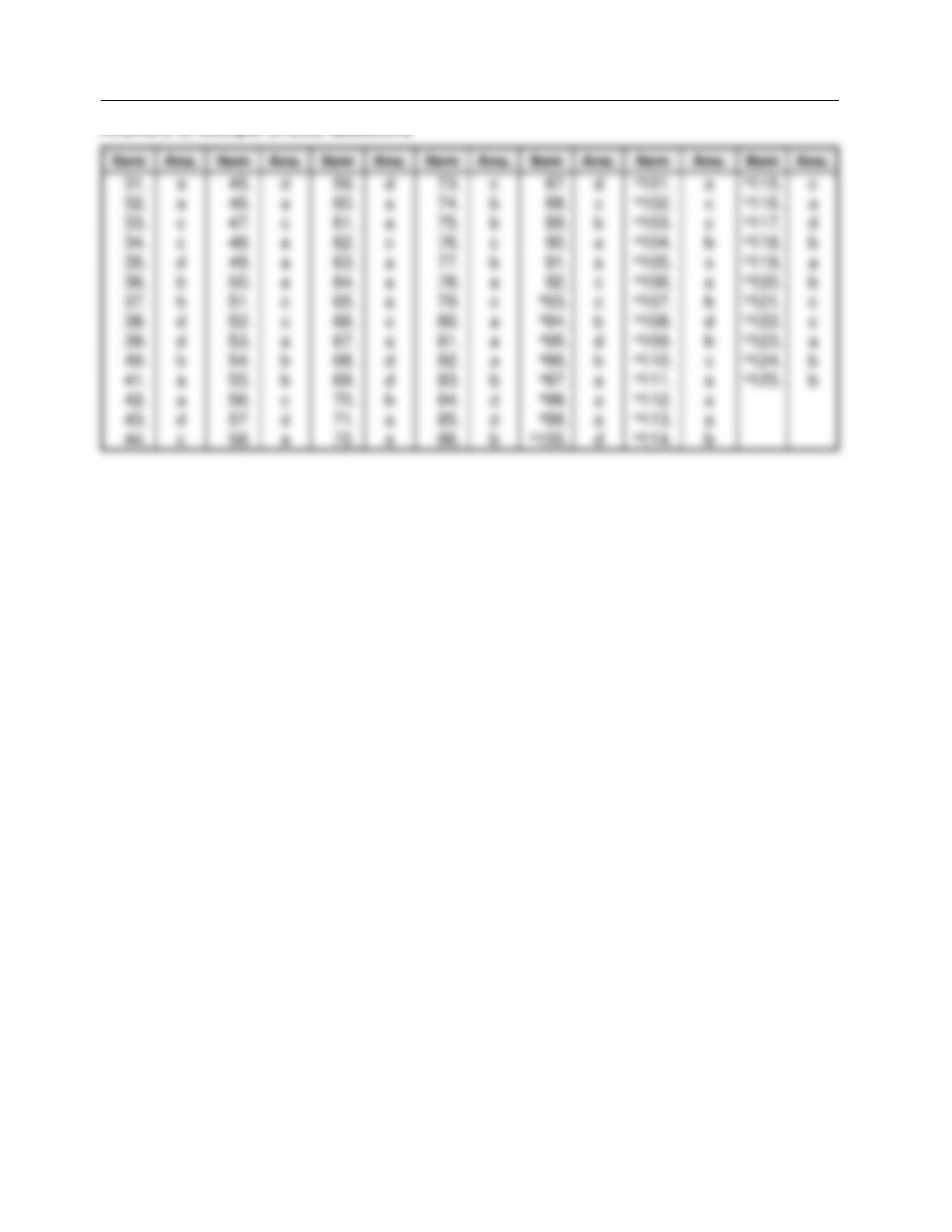
Answers to Multiple Choice Questions
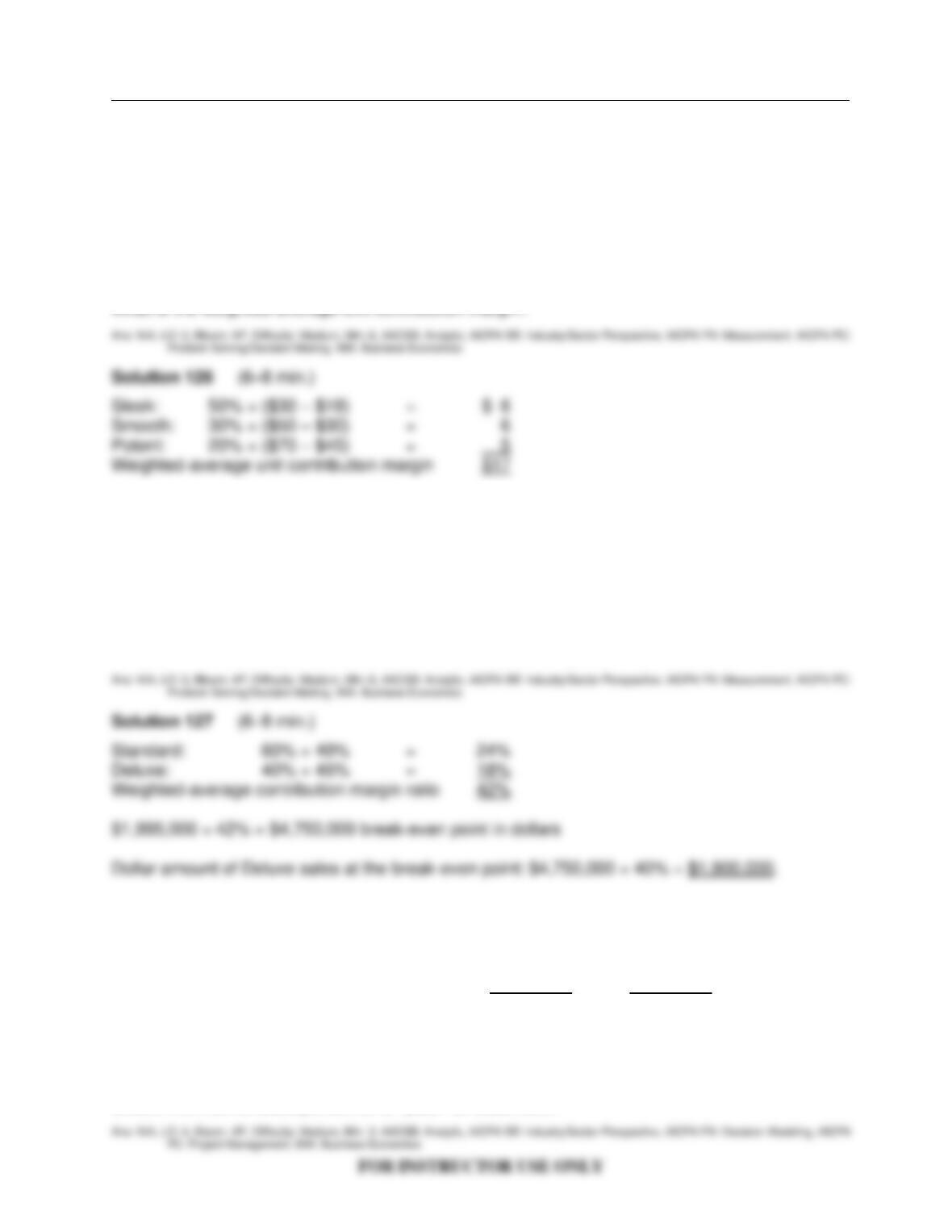
Cost-Volume-Profit Analysis: Additional Issues
19 – 29
BRIEF EXERCISES
BE 126
Archer Industries sells three different sets of sportswear. Sleek sells for $30 and has variable
costs of $18; Smooth sells for $50 and has variable costs of $30; Potent sells for $70 and has
variable costs of $45. The sales mix of the three sets is: Sleek, 50%; Smooth, 30%; and Potent,
20%.
Instructions
What is the weighted-average unit contribution margin?
BE 127
Lazaro Inc. sells two product lines. The sales mix of the product lines is: Standard, 60%; and
Deluxe, 40%. The contribution margin ratio of each line is: Standard, 40%; and Deluxe, 45%.
Lazaro’s fixed costs are $1,995,000.
Instructions
What is the dollar amount of Deluxe sales at the break-even point?
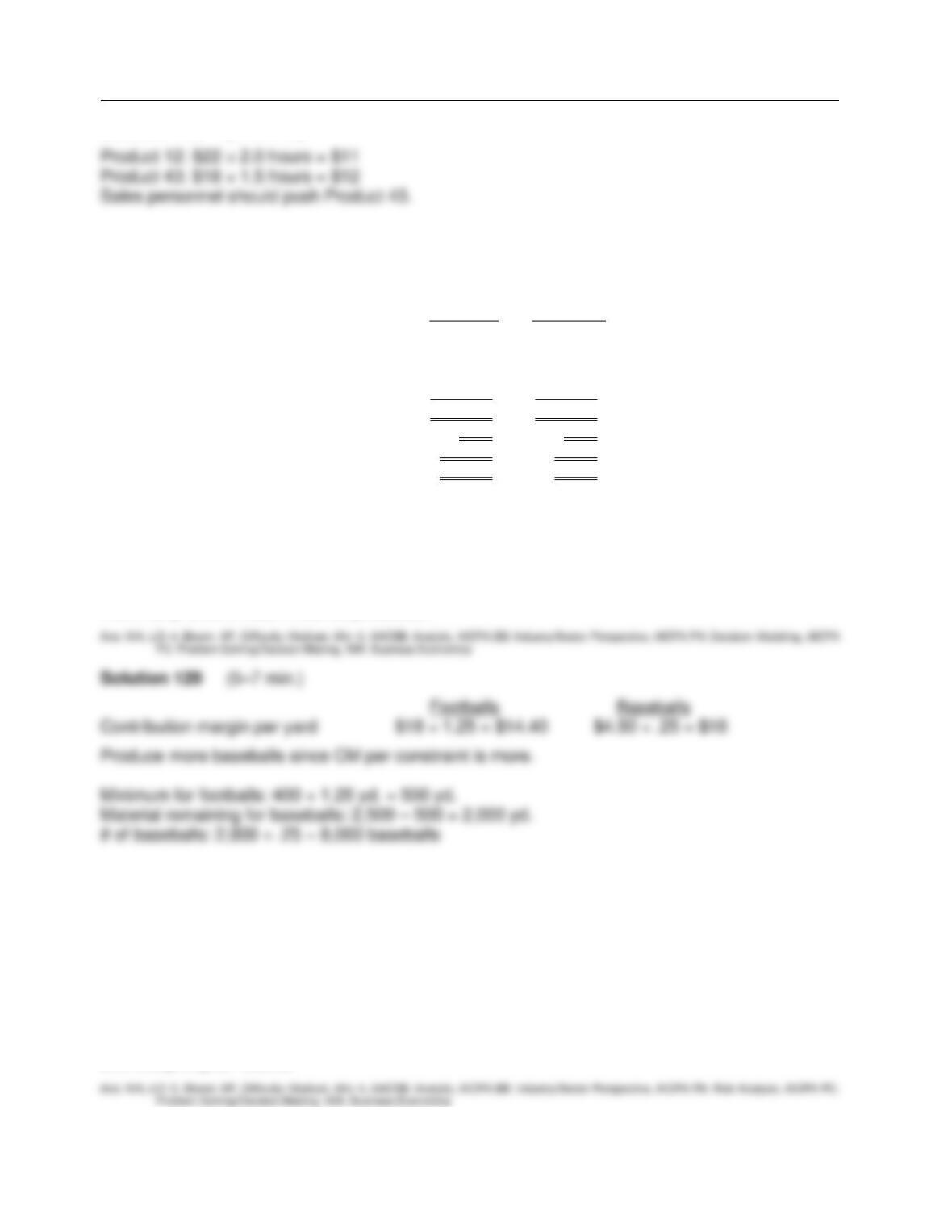
BE 128
Hunt, Inc. provided the following information concerning two products:
Product 12 Product 43
Contribution margin per unit $22 $18
Machine hours required for one unit 2 hours 1.5 hours
Instructions
Compute the contribution margin per unit of limited resource for each product. Which product
should Hunt tell its sales personnel to “push” to customers?
Test Bank for Accounting, Tools for Business Decision Making Fifth Edition
FOR INSTRUCTOR USE ONLY
19 – 30
Solution 128 (3–5 min.)
BE 129
Gallery Corporation makes two products, footballs and baseballs. Additional information follows:
Footballs Baseballs
Units 2,000 2,500
Sales $60,000 $25,000
Variable costs 24,000 13,750
Fixed costs 10,000 5,250
Net income $26,000 $ 6,000
Yards of leather per unit 1.25 0.25
Profit per unit $13.00 $2.40
Contribution margin per unit $18.00 $4.50
Assume that Gallery is able to order an additional 2,500 yards of leather and wishes to maximize
its income. Of the additional units it produces, at least 400 of each product are necessary for
sales.
Instructions
How many units of each must be produced?
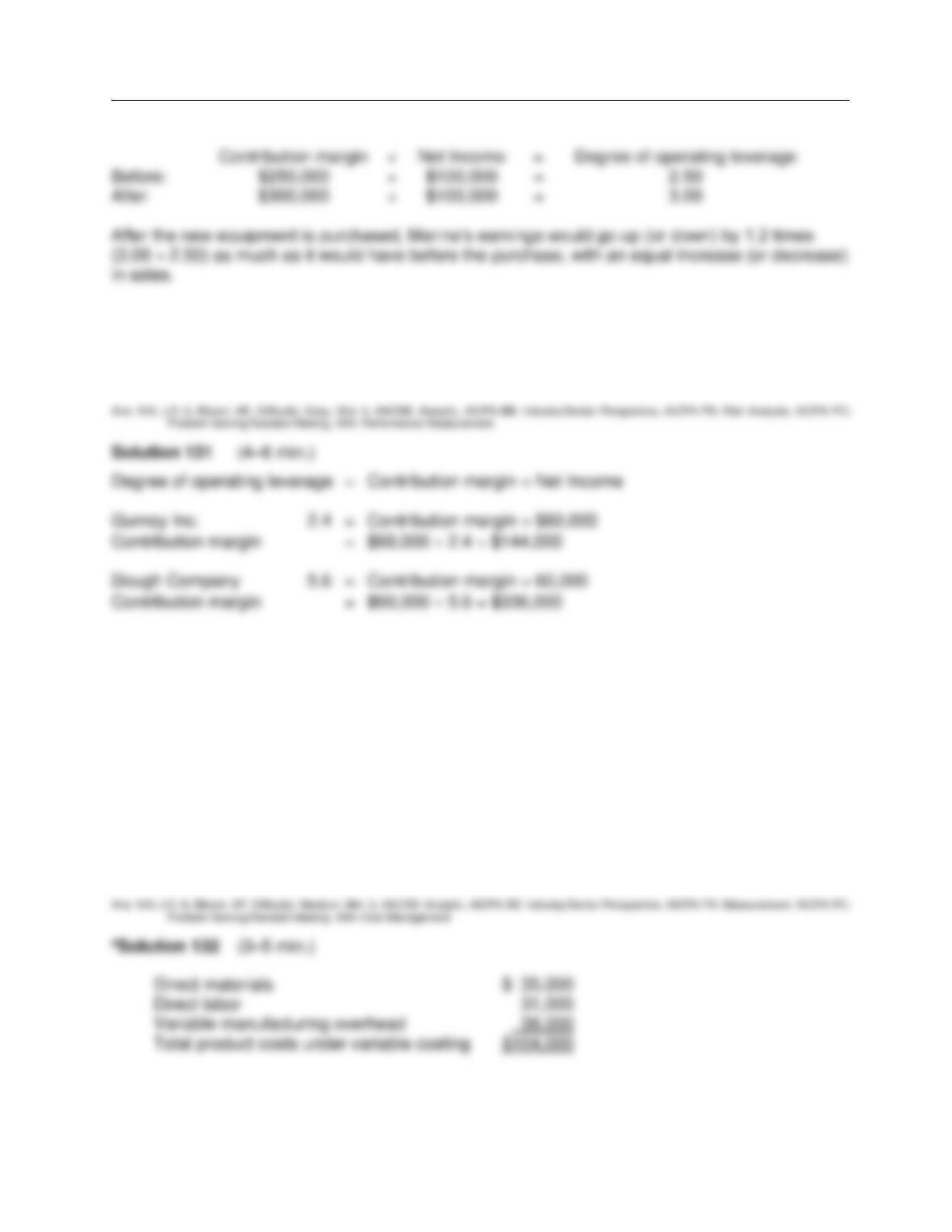
BE 130
Marina Manufacturing is considering buying new equipment for its factory. The new equipment
will reduce variable labor costs but increase depreciation expense. Contribution margin is
expected to increase from $250,000 to $300,000. Net income is expected to remain the same at
$100,000.
Instructions
Compute the degree of operating leverage before and after the purchase of the new equipment
and interpret your results.
Cost-Volume-Profit Analysis: Additional Issues
FOR INSTRUCTOR USE ONLY
19 – 31
Solution 130 (4–6 min.)
BE 131
The degree of operating leverage for Gurney, Inc.. and Dough Company are 2.4 and 5.6
respectively. Both have net incomes of $60,000. Determine their respective contribution margins.
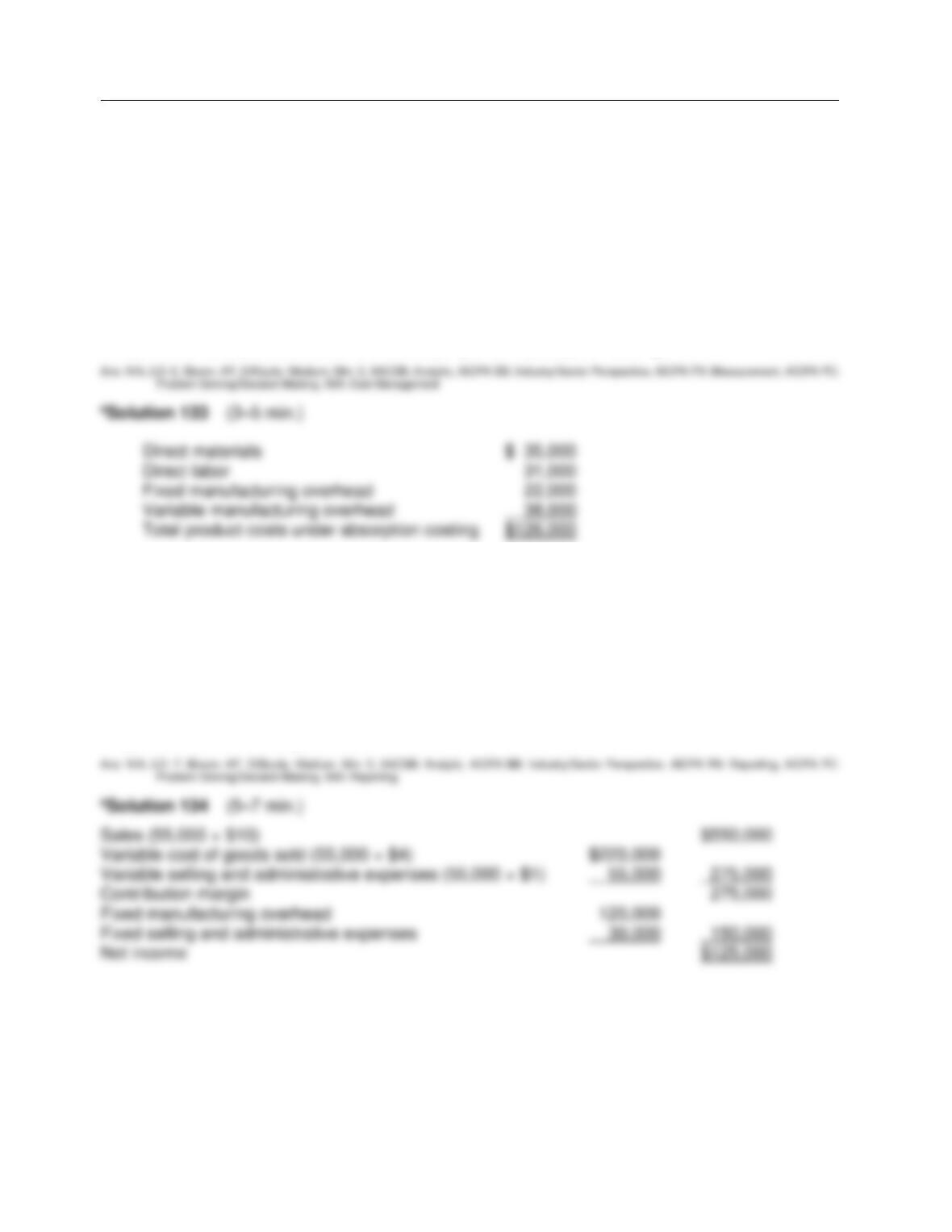
aBE 132
Swift Co. produces footballs. It incurred the following costs this year:
Direct materials $35,000
Direct labor 31,000
Fixed manufacturing overhead 22,000
Variable manufacturing overhead 38,000
Fixed selling and administrative expenses 23,000
Variable selling and administrative expenses 14,000
Instructions
What are the total product costs for the company under variable costing?
Test Bank for Accounting, Tools for Business Decision Making Fifth Edition
FOR INSTRUCTOR USE ONLY
19 – 32
aBE 133
Swift Co. produces footballs. It incurred the following costs this year:
Direct materials $35,000
Direct labor 31,000
Fixed manufacturing overhead 22,000
Variable manufacturing overhead 38,000
Fixed selling and administrative expenses 23,000
Variable selling and administrative expenses 14,000
Instructions
What are the total product costs for the company under absorption costing?
aBE 134
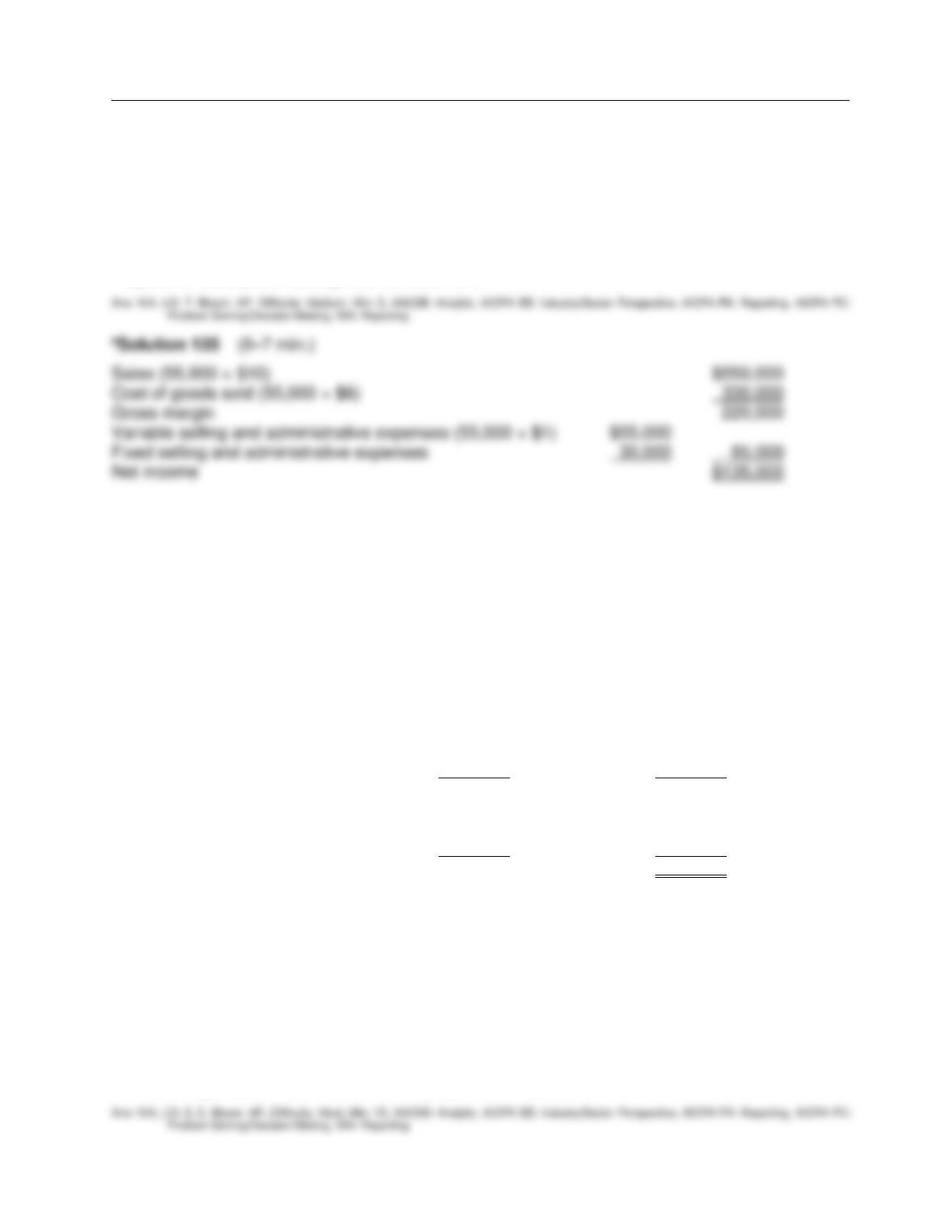
During 2013, Basler Manufacturing produced 60,000 units and sold 55,000 for $10 per unit.
Variable manufacturing costs were $4 per unit. Annual fixed manufacturing overhead was
$120,000 ($2 per unit). Variable selling and administrative costs were $1 per unit sold, and fixed
selling and administrative costs were $30,000.
Instructions
Prepare a variable costing income statement.
Cost-Volume-Profit Analysis: Additional Issues
FOR INSTRUCTOR USE ONLY
19 – 33
aBE 135
During 2013, Basler Manufacturing produced 60,000 units and sold 55,000 for $10 per unit.
Variable manufacturing costs were $4 per unit. Annual fixed manufacturing overhead was
$120,000 ($2 per unit). Variable selling and administrative costs were $1 per unit sold, and fixed
selling and administrative costs were $30,000.
Instructions
Prepare an absorption costing income statement.
EXERCISES
Ex. 136
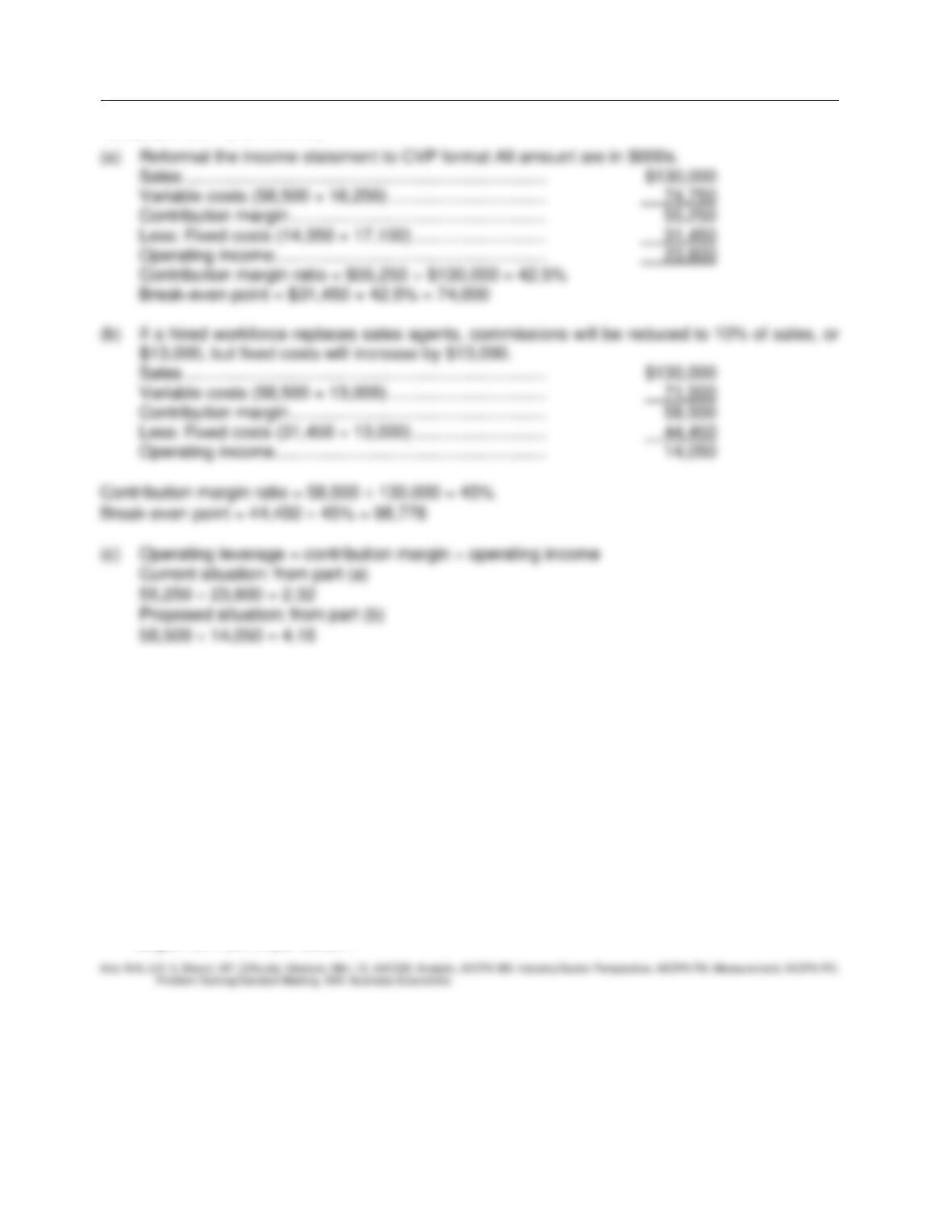
Kindle, Inc. manufactures cosmetic products that are sold through a network of sales agents. The
agents are paid a commission of 12.5% of sales. The income statement for the year ending
December 31, 2013, is as follow.
KINDLE, INC.
Income Statement
Year Ending December 31, 2013
Sales $130,000
Cost of goods sold
Variable $58,500
Fixed 14,350 72,850
Gross margin 57,150
Selling and marketing expenses
Commissions $16,250
Fixed costs 17,100 33,350
Operating income $ 23,800
The company is considering hiring its own sales staff to replace the network of agents. It will pay
its salespeople a commission of 10% and incur additional fixed costs of $13 million.
Instructions
(a) Under the current policy of using a network of sales agents, calculate Kindle, Inc.’s break–
even point in sales dollars for the year 2013.
(b) Calculate the company’s break-even point in sales dollars for the year 2013 if it hires its own
sales force to replace the network of agents.
(c) Calculate the degree of operating leverage at sales of $130 million if (1) Kindle, Inc. uses
sales agents, and (2) Kindle, Inc. employs its own sales staff.
Test Bank for Accounting, Tools for Business Decision Making Fifth Edition
FOR INSTRUCTOR USE ONLY
19 – 34
aSolution 136 (15–18 min.)
Ex. 137
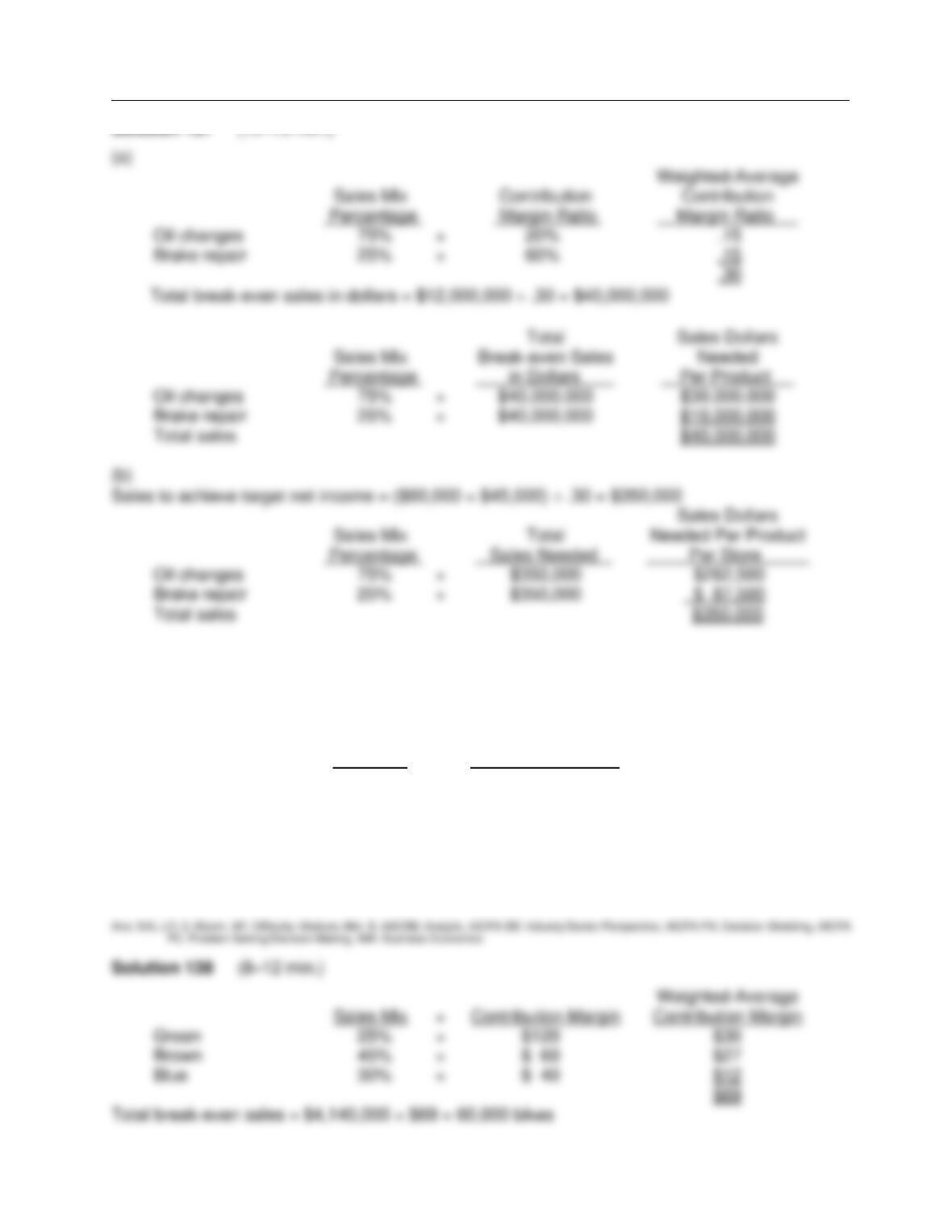
Qwik Service has over 200 auto-maintenance service outlets nationwide. It provides primarily two
lines of service: oil changes and brake repair. Oil change-related services represent 75% of its
sales and provide a contribution margin ratio of 20%. Brake repair represents 25% of its sales
and provides a 60% contribution margin ratio. The company’s fixed costs are $12,000,000 (that
is, $60,000 per service outlet).
Instructions
(a) Calculate the dollar amount of each type of service that the company must provide in order
to break even.
(b) The company has a desired net income of $45,000 per service outlet. What is the dollar
amount of each type of service that must be provided by each service outlet to meet its
target net income per outlet?
Cost-Volume-Profit Analysis: Additional Issues
FOR INSTRUCTOR USE ONLY
19 – 35
Ex. 138
Seaver Corporation manufactures mountain bikes. It has fixed costs of $4,140,000. Seaver’s
sales mix and contribution margin per unit is shown as follows:
Sales Mix Contribution Margin
Green 25% $120
Brown 45% $ 60
Blue 30% $ 40
Instructions
Compute the number of each type of bike that the company would need to sell in order to break
even under this product mix.