Test Bank Questions, Chapter 19
1. Which of the following best describes integration in the context of personal financial
planning?
a. Evaluating costs and benefits over time to find the best path to our goals.
b. Incorporating all members of the household into investment decision making.
c. Thoroughly diversifying investments geographically.
d. Updating the personal financial plan on a periodic basis.
e. None of the above.
2. Which of the following best describes a theory?
a. A detailed mathematical model that has little usefulness when making practical
decisions.
b. A detailed mathematical model that has significant usefulness when making
practical decisions.
c. A set of concepts that unifies a body of knowledge and helps you make better
decisions in practice.
d. An untested idea.
e. None of the above.
3. What is the goal of personal financial planning?
a. To maximize the revenue of household “member–owners” over their life cycle.
b. To minimize the expenses of household “member-owners” over their life cycle.
c. To minimize the degree of risk faced by household “member–owners” over their
life cycle.
d. To provide the highest standard of living possible for household “member–
owners” over their life cycle.
e. All of the above.
4. At equilibrium,
a. The benefits associated with one additional hour of leisure are equal to the costs
in disutility of giving up more than one hour of the leisure.
b. The benefits from revenues through one additional hour of work are equal to the
costs in disutility of giving up one additional hour of leisure time.

c. Additional revenue sources provide leisure benefits.
d. Both a and b.
e. Both b and c.
5. You desire to provide funds to educate your children. Is this a liability?
a. No.
b. Yes.
c. Yes, if there is a legal obligation to do so.
d. No, unless you have already accumulated the necessary funds.
e. None of the above.
6. Total portfolio management’s optimization model has as its payoff the asset-liability
mix providing the highest return possible. This return figure is:
a. The maximum amount that can be outlaid for discretionary items.
b. The minimum amount that can be outlaid for discretionary items.
c. The maximum amount that can be outlaid for nondiscretionary items.
d. The minimum amount that can be outlaid for nondiscretionary items.
e. None of the above.
7. Which of the following is not an advantage associated with a financial plan?
a. It imposes overall structure on the process through specific steps that should be
taken.
b. It compels you to order your priorities and provide a specific financial solution
using integrative techniques.
c. It presents a document to refer back to so that you can compare actual with
projected results and refresh your memory as thoughts of the original steps fade.
d. It provides a numerical base for adjustments as goals and resources change in the
future.
e. All of the above are advantages.
8. Why is there a need for the financial plan to integrate all financial actions?
a. Due to the possibility that the justification for some actions may be forgotten.

b. Due to the limited resources households have.
c. To satisfy certain regulation that financial planners must follow.
d. All of the above.
e. None of the above.
9. By which of the following steps in the financial planning process do we ask “Have
you analyzed all areas that you intended to?”
a. Establishing the scope of the activity.
b. Gathering the data and identifying goals.
c. Compiling and analyzing the data.
d. All of the above.
e. None of the above.
10. By which of the following steps in the financial planning process do we ask “Have
SWOT, sensitivity and scenario analysis been considered?”
a. Establishing the scope of the activity.
b. Gathering the data and identifying goals.
c. Compiling and analyzing the data.
d. All of the above.
e. None of the above.
11. For which of the following operating segments of the financial plan is the cash
relationship characterized as an outflow?
a. Revenues.
b. Living costs.
c. Retirement planning.
d. Both a and b.
e. Both b and c.
12. For which of the following operating segments of the financial plan is the cash
relationship characterized exclusively as an inflow?
a. Revenues.

b. Capital expenditures (nonfinancial investments).
c. Risk management
d. Both a and b.
e. Both b and c.
13. For which of the following operating segments of the financial plan is the function
characterized as “job and investments liquidation upon retirement fund household
activities”?
a. Risk management.
b. Financial investments.
c. Retirement planning.
d. Estate planning.
e. None of the above.
14. What is the household resource problem?
a. What the household should do to generate resources.
b. What the household should do to spend resources.
c. What the household should do with its current and future cash flow.
d. Both a and b.
e. Both b and c.
15. Which of the following segments of the financial plan is both a user and provider of
cash?
a. Financial investments.
b. Debt.
c. Capital expenditures.
d. Both a and b.
e. Both b and c.
16. Which of the following is not a tool that enhances the household’s decision making
function?
a. SWOT analysis.

b. Environmental analysis.
c. Sensitivity analysis.
d. Scenario analysis.
e. All of the above are tools that enhance the household’s decision making function.
17. To what do the letters in the acronym SWOT refer?
a. Strategy, weaknesses, opportunity, threat.
b. Strengths, wants, opportunity, threat.
c. Strengths, weaknesses, opportunities, threats.
d. Strengths, weaknesses, opportunities, timeline.
e. None of the above.
18. SWOT analysis can:
a. Uncover new information.
b. Form a realistic appraisal for the planning future.
c. Lead to changes in projections or practices.
d. All of the above.
e. None of the above.
19. Which area of personal financial planning is affected by the internal environment
variable “obligations in relation to assets and cash flow”?
a. Cash flow.
b. Debt.
c. Tax planning.
d. Risk management.
e. None of the above.
20. Which area of personal financial planning is affected by the external environment
variable “Change in projected inflation rate”?
a. Cash flow.
b. Debt.
c. Tax planning.

d. Risk management.
e. None of the above.
21. Sensitivity analysis:
a. Is sometimes less quantitatively based than SWOT.
b. Is identical to an SWOT analysis.
c. Is identifying those factors that could significantly alter anticipated planning
results.
d. All of the above.
e. None of the above.
22. Which of the following observes the effect of changes in multiple variables or in one
variable that influences many situations?
a. Scenario analysis.
b. Sensitivity analysis.
c. SWOT analysis.
d. All of the above.
e. None of the above.
23. Will a solution that does not give the highest revenues or result in the lowest risk ever
be the preferred course of action?
a. Yes, always.
b. Yes, if it costs significantly less to implement.
c. Yes, if it costs significantly more to implement.
d. Never.
e. None of the above.
24. The financial plan should be written:
a. Before the behavioral review.
b. After the behavioral review.
c. Both before and after the behavioral review.
d. During the beginning of the behavioral review.

e. None of the above.
25. An ideal financial plan should have:
a. A summary at the beginning.
b. A mix of written information, numbers through tables, and figures.
c. A summary at the end.
d. Both a and b.
e. All of the above.
26. For which part of the financial plan is “sets planning focus” a key contribution?
a. Statement of goals.
b. Summary of plan recommendations.
c. Summary.
d. Integration.
e. None of the above.
27. For which part of the financial plan is “special requirements of all types for household
members” a key contribution?
a. Employee benefits.
b. Educational planning.
c. Other planning.
d. Integration.
e. None of the above.
28. Which of the following is not a key to a successful financial plan?
a. A specific statement is made indicating whether the goals are doable and the
current household course is financially consistent with those goals.
b. Steps have been taken to help with any human shortcomings and nonfinancial
goals are given.
c. Before completing the plan, a review process has been undertaken that confirms
that the financial figures and recommendations make sense and are attainable,
given the personalities of the individuals.
d. None of the above are key to a successful financial plan.
e. All of the above are key to a successful financial plan.
29. Reviews of the financial plan should identify:
a. Cyclical differences.
b. Implementation differences.
c. Systematic differences.
d. All of the above.
e. None of the above.
Essay questions:
30. Please list 8 distinguishing features of personal financial planning theory, and
describe the benefit of each.
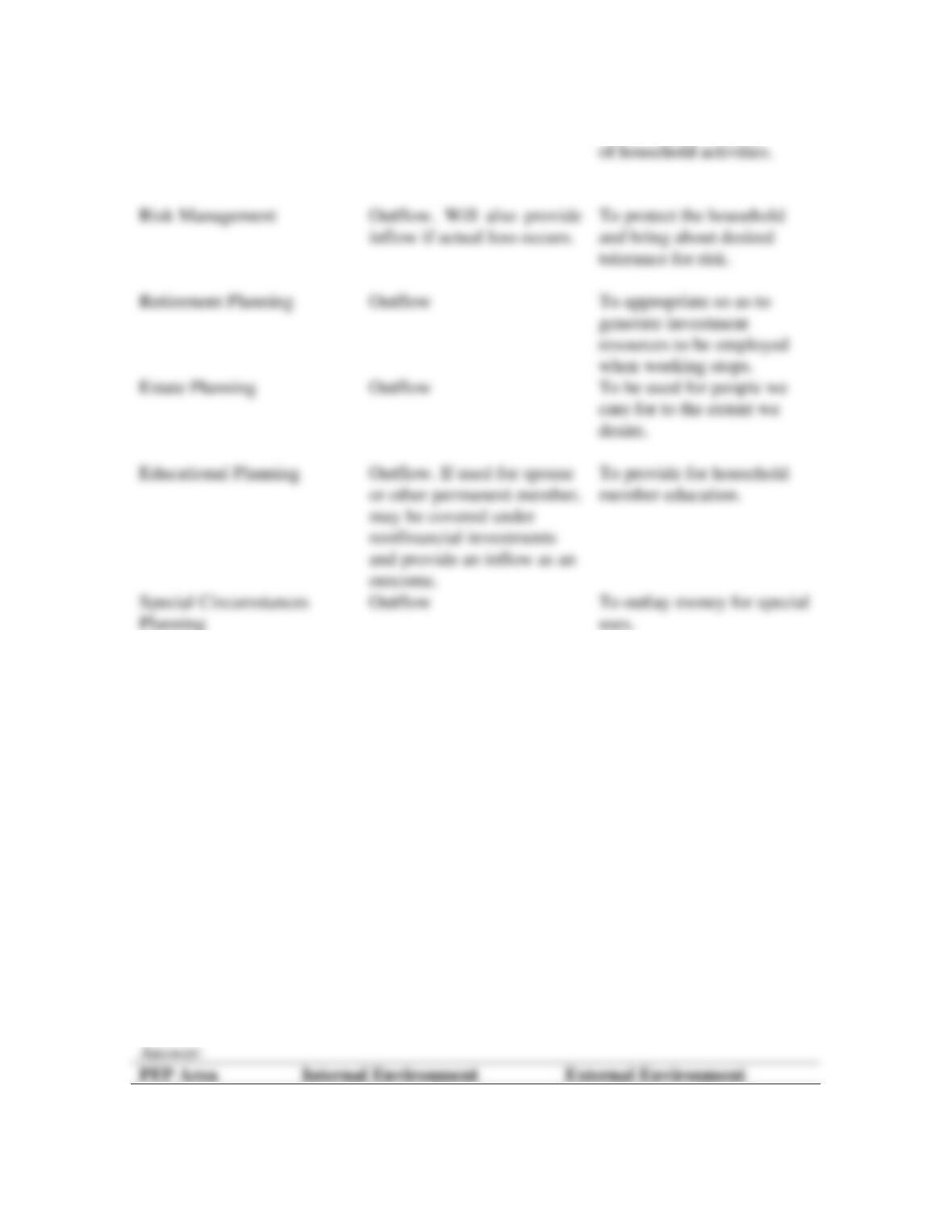
31. For each of the following operating segments of the financial plan, please specify the
cash relationship and the function.
a. Revenues
b. Living Costs
c. Debt
d. Capital Expenditures
e. (Nonfinancial Investments)
f. Financial Investments
g. Risk Management
h. Retirement Planning
i. Estate Planning
j. Educational Planning
k. Special Circumstances Planning
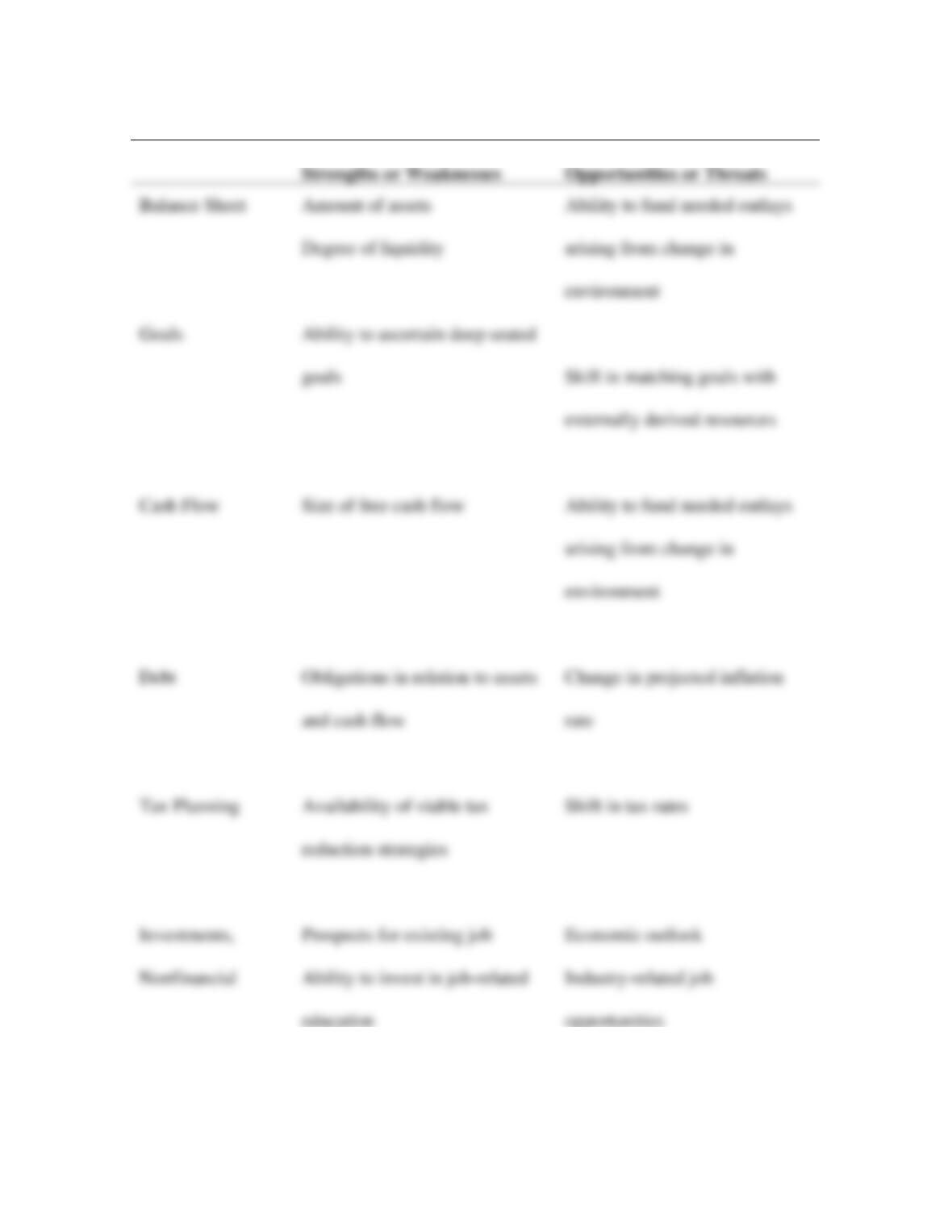
32. For each of the following personal financial planning areas, provide a representative
sampling of internal and external environmental variables that affect the given area of
financial planning.
a. Balance Sheet
b. Goals
c. Cash Flow
d. Debt
e. Tax Planning
f. Investments, Nonfinancial
g. Investments, Financial
h. Risk Management
i. Retirement Planning
j. Educational Planning
k. Employee Benefits
l. Other Planning
m. Estate Planning
=
=