Equity and Hybrid Instruments 19 – 16
40. The conversion premium is defined as which of the following?
a) The number of shares that a convertible security can be exchanged for.
b) The price at which a convertible security can be converted into common shares.
c) The value of a convertible security if it is immediately converted into common shares.
d) The percentage difference between the value at which the bonds are trading and their
conversion value.
41. The price at which a convertible bond would sell for if it could NOT be converted into
common stock is called:
a) floor value.
b) straight bond value.
c) convertible bond value.
d) conversion value.
42. Which of the following statements regarding convertible bonds is true?
a) The floor value is the lowest price a convertible bond will sell for.
b) The convertible bond’s floor value is determined by the maximum of the straight bond value
and the conversion value.
c) If the share price rises above the conversion price, investors will convert the bonds.
d) All of the above statements are true.
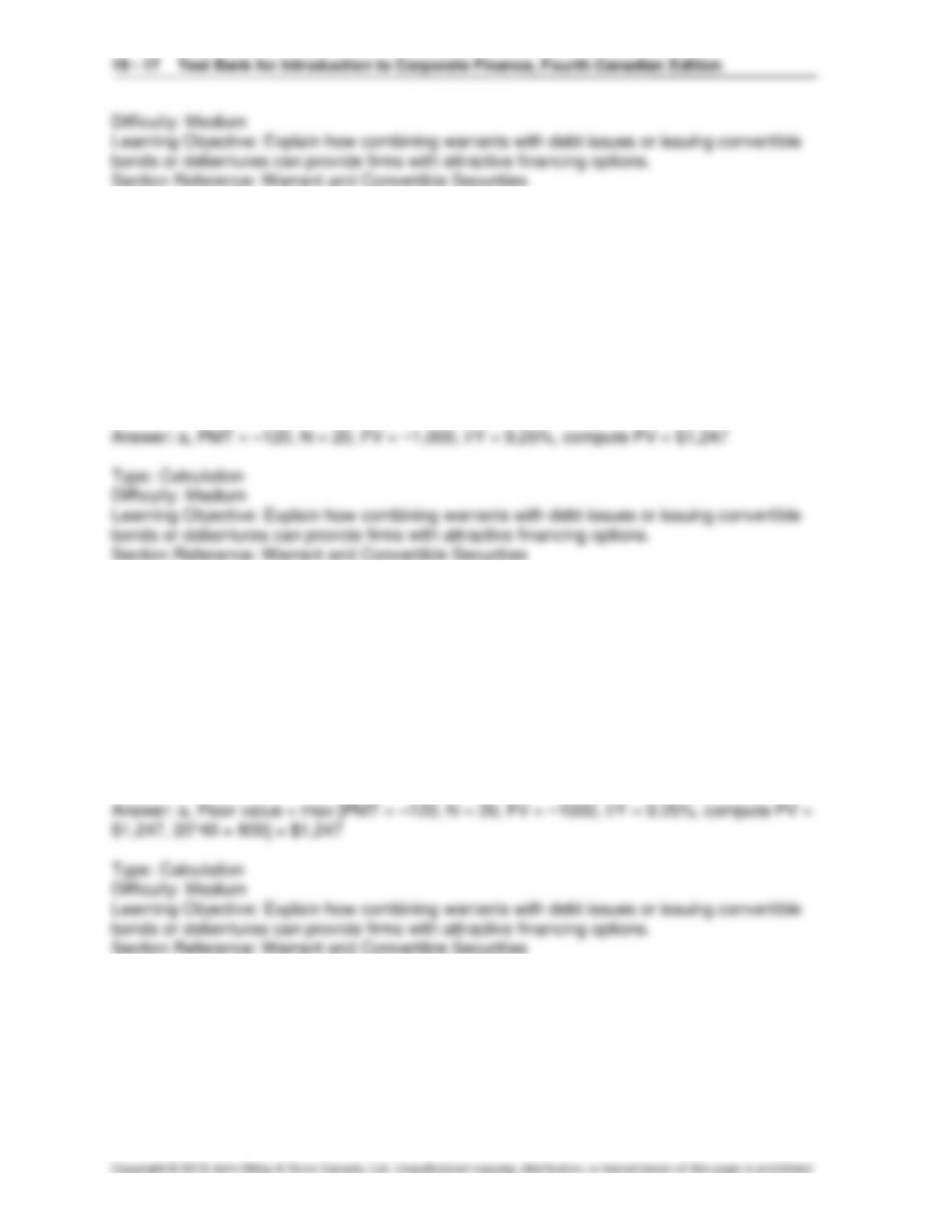
43. A 12% coupon bond has 20 years to maturity when market rates on similar non-convertible
bonds are 9.25%. It is convertible into 20 common shares and has a $1,000 par value. The
shares are currently trading at $40. What is the straight bond value, assuming it pays annual
coupons?
a) $1,247
b) $1,000
c) $1,207
d) $1,287
44. A 12% coupon bond has 20 years to maturity when market rates on similar non-convertible
bonds are 9.25%. It is convertible into 20 common shares and has a $1,000 par value. The
shares are currently trading at $40. What is the floor value of the bond, assuming it pays annual
coupons?
a) $1,247
b) $1,000
c) $800
d) $2,000
45. A 10% semiannual coupon bond has 10 years to maturity when market rates on similar non-
convertible bonds are 8.5%. It is convertible into 40 common shares and has a $1,000 par
value. The shares are currently trading at $30. What is the floor value of the bond, assuming it
pays semi-annual coupons?
a) $2,000
Equity and Hybrid Instruments 19 – 18
b) $1,100
c) $1,200
d) $1,000
46. Which of the following factors are considered when determining whether a security is debt or
equity?
I. Permanence factor
II. Subordination factor
III. Objective factor
IV. Legal factor
V. Subjective factor
a) I and II
b) I, II, and III
c) I, II, and IV
d) I, II, IV, and V
47. If you are to allocate the amount of hard retractable preferred shares in the financial
statements, where would they go?
a) Assets
b) Liabilities
c) Ownership equity
d) None of the above
48. If you are to allocate the amount of soft retractable preferred shares in the financial
statements, where would they go?
a) Assets
b) Liabilities
c) Ownership equity
d) None of the above
49. Which of the following is the hard retraction requirement?
a) The preferred shares must be paid off with common shares or other preferred shares.
b) The preferred shares must be paid off with cash.
c) The preferred shares must be paid off within 30 days of retraction.
d) The preferred shares can only be retracted in cases of financial distress.
50. A LYON is a note that:
a) is convertible.
b) has a zero coupon.
c) both of the above.
51. Which of the following statements regarding income bonds is/are true?
a) They appear similar to debt but are closer to equity.
b) They are generally issued after a reorganization.
c) The interest is tied to some level of the cash flow of the firm.
d) All of the above statements are true.
52. Which of the following is NOT an example of an indexed bond?
a) Commodity bond
b) Real return bond
c) Income bond
d) Callable bond
53. Which of the following securities provides a firm with results similar to those of a real return
bond?
a) Adjustable rate convertible subordinated securities
b) Liquid yield option notes
c) Income bond
d) Original issue discount bond
54. Rank the risk of the following securities from lowest to highest.
19 – 21 Test Bank for Introduction to Corporate Finance, Fourth Canadian Edition
I. Long-term unsecured debt
II. Convertible preferred shares
III. Common equity
IV. Bank loans
a) I, II, III, IV
b) IV, III, II, I
c) I, II, IV, III
d) IV, I, II, III
55. Which of the following statements is correct?
a) Adjustable rate convertible subordinated securities make the interest payments conditional on
prior dividend payments.
b) Income bonds pay out guaranteed and fixed coupons prior to common dividends.
c) Original issue discount bonds (OIDs) sell at a discount when issued by firms.
d) All of the above are correct.
Equity and Hybrid Instruments 19 – 22
PRACTICE PROBLEMS
56. Discuss how preferred shares have features of both debt and equity instruments.
57. What are the costs and benefits of preferred share financing?
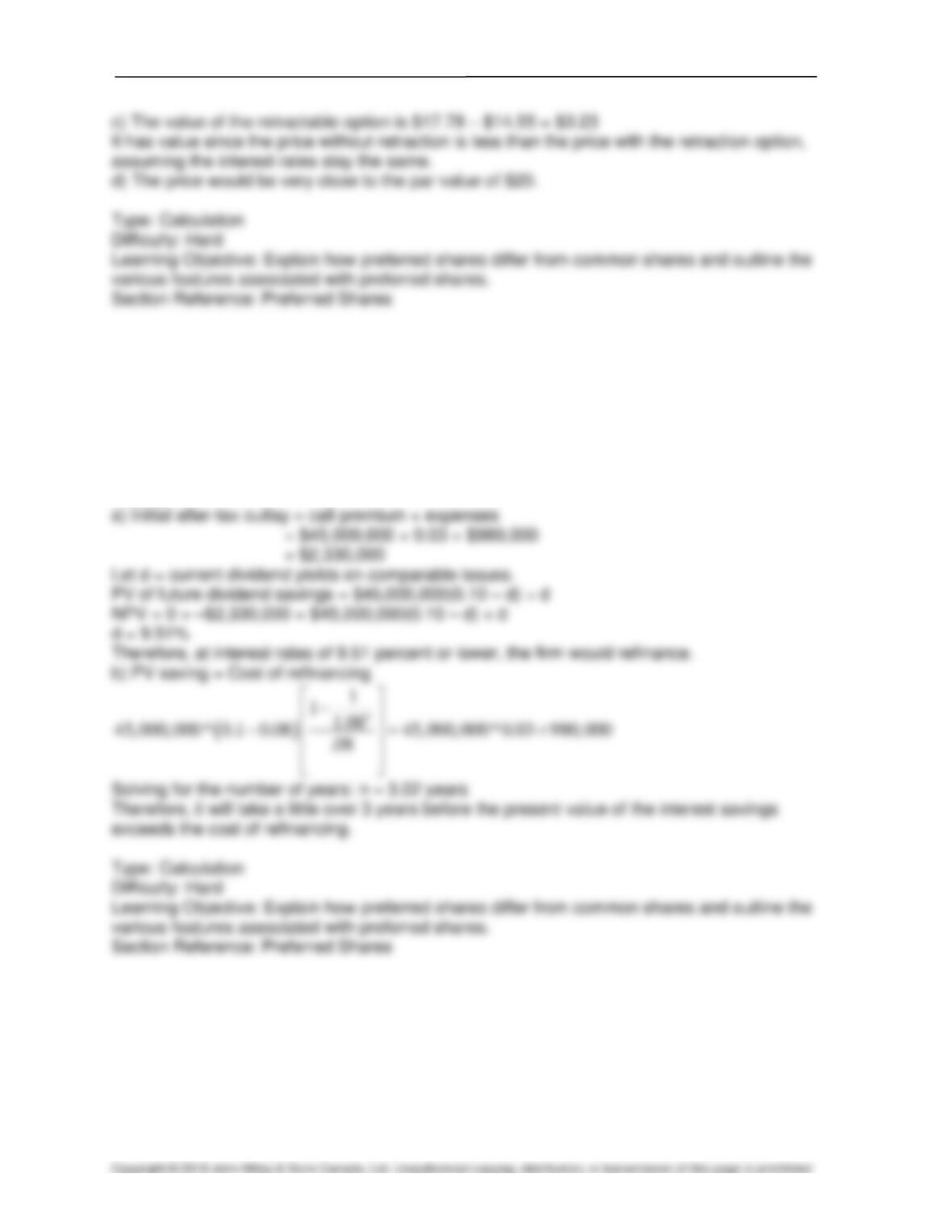
58. Montreal Financing has preferred shares with a par value of $20 outstanding. These shares
pay $1.60 in dividends annually.
a) What will be the market price of these shares if the current market yield is 11 percent?
b) What will be the market price of these shares if the current market yield is 11 percent and the
issue is retractable in five years at the par value?
c) What is the value of this retractable feature? Why does it have value?
d) What will be the market price of these shares if the issue is immediately redeemable and
retractable at par?
Answer:
19 – 23 Test Bank for Introduction to Corporate Finance, Fourth Canadian Edition
59. A firm has $45,000,000 of preferred shares outstanding that have a yield of 10 percent on
par and are callable at a 3 percent premium. New issues will cost $980,000 in issuing and
underwriting expenses.
a) At what interest rates would the firm want to refinance?
b) If the dividend yield drops to 8 percent, how long will it take before the present value of the
interest savings exceeds the cost of refinancing?
Answer:
60. You want to buy a portfolio of financial securities consisting of three, $1,000 face value
Government of Canada bonds and 500 preferred shares of Laurentide Resort Inc.
Laurentide Resort has a preferred share series trading on the Toronto Stock Exchange. It pays
a dividend of $0.56 semi-annually. The required rate of return on the stock is 12 percent
compounded semi-annually. The bonds have 4 years to maturity and an 8 percent semi-annual
coupon. Currently, the yield to maturity on these bonds is 10 percent compounded semi-
Equity and Hybrid Instruments 19 – 24
annually.
a) What is the current intrinsic value of Laurentide Resort’s preferred stock?
b) What is the current price of the 4-year coupon bonds?
c) What is the current value of your portfolio (i.e., bonds + preferred stock)?
d) It is now 2 years later. Market interest rates have dropped and the yield to maturity on these
bonds is now 8 percent. What is the value of the bonds at this time?
e) It is still 2 years later and the yield to maturity has dropped to 8%. Assume that the price of
Laurentide Resort Inc. is now $8.50. What is the expected annual rate of return on your portfolio
over the two years from your investment?
Answer:
61. Explain the importance of warrants in financing for firms.
62. Why is there a difference between the way the market classifies debt and the way the CRA
classifies it.
63. Describe convertible debt.
64. Explain the difference between the conversion price and the conversion ratio.
65. Explain how the value of convertible debt varies as a function of the common share price.
66. Give four reasons why companies use convertibles to raise capital instead of straight debt.
Answer:
67. Explain how equity can be viewed as a call option on the firm.
68. Explain how a warrant is viewed as a call option on the firm.
69. Explain an important implication of viewing a company’s common shares as a call option.
70. Explain the differences and similarities between warrants and convertibles.
Answer:
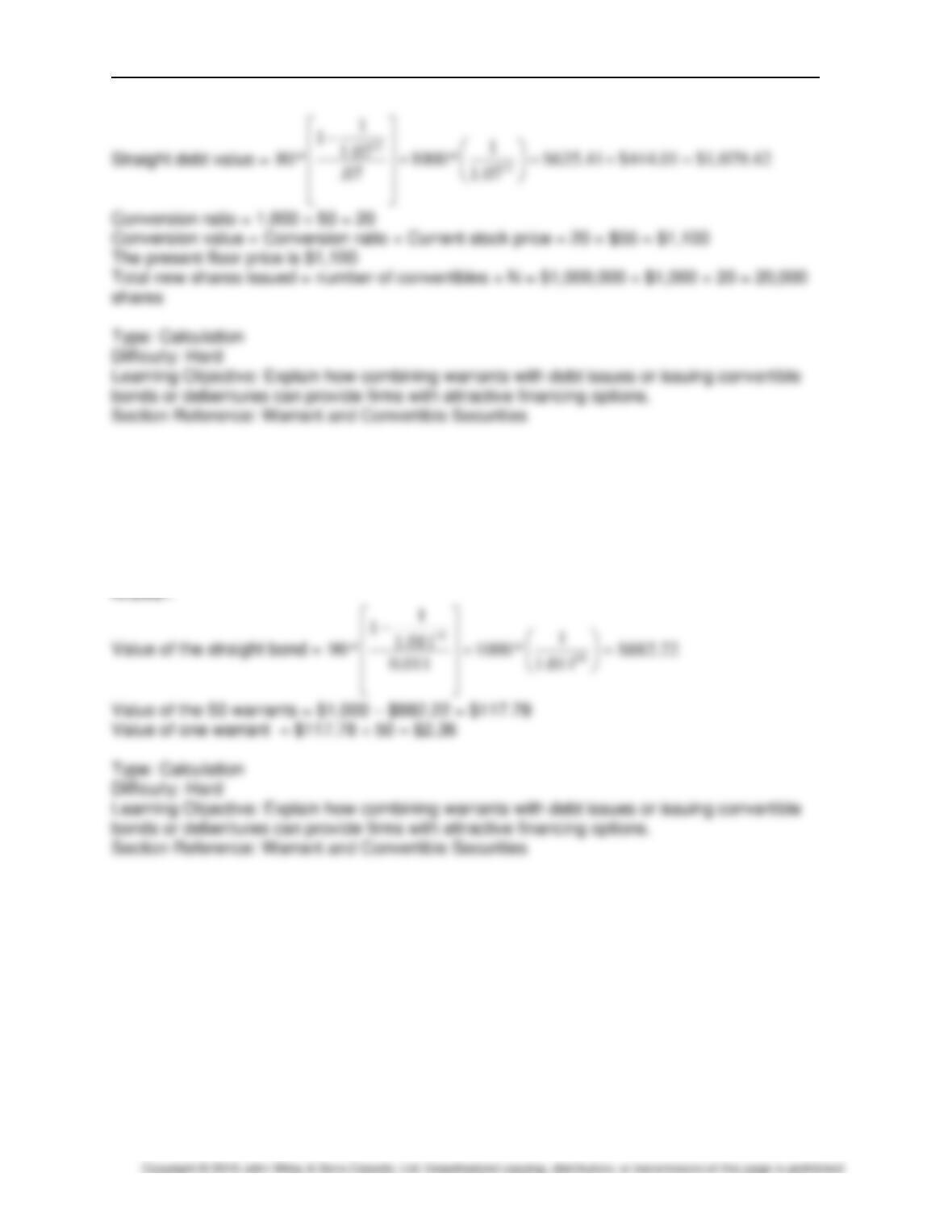
71. Toronto Skaters currently has $1,000,000 of 8 percent convertible debt outstanding. The
coupon interest is paid on an annual basis. The $1,000 face value debentures mature in 12
years and have a conversion price of $50. Similar straight debt currently yields 7 percent. The
firm’s common stock is currently trading for $55 per share. What is the current straight debt
value and the current conversion value of the convertibles? What is the floor price for the
convertibles? If all the convertible holders decided to convert, how many additional shares
would have to be issued?
Answer:
Equity and Hybrid Instruments 19 – 28
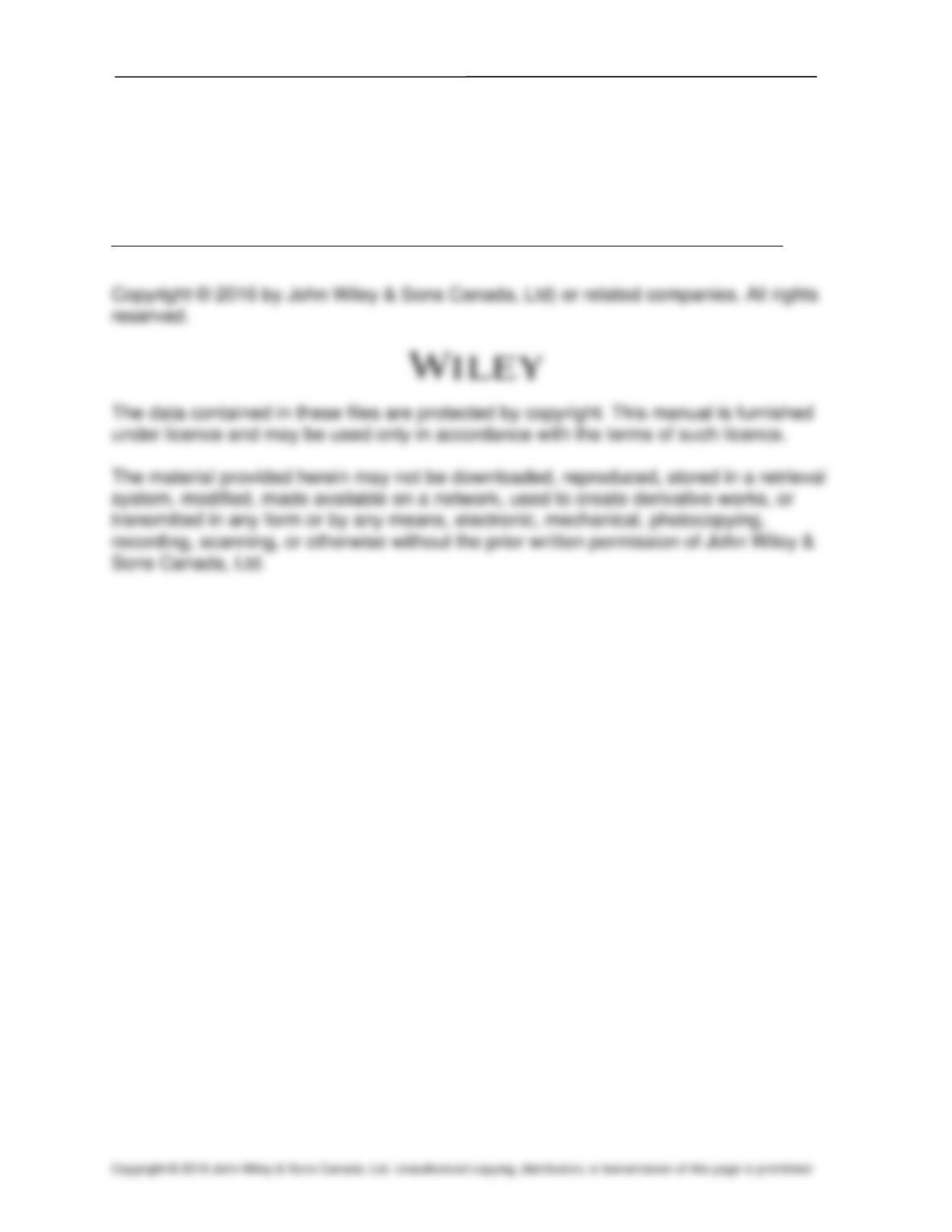
72. Hudson Bay Fishing Corporation has just issued a 10-year, 9 percent annual-pay bond with
a $1,000 face value. In addition, the bond was issued with 50 detachable warrants. The bond
was issued at par. Each warrant gives the owner the right to purchase 2 shares of the
company’s stock for $15 each. Bonds with equivalent risk but with no attached warrants
currently yield 11 percent. What is the value of one warrant?
19 – 29 Test Bank for Introduction to Corporate Finance, Fourth Canadian Edition
LEGAL NOTICE