
Test Bank Questions, Chapter 18
1. Why is knowledge of actual human behavior arguably more important for Personal
Financial Planning (PFP) than for any other area of finance?
a. Due to PFP’s closeness to human actions
b. Due to PFP’s emphasis on practicality
c. Due to the irrational nature of most personal finance decisions
d. Both a and b
e. Both b and c
2. Which of the following is a component of behavioral financial planning operations?
a. Estate planning
b. Traditional money planning and making more efficient financial decisions
c. Life planning
d. Both a and b
e. Both b and c
3. Behavioral economics and behavioral finance:
a. Consider the “ideal” person
b. Consider the “irrational” person
c. Examine people as they actually are
d. Both a and b
e. None of the above
4. What is the goal of an assessment of behavioral financial planning?
a. To understand and evaluate the contribution of behavioral analysis to PFP
b. To maximize revenue
c. To maximize profits
d. Both a and b
e. None of the above
5. Which of the following is not an assumption of traditional finance?

a. You are assumed to act logically all the time in seeking to maximize your
pleasure
b. You have perfect knowledge of all the information you need to make proper
decisions
c. You have full capability for recalling past experiences accurately
d. You also have the intellectual capacity to make the right decisions at all times
e. All of the above are assumptions of traditional finance
6. Which of the following best defines behavioral finance?
a. The study of human makeup and actions that explain logical economic and
financial behavior
b. The study of human makeup and actions that result in deviations from logical
economic and financial behavior
c. The study of market actions that explain logical economic and financial behavior
d. Both b and c
e. None of the above
7. Which of the following is not a criticism of behavioral finance?
a. It has no scientific underpinning
b. Its generalizations come from laboratory experiments and questionnaires
c. Its generalizations come from how people act in real life
d. All of the above are criticisms
e. None of the above is a criticism
8. Which of the following best defines behavioral financial planning?
a. The analysis of individual conduct and the development of practical techniques
to improve decision making
b. The analysis of individual conduct and the development of practical techniques
to eliminate decision making
c. The analysis of market conduct and the development of practical techniques to
improve decision making
d. The analysis of market conduct and the development of practical techniques to
eliminate decision making
e. None of the above

9. What is the mandate of behavioral financial planning?
a. To eliminate any behavior that is not result in revenue generation
b. To eliminate any behavior that is increases the risk to the revenue source
c. To focus on any behavior that provides a shortfall from ideal results and can be
improved upon
d. Both a and b
e. Both b and c
10. Which of the following is not a source of cognitive errors?
a. Lack of knowledge
b. Hubris
c. Weakness in perception and memory
d. Limited processing scope and speed
e. All of the above are sources of cognitive errors
11. Which of the following is an example of a visceral feeling?
a. Rage
b. Hunger
c. Fear
d. Pressure
e. All of the above
12. What are heuristics?
a. Simplified human approaches to complex tasks
b. Actions based on a flawed view of reality
c. A category of mnemonics
d. Difficult to understand contract details that clients often overlook.
e. None of the above

13. Which of the following best describes the heuristic of anchoring?
a. Judgments made on the basis of only one or two characteristics instead of
embarking on a detailed analysis
b. How you communicate a thought can affect the response
c. Using an outmoded or inappropriate standard can result in making incorrect
decisions when the standard is no longer appropriate
d. Placing too much weight on recent vivid experiences
e. None of the above
14. What is satisficing?
a. A method by which individuals seek satisfactory solution only if it is optimal as
well
b. A method by which individuals seek a satisfactory solution, not an optimal one
c. A heuristic that leads individuals to sacrifice satisfying solutions in order to
search for optimal solutions
d. Both a and b
e. Both b and c
15. Which of the following is not a way through which to overcome behavioral
shortcomings?
a. Restricting negative behavioral responses
b. Formal financial learning
c. Experience
d. Self-understanding
e. All of the above are ways to overcome behavioral shortcomings
16. “Leavings credit cards at home to reduce impulse buying” is an example of which of
the following control methods?
a. Thinking about nonessential purchases overnight
b. Restricting choices
c. Reducing proximity
d. Practicing mental accounting
e. None of the above

17. Which of the following best explains why life planning belongs under our definition
of behavioral finance?
a. It deals with human actions that deviate from the financial goal of making as
much money as possible
b. It deals with human actions that do not deviate from the financial goal of making
as much money as possible
c. Because behavior is strongly influenced by life experience
d. Both a and c
e. Both b and c
18. According to an academic study by Bruno S. Frey and Alois Stutzer, life satisfaction
has:
a. Increased dramatically between 1958 and 1991
b. Remained approximately level between 1958 and 1991
c. Decreased dramatically between 1958 and 1991
d. Increased dramatically between 1958 and 1974, and then decreased dramatically
e. Decreased dramatically between 1958 and 1974, and then increased dramatically
19. Which of the following statements is inaccurate?
a. Life goals are based on basic emotions and higher level feelings
b. Life goals extend beyond traditional finance
c. Life goals do not have a financial component
d. All of the above statements are accurate
e. All of the above statements are inaccurate
20. Which of the following is a higher-level feeling?
a. Good health.
b. Security
c. Comfort
d. All of the above
e. None of the above.

21. Which of the following is a basic feeling?
a. Close relationships
b. Caring relationships
c. Good health
d. All of the above
e. None of the above
22. Which of the following is not a common nonfinancial need of people that financial
planners can help with?
a. To find an interested person
b. To understand
c. To reward
d. To feel secure
e. To help establish goals
23. When a client feels understood by the financial planner,
a. The client is more receptive to a recommendation
b. The client is more understanding of the cost of the session
c. The client will be patient during periods of poor performance
d. All of the above
e. None of the above
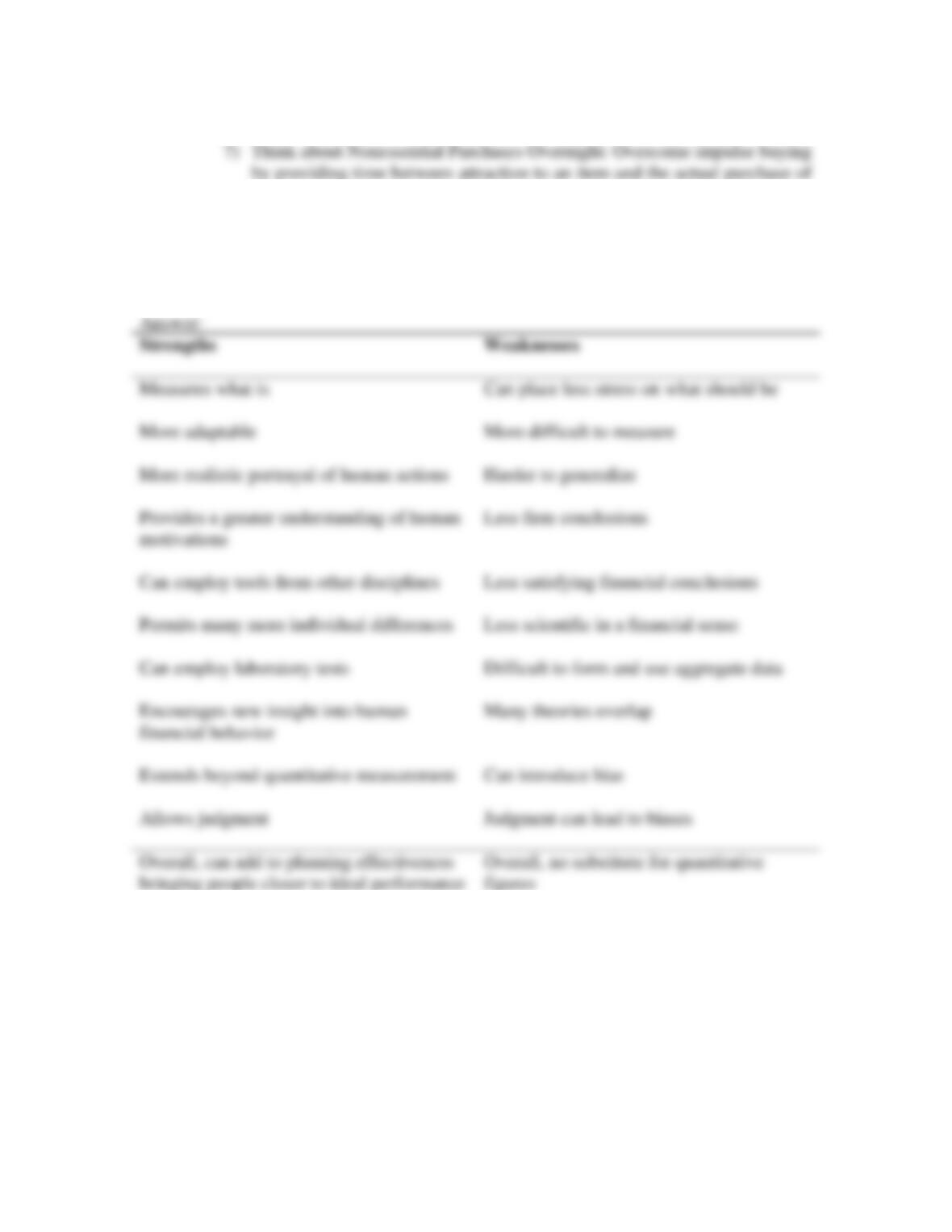
24. A weakness of behavioral finance relative to classical finance is that it is
characterized by:
a. Less firm conclusions
b. Less satisfying financial conclusions
c. Being less scientific in a financial sense
d. Both a and b
e. All of the above.

25. Which of the following best defines life planning?
a. A planning process that deals with the personal side of financial markets and
goes beyond money planning for analysis and scheduling of steps for realization
of personal goals
b. A planning process that deals with the personal side of the household enterprise
and is limited to money planning
c. A planning process that deals with the personal side of financial markets and is
limited to money planning
d. A planning process that deals with the personal side of the household enterprise
and goes beyond money planning for analysis and scheduling of steps for
realization of personal goals
e. None of the above
26. Which of the following best defines money planning?
a. Planning whose goals are financial
b. Planning whose goals include life planning objectives
c. Planning whose goals are strictly financial and do not include life planning
objectives
d. None of the above
e. Both a and b
27. Which of the following best defines visceral feelings?
a. Human shortcomings that come from impulses to take action that are often short–
term in nature and can cloud judgments
b. Instinctive human behaviors that come from impulses to take action that are
often short-term in nature and can improve judgments
c. Human shortcomings that come from impulses to take action that are often long-
term in nature and can cloud judgments
d. Instinctive human behaviors that come from impulses to take action that are
often long-term in nature and can improve judgments
e. None of the above
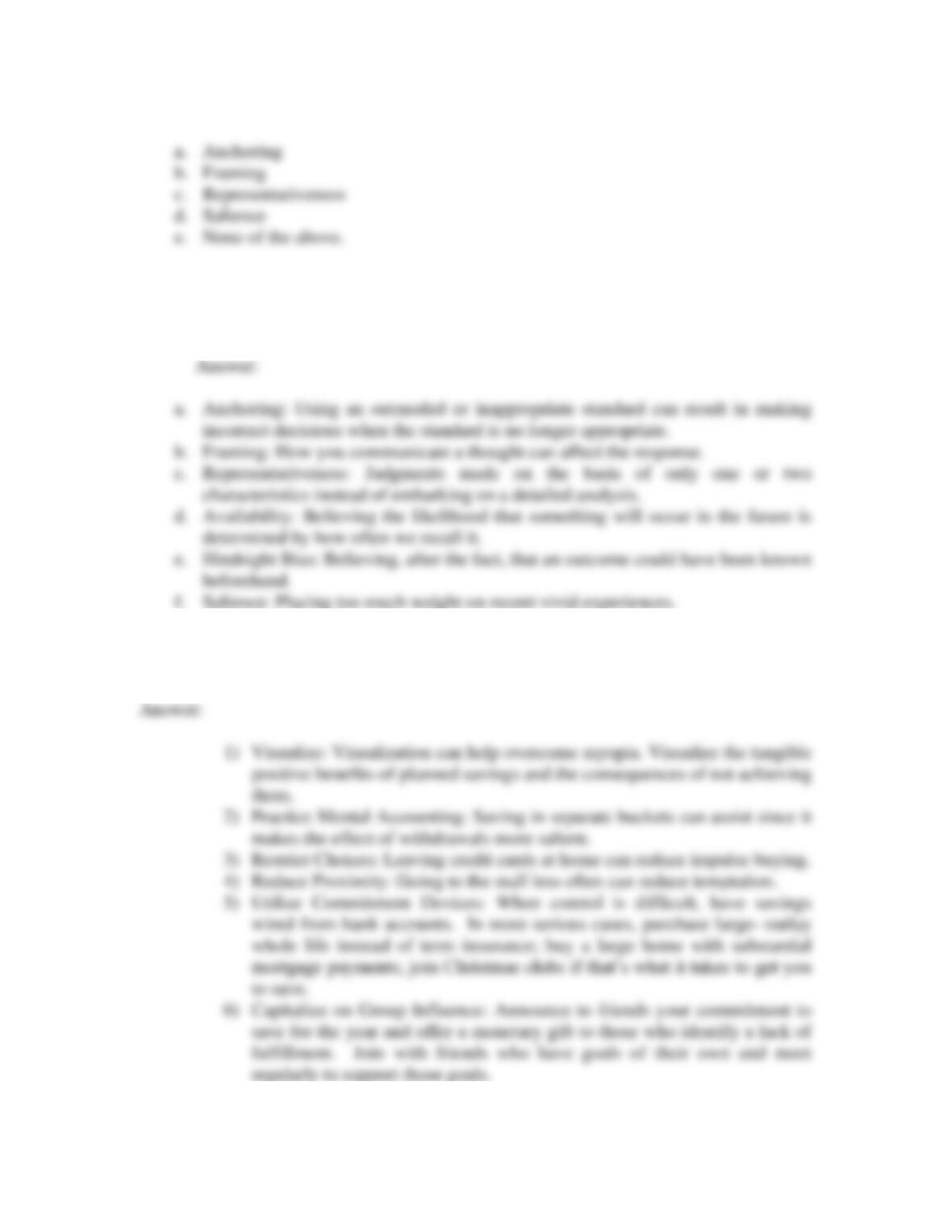
28. Which of the following heuristics are judgments made on the basis of only one or two
characteristics instead of embarking on a detailed analysis?
Essay questions:
29. Please list and describe six common heuristics.
30. Please list and discuss seven methods that are helpful for maintaining control to
achieve planned savings.
it.
31. What are the strengths and weaknesses of behavioral finance relative when compared
to classical finance?