Debt Instruments 18 – 12
30. Which of the following securities is secured by assets?
a) ABCP
b) A fixed interest rate loan
c) A debenture
d) All of the above
31. Junk bonds are:
a) speculative bonds with ratings below investment grade
b) subordinated debentures
c) a nickname for bonds traded in the Hong Kong market
d) corporate bonds of bankrupt companies
32. When specific assets such as land, plant, or equipment are pledged as collateral, what is
the term for the debt issue?
a) Debenture
b) Mortgage bond
c) Bond
d) Unsecured debt
33. Choose the best statement:
a) Mortgage bonds and debentures do not differ because they are both debt.
b) In the event of bankruptcy, debenture holders get paid after the claims of preferred
shareholders.
c) Mortgages are secured by claims on specific real assets while debentures are not.
d) Debentures are secured by claims on specific real assets while mortgages are not.
34. North American Bat Experts Company (NABE) has just sold a batting machine to a
Jamaican cricket team. The team will pay for the machine by borrowing the money from NABE
and securing the loan using the machine. This type of debt is called:
a) debenture
b) acceptance
c) purchase-money mortgage
d) line of credit
35. Private financing is advantageous because:
a) there are more restrictive covenants.
b) it is filed with the provincial securities commissions.
c) the firm is required to provide a detailed prospectus.
d) none of the above
36. Rank the following in order of priority in the event of bankruptcy:
I. Subordinated, secured debt
II. Subordinated, unsecured debt
III. Unsubordinated, secured debt
IV. Unsubordinated, unsecured debt
a) III, I, IV, II
b) IV, I, III, II
c) III, IV, I, II
d) IV, II, III, I
37. The Toronto Skaters Company currently has one issue of debt outstanding. Toronto Skaters
has decided to borrow more money by issuing new debt with a higher priority in the event of
bankruptcy. This could result in a violation of which type of covenant on the original debt?
a) Standard negative pledge
b) Cross-default clause
c) The new issue will not violate any covenant as there are never covenants when a firm has
only one issue of debt
d) This type of transaction is illegal
38. Evaluate the following statement:
Private debt financing is generally cheaper than public financing.
a) True
b) False
c) Need additional information
18 – 15 Test Bank for Introduction to Corporate Finance, Fourth Canadian Edition
39. Investment-grade debt rating refers to which of the following?
a) The issuer is less likely to meet debt payment opbligations.
b) The issuer is more likely to increase dividend payments.
c) The issuer is likely to meet debt payment obligations.
d) None of the above.
40. A junk bond is also known as:
a) a second mortgage
b) a high yield bond
c) a line of credit
d) a subordinated unsecured bond
41. Use the following statements to answer this question:
I. The debt rating is supposed to fluctuate with the economic cycle.
II. Balance sheet strength refers to the ability of the firm to cover its liabilities.
a) I and II are correct.
b) I and II are incorrect.
c) I is incorrect and II is correct.
d) I is correct and II is incorrect.
42. A bond referred to as a “high yield bond” is most likely:
a) of the highest credit quality
b) of investment grade
c) of satisfactory credit quality
d) of speculative grade
43. Is it possible for a company to have two debt issues with different debt ratings?
a) No, the rating agency evaluates the creditworthiness of the company.
b) Yes, but only if the company is a multinational and the debt has been issued in different
countries.
c) No, the company’s credit is the same for all bonds.
d) Yes, the rating agency evaluates the creditworthiness of the issue, not the company.
44. In determining its rating, DBRS looks at which of the following factors?
a) Core profitability
b) Balance sheet strength
c) Business strength
d) Strategy and management strength
e) All of the above
18 – 17 Test Bank for Introduction to Corporate Finance, Fourth Canadian Edition
Debt Instruments 18 – 18
PRACTICE PROBLEMS
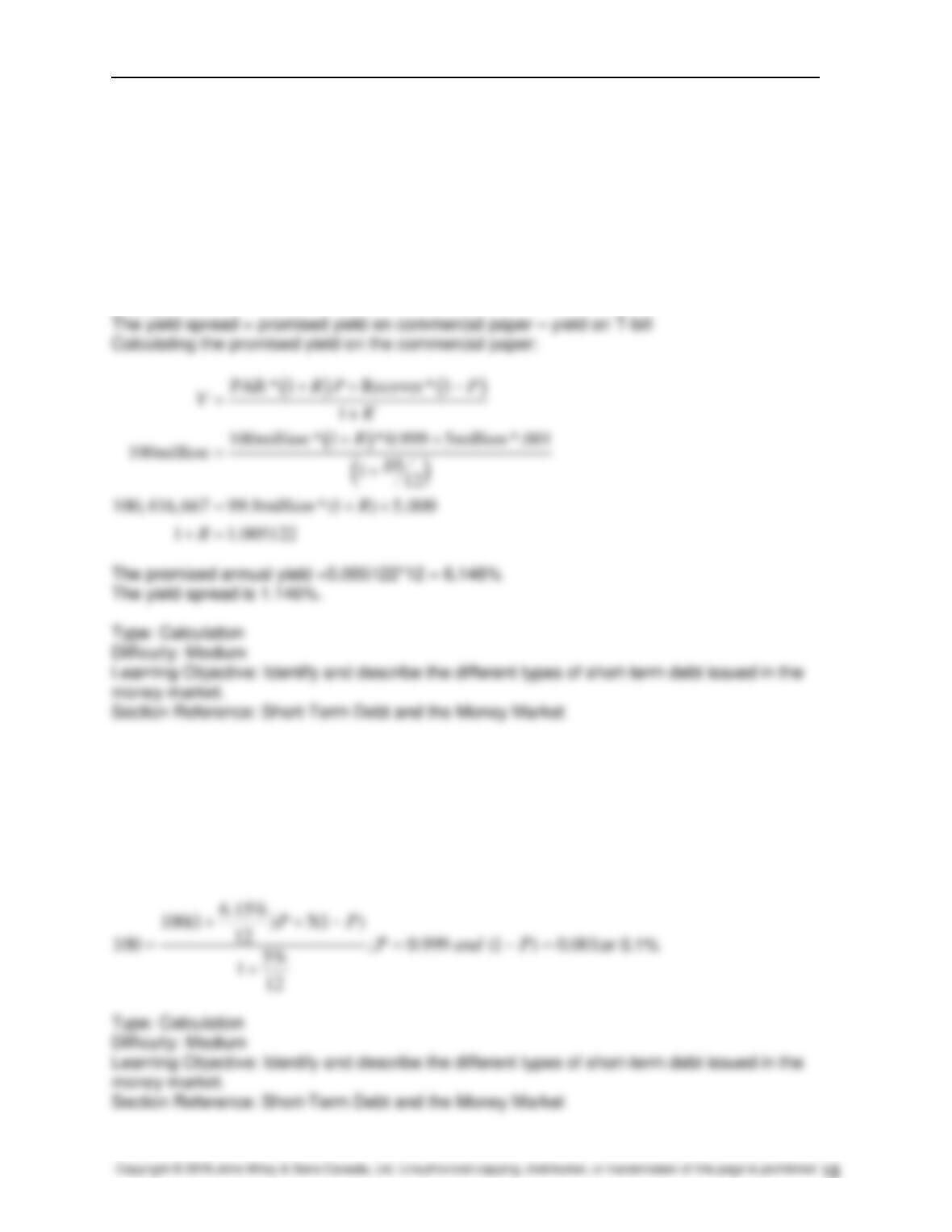
45. The 30-day T-bill rate is 5%. SWC Company has just issued $100 million of commercial
paper at par. There is a 0.1% chance the company will default on the issue. If the firm defaults,
the commercial paper will be worth $5 million. Determine the yield spread between the T-bill
rate and commercial paper assuming that the required return by investors in commercial paper
is equal to the T-bill rate.
Answer:
46. The 30-day T-bill rate is 5 percent. Toronto Skaters has just issued $100 million of
commercial paper at par. If the firm defaults, the commercial paper will be worth $5 million. The
promised annual yield is 6.15 percent and the required rate of return is equivalent to the T-bill
rate. What is the probability of default of Toronto Skaters?
Answer:
47. Laurentide Resort Company would like to issue $100 million of commercial paper. Define
liquidity support and describe why it would be important to investors.
Answer:
48. The Globe Theatre Company is negotiating a line of credit with a large bank. The bank is
willing to provide credit up to the minimum of 65% of the value of receivables or 70% of the
inventory value. If the firm currently has receivables valued at $50 million and inventory valued
at $60 million, what is the maximum credit limit available to this firm?
Answer:
49. You have observed that the credit ratings of firms are very stable over time. However, you
have also observed that the earnings of firms are cyclical. Explain how this is possible when
credit ratings are supposed to reflect the credit risk of the firm’s debt.
Answer:
50. Explain the implication of the failure of Lehman Brothers on short-term debt yields, and how
it was remedied.
51. Indicate important sources of finance available to corporations in the money market.
52. When Collingwood Corp. issued its 60-day commercial paper the promised yield was 9
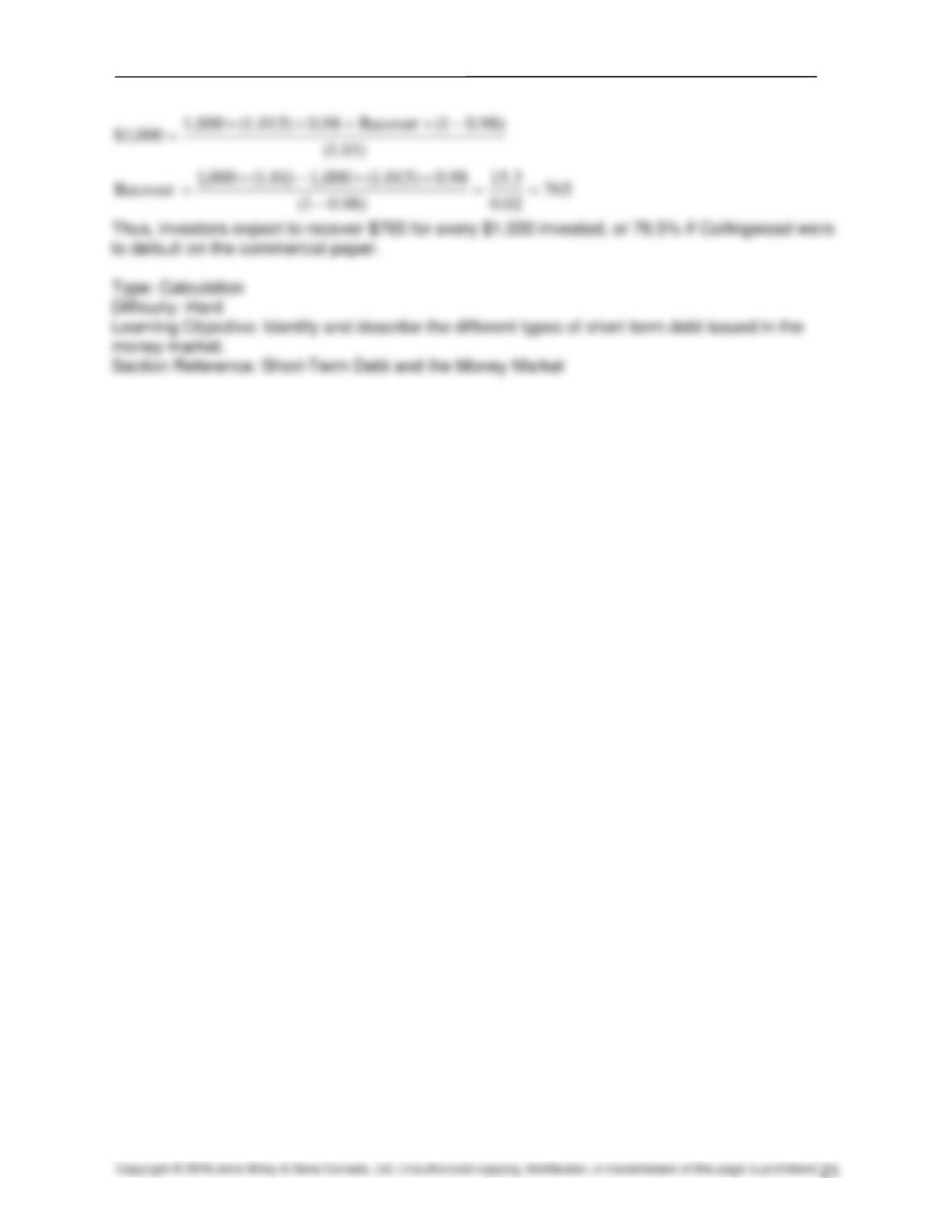
percent, whereas the 60-day T-bill yield was 6 percent. There is a 2 percent chance that
Collingwood will default on this debt. If investors were willing to pay the full par value amount
($1,000) to purchase the paper, how much do they expect to recover in the event of a default?
18 – 21 Test Bank for Introduction to Corporate Finance, Fourth Canadian Edition
Debt Instruments 18 – 22
LEGAL NOTICE