
Part 7 Long-Term Financing
CHAPTER 18
DEBT INSTRUMENTS
CHAPTER LEARNING OBJECTIVES
18.1 Define “debt” and identify the basic features that distinguish debt from
18.2 Identify and describe the different types of short-term debt issued in the
18.3 Describe the types of debt financing provided by banks.
18.4 Identify the requirements that must typically be satisfied for public debt
18.5 Explain how debt ratings are determined, what they mean, and how useful
they are in predicting default and recovery rates associated with public debt
issues.
Debt Instruments 18 – 2
MULTIPLE CHOICE QUESTIONS
1. Which of the following has the characteristics of a fixed contractual commitment?
a) Long-term debt
b) Common stock dividends
c) Preferred stock
d) Retained earnings
2. The Canada Revenue Agency uses which of the following tests to make sure that the interest
on debt is tax deductible?
a) Interest is compensation for the use or retention of money owed to another.
b) Interest must be referable to a principal sum.
c) Interest accrues from day to day.
d) All of the above
3. Which of the following represents tax-deductible expenses?
I. Rental on office building
II. Interest expense
III. Preferred stock dividends
IV. Common stock dividends
a) I and II
b) I, II, and III
c) III only
d) III and IV
4. Toronto Skaters has issued $100 million in bonds paying 6% interest per year. The firm has a
tax rate of 45%. The firm’s annual interest payments are ______ and the after-tax cost of the
debt is ______ per year.
a) $6 million, $6 million
b) $6 million, $2.7 million
c) $6 million, $3.3 million
d) $3.3 million, $2.7 million
5. Montreal Snowmobiles has issued bonds at par that are paying 10% interest per year. The
firm has a tax rate of 40%. What is the firm after-tax cost of debt?
a) 10%
b) 6%
c) 14%
d) 7%
6. Laurentide Ski Resort has to make a choice between two different debt issues. Issue 1 has
an interest rate of 5% and the interest is tax deductible. Issue 2 has an interest rate of 4% but
the interest is not tax deductible. If the firm has a tax rate of 40%, which issue is preferred and
why?
a) Issue 2 because the interest rate of 4% is less than the 5% of issue 1.
b) Issue 1 because the after-tax cost is 3% while the after-tax cost of issue 2 is 4%
c) Issue 1 because the after-tax cost is 2% while the after-tax cost of issue 2 is 4%
d) Issue 2 because the after-tax cost is 1.6% while the after-tax cost of Issue 1 is 2%
Debt Instruments 18 – 4
7. Use the following statements to answer this question:
I. Tax deductibility of dividends makes equity very desirable.
II. An instrument can be classified as debt even if it is not so in the Income Tax Act.
a) I and II are correct.
b) I and II are incorrect.
c) I is incorrect and II is correct.
d) I is correct and II is incorrect.
8. Generally, any debt instrument with a maturity of less than one year is called a ______, from
one to seven years is called a ______, and more than seven years is called a ______.
a) bond, bill, note
b) bill, bond, note
c) note, bill, bond
d) bill, note, bond
9. Which of the following is characterized as unsecured money market instrument?
a) Treasury bill
b) Debentures
c) Commercial paper
d) All of the above
e) a and c
18 – 5 Test Bank for Introduction to Corporate Finance, Fourth Canadian Edition
10. A treasury bill (T-bill) is a ______ issued by ______.
a) short-term promissory note, high quality Canadian firms
b) bond, high quality Canadian firms
c) short-term promissory note, a government treasury department
d) bond, the government of Canada
11. T-bill yields are quoted on a(n) ______ basis.
a) compound interest
b) after-tax
c) discount
d) none of the above
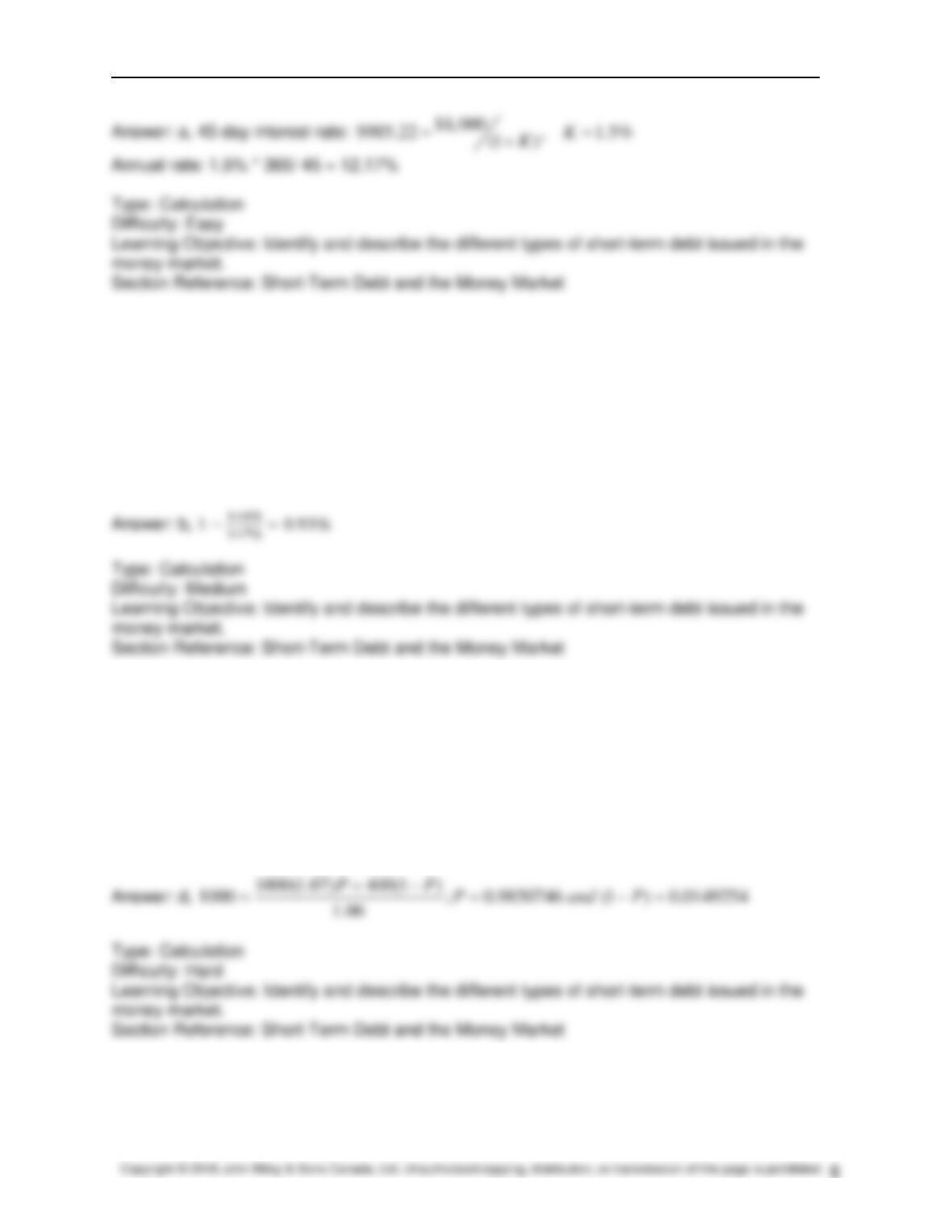
12. A Government of Canada T-bill with a face value of $1,000 and 45 days to maturity is
trading for $985.22. The 45-day interest rate is ______ and the annual rate is ______.
a) 1.5%, 12.17%
b) 12.17%, 1.5%
c) 1.5%, 12.84%
d) 12.84%, 1.5%
Debt Instruments 18 – 6
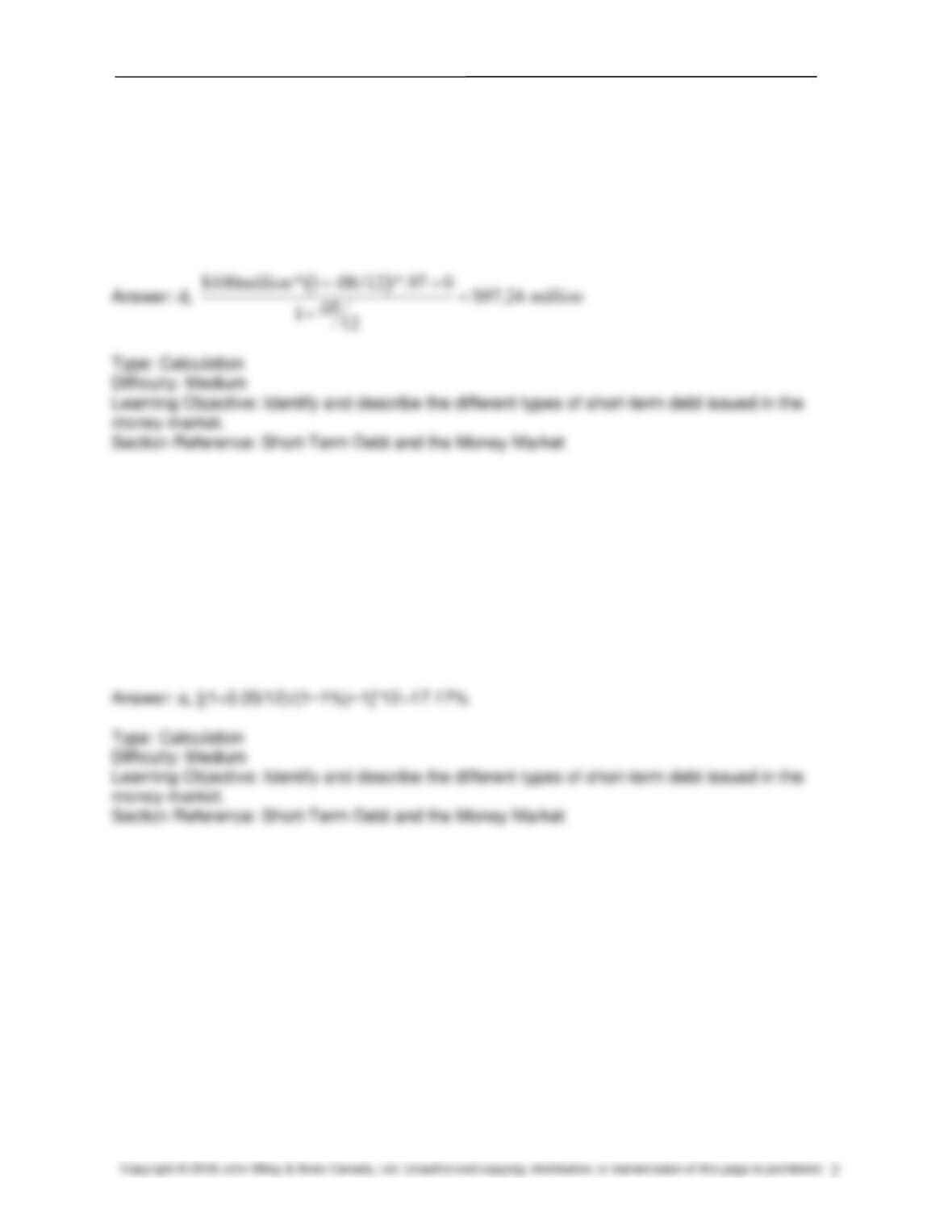
13. Laurentide Resorts is issuing commercial paper with 60 days to maturity. In case of default,
the investor will lose the total amount. The quoted rate for the issue is 7 percent, and an
equivalent government-backed security’s rate is 6 percent. What is the probability of default?
a) 0%
b) 0.93%
c) 1%
d) 99.06%
14. Laurentide Resorts is issuing commercial paper with 60 days to maturity. In case of default,
the investor will receive 40 cents on the dollar. The quoted rate for the issue is 7 percent, and
an equivalent government-backed security’s rate is 6 percent. What is the probability of default?
a) 0%
b) 0.94%
c) 1%
d) 1.49%
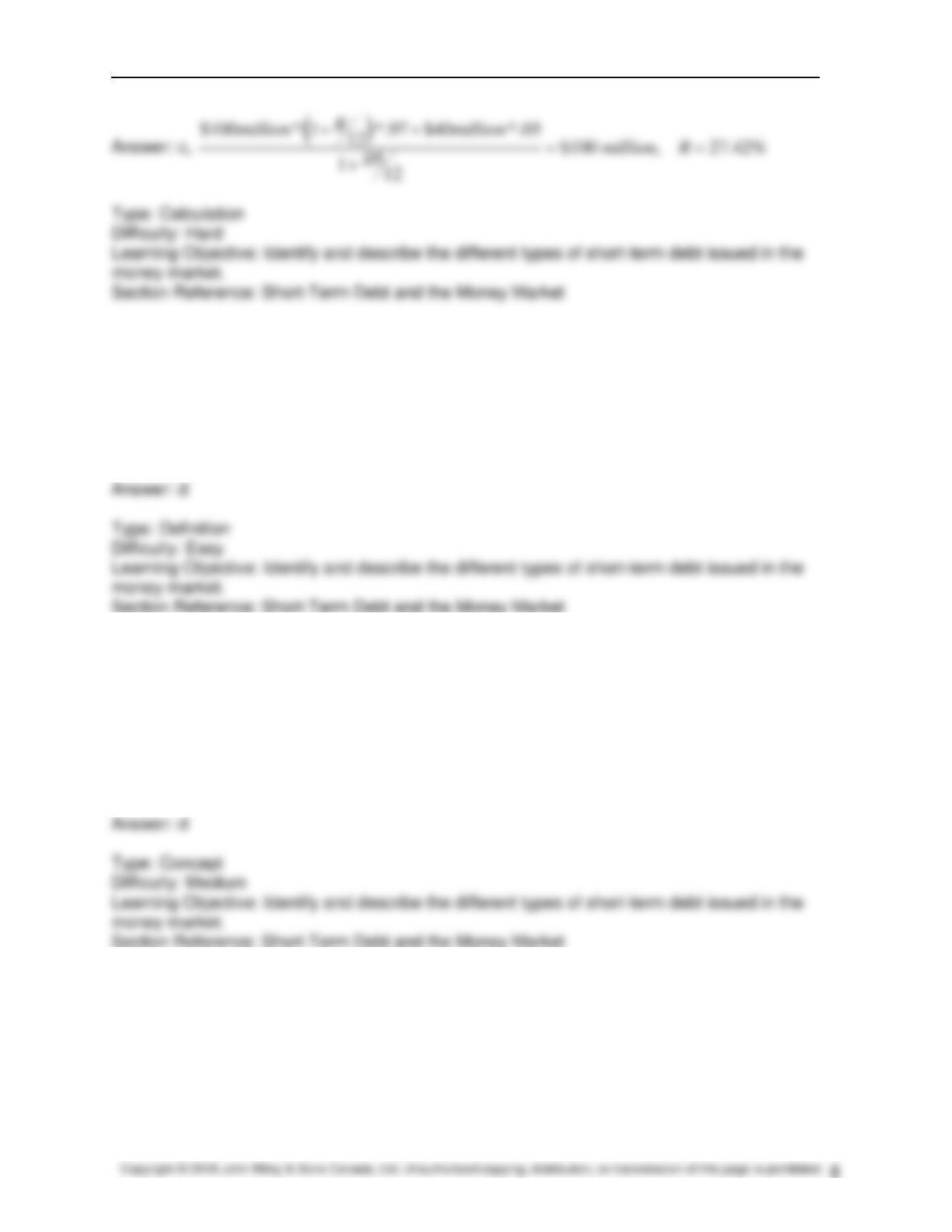
15. Saskatchewan Wheat Fields Inc. is planning to issue $100 million of commercial paper with
30 days to maturity. The quoted rate for the issue is 8%. There is a 3% probability that the firm
18 – 7 Test Bank for Introduction to Corporate Finance, Fourth Canadian Edition
will default on the issue and the investor will receive zero. If the investor’s required rate of return
is 5%, then the value of the issue is:
a) $100 million
b) $99.77 million
c) $99.59 million
d) $97.24 million
16. Saskatchewan Wheat Fields Inc. is planning to issue $100 million of commercial paper with
30 days to maturity. There is a 1% probability that the firm will default on the issue and the
investor will receive zero. The investor’s required rate of return is 5%. If the firm wishes to issue
the commercial paper at par, the promised yield must be:
a) 17.17%
b) 5%
c) 8.25%
d) 42.27%
17. Saskatchewan Wheat Fields Inc. is planning to issue $100 million of commercial paper with
30 days to maturity. There is a 3% probability that the firm will default on the issue and the
investor will receive $40 million (or 40 cents on the dollar). The investor’s required rate of return
is 5%. If the firm wishes to issue the commercial paper at par, the promised yield must be:
a) 2.29%
b) 7.01%
c) 27.42%
d) 42.27%
Debt Instruments 18 – 8
18. Bond rating services:
a) evaluate credit or default risk.
b) can affect bond prices by the ratings they give.
c) classify Government of Canada bonds as nearly default risk free.
d) all of the above
19. The promised yield on bankers’ acceptances is typically ______ than the promised yield on
the commercial paper of similar firms because ______.
a) higher; banks charge a fee to accept or guarantee the debt
b) lower; banks charge a fee to accept or guarantee the debt
c) higher; the banks that guarantee the debt are more creditworthy than the issuing firm
d) lower; the banks that guarantee the debt are more creditworthy than the issuing firm
20. The issuer of bankers’ acceptances is paying a promised yield of 5 percent. What would be
the promised yield on securities of the bank guaranteeing this issue?
a) Equivalent or less than 5%
b) Higher than 5%
c) Depends on the bank’s liquidity
18 – 9 Test Bank for Introduction to Corporate Finance, Fourth Canadian Edition
d) Cannot be determined
21. Use the following statements to answer this question:
I. The major implication of backing money market funds by risky assets is an increase in money
market spreads.
II. Bankers’ acceptances yields are always lower than commercial paper yields.
a) I and II are correct.
b) I and II are incorrect.
c) I is incorrect and II is correct.
d) I is correct and II is incorrect.
22. Short-term debt securities that are unsecured obligations issued by corporations are called:
a) Treasury bills.
b) debentures.
c) commercial paper.
d) all of the above.
23. The purpose of a covenant is:
a) to protect the lender in the event of default by the borrower.
b) to protect the borrower in the event of increasing product market competition.
c) to protect the borrower in the event of default by the lender.
Debt Instruments 18 – 10
d) to protect the borrower in the event of a deterioration of the credit quality of the lender.
24. Which of the following is an example of a covenant?
a) Requirement to maintain a minimum level of current ratio
b) Requirement to maintain a maximum level of net worth
c) No requirement to limit dividend payments
d) All of the above
25. In general, a line of credit has a ______ maturity while a term loan has a ______ maturity.
a) fixed; floating
b) floating; fixed
c) fixed; fixed
d) floating; floating
26. In general a “floating rate” on a debt issue refers to:
I. Variable payment times for the interest payments
II. Variable interest payments
III. Yield on the debt equals the average dividend yield on the Toronto Stock Exchange
a) I and II
b) II
c) II and III
d) I and III
27. Which of the following is the least important for assessing the company’s profile for a letter
of credit?
a) Current ratio
b) Debt to equity ratio
c) Price to earnings ratio
d) Receivables turnover
28. Which one of the following does not explain why banks enjoy lower asymmetry of
information?
a) The bank has access to the firm’s financial activity.
b) The company relies on the bank for financing and other hedging activities.
c) The company is required by law to give the bank access to privileged information.
d) The company provides information to negotiate banking products.
29. A typical five-year revolving line of credit is characterized by:
a) a fixed interest rate for the five years.
b) a floating interest rate, renewed periodically during the five-year term.
c) an interest rate that is lower than the prime rate because these lines of credit are only offered
to the most creditworthy firms.
d) b and c