Ch 18 Public and Private Financing: Initial Offerings, Seasoned Offerings, and Investment Banks
1. Going public establishes a market value for the firm’s stock, and it also ensures that a liquid market will continue to
exist for the firm’s shares. This is especially true for small firms that are not widely followed by security analysts.
a.
True
b.
False
False
1
False
financing
JFND-GO4G-EO4R-NQJS
4OTI-GO4W-NQNBEE
2. The cost of meeting SEC and possibly additional state reporting requirements regarding disclosure of financial
information, the danger of losing control, and the possibility of an inactive market and an attendant low stock price are
potential disadvantages of going public.
a.
True
b.
False
True
1
False
financing
3. Which of the following is generally NOT true and an advantage of going public?
a.
Increases the liquidity of the firm’s stock.
b.
Makes it easier to obtain new equity capital.
c.
Establishes a market value for the firm.
d.
Makes it easier for owner-managers to engage in profitable self-dealings.
e.
Facilitates stockholder diversification.
d
1
Difficulty: Moderate
Multiple Choice
FMTP.EHRH.17.18.02 – LO: 18-2
United States – BUSPROG: Analytic
United States – AK – DISC: Investments and hybrid fin – DISC: Investments and hybrid
United States – OH – Default City – TBA
Going public
TYPE: Multiple Choice: Conceptual
8/26/2015 10:47 AM
8/26/2015 10:47 AM
4. Which of the following statements about listing on a stock exchange is most CORRECT?
a.
Any firm can be listed on the NYSE as long as it pays the listing fee.
b.
Listing provides a company with some “free” advertising, and it may enhance the firm’s prestige and help it do
more business.
c.
Listing reduces the reporting requirements for firms, because listed firms file reports with the exchange rather
than with the SEC.
d.
The OTC is the second largest market for listed stock, and it is exceeded only by the NYSE.
e.
Listing is a decision of more significance to a firm than going public.
b
1
8/26/2015 10:47 AM
5. The term “leaving money on the table” refers to the situation where an investment banking house makes a very low bid
for the right to underwrite a firm’s new stock offering. The banker is, in effect, “buying the job” with the low bid and thus
not getting all the money his firm would normally earn on the job.
a.
True
b.
False
False
False. Leaving money on the table occurs when a security issue is underpriced.
1
False
financing
IPOs
JFND-GO4G-EO4R-NTKB
GO4W-NQNBEE
False
financing
Listing
JFND-GO4G-EO4R-NTKN
GO4W-NQNBEE
Ch 18 Public and Private Financing: Initial Offerings, Seasoned Offerings, and Investment Banks
6. Whereas commercial banks take deposits from some customers and make loans to other customers, the principal
activities of investment banks are (1) to help firms issue new stock and bonds and (2) to give firms advice with regard to
mergers and other financial matters. However, financial corporations often own and operate subsidiaries that operate as
commercial banks and others that are investment banks. This was not true some years ago, when the two types of banks
were required by law to be completely independent of one another.
a.
True
b.
False
True
1
False
financing
JFND-GO4G-EO4R-NTJ3
4OTI-GO4W-NQNBEE
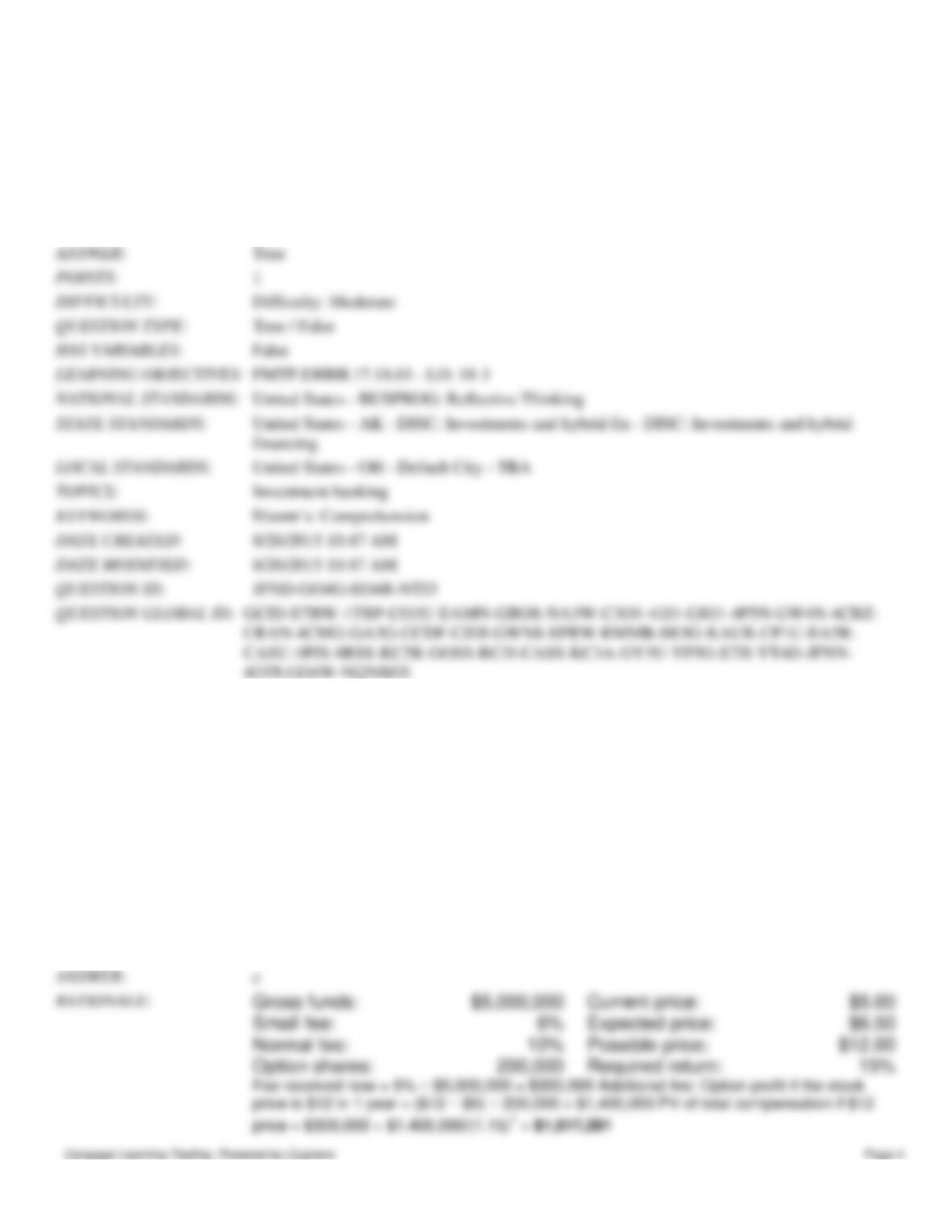
7. In its negotiations with its investment bankers, Patton Electronics has reached an agreement whereby the investment
bankers receive a smaller fee now (6% of gross proceeds versus their normal 10%) but also receive a 1-year option to
purchase an additional 200,000 shares at $5.00 per share. Patton will go public by selling $5,000,000 of new common
stock. The investment bankers expect to exercise the option and purchase the 200,000 shares in exactly one year, when the
stock price is forecasted to be $6.50 per share. However, there is a chance that the stock price will actually be $12.00 per
share one year from now. If the $12 price occurs, what would the present value of the entire underwriting compensation
be? Assume that the investment banker’s required return on such arrangements is 15%, and ignore taxes.
a.
$1,235,925
b.
$1,300,973
c.
$1,369,446
d.
$1,441,522
e.
$1,517,391
e
8. The term “equity carve-out” refers to the situation where a firm’s managers give themselves the right to purchase new
stock at a price far below the going market price. Since this dilutes the value of the public stockholders, it “carves out”
some of their value.
a.
True
b.
False
False
1
False
financing
JFND-GO4G-EO4R-NTKG
1
False
financing
JFND-GO4G-EO4R-NTJA
4OTI-GO4W-NQNBEE
9. If its managers make a tender offer and buy all shares that were not held by the management team, this is called a
private placement.
a.
True
b.
False
False
1
Difficulty: Easy
True / False
False
FMTP.EHRH.17.18.05 – LO: 18-5
United States – BUSPROG: Reflective Thinking
financing
United States – OH – Default City – TBA
Private placements
8/26/2015 10:47 AM
8/26/2015 10:47 AM
JFND-GO4G-EO4R-NQJU
4OTI-GO4W-NQNBEE
10. Which of the following statements is most CORRECT?
a.
Private placements occur most frequently with stocks, but bonds can also be sold in a private placement.
b.
Private placements are convenient for issuers, but the convenience is offset by higher flotation costs.
c.
The SEC requires that all private placements be handled by a registered investment banker.
d.
Private placements can generally bring in funds faster than is the case with public offerings.
e.
In a private placement, securities are sold to private (individual) investors rather than to institutions.
d
1
Difficulty: Moderate
Multiple Choice
False
FMTP.EHRH.17.18.05 – LO: 18-5
United States – BUSPROG: Analytic
financing
4OTI-GO4W-NQNBEE
11. Which of the following statements concerning common stock and the investment banking process is NOT
CORRECT?
a.
If a firm sells 1,000,000 new shares of Class B stock, the transaction occurs in the primary market.
b.
Listing a large firm’s stock is often considered to be beneficial to stockholders because the increases in
liquidity and reputation probably outweigh the additional costs to the firm.
c.
Stockholders have the right to elect the firm’s directors, who in turn select the officers who manage the
business. If stockholders are dissatisfied with management’s performance, an outside group may ask the
stockholders to vote for it in an effort to take control of the business. This action is called a tender offer.
d.
The announcement of a large issue of new stock could cause the stock price to fall. This loss is called “market
pressure,” and it is treated as a flotation cost because it is a cost to stockholders that is associated with the new
issue.
e.
The preemptive right gives each existing common stockholder the right to purchase his or her proportionate
share of a new stock issue.
c
Difficulty: Moderate
Multiple Choice
False
FMTP.EHRH.17.18.05 – LO: 18-5
United States – BUSPROG: Analytic
United States – AK – DISC: Investments and hybrid fin – DISC: Investments and hybrid
financing
United States – OH – Default City – TBA
Investment banking process
TYPE: Multiple Choice: Conceptual
8/26/2015 10:47 AM
8/26/2015 10:47 AM
JFND-GO4G-EO4R-NQJT
4OTI-GO4W-NQNBEE
United States – OH – Default City – TBA
Private placements
TYPE: Multiple Choice: Conceptual
8/26/2015 10:47 AM
8/26/2015 10:47 AM
JFND-GO4G-EO4R-NQJ1
4OTI-GO4W-NQNBEE
Ch 18 Public and Private Financing: Initial Offerings, Seasoned Offerings, and Investment Banks
12. Which of the following statements is NOT CORRECT?
a.
“Going public” establishes a firm’s true intrinsic value and ensures that a liquid market will always exist for
the firm’s shares.
b.
Publicly owned companies have sold shares to investors who are not associated with management, and they
must register with and report to a regulatory agency such as the SEC.
c.
When stock in a closely held corporation is offered to the public for the first time, the transaction is called
“going public,” and the market for such stock is called the new issue market.
d.
It is possible for a firm to go public and yet not raise any additional new capital.
e.
When a corporation’s shares are owned by a few individuals who own most of the stock or are part of the
firm’s management, we say that the firm is “closely, or privately, held.”
a
1
Difficulty: Moderate
Multiple Choice
False
FMTP.EHRH.17.18.05 – LO: 18-5
United States – BUSPROG: Analytic
United States – AK – DISC: Investments and hybrid fin – DISC: Investments and hybrid
financing
United States – OH – Default City – TBA
Investment banking process
TYPE: Multiple Choice: Conceptual
8/26/2015 10:47 AM
8/26/2015 10:47 AM
JFND-GO4G-EO4R-NQJO
GO4W-NQNBEE
13. To finance its ongoing construction project, Bowen-Roth Inc. will need $5,000,000 of new capital during each of the
next 3 years. The firm has a choice of issuing new debt or equity each year as the funds are needed, or issue only debt now
and equity later. Its target capital structure is 40% debt and 60% equity, and it wants to be at that structure in 3 years,
when the project has been completed. Debt flotation costs for a single debt issue would be 1.6% of the gross debt
proceeds. Yearly flotation costs for 3 separate issues of debt would be 3.0% of the gross amount. Ignoring time value
effects, how much would the firm save by raising all of the debt now, in a single issue, rather than in 3 separate issues?
a.
$79,425
b.
$83,606
c.
$88,006
d.
$92,406
e.
$97,027
c
14. Suppose a company issued 30-year bonds 4 years ago, when the yield curve was inverted. Since then long-term rates
(10 years or longer) have remained constant, but the yield curve has resumed its normal upward slope. Under such
conditions, a bond refunding would almost certainly be profitable.
a.
True
b.
False
False
1
False
financing
1
False
financing
JFND-GO4G-EO4R-NQJZ
GO4W-NQNBEE
15. The appropriate discount rate to use when analyzing a refunding decision is the after-tax cost of new debt, in part
because there is relatively little risk of not realizing the interest savings.
a.
True
b.
False
True
1
False
financing
JFND-GO4G-EO4R-NTKR
4OTI-GO4W-NQNBEE
16. If the firm uses the after-tax cost of new debt as the discount rate when analyzing a refunding decision, and if the NPV
of refunding is positive, then the value of the firm will be maximized if it immediately calls the outstanding debt and
replaces it with an issue that has a lower coupon rate.
a.
True
b.
False
False
1
False
financing
JFND-GO4G-EO4R-NTKF
4OTI-GO4W-NQNBEE
17. When a firm refunds a debt issue, the firm’s stockholders gain and its bondholders lose. This points out the risk of a
call provision to bondholders and explains why a non-callable bond will typically command a higher price than an
otherwise similar callable bond.
a.
True
b.
False
True
1
Difficulty: Moderate
True / False
False
FMTP.EHRH.17.18.08 – LO: 18-8
United States – BUSPROG: Reflective Thinking
financing
United States – OH – Default City – TBA
Refunding and callable bonds
8/26/2015 10:47 AM
8/26/2015 10:47 AM
JFND-GO4G-EO4R-NTJU
4OTI-GO4W-NQNBEE
18. Which of the following statements is most CORRECT?
a.
The key benefits associated with refunding debt are the reduction in the firm’s debt ratio and the creation of
more reserve borrowing capacity.
b.
The mechanics of finding the NPV of a refunding decision are fairly straightforward. However, the decision of
when to refund is not always clear because it requires a forecast of future interest rates.
c.
If a firm with a positive NPV refunding project delays refunding and interest rates rise, the firm can still obtain
the entire NPV by locking in a low coupon rate when the rates are low, even though it actually refunds the
debt after rates have risen.
d.
Suppose a firm is considering refunding and interest rates rise during time when the analysis is being done.
The rise in rates would tend to lower the expected price of the new bonds, which would make them cheaper to
United States – OH – Default City – TBA
Refunding decision
8/26/2015 10:47 AM
8/26/2015 10:47 AM
JFND-GO4G-EO4R-NTKD
4OTI-GO4W-NQNBEE

Ch 18 Public and Private Financing: Initial Offerings, Seasoned Offerings, and Investment Banks
the firm and thus increase the expected interest savings.
e.
If new debt is used to refund old debt, the correct discount rate to use in the refunding analysis is the before–
tax cost of new debt.
b
1
Difficulty: Moderate
Multiple Choice
False
FMTP.EHRH.17.18.08 – LO: 18-8
United States – BUSPROG: Analytic
United States – AK – DISC: Investments and hybrid fin – DISC: Investments and hybrid
financing
United States – OH – Default City – TBA
Refunding decision
TYPE: Multiple Choice: Conceptual
8/26/2015 10:47 AM
8/26/2015 10:47 AM
JFND-GO4G-EO4R-NTJ1
GO4W-NQNBEE
19. Which of the following factors would increase the likelihood that a company would call its outstanding bonds at this
time?
a.
A provision in the bond indenture lowers the call price on specific dates, and yesterday was one of those dates.
b.
The flotation costs associated with issuing new bonds rise.
c.
The firm’s CFO believes that interest rates are likely to decline in the future.
d.
The firm’s CFO believes that corporate tax rates are likely to be increased in the future.
e.
The yield to maturity on the company’s outstanding bonds increases due to a weakening of the firm’s financial
situation.
a
1
Difficulty: Moderate
Multiple Choice
False
FMTP.EHRH.17.18.08 – LO: 18-8
United States – BUSPROG: Analytic
United States – AK – DISC: Investments and hybrid fin – DISC: Investments and hybrid
financing
United States – OH – Default City – TBA
Refunding decision
TYPE: Multiple Choice: Conceptual
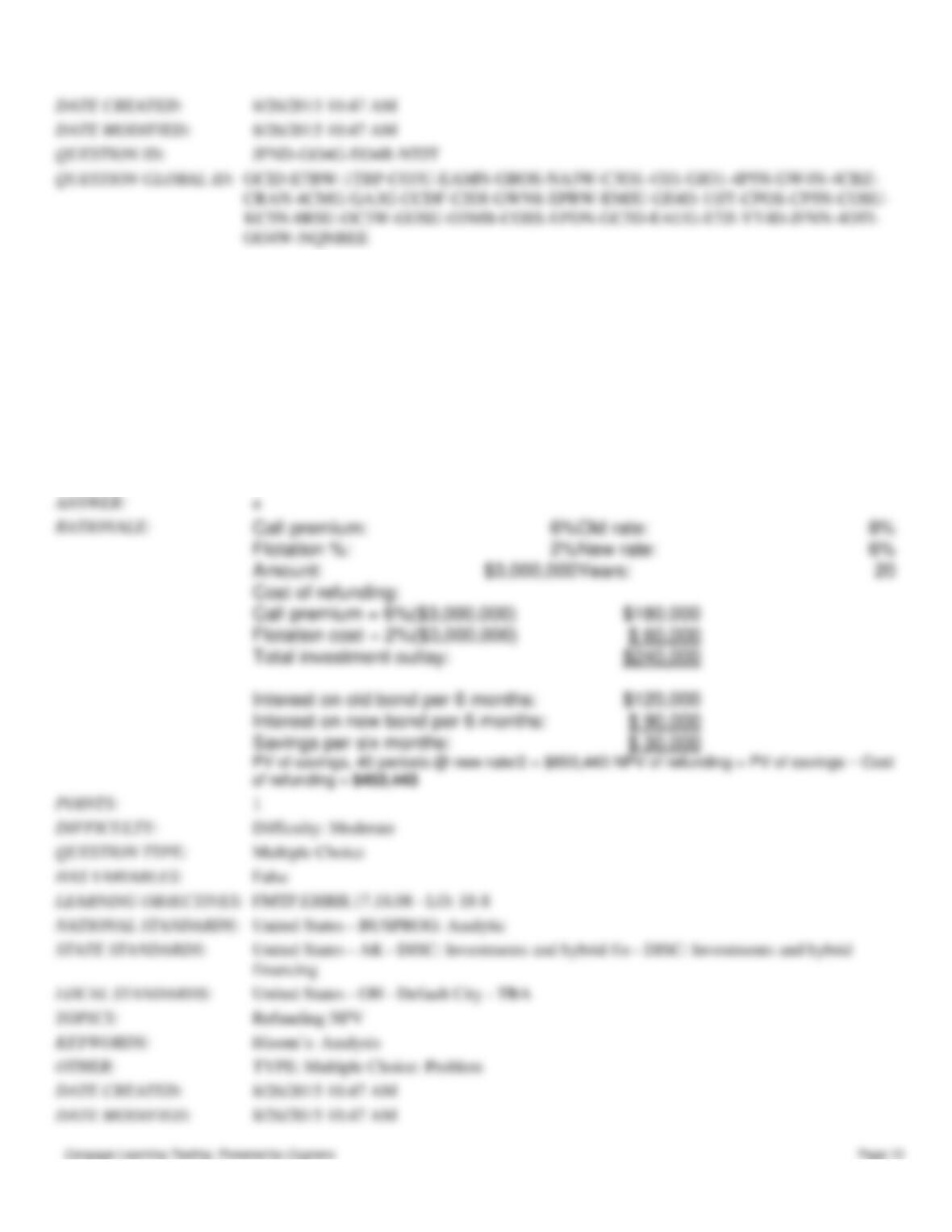
20. 10 years ago, the City of Melrose issued $3,000,000 of 8% coupon, 30-year, semiannual payment, tax-exempt muni
bonds. The bonds had 10 years of call protection, but now the bonds can be called if the city chooses to do so. The call
premium would be 6% of the face amount. New 20-year, 6%, semiannual payment bonds can be sold at par, but flotation
costs on this issue would be 2% of the amount of bonds sold. What is the net present value of the refunding? Note that
cities pay no income taxes, hence taxes are not relevant.
a.
$453,443
b.
$476,115
c.
$499,921
d.
$524,917
e.
$551,163
a
1
False
financing
JFND-GO4G-EO4R-NTJT
GO4W-NQNBEE
21. Five years ago, the State of Oklahoma issued $2,000,000 of 7% coupon, 20-year semiannual payment, tax-exempt
bonds. The bonds had 5 years of call protection, but now the state can call the bonds if it chooses to do so. The call
premium would be 5% of the face amount. Today 15-year, 5%, semiannual payment bonds can be sold at par, but
flotation costs on this issue would be 2%. What is the net present value of the refunding? Because these are tax-exempt
bonds, taxes are not relevant.
a.
$278,606
b.
$292,536
c.
$307,163
d.
$322,521
e.
$338,647
a
1
False
financing
JFND-GO4G-EO4R-NTJZ
JFND-GO4G-EO4R-NTJO
4OTI-GO4W-NQNBEE
22. Palmer Company has $5,000,000 of 15-year maturity bonds outstanding. Each bond has a maturity value of $1,000, an
annual coupon of 12.0%. The bonds can be called at any time with a premium of $50 per bond. If the bonds are called, the
company must pay flotation costs of $10 per new refunding bond. Ignore tax considerations⎯assume that the firm’s tax
rate is zero.
The company’s decision of whether to call the bonds depends critically on the current interest rate on newly issued bonds.
What is the breakeven interest rate, the rate below which it would be profitable to call in the bonds?
a.
9.57%
b.
10.07%
c.
10.60%
d.
11.16%
e.
11.72%
d
1
False
financing
4OTI-GO4W-NQNBEE
23. Stanovich Enterprises has 10-year, 12.0% semiannual coupon bonds outstanding. Each bond is now eligible to be
called at a call price of $1,060. If the bonds are called, the company must replace them with new 10-year bonds. The
flotation cost of issuing new bonds is estimated to be $45 per bond. How low would the yield to maturity on the new
bonds have to be in order for it to be profitable to call the bonds today, i.e., what is the nominal annual “breakeven rate”?
a.
9.29%
b.
9.78%
c.
10.29%
d.
10.81%
e.
11.35%
c
1
False
JFND-GO4G-EO4R-NTJS
4OTI-GO4W-NQNBEE
NorthWest Water (NWW)
Five years ago, NorthWest Water (NWW) issued $50,000,000 face value of 30-year bonds carrying a 14% (annual
payment) coupon. NWW is now considering refunding these bonds. It has been amortizing $3 million of flotation costs on
these bonds over their 30-year life. The company could sell a new issue of 25-year bonds at an annual interest rate of
11.67% in today’s market. A call premium of 14% would be required to retire the old bonds, and flotation costs on the
new issue would amount to $3 million. NWW’s marginal tax rate is 40%. The new bonds would be issued when the old
bonds are called.
24. Refer to the data for NorthWest Water (NWW). What is the required after-tax refunding investment outlay, i.e., the
cash outlay at the time of the refunding?
a.
$5,049,939
b.
$5,315,725
c.
$5,595,500
d.
$5,890,000
e.
$6,200,000
e
Amount:
Tax saving on unexpensed float cost
After tax cost of call premium:
1
United States – AK – DISC: Investments and hybrid fin – DISC: Investments and hybrid
financing
JFND-GO4G-EO4R-NTJI
4OTI-GO4W-NQNBEE
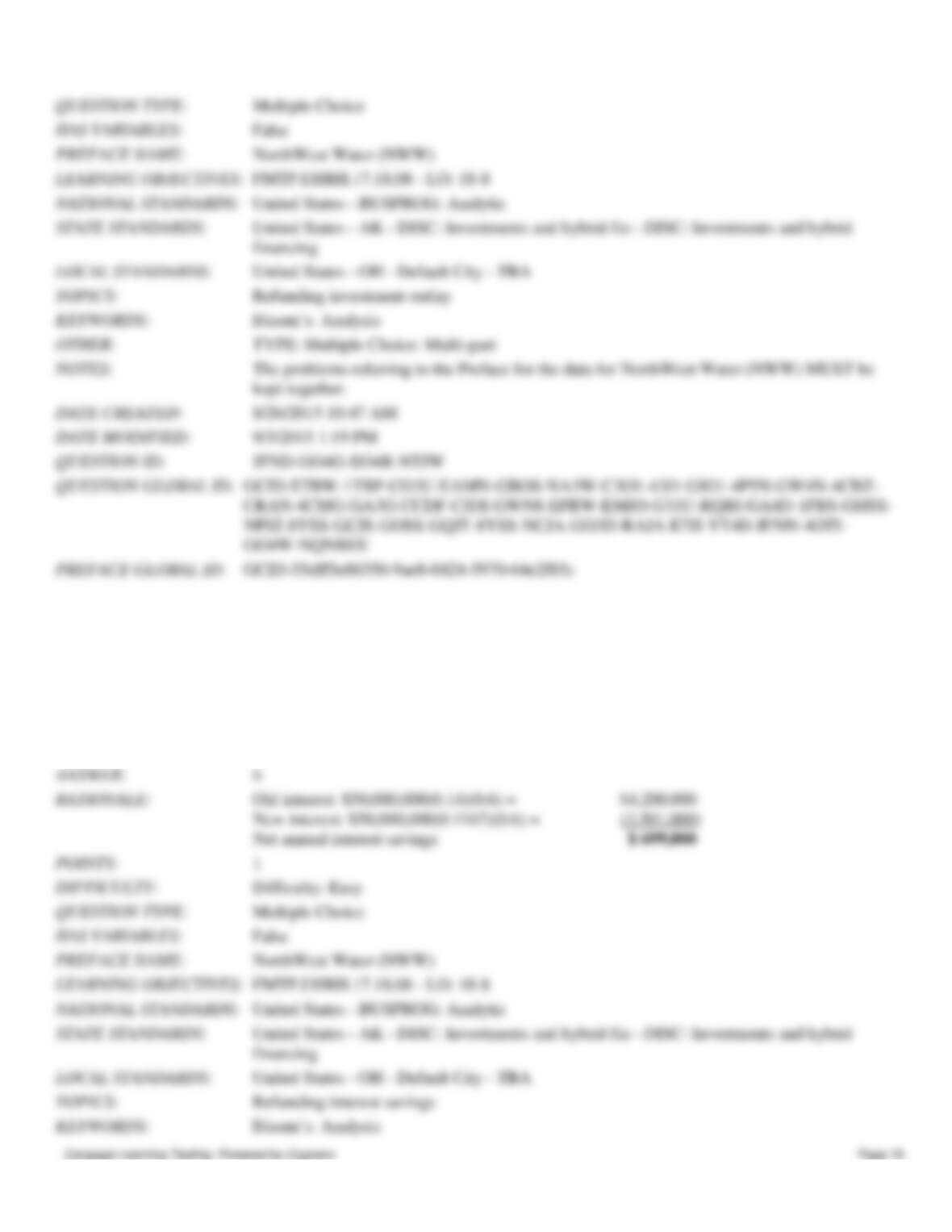
25. Refer to the data for NorthWest Water (NWW). What will the after-tax annual interest savings for NWW be if the
refunding takes place?
a.
$664,050
b.
$699,000
c.
$768,900
d.
$845,790
e.
$930,369
b
1
False
financing
False
financing
JFND-GO4G-EO4R-NTJW
GO4W-NQNBEE
GCID-55dff5e86350-9ae8-0424-5970-64e2f85c
Ch 18 Public and Private Financing: Initial Offerings, Seasoned Offerings, and Investment Banks
JFND-GO4G-EO4R-NT1N
GO4W-NQNBEE
GCID-55dff5e86350-9ae8-0424-5970-64e2f85c
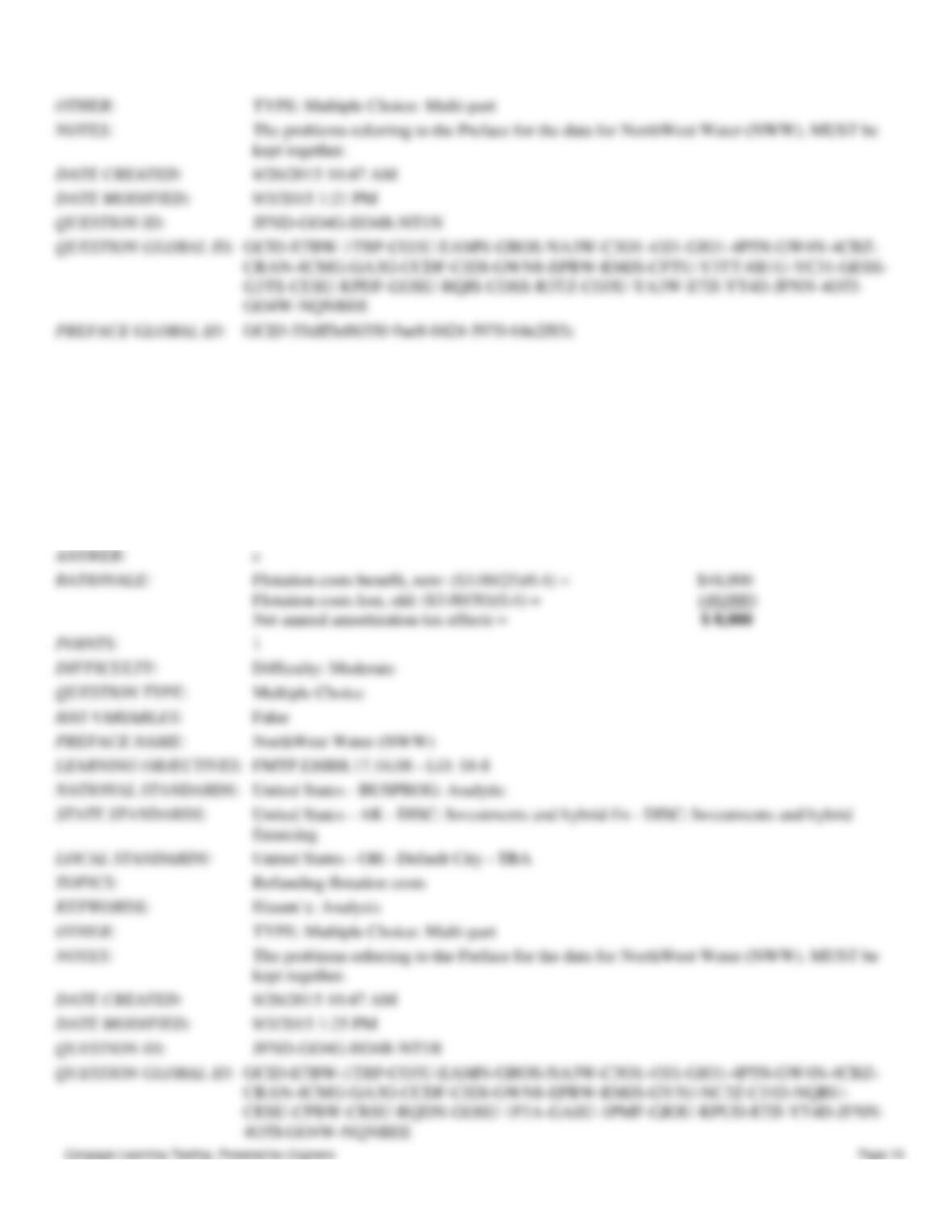
26. Refer to the data for NorthWest Water (NWW). The amortization of flotation costs reduces taxes and thus provides an
annual cash flow. What will the net increase or decrease in the annual flotation cost tax savings be if refunding takes
place?
a.
$6,480
b.
$7,200
c.
$8,000
d.
$8,800
e.
$9,680
c
False
financing
JFND-GO4G-EO4R-NT1B
4OTI-GO4W-NQNBEE
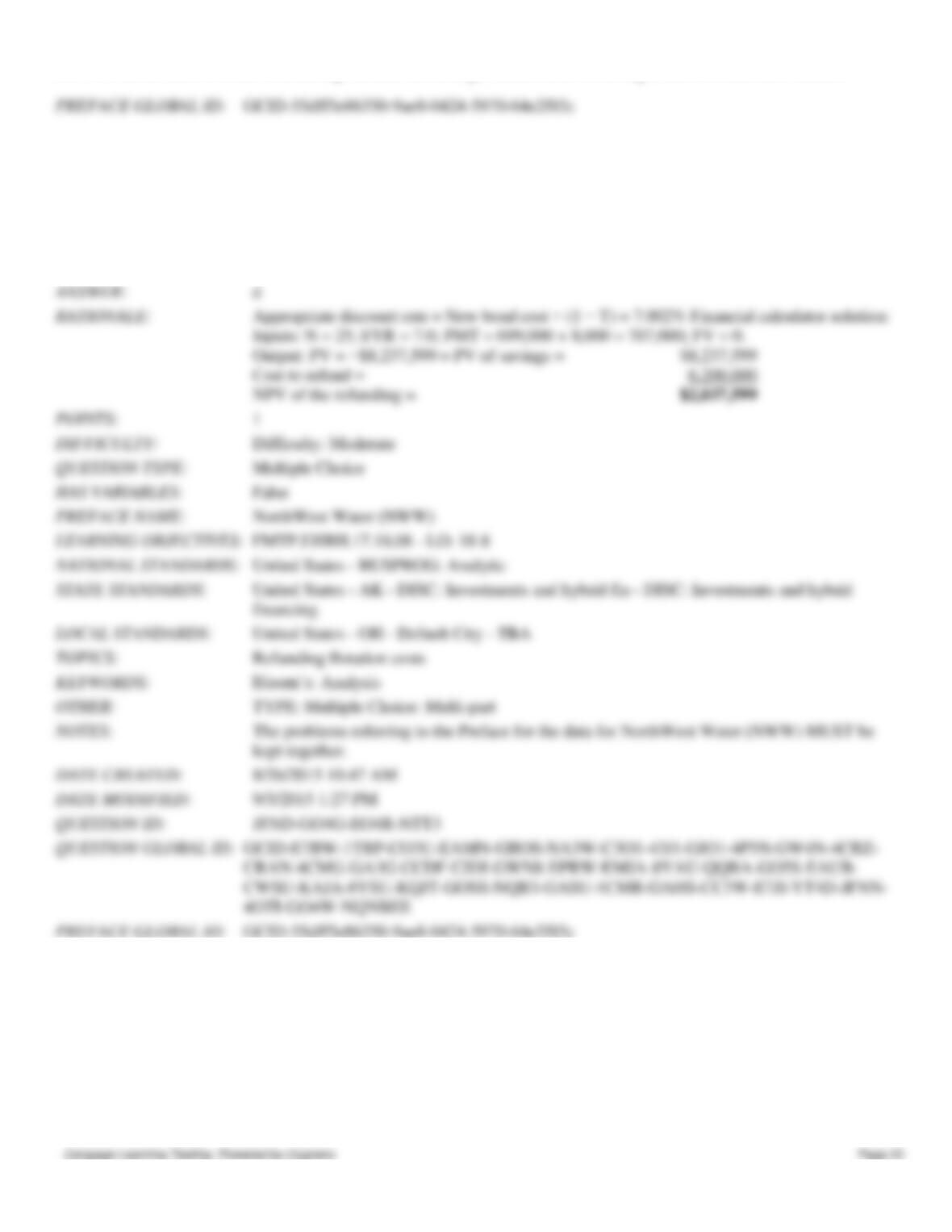
27. Refer to the data for NorthWest Water (NWW). What is the NPV if NWW refunds its bonds today?
a.
$1,746,987
b.
$1,838,933
c.
$1,935,719
d.
$2,037,599
e.
$2,241,359
d
1
False
financing
JFND-GO4G-EO4R-NTT3
4OTI-GO4W-NQNBEE
GCID-55dff5e86350-9ae8-0424-5970-64e2f85c
GCID-55dff5e86350-9ae8-0424-5970-64e2f85c