Cost-Volume-Profit
18 – 21
110. Nelson Manufacturing has the following data:
Variable costs are 60% of the unit selling price.
The contribution margin ratio is 40%.
The contribution margin per unit is $500.
The fixed costs are $300,000.
Which of the following does not express the break-even point?
a. $300,000 + .60X = X
b. $300,000 + .40X = X
c. $300,000 ÷ $500 = X
d. $300,000 ÷ .40 = X
111. A CVP graph does not include a
a. variable cost line.
b. fixed cost line.
c. sales line.
d. total cost line.
112. Boswell company reported the following information for the current year: Sales (50,000
units) $1,000,000, direct materials and direct labor $500,000, other variable costs
$50,000, and fixed costs $270,000. What is Boswell’s contribution margin ratio?
a. 68%.
b. 45%.
c. 32%.
d. 55%.
113. Boswell company reported the following information for the current year: Sales (50,000
units) $1,000,000, direct materials and direct labor $500,000, other variable costs
$50,000, and fixed costs $270,000. What is Boswell’s break-even point in units?
a. 24,546.
b. 30,000.
c. 38,334.
d. 42,188.
114. Walters Corporation sells radios for $50 per unit. The fixed costs are $420,000 and the
variable costs are 60% of the selling price. As a result of new automated equipment, it is
anticipated that fixed costs will increase by $100,000 and variable costs will be 50% of the
selling price. The new break-even point in units is:
a. 21,000
b. 20,800
c. 20,600
d. 16,800
Test Bank for Accounting, Tools for Business Decision Making Fifth Edition
18 – 22
115. Cunningham, Inc. sells MP3 players for $60 each. Variable costs are $40 per unit, and
fixed costs total $90,000. What sales are needed by Cunningham to break even?
a. $120,000.
b. $225,000.
c. $270,000.
d. $360,000.
116. Cunningham, Inc. sells MP3 players for $60 each. Variable costs are $40 per unit, and
fixed costs total $90,000. How many MP3 players must Cunningham sell to earn net
income of $210,000?
a. 15,000.
b. 5,250.
c. 3,750.
d. 4,500.
117. Gall Manufacturing sells a product for $50 per unit. The fixed costs are $735,000 and the
variable costs are 60% of the selling price. As a result of new automated equipment, it is
anticipated that fixed costs will increase by $175,000 and variable costs will be 50% of the
selling price. The new break-even point in units is:
a. 36,750.
b. 36,400.
c. 36,050.
d. 29,400.
118. Pascal, Inc. is planning to sell 800,000 units for $1.50 per unit. The contribution margin
ratio is 20%. If Pascal will break even at this level of sales, what are the fixed costs?
a. $240,000.
b. $560,000.
c. $800,000.
d. $960,000.
119. April Industries sells a product with a contribution margin of $12 per unit, fixed costs of
$148,800, and sales for the current year of $200,000. How much is April’s break-even
point?
a. 9,200 units
b. $51,200
c. 12,400 units
d. 4,267 units
Cost-Volume-Profit
18 – 23
120. Kaplan, Inc. produces flash drives for computers, which it sells for $20 each. The variable
cost to make each flash drive is $13. During April, 700 drives were sold. Fixed costs for
April were $2 per unit for a total of $1,400 for the month. How much is the monthly break–
even level of sales in dollars for Kaplan?
a. $200
b. $4,000
c. $14,000
d. $8,400
121. Vintage Wines has fixed costs of $15,000 per year. Its warehouse sells wine with variable
costs of 80% of its unit selling price. How much in sales does Vintage need to break even
per year?
a. $12,000
b. $3,000
c. $18,750
d. $75,000
122. Bruno & Court is a nonprofit organization that captures stray deer bewildered within
residential communities. Fixed costs are $15,000. The variable cost of capturing each
deer is $10 each. Bruno & Court is funded by a local philanthropy in the amount of
$48,000 for 2013. How many deer can Bruno & Court capture during 2013?
a. 3,300
b. 4,800
c. 6,300
d. 3,000
123. At the break-even point of 2,000 units, variable costs are $55,000, and fixed costs are
$32,000. How much is the selling price per unit?
a. $43.50
b. $11.50
c. $16.00
d. $27.50
124. Variable costs for Abbey, Inc. are 25% of sales. Its selling price is $80 per unit. If Abbey
sells one unit more than break-even units, how much will profit increase?
a. $60
b. $20
c. $25
d. $320
Test Bank for Accounting, Tools for Business Decision Making Fifth Edition
18 – 24
125. A company requires $1,360,000 in sales to meet its net income target. Its contribution
margin is 30%, and fixed costs are $240,000. What is the target net income?
a. $408,000
b. $312,000
c. $560,000
d. $168,000
126. Montoya Manufacturing has fixed costs of $2,500,000 and variable costs are 40% of
sales. What are the required sales if Montoya desires net income of $250,000?
a. $4,583,333
b. $4,166,667
c. $6,875,000
d. $6,250,000
127. Aero, Inc. requires sales of $2,000,000 to cover its fixed costs of $400,000 and to earn net
income of $500,000. What percent are variable costs of sales?
a. 25%
b. 55%
c. 20%
d. 45%
128. Lansbury Manufacturing produces hair brushes. The selling price is $20 per unit and the
variable costs are $8 per brush. Fixed costs per month are $4,800. If Lansbury sells 25
more units beyond breakeven, how much does profit increase as a result?
a. $300
b. $500
c. $200
d. $1,000
129. Hayduke Corporation reported the following results from the sale of 6,000 units in May:
sales $300,000, variable costs $180,000, fixed costs $90,000, and net income $30,000.
Assume that Hayduke increases the selling price by 10% on June 1. How many units will
have to be sold in June to maintain the same level of net income?
a. 4,800.
b. 5,160.
c. 5,400.
d. 6,000.
Cost-Volume-Profit
18 – 25
130. Keene, Inc. produces flash drives for computers, which it sells for $20 each. Each flash
drive costs $6 of variable costs to make. During March, 1,000 drives were sold. Fixed costs
for March were $4.90 per unit for a total of $4,900 for the month. If variable costs decrease
by 10%, what happens to the break-even level of units per month for Keene?
a. It is 10% higher than the original break-even point.
b. It decreases about 14 units.
c. It decreases about 35 units.
d. It depends on the number of units the company expects to produce and sell.
131. Reliable Manufacturing wants to sell a sufficient quantity of products to earn a profit of
$80,000. If the unit sales price is $10, unit variable cost is $8, and total fixed costs are
$160,000, how many units must be sold to earn income of $80,000?
a. 120,000 units
b. 80,000 units
c. 30,000 units
d. 1,200,000 units
132. How much sales are required to earn a target income of $160,000 if total fixed costs are
$200,000 and the contribution margin ratio is 40%?
a. $600,000
b. $400,000
c. $900,000
d. $660,000
133. Farmers’ Industries has fixed costs of $400,000 and variable costs are 60% of sales. How
much will Farmers report as sales when its net income equals $40,000?
a. $1,100,000
b. $733,333
c. $1,040,000
d. $264,000
134. Murphy Company produces flash drives for computers, which it sells for $20 each. Each
flash drive costs $8 of variable costs to make. During April, 700 drives were sold. Fixed
costs for April were $4 per unit for a total of $2,800 for the month. How much does
Murphy’s operating income increase for each $1,000 increase in revenue per month?
a. $600
b. $400
c. $14,000
d. Not enough information to determine the answer.
Test Bank for Accounting, Tools for Business Decision Making Fifth Edition
18 – 26
135. Greg’s Golf Carts produces two models: Model 24 has sales of 500 units with a
contribution margin of $40 each; Model 26 has sales of 350 units with a contribution
margin of $50 each. If sales of Model 26 increase by 100 units, how much will profit
change?
a. $5,000 increase
b. $17,500 increase
c. $22,500 increase
d. $35,000 increase
136. Wendy Industries produces only one product. Monthly fixed expenses are $12,000,
monthly unit sales are 2,500, and the unit contribution margin is $10. How much is
monthly net income?
a. $25,000
b. $37,000
c. $0
d. $13,000
137. A company desires to sell a sufficient quantity of products to earn a profit of $300,000. If
the unit sales price is $20, unit variable cost is $12, and total fixed costs are $600,000,
how many units must be sold to earn net income of $300,000?
a. 168,750 units
b. 112,500 units
c. 90,000 units
d. 67,500 units
138. Stephanie, Inc. sells its product for $40. The variable costs are $18 per unit. Fixed costs
are $16,000. The company is considering the purchase of an automated machine that will
result in a $2 reduction in unit variable costs and an increase of $5,000 in fixed costs.
Which of the following is true about the break-even point in units?
a. It will remain unchanged.
b. It will decrease.
c. It will increase.
d. It cannot be determined from the information provided.
Cost-Volume-Profit
18 – 27
139. How much sales are required to earn a target net income of $160,000 if total fixed costs
are $200,000 and the contribution margin ratio is 40%?
a. $500,000
b. $810,000
c. $900,000
d. $400,000
140. The following monthly data are available for Lumberyard Company. which produces only
one product: Selling price per unit, $42; Unit variable expenses, $14; Total fixed expenses,
$84,000; Actual sales for the month of June, 4,000 units. How much is the margin of
safety for the company for June?
a. $84,000
b. $42,000
c. $126,000
d. $1,000
141. Danny’s Lawn Equipment has actual sales of $800,000 and a break-even point of
$600,000. How much is its margin of safety ratio?
a. 25%
b. 33%
c. 67%
d. 75%
142. The following monthly data are available for Seasons Company which produces only one
product: Selling price per unit, $42; Unit variable expenses, $14; Total fixed expenses,
$84,000; Actual sales for the month of June, 5,000 units. How much is the margin of
safety for the company for June?
a. $56,000
b. $84,000
c. $126,000
d. $2,000
143. The amount by which actual or expected sales exceeds break-even sales is referred to as
a. contribution margin.
b. unanticipated profit.
c. margin of safety.
d. target net income.
Test Bank for Accounting, Tools for Business Decision Making Fifth Edition
18 – 28
144. In evaluating the margin of safety, the
a. break-even point is not relevant.
b. higher the margin of safety ratio, the greater the margin of safety.
c. higher the dollar amount, the lower the margin of safety.
d. higher the margin of safety ratio, the lower the fixed costs.
145. Within the relevant range, the variable cost per unit
a. differs at each activity level.
b. remains constant at each activity level.
c. increases as production increases.
d. decreases as production increases.
146. An example of a mixed cost is
a. direct materials.
b. supervisory salaries.
c. utility costs.
d. property taxes.
147. In the Restin Company, maintenance costs are a mixed cost. At the low level of activity
(160 direct labor hours), maintenance costs are $600. At the high level of activity (400
direct labor hours), maintenance costs are $1,100. Using the high-low method, what is the
variable maintenance cost per unit and the total fixed maintenance cost?
Variable Cost Per Unit Total Fixed Cost
a. $2.08 $268
b. $2.08 $500
c. $2.75 $220
d. $2.75 $400
148. Cost-volume-profit analysis includes all of the following assumptions except
a. the behavior of costs is curvilinear throughout the relevant range.
b. costs can be classified accurately as either variable or fixed.
c. changes in activity are the only factors that affect costs.
d. all units produced are sold.
149. The contribution margin ratio increases when
a. fixed costs increase.
b. fixed costs decrease.
c. variable costs as a percentage of sales decrease.
d. variable costs as a percentage of sales increase.
Cost-Volume-Profit
18 – 29
150. Contribution margin is
a. the amount of revenue remaining after deducting fixed costs.
b. available to cover fixed costs and contribute to income for the company.
c. sales less fixed costs.
d. unit selling price less unit fixed costs.
151. Chung, Inc. sells 100,000 wrenches for $18 per unit. Fixed costs are $525,000 and net
income is $375,000. What should be reported as variable expenses in the CVP income
statement?
a. $810,000
b. $900,000
c. $1,425,000
d. $1,275,000
152. Sweet Manufacturing is planning to sell 400,000 hammers for $3 per unit. The contribution
margin ratio is 20%. If Sweet will break even at this level of sales, what are the fixed
costs?
a. $240,000
b. $560,000
c. $800,000
d. $960,000
153. At the break-even point,
a. sales equal total variable costs.
b. contribution margin equals total variable costs.
c. contribution margin equals total fixed costs.
d. sales equal total fixed costs.
154. Wilton Co. reported the following results from the sale of 5,000 hammers in May: sales
$200,000, variable costs $120,000, fixed costs $60,000, and net income $20,000. Assume
that Wilton increases the selling price of hammers by 10% on June 1. How many
hammers will have to be sold in June to maintain the same level of net income?
a. 4,000
b. 4,300
c. 4,500
d. 5,000
Test Bank for Accounting, Tools for Business Decision Making Fifth Edition
FOR INSTRUCTOR USE ONLY
18 – 30
155. Required sales in dollars to meet a target net income is computed by dividing
a. fixed costs plus target net income by contribution margin per unit.
b. variable costs plus target net income by contribution margin per unit.
c. fixed costs plus target net income by contribution margin ratio.
d. total costs plus target net income by contribution margin ratio.
156. Bolton Industries had actual sales of $750,000 when break-even sales were $600,000.
What is the margin of safety ratio?
a. 20%
b. 25%
c. 75%
d. 80%
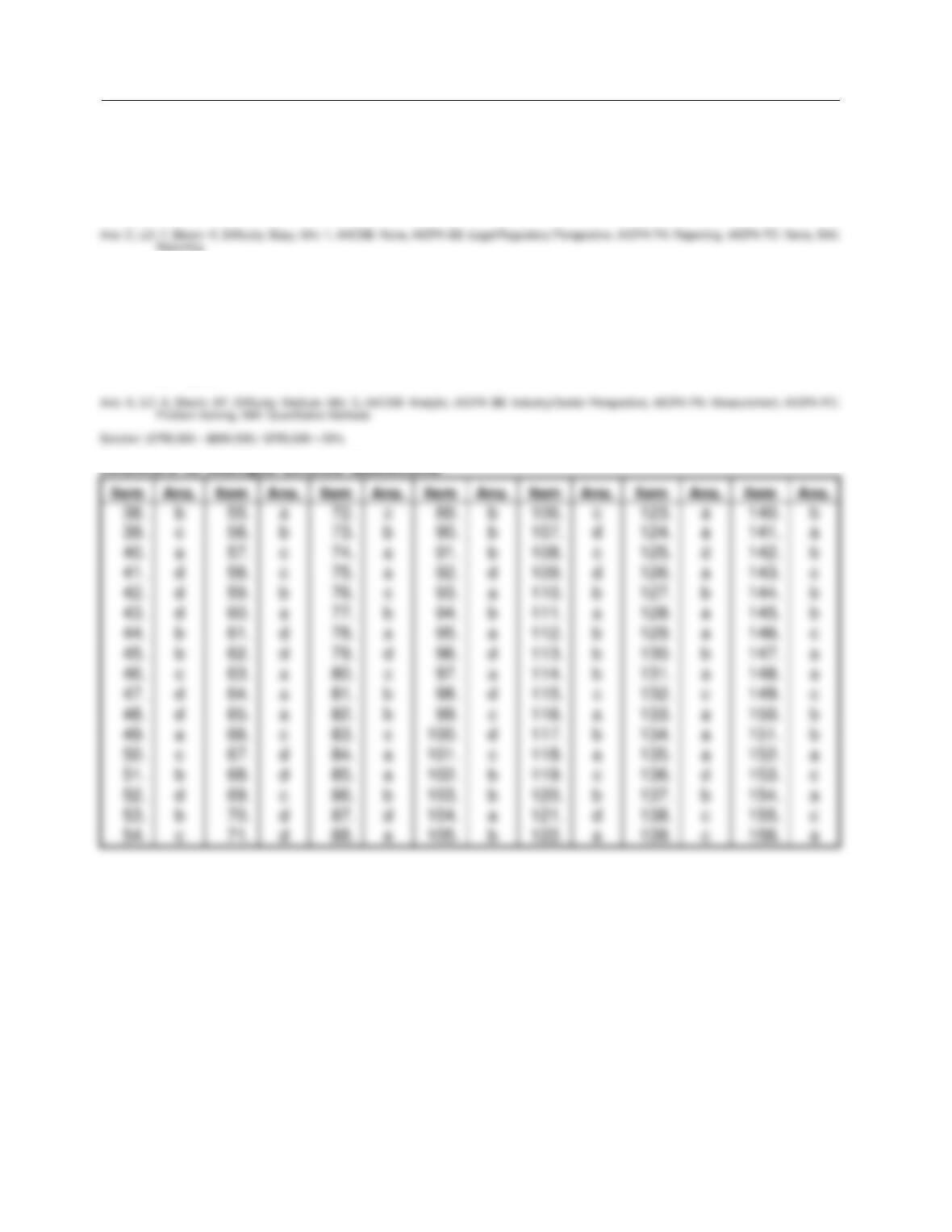
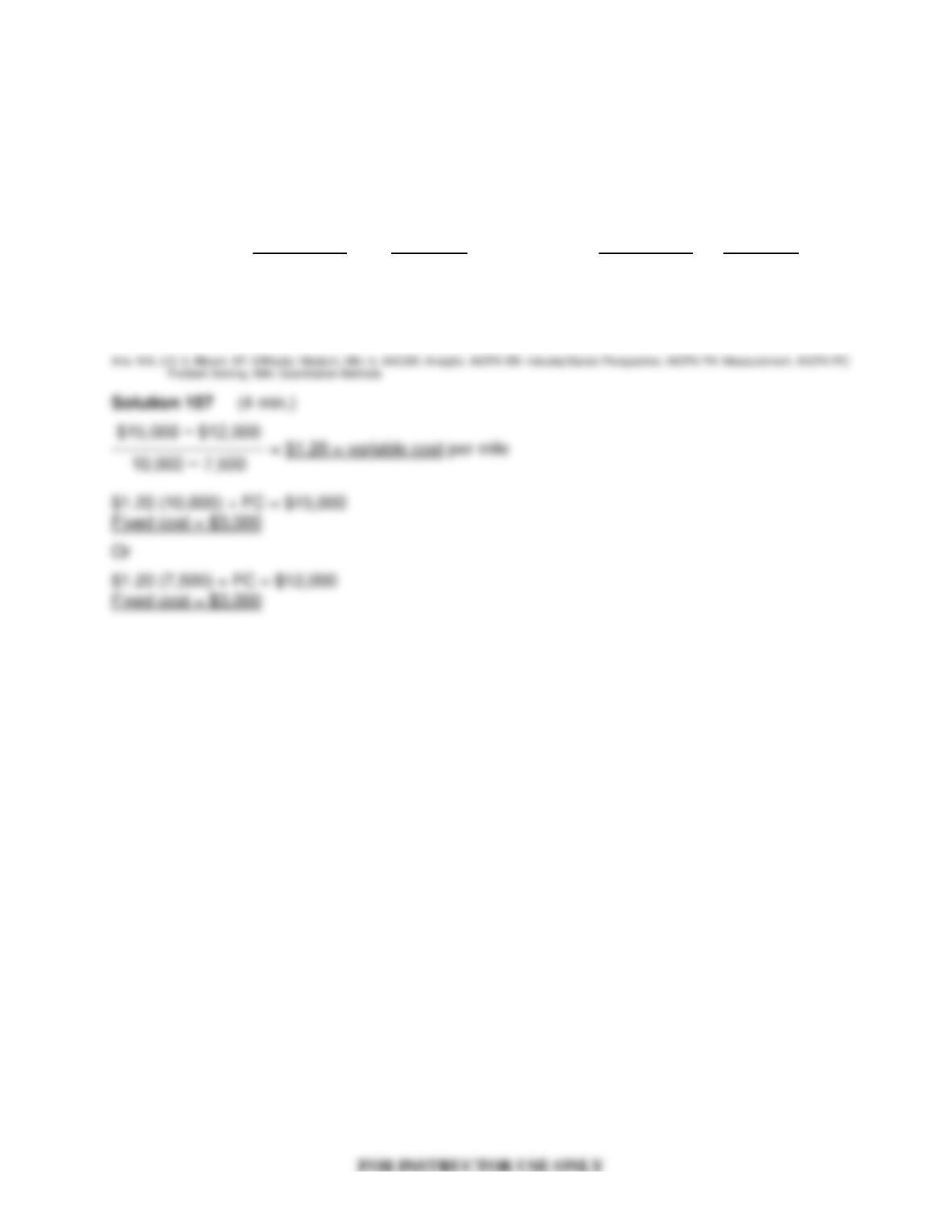
Answers to Multiple Choice Questions
Cost-Volume-Profit
18 – 31
BRIEF EXERCISES
BE 157
Dollywood Corporation accumulates the following data concerning a mixed cost, using miles as
the activity level.
Miles Driven
Total Cost
Miles Driven
Total Cost
January
10,000
$15,000
March
9,000
$12,500
February
8,000
$14,500
April
7,500
$12,000
Instructions
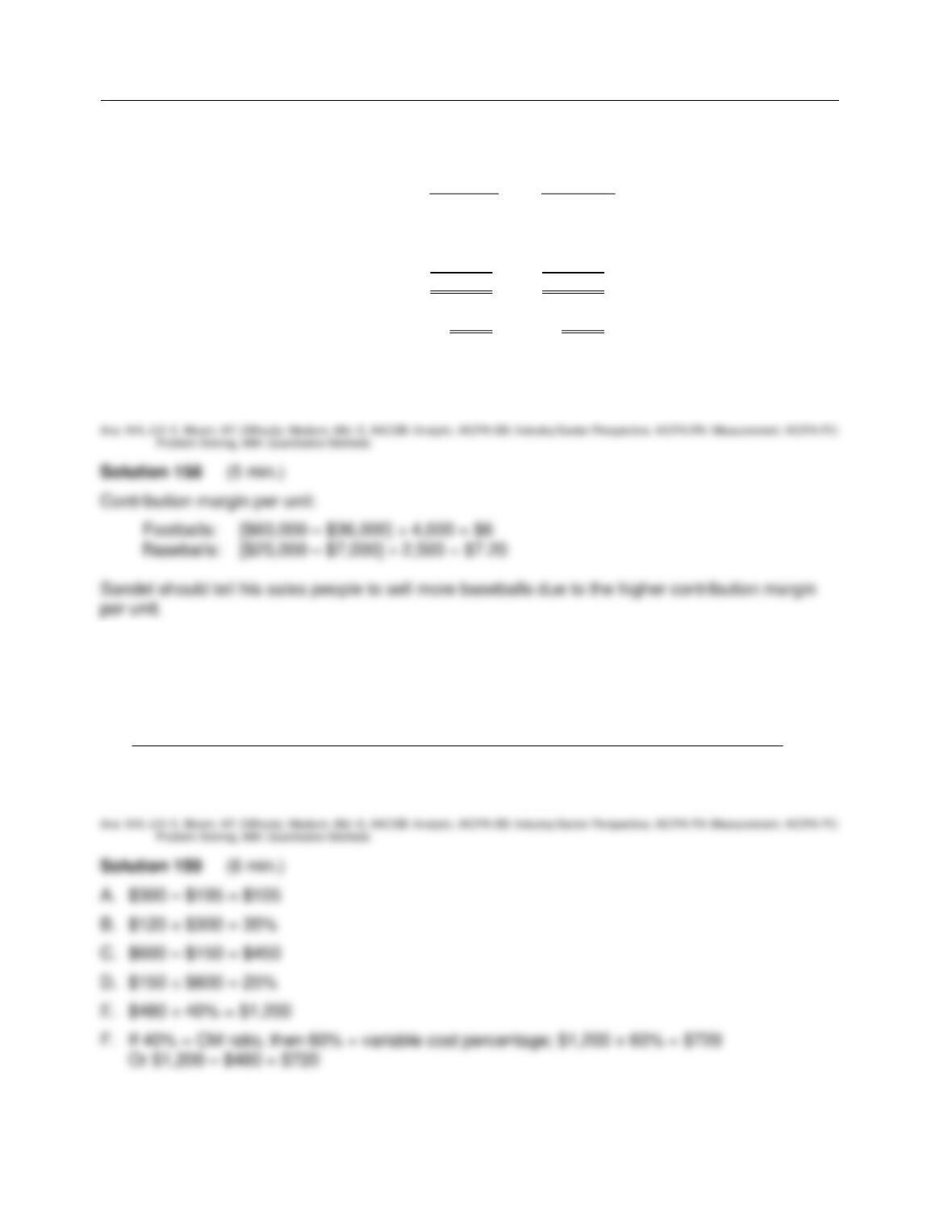
Compute the variable and fixed cost elements using the high-low method.
Test Bank for Accounting, Tools for Business Decision Making Fifth Edition
FOR INSTRUCTOR USE ONLY
18 – 32
BE 158
Sandel Company makes 2 products, footballs and baseballs. Additional information follows:
Footballs Baseballs
Units 4,000 2,500
Sales $60,000 $25,000
Variable costs 36,000 7,000
Fixed costs 9,000 9,000
Net income $15,000 $ 9,000
Profit per unit $3.75 $3.60
Instructions
Sandel has unlimited demand for both products. Therefore, which product should Sandel tell his
sales people to emphasize?
BE 159
Determine the missing amounts.
Unit Selling Price
Unit Variable Costs
Contribution Margin
per Unit
Contribution
Margin Ratio
1.
$300
$195
A.
B.
2.
$600
C.
$150
D.
3.
E.
F.
$480
40%
Cost-Volume-Profit
FOR INSTRUCTOR USE ONLY
18 – 33
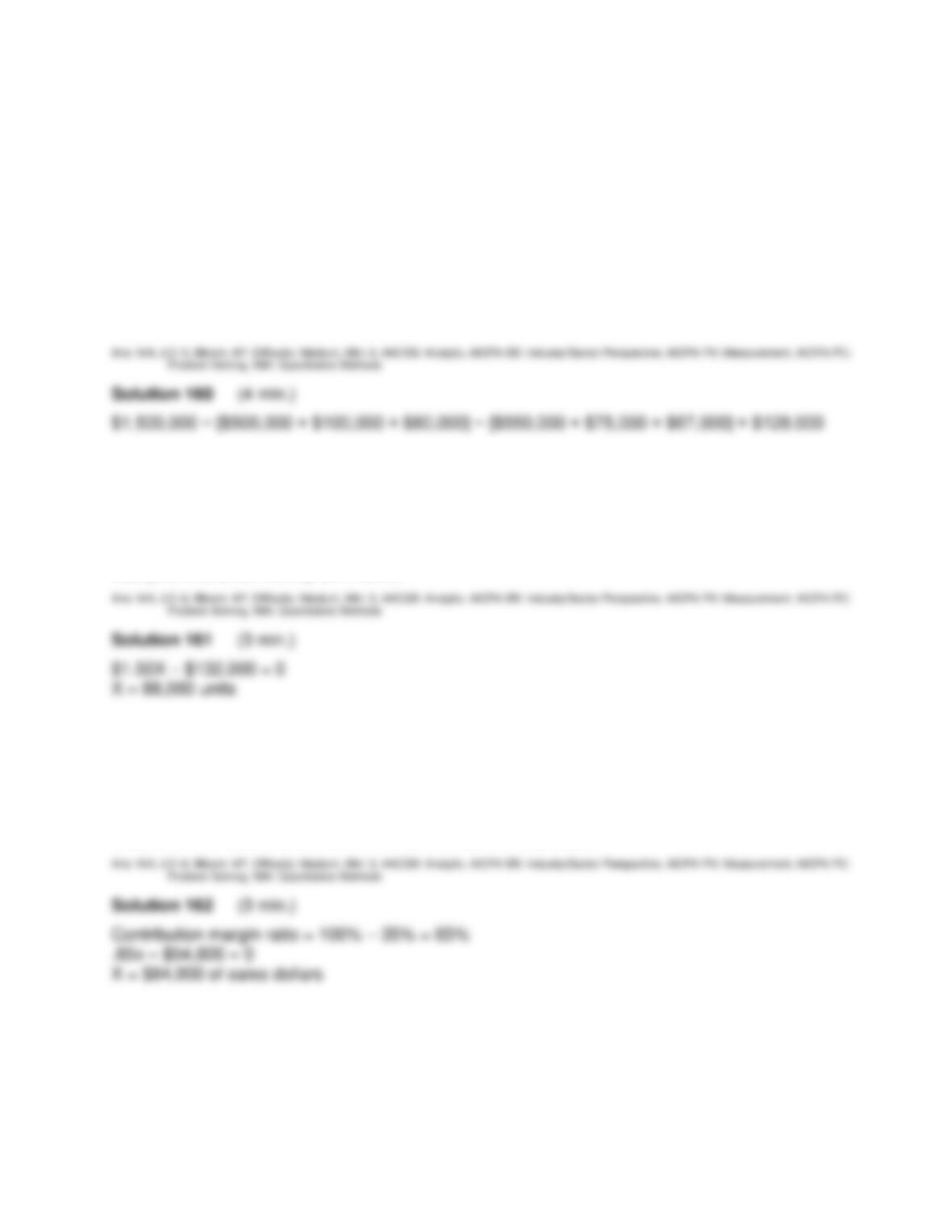
BE 160
Kipling Company has sales of $1,500,000 for the first quarter of 2013. In making the sales, the
company incurred the following costs and expenses.
Variable
Fixed
Product costs
$500,000
$550,000
Selling expenses
100,000
75,000
Administrative expenses
80,000
67,000
Instructions
Calculate net income under CVP for 2013.
BE 161
Hurly Co. has fixed costs totaling $132,000. Its contribution margin per unit is $1.50, and the
selling price is $5.50 per unit.
Instructions
Compute the break-even point in units.
BE 162
Salem Bakery sells boxes of donuts each with a variable cost percentage of 35%. Its fixed costs
are $54,600 per year.
Instructions
Determine the sales dollars Salem needs to break even per year.
Test Bank for Accounting, Tools for Business Decision Making Fifth Edition
FOR INSTRUCTOR USE ONLY
18 – 34
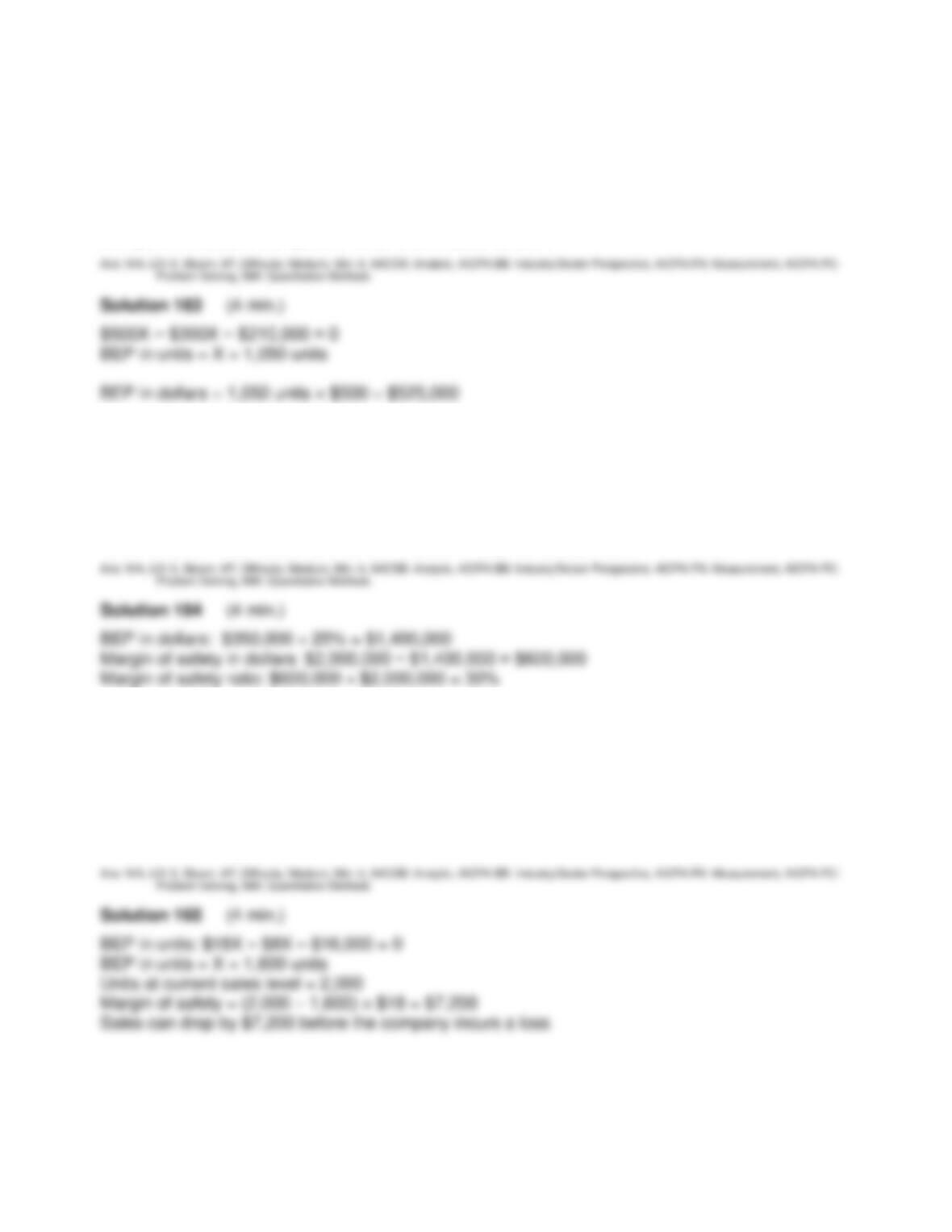
BE 163
Cannon Co. has a unit selling price of $500, variable cost per unit $300, and fixed costs of
$210,000.
Instructions
Compute the break-even point in units and in sales dollars.
BE 164
Oakbrook, Inc. reported actual sales of $2,000,000, and fixed costs of $350,000. The contribution
margin ratio is 25%.
Instructions
Compute the margin of safety in dollars and the margin of safety ratio.
BE 165
The following monthly data are available for Fortner Industries which produces only one product
which it sells for $18 each. Its unit variable costs are $8, and its total fixed expenses are $16,000.
Actual sales for the month of May totaled 2,000 units.
Instructions
Compute the margin of safety in dollars for the company for May.
Cost-Volume-Profit
FOR INSTRUCTOR USE ONLY
18 – 35
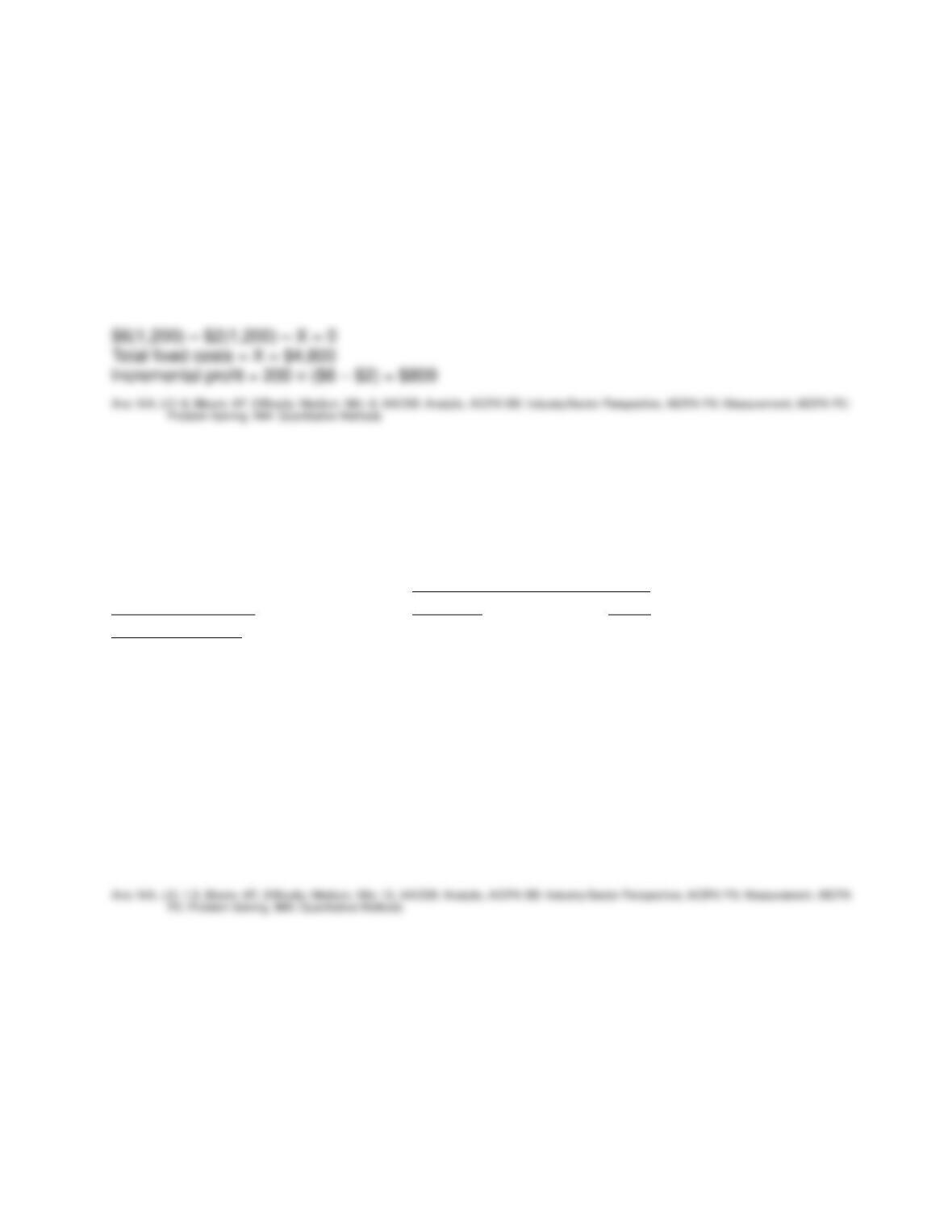
BE 166
At break-even point, a company sells 1,200 widgets. Its selling price is $6 per widget, variable
cost is $2 per widget, and its fixed cost is $4 per widget.
Instructions
If it sells 200 additional widgets, determine the company’s incremental profit.
Solution 166 (4 min.)
EXERCISES
Ex. 167
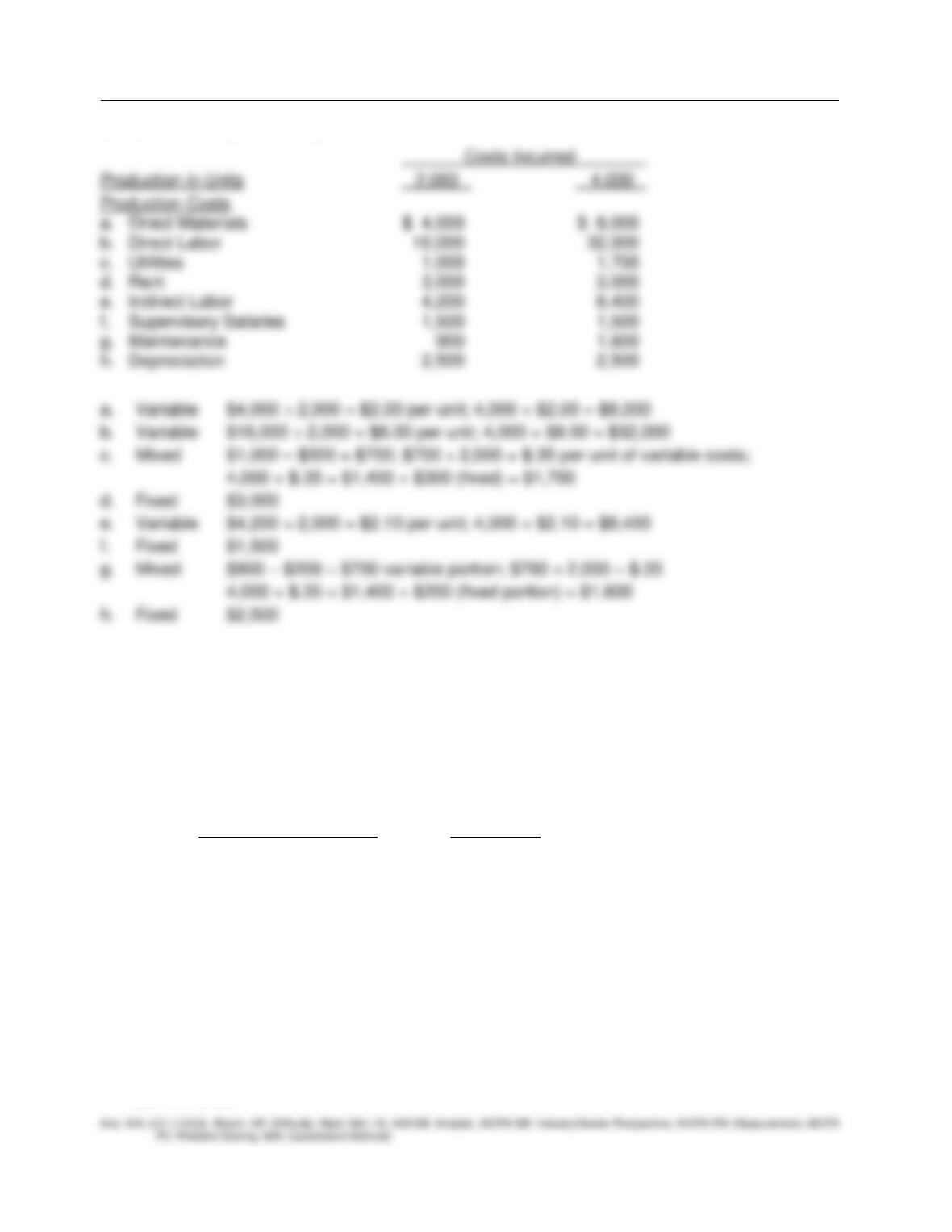
Sandburg Manufacturing manufactures a single product. Annual production costs incurred in the
manufacturing process are shown below for the production of 2,000 units. The Utilities and
Maintenance are mixed costs. The fixed portions of these costs are $300 and $200, respectively.
Costs Incurred
Production in Units 2,000 4,000
Production Costs
a. Direct Materials $ 4,000 ?
b. Direct Labor 16,000 ?
c. Utilities 1,000 ?
d. Rent 3,000 ?
e. Indirect Labor 4,200 ?
f. Supervisory Salaries 1,500 ?
g. Maintenance 900 ?
h. Depreciation 2,500 ?
Instructions
Calculate the expected costs to be incurred when production is 4,000 units. Use your knowledge
of cost behavior to determine which of the other costs are fixed or variable.
Test Bank for Accounting, Tools for Business Decision Making Fifth Edition
FOR INSTRUCTOR USE ONLY
18 – 36
Solution 167 (12–18 min.)
Ex. 168
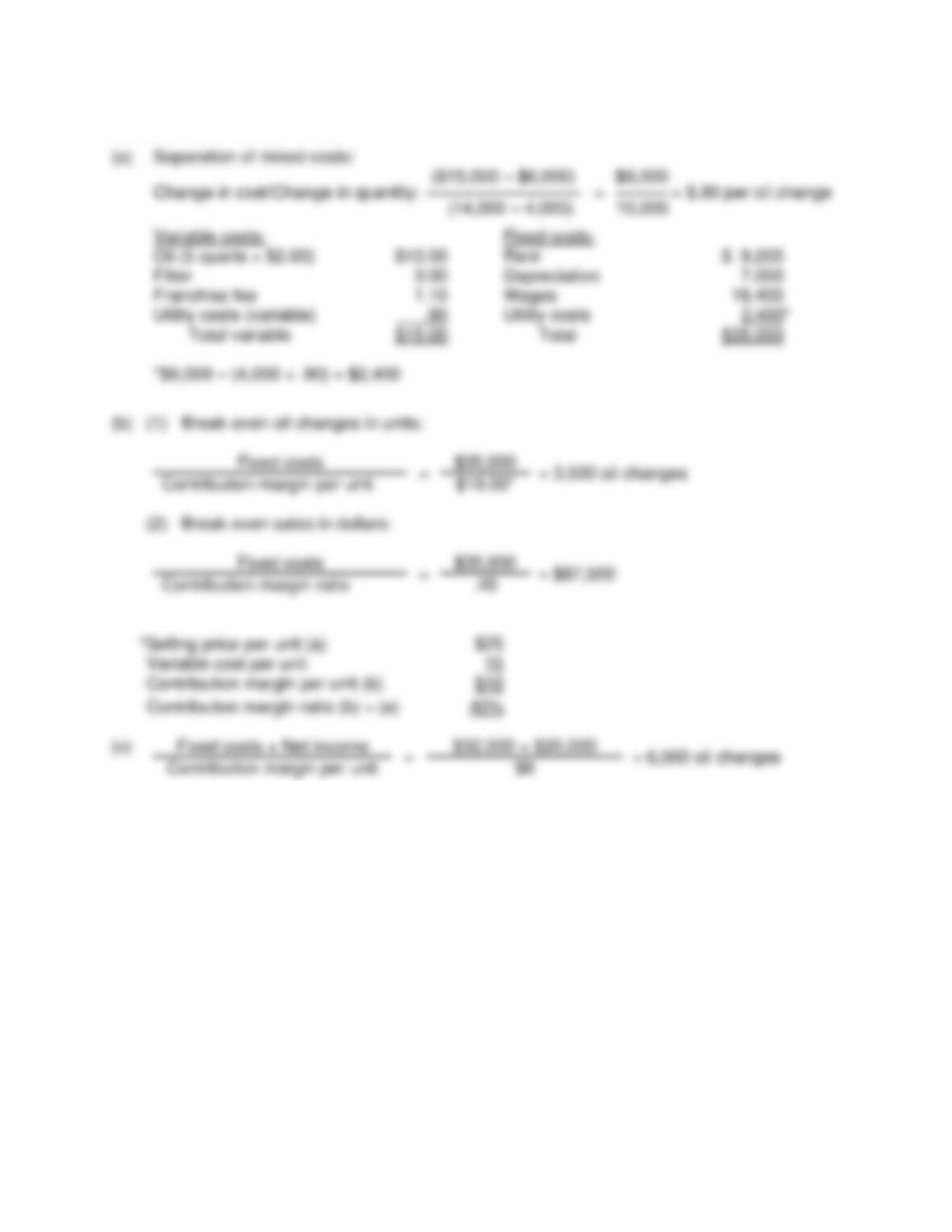
Bill Braddock is considering opening a Fast ‘n Clean Car Service Center. He estimates that the
following costs will be incurred during his first year of operations: Rent $9,200, Depreciation on
equipment $7,000, Wages $16,400, Motor oil $2.00 per quart. He estimates that each oil change
will require 5 quarts of oil. Oil filters will cost $3.00 each. He must also pay The Fast ‘n Clean
Corporation a franchise fee of $1.10 per oil change, since he will operate the business as a
franchise. In addition, utility costs are expected to behave in relation to the number of oil changes
as follows:
Number of Oil Changes Utility Costs
4,000 $ 6,000
6,000 $ 7,300
9,000 $ 9,600
12,000 $12,600
14,000 $15,000
Bill Braddock anticipates that he can provide the oil change service with a filter at $25 each.
Instructions
(a) Using the high-low method, determine variable costs per unit and total fixed costs.
(b) Determine the break-even point in number of oil changes and sales dollars.
(c) Without regard to your answers in parts (a) and (b), determine the oil changes required to
earn net income of $20,000, assuming fixed costs are $32,000 and the contribution margin
per unit is $8.
Cost-Volume-Profit
FOR INSTRUCTOR USE ONLY
18 – 37
Solution 168 (19–24 min.)
Ex. 169
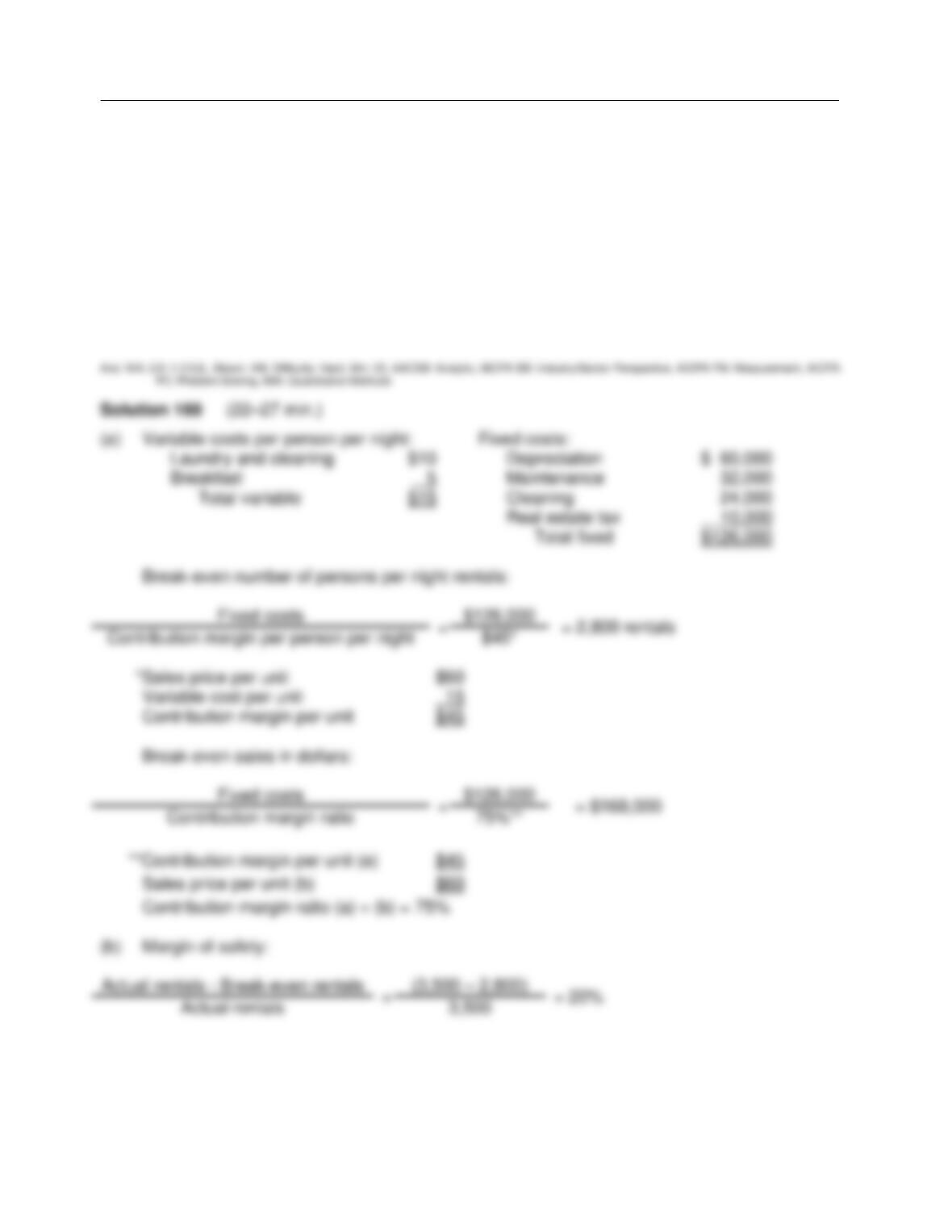
Jane Botosan operates a bed and breakfast hotel in a resort area near Lake Michigan.
Depreciation on the hotel is $60,000 per year. Jane employs a maintenance person at an annual
salary of $32,000 and a cleaning person at an annual salary of $24,000. Real estate taxes are
$10,000 per year. The rooms rent at an average price of $60 per person per night including
breakfast. Other costs are laundry and cleaning service at a cost of $10 per person per night and
the cost of food which is $5 per person per night.
Test Bank for Accounting, Tools for Business Decision Making Fifth Edition
FOR INSTRUCTOR USE ONLY
18 – 38
Ex. 169 (Cont.)
Instructions
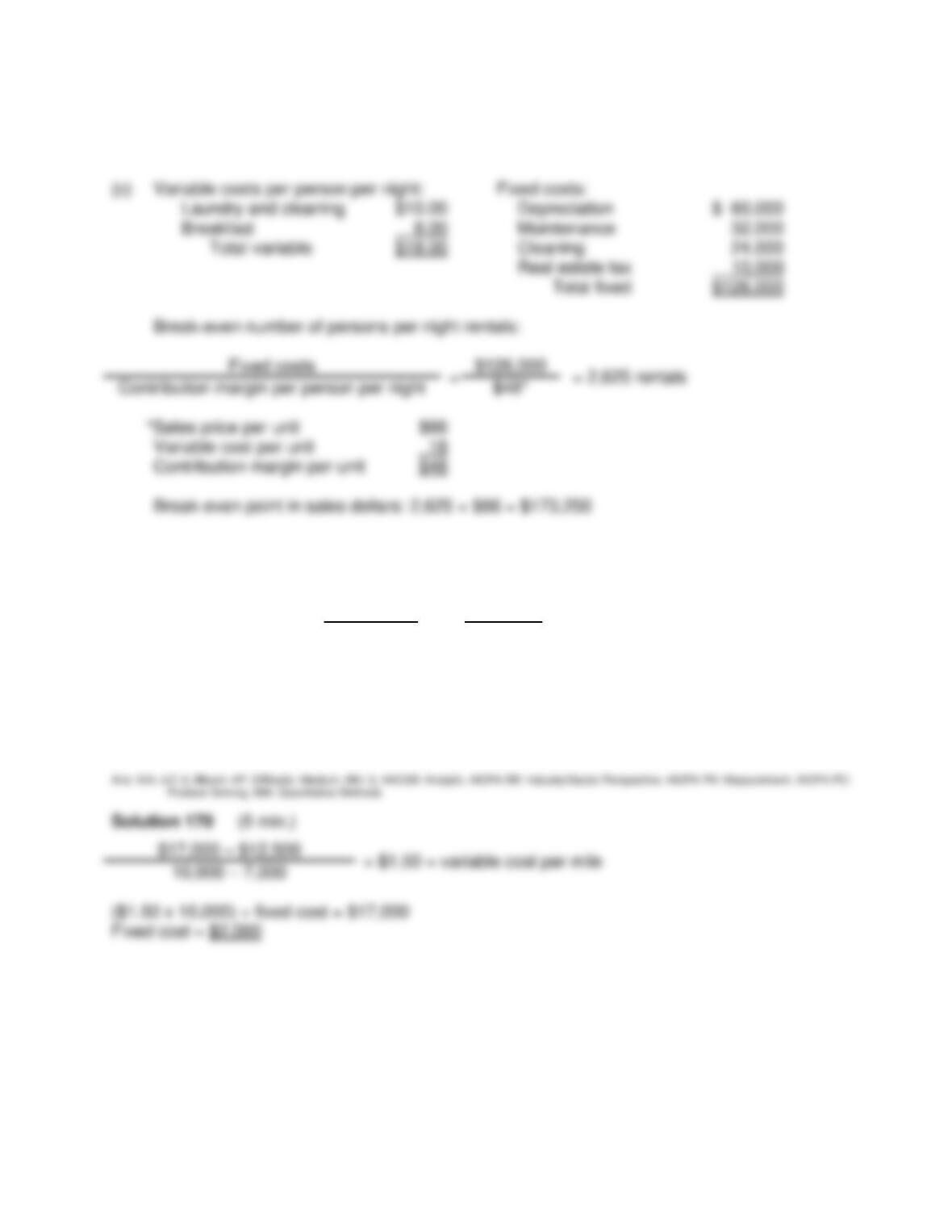
(a) Determine the number of rentals and the sales revenue Jane needs to break even using the
contribution margin technique.
(b) If the current level of rentals is 3,500, by what percentage can rentals decrease before Jane
has to worry about having a net loss?
(c) Jane is considering upgrading the breakfast service to attract more business and increase
prices. This will cost an additional $3 for food costs per person per night. Jane feels she can
increase the room rate to $66 per person per night. Determine the number of rentals and the
sales revenue Jane needs to break even if the changes are made.
Cost-Volume-Profit
FOR INSTRUCTOR USE ONLY
18 – 39
Solution 169 (Cont.)
Ex. 170
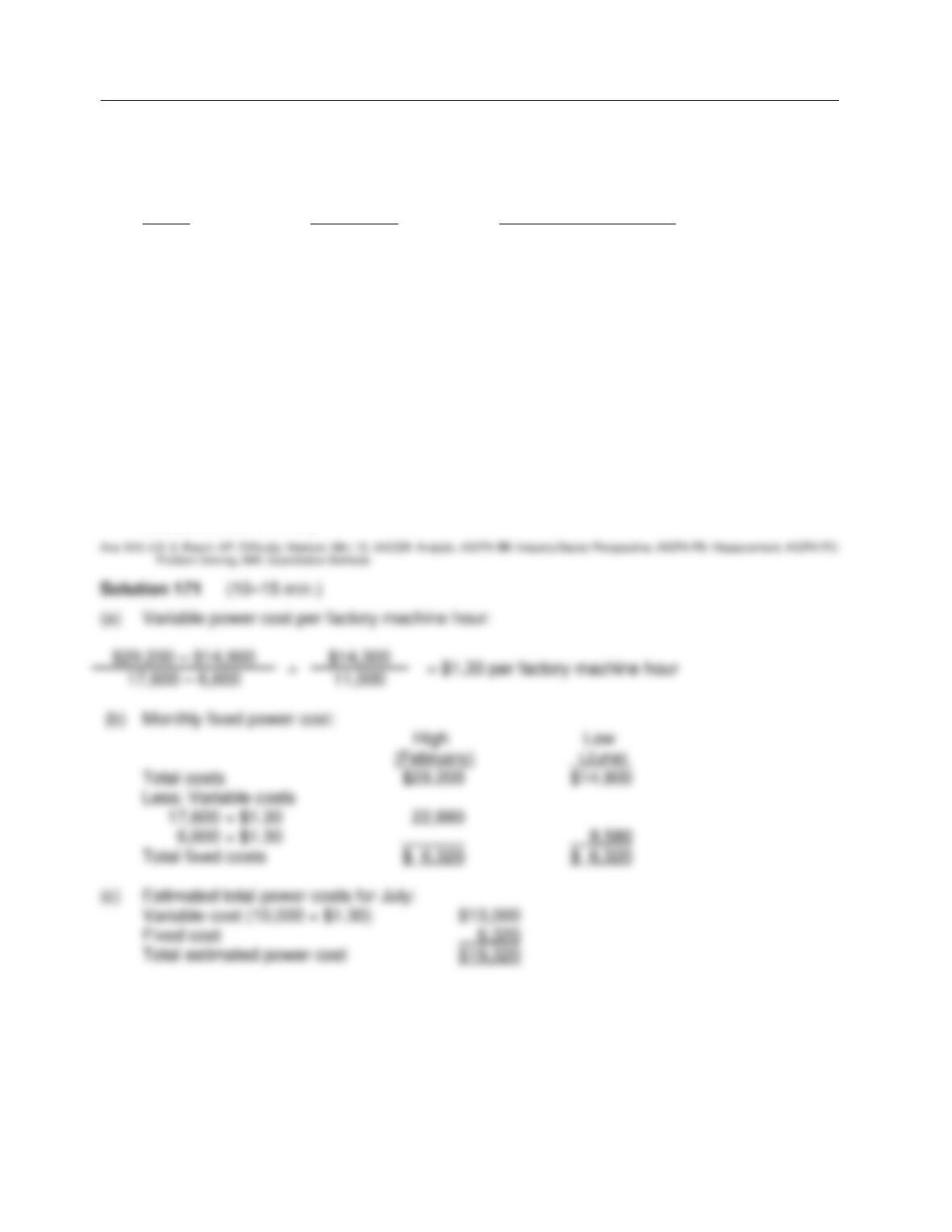
Corris Co. accumulates the following data concerning a mixed cost, using miles as the activity
level.
Miles Driven Total Cost
January 10,000 $17,000
February 8,000 13,500
March 9,000 14,400
April 7,000 12,500
Instructions
Compute the variable and fixed cost elements using the high-low method.
Test Bank for Accounting, Tools for Business Decision Making Fifth Edition
FOR INSTRUCTOR USE ONLY
18 – 40
Ex. 171
Moresan Co. gathered the following information on power costs and factory machine usage for
the last six months:
Month Power Cost Factory Machine Hours
January $24,400 13,900
February 29,200 17,600
March 29,000 16,800
April 22,340 13,200
May 19,900 11,600
June 14,900 6,600
Instructions
Using the high-low method of analyzing costs, answer the following questions and show
computations to support your answers.
(a) What is the estimated variable portion of power costs per factory machine hour?
(b) What is the estimated fixed power cost each month?
(c) If it is estimated that 10,000 factory machine hours will be run in July, what is the expected
total power cost for July?