
Money, Banking, and the Financial System (Hubbard/O’Brien)
Chapter 18 Monetary Theory II: The IS-MP Model
18.1 The IS Curve
1) If AE > Y, which of the following will NOT occur?
A) inventories will decline
B) actual investment will be more than planned investment
C) employment will increase
D) GDP will increase
2) If AE < Y, which of the following will NOT occur?
A) inventories will decline
B) actual investment will be more than planned investment
C) employment will decline
D) GDP will decline
3) The IS curve depicts the relationship between
A) aggregate output and the real interest rate.
B) investment demand and the real interest rate.
C) investment demand and the level of current output.
D) national saving and the level of current output.
4) In a move up the IS curve,
A) investment rises.
B) output falls.
C) the real interest rate falls.
D) saving rises.
5) Which of the following would NOT cause a shift in the IS curve?
A) an increase in the domestic real interest rate
B) an increase in consumer confidence
C) a decrease in the expected future profitability of capital
D) a decrease in government purchases
6) Which of the following would NOT cause the IS curve to shift to the left?
A) a decrease in government purchases
B) an increase in consumer confidence
C) a decrease in foreign demand for domestic products
D) a decrease in the expected future profitability of capital
7) Which of the following statements about potential GDP is false?
A) The Fed’s goal is to have equilibrium GDP close to potential GDP.
B) When GDP is at potential, cyclical unemployment is zero.
C) It occurs when firms are producing at their maximum level of output.
D) It occurs when firms are producing with a workforce of normal size working normal hours.
8) Which of the following does NOT lead to an increase in potential GDP?
A) labor force grows
B) technological change takes place
C) new machinery and equipment are installed
D) aggregate expenditures increase
9) The series of induced changes in consumption spending that result from an initial change in
autonomous expenditure is called the
A) induced effect.
B) autonomous effect.
C) multiplier effect.
D) consumption effect
10) If a $10 billion increase in investment leads to a $20 billion increase in GDP, the multiplier
is
A) 0.5
B) 2
C) 10
D) 30
11) In a simple model of the economy, if the MPC is 0.8, the multiplier will equal
A) 0.2
B) 0.8
C) 1.25
D) 5
12) The level of potential GDP
A) increases as the real rate of interest decreases.
B) increases as the real rate of interest increases.
C) is unaffected by the real rate of interest.
D) is represented on the IS-MP model by a horizontal line at the world real rate of interest.
13) An increase in the expected profitability of investment will cause
A) IS to shift right.
B) IS to shift left.
C) MP to shift upward.
D) MP to shift downward.
14) What effect would economic weakness in Europe due to a sovereign debt crisis have on the
U.S. economy?
A) IS shifts to the right
B) IS shifts to the left
C) potential GDP increases
D) potential GDP decreases
15) An increase in the real interest rate causes
A) the IS curve to shift to the right.
B) the IS curve to shift to the left.
C) a movement up the IS curve.
D) a movement down the IS curve.
16) What three parts of the economy are represented in the IS-MP model?
17) How is the economy likely to respond when AE (sales) exceed production?
18) How does the goods market return to equilibrium if AE is less than production?
19) What is potential GDP? What happens to unemployment when GDP is at its potential?
20) What is the difference between an autonomous change in spending and an induced change in
spending?
21) What is the multiplier effect?
22) What is the multiplier? If MPC =0.75, what is the value of the multiplier in the simple model
of the economy?
23) Use the following data to calculate equilibrium real GDP: C= .75Y, I = $2 trillion, G=$1
trillion and NX = -$0.5 trillion.
24) Explain how does an increase in real interest rates affect the components of AE.
25) What is the inflation gap? What is the output gap?
18.2 The MP Curve and the Phillips Curve
1) The MP curve represents
A) the Fed’s monetary policy actions in setting a target for the federal funds rate.
B) the relationship between the money supply and the price level.
C) a relationship between the real interest rate and manufacturing production.
D) the relationship between real interest rates and potential GDP.
2) Which interest rates is most relevant in determining aggregate expenditures?
A) federal funds rate
B) short-term real interest rate
C) long-term nominal interest rate
D) long-term real interest rate
3) All of the following help provide the basis for the Fed controlling the real interest rate in the
IS-MP model EXCEPT
A) the Fed controls the federal funds rate through open market operations.
B) if expected future inflation remains stable, changes in nominal interest rates reflect changes in
real interest rates.
C) short-term and long-term interest rates tend to move together.
D) the Fed’s increased use of TIPS in conducting monetary policy.
4) In the IS-MP model, when the Fed increases the real interest rate
A) the MP curve shifts up resulting in a decline in the output gap.
B) the MP curve shifts up resulting in an increase in the output gap.
C) the MP curve shifts down resulting in a decline in the output gap.
D) the MP curve shifts down resulting in an increase in the output gap.
5) When the Fed reduces the real interest rate, which of the following does NOT increase?
A) consumption
B) investment
C) government purchases
D) net exports
6) The graph of the short-run relationship between the unemployment rate and inflation is called
a(n)
A) MP curve.
B) LM curve.
C) IS curve.
D) Phillips curve.
7) Economists who have studied the Phillips curve have concluded that it can shift due to all of
the following EXCEPT
A) demand shccks.
B) supply shocks.
C) changes in household expectations of inflation.
D) changes in firms’ expectations of inflation.
8) Most economists think changes in which type of unemployment affects inflation?
A) frictional unemployment
B) cyclical unemployment
C) structural unemployment
D) natural rate of unemployment
9) The relationship between the output gap and the cyclical rate of unemployment is known as
A) the Phillips curve.
B) the LM curve.
C) Murphy’s law.
D) Okun’s law.
10) Which of the following is NOT a reason given by economists for the failure of Okun’s law to
account for the rise in unemployment during the recession of 2007-2009?
A) increased willingness among firms to lay off workers during recessions
B) a surge in productivity during the recession
C) the unusual severity of the recession
D) it does not take into account the effect of the stimulus
11) How do expectations of higher inflation become embedded in the economy and affect actual
inflation?
12) How can the difference between the current unemployment rate and the natural rate of
unemployment help explain changes in inflation?

18.3 Equilibrium in the IS-MP model
1) A closed economy is one in which
A) investment spending is zero.
B) government spending is zero.
C) there are no imports or exports.
D) demand equals supply in every market.
2) In a closed economy, the total quantity of goods demanded equals the sum of
A) consumption spending, investment spending, and government spending.
B) consumption spending, national saving, and taxes.
C) consumption spending, government spending, and taxes.
D) investment spending, national saving, and taxes.
3) In a closed economy, the goods market is in equilibrium when
A) Y = S + I + G.
B) C + S = I + G.
C) C + I = S + G.
D) Y = C + I + G.

4) In a closed economy, if the goods market is in equilibrium, national saving is $2 trillion,
national consumption is $7 trillion, and government purchases are $2.5 trillion, then GDP equals
A) $7 trillion.
B) $9.5 trillion.
C) $11.5 trillion.
D) Not enough information has been provided to determine the answer.
5) In a closed economy, national saving equals
A) C + I + G.
B) Y – C – G.
C) Y – C – I.
D) Y – G – I.
6) For the goods market to be in equilibrium in a closed economy, which of the following must
be true?
A) Y = S + I + G
B) S + I = C + G
C) S + G = Y + C
D) S = I
7) All of the following are likely results of a negative demand shock EXCEPT
A) a negative output gap.
B) lower inflation.
C) IS shifts to the left.
D) Phillips curve shifts to the left.
8) Which of the following is the least likely take place if the Fed responds to a negative demand
shock by reducing the real interest rate?
A) IS shifts to the right
B) output gap returns to zero
C) inflation returns to its previous rate
D) MP shifts down
9) Which of the following prevented the Fed from reducing long-term real interest rates during
the Financial Crisis of 2007-2009?
A) an increase in expected inflation
B) an increase in the risk premium
C) the collapse in the housing market
D) the failure of the federal funds rate to respond to monetary policy
10) What unusual measures did the Fed take in trying to reduce the risk premium during the
Financial Crisis of 2007-2009?
A) buying mortgage-backed securities issued by Fannie Mae and Freddie Mac
B) reducing the federal funds rate multiple times
C) issuing its own securities
D) eliminating the discount rate on loans to member banks
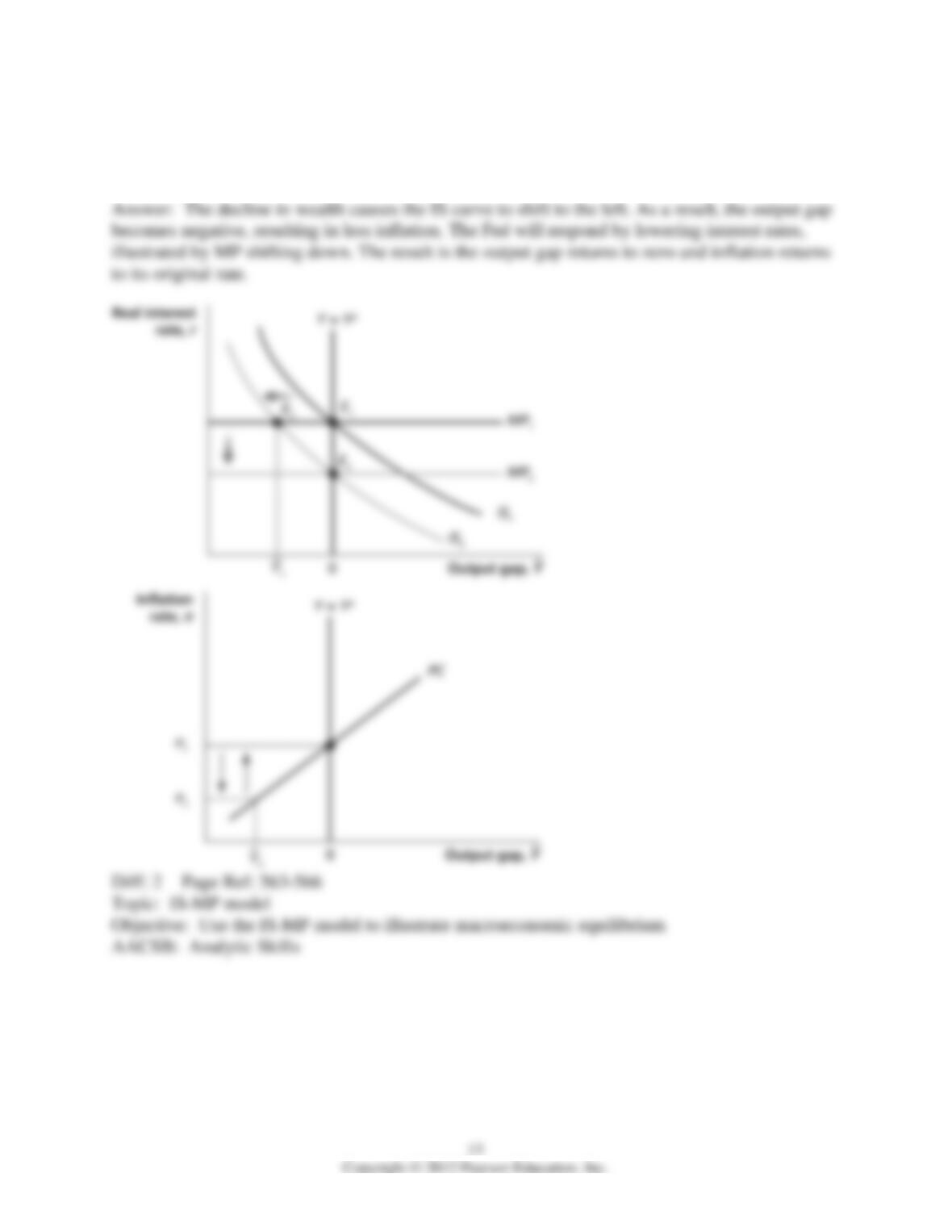
11) Suppose the stock market crashes resulting in a significant decline in the wealth of
consumers. Make use of the IS-MP model to illustrate the impact this has on the economy. How
is the Fed likely to respond? Show the impact of the change in monetary policy on the graph of
the IS-MP model.
12) What limited the effectiveness of monetary policy during the Financial Crisis of 2007-2009?
18.4 Are Interest Rates All that Matter for Monetary Policy?
1) The bank lending channel
A) emphasizes the role of interest rates in the money supply process.
B) emphasizes the importance of borrowers’ net worth to the decision of lenders to grant loans.
C) emphasizes the behavior of bank-dependent borrowers.
D) is another name for the interest rate channel.
2) In the bank lending channel, an important reason for output increases in the short run after an
expansionary monetary policy is that
A) the funds directly available for households and firms to spend will increase.
B) prices will increase, making increased production more profitable for firms.
C) the increase in government spending from an expansionary monetary policy increases output
through the multiplier effect.
D) the ability of banks to make loans will increase.
3) Which of the following is NOT true of the interest rate channel?
A) bank loans play no special role.
B) the Fed changes the real interest rate which affects the components of aggregate expenditures.
C) borrowers are indifferent as to how and from whom they raise funds.
D) alternative sources of funds are not substitutes for each other.
4) Which of the following statements is correct?
A) Because in practice few borrowers are bank-dependent, the bank lending channel is of little
real-world importance.
B) In the interest rate channel, an expansionary monetary policy may cause a leftward shift in the
AD curve.
C) In the bank lending channel, an expansionary monetary policy can increase output in the short
run even if it does not result in a decrease in the real interest rate.
D) In the interest rate channel, an expansionary monetary policy affects spending but not output.
5) Analysts have attempted to model the impact of monetary policy on net worth by emphasizing
A) the impact of lower interest rates on business spending on fixed investment.
B) the impact of lower interest rates on household spending on housing and durable goods.
C) the liquidity of balance sheet positions as a determinant of business and household spending.
D) the greater variability of business spending compared to household spending.
6) The balance sheet channel describes ways in which interest rate changes resulting from
monetary policy affect
A) the portfolio decisions of households.
B) the portfolio decisions of businesses.
C) borrowers’ net worth.
D) lenders’ net worth.

7) Increases in interest rates
A) reduce borrowers’ net worth.
B) reduce lenders’ net worth.
C) increase the present value of borrowers’ assets.
D) raise the cost to businesses of internal funding.
8) Changes in net worth and liquidity may significantly affect the volume of lending and
economic activity according to the
A) interest rate channel.
B) balance sheet channel.
C) money channel.
D) bank lending channel.
9) Monetary policy can have substantial effects on the economy even when nominal interest rates
are very low
A) since real rates are what affects borrowing and spending decisions.
B) by improving borrower and bank balance sheets.
C) by reducing transactions costs.
D) only when the policy is substantial.
10) Lower interest rates which reduce the debt-servicing burden of households, thus increasing
their net worth, is best described by the
A) bank lending channel.
B) money channel.
C) financial market channel.
D) balance sheet channel.
11) How does an expansionary monetary policy affect aggregate expenditures according to the
bank lending channel?
18.5 Appendix: The IS-LM Model
1) A decline in the output gap causes the demand for real balances
A) to rise and the interest rate to fall.
B) to fall and the interest rate to rise.
C) and the interest rate to fall.
D) and the interest rate to rise.
2) An increase in the output gap causes the demand for real balances
A) to rise and the interest rate to fall.
B) to fall and the interest rate to rise.
C) and the interest rate to fall.
D) and the interest rate to rise.
3) The LM curve is the combinations of
A) the output gap and the real interest rate for which the money market is in equilibrium.
B) the inflation rate and nominal interest rate for which the money market is in equilibrium.
C) the inflation rate and real interest rate for which the money market is in equilibrium.
D) the inflation rate and real interest rate for which the goods market is in equilibrium.
4) The LM curve slopes upward to the right because
A) the demand for money plus the demand for nonmoney assets must equal the supply of money
plus the supply of nonmoney assets.
B) a higher real interest rate is associated with a higher level of the output gap in money market
equilibrium.
C) a higher real interest rate is associated with a higher level of saving in goods market
equilibrium.
D) in equilibrium the actual real interest rate must increase one-for-one with expected real
interest rate.
5) At any point along the LM curve,
A) the quantity of money demanded equals the quantity of money supplied.
B) the economy must be in general equilibrium.
C) the nominal interest rate must equal the real interest rate.
D) saving must equal investment.
6) An increase in the money supply will cause
A) the IS curve to shift down and to the right.
B) the IS curve to shift up and to the left.
C) the LM curve to shift down and to the right.
D) the LM curve to shift up and to the left.