Chapter 18: Derivatives True/False Page 619
(Difficulty Levels: Easy, Easy/Medium, Medium, Medium/Hard, and Hard)
Please see the preface for information on the AACSB letter indicators (F, M, etc.) on the subject
lines.
Multiple Choice: True/False
1
. One objective of risk management can be to reduce the volatility of a
firm’s cash flows.
a. True
b. False
2
. In theory, reducing the volatility of its cash flows will always
increase a company’s value.
a. True
b. False
3
. Interest rate swaps allow a firm to exchange fixed for floating-rate
payments, but a swap cannot reduce actual net interest expenses.
a. True
b. False
4
. Speculative risks are symmetrical in the sense that they offer the
chance of a gain as well as a loss, while pure risks are those that can
only lead to losses.
a. True
b. False
5
. The two basic types of hedges involving the futures market are long
hedges and short hedges, where the words “long” and “short” refer to
the maturity of the hedging instrument. For example, a long hedge
might use Treasury bonds, while a short hedge might use 3–month T–
bills.
a. True
b. False
CHAPTER 18
DERIVATIVES AND RISK MANAGEMENT
Page 620 Conceptual M/C Chapter 18: Derivatives
Multiple Choice: Conceptual
6
. Which of the following is NOT an example of a derivative security?
a. Futures.
b. Options.
c. Swaps.
d. Forward contracts.
e. Preferred stock.
7
. The value of a stock option depends on all of the following EXCEPT:
a. Exercise price.
b. Variability of the stock price.
c. Length of time until option expiration.
d. Risk-free rate of interest.
e. Bond price.
8
. Which of the following statements concerning risk management is NOT
CORRECT?
a. Risk management can reduce the volatility of cash flows, and this
decreases the probability of bankruptcy.
b. Risk management makes sense for firms directly engaged in activities
that involve commodities whose values can be hedged, but it doesn’t
make much sense for most other firms.
c. Companies with volatile earnings pay more taxes than companies with
more stable earnings due to the treatment of tax credits and the
rules governing corporate loss carry-forwards and carry-backs.
Therefore, our tax system encourages risk management to stabilize
earnings.
d. Risk management can reduce the likelihood of low cash flows, and
therefore reduce the probability of financial distress.
e. Risk management involves identifying events that could have adverse
financial consequences and then taking actions to prevent and/or to
minimize the damage caused by these events.
9
. An option that gives the holder the right to sell a stock at a
specified price at some time in the future is called a(n)
a. Call option.
b. Put option.
c. Out-of-the-money option.
d. Naked option.
e. Covered option.
Chapter 18: Derivatives Conceptual M/C Page 621
10
. An option that gives the holder the right to buy a stock at a specified
price at some time in the future is called a(n)
a. Call option.
b. Put option.
c. Out-of-the-money option.
d. Naked option.
e. Covered option.
11
. A call option whose underlying stock value is less than the
corresponding exercise price is an example of a(n)
a. Straddle option.
b. Put option.
c. Out-of-the-money option.
d. Naked option.
e. Covered option.
12
. An investor who “writes” a call option without the stock in his or her
portfolio to back it up is selling a(n)
a. Call option.
b. Put option.
c. Out-of-the-money option.
d. Naked option.
e. Covered option.
13
. An investor who ”writes” a call option against stock held in his or her
portfolio is selling a(n)
a. Straddle option.
b. Put option.
c. Out-of-the-money option.
d. Naked option.
e. Covered option.
14
. Which of the following statements is CORRECT?
a. Put options give investors the right to buy a stock at a certain
exercise price before a specified date.
b. Call options give investors the right to sell a stock at a certain
exercise price before a specified date.
c. Options typically sell for less than their exercise value.
d. LEAPS are very short-term options that have begun trading on the
exchanges in recent years.
e. Option holders are not entitled to receive dividends unless they
choose to exercise their option.
Page 622 Conceptual M/C Chapter 18: Derivatives
15
. Which of the following is NOT a way risk management can be used to
increase the value of a firm?
a. Risk management can increase debt capacity.
b. Risk management can help a firm maintain its optimal capital budget.
c. Risk management can reduce the expected costs of financial distress.
d. Risk management can help firms minimize taxes.
e. Risk management can allow managers to defer receipt of their bonuses
and thus postpone tax payments.
16
. Deeble Construction Co.’s stock is trading at $30 a share. There are
also call options on the company’s stock, some with an exercise price
of $25 and some with an exercise price of $35. All options expire in 3
months. Which of the following best describes the value of these
options?
a. If Deeble’s stock price rose by $5, the exercise value of the
options with the $25 exercise price would also increase by $5.
b. The options with the $25 exercise price will sell for less than the
options with the $35 exercise price.
c. The options with the $25 exercise price have an exercise value
greater than $5.
d. The options with the $35 exercise price have an exercise value
greater than $0.
e. The options with the $25 exercise price will sell for $5.
17
. Which of the following statements is most CORRECT?
a. One advantage of forward contracts is that they are default free.
b. Futures contracts generally trade on an organized exchange and are
marked to market daily.
c. Goods are never delivered under forward contracts, but are almost
always delivered under futures contracts.
d. Forward contracts are generally standardized instruments, whereas
futures contracts are generally tailor-made for the 2 parties of the
contract.
e. Essentially there are no differences between forward and futures
contracts, except that forward contracts are used only for financial
assets while futures contracts are used only for commodities.
18
. A swap is a method used to reduce financial risk. Which of the
following statements about swaps, if any, is NOT CORRECT?
a. A swap involves the exchange of cash payment obligations.
b. The earliest swaps were currency swaps, in which companies traded
debt denominated in different currencies, say dollars and pounds.
c. Swaps are very often arranged by a financial intermediary, who may
or may not take the position of one of the counterparties.
d. A problem with swaps is that no standardized contracts exist, which
has prevented the development of a secondary market.
Chapter 18: Derivatives Conceptual M/C Page 623
e. Swaps can involve side payments in order to get the counterparty to
agree to the swap.
19
. A commercial bank recognizes that its net income suffers whenever
interest rates increase. Which of the following strategies would
protect the bank against rising interest rates?
a. Buying inverse floaters.
b. Entering into an interest rate swap where the bank receives a fixed
payment stream, and in return agrees to make payments that float
with market interest rates.
c. Purchase principal only (PO) strips that decline in value whenever
interest rates rise.
d. Enter into a short hedge where the bank agrees to sell interest rate
futures.
e. Sell some of the bank’s floating–rate loans and use the proceeds to
make fixed-rate loans.
20
. There are call options on the common stock of XYZ Corporation. Which
of the following best describes the factors that affect call option
values?
a. The price of call options will rise if XYZ’s stock price rises.
b. The higher the strike price, the higher the call option price.
c. Assuming the same strike price, a call option that expires in 1
month will sell for a higher price than one that expires in 3
months.
d. The less volatile a stock’s price, the more valuable a call option
on the stock is.
e. If the risk–free rate of interest increases, the value of call
options will decrease.
21
. Which of the following events is likely to decrease the value of call
options on the common stock of GCC Company?
a. An increase in GCC’s stock price.
b. An increase in the exercise price of the option.
c. An increase in the amount of time until the option expires.
d. An increase in the risk-free rate.
e. GCC’s stock price becomes more risky (higher variance).
22
. Which of the following statements regarding factors that affect call
option prices is CORRECT?
a. The longer the time until the call option expires the smaller its
value and the smaller its premium.
b. An option on an extremely volatile stock is worth less than one on a
very stable stock.
c. The price of a call option increases as the risk-free rate
increases.

Page 624 Conceptual M/C Chapter 18: Derivatives
d. Two call options on the same stock will have the same value even if
they have different strike prices.
e. If you observe that a put option on a stock increases in value, then
a call option on that same stock also increases in value.
Chapter 18: Derivatives Conceptual M/C Page 625
23
. Which of the following statements is CORRECT?
a. An option’s value is determined by its exercise value, which is the
market price of the stock less its strike price. Thus, an option
can’t sell for more than its exercise value.
b. As a stock’s price increases, the premium portion of an option on
that stock increases because the difference between the stock price
and the fixed strike price increases.
c. If the company is consistently profitable, its call options will
always be in the money.
d. The market value of an option depends in part on the option’s length
of time until expiration and on the variability of the underlying
stock’s price.
e. The potential loss on an option decreases as the option sells at
higher and higher prices because the profit margin becomes larger.
24
. A riskless hedge can best be defined as
a. A situation in which aggregate risk can be reduced by derivatives
transactions between two parties.
b. A hedge in which an investor buys a stock and simultaneously sells a
call option on that stock and ends up with a riskless position.
c. Standardized contracts that are traded on exchanges and are “marked
to market” daily, but where physical delivery of the underlying
asset is virtually never taken.
d. Two parties agree to exchange obligations to make specified payment
streams.
e. Simultaneously buying and selling a call option with the same
exercise price.
25
. Warnes Motors’ stock is trading at $20 a share. Three-month call
options with an exercise price of $20 have a price of $1.50. Which of
the following will occur if the stock price increases 10% to $22 a
share?
a. The price of the call option will increase by $2.
b. The price of the call option will increase by less than $2, but the
percentage increase in price will be more than 10%.
c. The price of the call option will increase by less than $2, and the
percentage increase in price will be less than 10%.
d. The price of the call option will increase by more than $2.
e. The price of the call option will increase by more than $2, but the
percentage increase in price will be less than 10%.
Page 626 M/C Problems Chapter 18: Derivatives
Multiple Choice: Problems
26
. A 6-month call option on Romer Technologies’ stock has a strike price
of $45 and sells in the market for $8.25. Romer’s current stock price
is $48. What is the exercise value of the option?
a. $3.00
b. $3.75
c. $4.69
d. $5.86
e. $7.32
27
. A 6-month call option on Meyers Inc.’s stock has a strike price of $45
and sells in the market for $8.25. Meyers’ current stock price is $48.
What is the option premium?
a. $4.25
b. $4.73
c. $5.25
d. $5.78
e. $6.35
28
. A 6-month put option on Makler Corp.’s stock has a strike price of $45
and sells in the market for $8.90. Makler’s current stock price is
$41. What is the exercise value of the option?
a. $2.62
b. $2.92
c. $3.24
d. $3.60
e. $4.00
29
. A 6-month put option on Smith Corp.’s stock has a strike price of $45
and sells in the market for $8.90. Smith’s current stock price is $41.
What is the option premium?
a. $4.41
b. $4.90
c. $5.39
d. $5.93
e. $6.52
Chapter 18: Derivatives M/C Problems Page 627
30
. Looking at The Wall Street Journal you observe that the settlement
price on a hypothetical 10-year, semiannual payment, 6% coupon Treasury
note is 105-21. If the note has a $1,000 par value, what is the
implied Treasury note rate?
a. 5.27%
b. 5.53%
c. 5.80%
d. 6.10%
e. 6.40%
31
. Lissa Co.’s stock price is currently $30.25. A 6-month call option on
Lissa’s stock has a strike price of $25 and has an expected volatility
of 40% (i.e., expected standard deviation = 40%). The risk-free rate
is 6%. According to the Black-Scholes option pricing model, what is
the value of the option?
a. $5.06
b. $5.62
c. $6.24
d. $6.94
e. $7.63
32
. Suppose a CBOT 10-year U.S. Treasury note futures contract has a quoted
price of 89-09. What is the implied annual interest rate inherent in
this futures contract?
a. 6.81%
b. 7.17%
c. 7.55%
d. 7.92%
e. 8.32%
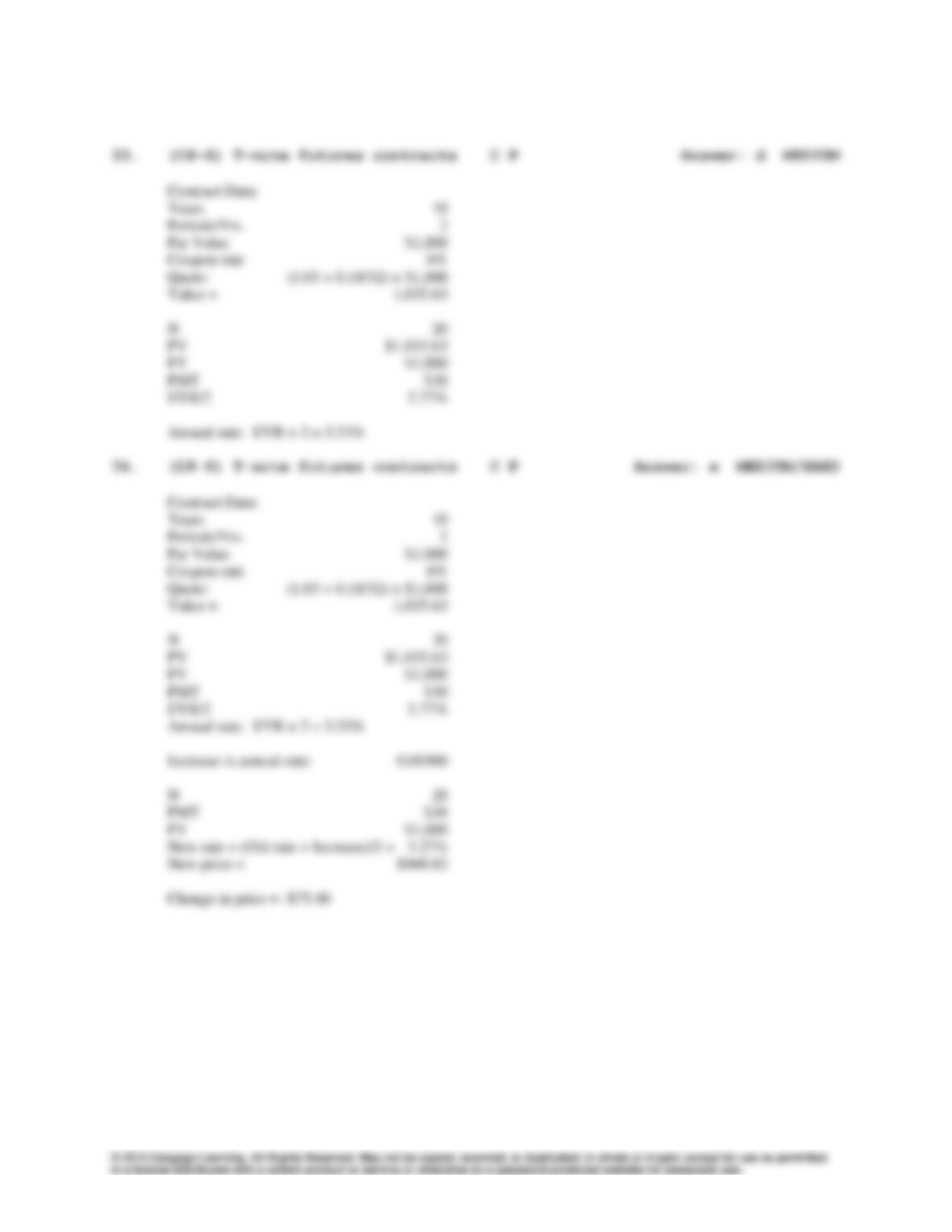
33
. Suppose a CBOT 10-year U.S. Treasury note futures contract has a quoted
price of 103-18. What is the implied annual interest rate inherent in
the futures contract?
a. 4.74%
b. 4.99%
c. 5.25%
d. 5.53%
e. 5.81%
Page 628 M/C Problems Chapter 18: Derivatives
34
. Suppose a CBOT 10-year U.S. Treasury note futures contract has a quoted
price of 103-18. If annual interest rates go up by 1.00 percentage
point, what is the gain or loss on the futures contract? (Assume a
$1,000 par value, round the new interest rate to 4 decimal places when
written as a decimal, and round the change in price up to the nearest
whole dollar.)
a. -$61.00
b. -$64.00
c. -$67.00
d. -$71.00
e. -$75.00
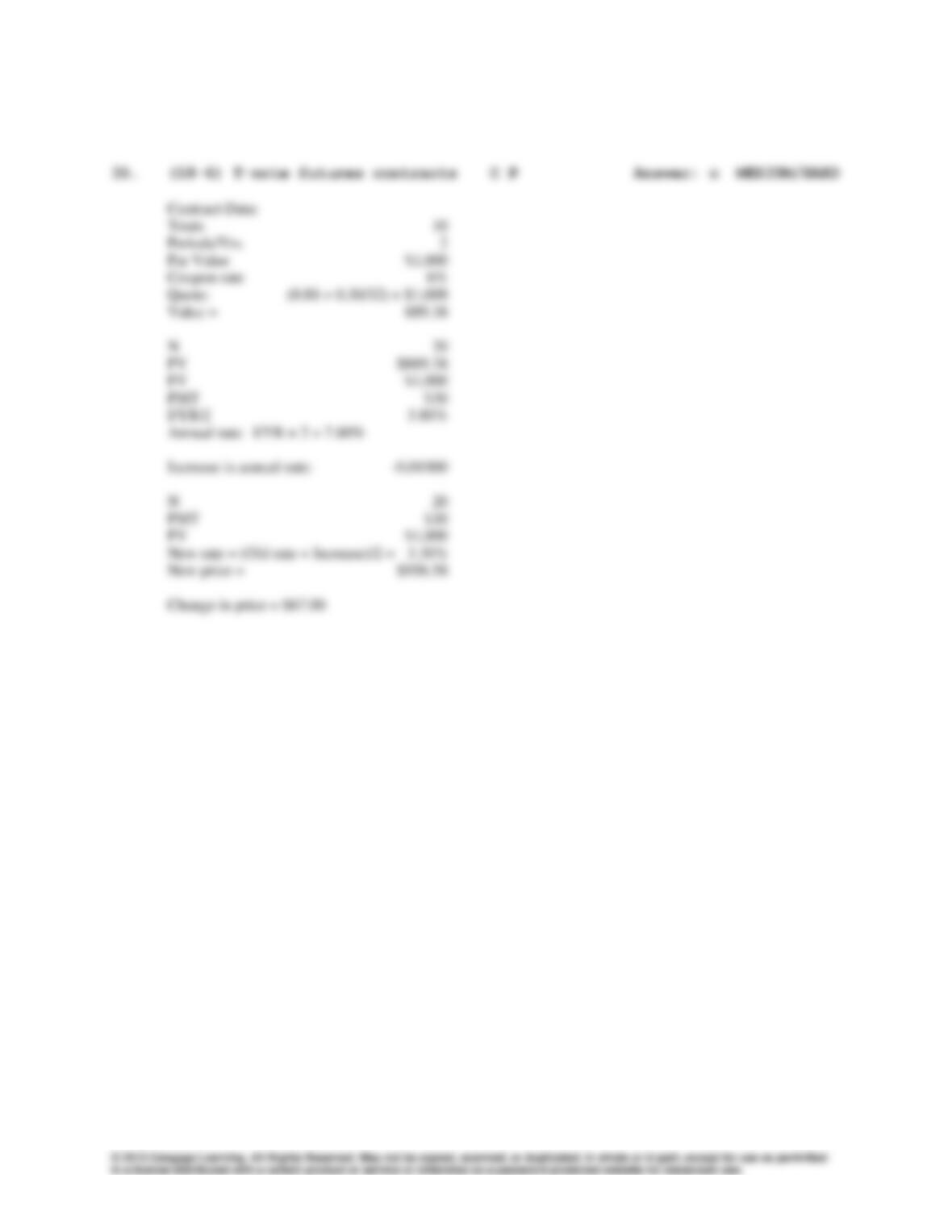
35
. Suppose a CBOT 10-year U.S. Treasury note futures contract has a quoted
price of 88-30. If annual interest rates go down by 1.00 percentage
point, what is the gain or loss on the futures contract? (Assume a
$1,000 par value, round the new interest rate to 4 decimal places when
written as a decimal, and round the change in price up to the nearest
whole dollar.)
a. $63.00
b. $65.00
c. $67.00
d. $69.00
e. $71.00
Chapter 18: Derivatives Answers Page 629
CHAPTER 18
ANSWERS AND SOLUTIONS
Page 630 Answers Chapter 18: Derivatives
Chapter 18: Derivatives Answers Page 631
Page 632 Answers Chapter 18: Derivatives
Chapter 18: Derivatives Answers Page 633