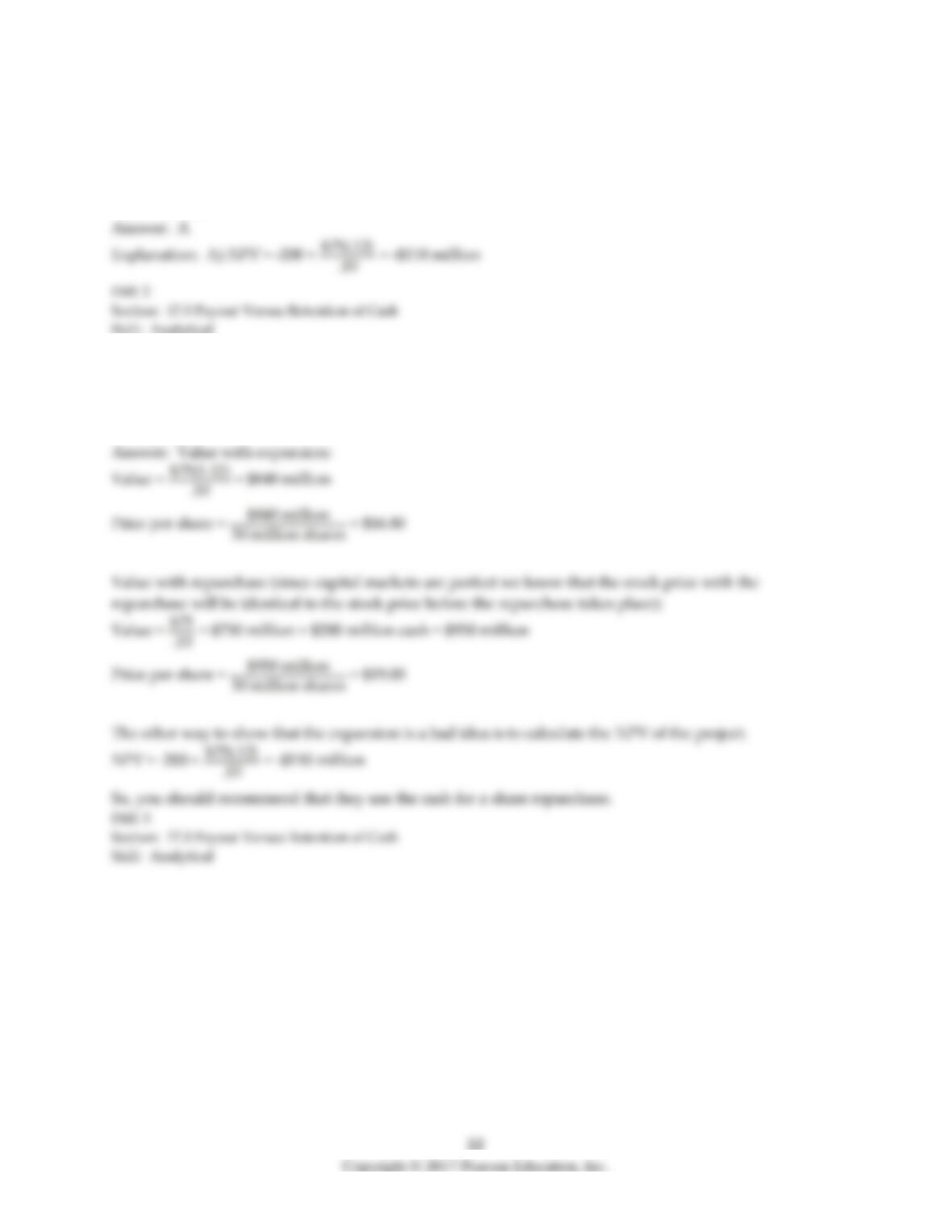
21) The NPV of Iota’s expansion project is closest to:
A) -$110 million
B) -$137.5 million
C) $0
D) $75 million
22) A member of Iota’s board of directors suggests that Iota’s stock price would be higher if they used
the $200 million to repurchase shares instead of funding the expansion. If you were advising the board,
what course of action would you recommend, expansion or repurchase? Which provides the higher
stock price?
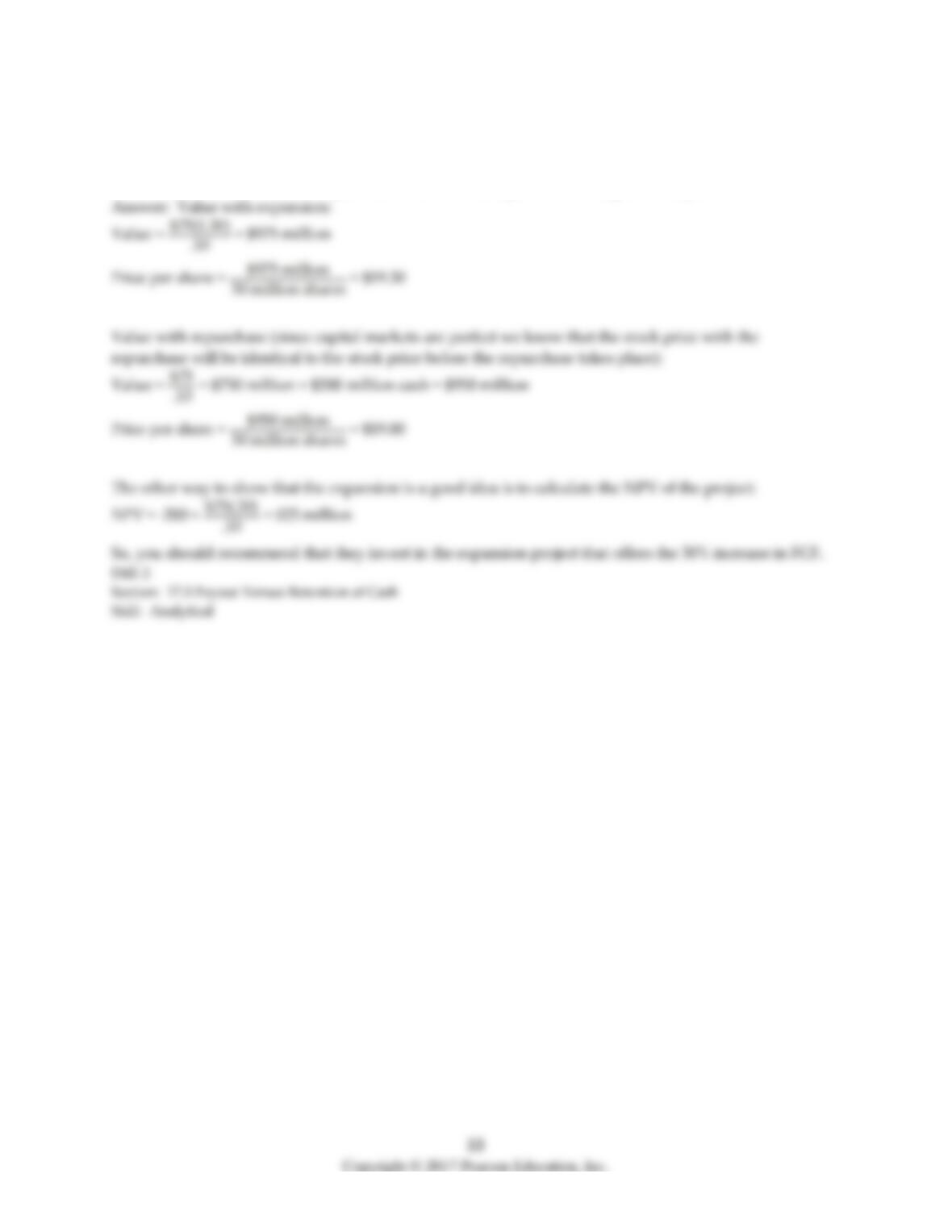
23) Suppose that Iota is able to invest the $200 million in excess cash into a project that will increase
future free cash flows by 30%. If you were advising the board, what course of action would you
recommend, investing the $200 million in an expansion project that will raise future free cash flows by
30% or use the $200 million to repurchase shares? Which provides the higher stock price?
34
Use the information for the question(s) below.
Consider the following tax rates:
Year
Corporate
Tax Rate
Capital
Gains
Rate
Ordinary
Income Rate
Dividend
Rate
1997-2000
35%
20%
40%
40%
2001-2002
35%
20%
39%
39%
2003–
35%
15%
35%
15%
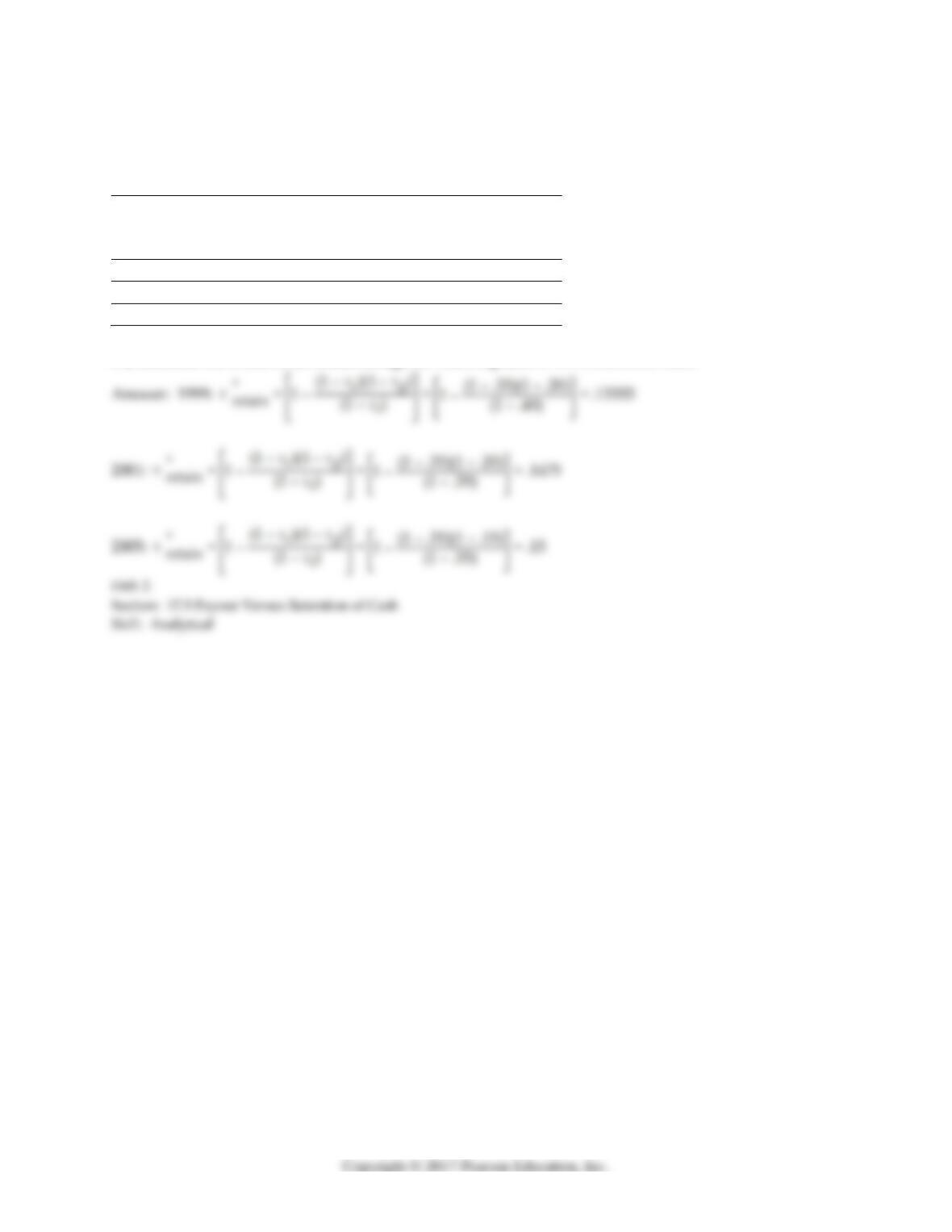
24) Calculate the effective tax disadvantage for retaining cash in 1999, 2001, and 2005.

17.6 Signaling with Payout Policy
1) Which of the following statements is FALSE?
A) Firms adjust dividends relatively infrequently, and dividends are much less volatile than earnings.
This practice of maintaining relatively constant dividends is called dividend signaling.
B) When a firm increases its dividend, it sends a positive signal to investors that management expects to
be able to afford the higher dividend for the foreseeable future.
C) The average size of the stock price reaction increases with the magnitude of the dividend change,
and is larger for dividend cuts.
D) When managers cut the dividend, it may signal that they have given up hope that earnings will
rebound in the near term and need to reduce the dividend to save cash.
2) Which of the following statements is FALSE?
A) If firms smooth dividends, the firm’s dividend choice will contain information regarding
management’s expectations of future earnings.
B) Because of the increasing popularity of repurchases, firms cut dividends much more frequently than
they increase them.
C) Announcing a share repurchase today does not necessarily represent a long–term commitment to
repurchase shares.
D) While cutting the dividend is costly for managers in terms of their reputation and the reaction of
investors, it is by no means as costly as failing to make debt payments.
3) Which of the following statements is FALSE?
A) Managers are much less committed to dividend payments than to share repurchases.
B) Share repurchases are a credible signal that the shares are under-priced, because if they are over-
priced a share repurchase is costly for current shareholders.
C) While an increase of a firm’s dividend may signal management’s optimism regarding its future cash
flows, it might also signal a lack of investment opportunities.
D) Managers will clearly be more likely to repurchase shares if they believe the stock to be under–
valued.
Use the information for the question(s) below.
Rockwood Industries has 100 million shares outstanding, a current share price of $25, and no debt.
Rockwood’s management believes that the shares are under–priced, and that the true value is $30 per
share. Rockwood plans to pay $250 million in cash to its shareholders by repurchasing shares.
Management expects that very soon new information will come out that will cause investors to revise
their opinion of the firm and agree with Rockwood’s assessment of the firm‘s true value.
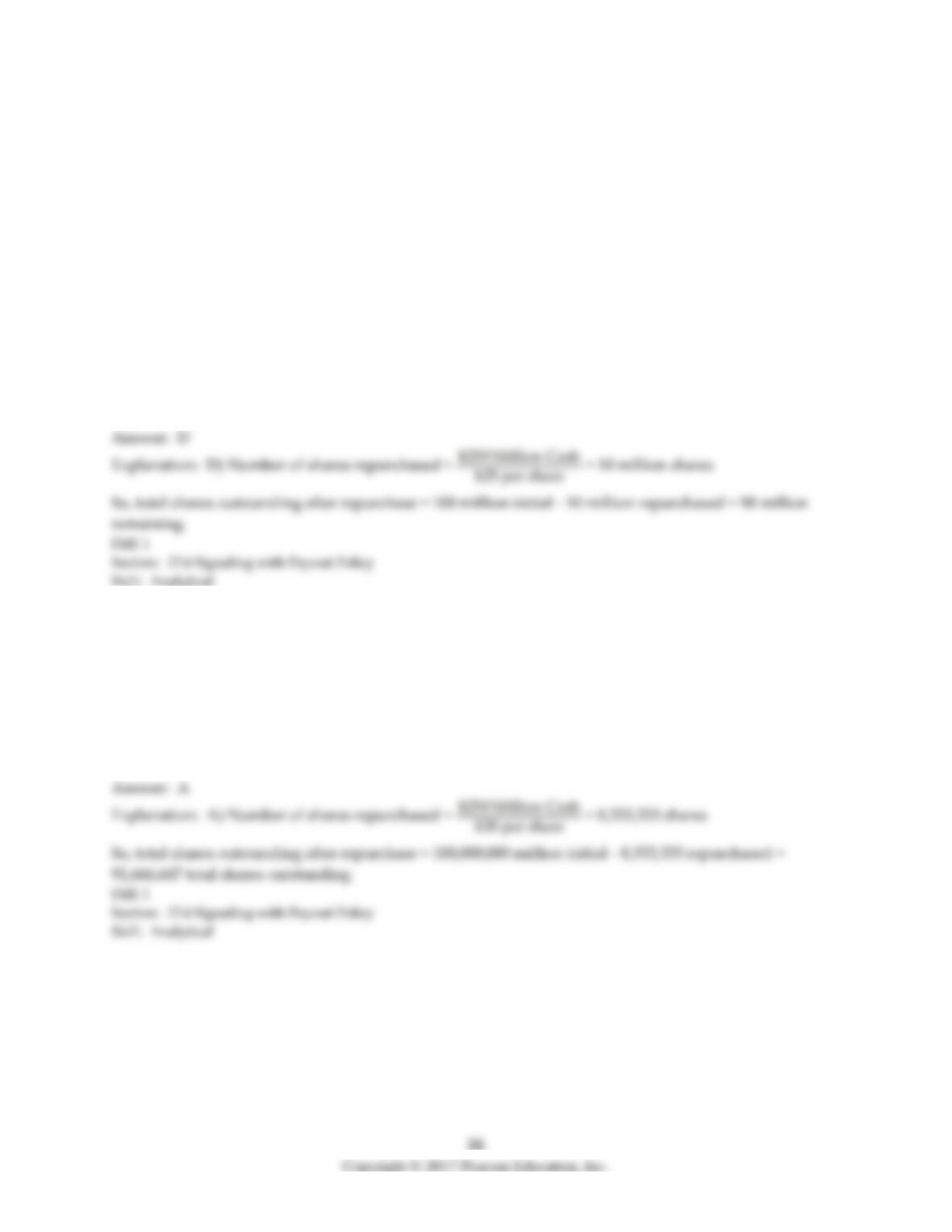
4) If Rockwood is able to repurchase shares prior to the market becoming aware of the new information
regarding Rockwood’s true value, then the number of shares outstanding following the repurchase is
closest to:
A) 92 million
B) 10 million
C) 75 million
D) 90 million
5) Assume that Rockwood is not able to repurchase shares prior to the market becoming aware of the
new information regarding Rockwood’s true value. If Rockwood repurchases the shares following the
release of the new information, then the number of shares outstanding following the repurchase is
closest to:
A) 92 million
B) 90 million
C) 75 million
D) 10 million
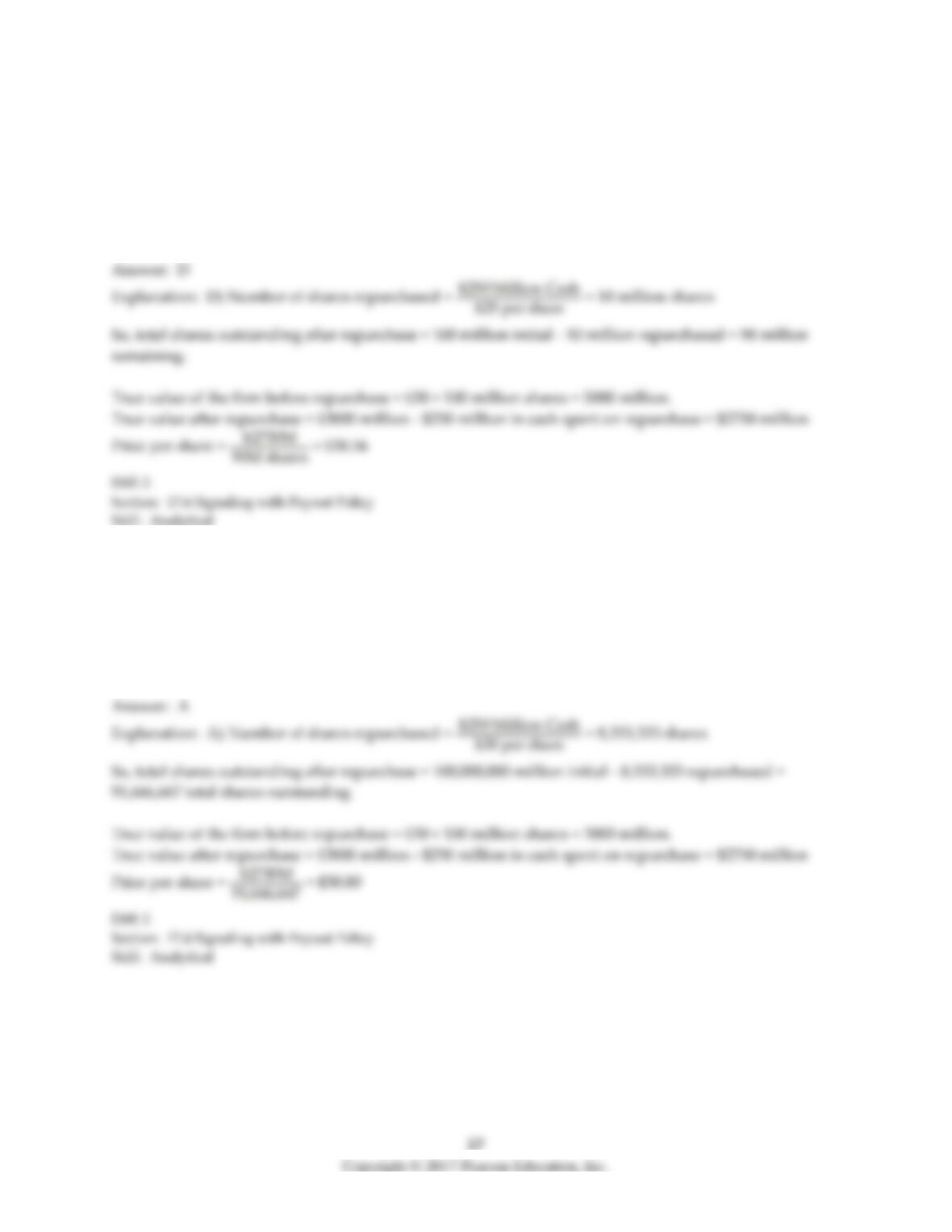
6) Assume that Rockwood is able to repurchase shares prior to the market becoming aware of the new
information regarding Rockwood’s true value. After the repurchase, and following the release of the
new information regarding the true value of Rockwood, the firm’s share price is closest to:
A) $30.00
B) $31.50
C) $28.75
D) $30.60
7) Assume that Rockwood is not able to repurchase shares prior to the market becoming aware of the
new information regarding Rockwood’s true value. After the release of the new information regarding
the true value of Rockwood, and following the repurchase, the firm’s share price is closest to:
A) $30.00
B) $30.60
C) $28.75
D) $31.50
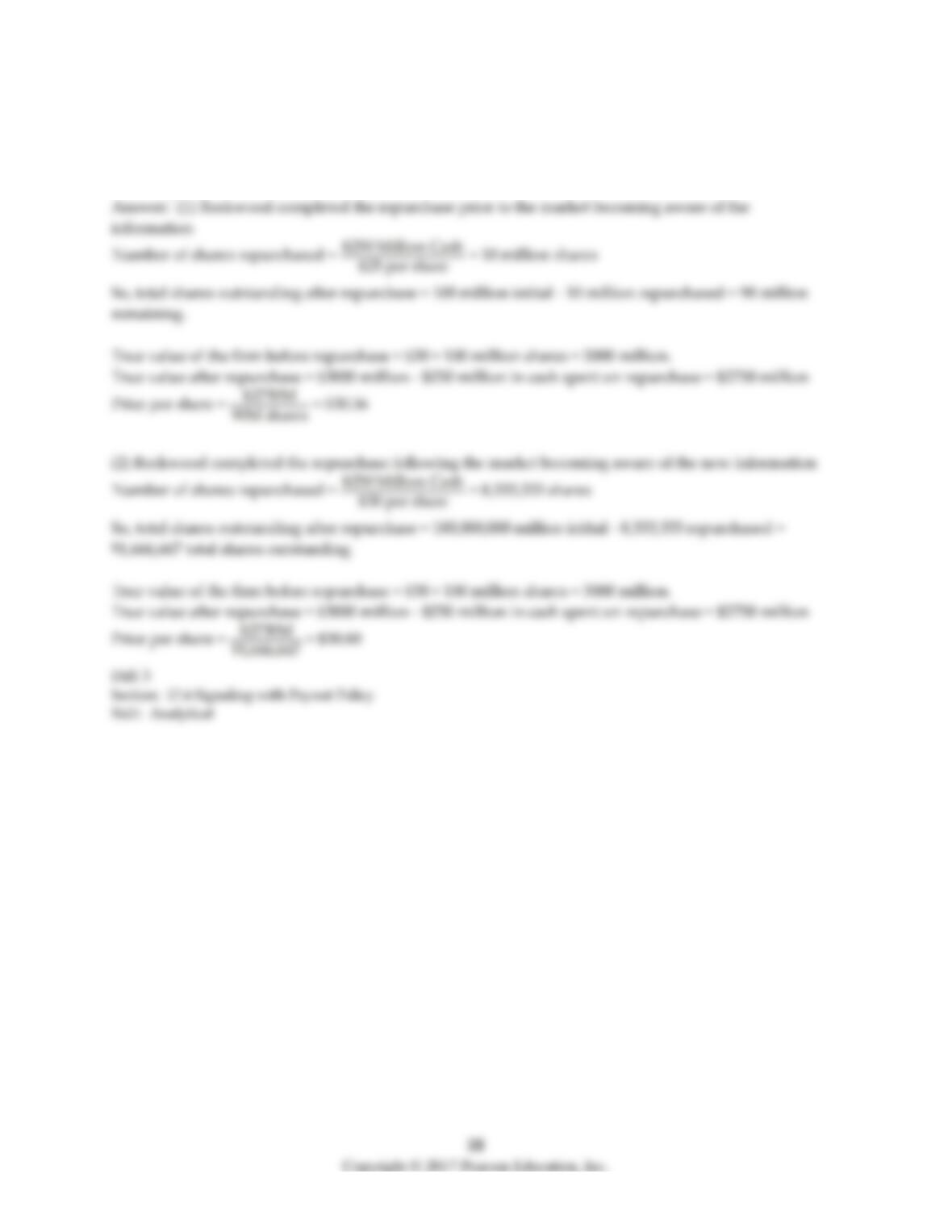
8) Calculate Rockwood‘s stock price following the market becoming aware of the new information
regarding Rockwood’s true value, if (1) Rockwood completed the repurchase prior to the market
becoming aware of the information and (2) Rockwood completed the repurchase following the market
becoming aware of the new information.
17.7 Stock Dividends, Splits, and Spin-offs
1) Taggart Transcontinental shares are currently trading at $200 per share. The split ratio needed to
bring the stock price down to $80 is:
A) 2:1
B) 3:1
C) 2:5
D) 5:2
2) Which of the following statements is FALSE?
A) Stocks generally trade in lots of 1000 shares, and in any case do not trade in units less than one share.
B) Non-cash special dividends are commonly used to spin off assets or a subsidiary as a separate
company.
C) The typical motivation for a stock split is to keep the share price in a range thought to be attractive to
small investors.
D) If a company declares a 10% stock dividend, each shareholder will receive one new share of stock for
every 10 shares already owned.
3) Which of the following statements is FALSE?
A) With a stock dividend, a firm does not pay out any cash to shareholders. As a result, the total market
value of the firm’s assets and liabilities, and therefore of its equity, is unchanged.
B) If the price of the stock falls too low, a company can engage in a reverse split and reduce the number
of shares outstanding.
C) Stock dividends of 50% or higher are generally referred to as stock splits.
D) Rather than pay a dividend using cash or shares of its own stock, a firm can also distribute shares of
a subsidiary in a transaction referred to as a off-shoot.
Use the information for the question(s) below.
Luther Industries currently has 5 million shares outstanding and its stock is currently trading at $40 per
share.
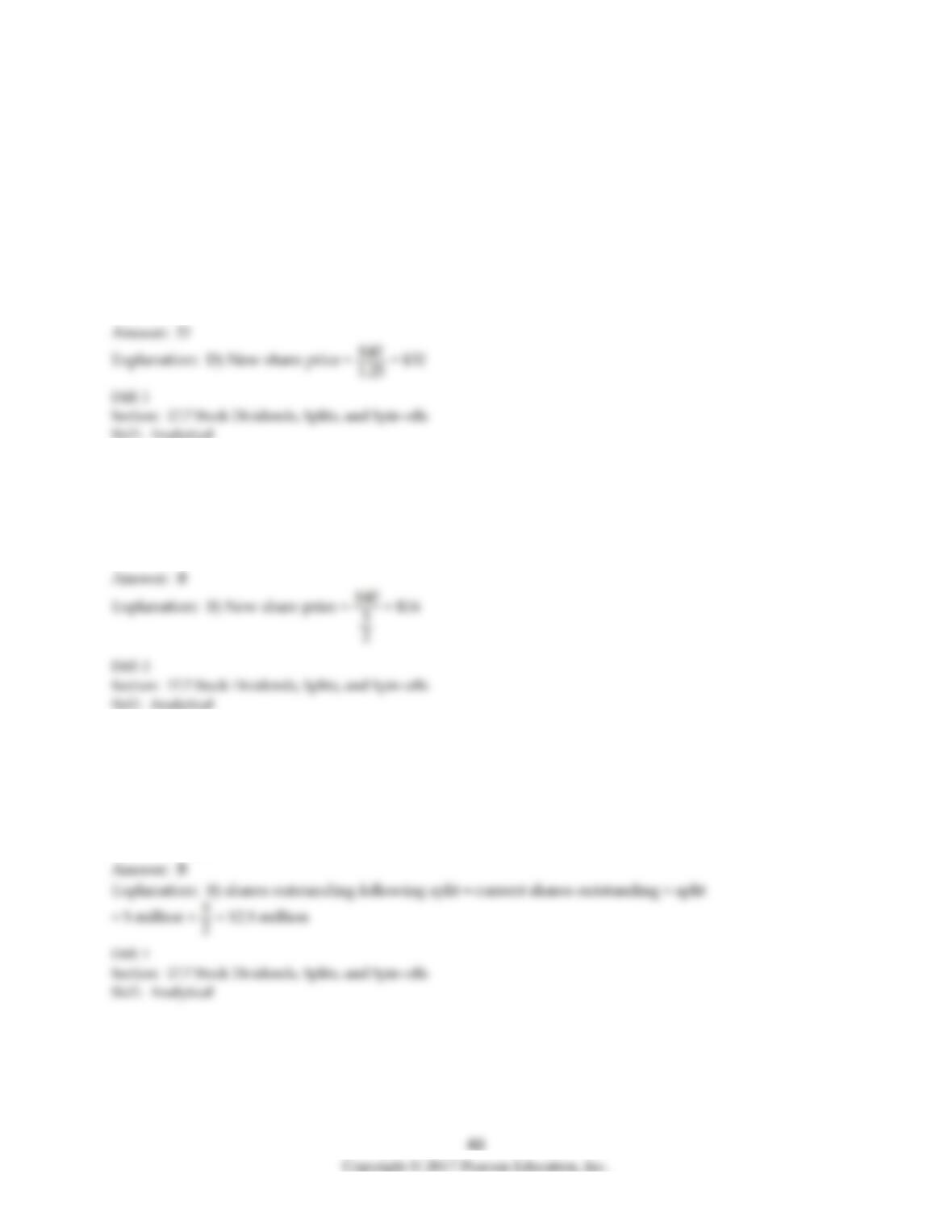
4) Assuming Luther issues a 25% stock dividend, then Luther’s new share price is closest to:
A) $24.00
B) $30.00
C) $16.00
D) $32.00
5) Assuming Luther issues a 5:2 stock split, then Luther’s new share price is closest to:
A) $32.00
B) $16.00
C) $24.00
D) $30.00
6) Assuming Luther issues a 5:2 stock split, then the number of shares Luther will have outstanding
following the split is closest to:
A) 25.0 million
B) 12.5 million
C) 2.0 million
D) 16.0 million
7) Delta Products has decided to spin-off one of its subsidiaries, Gamma Technologies. Each Delta
shareholder will receive 0.125 shares of Gamma for each share of Delta they own. Delta’s price is $35.00
cum-dividend and immediately after the spin-off Gamma Technologies was trading for $24.00 per
share. In a perfect capital market, what would Delta Product’s ex-dividend share price be after this
transaction?