Corporate Finance, 4e (Berk / DeMarzo)
Chapter 17 Payout Policy
17.1 Distributions to Shareholders
1) The date on which the board authorizes the dividend is the:
A) declaration date.
B) distribution date.
C) record date.
D) ex-dividend date.
2) The firm will pay the dividend to all shareholders who are registered owners on a specific date, set by
the board, called the:
A) declaration date.
B) record date.
C) distribution date.
D) ex-dividend date.
3) Anyone who purchases the stock on or after the ________ date will not receive the dividend.
A) distribution
B) record
C) ex-dividend
D) declaration
4) The firm mails dividend checks to the registered shareholders on the:
A) ex-dividend date.
B) declaration date.
C) distribution date.
D) record date.
5) Which of the following statements is FALSE?
A) From an accounting perspective, dividends generally reduce the firm’s current (or accumulated)
retained earnings.
B) The way a firm chooses between paying dividends and retaining earnings is referred to as its payout
policy.
C) Most companies that pay dividends pay them semiannually.
D) Occasionally, a firm may pay a one-time, special dividend that is usually much larger than a regular
dividend.
6) A firm can repurchase shares through a(n) ________ in which it offers to buy shares at a prespecified
price during a short time period—generally within 20 days.
A) tender offer
B) open market share repurchases
C) targeted repurchase
D) Dutch auction share repurchase
7) A method to repurchase shares is the ________, in which the firm lists different prices at which it is
prepared to buy shares, and shareholders in turn indicate how many shares they are willing to sell at
each price.
A) tender offer
B) Dutch auction share repurchase
C) targeted repurchase
D) open market share repurchases
8) A(n) ________ may occur if a major shareholder desires to sell a large number of shares but the
market for the shares is not sufficiently liquid to sustain such a large sale without severely affecting the
price.
A) open market share repurchases
B) Dutch auction share repurchase
C) tender offer
D) targeted repurchase
9) A(n) ________ is the most common way that firms repurchase shares.
A) targeted repurchase
B) Dutch auction share repurchase
C) tender offer
D) open market share repurchases
17.2 Comparison of Dividends and Share Repurchases
1) Taggart Transcontinental has announced a $2 dividend. If Taggart’s last price cum–dividend is $45,
then, assuming perfect capital markets, what should its first ex-dividend price be?
A) $0
B) $2
C) $43
D) $45
Use the following information to answer the question(s) below.
Wyatt Oil has assets with a market value of $600 million, $70 million of which are cash. It has debt of
$250 million, and 20 million shares outstanding. Assume perfect capital markets.
2) Wyatt Oil’s current stock price is closest to:
A) $11.00
B) $12.50
C) $14.00
D) $17.50
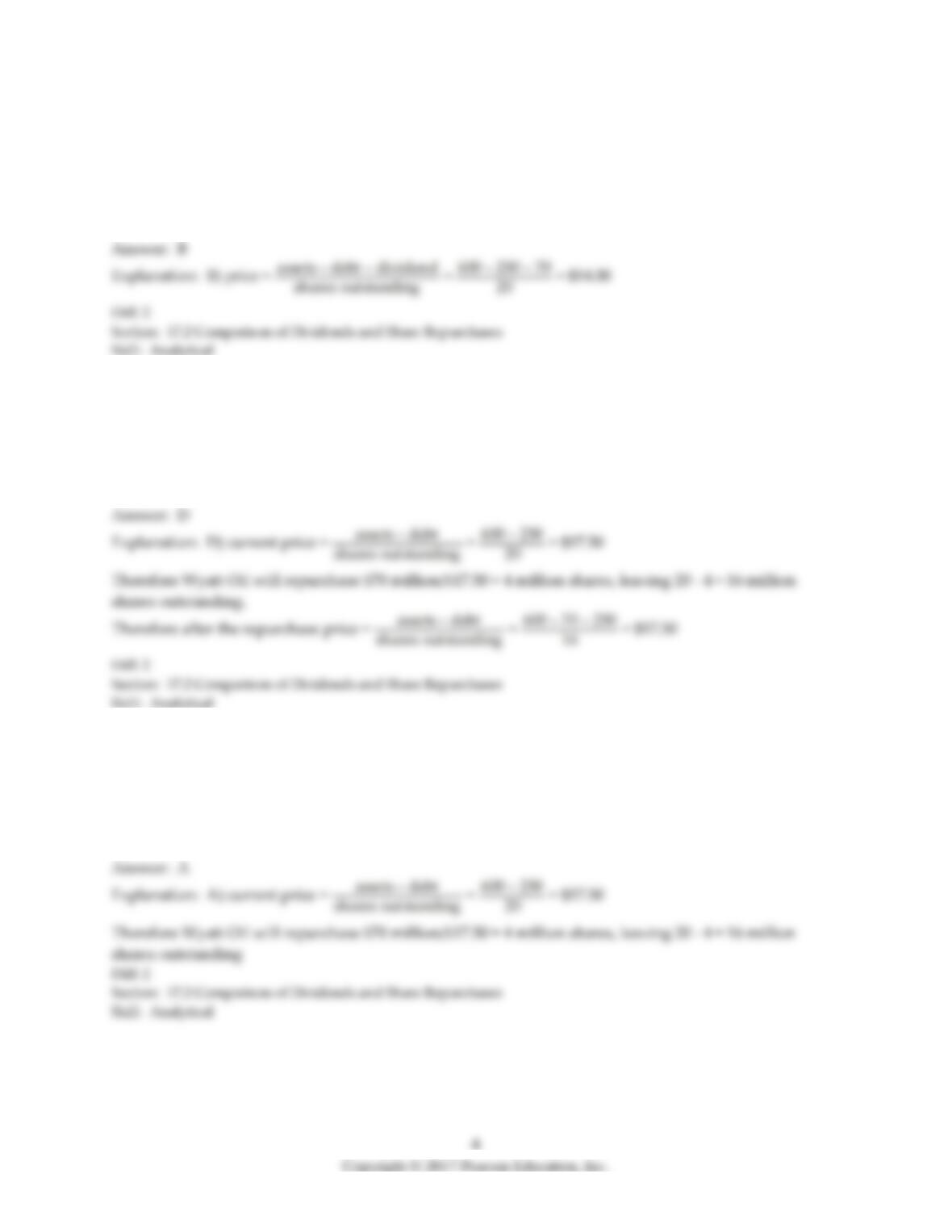
3) If Wyatt Oil distributes the $70 million as a dividend, then its stock price after the dividend will be
closest to:
A) $12.50
B) $14.00
C) $17.50
D) $26.50
4) If Wyatt Oil distributes the $70 million as a share repurchase, then its stock price after the share
repurchase will be closest to:
A) $11.00
B) $12.50
C) $14.00
D) $17.50
5) If Wyatt Oil distributes the $70 million as a share repurchase, then the number of shares outstanding
after the repurchase will be closest to:
A) 16.0 million
B) 16.5 million
C) 17.5 million
D) 18.0 million
6) If Wyatt Oil distributes the $70 million as a dividend, then its debt–to-equity ratio after the dividend
will be closest to:
A) 0.7
B) 0.9
C) 1.0
D) 1.1
7) If Wyatt Oil distributes the $70 million as a share repurchase, then its debt–to-equity ratio after the
share repurchase will be closest to:
A) 0.9
B) 1.0
C) 1.1
D) 1.4
8) Which of the following statements is FALSE?
A) In perfect capital markets, holding fixed the investment policy of a firm, the firm’s choice of dividend
policy is irrelevant and does not affect the initial share price.
B) In a perfect capital market, when a dividend is paid, the share price drops by the amount of the
dividend when the stock begins to trade ex–dividend.
C) In perfect capital markets, an open market share repurchase has no effect on the stock price, and the
stock price is the same as the ex-dividend price if a dividend were paid instead.
D) In perfect capital markets, investors are indifferent between the firm distributing funds via
dividends or share repurchases. By reinvesting dividends or selling shares, they can replicate either
payout method on their own.
Use the information for the question(s) below.
Omicron Technologies has $50 million in excess cash and no debt. The firm expects to generate
additional free cash flows of $40 million per year in subsequent years and will pay out these future free
cash flows as regular dividends. Omicrons unlevered cost of capital is 10% and there are 10 million
shares outstanding. Omicron’s board is meeting to decide whether to pay out its $50 million in excess
cash as a special dividend or to use it to repurchase shares of the firm’s stock.
9) Omicron’s enterprise value is closest to:
A) $500 million
B) $900 million
C) $450 million
D) $400 million
10) Including its cash, Omicron’s total market value is closest to:
A) $500 million
B) $900 million
C) $400 million
D) $450 million
11) Assume that Omicron uses the entire $50 million in excess cash to pay a special dividend. The
amount of the special dividend is closest to:
A) $5.00
B) $9.00
C) $4.00
D) $4.50
12) Assume that Omicron uses the entire $50 million in excess cash to pay a special dividend. The
amount of the regular yearly dividends in the future is closest to:
A) $4.50
B) $5.00
C) $4.00
D) $9.00
13) Assume that Omicron uses the entire $50 million in excess cash to pay a special dividend.
Omicron’s cum-dividend price is closest to:
A) $50.00
B) $40.00
C) $5.00
D) $45.00
14) Assume that Omicron uses the entire $50 million in excess cash to pay a special dividend.
Omicron’s ex-dividend price is closest to:
A) $40.00
B) $5.00
C) $50.00
D) $45.00
15) Assume that Omicron uses the entire $50 million to repurchase shares. The number of shares that
Omicron will repurchase is closest to:
A) 1.0 million
B) 1.2 million
C) 1.1 million
D) 0.9 million
16) Assume that Omicron uses the entire $50 million to repurchase shares. The number of shares that
Omicron will have outstanding following the repurchase is closest to:
A) 8.8 million
B) 1.2 million
C) 9.0 million
D) 8.9 million
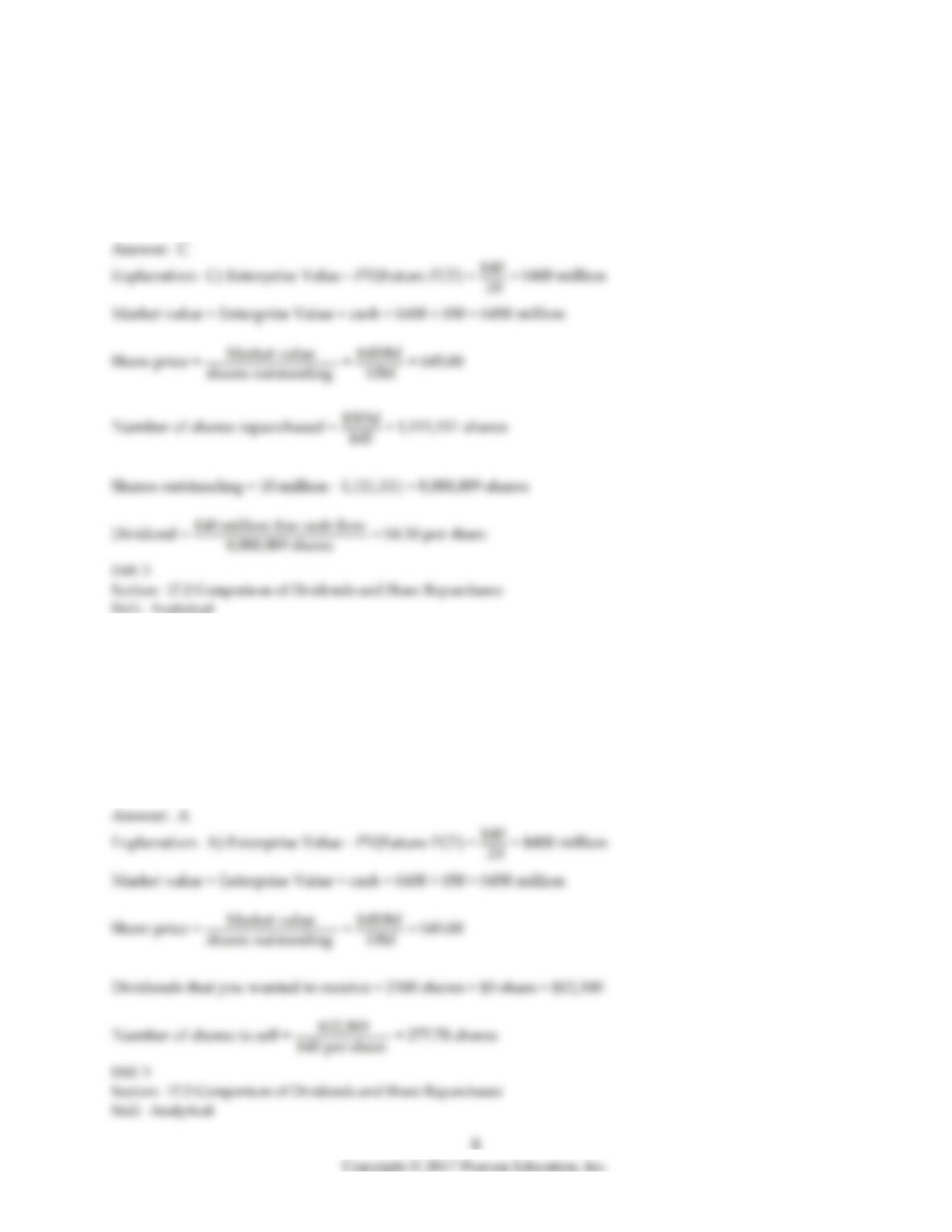
17) Assume that Omicron uses the entire $50 million to repurchase shares. The amount of the regular
yearly dividends in the future is closest to:
A) $9.00
B) $5.00
C) $4.50
D) $4.00
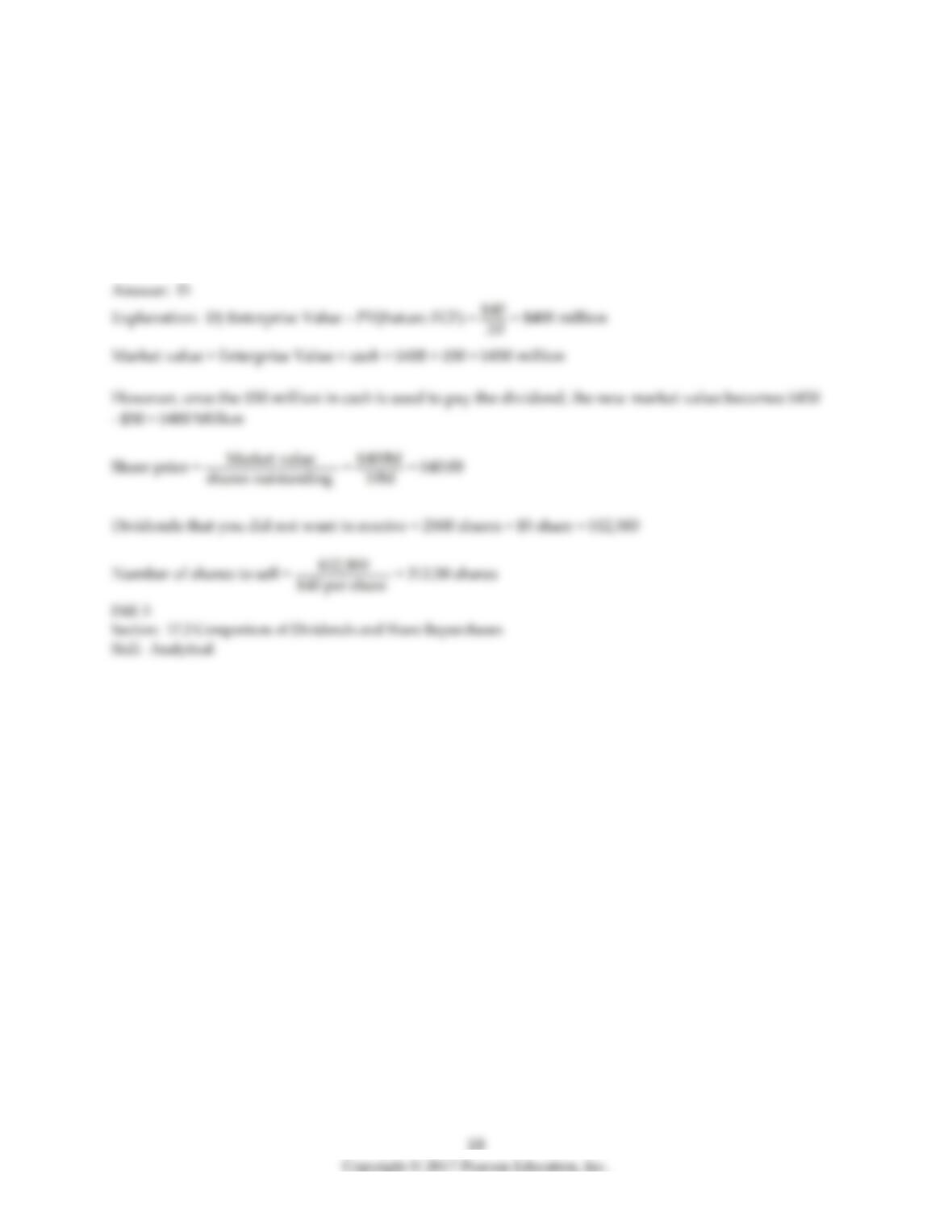
18) Assume that you own 2500 shares of Omicron stock and that Omicron uses the entire $50 million to
repurchase shares. Suppose you are unhappy with Omicron’s decision and would prefer that Omicron
used the excess cash to pay a special dividend. The number of shares that you would have to sell in
order to receive the same amount of cash as if Omicron paid the special dividend is closest to:
A) 275
B) 310
C) 125
D) 250
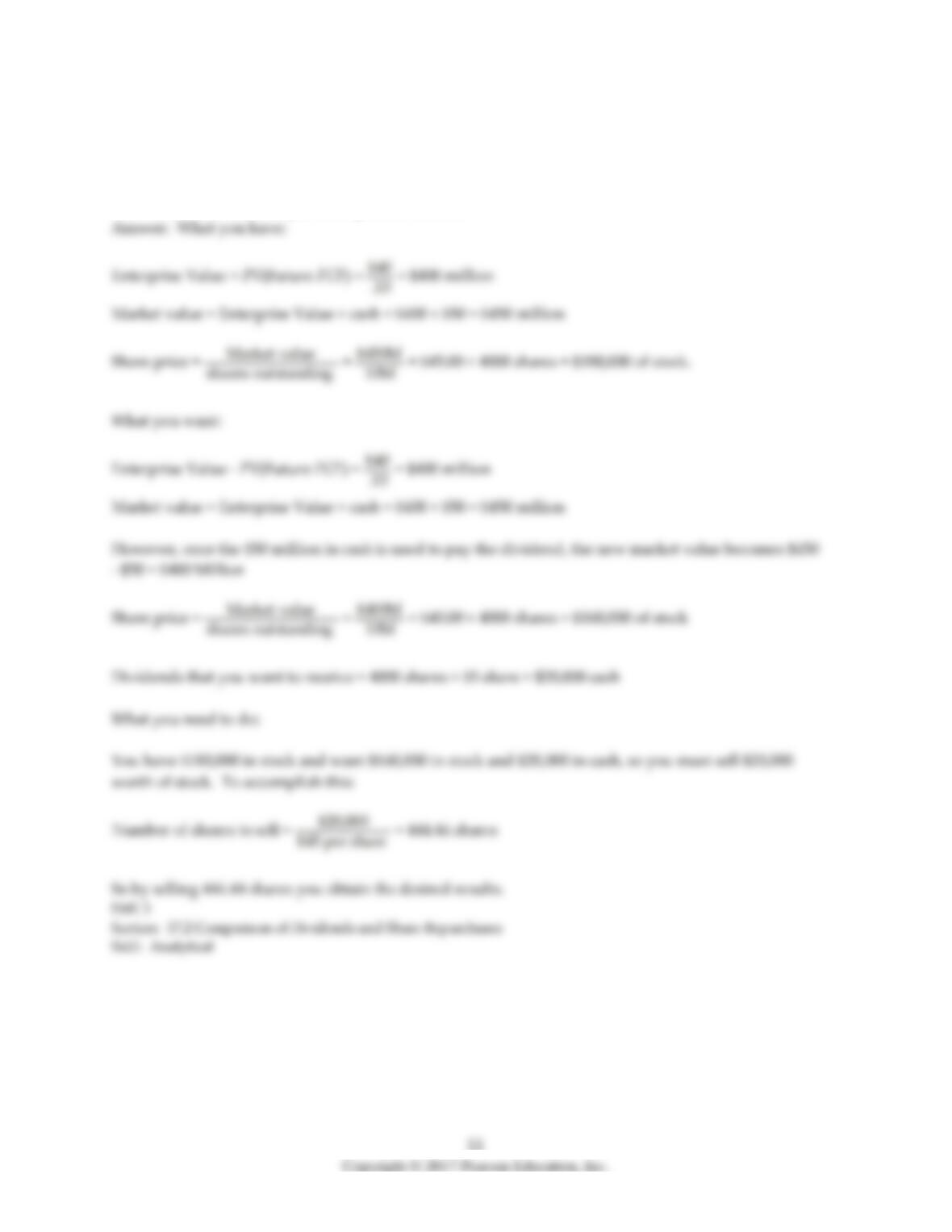
19) Assume that you own 2500 shares of Omicron stock and that Omicron uses the entire $50 million to
pay a special dividend. Suppose you are unhappy with Omicron’s decision and would prefer that
Omicron used the excess cash to repurchase shares. The number of shares that you would have to buy
in order to undo the special cash dividend that Omicron paid is closest to:
A) 125
B) 275
C) 250
D) 310
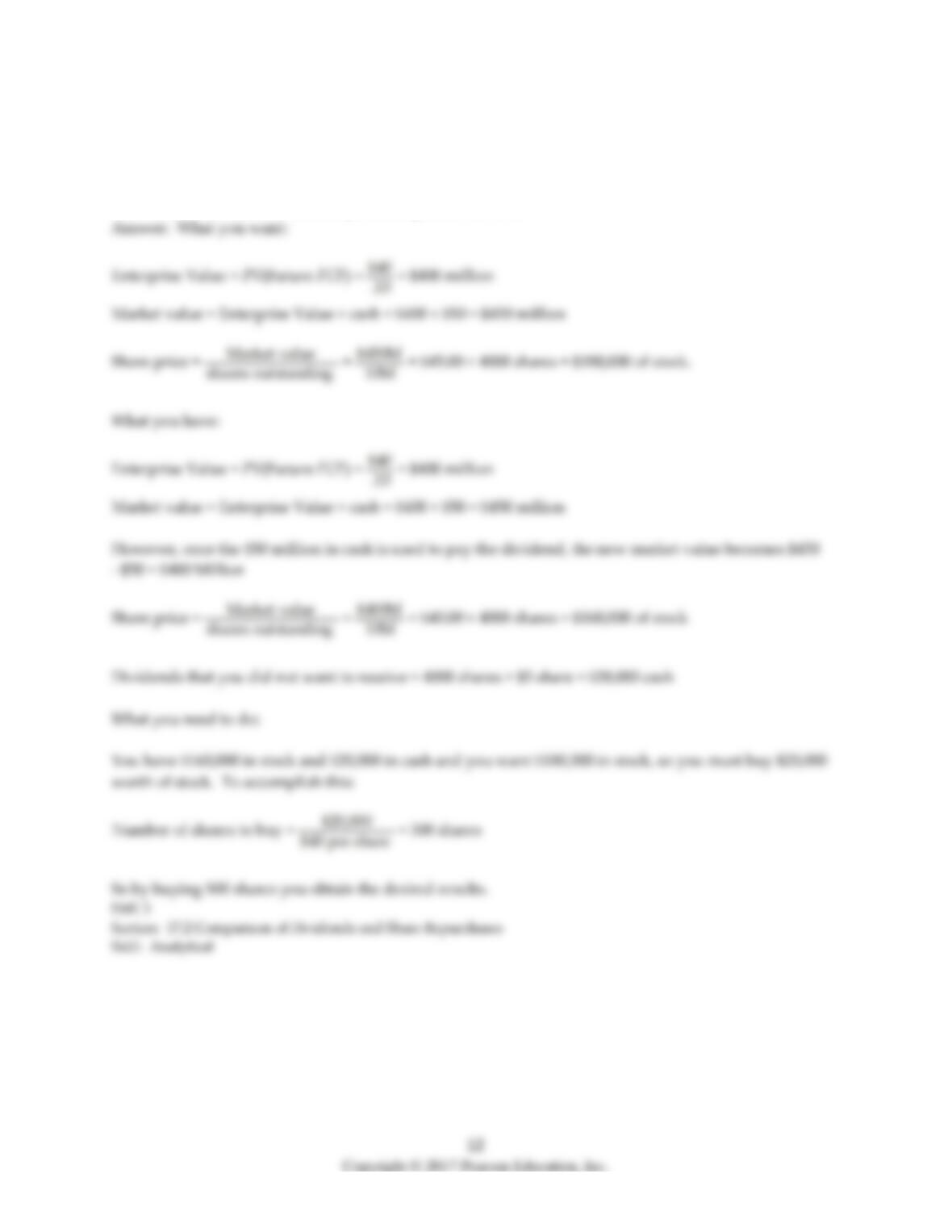
20) Assume that you own 4000 shares of Omicron stock and that Omicron uses the entire $50 million to
repurchase shares. Suppose you are unhappy with Omicron’s decision and would have preferred that
Omicron used the excess cash to pay a special dividend. Detail exactly how you could create a
homemade dividend that will provide you with the same combination of cash and stock that you would
have received if Omicron paid the special dividend.
21) Assume that you own 4000 shares of Omicron stock and that Omicron uses the entire $50 million to
pay a special dividend. Suppose you are unhappy with Omicron’s decision and would have preferred
that Omicron used the excess cash to repurchase stock. Detail exactly how you could undo the
dividend in a way that will provide you with the same combination of cash and stock that you would
have received if Omicron had not paid the special dividend.
17.3 The Tax Disadvantage of Dividends
Use the following information to answer the question(s) below.
Year(s)
Capital Gains
Dividends
1987
28%
39%
1988 – 1990
28%
28%
1991 – 1992
28%
31%
1993 – 1996
28%
40%
1997 – 2000
20%
40%
2001 – 2002
20%
39%
2003 – 2009
15%
15%
1) In which years were dividends tax disadvantaged?
A) 1987 – 2002
B) 1987, 1993 – 2002
C) 1987, 1991 – 2002
D) 1988 – 1990, 2003 – 2009
Year(s)
Capital Gains
1988 – 1990
1991 – 1992
1993 – 1996
1997 – 2000
2001 – 2002
2003 – 2009
2) In which years were dividends NOT tax disadvantaged?
A) 1987 – 2002
B) 1987, 1993 – 2002
C) 1987, 1991 – 2002
D) 1988 – 1990, 2003 – 2009
3) Which of the following statements is FALSE?
A) Unlike with capital structure, taxes are not an important market imperfection that influence a firm’s
decision to pay dividends or repurchase shares.
B) If dividends are taxed at a higher rate than capital gains, which has been true until the most recent
change to the tax code, shareholders will prefer share repurchases to dividends.
C) Shareholders typically must pay taxes on the dividends they receive. They must also pay capital
gains taxes when they sell their shares.
D) Because long-term investors can defer the capital gains tax until they sell, there is still a tax
advantage for share repurchases over dividends.

4) Which of the following statements is FALSE?
A) When a firm pays a dividend, shareholders are taxed according to the dividend tax rate. If the firm
repurchases shares instead, and shareholders sell shares to create a homemade dividend, the
homemade dividend will be taxed according to the capital gains tax rate.
B) When the tax rate on dividends exceeds the tax rate on capital gains, shareholders will pay lower
taxes if a firm uses share repurchases for all payouts rather than dividends.
C) Firms that use dividends will have to pay a lower after-tax return to offer their investors the same
pre-tax return as firms that use share repurchases.
D) The optimal dividend policy when the dividend tax rate exceeds the capital gain tax rate is to pay no
dividends at all.
5) Which of the following statements is FALSE?
A) While firms do still pay dividends, substantial evidence shows that many firms have recognized
their tax disadvantage.
B) The fact that firms continue to issue dividends despite their tax disadvantage is often referred to as
the dividend puzzle.
C) At the end of the 1990s, dividend payments exceeded the value of repurchases for U.S. industrial
firms.
D) While evidence is indicative of the growing importance of share repurchases as a part of firms’
payout policies, it also shows that dividends remain a key form of payouts to shareholders.
Use the information for the question(s) below.
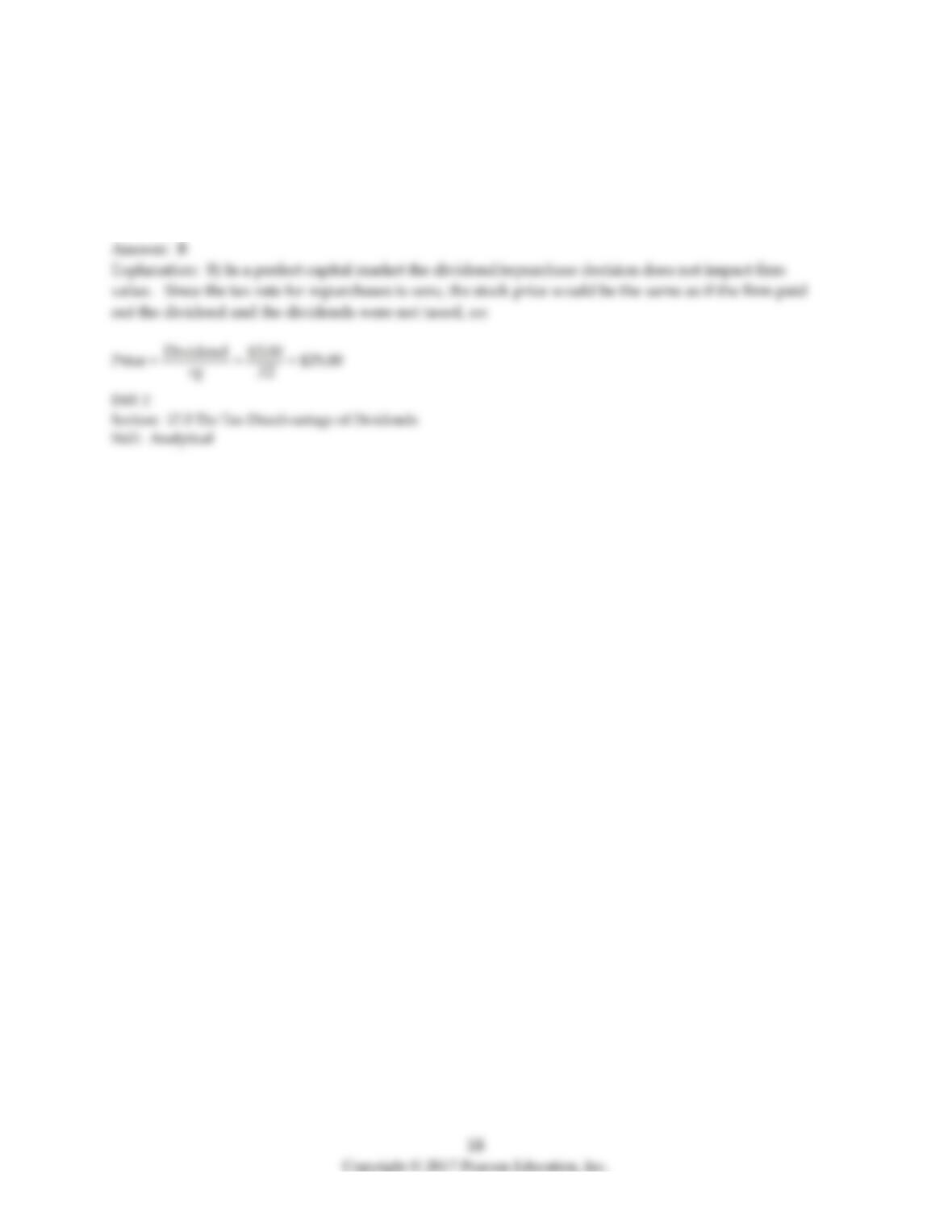
The JRN Corporation will pay a constant dividend of $3 per share, per year, in perpetuity. Assume that
all investors pay a 20% tax on dividends and that there is no capital gains tax. The cost of capital for
investing in JRN stock is 12%.
6) The price of a share of JRN’s stock is closest to:
A) $20.00
B) $24.00
C) $25.00
D) $18.00
7) Assume that management makes a surprise announcement that JRN will no longer pay dividends but
will use the cash to repurchase stock instead. The price of a share of JRN’s stock is now closest to:
A) $20.00
B) $25.00
C) $18.00
D) $24.00
17.4 Dividend Capture and Tax Clienteles
Use the following information to answer the question(s) below.
Year(s)
Capital Gains
Dividends
1987
28%
39%
1988 – 1990
28%
28%
1991 – 1992
28%
31%
1993 – 1996
28%
40%
1997 – 2000
20%
40%
2001 – 2002
20%
39%
2003 – 2009
15%
15%
1) The effective dividend tax rate in 1989 is closest to:
A) 0%
B) 20%
C) 25%
D) 30%
2) The effective dividend tax rate in 1999 is closest to:
A) 0%
B) 20%
C) 25%
D) 30%
3) Wyatt Oil pays a regular dividend of $2.50 per share. Typically the stock price drops by $2.00 per
share when the stock goes ex–dividend. Suppose the capital gains tax rate is 20%, but investors pay
different tax rates on dividends. Absent transactions cost, the highest dividend tax rate of an investor
who could gain from trading to capture the dividend is closest to:
A) 0%
B) 20%
C) 24%
D) 36%
Use the following information to answer the question(s) below.
Suppose that all capital gains are taxed at a 20% rate, and that the dividend tax rate is 40%. Rearden
Metal is currently trading for $40 per share, and is about to pay a $5 special dividend.
4) Absent any other trading frictions or news, Rearden’s share price just after the dividend is paid will
be closest to:
A) $35
B) $36
C) $37
D) $40
5) The effective dividend tax rate for an investor in Rearden Metal is closest to:
A) 0%
B) 20%
C) 25%
D) 30%
6) Suppose that Rearden Metal made a surprise announcement that it would do a share repurchase
rather than pay a special dividend, the net tax savings per share for an investor that would result from
this decision is closest to:
A) $1.25
B) $3.75
C) $4.00
D) $5.00
7) Which of the following statements is FALSE?
A) Tax rates vary by income, by jurisdiction, and by whether the stock is held in a retirement account.
Because of these differences, firms may attract different groups of investors depending on their
dividend policy.
B) While many investors have a tax preference for share repurchases rather than dividends, the strength
of that preference depends on the difference between the dividend tax rate and the capital gains tax rate
that they face.
C) Long-term investors are more heavily taxed on capital gains, so they would prefer dividend
payments to share repurchases.
D) One-year investors, pension funds, and other non-taxed investors have no tax preference for share
repurchases over dividends, they would prefer a payout policy that most closely matches their cash
needs.
8) Which of the following statements is FALSE?
A) Individuals in the highest tax brackets have a preference for stocks that pay high dividends, whereas
tax-free investors and corporations have a preference for stocks with no or low dividends.
B) To compare investor preferences, we must quantify the combined effects of dividend and capital
gains taxes to determine an effective dividend tax rate for an investor.
C) The dividend-capture theory states that absent transaction costs, investors can trade shares at the
time of the dividend so that non-taxed investors receive the dividend.
D) Differences in tax preferences create clientele effects, in which the dividend policy of a firm is
optimized for the tax preference of its investor clientele.
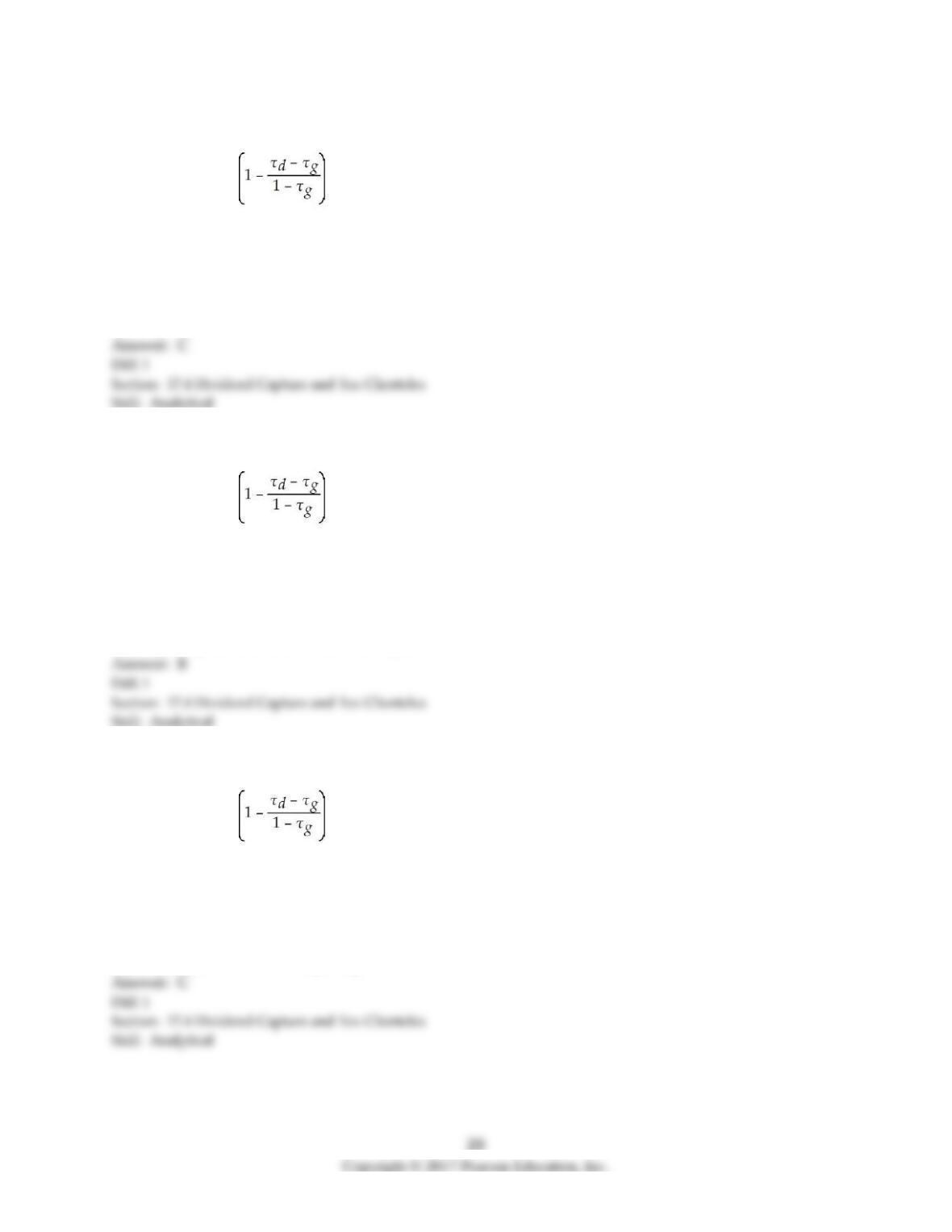
9) Consider the following equation:
Pcum – Pex = Div ×
The term Pcum is:
A) the personal tax rate for capital gains.
B) the price per share after a dividend is paid.
C) the price per share before a dividend is paid.
D) the personal tax rate for dividend.
10) Consider the following equation:
Pcum – Pex = Div ×
The term τg is:
A) the personal tax rate for dividend.
B) the personal tax rate for capital gains.
C) the price per share before a dividend is paid.
D) the price per share after a dividend is paid.
11) Consider the following equation:
Pcum – Pex = Div ×
The term Pex is:
A) the personal tax rate for dividend.
B) the price per share before a dividend is paid.
C) the price per share after a dividend is paid.
D) the personal tax rate for capital gains.