CHAPTER 17—DYNAMIC CAPITAL STRUCTURES AND CORPORATE VALUATION
1. In a world with no taxes, MM show that a firm’s capital structure does not affect the firm’s value. However, when taxes
are considered, MM show a positive relationship between debt and value, i.e., its value rises as its debt is increased.
a.
True
b.
False
True
1
2. According to MM, in a world without taxes the optimal capital structure for a firm is approximately 100% debt
financing.
a.
True
b.
False
False
1
3. MM showed that in a world with taxes, a firm’s optimal capital structure would be almost 100% debt.
a.
True
b.
False
True
1
4. MM showed that in a world without taxes, a firm’s value is not affected by its capital structure.
a.
True
b.
False

CHAPTER 17—DYNAMIC CAPITAL STRUCTURES AND CORPORATE VALUATION
True
1
5. The Miller model begins with the MM model with taxes and then adds personal taxes.
a.
True
b.
False
True
1
6. The Miller model begins with the MM model without corporate taxes and then adds personal taxes.
a.
True
b.
False
False
1
7. Other things held constant, an increase in financial leverage will increase a firm’s market (or systematic) risk as
measured by its beta coefficient.
a.
True
b.
False
True
1
CHAPTER 17—DYNAMIC CAPITAL STRUCTURES AND CORPORATE VALUATION
8. The MM model with corporate taxes is the same as the Miller model, but with zero personal taxes.
a.
True
b.
False
True
1
9. The MM model is the same as the Miller model, but with zero corporate taxes.
a.
True
b.
False
False
1
10. In the MM extension with growth, the appropriate discount rate for the tax shield is the unlevered cost of equity.
a.
True
b.
False
True
1
CHAPTER 17—DYNAMIC CAPITAL STRUCTURES AND CORPORATE VALUATION
11. In the MM extension with growth, the appropriate discount rate for the tax shield is the WACC.
a.
True
b.
False
False
1
12. In the MM extension with growth, the appropriate discount rate for the tax shield is the after-tax cost of debt.
a.
True
b.
False
False
1
13. When a firm has risky debt, its equity can be viewed as an option on the total value of the firm with an exercise price
equal to the face value of the debt.
a.
True
b.
False
True
1
14. When a firm has risky debt, its debt can be viewed as an option on the total value of the firm with an exercise price
equal to the face value of the equity.
a.
True
b.
False
CHAPTER 17—DYNAMIC CAPITAL STRUCTURES AND CORPORATE VALUATION
1
Difficulty: Moderate
INTE.GENE.16.112 – LO: 17-4
United States – BUSPROG: Reflective Thinking
United States – AK – DISC: Capital structure
United States – OH – Default City – TBA
Equity as an option
15. The major contribution of the Miller model is that it demonstrates that
a.
personal taxes decrease the value of using corporate debt.
b.
financial distress and agency costs reduce the value of using corporate debt.
c.
equity costs increase with financial leverage.
d.
debt costs increase with financial leverage.
e.
personal taxes increase the value of using corporate debt.
1
Difficulty: Moderate
INTE.GENE.16.111 – LO: 17-5
United States – BUSPROG: Analytic
United States – AK – DISC: Capital structure
United States – OH – Default City – TBA
Miller model
TYPE: Multiple Choice: Conceptual
16. Which of the following statements concerning capital structure theory is NOT CORRECT?
a.
Under MM with zero taxes, financial leverage has no effect on a firm’s value.
b.
Under MM with corporate taxes, the value of a levered firm exceeds the value of the unlevered firm by the
product of the tax rate times the market value dollar amount of debt.
c.
Under MM with corporate taxes, rs increases with leverage, and this increase exactly offsets the tax benefits of
debt financing.
d.
Under MM with corporate taxes, the effect of business risk is automatically incorporated because rsL is a
function of rsU.
e.
The major contribution of Miller’s theory is that it demonstrates that personal taxes decrease the value of using
corporate debt.
1
Difficulty: Moderate
INTE.GENE.16.111 – LO: 17-5
United States – BUSPROG: Analytic
United States – AK – DISC: Capital structure
United States – OH – Default City – TBA
CHAPTER 17—DYNAMIC CAPITAL STRUCTURES AND CORPORATE VALUATION
17. Which of the following statements concerning the MM extension with growth is NOT CORRECT?
a.
The value of a growing tax shield is greater than the value of a constant tax shield.
b.
For a given D/S, the levered cost of equity is greater than the levered cost of equity under MM’s original (with
tax) assumptions.
c.
For a given D/S, the WACC is less than the WACC under MM’s original (with tax) assumptions.
d.
The total value of the firm increases with the amount of debt.
e.
The tax shields should be discounted at the unlevered cost of equity.
1
Difficulty: Moderate
INTE.GENE.16.113 – LO: 17-3
United States – BUSPROG: Analytic
United States – AK – DISC: Capital structure
United States – OH – Default City – TBA
TYPE: Multiple Choice: Conceptual
18. Which of the following statements concerning the MM extension with growth is NOT CORRECT?
a.
The value of a growing tax shield is greater than the value of a constant tax shield.
b.
For a given D/S, the levered cost of equity is greater than the levered cost of equity under MM’s original (with
tax) assumptions.
c.
For a given D/S, the WACC is greater than the WACC under MM’s original (with tax) assumptions.
d.
The total value of the firm increases with the amount of debt.
e.
The tax shields should be discounted at the cost of debt.
1
Difficulty: Moderate
INTE.GENE.16.113 – LO: 17-3
United States – BUSPROG: Analytic
United States – AK – DISC: Capital structure
United States – OH – Default City – TBA
TYPE: Multiple Choice: Conceptual
19. Which of the following statements concerning the MM extension with growth is NOT CORRECT?
a.
The value of a growing tax shield is greater than the value of a constant tax shield.
b.
For a given D/S, the levered cost of equity is greater than the levered cost of equity under MM’s original (with
tax) assumptions.
TYPE: Multiple Choice: Conceptual
CHAPTER 17—DYNAMIC CAPITAL STRUCTURES AND CORPORATE VALUATION
c.
For a given D/S, the WACC is greater than the WACC under MM’s original (with tax) assumptions.
d.
The total value of the firm is independent of the amount of debt it uses.
e.
The tax shields should be discounted at the unlevered cost of equity.
d
1
Difficulty: Moderate
INTE.GENE.16.113 – LO: 17-3
United States – BUSPROG: Analytic
United States – AK – DISC: Capital structure
United States – OH – Default City – TBA
TYPE: Multiple Choice: Conceptual
20. The market value of Firm L’s debt is $200,000 and its yield is 9%. The firm’s equity has a market value of $300,000,
its earnings are growing at a rate of 5%, and its tax rate is 40%. A similar firm with no debt has a cost of equity of 12%.
Under the MM extension with growth, what is Firm L’s cost of equity?
a.
11.4%
b.
12.0%
c.
12.6%
d.
13.3%
e.
14.0%
e
1
Difficulty: Moderate
INTE.GENE.16.113 – LO: 17-3
United States – BUSPROG: Analytic
United States – AK – DISC: Capital structure
United States – OH – Default City – TBA
TYPE: Multiple Choice: Problem
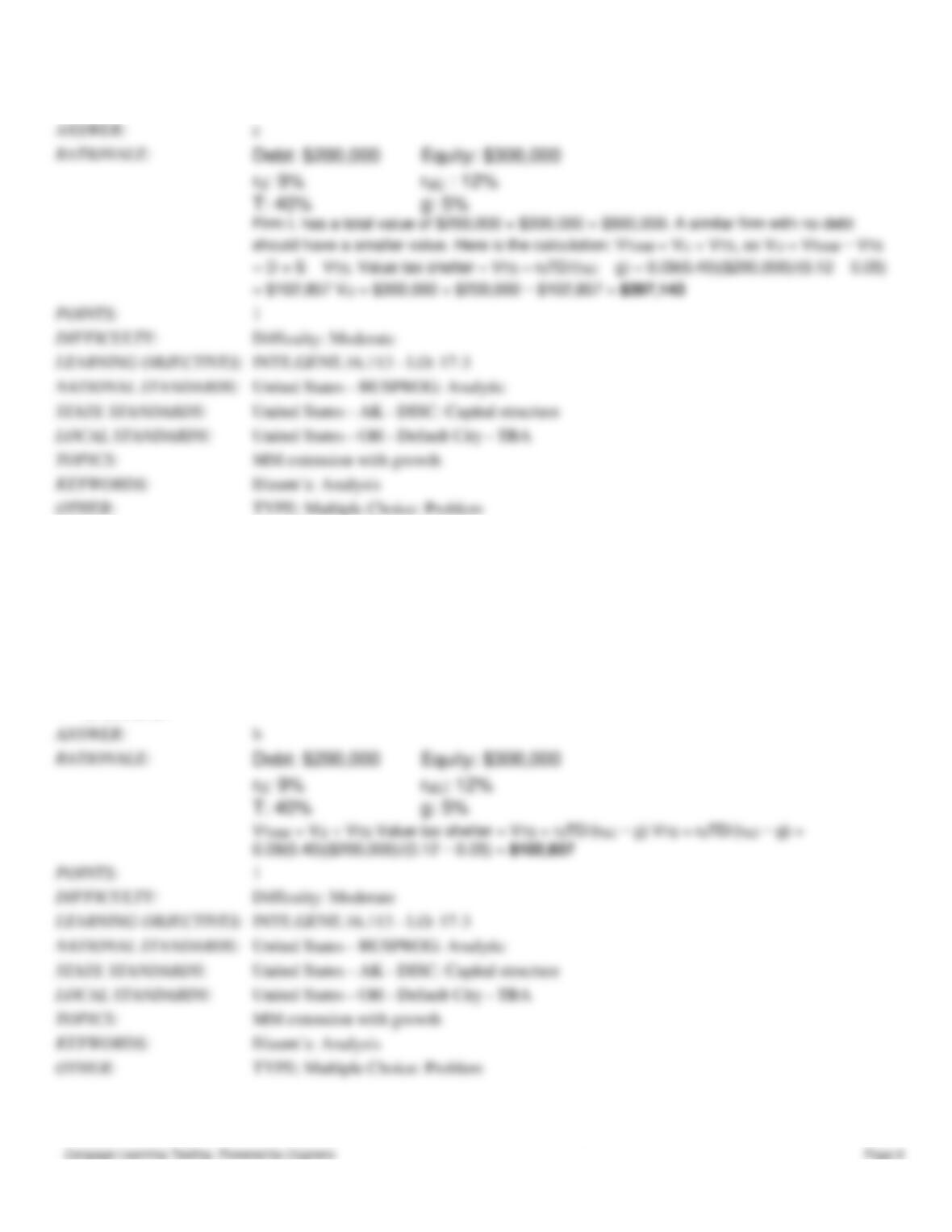
21. The market value of Firm L’s debt is $200,000 and its yield is 9%. The firm’s equity has a market value of $300,000,
its earnings are growing at a 5% rate, and its tax rate is 40%. A similar firm with no debt has a cost of equity of 12%.
Under the MM extension with growth, what would Firm L’s total value be if it had no debt?
a.
$358,421
b.
$377,286
c.
$397,143
d.
$417,000
CHAPTER 17—DYNAMIC CAPITAL STRUCTURES AND CORPORATE VALUATION
e.
$437,850
c
1
Difficulty: Moderate
INTE.GENE.16.113 – LO: 17-3
United States – BUSPROG: Analytic
United States – AK – DISC: Capital structure
United States – OH – Default City – TBA
TYPE: Multiple Choice: Problem
22. A local firm has debt worth $200,000, with a yield of 9%, and equity worth $300,000. It is growing at a 5% rate, and
its tax rate is 40%. A similar firm with no debt has a cost of equity of 12%. Under the MM extension with growth, what is
the value of your firm’s tax shield, i.e., how much value does the use of debt add?
a.
$92,571
b.
$102,857
c.
$113,143
d.
$124,457
e.
$136,903
b
1
Difficulty: Moderate
INTE.GENE.16.113 – LO: 17-3
United States – BUSPROG: Analytic
United States – AK – DISC: Capital structure
United States – OH – Default City – TBA
TYPE: Multiple Choice: Problem
Exhibit 17.1
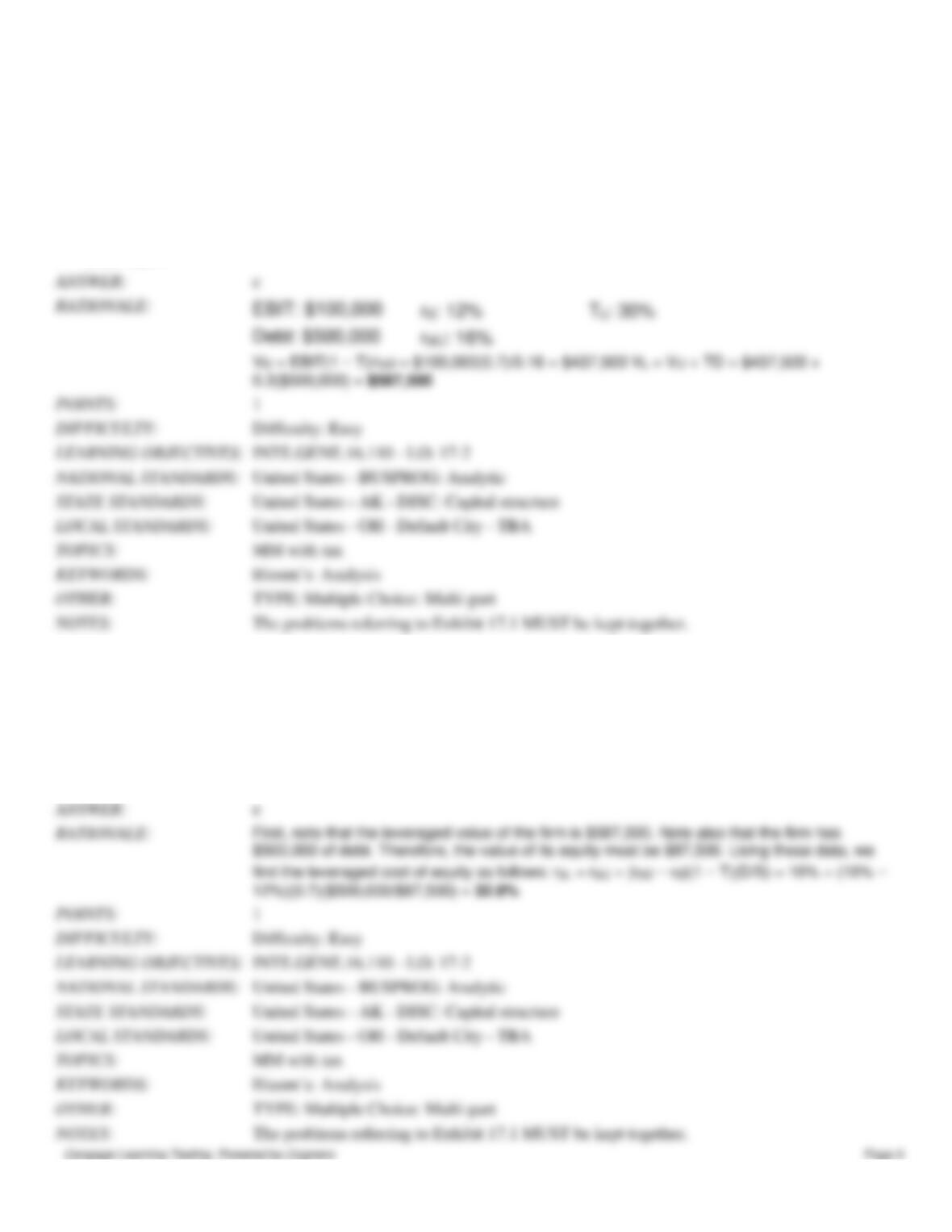
Eccles Inc., a zero growth firm, has an expected EBIT of $100,000 and a corporate tax rate of 30%. Eccles uses $500,000
CHAPTER 17—DYNAMIC CAPITAL STRUCTURES AND CORPORATE VALUATION
of 12.0% debt, and the cost of equity to an unlevered firm in the same risk class is 16.0%.
23. Refer to Exhibit 17.1. What is the value of the firm according to MM with corporate taxes?
a.
$475,875
b.
$528,750
c.
$587,500
d.
$646,250
e.
$710,875
c
1
24. Refer to Exhibit 17.1. What is the firm’s cost of equity?
a.
21.0%
b.
23.3%
c.
25.9%
d.
28.8%
e.
32.0%
e
1
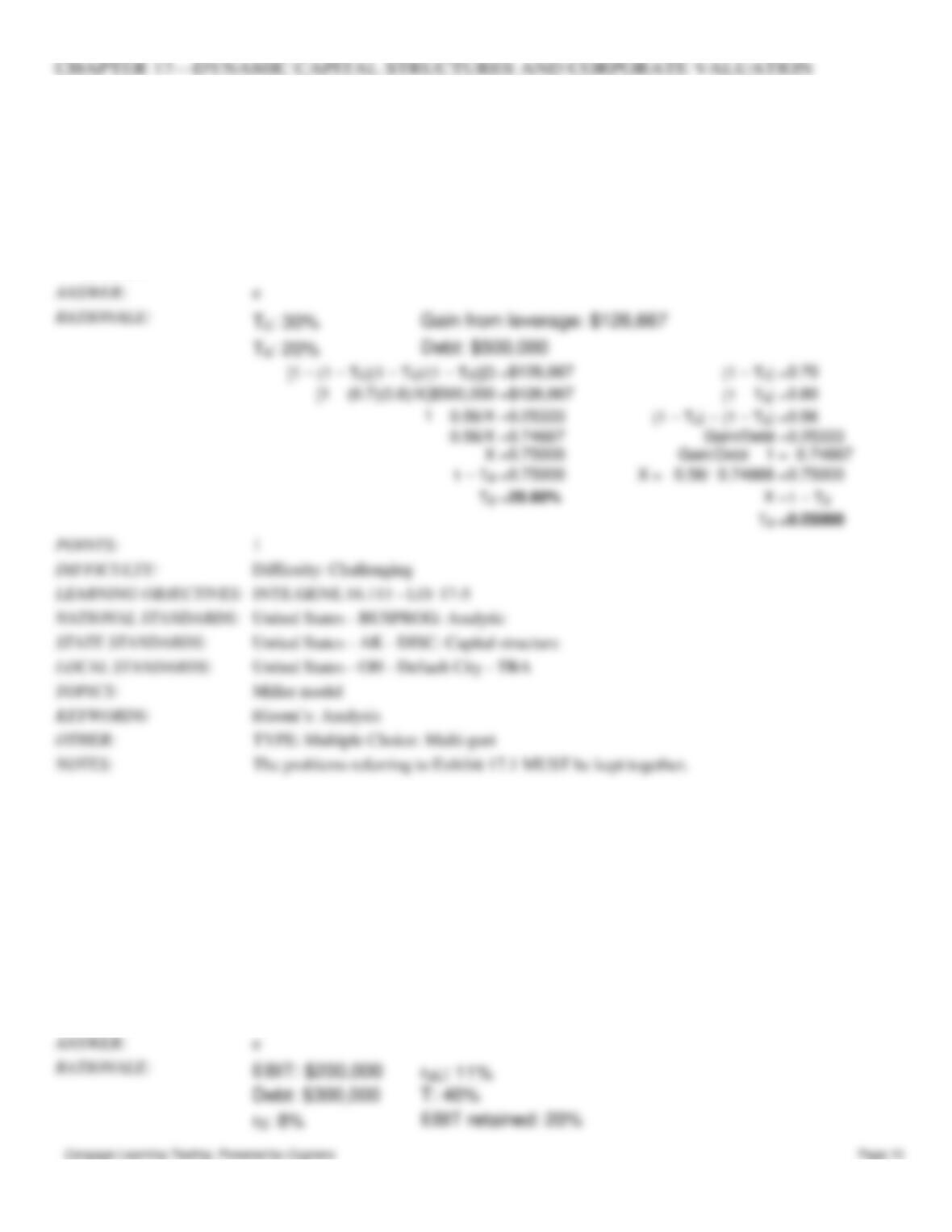
25. Refer to Exhibit 17.1. Assume that the firm’s gain from leverage according to the Miller model is $126,667. If the
effective personal tax rate on stock income is TS = 20%, what is the implied personal tax rate on debt income?
a.
16.4%
b.
18.2%
c.
20.2%
d.
22.5%
e.
25.0%
e
1
Difficulty: Challenging
INTE.GENE.16.111 – LO: 17-5
United States – BUSPROG: Analytic
United States – OH – Default City – TBA
Miller model
TYPE: Multiple Choice: Multi-part
The problems referring to Exhibit 17.1 MUST be kept together.
Exhibit 17.2
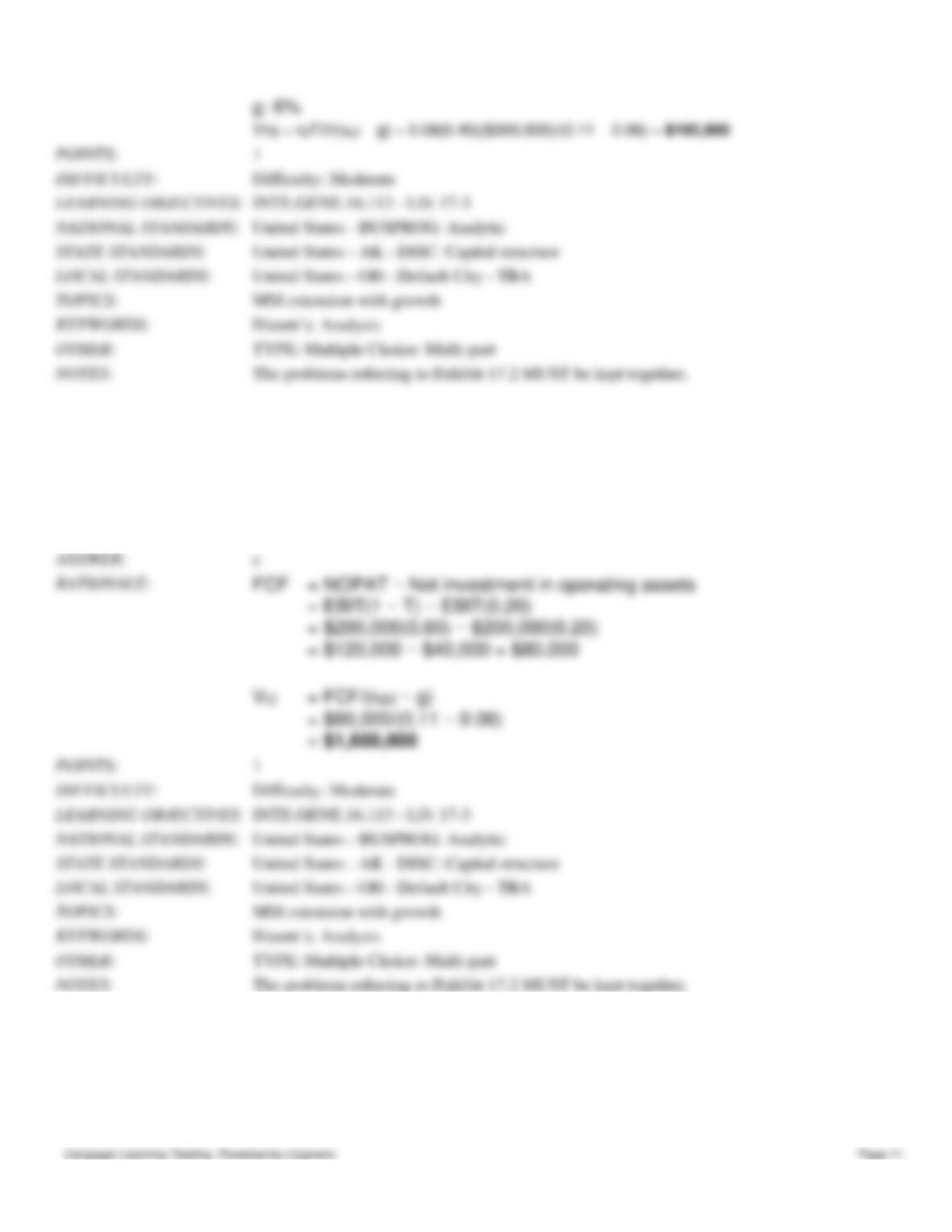
Kitto Electronics has an EBIT of $200,000, a growth rate of 6%, and its tax rate is 40%. In order to support growth, Kitto
must reinvest 20% of its EBIT in net operating assets. Kitto has $300,000 in 8% debt outstanding, and a similar company
with no debt has a cost of equity of 11%.
26. Refer to Exhibit 17.2. According to the MM extension with growth, what is the value of Kitto’s tax shield?
a.
$156,385
b.
$164,616
c.
$173,280
d.
$182,400
e.
$192,000
e
CHAPTER 17—DYNAMIC CAPITAL STRUCTURES AND CORPORATE VALUATION
27. Refer to Exhibit 17.2. According to the MM extension with growth, what is Kitto‘s unlevered value?
a.
$1,296,000
b.
$1,440,000
c.
$1,600,000
d.
$1,760,000
e.
$1,936,000
c
1
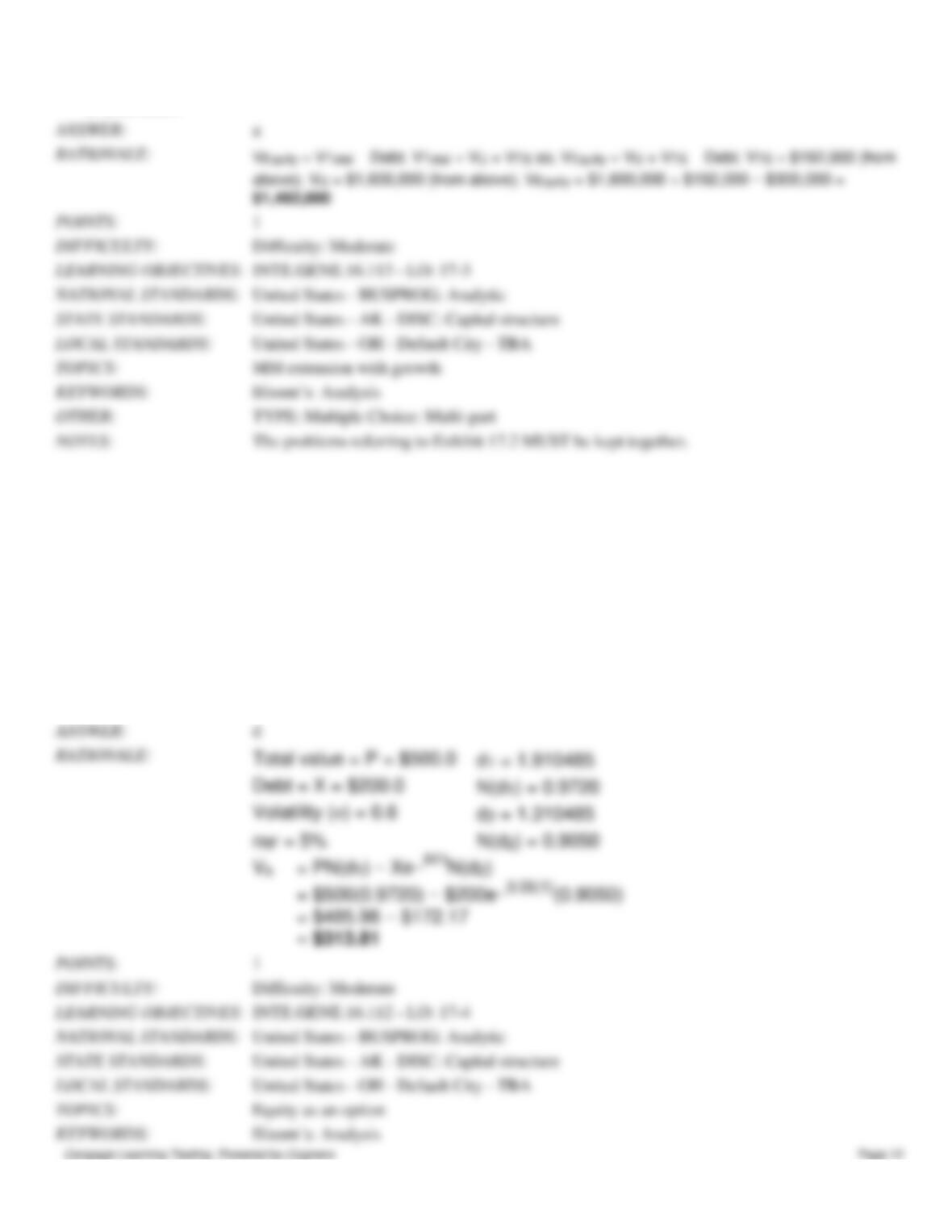
28. Refer to Exhibit 17.2. According to the MM extension with growth, what is Kitto‘s value of equity?
a.
$1,492,000
b.
$1,529,300
c.
$1,567,533
d.
$1,606,721
1
CHAPTER 17—DYNAMIC CAPITAL STRUCTURES AND CORPORATE VALUATION
e.
$1,646,889
a
1
Exhibit 17.3
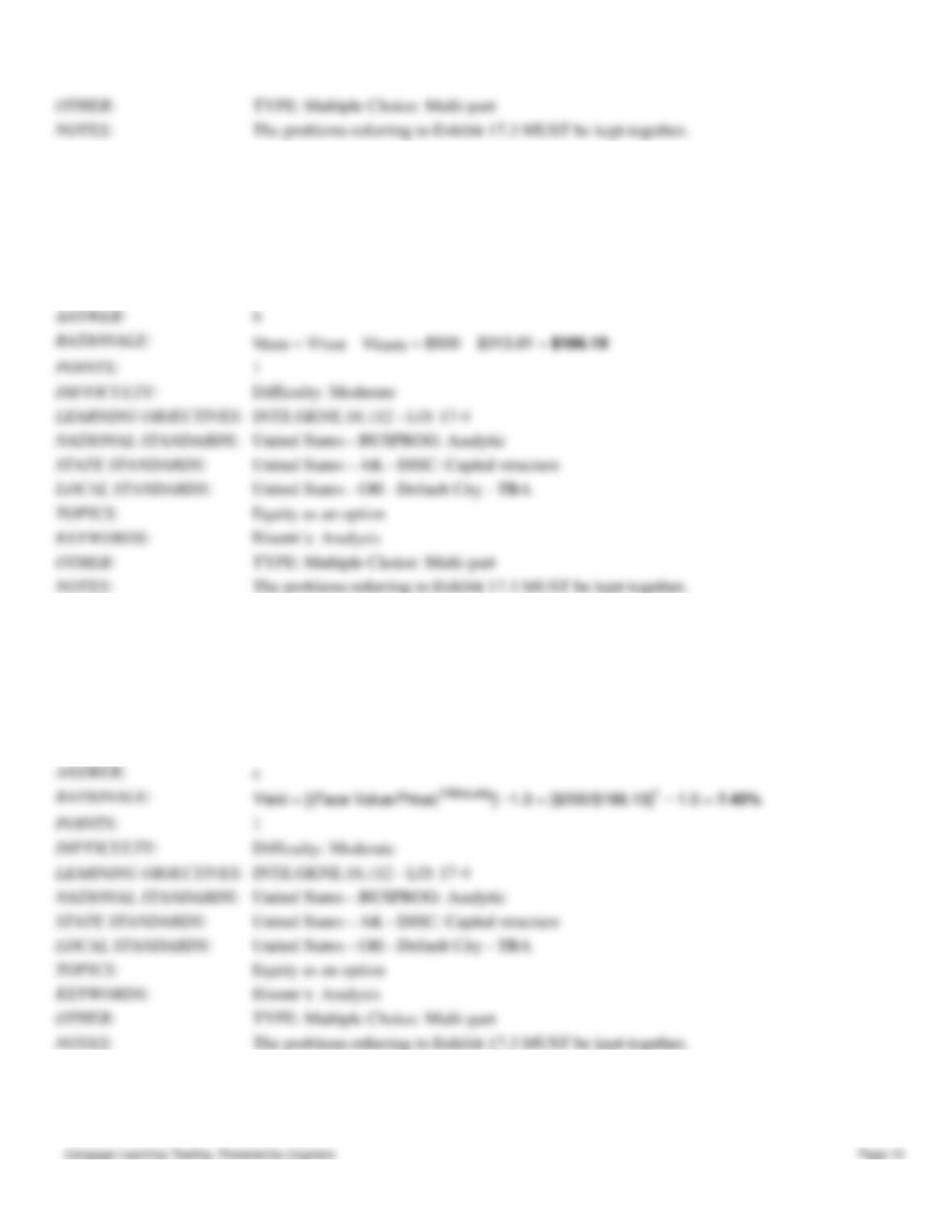
The total value (debt plus equity) of Wilson Dover Inc. is $500 million and the face value of its 1-year coupon debt is
$200 million. The volatility (σ) of Wilson Dover’s total value is 0.60, and the risk-free rate is 5%. Assume that N(d1) =
0.9720 and N(d2) = 0.9050.
29. Refer to Exhibit 17.3. What is the value (in millions) of Wilson Dover’s equity if it is viewed as an option?
a.
$228.77
b.
$254.19
c.
$282.43
d.
$313.81
e.
$345.19
d
1
CHAPTER 17—DYNAMIC CAPITAL STRUCTURES AND CORPORATE VALUATION
30. Refer to Exhibit 17.3. What is the value (in millions) of Wilson Dover’s debt if its equity is viewed as an option?
a.
$167.57
b.
$186.19
c.
$204.81
d.
$225.29
e.
$247.82
b
1
31. Refer to Exhibit 17.3. What is the yield on Wilson Dover’s debt?
a.
6.04%
b.
6.36%
c.
6.70%
d.
7.05%
e.
7.42%
e
1