66. A component of the average payment period is
a.
the time from the purchase of raw materials until the firm places the payment in the mail.
b.
the time it takes after the firm places its payment in the mail until the supplier has
withdrawn funds from the firm’s account.
c.
both a and b
d.
either a or b
67. The primary purpose of the accounts payable function
a.
is to examine all incoming invoices and determine the proper amount to be paid.
b.
is to generate float for the firm.
c.
is to pay invoices as soon as possible.
d.
none of the above.
68. National Groceries chooses to have it local stores make payments on their own payables. National
utilizes a
a.
centralized payment system.
b.
fragmented payment system.
c.
decentralized payment system.
d.
none of the above.
69. Near-cash assets in the form of short-term investments are often called
a.
marketable securities.
b.
corporate bonds.
c.
treasury notes.
d.
treasury bonds.
70. A supplier has offered you credit terms of 3/10 net 30. What is the implied rate of interest in the terms?
a.
56.44%
b.
37.08%
c.
5.69%
d.
3.09%
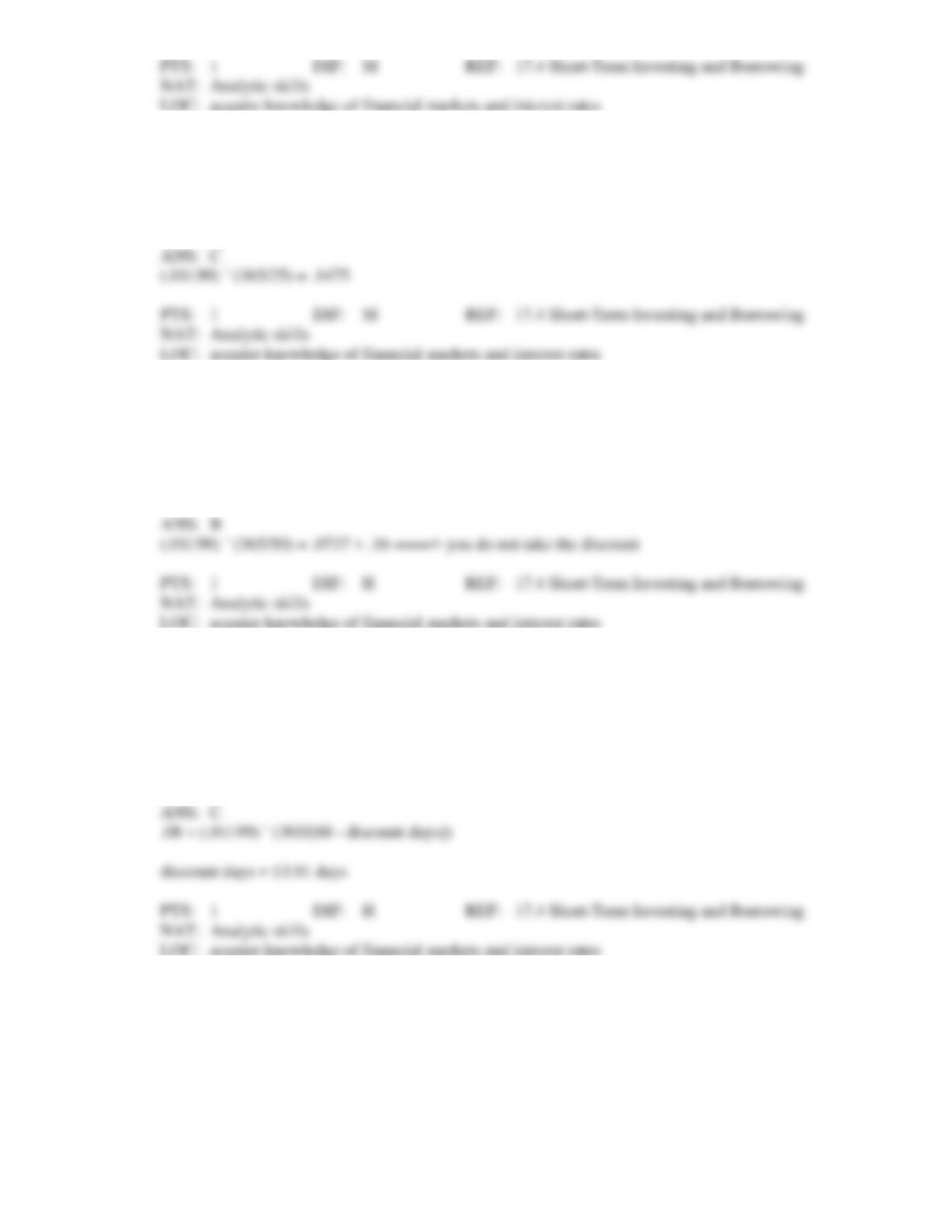
71. You are offered credit terms of 1/20 net 45. What is the implied rate of interest by the discount?
a.
1.01%
b.
12.12%
c.
14.75%
d.
25.25%
72. Your cost of capital is 16% and you are offered credit terms of 1/10 net 60. Do you take the discount
or not and why?
a.
you take the discount because 7.37% is less than 16%
b.
you do not take the discount because 7.37% is less than 16%
c.
you take the discount because 23.37% is greater than 16%
d.
you do not take the discount because 7.37% is less than 16%
73. Your cost of capital is 8% and you are offered a discount of 1% for early payment, otherwise the entire
amount is due in 60 days. How many days after purchase will cause you to be indifferent between
taking the discount and not taking the discount?
a.
46.08 days
b.
21.69 days
c.
13.91 days
d.
60 days
74. A bank service that provides early notification of checks that will be presented against a company’s
account on a given day is called
a.
a controlled disbursement.
b.
a positive pay disbursement.
c.
an integrated accounts payable.
d.
none of the above.
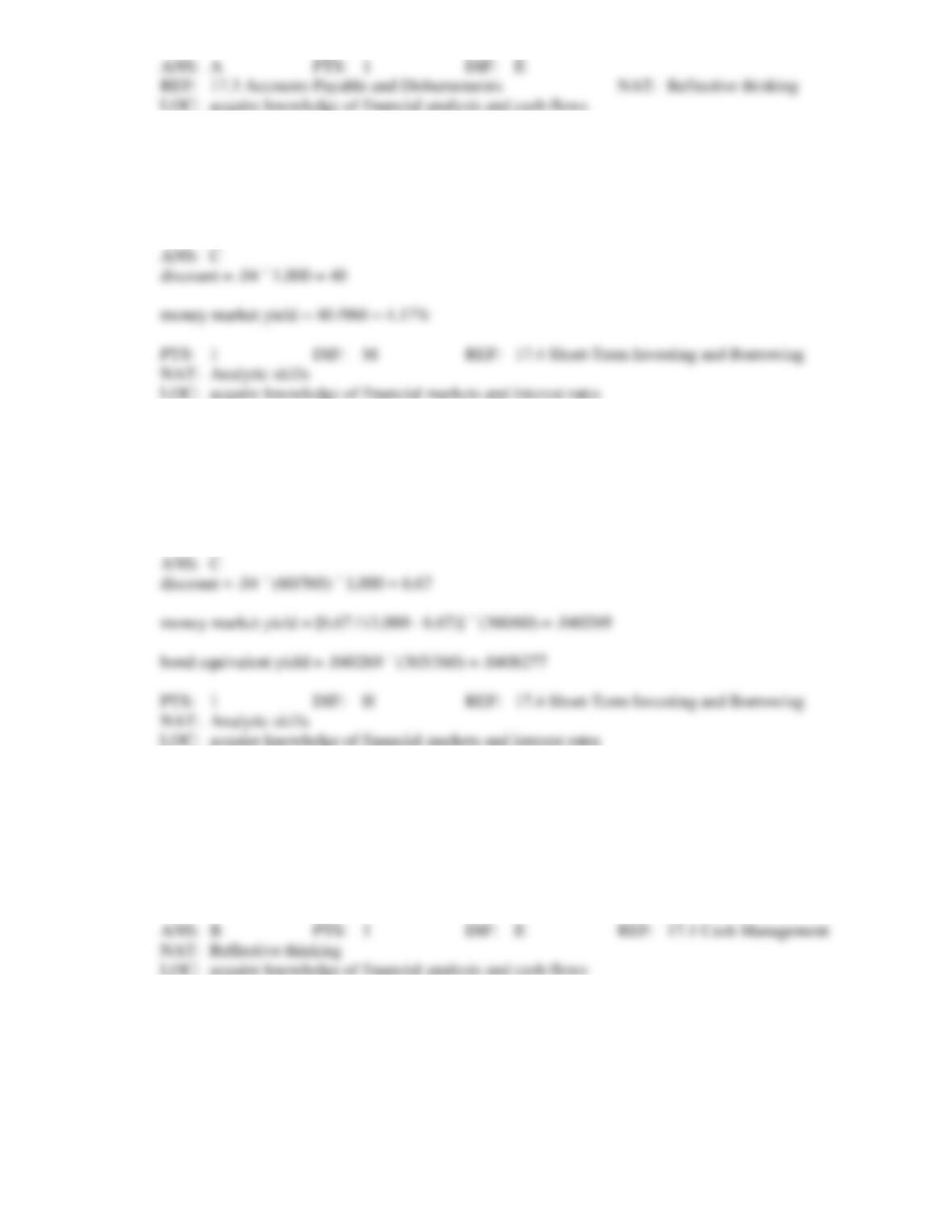
75. What is the money market yield for a one-year treasury bill that is priced at a 4% discount?
a.
3.83%
b.
4%
c.
4.17%
d.
4.22%
76. A 60-day treasury bill is priced at a 4% discount rate. What is the bond-equivalent yield of the
security?
a.
4.00%
b.
4.03%
c.
4.08%
d.
6.67%
77. Which of the following statements is a detailed invoice listing all checks cleared, account charges,
lockbox charges, electronic transactions, etc.?
a.
bank statement
b.
bank account analysis statement
c.
reconciliation statement
d.
financial statement
e.
none of the above
78. Which of the following statements concerning mail-based collection systems is true?
a.
Regardless of recent developments in payment processing equipment, it is still too
expensive for smaller companies to use mail-based collection systems.
b.
Generally it is cheaper for high-volume processors to use the lockbox system rather than
mail-based collection systems.
c.
Low-volume processors may find that using a lockbox system is more cost effective than a
mail-based collection system.
d.
All of the above statements are true.
e.
Only (a) and (b) are true.
79. Which of the following is not a benefit of using EIPP in the business-to-business market?
a.
Reduced float to the receiving party
b.
Lower cost of receivables processing for the receiver and payment initiation and
reconciliation costs for the payer
c.
Better forecasting for both receiver and payer
d.
Lower cost of receivables processing for the payer and payment initiation and
reconciliation costs for the receiver.
e.
All of the above are benefits
80. Which of the following is not an advantage of cash concentration?
a.
It creates a large pool of funds for use in making short-term cash investments.
b.
Concentrating the firm’s cash in one account improves the tracking and internal control of
the firm’s cash.
c.
It results in having fewer investment opportunities to choose from.
d.
All of the above are advantages.
81. Which of the following can be thought of as an electronic DTC?
a.
Wire transfer
b.
Automated Clearinghouse Debit Transfer
c.
Concentrated banking
d.
Field-banking system
e.
None of the above
82. Which of the following is true concerning transfer mechanisms?
a.
The firm must choose the mechanism that offers the highest earnings on the increased
funds’ availability.
b.
The firm must choose the mechanism that offers the lowest costs.
c.
The firm must balance the marginal costs vs. the marginal benefits and select the one with
the highest marginal profit.
d.
In practice, most companies use wire transfers for large transfers of funds from lockbox
systems and EDTs for high-volume, low-dollar transfers from small deposit banks.
e.
Both (c) and (d) are true.
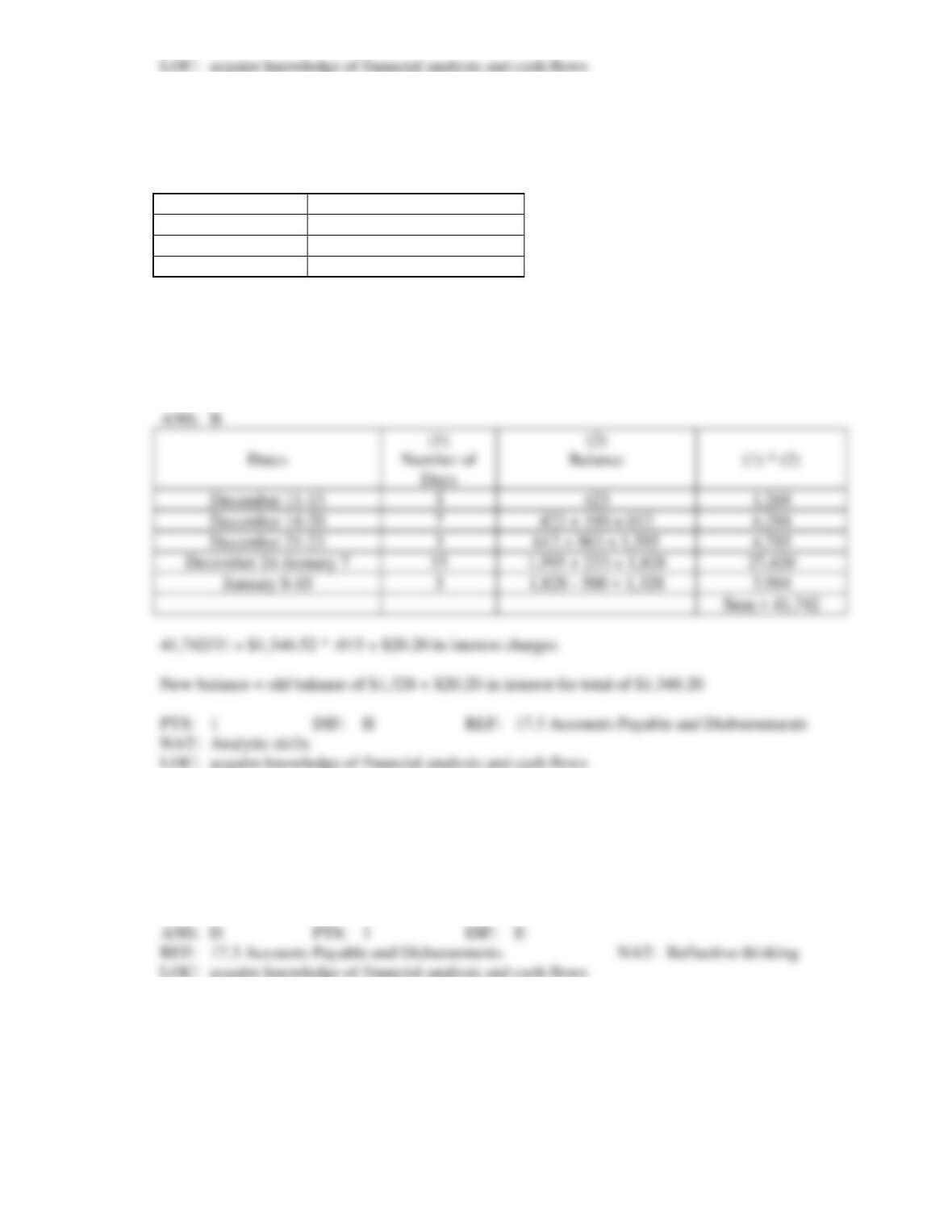
83. You have a credit card with NewBank. Calculate the new balance as of January 10 after considering
the finance charge for the month which is a 1.5% monthly rate based on the average daily balance and
the following purchases/payments. Your outstanding balance on December 10th is $423 and your
statement extends from December 10 through January 10.
December 13
Purchase of $189
December 20
Purchase of $983
December 23
Purchase of $233
January 7
Payment of $500
a.
$1,346.52
b.
$1,348.20
c.
$1,328.00
d.
$41,742
e.
none of the above
15
84. A zero-balance account is designed to:
a.
provide early notification of checks that will be presented against a company’s account on
a given day.
b.
help combat a common type of check fraud.
c.
provide a company with outsourcing of its accounts payable or disbursement operations.
d.
eliminate nonearning cash balances in corporate checking accounts.
85. Controlled disbursement is designed to:
a.
provide early notification of checks that will be presented against a company’s account on
a given day.
b.
help combat a common type of check fraud.
c.
provide a company with outsourcing of its accounts payable or disbursement operations.
d.
eliminate nonearning cash balances in corporate checking accounts.
86. Integrated accounts payable:
a.
provide early notification of checks that will be presented against a company’s account on
a given day.
b.
help combat a common type of check fraud.
c.
provide a company with outsourcing of its accounts payable or disbursement operations.
d.
eliminate nonearning cash balances in corporate checking accounts.
87. Purchasing (or procurement) cards are designed to:
a.
reduce the cost of low-dollar indirect purchases.
b.
help combat a common type of check fraud.
c.
provide a company with outsourcing of its accounts payable or disbursement operations.
d.
eliminate nonearning cash balances in corporate checking accounts.
88. Which of the following are listed as a common fraud prevention measures?
a.
Using positive pay services
b.
Separating check-issuance duties (approval, signing and reconciliation)
c.
Increasing the use of electronic payment methods
d.
Using safety measures on checks such as microprinting and watermarks
e.
all of the above are listed as common fraud prevention measures
89. Emma is evaluating a Treasury Bill. It is a $1 million face value with a discount of 2.55% and
maturing in 91 days. What is the dollar discount?
a.
$6,445.83
b.
$2,550.00
c.
$1,611.46
d.
$8,011.06
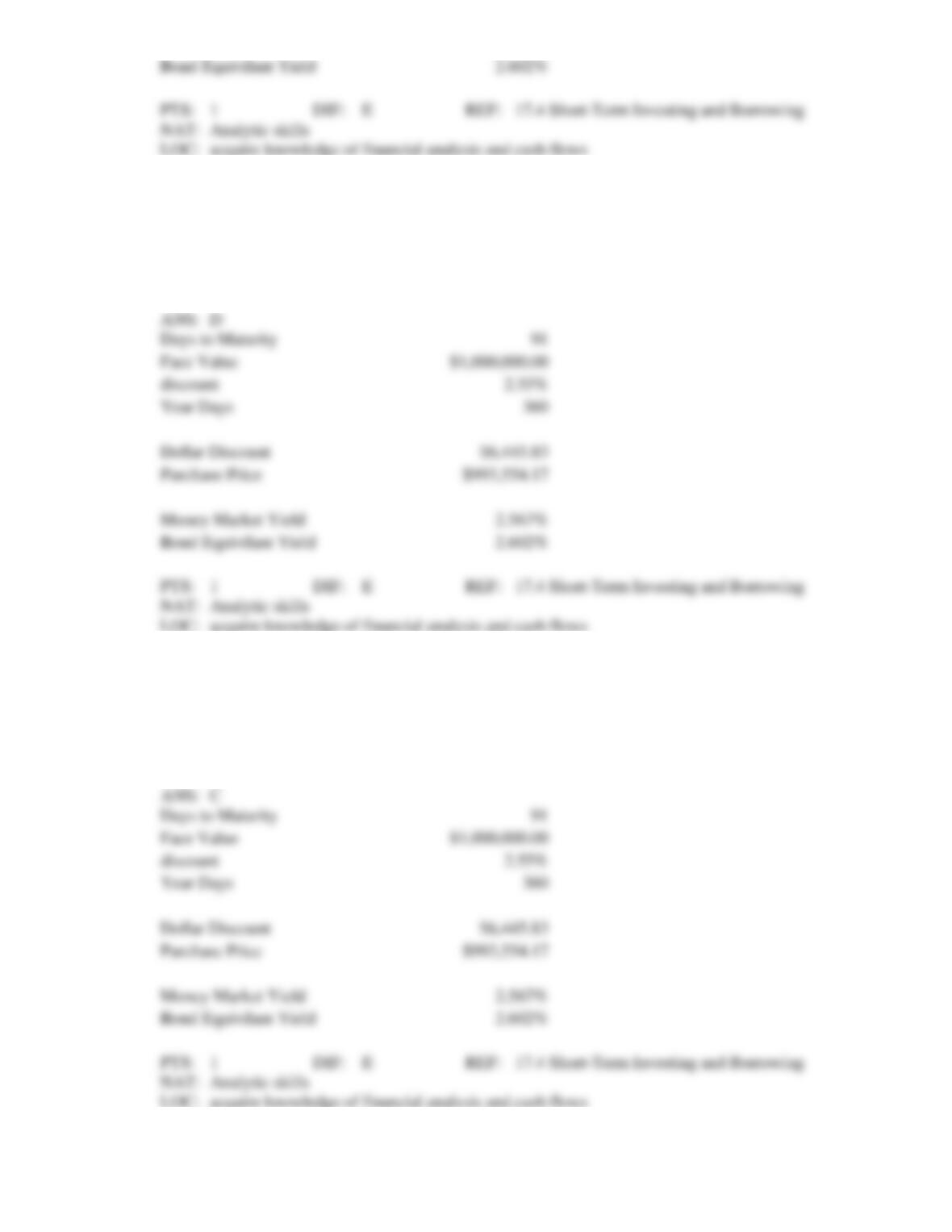
90. Emma is evaluating a Treasury Bill. It is a $1 million face value with a discount of 2.55% and
maturing in 91 days. What is the purchase price?
a.
$1,000,000.00
b.
$987,108.33
c.
$1,025,500.00
d.
$993,554.17
91. Emma is evaluating a Treasury Bill. It is a $1 million face value with a discount of 2.55% and
maturing in 91 days. What is the money market yield?
a.
2.550%
b.
2.585%
c.
2.567%
d.
2.602%
92. Emma is evaluating a Treasury Bill. It is a $1 million face value with a discount of 2.55% and
maturing in 91 days. What is the bond equivalent yield?
a.
2.550%
b.
2.585%
c.
2.567%
d.
2.602%
93. Roxy is evaluating a Treasury Bill. It is a $1 million face value with a discount of 2.75% and
maturing in 182 days.What is the dollar discount?
a.
$13,902.78
b.
$2,750.00
c.
$3,475.69
d.
$8,639.38
94. Roxy is evaluating a Treasury Bill. It is a $1 million face value with a discount of 2.75% and
maturing in 182 days. What is the purchase price?
a.
$1,000,000.00
b.
$986,097.22
c.
$972,194.44
d.
$1,027,500.00
95. Roxy is evaluating a Treasury Bill. It is a $1 million face value with a discount of 2.75% and
maturing in 182 days. What is the money market yield?
a.
2.789%
b.
2.828%
c.
2.750%
d.
2.788%
96. Roxy is evaluating a Treasury Bill. It is a $1 million face value with a discount of 2.75% and
maturing in 182 days. What is the bond equivalent yield?
a.
2.789%
b.
2.828%
c.
2.750%
d.
2.788%
97. Roxy is evaluating a Treasury Bill. It is a $1 million face value with a discount of 2.75% and
maturing in 182 days. What is the bond equivalent yield?
a.
2.789%
b.
2.828%
c.
2.750%
d.
2.788%
98. Louis is evaluating a Treasury Bill. It is a $1 million face value with a discount of 3.25% and
maturing in 182 days. What is the dollar discount?
a.
$10,210.18
b.
$4,107.64
c.
$3,250.00
d.
$16,430.56
99. Louis is evaluating a Treasury Bill. It is a $1 million face value with a discount of 3.25% and
maturing in 182 days. What is the purchase price?
a.
$1,000,000.00
b.
$967,138.89
c.
$983,569.44
d.
$1,032,500.00
100. Louis is evaluating a Treasury Bill. It is a $1 million face value with a discount of 3.25% and
maturing in 182 days. What is the money market yield?
a.
3.250%
b.
3.250%
c.
3.304%
d.
3.350%
$16,430.56
$16,430.56
101. Louis is evaluating a Treasury Bill. It is a $1 million face value with a discount of 3.25% and
maturing in 182 days. What is the bond equivalent yield?
a.
3.250%
b.
3.250%
c.
3.304%
d.
3.350%
102. Emma is evaluating a lock-box system that will reduce float by 4 days. The firm has annual sales of
$52 million and an opportunity cost of 15%.If the lock-box system is adopted, what is the amount of
funds released?
a.
$ 85,479.45
b.
$ 142,465.75
c.
$ 21,369.86
d.
$ 569,863.01
103. Emma is evaluating a lock-box system that will reduce float by 4 days. The firm has annual sales of
$52 million and an opportunity cost of 15%. If the lock-box system is adopted, what is the value of
funds released?
a.
$ 85,479.45
b.
$ 142,465.75
c.
$ 21,369.86
d.
$ 569,863.01
104. Roxy is evaluating a lock-box system that will reduce float by 6 days. The firm has annual sales of
$180 million and an opportunity cost of 12%. If the lock-box system is adopted, what is the amount
of funds released?
a.
$ 355,068.49
b.
$ 493,150.68
c.
$ 59,178.08
d.
$ 2,958,904.11
105. Roxy is evaluating a lock-box system that will reduce float by 6 days. The firm has annual sales of
$180 million and an opportunity cost of 12%. If the lock-box system is adopted, what is the value of
funds released?
a.
$ 493,150.68
b.
$ 355,068.49
c.
$ 59,178.08
d.
$ 2,958,904.11