32) Which of the following is most likely to have an impact on the growth of productivity?
A) a decrease in the price level
B) an increase in government regulation of workplace safety
C) an increase in the labor supply
D) a decrease in real money balances
33) Which of the following is NOT an example of a supply shock?
A) a drought in the Midwest
B) a decline in natural gas prices following discovery of new fields
C) the introduction of a new line of computer-controlled machine tools in manufacturing
D) a substantial increase in federal government spending on medicare
34) Make use of the misperceptions theory to explain why the short-run aggregate supply curve
is upward sloping.
35) According to the New Classical theory, why may output differ from its full-employment
level in the short run?
36) How do New Keynesians use the existence of long-term nominal contracts to help explain
the failure of prices to adjust in the short run?
37) How do new Keynesians use menu costs to help explain price stickiness in the short run?
38) According to New Keynesians, why can firms increase output in the short run in response to
higher prices?
39) Explain what happens to the short-run aggregate supply curve when output exceeds its
potential.
40) What are the principal sources of change in productivity growth?
17.3 Equilibrium in the Aggregate Demand and Aggregate Supply Model
1) In the aggregate demand-aggregate supply model, if entrepreneurs become convinced that
future profitability of capital has increased,
A) current output will fall, but the price level will rise.
B) current output will rise, but the price level will fall.
C) current output and the price level will both rise.
D) current output and the price level will both fall.
2) When output exceeds its full-employment level,
A) the short-run aggregate supply function shifts up.
B) wages fall.
C) the short-run aggregate supply function shifts down.
D) aggregate supply exceeds aggregate demand.
3) When output is below its full-employment level, the short-run aggregate supply will shift
down and to the right because
A) the expected price level will be below the actual price level.
B) workers’ wages will decline.
C) prices of nonlabor inputs will rise.
D) workers’ wages will rise.
4) If oil prices fall at the same time that the federal government increases its purchases, in the
short run
A) aggregate output and the price level will both increase.
B) aggregate output will increase, but the price level will fall.
C) aggregate output and the price level will both fall.
D) aggregate output will increase, but the price level may either increase or decrease.
5) If the expected price level increases at the same time that the federal government cuts taxes, in
the short run
A) aggregate output and the price level will both increase.
B) aggregate output will increase, but the price level will fall.
C) aggregate output and the price level will both fall.
D) the price level will increase, but aggregate output may either increase or decrease.
6) If labor costs rise at the same time that the federal government decreases its purchases, in the
short run
A) aggregate output and the price level will both increase.
B) aggregate output will increase, but the price level will fall.
C) aggregate output and the price level will both fall.
D) aggregate output will fall, but the price level may either increase or decrease.
7) If the economy is initially at equilibrium and an unexpected decline in aggregate demand
takes place, in the short run aggregate output will
A) fall in the new classical view, but not in the new Keynesian view.
B) fall in the new Keynesian view, but not in the new classical view.
C) fall in both the new Keynesian and new classical views.
D) remain at full employment in both the new classical and new Keynesian views.
8) Economists generally agree that in the long run changes in aggregate demand affect
A) aggregate output but not the price level.
B) the price level but not aggregate output.
C) both the price level and aggregate output.
D) neither the price level nor aggregate output.
9) In the aggregate demand-aggregate supply model, if the Federal Reserve decides to decrease
the nominal money supply,
A) current output will fall, but the price level will rise.
B) current output will rise, but the price level will fall.
C) current output and the price level will both rise.
D) current output and the price level will both fall.
10) According to AD-AS model, the primary long-run effect of increases in the money supply is
A) higher price level.
B) higher GDP.
C) lower price level.
D) lower GDP.
11) Monetary neutrality refers to the fact that changes in the money supply
A) affect output more in the long run than in the short run.
B) have no effect on output in the long run.
C) affect only output in the long run.
D) have a greater effect on prices in the short run than in the long run.
12) When economists state that money is neutral in the long run, they mean that in the long run,
A) fluctuations in the money supply are equally likely to lead to recessions as to expansions.
B) changes in the money supply have the same impact on the rich as they do on the poor.
C) the level of output is independent of the nominal money supply.
D) the price level is independent of the nominal money supply.
13) In the long run, the key reason that money is neutral is that
A) the federal budget is balanced.
B) prices are flexible.
C) business cycles have become much milder.
D) the nominal interest rate must equal the real interest rate.
14) In the long run, one-time increases or decreases in the nominal money supply affect
A) real output, but not the price level.
B) the price level, but not real output.
C) both real output and the price level.
D) neither real output nor the price level.
15) The Federal Reserve pursued an expansionary monetary policy during 1964 in order to
A) pull the United States out of a deep recession.
B) counteract the effects of a deep cut in federal income taxes.
C) keep interest rates from rising.
D) bring down the inflation rate.
16) During the years from 1964 to 1969, inflation increased in the United States
A) when the AD curve shifted up and to the right, even though the SRAS curve remained stable.
B) when the SRAS curve shifted up and to the left, even though the AD curve remained stable.
C) when the AD curve shifted up and to the right and the SRAS curve shifted up and to the left.
D) despite the AD and SRAS curves remaining stable.
17) The result of the supply shocks of 1973-1974 was to
A) reduce aggregate output and raise the price level.
B) reduce the price level and raise aggregate output.
C) reduce both aggregate output and the price level.
D) raise both aggregate output and the price level.
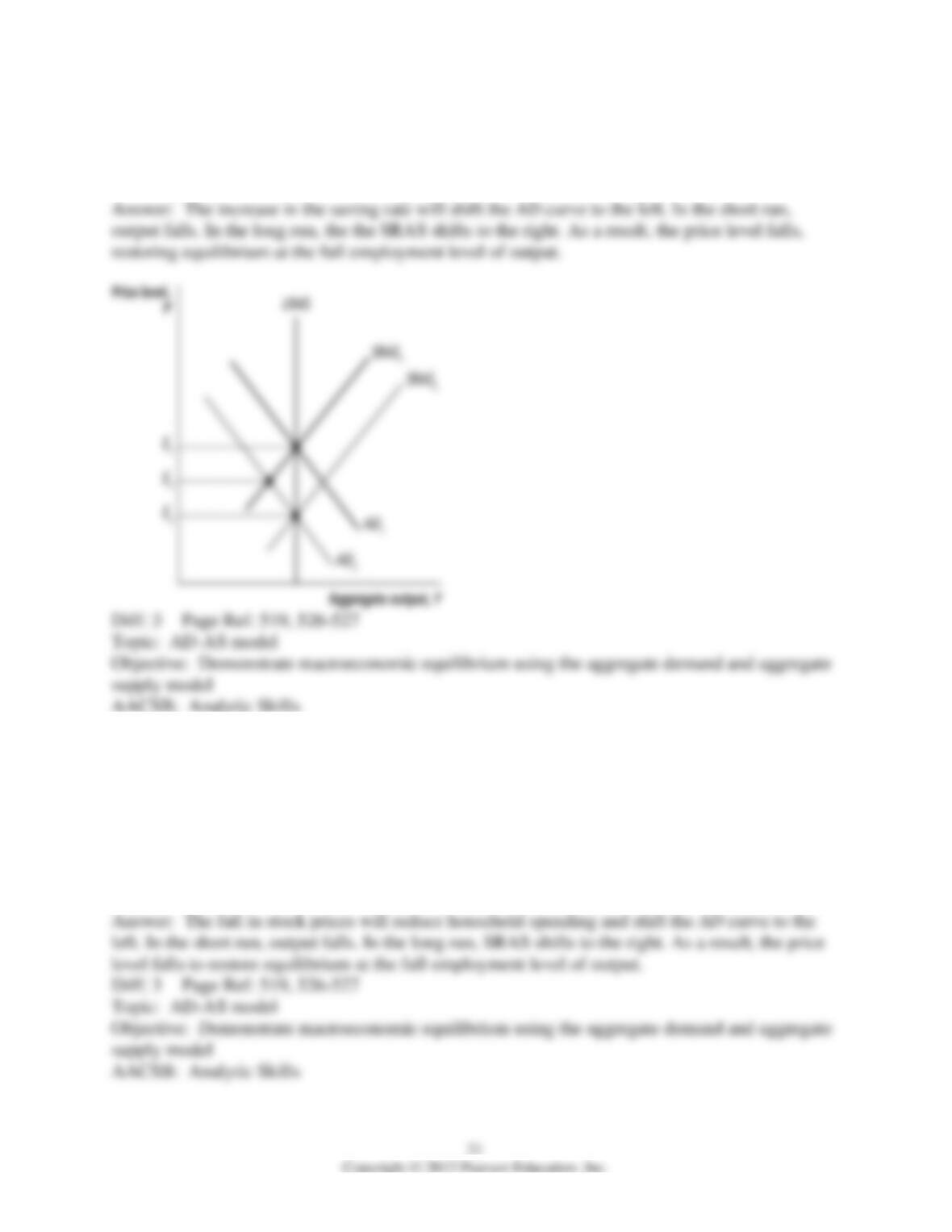
18) Suppose that initially U.S. households are saving only a small fraction of their incomes
because they are relying on rapid increase in stock prices to increase their wealth. If stock prices
decline and households decide to increase their saving rate, what will be impact on output in the
new Keynesian view? Be sure to distinguish the short run from the long run.
19) Suppose that many households look to the stock market to gauge how the economy is likely
to perform in the future. When stock prices are rising, then households will be optimistic about
the future state of the economy and will increase their spending on houses and consumer
durables, such as cars and furniture. When stock prices are falling, then households will be
pessimistic about the future and will cut back on their spending. If this view of the link between
stock prices and household spending is correct, then what will be the effect of a decline in stock
prices on output in the new Keynesian view? Be sure to distinguish the short run from the long
run.
20) Analyze the following statement: “I know the fact that prices have started to rise rapidly
seems like bad news, but at least prices starting to go up means that output must be starting to go
up as well.”
17.4 The Effects of Monetary Policy
1) Why are many economists skeptical of the Fed’s ability to fine tune the economy?
A) monetary policy only affects output in the long run
B) lags in policy make it difficult to properly time policy
C) fiscal policy can be implemented more quickly than monetary policy
D) monetary policy does not have any effect on output
2) Stabilization policy refers to attempts to
A) shift the AD curve to smooth short-run fluctuations in output.
B) shift the SRAS curve to smooth short-run fluctuations in output.
C) shift the AD curve to keep the price level as low as possible.
D) shift the SRAS curve to keep the nominal interest rate as low as possible.
3) Which of the following statements concerning stabilization policy is correct?
A) Increasing government spending during an economic boom would be an example of a
stabilization policy.
B) Increasing taxes during a recession would be an example of a stabilization policy.
C) New Keynesian economists are skeptical of the value of stabilization policies.
D) Increasing the money supply during a recession is an example of a stabilization policy.
4) An expansionary monetary policy that successfully counteracts a recession has the side effect
of
A) lower investment spending than if no action had been taken.
B) a larger government deficit than if no action had been taken.
C) a higher price level than if no action had been taken.
D) lower output than if no action had been taken.
5) In comparing the views of economists on stabilization policy in the 1960s with the current
views of economists on stabilization policy, one can say
A) few economists in the 1960s favored stabilization policy, while most economists currently
favor stabilization policy.
B) economists’ views on stabilization policy have changed very little since the 1960s.
C) fewer economists currently believe it is possible to use stabilization policy to fine-tune the
economy than in the 1960s.
D) almost no economists in the currently believe stabilization policy should be used.
6) Which of the following is NOT a reason for the weak recovery following the 2007-2009
recession?
A) recessions started by financial crises are almost always severe
B) the decline in the automobile industry appeared to be structural
C) the collapse of the housing market was long lived
D) the recession was caused by a decline in short-run aggregate supply
7) An argument in support of hysteresis is
A) companies may be reluctant to hire workers until AD increases.
B) prices are sticky in the short run.
C) the skills of unemployed workers may deteriorate making it more difficult to find a job.
D) overlapping wage contracts.
8) Economists who are skeptical of hysteresis in Europe cite all of the following as reasons for
persistently high unemployment in Europe EXCEPT
A) generous unemployment benefits.
B) restrictions on firms’ ability to hire and fire workers.
C) the existence of an ongoing recession.
D) high tax rates.
9) Which of the following was NOT cited as contributing to unusual uncertainty having an
adverse effect on aggregate supply?
A) the possibility that Congress may let the 2001, 2003 tax cuts to expire
B) the Fed’s limited use of monetary policy in fighting the recession
C) the severity of the financial crisis
D) concern that the Affordable Care act would increase the cost of hiring workers
10) According to Robert Gordon, what led to the decline in unemployment in the 1940s?
A) structural barriers to expanding output and employment disappeared once a sufficiently large
increase in aggregate demand had taken place
B) decline in unionization of the workforce
C) President Truman moving away from the policies implemented by President Roosevelt
D) the strengthening of property rights following the end of the New Deal
11) Explain why some economists claim that the persistence of high unemployment rates during
the recovery from the recession of 2007––2009 is evidence of “hysteresis.”
12) According to some economists, what contributed to the unusual uncertainty that adversely
affected aggregate supply during the recovery following the recession of 2007-2009?