
Chapter 17 – Common and Preferred Stock Financing
1. Common stockholders have a residual claim to income, in other words they are last in line.
2. Common stockholders have a legal claim to dividend income.
3. A common stockholder cannot force a company into bankruptcy for eliminating the
dividend.

Chapter 17 – Common and Preferred Stock Financing
4. Stock classes are similar to bond ratings in that they are used to rank the performance of
different corporation’s stock.
5. Stock classes may differ in both voting rights and dividend rights.
6. Occasionally, a company will have several classes of common stock, with each class
carrying different rights to dividends and income.
7. Common stockholders may assign a proxy, or the power to cast their ballot, only when
majority voting is in place.
Chapter 17 – Common and Preferred Stock Financing
8. Under majority voting, it is easier for minority stockholders to elect some directors to the
board.
9. The type of shareholder voting has become less important with the influence of takeovers,
leveraged buy-outs, and other challenges to management control.
10. Bondholders never have any control over the actions of a firm.
11. The increasing sophistication of individual investors has decreased the role of institutional
investors in the stock market.

Chapter 17 – Common and Preferred Stock Financing
12. Under cumulative voting, holding 30% of the shares outstanding will guarantee an
investor the ability to elect 3 of 9 directors to the board.
13. Stockholders always have preemptive rights when new issues of stock are offered.
14. A rights offering may be of limited value to shareholders.
15. After a rights offering the common stock price will sell at the subscription price.
16. Pre-emptive rights offerings are an especially popular way in Europe to raise money and
fund expansions.

Chapter 17 – Common and Preferred Stock Financing
17. When a stock sells ex-rights, the sale of the shares no longer entitles the purchaser to
receive a right.
18. The difference between the rights-on and ex-rights price is equal to the subscription price
divided by N.
19. The difference between the rights-on and ex-rights common stock price is equal to the
value of a right.
20. The ex-rights date usually takes place after the end of the subscription period.

Chapter 17 – Common and Preferred Stock Financing
21. The current market value of Markowitz Corp stock is $61. If ten rights are required to buy
one additional share of Markowitz, at the subscription price of $50, then the rights are worth
$1.00.
22. Stock purchased through a rights offering may carry lower margin requirements.
23. A poison pill will raise the potential for maximizing shareholder value because it deters
takeover bids.
24. American Depository Receipts (ADRs) are certificates that give foreign stockholders a
legal claim on U.S. companies’ foreign stock.

Chapter 17 – Common and Preferred Stock Financing
25. Although ADRs are traded in the U.S in dollars, foreign currency risk for the investor
remains.
26. Preferred stock dividends are a deductible expense for a corporation.
27. The after-tax cost of debt is cheaper than preferred stock to the issuing corporation.
28. Preferred stock generally carries a higher interest rate than debt.
29. To the security holder, preferred stock offers the highest risk and the lowest return.

Chapter 17 – Common and Preferred Stock Financing
30. To the individual recipient, preferred stock dividends offer no advantage over common
stock dividends.
31. If a company has preferred stock, it must pay the dividends on the preferred even if it
shows no profit for the year.
32. Because of tax considerations, corporations often are able to issue preferred stock at a
slightly lower yield than debt.
33. Participating preferred stock may receive an extra dividend in a particularly good year
when earnings are above a stated level.

Chapter 17 – Common and Preferred Stock Financing
34. Generally the receipt of corporate bond interest is more valuable than preferred dividends
to corporate investors.
35. Convertible exchangeable preferreds give the holder the sole right to exchange their
preferred stock for common stock.
36. Some preferred stocks are participating preferreds and this may allow for an increase in
the preferred stock dividend when the common stock dividend equals the preferred stock
dividend.
37. Participating preferred stock is advantageous to common stockholders.

Chapter 17 – Common and Preferred Stock Financing
38. The market price of floating rate preferred stock is less volatile than that of regular
preferred stock.
39. Floating rate preferred stock allows shareholders to receive more or less than the quoted
dividend based on the firm’s success.
40. The floating rate feature on preferred stock causes more volatility in its price.
41. Participating preferred stock gives its owners voting rights.
42. Dutch Auction preferred stocks, unlike standard preferred stocks, are typically short-term
instruments.

Chapter 17 – Common and Preferred Stock Financing
43. If a corporation pays no taxes because it is losing money, a preferred stock issuance
becomes more attractive relative to a debt issuance.
44. A rights offering is generally financially advantageous to the investor because it provides
them with additional shares of stock.
45. Investors are usually in favor of poison pills because it prevents takeovers.
46. ADRs are subject to foreign exchange risk unlike direct methods of investing on the
foreign exchange.
Chapter 17 – Common and Preferred Stock Financing
47. Preferred stock would generally provide a lower before-tax yield to investors than secured
debt due to its lower risk.
48. An increasing proportion of shares in the U.S. are owned by:
49. Which of the following is not a true statement?
Chapter 17 – Common and Preferred Stock Financing
50. When comparing common stock of the same company it is fair to say that
51. A proxy is
52. Which of the following statements is true with respect to cumulative voting?
Chapter 17 – Common and Preferred Stock Financing
53. The purpose of cumulative voting is
54. Under normal operating conditions, the board of directors is elected by
55. Given that there are 4,000,000 shares outstanding in Miller Corp., how many shares will
be required for a minority group of stockholders to elect 2 of the 9 members on the board of
directors? (Assume cumulative voting required)
Chapter 17 – Common and Preferred Stock Financing
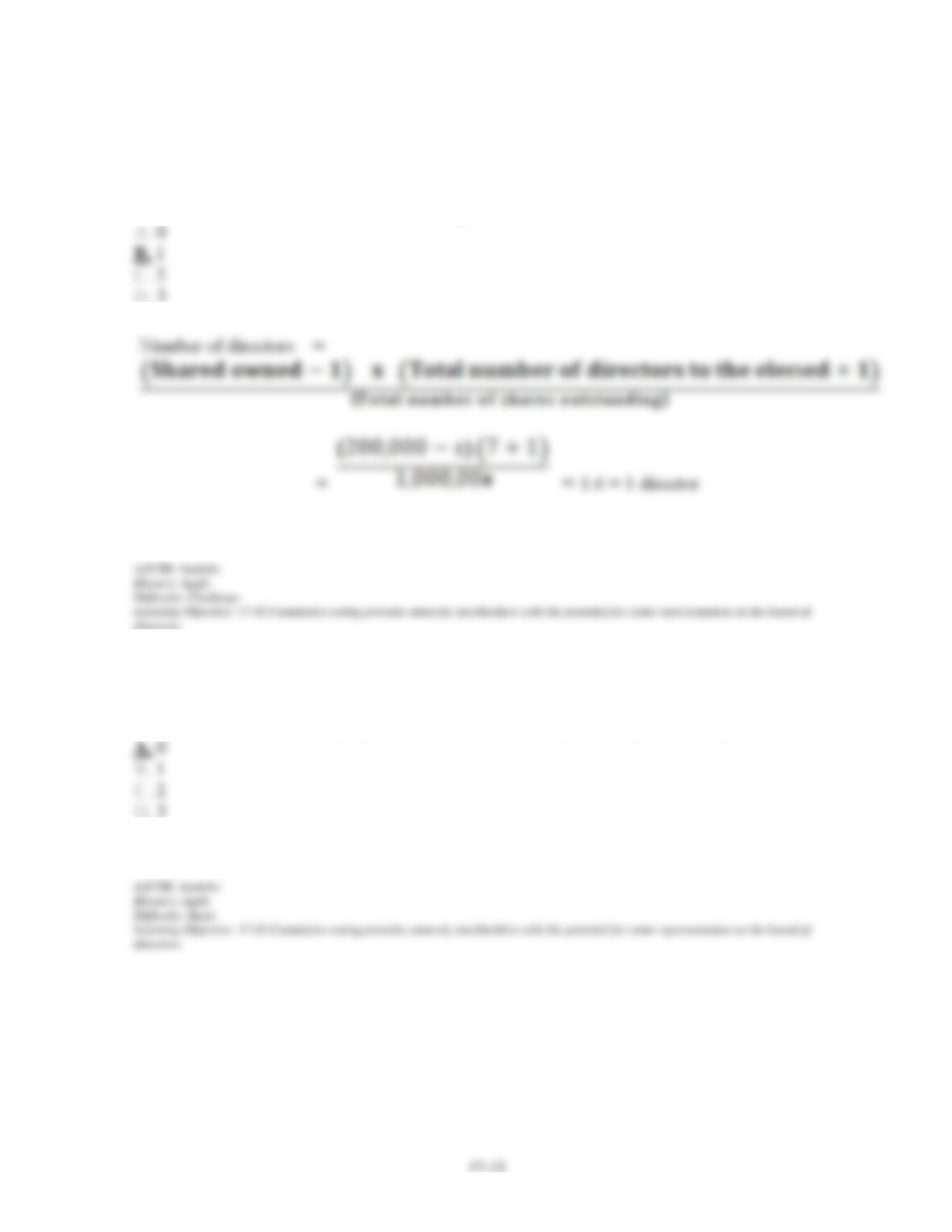
56. Sharpe Products has 1 million outstanding shares and 7 directors to be elected.
Cumulonimbus Holdings owns 200,000 shares of Sharpe. How many directors can
Cumulonimbus elect with cumulative voting?
57. Coase Corp. has 10,000,000 outstanding shares. There are 11 directors on the firm’s board.
The Becker family owns 2,300,000 shares of Coase Corp. How many directors can the Becker
family be assured of electing by themselves if Coase Corp. uses majority voting?
Chapter 17 – Common and Preferred Stock Financing
58. A rights offer made to existing shareholders with the sole purpose of making it more
difficult for another firm to acquire the company is called
59. There are a number of possible advantages to a rights offering:
60. The effect of a rights offering on a stockholder is
Chapter 17 – Common and Preferred Stock Financing
61. The most important feature of the preemptive right is that the rights
62. If a corporate charter includes a provision for preemptive rights, the stockholders
63. “Preemptive rights” means that