Auditing, 12e (Arens)
Chapter 17 Audit of the Inventory and Distribution Cycle
17.1 Describe the business functions, documents, and records of the inventory and distribution
cycle
1) Obtaining an adequate understanding of the client’s business is important in physical
observation of inventory because
A) it is required by GAAP.
B) it will help the auditor in assessing the risk of theft of inventory.
C) inventory is normally a significant item.
D) inventory varies significantly for different companies.
2) The form used to request the purchasing department to place orders for inventory items is the
A) purchase order.
B) purchase requisition.
C) materials requisition.
D) bill of lading.
3) The inventory and distribution cycle can be thought of as comprising two separate but closely
related systems, one involving the actual physical flow of goods, and the other the
A) internal control over those goods.
B) related costs.
C) storing of the goods.
D) prevention of waste, obsolescence, and theft.
4) The bias in recording inventory would be toward
A) overstatement.
B) understatement.
C) increasing share price.
D) income smoothing.
5) The auditor has determined that the risks are high that the client would overvalue inventory.
Which audit assertions would require additional testing?
A) accuracy and existence
B) allocation and accuracy
C) accuracy and valuation
D) valuation and classification
6) The auditor evaluates the internal transfer of assets and related costs during the
A) acquisition and payments cycle.
B) human resources and payroll cycle.
C) sales and collection cycle.
D) inventory and distribution cycle.
7) The costs used to value the physical inventory must be tested to determine whether the client
has correctly followed an inventory method that is in accordance with an acceptable financial
reporting framework and is consistent with previous years. The audit procedures used to verify
these costs are referred to as inventory
A) price tests.
B) compilation tests.
C) cost allocation tests.
D) consistency tests.
8) State the six functions that make up the inventory and distribution cycle and, for each
function, identify the related documents and/or records that would be used by a manufacturing
company.
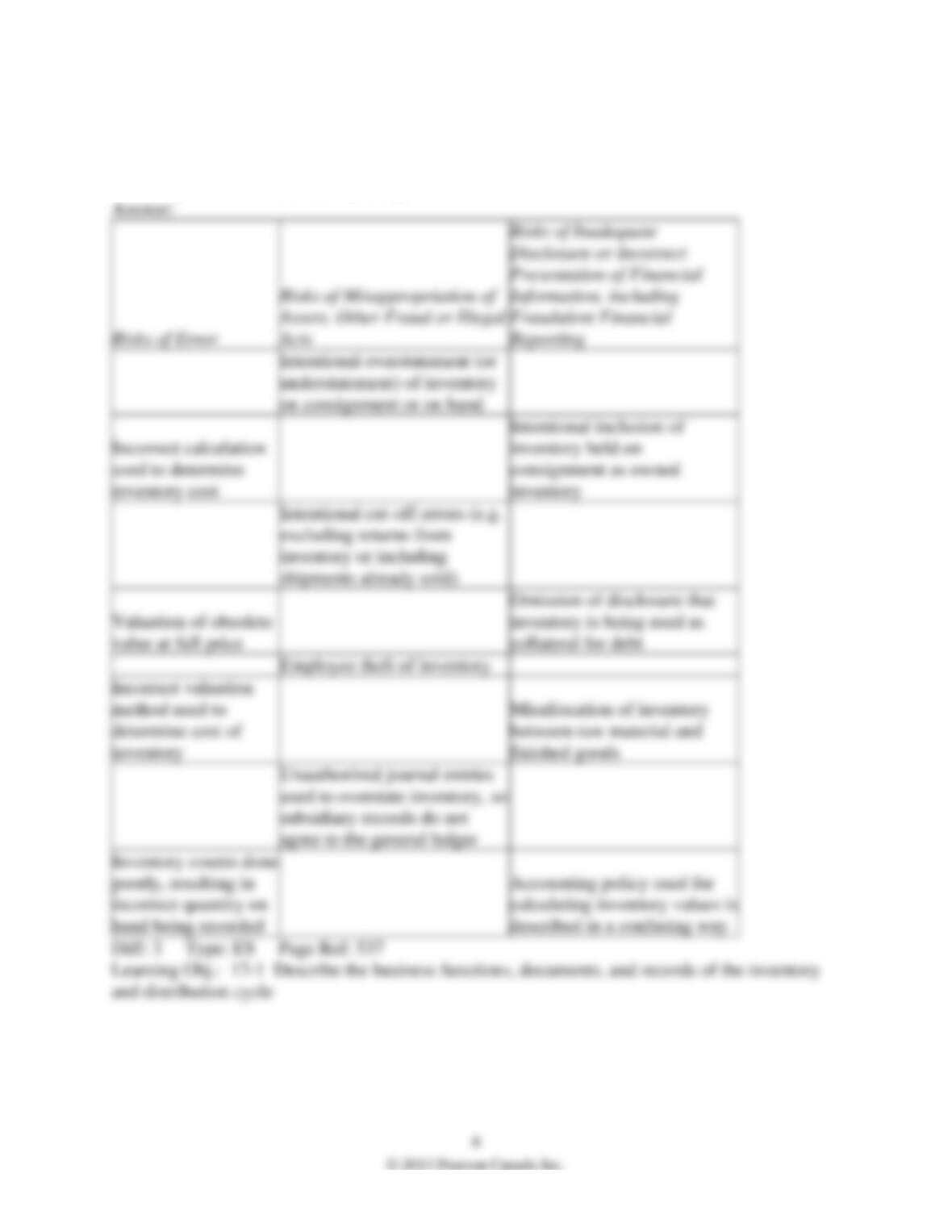
9) Describe the major risks of error or fraud in the inventory and distribution cycle, using the
headings of (i) risks of error, (ii) risks of misappropriation of assets, other fraud or illegal acts,
and (iii) risks of inadequate disclosure or incorrect presentation of financial information,
including fraudulent financial reporting.
17.2 Select audit steps to audit the five different parts of the inventory and distribution cycle
1) Receipt of ordered materials by the receiving department will generate the completion of a
form called the
A) receiving report.
B) materials requisition.
C) bill of lading.
D) inventory acquisition summary.
2) The overall objective in the audit of the inventory and distribution cycle is to determine that
A) costs of goods sold and gross profit are correctly stated on the income statement.
B) inventory items on the balance sheet are neither fraudulent nor materially in error.
C) gross profit and inventory are fairly presented on the financial statements.
D) inventory and cost of goods sold are fairly stated on the financial statements.
3) The controls over purchase requisitions and the related purchase orders are evaluated and
tested as part of the
A) inventory and distribution cycle.
B) acquisitions and payments cycle.
C) human resources and payroll cycle.
D) capital acquisitions cycle.
4) When labour is a significant part of inventory, verifying the proper accounting of these costs
should be tested in the
A) inventory and distribution cycle.
B) human resources and payroll cycle.
C) acquisitions and payments cycle.
D) cash cycle.
5) Master files, worksheets, and reports that accumulate material, labour, and overhead as the
costs are incurred are
A) accounting system controls.
B) storeroom documents.
C) finished goods inventory records.
D) cost accounting records.
6) Segregation of duties between production, inventory control, and accounting are important
controls in the inventory and distribution cycle. How would the auditor test these controls? Using
A) inquiry and reperformance.
B) observation and inquiry.
C) observation and reperformance.
D) discussion with managment.
7) Shipping of finished goods is an integral part of the
A) acquisitions and payments cycle.
B) inventory and distribution cycle.
C) sales and collections cycle.
D) human resources and payroll cycle.
8) The auditor must verify whether the physical counts were correctly summarized, the inventory
quantities and prices were correctly extended, and the extended inventory was correctly footed.
These tests are called
A) price tests.
B) compilation tests.
C) cost tests.
D) mechanical tests.
9) Cost accounting controls are those related to the physical inventory and the consequent costs
from the point at which
A) materials are ordered for purchase until the finished product is sold.
B) raw materials are requisitioned until the finished product is sent to storage.
C) raw materials are requisitioned until the finished product is completely manufactured.
D) the customer’s order is received until the finished product is shipped.
10) To protect the inventory, Globus Corp wants to assign the custody of inventory to a specific
responsible individual. Globus can accomplish this by requesting
A) a designated employee to authorize movement of inventory.
B) employees to have photo id cards.
C) have restricted access to the production facility.
D) have frequent inventory counts.
11) A well-designed computerized system of perpetual inventory data files includes information
about the
A) units of inventory purchased, sold, and on hand.
B) unit costs of inventory purchased, sold, and on hand.
C) units and unit costs of inventory purchased, sold, and on hand.
D) units of raw materials, work-in-process, and finished goods.
12) The auditor’s tests of the adequacy of the physical controls over raw materials, work-in–
process, and finished goods are usually limited to
A) observation and inquiry.
B) inspection and observation.
C) inspection and confirmation.
D) inspection and inquiry.
13) The existence of an adequate storeroom with a competent custodian in charge results in the
orderly storage of inventory. It can protect inventory from theft and misuse. How would the
auditor assess these controls? Using
A) observation during the audit and inquiry of the accounting staff.
B) inquiry of the accounting staff and inspection of theft statistics.
C) observation during the inventory count and inquiry of inventory personnel.
D) inspection of inventory damage statistics and inquiry of inventory personnel.
14) If the auditor concludes that the physical controls over inventory are so inadequate that
inventory will be difficult to count, the auditor should
A) inquire of management the additional controls that can be put in place to enable a better count
to be carried out.
B) conduct additional control tests over the pricing and compilation of inventory to obtain a
higher degree of accuracy.
C) rely upon the perpetual inventory master files rather than the physical count.
D) expand the observation of physical inventory tests to ensure that an adequate count is carried
out.
15) The auditor would like to test the existence and accuracy of the transfer of goods from the
raw materials storeroom to the manufacturing assembly lines. Which of the following audit
procedures should be used?
A) conduct a variance analysis of the costs associated with manufacturing, looking for gross
profit fluctuations
B) account for a sequence of raw material requisitions, examining details and looking for proper
approvals
C) look at overtime records to determine the amount and timing of overtime hours used in the
manufacturing process
D) inquire of the inventory custodian with respect to procedures used to transfer raw materials to
the production line
16) It is frequently possible to test the physical inventory prior to the balance sheet date when
A) there are accurate perpetual inventory master files.
B) year-end sales are small.
C) the internal control system is no better at year-end than at an earlier point in time.
D) client counts inventory at interim dates.
17) The auditor has determined that the perpetual inventory master files are high quality,
assessing control risk related to physical observation of inventory as low. How does this affect
audit testing? The auditor may
A) reduce the extent of control tests over data entry to the master file.
B) reduce the extent of the tests of physical inventory.
C) reduce the extent of control tests with respect to program change controls.
D) increase assessed inherent risks over the tests of physical inventory.
18) Which one of the following analytical procedures would be most helpful in alerting the
auditor to the possibility of obsolete inventory? Comparing
A) gross margin percentage with previous years.
B) unit costs of inventory with previous years.
C) inventory turnover with previous years.
D) current year manufacturing costs with previous years.
19) To detect an overstatement or understatement of inventory and cost of goods sold, the auditor
may perform an analytical procedure such as comparing
A) gross margin percentage with previous years.
B) inventory turnover with previous years.
C) current year manufacturing costs with previous years.
D) extended inventory value with previous years.
20) Which analytical procedures will help the auditor identify possible misstatements in
compilation, unit costs, or extensions that affect inventory and cost of goods sold? Compare
A) compare gross margin percentage with previous years’.
B) unit costs of inventory with previous years’.
C) inventory turnover with previous years’.
D) extended inventory value with previous years’.
21) The CAS require that audit procedures for inventory include that the auditor
A) must count the inventory.
B) must be present at the count and must receive adequate documentation from client regarding
the effectiveness of inventory-taking.
C) must be present at the count and evaluate the methods followed in the determination of
quantities and values.
D) need not be present at the count but must review the methods followed in the determination of
quantities and values.
22) The audit of the inventory and distribution cycle consists of five parts. State the five parts
and, for each part, identify the cycle in which that part is tested by the auditor.
23) Discuss the methodology for designing tests of details of balances for inventory.
24) What are inventory price tests and inventory compilation tests? Provide an example of each.
17.3 Explain the role of each of the following types of tests in the audit of inventory
1) If the auditor is appointed after the year end of the client, the auditor
A) should qualify the audit opinion for the inventory balance and cost of sales.
B) could attend a current perpetual inventory count and roll backward with the records.
C) should do an inventory count as soon as he is appointed.
D) will inquire with management of the company about the inventory count performed at year
end.
2) Dishware Distribution Limited uses average costing to cost its inventory. It keeps a perpetual
inventory file that is linked to its sales systems. It orders inventory in for specific customers as
needed, and traditionally has a slow time just before its year end. Accordingly, inventory at the
yearend is about $2,000, while materiality is about $30,000. How should the auditor approach
the audit of physical inventory?
A) exclude testing of physical inventory from the audit program
B) use attribute sampling to select a sample of items to count
C) use dollar unit sampling to select a sample of items to count
D) count only those items that have a dollar value in excess of $100
3) The auditor has evaluated the effectiveness of the client’s procedures to count inventory, and
has provided constructive suggestions for improvement. However, the client has not
implemented the suggestions, so the auditor has concluded that the inventory instructions do not
provide adequate controls. This means that the auditor
A) must send a management letter informing management of the impact of these weaknesses.
B) must spend more time ensuring that the physical count is accurate.
C) should use attribute sampling to select a smaller sampling for testing the physical inventory.
D) increase the level of price and compilation tests to ensure better quality inventory pricing
data.