
Use the information for the question(s) below.
Big Blue Banana (BBB) is a clothing retailer with a current share price of $10.00 and with 25 million
shares outstanding. Suppose that Big Blue Banana announces plans to lower its corporate taxes by
borrowing $100 million and using the proceeds to repurchase shares.
16) Suppose that BBB pays corporate taxes of 40% and that shareholders expects the change in debt to
be permanent. Assume that capital markets are perfect except for the existence of corporate taxes and
financial distress costs. If the price of BBB‘s stock rises to $10.80 per share following the announcement,
then the present value of BBB’s financial distress costs is closest to:
16.5 Exploiting Debt Holders: The Agency Costs of Leverage
Use the following information to answer the question(s) below.
Nielson Motors has a debt–equity ratio of 1.8, an equity beta of 1.6, and a debt beta of 0.20. It is currently
evaluating the following projects, none of which would change Nielson’s volatility.
Project
1
2
3
4
5
Investment
100
75
120
60
80
NPV
23
12
18
15
14
(All amounts are in $millions.)
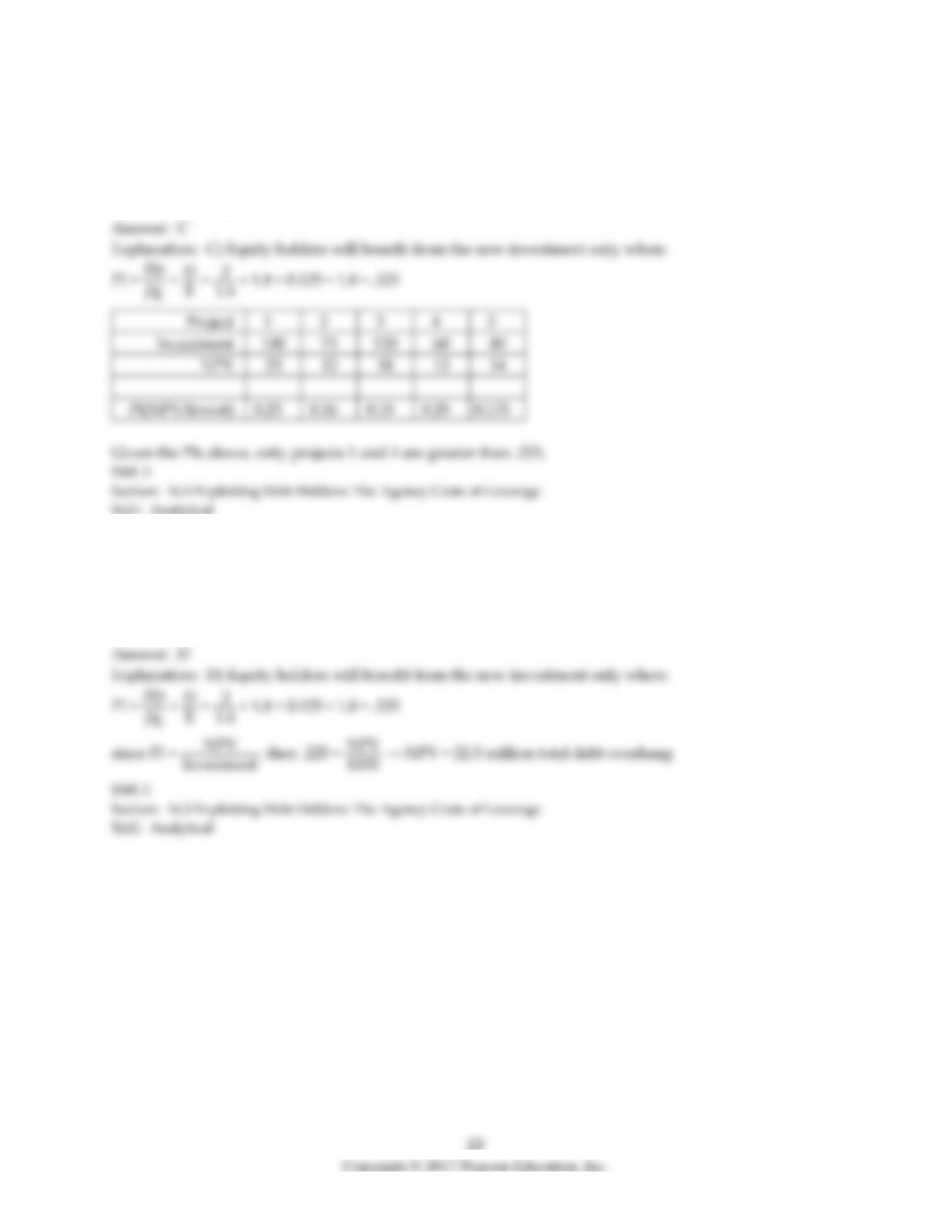
1) Nielson Motors should accept those projects with profitability ratios greater than:
A) 0.15
B) 0.175
C) 0.20
D) 0.225
2) Which of the following projects should Nielson Motors accept?
A) 1 only
B) 1, 2, and 3 only
C) 1 and 4 only
D) 2, 3, and 5 only
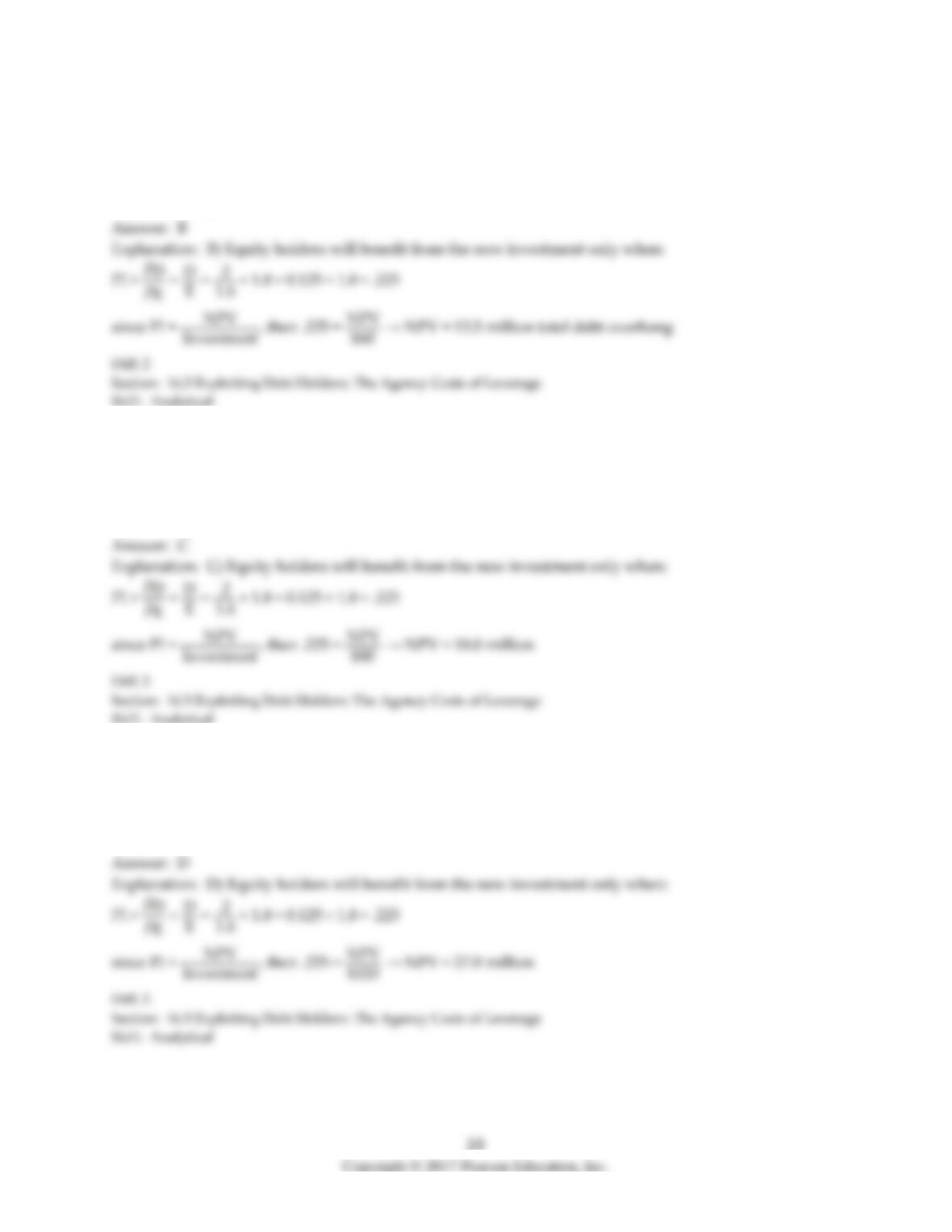
3) The total debt overhang associated with accepting project 1, is closest to:
A) $0 million
B) $12.5 million
C) $14.4 million
D) $22.5 million
4) The total debt overhang associated with accepting project 4, is closest to:
A) $0 million
B) $13.5 million
C) $15.0 million
D) $38.6 million
5) In order for Nielson Motor’s to be willing to invest, project 5 must have an NPV greater than:
A) $10.0 million
B) $12.5 million
C) $18.0 million
D) $22.5 million
6) In order for Nielson Motor’s to be willing to invest, project 3 must have an NPV greater than:
A) $12.5 million
B) $15.0 million
C) $22.5 million
D) $27.0 million
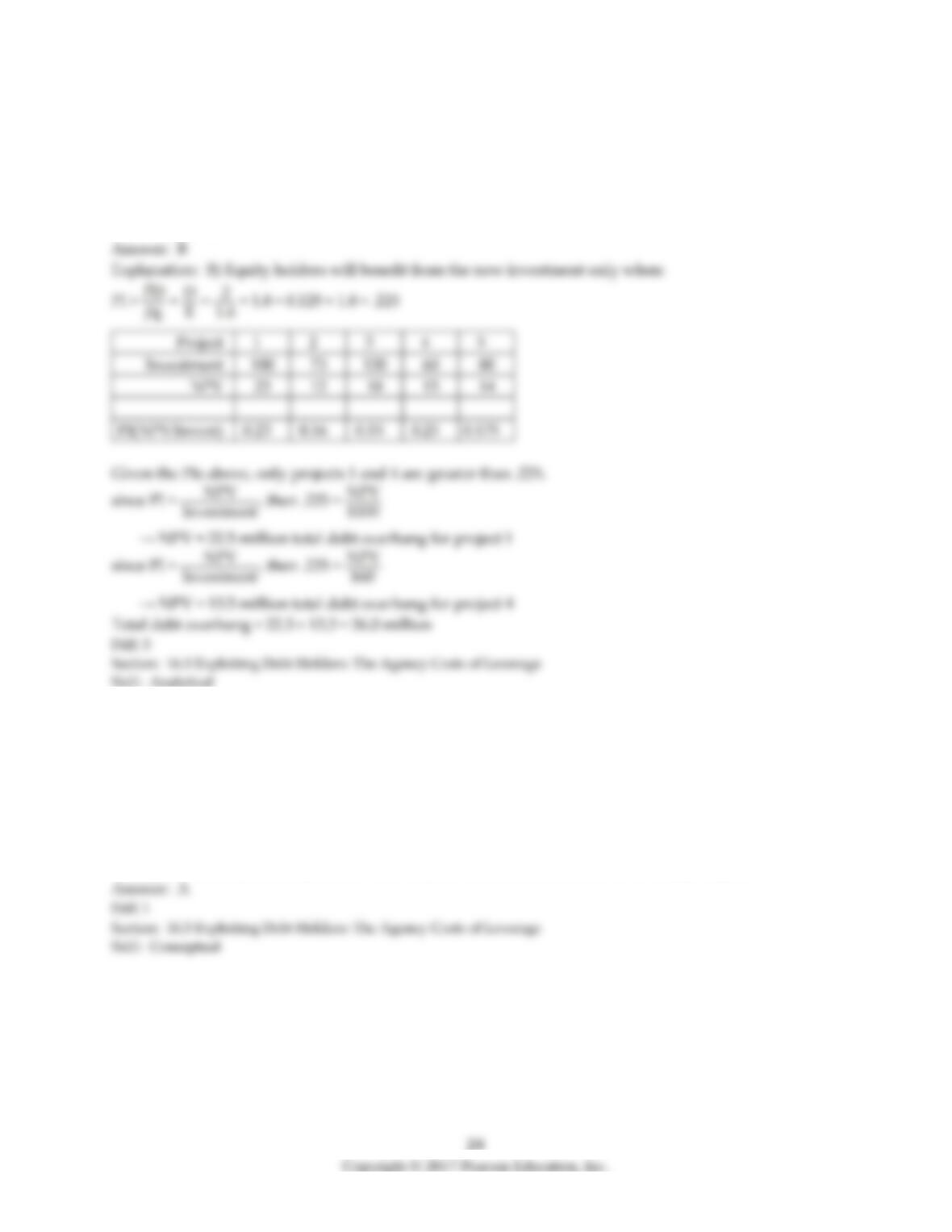
7) If Nielson Motors invests in only those projects which are beneficial to the stockholders, then the total
debt overhang associated with accepting these project(s) is closest to:
A) $22.5 million
B) $36.0 million
C) $38.0 million
D) $57.5 million
8) Which of the following statements is FALSE?
A) When a firm faces financial distress, creditors can gain by making sufficiently risky investments,
even if they have negative NPV.
B) When a firm has leverage, a conflict of interest exists if investment decisions have different
consequences for the value of equity and the value of debt.
C) In some circumstances, managers may take actions that benefit shareholders but harm the firm’s
creditors and lower the total value of the firm.
D) Agency costs are costs that arise when there are conflicts of interest between stakeholders.
9) Which of the following statements is FALSE?
A) When a firm faces financial distress, shareholders have an incentive not to invest and to withdraw
money from the firm if possible.
B) Because top managers often hold shares in the firm and are hired and retained with the approval of
the board of directors, which itself is elected by shareholders, managers will generally make decisions
that increase the value of the firm’s equity.
C) An over-investment problem occurs when shareholders have an incentive to invest in risky positive–
NPV projects.
D) A negative-NPV project destroys value for the firm overall.
10) Which of the following statements is FALSE?
A) The agency costs of debt can arise only if there is no chance the firm will default and impose losses
on its debt holders.
B) Agency costs represent another cost of increasing the firm’s leverage that will affect the firm’s
optimal capital structure choice.
C) An under-investment problem occurs when shareholders choose to not invest in a positive-NPV
project.
D) When a firm faces financial distress, it may choose not to finance new, positive-NPV projects.
11) Which of the following statements is FALSE?
A) Creditors often place restrictions on the actions that the firm can take. Such restrictions are referred
to as debt covenants.
B) Covenants are often designed to prevent management from exploiting debt holders, so they may
help to reduce agency costs.
C) Agency costs are smallest for long-term debt.
D) Covenants may limit the firm’s ability to pay large dividends or the types of investments that the
firm can make.
Use the information for the question(s) below.
JR Industries has a $20 million loan due at the end of the year and under its current business strategy its
assets will have a market value of only $15 million when the loan comes due. JR is considering a new
much riskier business strategy. While this new riskier strategy can be implemented using JR’s existing
assets without any additional investment, the new strategy has only a 40% probability of succeeding. If
the new strategy is a success, the market value of JR’s assets will be $30, but if the strategy fails the
assets will be worth only $5 million.
12) What is the overall expected payoff under JR’s new riskier business strategy?
A) $4 million
B) $11 million
C) $20 million
D) $15 million
13) What is the expected payoff to debt holders under JR’s new riskier business strategy?
A) $20 million
B) $4 million
C) $15 million
D) $11 million
14) What is the expected payoff to equity holders under JR’s new riskier business strategy?
A) $15 million
B) $11 million
C) $20 million
D) $4 million
Use the information for the question(s) below.
Wildcat Drilling is an oil and gas exploration company that is currently operating two active oil fields
with a market value of $200 million each. Unfortunately, Wildcat Drilling has $500 million in debt
coming due at the end of the year. A large oil company has offered Wildcat drilling a highly
speculative, but potentially very valuable, oil and gas lease in exchange for one of their active oil fields.
If Wildcat accepts the trade, there is a 10% chance that Wildcat will discover a major new oil field that
would be worth $1.2 billion, a 15% that Wildcat will discover a productive oil field that would be worth
$600 million, and a 75% chance that Wildcat will not discover oil at all.
15) What is the overall expected payoff to Wildcat from the speculative oil lease deal?
A) $360 million
B) $275 million
C) $85 million
D) $160 million
16) What is the expected payoff to debt holders with the speculative oil lease deal?
A) $10 million
B) $275 million
C) $85 million
D) $160 million
17) What is the expected payoff to equity holders with the speculative oil lease deal?
A) $10 million
B) $160 million
C) $275 million
D) $85 million
18) A type of agency problem that results in shareholders gaining from decisions that increase the risk
of the firm sufficiently, even if they have negative NPV is:
A) asset substitution.
B) debt overhang.
C) underinvestment.
D) cashing out.
19) A type of agency problem that results in shareholders gaining by choosing not to finance new,
positive-NPV projects is:
A) asset substitution.
B) debt overhang.
C) excessive risk-taking.
D) distress costs.
20) In an agency problem known as asset substitution, the agency cost is paid by:
A) the debt holders, since if the risky project is not successful debt holders will lose all their money.
B) the debt holders, since if the risky project is successful debt holders will receive less money.
C) the equity holders, since the strategy has a negative expected payoff.
D) the equity holders, since they will lose all their money whether or not the project is successful.
21) In an agency problem known as debt overhang, if the company has risky debt outstanding, equity
holders will choose to invest only if:
A) the NPV of the project exceeds a cutoff equal to the relative riskiness of the firm’s debt times its debt–
equity ratio.
B) the profitability index of the project exceeds a cutoff equal to the relative riskiness of the firm’s debt
times its debt-equity ratio.
C) the NPV of the project is negative.
D) the debt holders will lose all their money.
22) The cost of ________ is highest for firms that are likely to have profitable future growth
opportunities requiring large investments.
A) asset substitution
B) debt overhang
C) debt covenants
D) debt maturity
23) The cost of ________ is highest for firms that can easily increase the risk of their investments.
A) asset substitution
B) debt overhang
C) debt covenants
D) debt maturity
24) The term moral hazard refers to:
A) the chance the firm will default and impose losses on its debtholders.
B) the under-investment problem.
C) the over-investment problem.
D) the idea that individuals will change their behavior if they are not fully exposed to its consequences.
25) Which of the following agency problems represents a form of moral hazard?
A) asset substitution
B) debt overhang
C) cashing out
D) All of the above are examples of moral hazard.
26) Which of the following is one unintended consequence of the federal bailouts in response to the 2008
financial crisis?
A) Bondholders will charge equity holders for the risk of this abuse.
B) Equity holders will credibly commit not to take excessive risk by agreeing to very strong bond
covenants.
C) Lenders to corporations considered “too big to fail” may presume they have an implicit government
guarantee, thus lowering their incentives to insist on strong covenants.
D) Managers who earned large bonuses when their businesses did well did not need to repay those
bonuses later when things turned sour.
27) Rose Industries has a $20 million loan due at the end of the year and its assets will have a market
value of only $15 million when the loan comes due. Currently Rose has $2 million in cash. Rose is
considering two possible alternative uses for this cash. One possibility is to pay the $2 million out to
shareholders in the form of a special dividend. The second possibility is to invest the $2 million into a
project that offers a $4 million NPV. What are the payoffs to the debt and equity holders under each of
the two alternatives? Which alternative would equity holders prefer? Which alternative would debt
holders prefer? What is the economic term that describes this situation?
16.6 Motivating Managers: The Agency Benefits of Leverage
1) Which of the following statements is FALSE?
A) One disadvantage of using leverage is that it does not allow the original owners of the firm to
maintain their equity stake.
B) The separation of ownership and control creates the possibility of management entrenchment; facing
little threat of being fired and replaced, managers are free to run the firm in their own best interests.
C) Managers also have their own personal interests, which may differ from those of both equity holders
and debt holders.
D) The costs of reduced effort and excessive spending on perks are another form of agency cost.
2) Which of the following statements is FALSE?
A) A serious concern for large corporations is that managers may make large, unprofitable investments.
B) While overspending on personal perks may be a problem for large firms, these costs are likely to be
small relative to the overall value of the firm.
C) Some financial economists explain a manager’s willingness to engage in negative-NPV investments
as empire building.
D) While ownership is often diluted for small, young firms, ownership typically becomes concentrated
over time as a firm grows.
3) Which of the following statements is FALSE?
A) Leverage can reduce the degree of managerial entrenchment because managers are more likely to be
fired when a firm faces financial distress.
B) When a firm is highly levered, creditors themselves will closely monitor the actions of managers,
providing an additional layer of management oversight.
C) According to the empire building hypothesis, leverage increases firm value because it commits the
firm to making future interest payments, thereby reducing excess cash flows and wasteful investment
by managers.
D) Managers of large firms tend to earn higher salaries, and they may also have more prestige and
garner greater publicity than managers of small firms. As a result, managers may expand (or fail to shut
down) unprofitable divisions, pay too much for acquisitions, make unnecessary capital expenditures, or
hire unnecessary employees.