Corporate Finance, 4e (Berk / DeMarzo)
Chapter 16 Financial Distress, Managerial Incentives, and Information
16.1 Default and Bankruptcy in a Perfect Market
1) Which of the following statements is FALSE?
A) Equity holders expect to receive dividends and the firm is legally obligated to pay them.
B) A firm that fails to make the required interest or principal payments on the debt is in default.
C) In the extreme case, the debt holders take legal ownership of the firm’s assets through a process
called bankruptcy.
D) After a firm defaults, debt holders are given certain rights to the assets of the firm.
2) Which of the following statements is FALSE?
A) An important consequence of leverage is the risk of bankruptcy.
B) Whether default occurs depends on the cash flows, not on the relative values of the firm’s assets and
liabilities.
C) Economic distress is a significant decline in the value of a firm’s assets, whether or not it experiences
financial distress due to leverage.
D) Modigliani and Miller’s results continue to hold in a perfect market even when debt is risky and the
firm may default.
Use the information for the question(s) below.
Monsters Incorporated (MI) in ready to launch a new product. Depending upon the success of this
product, MI will have a value of either $100 million, $150 million, or $191 million, with each outcome
being equally likely. The cash flows are unrelated to the state of the economy (i.e. risk from the project
is diversifiable) so that the project has a beta of 0 and a cost of capital equal to the risk–free rate, which is
currently 5%. Assume that the capital markets are perfect.
3) The initial value of MI’s equity without leverage is closest to:
A) $133 million
B) $147 million
C) $140 million
D) $150 million
4) Suppose that MI has zero-coupon debt with a $125 million face value due next year. The initial value
of MI’s debt is closest to:
A) $125 million
B) $111 million
C) $100 million
D) $116 million
5) Suppose that MI has zero-coupon debt with a $125 million face value due next year. The yield to
maturity of MI’s debt is closest to:
A) 12.5%
B) 7.8%
C) 25.0%
D) 5.0%
6) Suppose that MI has zero-coupon debt with a $125 million face value due next year. The expected
return of MI’s debt is closest to:
A) 25.0%
B) 12.5%
C) 5.0%
D) 7.8%
7) Suppose that MI has zero-coupon debt with a $125 million face value due next year. The initial value
of MI’s equity is closest to:
A) $30 million
B) $15 million
C) $29 million
D) $24 million
8) Suppose that MI has zero-coupon debt with a $125 million face value due next year. The total value
of MI with leverage is closest to:
A) $133 million
B) $140 million
C) $147 million
D) $125 million
Use the information for the question(s) below.
Kinston Enterprises has no debt and a debt obligation of $47 million that is due now. The market value
of Kinston’s assets is $102 million, and the firm has no other liabilities. Assume that capital markets are
perfect and that Kinston has 5 million shares outstanding.
9) Kinston’s current share price is closest to:
A) $20.40
B) $9.40
C) $11.00
D) $10.00
4
10) The number of new shares that Kinston must issue to raise the capital needed to pay its debt
obligation is closest to:
A) 4.3 million
B) 4.7 million
C) 5.0 million
D) 4.0 million
Use the information for the question(s) below.
Monsters Incorporated (MI) in ready to launch a new product. Depending upon the success of this
product, MI will have a value of either $100 million, $150 million, or $191 million, with each outcome
being equally likely. The cash flows are unrelated to the state of the economy (i.e. risk from the project
is diversifiable) so that the project has a beta of 0 and a cost of capital equal to the risk–free rate, which is
currently 5%. Assume that the capital markets are perfect.
11) Suppose that MI has zero-coupon debt with a $140 million face value due next year. Calculate the
value of levered equity, the value of debt, and the total value of MI with leverage.
16.2 The Costs of Bankruptcy and Financial Distress
1) Taggart Transcontinental has a value of $500 million if it continues to operate, but has outstanding
debt of $600 million. If Taggart declares bankruptcy, bankruptcy costs will equal $50 million, and the
remaining $450 million will go to creditors. Instead of declaring bankruptcy, Taggart proposes to
exchange the firm’s debt for a fraction of its equity in a workout. The minimum fraction of the firm’s
equity that Taggart would need to offer to its creditors for the workout to be successful is closest to:
A) 50%
B) 75%
C) 83%
D) 90%
Use the following information to answer the question(s) below.
Suppose that you have received two job offers. Rearden Metal offers you a contract for $75,000 per year
for the next two years while Wyatt Oil offers you a contract for $90,000 per year for the next two years.
Both jobs are equivalent. Suppose that Rearden Metal’s contract is certain, but Wyatt Oil has a 60%
chance of going bankrupt at the end of the year. In the event that Wyatt Oil files for bankruptcy, it will
cancel your contract and pay you the lowest amount possible for you to not quit. If you do quit, you
expect you could find an new job paying $75,000 per year, but you would be unemployed for four
months while searching for this new job.
2) If you take the job with Wyatt Oil, then, in the event of bankruptcy, the least amount that Wyatt Oil
would pay you next year is closest to:
A) $45,000
B) $50,000
C) $54,000
D) $75,000
3) Assuming your cost of capital is 6 percent, the present value of your expected wage if you accept
Rearden Metal’s offer is closest to:
A) $133,000
B) $138,000
C) $140,000
D) $144,000
4) Assuming your cost of capital is 6 percent, the present value of your expected wage if you accept
Wyatt Oil’s offer is closest to:
A) $138,000
B) $140,000
C) $144,000
D) $150,000
5) Assuming your cost of capital is 6 percent, based on the present value of your expected wage you
should:
A) accept Rearden’s offer since the PV of your expected wage would be approximately $6000 higher.
B) accept Rearden’s offer since the PV of your expected wage would be approximately $8000 lower.
C) accept Rearden’s offer since the PV of your expected wage would be approximately $8000 higher.
D) accept Wyatt’s offer since the PV of your expected wage would be approximately $6000 higher.
6) Which of the following statements is FALSE?
A) When a firm fails to make a required payment to debt holders, it is in bankruptcy.
B) With perfect capital markets, the risk of bankruptcy is not a disadvantage of debt—bankruptcy
simply shifts the ownership of the firm from equity holders to debt holders without changing the total
value available to all investors.
C) Bankruptcy is a long and complicated process that imposes both direct and indirect costs on the firm
and its investors that the assumption of perfect capital markets ignores.
D) Bankruptcy is rarely simple and straightforward—equity holders don’t just “hand the keys” to debt
holders the moment the firm defaults on a debt payment.
7) Which of the following statements is FALSE?
A) The U.S. bankruptcy code was created to organize this process so that creditors are treated fairly and
the value of the assets is not needlessly destroyed.
B) Because the assets of the firm might be more valuable if kept together, creditors seizing assets in a
piecemeal fashion might destroy much of the remaining value of the firm.
C) Debt holders can then take legal action against the firm to collect payment by seizing the firm’s
assets.
D) Because most firms have multiple creditors, coordination makes it difficult to guarantee that each
creditor will be treated fairly.
8) Which of the following statements is FALSE?
A) According to the provisions of the 1978 Bankruptcy Reform Act, U.S. firms can file for two forms of
bankruptcy protection: Chapter 11 or Chapter 13.
B) The Chapter 11 reorganization plan specifies the treatment of each creditor of the firm. In addition to
cash payment, creditors may receive new debt or equity securities of the firm. The value of cash and
securities is generally less than the amount each creditor is owed, but more than the creditors would
receive if the firm were shut down immediately and liquidated.
C) In the more common form of bankruptcy for large corporations, Chapter 11 reorganization, all
pending collection attempts are automatically suspended, and the firm’s existing management is given
the opportunity to propose a reorganization plan.
D) While developing a Chapter 11 reorganization plan, management continues to operate the business.
9) Which of the following statements is FALSE?
A) The creditors must vote to accept the Chapter 11 reorganization plan, and the bankruptcy court must
approve it. If an acceptable plan is not put forth, the court may ultimately force a Chapter 7 liquidation
of the firm.
B) In Chapter 13 liquidation, a trustee is appointed to oversee the liquidation of the firm’s assets
through an auction. The proceeds from the liquidation are used to pay the firm’s creditors, and the firm
ceases to exist.
C) When a corporation becomes financially distressed, outside professionals, such as legal and
accounting experts, consultants, appraisers, auctioneers, and others with experience selling distressed
assets, are generally hired.
D) In the case of Chapter 11 reorganization, creditors must often wait several years for a reorganization
plan to be approved and to receive payment.
10) Which of the following statements is FALSE?
A) Whether paid by the firm or its creditors, the indirect costs of bankruptcy increase the value of the
assets that the firm’s investors will ultimately receive.
B) In addition to the money spent by the firm, the creditors may incur costs during the bankruptcy
process.
C) The bankruptcy code is designed to provide an orderly process for settling a firm’s debts.
D) To ensure that their rights and interests are respected, and to assist in valuing their claims in a
proposed reorganization, creditors may seek separate legal representation and professional advice.
11) Which of the following statements is FALSE?
A) The direct costs of bankruptcy are likely to be higher for firms with more complicated business
operations and for firms with larger numbers of creditors, because it may be more difficult to reach
agreement among many creditors regarding the final disposition of the firm’s assets.
B) In a prepackaged bankruptcy (or “prepack”) a firm will first develop a reorganization plan with the
agreement of its main creditors, and then file Chapter 7 to implement the plan and pressure any
creditors who attempt to hold out for better terms.
C) A study of Chapter 7 liquidations of small businesses found that the average direct costs of
bankruptcy were 12% of the value of the firm’s assets.
D) Studies typically report that the average direct costs of bankruptcy are approximately 3% to 4% of
the pre-bankruptcy market value of total assets.
12) Which of the following statements is FALSE?
A) Although indirect costs of bankruptcy are difficult to measure accurately, they are typically much
smaller than the direct costs of bankruptcy.
B) Bankruptcy protection can be used by management to delay the liquidation of a firm that should be
shut down.
C) Because many aspects of the bankruptcy process are independent of the size of the firm, the costs are
typically higher, in percentage terms, for smaller firms.
D) Aside from the direct legal and administrative costs of bankruptcy, many other indirect costs are
associated with financial distress (whether or not the firm has formally filed for bankruptcy).
13) Which of the following statements is FALSE?
A) The costs of selling assets below their value are greatest for firms with assets that lack competitive,
liquid markets.
B) Firms in financial distress tend to have difficulty collecting money that is owed to them.
C) Suppliers may be unwilling to provide a firm with inventory if they fear they will not be paid.
D) The loss of customers is likely to be large for producers of raw materials (such as sugar or
aluminum), as the value of these goods, once delivered, depends on the seller’s continued success.
14) Which of the following is NOT an indirect cost of bankruptcy?
A) Legal fees
B) Delayed liquidation
C) Costs to creditors
D) Loss of customers
15) Which of the following is NOT an indirect cost of bankruptcy?
A) Loss of suppliers
B) Fire sales of assets
C) Costs of appraisers
D) Loss of employees
16) Which of the following is NOT a direct cost of bankruptcy?
A) Costs to creditors
B) Investment banking costs
C) Costs of accounting experts
D) Legal costs and fees
17) Because debtor–in-possession (DIP) financing is senior to all existing creditors:
A) it allows a firm that has filed for bankruptcy renewed access to financing to keep operating.
B) it is an important cost for firms that rely heavily on trade credit.
C) it is likely to be small for producers of raw materials, as the value of those goods, once delivered,
does not depend on the seller’s continued success.
D) it allows debtors to assume they may have an opportunity to avoid their obligations to a firm.
18) List five general categories of indirect costs associated with bankruptcy.
16.3 Financial Distress Costs and Firm Value
1) Which of the following statements is FALSE?
A) Debt holders are not foolish—they recognize that when the firm defaults, they will not be able to get
the full value of the assets. As a result, they will pay less for the debt initially.
B) The costs of financial distress represent an important departure from Modigliani and Miller’s
assumption of perfect capital markets.
C) Levered firms risk incurring financial distress costs that reduce the cash flows available to investors.
D) When securities are fairly priced, the original shareholders of a firm pay the future value of the costs
associated with bankruptcy and financial distress.
Use the information for the question(s) below.
Monsters Incorporated (MI) in ready to launch a new product. Depending upon the success of this
product, MI will have a value of either $100 million, $150 million, or $191 million, with each outcome
being equally likely. The cash flows are unrelated to the state of the economy (i.e. risk from the project
is diversifiable) so that the project has a beta of 0 and a cost of capital equal to the risk-free rate, which is
currently 5%. Assume that the capital markets are perfect.
2) Assuming that in the event of default, 20% of the value of MI’s assets will be lost in bankruptcy costs,
the initial value of MI’s equity without leverage is closest to:
A) $150 million
B) $147 million
C) $140 million
D) $133 million
3) Assume that in the event of default, 20% of the value of MI’s assets will be lost in bankruptcy costs
and suppose that MI has zero-coupon debt with a $125 million face value due next year. The initial
value of MI’s debt is closest to:
A) $110 million
B) $105 million
C) $125 million
D) $111 million
4) Assume that in the event of default, 20% of the value of MI’s assets will be lost in bankruptcy costs
and suppose that MI has zero-coupon debt with a $125 million face value due next year. The yield to
maturity of MI’s debt is closest to:
A) 13.75%
B) 5.00%
C) 19.25%
D) 12.50%
5) Assume that in the event of default, 20% of the value of MI’s assets will be lost in bankruptcy costs
and suppose that MI has zero-coupon debt with a $125 million face value due next year. The initial
value of MI’s equity is closest to:
A) $30 million
B) $29 million
C) $15 million
D) $24 million
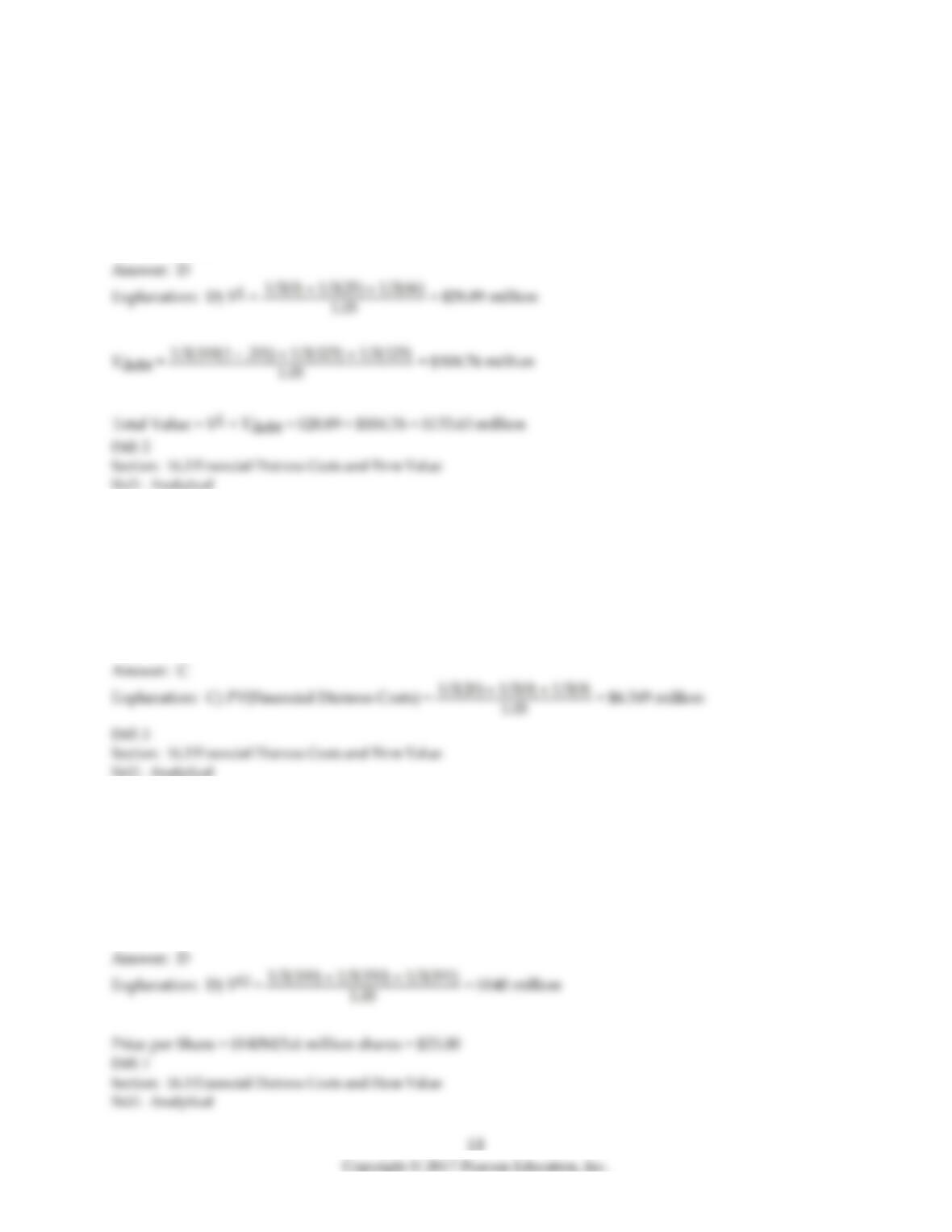
6) Assume that in the event of default, 20% of the value of MI’s assets will be lost in bankruptcy costs
and suppose that MI has zero-coupon debt with a $125 million face value due next year. The total value
of MI with leverage is closest to:
A) $140 million
B) $100 million
C) $125 million
D) $134 million
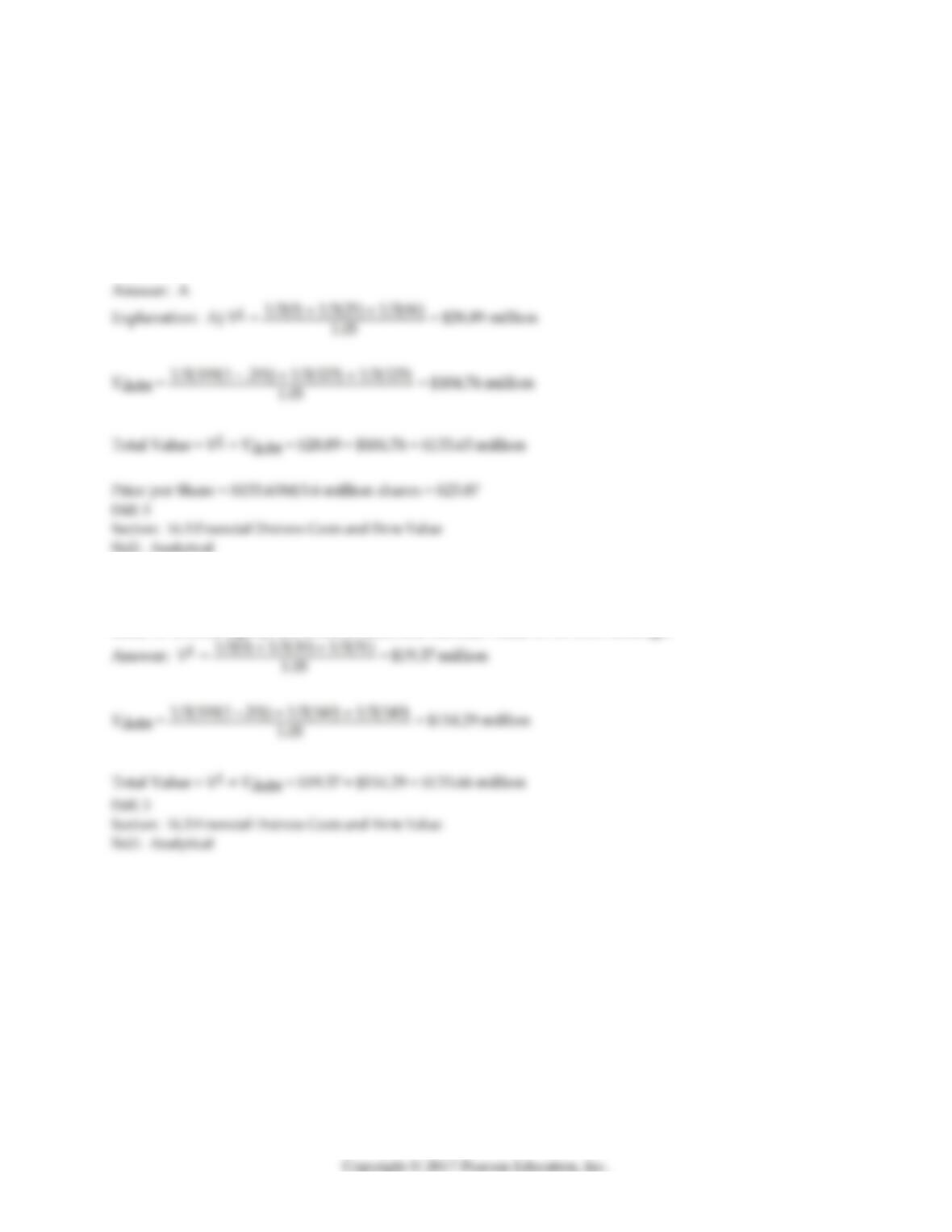
7) Assume that in the event of default, 20% of the value of MI’s assets will be lost in bankruptcy costs
and suppose that MI has zero-coupon debt with a $125 million face value due next year. The present
value of MI’s financial distress costs is closest to:
A) $20.0 million
B) $6.6 million
C) $6.3 million
D) $19.0 million
8) Assume that in the event of default, 20% of the value of MI’s assets will be lost in bankruptcy costs.
Suppose that at the start of the year, MI has no debt outstanding, but has 5.6 million shares of stock
outstanding. If MI does not issue debt, its share price is closest to:
A) $5.15
B) $23.75
C) $23.90
D) $25.00
14
9) Assume that in the event of default, 20% of the value of MI’s assets will be lost in bankruptcy costs.
Suppose that at the start of the year, MI has no debt outstanding, but has 5.6 million shares of stock
outstanding. If MI issues debt of $125 million due next year and uses the proceeds to repurchase shares,
the share price following the announcement of the repurchase will be closest to:
A) $23.90
B) $23.75
C) $25.00
D) $5.15
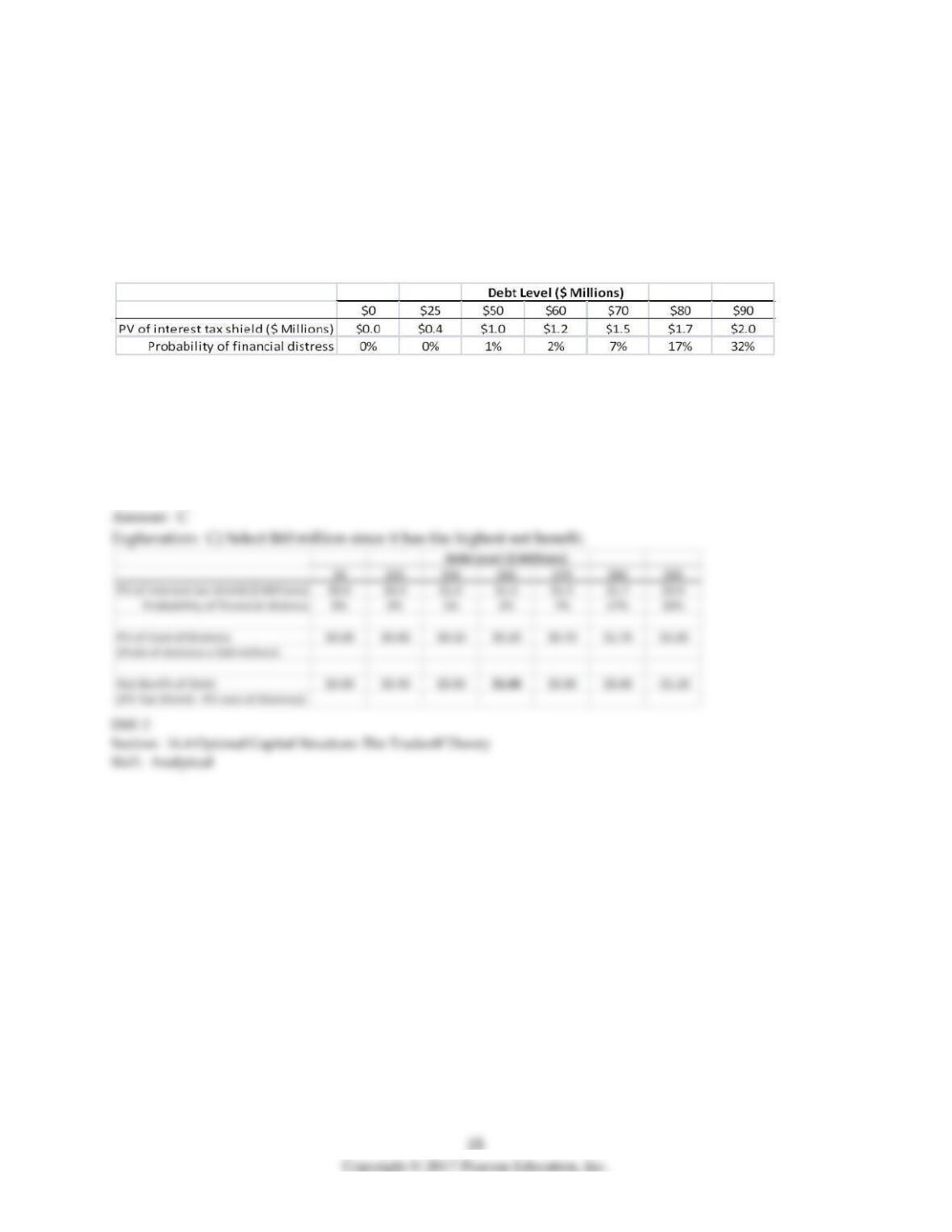
10) Assume that in the event of default, 20% of the value of MI’s assets will be lost in bankruptcy costs
and suppose that MI has zero-coupon debt with a $140 million face value due next year. Calculate the
value of levered equity, the value of debt, and the total value of MI with leverage.
16.4 Optimal Capital Structure: The Trade-off Theory
Use the following information to answer the question(s) below.
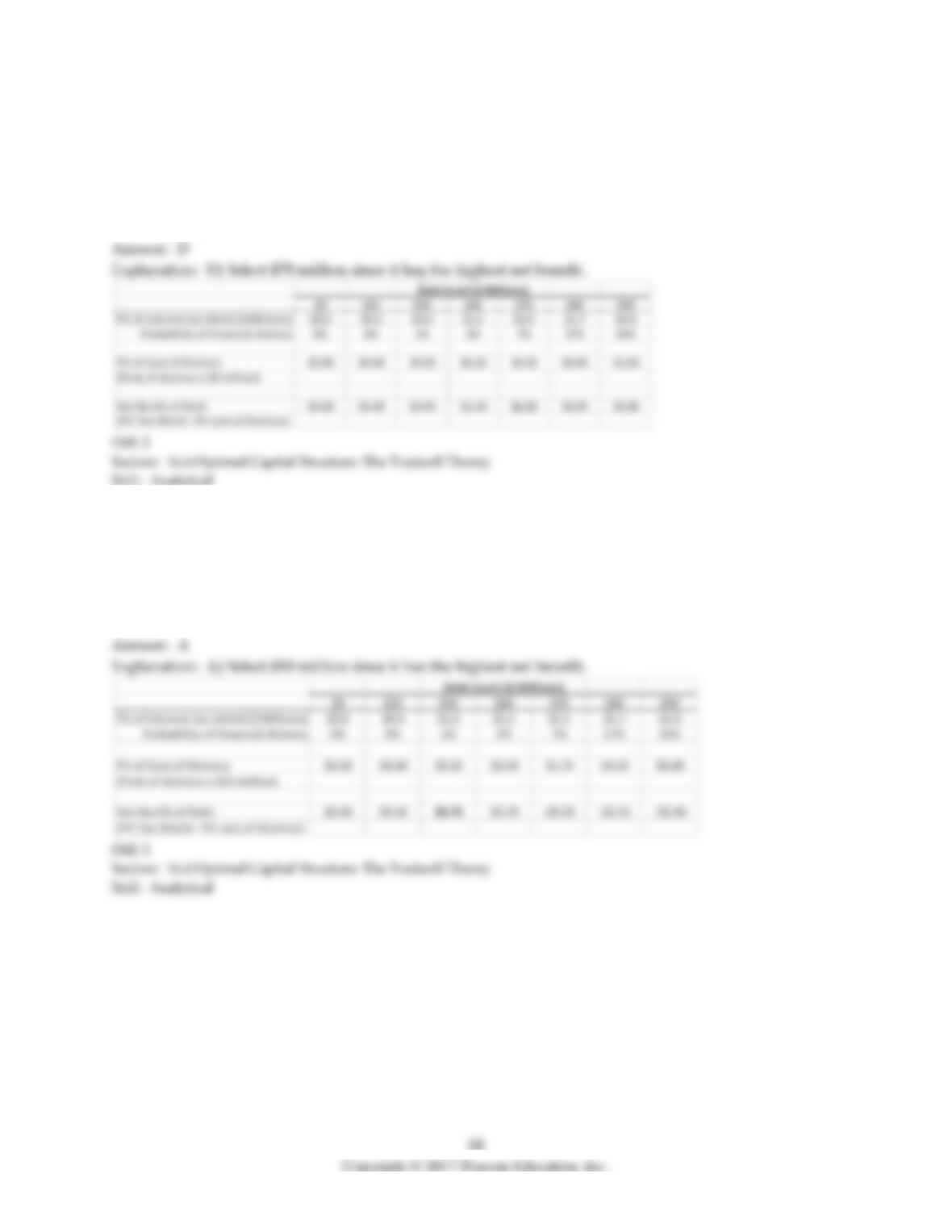
d’Anconia Copper is considering issuing one year debt, and has come up with the following estimates
of the value of the interest tax shield and the probability of distress for different levels of debt:
1) If in the event of distress, the present value of distress costs is equal to $10 million, then the optimal
level of debt for d’Anconia Copper is:
A) $25 million
B) $50 million
C) $60 million
D) $70 million
2) If in the event of distress, the present value of distress costs is equal to $5 million, then the optimal
level of debt for d‘Anconia Copper is:
A) $25 million
B) $50 million
C) $60 million
D) $70 million
3) If in the event of distress, the present value of distress costs is equal to $25 million, then the optimal
level of debt for d’Anconia Copper is:
A) $50 million
B) $60 million
C) $70 million
D) $80 million
4) Which of the following statements is FALSE?
A) The tradeoff theory weighs the costs of debt that result from shielding cash flows from taxes against
the benefits from the effects of financial distress associated with leverage.
B) Leverage has costs as well as benefits.
C) According to the tradeoff theory, the total value of a levered firm equals the value of the firm
without leverage plus the present value of the tax savings from debt, less the present value of financial
distress costs.
D) Firms have an incentive to increase leverage to exploit the tax benefits of debt. But with too much
debt, they are more likely to risk default and incur financial distress costs.
5) Which of the following statements is FALSE?
A) Calculating the precise present value of financial distress costs is a relatively straightforward
process.
B) Two key qualitative factors determine the present value of financial distress costs: (1) the probability
of financial distress and (2) the magnitude of the costs after a firm is in distress.
C) Technology firms are likely to incur high costs when they are in financial distress, due to the
potential for loss of customers and key personnel, as well as a lack of tangible assets that can be easily
liquidated.
D) The magnitude of the financial distress costs will depend on the relative importance of the sources of
these costs and is likely to vary by industry.
6) Which of the following statements is FALSE?
A) Real estate firms are likely to have low costs of financial distress, as much of their value derives from
assets that can be sold relatively easily.
B) For low levels of debt, the risk of default remains low and the main effect of an increase in leverage is
an increase in the interest tax shield, which has present value τ*D, where τ* is the effective tax
advantage of debt.
C) Firms whose value and cash flows are very volatile (for example, semiconductor firms) must have
much higher levels of debt to avoid a significant risk of default.
D) The probability of financial distress depends on the likelihood that a firm will be unable to meet its
debt commitments and therefore default.
7) Which of the following statements is FALSE?
A) Firms with steady, reliable cash flows, such as utility companies, are able to use high levels of debt
and still have a very low probability of default.
B) If there were no costs of financial distress, the value of the firm would continue to increase with
increasing debt until the interest on the debt exceeds the firm’s earnings before interest and taxes and
the tax shield is exhausted.
C) The costs of financial distress reduce the value of the levered firm, VL. The amount of the reduction
decreases with the probability of default, which in turn increases with the level of the debt D.
D) The tradeoff theory states that firms should increase their leverage until it reaches the level D* for
which VL is maximized.
8) Which of the following statements is FALSE?
A) The presence of financial distress costs can explain why firms choose debt levels that are too high to
fully exploit the interest tax shield.
B) With higher costs of financial distress, it is optimal for the firm to choose lower leverage.
C) Differences in the magnitude of financial distress costs and the volatility of cash flows can explain
the differences in the use of leverage across industries.
D) At the point D*, where VL is maximized, the tax savings that result from increasing leverage are just
offset by the increased probability of incurring the costs of financial distress.
9) Which of the following industries is likely to have the lowest costs of financial distress?
A) Airlines
B) Computer software
C) Biotechnology
D) Electric utilities
10) Which of the following industries likely to have the highest costs of financial distress?
A) Grocery store
B) Semiconductors
C) Real estate
D) Utilities
Use the information for the question(s) below.
Big Blue Banana (BBB) is a clothing retailer with a current share price of $10.00 and with 25 million
shares outstanding. Suppose that Big Blue Banana announces plans to lower its corporate taxes by
borrowing $100 million and using the proceeds to repurchase shares.
11) Assuming perfect capital markets, the share price for BBB after this announcement is closest to:
A) $11.40
B) $10.85
C) $10.00
D) $8.60
12) Suppose that BBB pays corporate taxes of 35% and that shareholders expects the change in debt to
be permanent. Assuming that capital markets are perfect except for the existence of corporate taxes, the
share price for BBB after this announcement is closest to:
A) $10.00
B) $10.85
C) $8.60
D) $11.40
13) Suppose that BBB pays corporate taxes of 35% and that shareholders expects the change in debt to
be permanent. Assume that capital markets are perfect except for the existence of corporate taxes and
financial distress costs. If the price of BBB’s stock rises to $10.85 per share following the announcement,
then the present value of BBB’s financial distress costs is closest to:
A) $21.25 million
B) $35.00 million
C) $11.40 million
D) $13.75 million
Use the information for the question(s) below.
Luther Industries has no debt and expects to generate free cash flows of $48 million each year. Luther
believes that if it permanently increases its level of debt to $100 million, the risk of financial distress may
cause it to lose some customers and receive less favorable terms from its suppliers. As a result, Luther’s
expected free cash flows with debt will be only $44 million per year. Suppose Luther’s tax rate is 40%,
the risk-free rate is 6%, the expected return of the market is 14%, and the beta of Luther’s free cash flows
is 1.25 (with or without leverage).
14) The value of Luther without leverage is closest to:
A) $315 million
B) $300 million
C) $205 million
D) $340 million
15) The value of Luther with leverage is closest to:
A) $315 million
B) $340 million
C) $205 million
D) $300 million