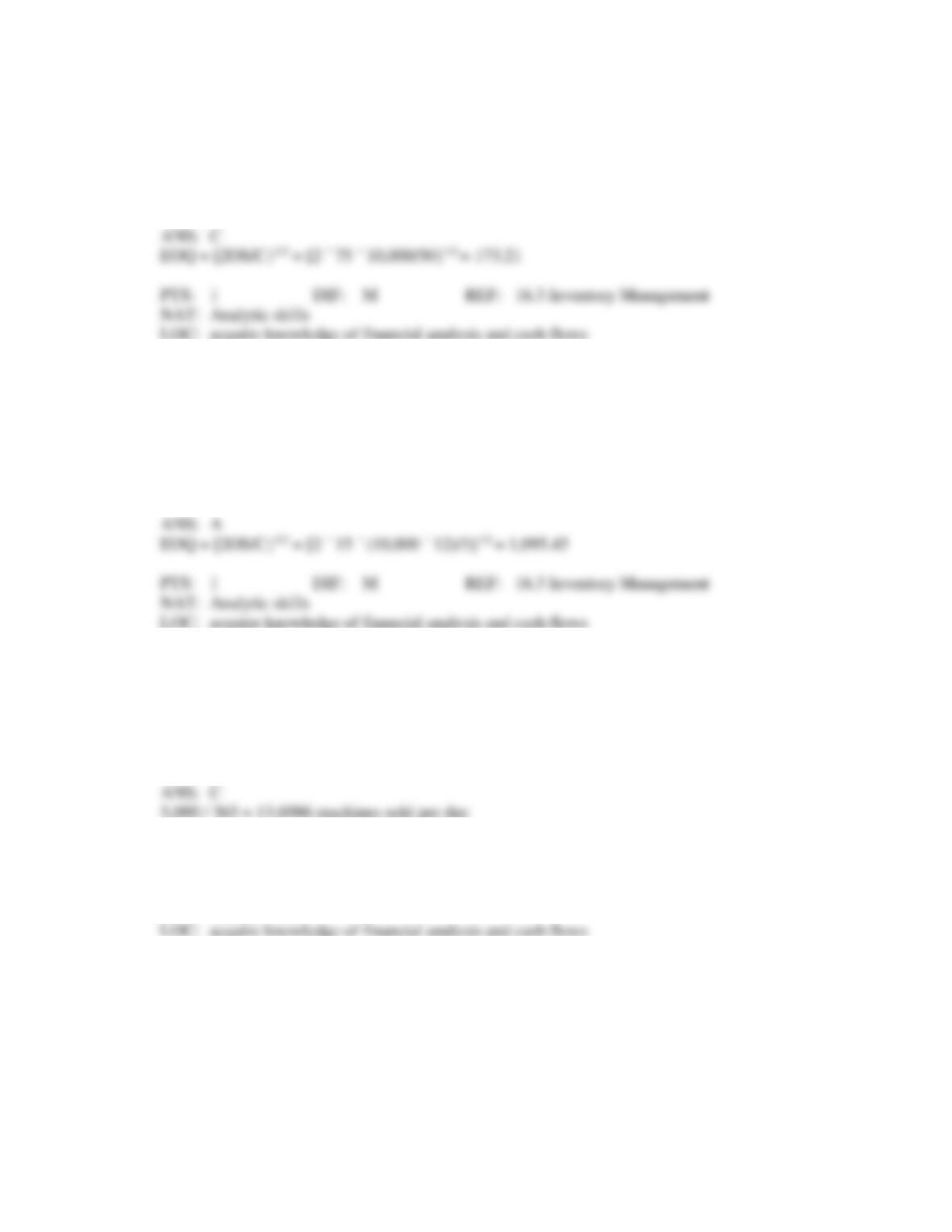
61. Franconia Notch Blowers would like to find the optimum size order given that it annually sells 10,000
snow blowers per year. It costs Franconia $75 each time it processes an order for snow blowers and the
carrying cost for each blower is $50 per year. What is the optimum order size for Franconia?
a.
30,000
b.
15,000
c.
173.21
d.
122.47
62. The Shoe Club expects to sell 10,000 shoes per month next year. If it costs Shoe Club $15 every time
it processes a shoe order and the cost of holding a pair of shoes is about $3 per year, then what is the
optimum number of pairs of shoes to order for The Shoe Club?
a.
1,095.45
b.
1,000.00
c.
316.23
d.
100.00
63. The Good Espresso Machine, Inc. sells 5,000 machines per year. If it typically takes 5 days to process
and receive an order, then at what level of inventory should the firm place an order?
a.
2.74 machines
b.
13.70 machines
c.
68.49 machines
d.
684.9 machines
13.6986 machines sold per day x 5 days = 68.49 units to cover the 5 day ordering period
PTS: 1 DIF: M REF: 16.3 Inventory Management
NAT: Analytic skills
64. You are consulting for a firm that anticipates that it will sell 730,000 units this year. The firm’s policy
is to begin to process a new order when the inventory level is just 10,000 units. What does that imply
about the amount of time it take to process and receive an order?
a.
10 days
b.
5 days
c.
2 days
d.
more information is need to answer the question
65. An inventory system that is premised on materials arriving exactly when they are needed for
production is called
a.
materials resource planning.
b.
material resource planning II.
c.
a just-in-time inventory system.
d.
none of the above.
66. The outright sale of a firm’s receivables to a third party is called
a.
a write-off.
b.
factoring.
c.
re-invoicing.
d.
none of the above.
67. The part of credit policy that dictates how delinquent accounts should be handled is called
a.
setting the credit terms.
b.
determining credit standards.
c.
developing a collection policy.
d.
none of the above.
68. Firms that tend to do extensive credit checks on clients before offering credit are more likely to be
a.
firms with low variable costs.
b.
firms with high variable costs.
c.
firms with high fixed costs.
d.
none of the above.
69. Which of the following is not one of the five C’s of credit?
a.
character
b.
collections
c.
capital
d.
collateral
NARRBEGIN: Competitive Mesh Shirts
Competitive Mesh Shirts
Competitive Mesh Shirts is considering a plan to ease its credit terms in order to generate greater
revenues. Last year, Competitive had sales of 1,000,000 units at a price and variable cost of $20 and
$15, respectively. Its current average collection period is 20 days and its percentage of bad debt
expense is 2% while it required return on investment is 10%. If Competitive were to ease its credit
terms, the firm anticipates that its sales would increase to 1,200,000 units without a change in price or
variable costs. However, the average collection period is expected to increase to 30 days and bad debt
expense is expected to increase to 3%.
NARREND
70. What is Competitive’s current average investment in accounts receivable?
a.
$41,095.89
b.
$54,794.52
c.
$821,917.81
d.
not enough information is given
71. What is Competitive’s expected increase in bad debt expense?
a.
$720,000
b.
$400,000
c.
$320,000
d.
there is not enough information given
72. What will be Competitive’s cost of marginal investment in accounts receivable?
a.
$1,479,452.84
b.
$821,917.81
c.
$65,753.50
d.
There is not enough information given
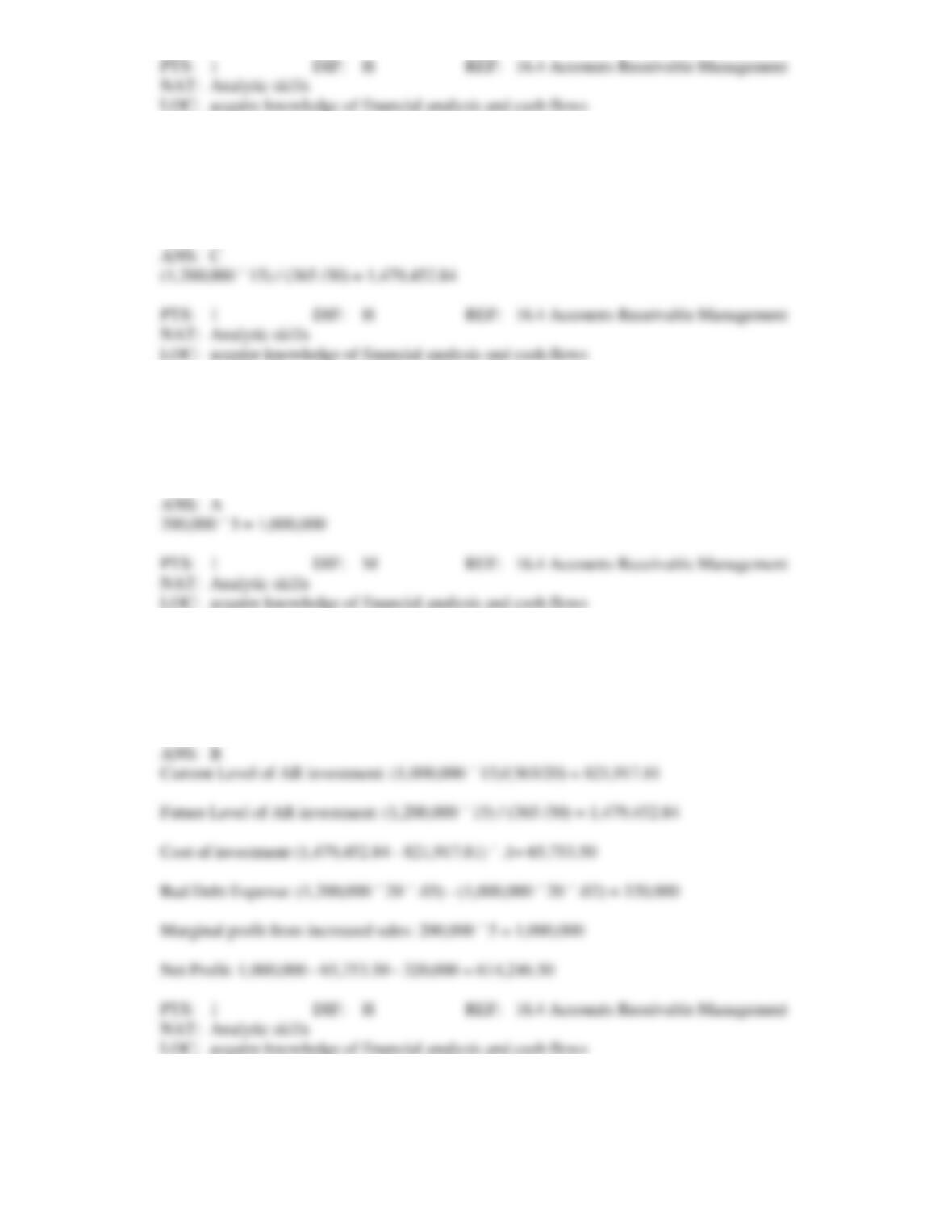
73. What is Competitive’s future average investment in accounts receivable?
a.
$3,287.67
b.
$98,630.14
c.
$1,479,452.84
d.
not enough information is given
74. What is Competitive’s marginal profit from increased sales?
a.
$1,000,000
b.
$5,000,000
c.
$6,000,000
d.
$7,000,000
75. What is Competitive’s net profit for the credit decision at hand?
a.
$1,000,000.00
b.
$614,246.50
c.
$320,000.00
d.
$65,753.50
76. A positive cash conversion cycle means that:
a.
trade credit is providing enough financing to cover the firm’s entire operating cycle.
b.
the firm collects on sales more slowly than it pays its payables.
c.
the firm collects on sales more quickly than it pays its payables.
d.
trade credit does not provide enough financing to cover the firm’s entire operating cycle.
77. With respect to inventory:
a.
more is better as it will lead to happier customers
b.
the larger the level, the faster the total asset turnover and the higher the return on total
assets
c.
additional investment in inventory must be justified by additional returns.
d.
all of the above
e.
(b) and (c) only
78. For accounts receivable, with respect to cost trade-offs the costs that must be evaluated are:
a.
the cost of investment in accounts receivable and bad debts and the opportunity cost of lost
sales due to overly restrictive credit policy and/or terms.
b.
carrying costs and order and setup costs associated with replenishment and production of
finished goods.
c.
costs of reduced liquidity and financing costs resulting from the use of less expensive
short-term financing.
d.
none of the above
79. In the ABC System, inventory is categorized based upon:
a.
volume
b.
color
c.
dollar investment
d.
none of the above
80. Some individuals and families buy staple items such as paper goods from warehouse clubs in large
quantities. In such a situation, what is an example of holding costs?
a.
There are no holding costs.
b.
The opportunity cost associated with having your money tied up in inventory.
c.
The transportation costs of going to the store.
d.
Both (b) and (c)
81. Manufacturing resource planning II (MRPII):
a.
typically involves the management of A items (from the ABC System).
b.
uses a complex computerized system to integrate data from various departments.
c.
expands on Material Requirements Planning.
d.
all of the above
e.
(b) and (c) only
82. Factors to consider when granting credit to customers include:
a.
the variable costs of the products the firm is selling on credit.
b.
the credit limit being offered to the customer.
c.
the ability of the customer to repay.
d.
all of the above
e.
(b) and (c) only
83. What is the name of the procedure that applies statistically derived weights for key financial and credit
characteristics to predict whether or not a credit applicant with specific scores for each characteristic
will pay the requested credit in a timely fashion?
a.
aging of accounts receivable
b.
payment pattern monitoring
c.
credit scoring
d.
just-in-time system
e.
none of the above
84. The procedures used by a company to collect overdue or delinquent accounts receivable are called
a.
credit monitoring.
b.
collection policy.
c.
aging of accounts receivable.
d.
payment pattern monitoring.
85. Which of the following statements is true?
a.
The ACP is prone to sending misleading signals when daily sales fluctuate.
b.
The ACP is also known as the days’ sales outstanding.
c.
The ACP represents how long a firm’s inventory remains in its warehouse.
d.
all of the above
e.
(a) and (b) only
86. The schedule that indicates the portions of the total accounts receivable balance that have been
outstanding for specified periods of time is known as the
a.
payment pattern monitoring.
b.
aging of accounts receivable.
c.
credit scoring.
d.
just-in-time system.
e.
none of these
87. What is the normal timing in which a firm’s customers pay their accounts, expressed as the percentage
of monthly sales collected in each month following the sale?
a.
payment pattern
b.
aging of accounts receivable
c.
credit scoring
d.
just-in-time system
e.
none of the above
88. What is the process through which a customer’s payment is posted to its account and the outstanding
invoices are cleared as paid?
a.
payment pattern monitoring
b.
aging of accounts receivable
c.
cash application
d.
just-in-time system
e.
none of the above
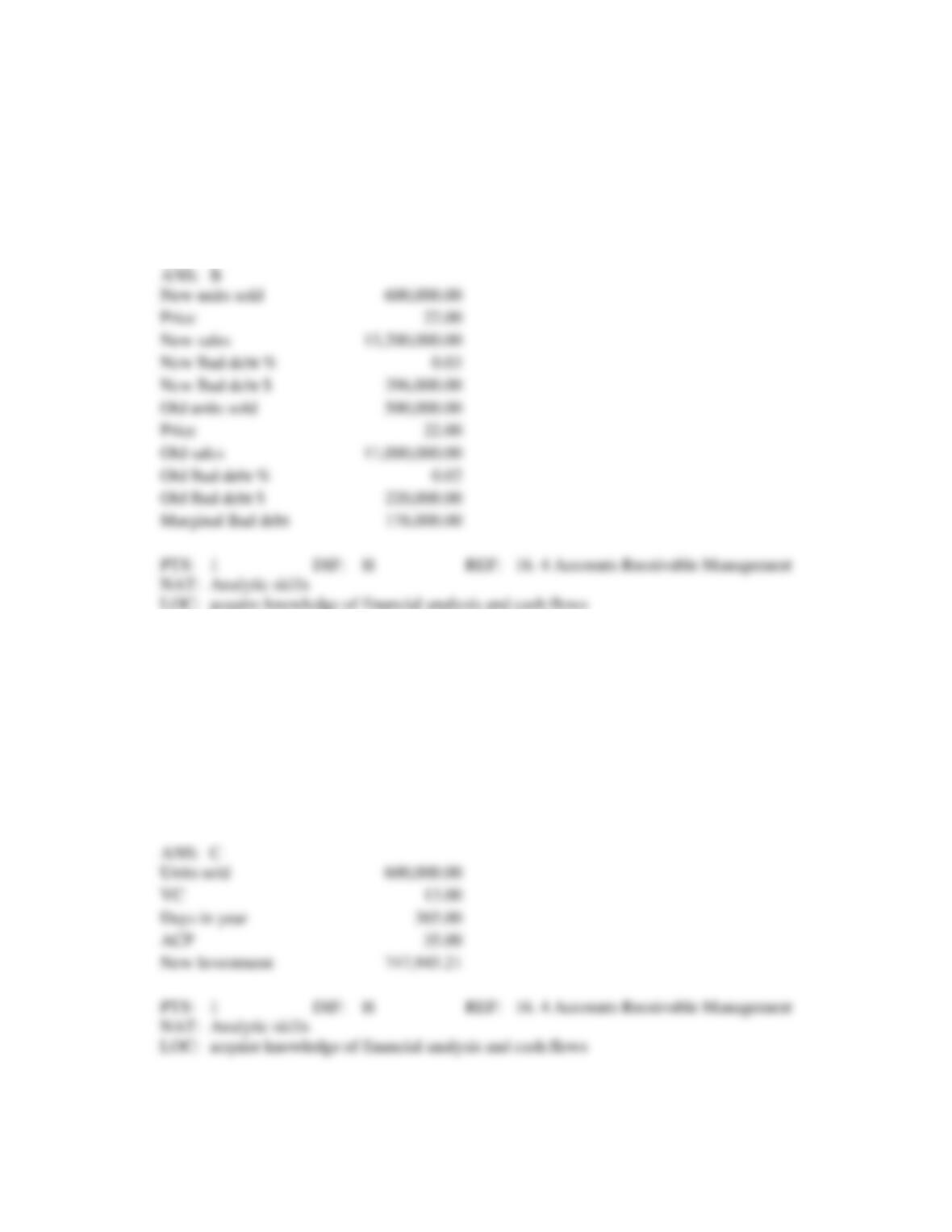
89. Emma International is considering easing credit standards to increase sales, and potentially profits.
Currently the firm sells 500,000 units at a sales price of $22 per unit and variable cost of $13 per unit.
Currently the average collection period is 25 days and the bad debt expense is 2% of sales. The
required return on investment is 12%. If credit standards are eased, the sales will increase to 600,000
units; the ACP will increase to 35 days; and the bad debt expense will increase to 3% All else will
remain the same. What the current average in investment in accounts receivable?
a.
$ 445,205.48
b.
$ 753,424.66
c.
$6,278,538.81
d.
$ 178,082.19
90. Emma International is considering easing credit standards to increase sales, and potentially profits.
Currently the firm sells 500,000 units at a sales price of $22 per unit and variable cost of $13 per unit.
Currently the average collection period is 25 days and the bad debt expense is 2% of sales. The
required return on investment is 12%. If credit standards are eased, the sales will increase to 600,000
units; the ACP will increase to 35 days; and the bad debt expense will increase to 3% All else will
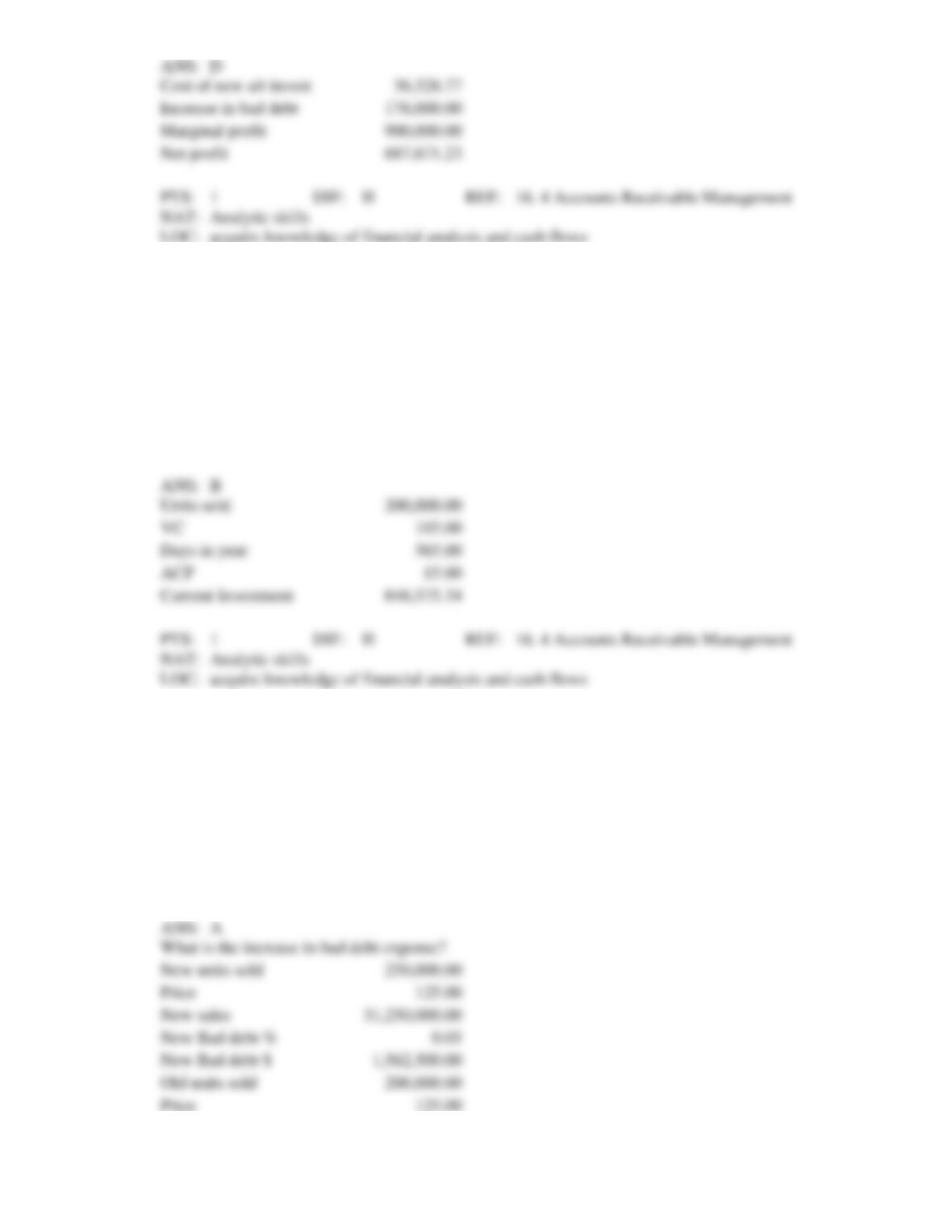
remain the same. What is the increase in bad debt expense?
a.
$2,200,000.00
b.
$ 176,000.00
c.
$ 396,000.00
d.
$ 220,000.00
91. Emma International is considering easing credit standards to increase sales, and potentially profits.
Currently the firm sells 500,000 units at a sales price of $22 per unit and variable cost of $13 per unit.
Currently the average collection period is 25 days and the bad debt expense is 2% of sales. The
required return on investment is 12%. If credit standards are eased, the sales will increase to 600,000
units; the ACP will increase to 35 days; and the bad debt expense will increase to 3% All else will
remain the same. What is the new investment in investment in accounts receivable?
a.
$ 124,657.53
b.
$1,265,753.42
c.
$ 747,945.21
d.
$ 623,287.67
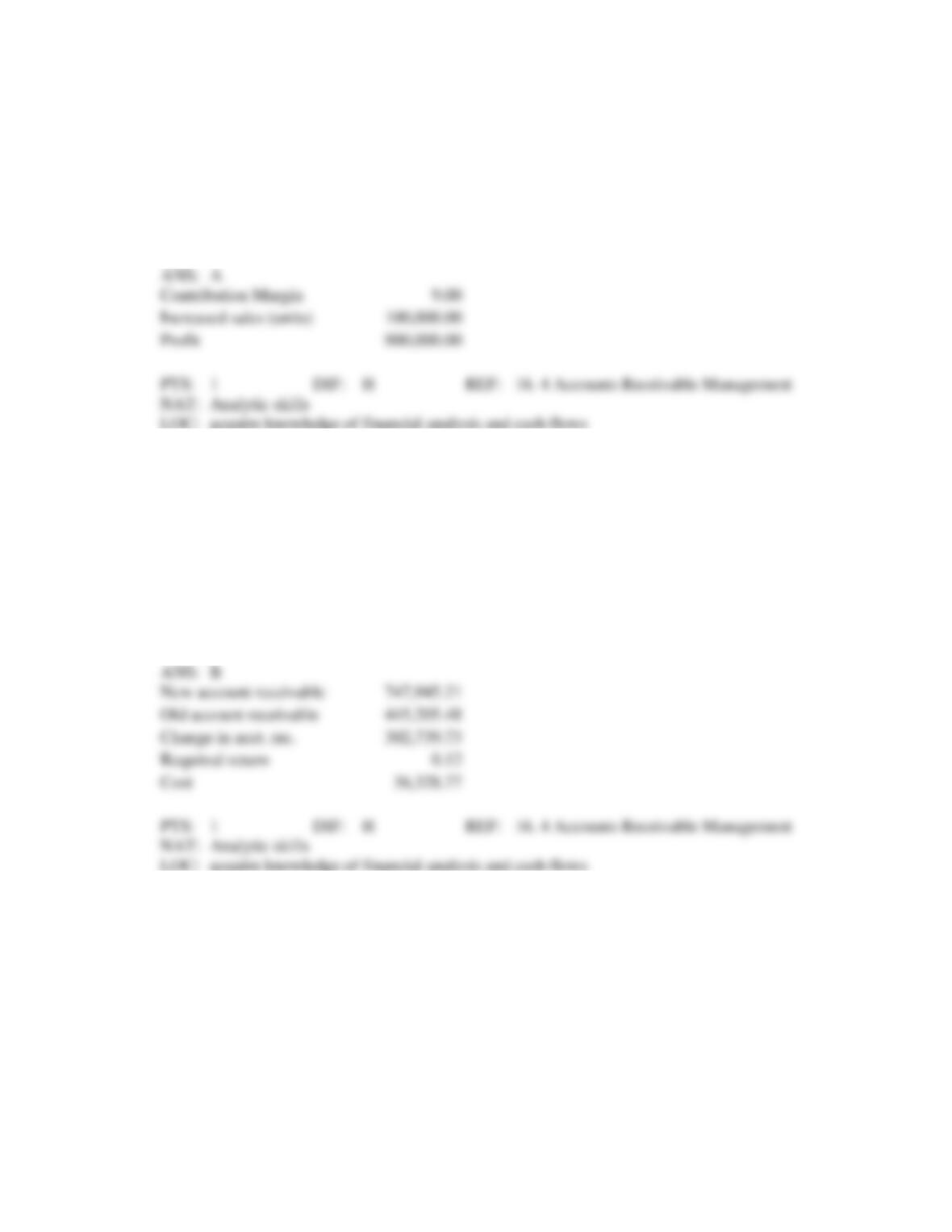
92. Emma International is considering easing credit standards to increase sales, and potentially profits.
Currently the firm sells 500,000 units at a sales price of $22 per unit and variable cost of $13 per unit.
Currently the average collection period is 25 days and the bad debt expense is 2% of sales. The
required return on investment is 12%. If credit standards are eased, the sales will increase to 600,000
units; the ACP will increase to 35 days; and the bad debt expense will increase to 3% All else will
remain the same. What is the marginal profit from increased sales?
a.
$ 900,000.00
b.
$11,000,000.00
c.
$ 2,200,000.00
d.
$ 1,300,000.00
93. Emma International is considering easing credit standards to increase sales, and potentially profits.
Currently the firm sells 500,000 units at a sales price of $22 per unit and variable cost of $13 per unit.
Currently the average collection period is 25 days and the bad debt expense is 2% of sales. The
required return on investment is 12%. If credit standards are eased, the sales will increase to 600,000
units; the ACP will increase to 35 days; and the bad debt expense will increase to 3% All else will
remain the same. What is the cost associated with the increased investment in accounts receivable?
a.
$ 53,424.66
b.
$ 36,328.77
c.
$ 89,753.42
d.
$1,584,000.00
94. Emma International is considering easing credit standards to increase sales, and potentially profits.
Currently the firm sells 500,000 units at a sales price of $22 per unit and variable cost of $13 per unit.
Currently the average collection period is 25 days and the bad debt expense is 2% of sales. The
required return on investment is 12%. If credit standards are eased, the sales will increase to 600,000
units; the ACP will increase to 35 days; and the bad debt expense will increase to 3% All else will
remain the same. What is the profit (or loss) associated with easing credit standards?
a.
$724,000.00
b.
$511,671.23
c.
$212,328.77
d.
$687,671.23
95. Louis International is considering easing credit standards to increase sales, and potentially profits.
Currently the firm sells 200,000 units at a sales price of $125 per unit and variable cost of $103 per
unit. Currently the average collection period is 15 days and the bad debt expense is 3% of sales. The
required return on investment is 18%. If credit standards are eased, the sales will increase to 250,000
units; the ACP will increase to 35 days; and the bad debt expense will increase to 5% All else will
remain the same.What the current average in investment in accounts receivable?
a.
$1,027,397.26
b.
$ 846,575.34
c.
$5,707,762.56
d.
$ 564,383.56
96. Louis International is considering easing credit standards to increase sales, and potentially profits.
Currently the firm sells 200,000 units at a sales price of $125 per unit and variable cost of $103 per
unit. Currently the average collection period is 15 days and the bad debt expense is 3% of sales. The
required return on investment is 18%. If credit standards are eased, the sales will increase to 250,000
units; the ACP will increase to 35 days; and the bad debt expense will increase to 5% All else will
remain the same. What is the increase in bad debt expense?
a.
$ 812,500.00
b.
$6,250,000.00
c.
$1,562,500.00
d.
$ 750,000.00
97. Louis International is considering easing credit standards to increase sales, and potentially profits.
Currently the firm sells 200,000 units at a sales price of $125 per unit and variable cost of $103 per
unit. Currently the average collection period is 15 days and the bad debt expense is 3% of sales. The
required return on investment is 18%. If credit standards are eased, the sales will increase to 250,000
units; the ACP will increase to 35 days; and the bad debt expense will increase to 5% All else will
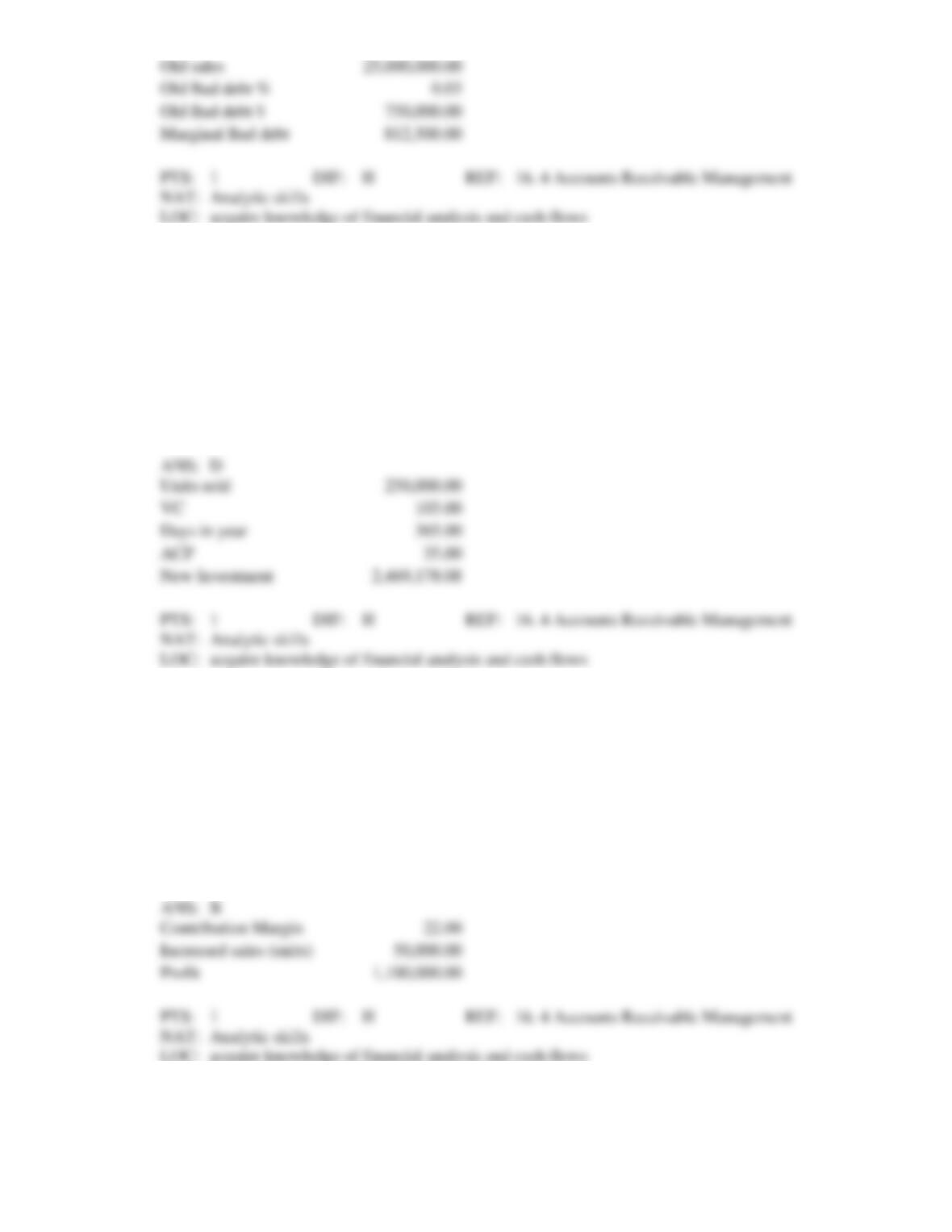
remain the same. What is the new investment in investment in accounts receivable?
a.
$493,835.62
b.
$2,996,575.34
c.
$1,975,342.47
d.
$2,469,178.08
98. Louis International is considering easing credit standards to increase sales, and potentially profits.
Currently the firm sells 200,000 units at a sales price of $125 per unit and variable cost of $103 per
unit. Currently the average collection period is 15 days and the bad debt expense is 3% of sales. The
required return on investment is 18%. If credit standards are eased, the sales will increase to 250,000
units; the ACP will increase to 35 days; and the bad debt expense will increase to 5% All else will
remain the same. What is the marginal profit from increased sales?
a.
$6,250,000.00
b.
$1,100,000.00
c.
$25,000,000.00
d.
$5,150,000.00
99. Louis International is considering easing credit standards to increase sales, and potentially profits.
Currently the firm sells 200,000 units at a sales price of $125 per unit and variable cost of $103 per
unit. Currently the average collection period is 15 days and the bad debt expense is 3% of sales. The
required return on investment is 18%. If credit standards are eased, the sales will increase to 250,000
units; the ACP will increase to 35 days; and the bad debt expense will increase to 5% All else will
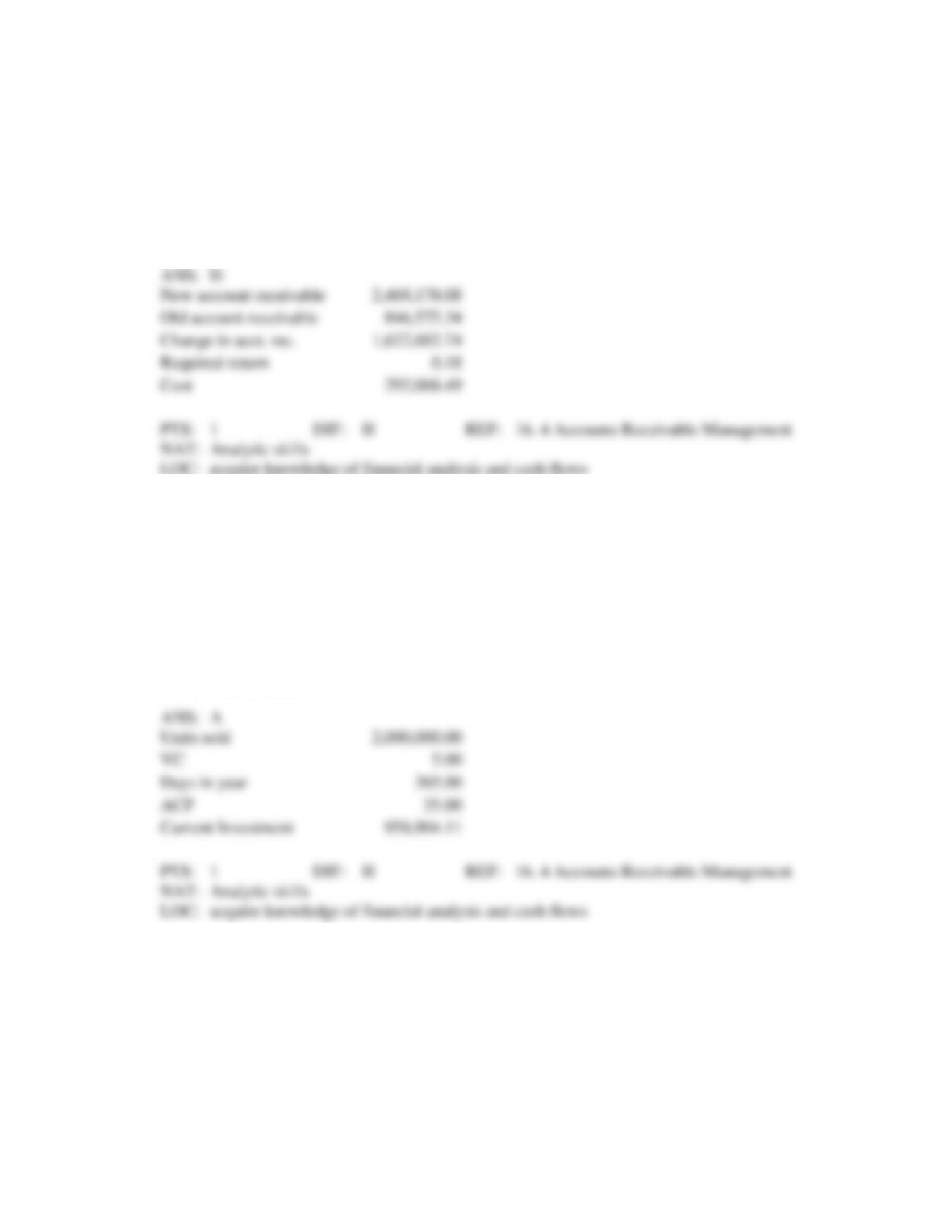
remain the same. What is the cost associated with the increased investment in accounts receivable?
a.
$152,383.56
b.
$444,452.05
c.
$152,383.56
d.
$292,068.49
100. Roxy International is considering easing credit standards to increase sales, and potentially profits.
Currently the firm sells 2,000,000 units at a sales price of $7 per unit and variable cost of $5 per unit.
Currently the average collection period is 35 days and the bad debt expense is 2% of sales. The
required return on investment is 18%. If credit standards are eased, the sales will increase to
2,500,000 units; the ACP will increase to 65 days; and the bad debt expense will increase to 5% All
else will remain the same. What the current average in investment in accounts receivable?
a.
$ 958,904.11
b.
$1,342,465.75
c.
$7,458,143.07
d.
$ 273,972.60
101. Roxy International is considering easing credit standards to increase sales, and potentially profits.
Currently the firm sells 2,000,000 units at a sales price of $7 per unit and variable cost of $5 per unit.
Currently the average collection period is 35 days and the bad debt expense is 2% of sales. The
required return on investment is 18%. If credit standards are eased, the sales will increase to
2,500,000 units; the ACP will increase to 65 days; and the bad debt expense will increase to 5% All
else will remain the same. What is the increase in bad debt expense?
a.
$3,500,000.00
b.
$ 875,000.00
c.
$ 595,000.00
d.
$ 280,000.00
102. Roxy International is considering easing credit standards to increase sales, and potentially profits.
Currently the firm sells 2,000,000 units at a sales price of $7 per unit and variable cost of $5 per unit.
Currently the average collection period is 35 days and the bad debt expense is 2% of sales. The
required return on investment is 18%. If credit standards are eased, the sales will increase to
2,500,000 units; the ACP will increase to 65 days; and the bad debt expense will increase to 5% All
else will remain the same. What is the new investment in investment in accounts receivable?
a.
$ 445,205.48
b.
$2,226,027.40
c.
$3,116,438.36
d.
$1,780,821.92
103. Roxy International is considering easing credit standards to increase sales, and potentially profits.
Currently the firm sells 2,000,000 units at a sales price of $7 per unit and variable cost of $5 per unit.
Currently the average collection period is 35 days and the bad debt expense is 2% of sales. The
required return on investment is 18%. If credit standards are eased, the sales will increase to
2,500,000 units; the ACP will increase to 65 days; and the bad debt expense will increase to 5% All
else will remain the same. What is the marginal profit from increased sales?
a.
$ 3,500,000.00
b.
$ 1,000,000.00
c.
$ 2,500,000.00
d.
$14,000,000.00
104. Roxy International is considering easing credit standards to increase sales, and potentially profits.
Currently the firm sells 2,000,000 units at a sales price of $7 per unit and variable cost of $5 per unit.
Currently the average collection period is 35 days and the bad debt expense is 2% of sales. The
required return on investment is 18%. If credit standards are eased, the sales will increase to
2,500,000 units; the ACP will increase to 65 days; and the bad debt expense will increase to 5% All
else will remain the same. What is the cost associated with the increased investment in accounts
receivable?
a.
$ 172,602.74
b.
$ 400,684.93
c.
$3,150,000.00
d.
$ 228,082.19
105. Roxy International is considering easing credit standards to increase sales, and potentially profits.
Currently the firm sells 2,000,000 units at a sales price of $7 per unit and variable cost of $5 per unit.
Currently the average collection period is 35 days and the bad debt expense is 2% of sales. The
required return on investment is 18%. If credit standards are eased, the sales will increase to
2,500,000 units; the ACP will increase to 65 days; and the bad debt expense will increase to 5% All
else will remain the same. What is the profit (or loss) associated with easing credit standards?
a.
$176,917.81
b.
$405,000.00
c.
– $418,082.19
d.
$823,082.19