8) Which of the following criteria need NOT be satisfied for choosing a policy instrument?
A) The variable must be measurable.
B) The variable must be controllable.
C) The variable must be predictable.
D) The variable must be transportable.
9) Which of the following is NOT a requirement in selecting a policy instrument?
A) measurability
B) controllability
C) flexibility
D) predictability
10) When it comes to choosing an policy instrument, both the ________ rate and ________
aggregates are measured accurately and are available daily with almost no delay.
A) three-month T-bill; monetary
B) three-month T-bill; reserve
C) federal funds; monetary
D) federal funds; reserve
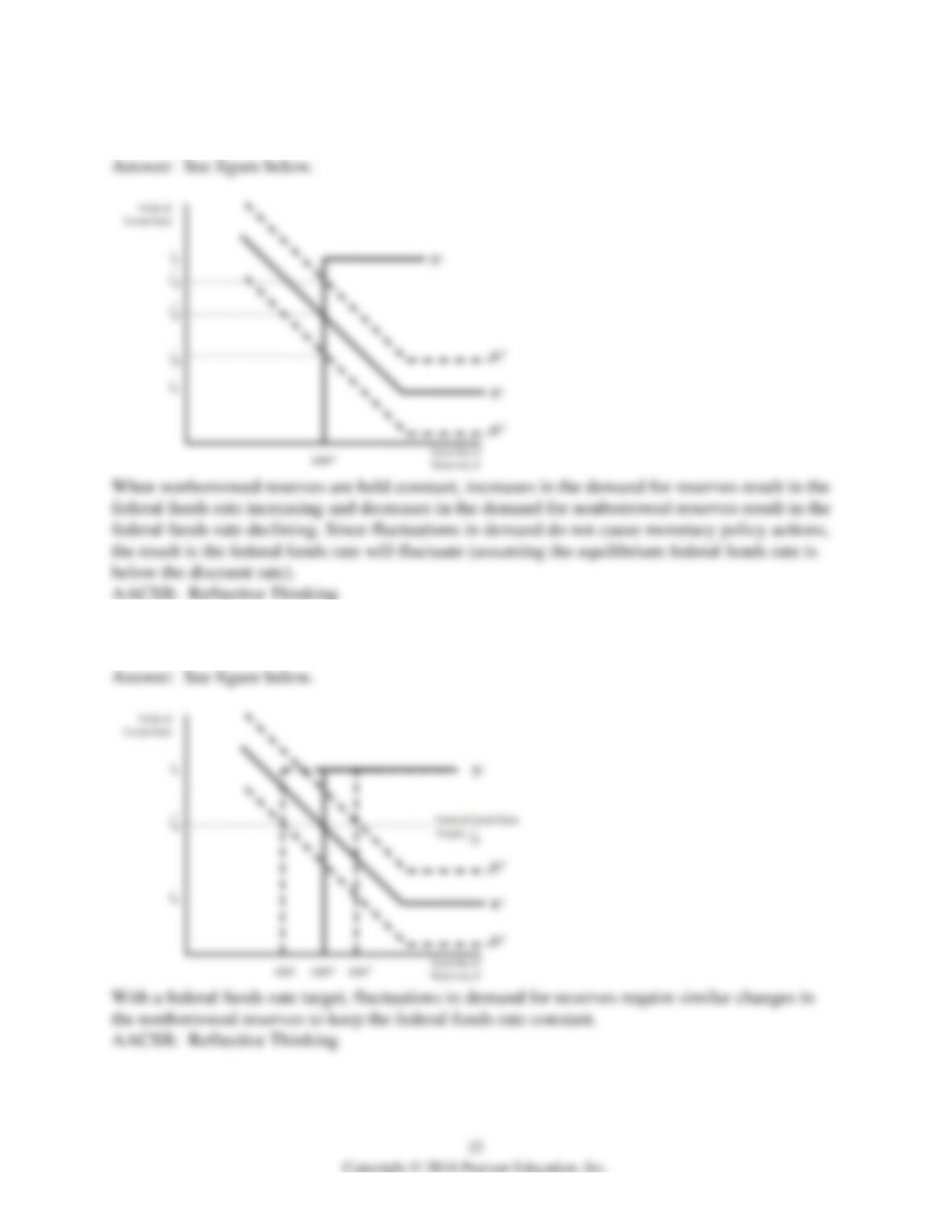
11) Explain and demonstrate graphically how targeting nonborrowed reserves can result in
federal funds rate instability.
12) Explain and demonstrate graphically how targeting the federal funds rate can result in
fluctuations in nonborrowed reserves.
16.9 Tactics: The Taylor Rule
1) According to the Taylor rule, the Fed should raise the federal funds interest rate when
inflation ________ the Fed’s inflation target or when real GDP ________ the Fed’s output target.
A) rises above; drops below
B) drops below; drops below
C) rises above; rises above
D) drops below; rises above
2) Using Taylor’s rule, when the equilibrium real federal funds rate is 3 percent, the positive
output gap is 2 percent, the target inflation rate is 1 percent, and the actual inflation rate is 2
percent, the nominal federal funds rate target should be
A) 5 percent.
B) 5.5 percent.
C) 6 percent.
D) 6.5 percent.
3) Using Taylor’s rule, when the equilibrium real federal funds rate is 2 percent, there is no
output gap, the actual inflation rate is zero, and the target inflation rate is 2 percent, the nominal
federal funds rate should be
A) 0 percent.
B) 1 percent.
C) 2 percent.
D) 3 percent.
4) According to the Taylor Principle, when the inflation rate rises, the nominal interest rate
should be ________ by ________ than the inflation rate increase.
A) increased; more
B) increased; less
C) decreased; more
D) decreased; less
5) If the Taylor Principle is not followed and nominal interest rates are increased by less than the
increase in the inflation rate, then real interest rates will ________ and monetary policy will be
too ________.
A) rise; tight
B) rise; loose
C) fall; tight
D) fall; loose
6) The rate of inflation tends to remain constant when
A) the unemployment rate is above the NAIRU.
B) the unemployment rate equals the NAIRU.
C) the unemployment rate is below the NAIRU.
D) the unemployment rate increases faster than the NAIRU increases.
7) The rate of inflation increases when
A) the unemployment rate equals the NAIRU.
B) the unemployment rate exceeds the NAIRU.
C) the unemployment rate is less than the NAIRU.
D) the unemployment rate increases faster than the NAIRU increases.
8) Explain the Taylor rule, including the formula for setting the federal funds rate target, and the
components of the formula. If the Fed were to use this rule, how many goals would it use to set
monetary policy?
16.10 Web Appendix 1: Monetary Targeting
1) In pursuing a strategy of monetary targeting, the central bank announces that it will achieve a
certain value (the target) of the annual growth rate of a ________.
A) a monetary aggregate
B) a reserve aggregate
C) the monetary base
D) GDP
2) During the years 1979 to 1982, the Federal Reserve’s announced policy was monetary
targeting. During this time period the Federal Reserve
A) hit all of their monetary targets.
B) did not hit any of their monetary targets because it is believed that controlling the money
supply was not the intent of the Federal Reserve.
C) did not hit any of their monetary targets because they were unrealistic.
D) hit about half of their monetary targets.
3) Compared to the United States, Japan’s experience with monetary targeting during the 1978––
1987 period performed
A) better with regard to the inflation rate and output fluctuations.
B) worse with regard to the inflation rate and output fluctuations.
C) better with regard to the inflation rate, but worse with regard to output fluctuations.
D) worse with regard to the inflation rate, but better with regard to output fluctuations.
4) One of the factors that contributed to the success German policymakers had using a monetary
targeting type policy starting in the mid-1970s and continuing through the next two decades was
that
A) they used a rigid target for the money growth rate.
B) they implemented policy so their inflation rate goal was met in the short run.
C) the money target was flexible to allow the Bundesbank to concentrate on other goals as
needed.
D) they rarely communicated the intentions of policy to the public in order to keep the public
from panicking.
5) The European Central Bank (ECB) pursues a hybrid monetary policy strategy that has
elements in common with the -targeting strategy previously used by the
Bundesbank but also includes some elements of targeting.
A) monetary; inflation
B) inflation; monetary
C) monetary; exchange rate
D) monetary; nominal GDP
6) Which of the following is an advantage to money targeting?
A) There is an immediate signal on the achievement of the target.
B) It does not rely on a stable money-inflation relationship.
C) It implies lack of transparency.
D) It implies smaller output fluctuations.
7) Which of the following is a disadvantage to monetary targeting?
A) It relies on a stable money-inflation relationship.
B) There is a delayed signal about the achievement of a target.
C) It implies larger output fluctuations.
D) It implies a lack of transparency.
8) If the relationship between the monetary aggregate and the goal variable is weak, then
A) monetary aggregate targeting is superior to exchange-rate targeting.
B) monetary aggregate targeting is superior to inflation targeting.
C) inflation targeting is superior to exchange-rate targeting.
D) monetary aggregate targeting will not work.
9) The monetary policy strategy that relies on a stable money-income relationship is
A) exchange-rate targeting.
B) monetary targeting.
C) inflation targeting.
D) the implicit nominal anchor.
16.11 Web Appendix 2: A Brief History of Federal Reserve Policymaking
1) In its earliest years, the Federal Reserve’s guiding principle for the conduct of monetary policy
was known as the
A) real bills doctrine.
B) liberal liquidity doctrine.
C) free reserves doctrine.
D) quantity theory of money.
2) The guiding principle for the conduct of monetary policy that held that as long as loans were
being made for “productive” purposes, then providing reserves to the banking system to make
these loans would not be inflationary became known as the
A) free reserves doctrine.
B) Benjamin Strong doctrine.
C) efficient liquidity doctrine.
D) real bills doctrine.
3) The real bills doctrine was the guiding principle for the conduct of monetary policy during the
A) 1910s.
B) 1940s.
C) 1950s.
D) 1960s.
4) The Fed accidentally discovered open market operations in the early
A) 1920s.
B) 1910s.
C) 1900s.
D) 1890s.
5) The Fed accidentally discovered open market operations when
A) it came to the rescue of failing banks in the early 1930s, and found that its purchases of bank
loans injected reserves into the banking system.
B) it purchased securities for income following the 1920-1921 recession.
C) it attempted to slow inflation in 1919 by selling securities and found that its sales drained
reserves from the banking system.
D) it reinterpreted a key provision of the Federal Reserve Act.
6) The Fed’s mistakes of the early 1930s were compounded by its decision to
A) raise reserve requirements in 1936-1937.
B) lower reserve requirements in 1936-1937.
C) raise the monetary base in 1936-1937.
D) lower the monetary base in 1936-1937.
7) During World War II, whenever interest rates would ________ and the price of bonds would
begin to ________, the Fed would make open market purchases.
A) rise; rise
B) rise; fall
C) fall; rise
D) fall; fall
8) During World War II, whenever interest rates would rise and the price of bonds would begin
to fall, the Fed would
A) lower reserve requirements.
B) raise reserve requirements.
C) make open market purchases of government securities.
D) make open market sales of government securities.
9) During World War II, the Fed in effect relinquished its control of monetary policy through its
policy of
A) continually lowering reserve requirements.
B) continually raising reserve requirements.
C) pegging interest rates.
D) targeting free reserves.
10) The Fed was committed to keeping interest rates low to assist Treasury financing of budget
deficits
A) only during World War I.
B) during the Great Depression.
C) during World War I and World War II.
D) throughout the entire existence of the Fed.
11) The Fed-Treasury Accord of March 1951 provided the Fed greater freedom to
A) let interest rates increase.
B) let unemployment increase.
C) let inflation accelerate.
D) let exchange rates increase.
12) During the 1950s, the Fed targeted
A) M1.
B) M2.
C) the monetary base.
D) money market conditions.
13) During the 1950s, Fed monetary policy targeted
A) the monetary base.
B) the exchange rate.
C) discount loans.
D) interest rates.
14) Targeting interest rates can be procyclical because
A) an increase in income increases interest rates, causing the Fed to buy bonds, increasing the
monetary base and money supply, leading to further increases in income.
B) an increase in interest rates increases income, causing the Fed to buy bonds, increasing the
monetary base and money supply, leading to further increases in income.
C) an increase in the monetary base increases the money supply, causing the Fed to buy bonds,
increasing the monetary base and money supply, leading to further increases in income.
D) an increase in income increases the monetary base and money supply, causing the Fed to buy
bonds to increase interest rates and income.
15) High inflation can spiral out of control when
A) expected inflation increases nominal interest rates, causing the Fed to buy bonds, increasing
the money supply and further increasing inflation.
B) expected inflation decreases nominal interest rates, causing the Fed to buy bonds, increasing
the money supply and further increasing inflation.
C) expected inflation increases nominal interest rates, causing the Fed to sell bonds, increasing
the money supply and further increasing inflation.
D) expected inflation decreases nominal interest rates, causing the Fed to sell bonds, increasing
the money supply and further increasing inflation.
16) In practice, the Fed’s policy of targeting money market conditions in the 1960s proved to be
A) countercyclical, helping to stabilize the economy.
B) procyclical, destabilizing the economy.
C) procyclical, helping to stabilize the economy.
D) countercyclical, destabilizing the economy.
17) In practice, the Fed’s policy of targeting ________ in the 1960s proved to be ________,
destabilizing the economy.
A) money market conditions; countercyclical
B) money market conditions; procyclical
C) monetary aggregates; countercyclical
D) monetary aggregates; procyclical
18) Although the Fed professed employment of a monetary aggregate targeting strategy during
the 1970s, its behavior suggests that it emphasized
A) free-reserve targeting.
B) interest-rate targeting.
C) a real-bills doctrine.
D) price-index targeting.
19) Although the Fed professed employment of ________ targeting during the 1970s, its
behavior suggests that it emphasized ________ targeting.
A) free-reserve; interest-rate
B) interest-rate; monetary aggregate
C) monetary aggregate; interest-rate
D) free reserve; monetary aggregate
20) The Fed’s use of the federal funds rate as an operating target in the 1970s resulted in
A) countercyclical monetary policy.
B) too slow growth in M1 throughout the decade.
C) procyclical monetary policy.
D) too rapid growth in M1 throughout the decade.
21) The Fed’s use of the ________ as an operating target in the 1970s resulted in ________
monetary policy.
A) federal funds rate; countercyclical
B) federal funds rate; procyclical
C) M1 money supply; countercyclical
D) M1 money supply; procyclical
22) In the 1970s, the Fed selected an interest rate as an operating target rather than a reserve
aggregate primarily because it
A) had no interest in targeting a monetary aggregate, as evidenced by its unwillingness to target
a reserve aggregate.
B) was still very concerned with achieving interest rate stability.
C) was committed to targeting free reserves.
D) was committed to the real bills doctrine.
23) The Fed operating procedures employed between 1979 and 1982 resulted in ________
swings in the federal funds rate and ________ swings in the M1 growth rate.
A) increased; increased
B) increased; decreased
C) decreased; decreased
D) decreased; increased
24) The fluctuations in both money supply growth and the federal funds rate during 1979-1982
suggest that the Fed
A) had shifted to borrowed reserves as an operating target.
B) had shifted to total reserves as an operating target.
C) had shifted to the monetary base as an operating target.
D) never intended to target monetary aggregates.
25) Large fluctuations in money supply growth and smaller fluctuations in the federal funds rate
between October 1982 and the early 1990s indicate that the Fed had shifted to ________ as an
operating target.
A) borrowed reserves
B) nonborrowed reserves
C) excess reserves
D) required reserves
26) The strengthening of the dollar between 1980 and 1985 contributed to a ________ in
American competitiveness, putting pressure on the Fed to pursue a more ________ monetary
policy.
A) decrease; contractionary
B) increase; expansionary
C) increase; contractionary
D) decrease; expansionary
27) A borrowed reserves target is ________ because increases in income ________ interest rates
and discount loans, causing the Fed to ________ the monetary base, everything else held
constant.
A) procyclical; increase; increase
B) countercyclical; increase; increase
C) procyclical; reduce; reduce
D) countercyclical; reduce; reduce
28) Fed policy since the early 1990s indicates that it is pursuing a policy of targeting the
A) monetary base.
B) money supply.
C) federal funds interest rate.
D) exchange rate.
29) Since the early 1990s, the Fed has conducted monetary policy by setting a target for the
A) level of borrowed reserves.
B) monetary base.
C) federal funds rate.
D) inflation rate.
30) The Fed can engage in preemptive strikes against a rise in inflation by ________ the federal
funds interest rate; it can act preemptively against negative demand shocks by ________ the
federal funds interest rate.
A) raising; lowering
B) raising; raising
C) lowering; lowering
D) lowering; raising
31) International policy coordination refers to
A) central banks in major nations acting without regard to the global consequences of their
policies.
B) central banks in major nations pursuing only domestic objectives.
C) central banks adopting policies in pursuit of joint objectives.
D) central banks all adopting identical policies.
32) The Federal Reserve has been ________ preemptive because of the changing view that
monetary policy has to be ________ looking.
A) more; forward
B) more; backward
C) less; forward
D) less; backward