Money, Banking, and the Financial System (Hubbard/O’Brien)
Chapter 16 The International Financial System and Monetary Policy
16.1 Foreign Exchange Intervention and the Monetary Base
1) International financial transactions are most likely to affect the U.S. monetary base when
A) the United States is in recession.
B) the United States is experiencing a severe inflation.
C) the Fed tries to influence the foreign-exchange value of the dollar.
D) interest rates in the United States are highly variable.
2) Deliberate actions by a central bank to influence the exchange rate are known as
A) current account actions.
B) foreign-exchange market interventions.
C) dollar-value operations.
D) foreign-commerce maneuvers.
3) Foreign-exchange market interventions will always
A) lead to a decline in domestic interest rates relative to foreign interest rates.
B) lead to a rise in domestic interest rates relative to foreign interest rates.
C) lead to a decline in the domestic money supply.
D) alter a central bank’s holdings of international reserves.
4) International reserves are
A) assets denominated in a foreign currency and used in international transactions.
B) reserves the Fed requires banks to hold against Eurodollar deposits.
C) reserves the International Monetary Fund requires banks to hold if they wish to participate in
the market for foreign exchange.
D) central bank holdings of gold.
5) If the Fed wants to increase the value of the dollar, it will
A) sell foreign securities and buy dollars in international currency markets.
B) buy foreign securities and sell dollars in international currency markets.
C) buy foreign securities and also buy dollars in international currency markets.
D) sell foreign securities and also sell dollars in international currency markets.
6) If the Fed wants to reduce the value of the dollar, it will
A) sell foreign assets and buy dollars.
B) sell dollars and buy foreign assets.
C) buy foreign assets and also buy dollars.
D) sell foreign assets and also sell dollars.
7) When a central bank buys foreign assets,
A) its holdings of foreign assets rise by the amount of the purchase, but the monetary base is
unaffected.
B) its holdings of foreign assets and the monetary base rise by the amount of the purchase.
C) its holdings of foreign assets rise by the amount of the purchase, and the monetary base rises
by the amount of the purchase times the money multiplier.
D) the monetary base falls by the amount of the purchase.
8) When a central bank buys foreign assets,
A) its assets and liabilities rise by the same amount.
B) its assets and liabilities fall by the same amount.
C) the composition of its assets changes, but its liabilities are unaffected.
D) the composition of its liabilities changes, but its assets are unaffected.
9) If the Fed buys $2 billion of short-term securities issued by the government of Japan and pays
for them by writing a check for $2 billion,
A) its assets will rise by $2 billion and its liabilities will fall by $2 billion.
B) its assets will fall by $2 billion and its liabilities will rise by $2 billion.
C) its assets and liabilities will both fall by $2 billion.
D) its assets and liabilities will both rise by $2 billion.
10) If the Fed buys $2 billion of short-term securities issued by the government of Japan and
pays for them by writing a check for $2 billion,
A) its assets will rise by $2 billion and the monetary base will rise by $2 billion.
B) its assets will fall by $2 billion and the monetary base will fall by $2 billion.
C) its assets will rise by $2 billion and the monetary base will fall by $2 billion.
D) its assets will fall by $2 billion and the monetary base will rise by $2 billion.
11) When the Fed sells foreign assets and buy domestic assets at the same time,
A) its assets and liabilities rise by the same amount.
B) its assets and liabilities fall by the same amount.
C) the composition of its assets changes, but its liabilities are unaffected.
D) the composition of its liabilities changes, but its assets are unaffected.
12) If the Fed sells foreign assets, the monetary base will
A) fall by the amount of the sale, only if the Fed buys domestic bank deposits with the proceeds.
B) fall by the amount of the sale, only if the Fed buys domestic currency with the proceeds.
C) fall by the amount of the sale, whether the Fed buys domestic bank deposits or domestic
currency with the proceeds.
D) rise by the amount of the sale.
13) A sale of foreign assets by a central bank has the same effect on the monetary base as
A) a decrease in the discount rate.
B) a decrease in the required reserve ratio.
C) an open market sale of government bonds.
D) an open market purchase of government bonds.
14) An unsterilized foreign-exchange intervention occurs
A) whenever a central bank purchases or sells domestic currency.
B) whenever a central bank purchases or sells foreign currency.
C) whenever a central bank allows the monetary base to respond to the sale or purchase of
domestic currency.
D) whenever a central bank fails to reduce its holdings of gold by the amount of a foreign–
exchange purchase.
15) If the central bank buys foreign assets,
A) the domestic monetary base will decline.
B) domestic short-term interest rates will decline.
C) the foreign-exchange value of the domestic currency will rise.
D) its holdings of international reserves will rise.
16) If the Fed sterilizes the purchase of foreign assets,
A) the monetary base is left unchanged.
B) the monetary base rises by the amount of the purchase.
C) the monetary base falls by the amount of the purchase.
D) the monetary base may rise, fall, or remain unchanged depending on the reaction of domestic
interest rates to the purchase.
17) When the Fed allows the monetary base to respond to the purchase or sale of domestic
currency in the foreign exchange market, the process is called
A) open market operations.
B) hedging.
C) sterilized intervention.
D) unsterilized intervention.
18) If the Fed sterilizes the purchase of foreign assets,
A) its assets and liabilities rise by the same amount.
B) its assets and liabilities fall by the same amount.
C) the composition of its assets changes, but its liabilities are unaffected.
D) the composition of its liabilities changes, but its assets are unaffected.
19) If the Fed sells $1 billion of short-term securities issued by the Bank of Japan and at the
same time purchases $1 billion of short-term securities issued by the U.S. Treasury,
A) the monetary base will decline by $1 billion.
B) the monetary base will rise by $1 billion.
C) the Fed has conducted an unsterilized foreign-exchange intervention.
D) the Fed has conducted a sterilized foreign-exchange intervention.
20) Make use of a T-account to show the effect of the Fed’s purchase of $5 billion worth of
foreign government securities on the Fed’s balance sheet (note: assume the Fed writes a check to
purchase the securities)
21) Make use of a T-account to show the effect of the Fed’s sale of $500 million worth of
government securities on the Fed’s balance sheet. (assume the Fed receives a check from the sale
of securities)
22) How does a sterilized intervention by the Fed in foreign exchange market differ from an
unsterilized intervention?
1) The main reason central banks engage in foreign-exchange interventions is to
A) stabilize the domestic money supply.
B) stabilize domestic interest rates.
C) stabilize foreign interest rates.
D) stabilize the exchange rate.
2) Why may a central bank intervene in the foreign exchange market when its currency is
depreciating?
A) concerns about the country’s exports becoming less competitive
B) concerns about inflation
C) concerns about deflation
D) to sterilize the effects on the domestic economy
3) Why may a central bank intervene in the foreign exchange market when its currency is
appreciating?
A) concerns about the country’s exports becoming less competitive
B) concerns about inflation
C) concerns about imports becoming less competitive
D) to sterilize the effects on the domestic economy
4) A central bank might attempt to offset an increase in the cost of foreign goods by
A) selling its own currency in the foreign-exchange market.
B) buying its own currency in the foreign-exchange market.
C) lowering domestic interest rates.
D) raising the prices of domestic goods by a similar amount.
5) A central bank may be reluctant to see its currency appreciate because
A) rising prices of imports will contribute to inflation.
B) falling prices of exports will contribute to inflation.
C) the country’s goods may become uncompetitive in world markets.
D) the country’s monetary base will increase.
6) If a central bank wishes to raise the foreign-exchange value of its currency, it will
A) buy domestic currency and sell foreign assets.
B) sell domestic currency and buy foreign assets.
C) attempt to reduce domestic interest rates.
D) attempt to raise the domestic price level relative to foreign price levels.
7) If a central bank wishes to lower the foreign-exchange value of its currency, it will
A) buy domestic currency and sell foreign assets.
B) sell domestic currency and buy foreign assets.
C) attempt to raise domestic interest rates.
D) attempt to lower the domestic price level relative to foreign price levels.
8) An unsterilized intervention in which the central bank sells foreign assets to purchase
domestic currency will result in
A) higher domestic interest rates.
B) lower domestic interest rates.
C) an increase in the money supply.
D) lower domestic interest rates and an increase in the money supply.
9) Which of the following will NOT result from an unsterilized intervention in which the central
bank sells foreign assets to purchase domestic currency?
A) Domestic interest rates will rise.
B) The foreign-exchange value of the domestic currency will rise.
C) The central bank will experience a decrease in international reserves.
D) The domestic money supply will rise.
10) If a central bank engages in an unsterilized foreign-exchange intervention with the intention
of raising the foreign-exchange value of its currency,
A) the central bank’s holdings of international reserves will fall.
B) the domestic money supply will rise.
C) domestic interest rates will fall.
D) it will buy foreign assets.
11) Countries in which region experienced disruptive capital flows in 1997-98?
A) Eastern Europe
B) Western Europe
C) Latin America
D) East Asia
12) Capital inflow restrictions
A) receive less support from economists than full capital controls.
B) may lessen domestic lending booms and risk-taking by domestic banks.
C) were imposed in the United States during the late 1990s.
D) were imposed in Europe in May 2000.
13) Although coordinated changes in monetary policy are likely to affect the exchange rate,
A) it has proven impossible to achieve such coordination among the world’s central banks.
B) sterilized interventions by themselves are unlikely to have a long-term effect on the exchange
rate.
C) they can do so only at the cost of increasing the worldwide inflation rate.
D) they can do so only at the cost of significantly increasing the chances of worldwide recession.
14) Throughout most of the post-World War II period, the use of capital controls by governments
around the world was declining. But in the late 1990s, a number of governments expressed
renewed interest in capital controls. What accounts for this renewed interest?
15) Discuss the problems associated with the imposition of capital controls.
16) Why do restrictions on capital inflows receive more support from some economists than
restrictions of capital outflows?
17) What alternative to restrictions on capital inflows do some economists recommend to
minimize the possibility of increased lending booms and risk taking by domestic banks?
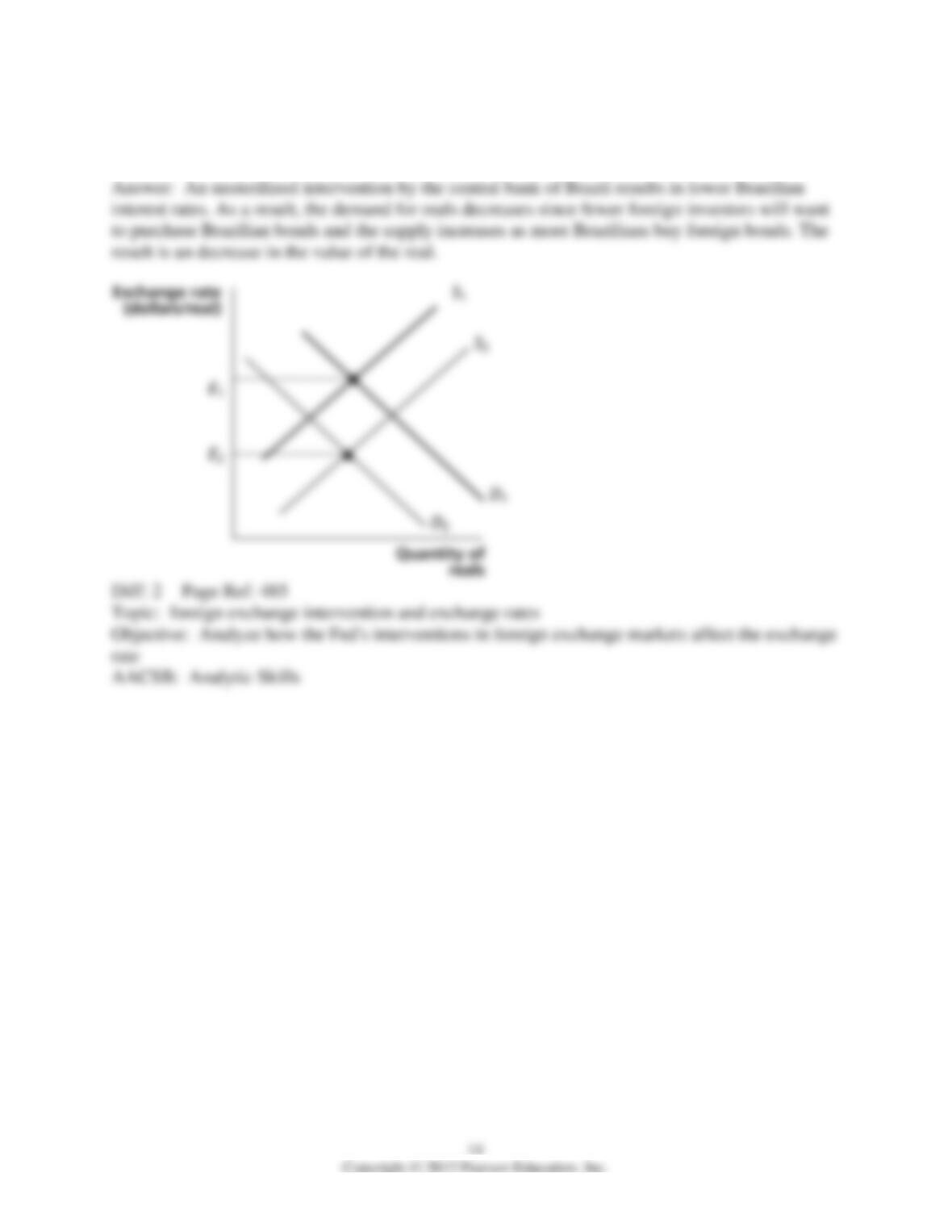
18) Make use of a graph of the foreign exchange market to show how the Brazilian Central Bank
can use an unsterilized intervention to reduce the value of its currency, the real, in terms of the
dollar.
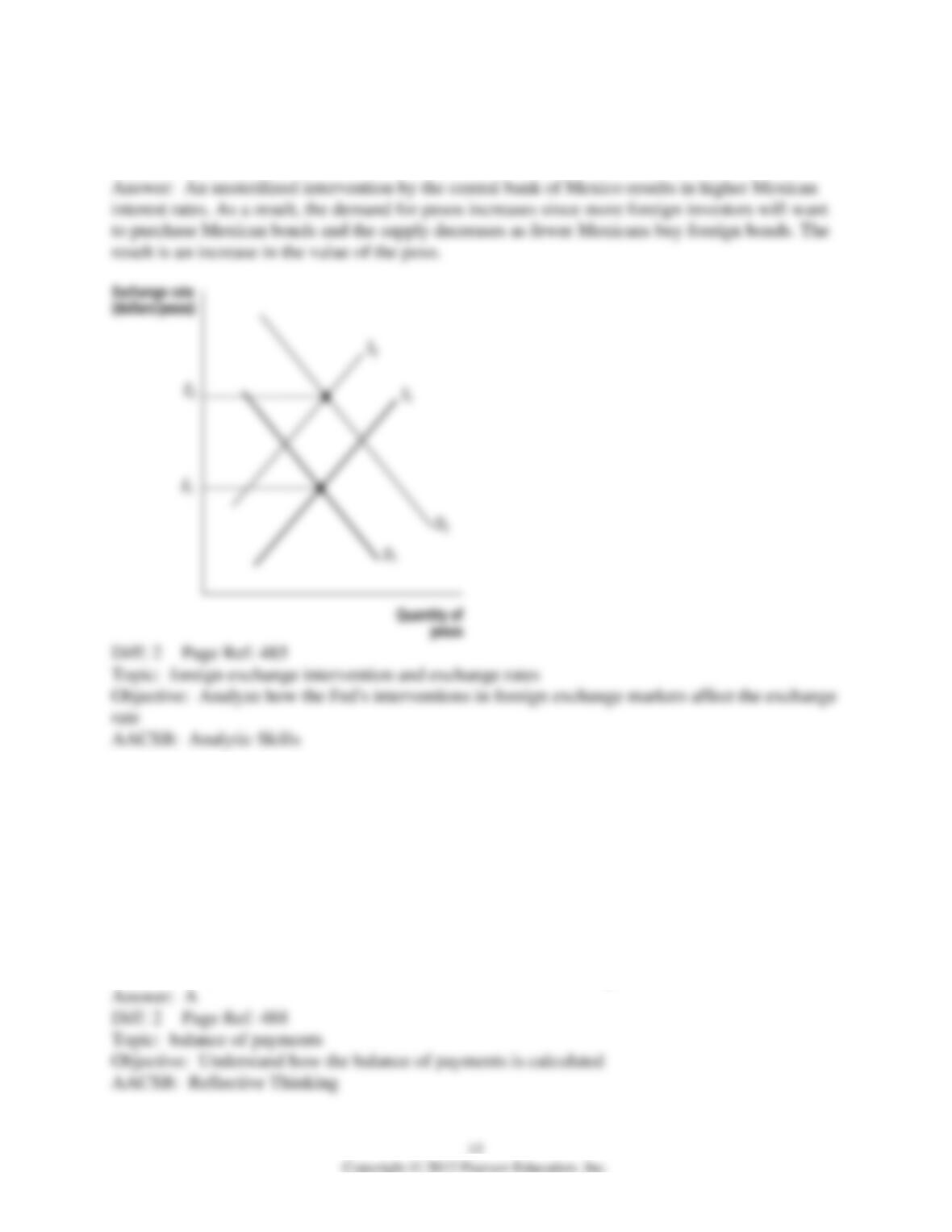
19) Make use of a graph of the foreign exchange market to show how the Central Bank of
Mexico can use an unsterilized intervention to increase the value of its currency, the peso, in
terms of the dollar.
16.3 The Balance of Payments
1) Which of the following is true of the U.S. balance of payments?
A) It includes as receipts all inflows of funds from foreigners to the United States.
B) It includes as receipts only inflows of funds used to purchase U.S. produced goods and
services.
C) It includes as receipts inflows of funds used to purchase U.S. goods or services or to acquire
U.S. assets but not funds received as unilateral transfers.
D) It includes as receipts inflows of funds used to purchase U.S. goods or services and funds
received as unilateral transfers but not inflows of funds used to acquire U.S. assets.