Chapter 16: Alternative Exit and Restructuring Strategies
Divestitures, Spin-Offs, Carve-Outs, Split-Ups, and Split-Offs
Answers to End of Chapter Discussion Questions
16.1 What are the advantages and disadvantages of tracking or target stocks to investors and to the firm?
16.2 How would you decide when to sell a business?
16.3 What factors influence a parent firm’s decision to undertake a spin-off rather than a divestiture or equity carve-out?
16.4 How might the form of payment affect the abnormal return to sellers and buyers?
16.5 How might spin-offs result in a wealth transfer from bondholders to shareholders?
16.6 Explain how executing successfully a large-scale divestiture can be highly complex. This is especially true when the
divested unit is integrated with the parent’s functional departments and with other units operated by the parent.
Consider the challenges of interdependencies, regulatory requirements, and customer and employee perceptions.
16.7 On April 25, 2001, in an effort to increase shareholder value, USX announced its intention to split U.S. Steel and
Marathon Oil into two separately traded companies. The breakup gives holders of Marathon Oil stock an opportunity
to participate in the ongoing consolidation within the global oil and gas industry. Holders of USX–U.S. Steel Group
common stock (target stock) would become holders of newly formed Pittsburgh-based United States Steel
Corporation. What other alternatives could USX have pursued to increase shareholder value? Why do you believe
they pursued the breakup strategy rather than some of the alternatives?
16.8 Hewlett Packard (HP) announced the spin-off of its Agilent Technologies unit to focus on its main business of
computers and printers. Hewlett Packard provided Agilent with $983 million in start-up funding. HP retained a
controlling interest until mid-2000, when it spun-off the rest of its shares in Agilent to HP shareholders as a tax-free
transaction. Discuss the reasons why HP may have chosen a staged transaction rather than an outright divestiture of
the business.
3
16.9 After months of trying to sell its 81 percent stake in Blockbuster Inc., Viacom undertook a spin-off in mid 2004. Why
would Viacom choose to spin-off rather than divest its Blockbuster unit? Explain your answer.
16.10 Since 2001, GE, the world’s largest conglomerate, had been underperforming the S&P 500 stock index. In late 2008,
the firm announced that it was considering spinning off its consumer and industrial unit. What do you believe are
GE’s motives for their proposed restructuring? Why do you believe they chose a spin-off rather than an alternative
restructuring strategy?
Solutions to Chapter Case Questions
Anatomy of a Spin-Off—Northrop Grumman Exits the Shipbuilding Business
Discussion Questions
1. Speculate as to why Northrop Grumman used a spin-off rather than a divestiture, split-off or split up to separate
Huntington Ingalls from the rest of its operations? What were the advantages of the spin-off over the other
restructuring strategies.
2. What is the likely impact of the spin–off on Northrop Grumman’s share price immediately following the spin-off of
Huntington Ingalls assuming no other factors offset it?
3. Why do businesses that have been spun off from their parent often immediately put antitakeover defenses in place?
4
4. Why would the U.S. Internal Revenue Service be concerned about a change of control of the spun-off business such
that it might revoke its ruling that the spin-off satisfied the requirements to be tax-free?
.
5. Describe how you as an analyst would estimate the potential impact of the Huntington Ingalls Industries spin-off on
the long–term value of Northrop Grumman’s share price?
Examination Questions and Answers
1. Divestitures, spin-offs, equity carve-outs, split-ups, and bust-ups are commonly used strategies to exit businesses.
True or False
2. Empirical studies show that the desire by parent firms to increase strategic focus is an important motive for exiting
businesses. True or False
3. Antitrust regulatory agencies may make their approval of a merger contingent on the willingness of the merger
partners to divest certain businesses. True or False
4. In deciding to sell a business, a parent firm should compare the business’ after-tax value in sale with its pre-tax value
to the parent as part of the parent.
True or False
5. The timing of a divestiture is important. If the business to be sold is highly cyclical, the sale should be timed to
coincide with the firm’s peak year earnings. True or False
6. A spin-off is a transaction involving a separate legal entity whose shares are sold to the parent firm’s shareholders.
True or False
7. A spin-off is a transaction in which a parent creates a new legal subsidiary and distributes shares it owns in the
subsidiary to its current shareholders as a stock dividend. True or False

8. In a spin–off, the proportional ownership of shares in the new legal subsidiary is the same as the stockholders’
proportional ownership of shares in the parent firm. True or False
9. In a spin-off, the board of directors is the same as the board of directors of the parent firm. True or False
10. A split-up involves the creation of a new class of stock for each of the parent’s operating subsidiaries, paying current
shareholders a dividend of each new class of stock, and then dissolving the remaining corporate shell. True or False
11. Spin-offs are generally immediately taxable to shareholders. True or False
12. Both a divestiture and a spin-off generally generate a cash infusion for the parent. True or False
13. Equity carve-outs have some of the characteristics of both divestitures and spin-offs. True or False
14. The parent firm generally retains control of the business involved in an equity carve-out. True or False
15. An equity carve-out is often a prelude to a complete divestiture of a business by the parent. True or False
16. Although the parent often retains control in an equity carve-out, the shareholder base of the subsidiary may be
different that that of the parent. True or False
17. In an equity carve-out, the cash raised by the subsidiary in this manner may be transferred to the parent as a dividend
or as an inter-company loan. True or False
18. When a parent creates a tracking stock for a subsidiary, it is giving up all control of that subsidiary. True or False
19. Tracking stocks are often created to give investors a pure play investment opportunity in one of the parent’s
subsidiaries. True or False
20. Tracking stocks may create internal operating conflicts among the parent’s business units in terms of how the
consolidated firm’s cash is allocated among its business units. True or False
21. Voluntary bust–ups or liquidations by the parent firm reflect management’s judgment that the sale of individual parts
of the firm could realize greater value than the value created by a continuation of the combined corporation. True or
False
22. In general, a voluntary bust-up or liquidation has the advantage over mergers of deferring the recognition of a gain by
the stockholders of the selling company until they eventually sell the stock. True or False
23. When a firm is unable to pay its liabilities as they come due, it is said to be in bankruptcy. True or False

6
24. Equity carve-outs are similar to divestitures and spin-offs in that they provide a cash infusion to the parent. True or
False
25. The divesting firm is required to recognize a gain or loss for financial reporting purposes equal to the difference
between the book value of the consideration received for the divested operation and its fair value. True or False
26. In a private solicitation, the parent firm may hire an investment banker or undertake on its own to identify potential
buyers to be contacted. True or False
27. A parent firm’s decision to sell or to retain a subsidiary is often made by comparing the after-tax equity value of the
subsidiary with the pre-tax and interest sale value of the business. True or False
28. A parent firm rarely chooses to divest an undervalued business and return the cash to shareholders either through a
liquidating dividend or share repurchase. True or False
29. The divestiture of a business always results in the parent receiving cash from the buyer? True or False
30. Management may sell assets to fund diversification opportunities? True or False
31. Many corporations, particularly large, highly diversified organizations, constantly are reviewing ways in which they
can enhance shareholder value by changing the composition of their assets, liabilities, equity, and operations. True or
False
32. Divestitures, spin-offs, equity carve-outs, split-ups, split-offs, and bust-ups are commonly used strategies to exit
businesses and to redeploy corporate assets by returning cash or noncash assets through a special dividend to
shareholders. True or False
33. Managing highly diverse and complex portfolios of businesses is both time consuming and distracting. This is
particularly true when the businesses are in largely related industries. True or False
34. A business that is rich in high-growth opportunities may be an excellent candidate for divestiture to a strategic buyer
with significant cash resources and limited growth opportunities. True or False
35. A substantial body of evidence indicates that increasing a firm’s degree of diversification can improve substantially
financial returns to shareholders. True or False
36. Empirical studies show that exit strategies, which return cash to shareholders, tend to have a highly unfavorable
impact on shareholder wealth creation. True or False
37. Acquiring companies often find themselves with certain assets and operations of the acquired company that do not fit
their primary strategy. Such assets may be divested to fund future investments. True of False
38. Divestitures always result in the parent receiving stock or debt from the buyer. True or False

39. The decision to sell or to retain the business depends on a comparison of the pre-tax value of the business to the parent
with the after-tax proceeds from the sale of the business. True or False
40. Although the sale value may exceed the equity value of the business, the parent may choose to retain the business for
strategic reasons. True or False
41. In a public solicitation, a firm can announce publicly that it is putting itself, a subsidiary, or a product line up for sale.
Either potential buyers contact the seller or the seller actively solicits bids from potential buyers or both. True or
False
42. In either a public or private solicitation, interested parties are asked to sign confidentiality agreements after they are
given access to proprietary information but before they are asked to make a bid. True or False
43. The divesting firm is required to recognize a gain or loss for financial reporting purposes equal to the difference
between the fair value of the consideration received for the divested operation and its market value. True or False
44. In a spin-off, some shareholders receive proportionately more shares than others. True or False
45. Like divestitures or equity carve-outs, the spin-off generally results in an infusion of cash to the parent company.
True or False
46. A split-up involves carving out a portion of the equity of each of the parent’s operating subsidiaries and selling the
shares to the public. True or False
47. Parent firms with a high tax basis in a business may choose to spin-off the unit as a tax-free distribution to
shareholders rather than sell the business and incur a substantial tax liability. True or False
48. Split-ups and spin-offs generally are taxable to shareholders. True or False
49. For financial reporting purposes, the parent firm should account for the spin–off of a subsidiary’s stock to its
shareholders at book value with no gain or loss recognized, other than any reduction in value due to impairment. True
or False
50. In an equity carve-out, minority shareholders are eliminated. True or False
51. Although the parent retains control, the shareholder base of the subsidiary that has undergone an equity carve-out is
unlikely to be different than that of the parent as a result of the public sale of equity. True or False
52. In addition, stock-based incentive programs to attract and retain key managers can be implemented for each operation
with its own tracking stock. True or False

8
53. For financial reporting purposes, a distribution of tracking stock splits the parent firm’s equity structure into separate
classes of stock without a legal split-up of the firm. True or False
54. Unlike a spin-off or carve-out, the parent retains complete ownership of the business for which it has created a
tracking stock. True or False
55. A disadvantage of a split-off is that they tend to increase the pressure on the spun–off firm’s share price, because
shareholders who exchange their stock are more likely to sell the new stock. True or False
56. Equity ownership changes in spin-offs, but it does not change in split-ups. True or False
57. The reasons for selecting a divestiture, carve-out, or spin-off strategy are basically the same. True or False
58. A spin-off is tax free to the shareholders if it is properly structured. In contrast, the cash proceeds from an outright sale
may be taxable to the parent to the extent a gain is realized. True or False
59. Restructuring actions may provide tax benefits that cannot be realized without undertaking a restructuring of the
business. True or False
60. Parent firms often exit businesses that consistently fail to meet or exceed the parent’s hurdle rate requirements. True
or False
61. Divestitures are always taxable to the selling firm? True or False
1. Which of the following is generally considered a motive for exiting businesses?
a. Changing corporate strategy or focus
b. Underperforming businesses
c. Regulatory concerns
d. Lack of fit
e. All of the above
2. To decide if a business is worth more to the shareholder if sold, the parent firm generally considers all of the
following factors except for
a. The after-tax cash flows of the business to be sold
b. The after-tax sale value of the business to be sold
c. The parent’s cost of capital
d. A and B
e. A, B, and C
3. Which of the following is not a characteristic of a spin-off?
a. The parent creates a new legal subsidiary for the business to be spun-off
b. The shares of the new subsidiary are sold to the public
c. The ownership of shares in the new legal subsidiary is the same as the stockholders’ proportional ownership
of shares in the parent firm
d. The new business once spun-off has its own management and board
e. Spin-offs are generally not taxable to the parent’s shareholders if properly structured

9
4. A spin-off may create shareholder wealth for all of the following reasons except for
a. Spin-offs are generally not taxable if properly structured
b. The spin-off’s management and board is independent of the former parent
c. Investors will be better able to value the spin-off
d. The cost of capital of the spin-off is generally higher than when it was part of the parent
e. The spin-off may be subsequently acquired by another firm
5. An equity carve-out differs from a spin-off for all but which one of the following reasons?
a. Generates a cash infusion into the parent
b. Is undertaken when the unit has very little synergy with the parent
c. The proceeds often are taxable to the parent
d. Continues to be influenced by the parent’s management and board
e. The carve–out’s shareholders may differ from those of the parent’s shareholders
6. Which one of the following is generally not a reason for issuing tracking stocks?
a. To give investors a “pure play” in a specific business owned by the parent
b. To create a currency for the business to acquire other firms
c. To enhance the likelihood that the business will be acquired
d. To create an incentive for management receiving the stock
e. To raise capital for the parent or for the business for which the tracking stock is created
7. For a spin-off to be tax-free to the shareholder it must satisfy which of the following:
a. The parent firm must have a controlling interest in the subsidiary before it is spun off.
b. After the spin-off, both the parent and the subsidiary must remain in the same line of business in which each
was involved for at least 5 years before the spin-off.
c. The spin-off cannot have been used as a means of avoiding dividend taxation by converting ordinary income
into capital gains.
d. The parent’s shareholders must maintain significant ownership in both the parent and the subsidiary
following the transactions.
e. All of the above
8. Which of the following is not true of a divestiture?
a. May create cash infusion for the parent firm
b. Parent ceases to exist
c. Proceeds of sale taxable if returned to shareholders through a dividend or stock buyback
d. A new legal subsidiary may be created
e. B and C
9. Which of the following is not true of a spin-off?
a. Creates cash infusion for parent
b. Change in equity ownership of the spin-off
c. New legal entity created
d. New shares issued to the public
e. A, B, and D
10. Which of the following is not true of an equity carve-out?
a. Creates cash infusion for the parent
b. Change in equity ownership of the unit involved in the carve–out
c. New shares issued to the public
d. Taxable if proceeds returned to shareholders through a dividend or stock buyback

10
e. Parent ceases to exist
11. Which of the following is true about a voluntary bust-up?
a. Parent ceases to exist
b. Cash infusion to the parent
c. Parent stock is exchanged for subsidiary stock
d. New shares issued to the public
e. Parent remains in control
12. Which of the following is generally not considered a common motive for exiting businesses?
a. Changing strategy or focus
b. Desire to achieve economies of scale
c. Lack of fit with the parent’s other businesses
d. Discarding unwanted businesses from prior acquisitions
e. All of the above
13. An equity carve-out by a parent of one of its subsidiaries is often a precursor to a
a. Complete divestiture or spin-off of the subsidiary
b. An acquisition
c. A merger
d. Joint venture
e. The creation of a tracking stock
14. Which of the following is a common problem associated with tracking stocks?
a. Tracking stocks often de-motivate managers of the business for which the stock is created
b. Such stocks are too complicated for investors to understand
c. Tracking stocks may create internal operating conflicts among the parent’s business units
d. Such stocks often create huge tax liabilities for the parent
e. None of the above
15. Which of the following is not true of a split-off?
a. A split-off is a variation of a spin-off
b. Parent company shareholders receive shares in a subsidiary in return for surrendering their parent company
shares
c. Split-offs are best suited for disposing of a less than 100 percent investment stake in a subsidiary,
d. A split-off reduces the parent firm’s earnings per share.
e. The split-off reduces the pressure on the spun-off firm’s share price
16. A diversified automotive parts supplier has decided to sell its valve manufacturing business. This sale is referred to as
a
a. Merger
b. Divestiture
c. Spin-off
d. Equity carveout
e. Liquidation
17. As part of its restructuring plan, a holding company plans to undertake an IPO for 35 percent of the shares it owns in a
subsidiary. The sale of these shares would be called a
a. Divestiture
b. Split-off
c. Split-up

11
d. Equity carveout
e. Breakup
18. A firm decides to distribute all of the shares it holds in a subsidiary to its shareholders. The distribution would be
called a
a. Divestiture
b. Split-up
c. Spin-off
d. Split-up
e. Equity carveout
19. The board of directors of a large conglomerate has decided that the investment opportunities for the firm are limited
and that greater value could be created for the shareholders if the firm were divided into four independent businesses.
Following approval by shareholders, the firm executed this strategy which is best described as a
a. Split-up
b. Split-off
c. Spin-off
d. Equity carveout
e. Reverse merger
20. The board of directors of a firm approves an exchange offer in which their shareholders are offered stock in one of the
firm’s subsidiaries in exchange for their holdings of parent company stock. This offer is best described as a
a. Split-up
b. Split-off
c. Equity carve–out
d. Spin-off
e. Tender offer
Case Study Short Essay Examination Questions
The Anatomy of a Reverse Morris Trust Transaction:
The Pringles Potato Chip Saga1
Key Points
Greater shareholder value may be created by exiting rather than operating a business.
Deal structures can impose significant limitations on a firm’s future strategies and tactics.
_____________________________________________________________________________________________
Following a rigorous portfolio review and an informal expression of interest in the Pringles brand by Diamond Foods
(Diamond) in late 2009, Proctor & Gamble (P&G), the world’s leading manufacturer of household products, believed that
Pringles could be worth more to its shareholders if divested than if retained. Pringles is the iconic potato chip brand, with sales
in 140 countries and operations in the United States, Europe, and Asia.
Diamond’s executive management had long viewed the Pringles’ brand as an attractive fit for their strategy of building,
acquiring, and energizing brands. The acquisition of Pringles would triple the size of the firm’s snack business and provide
greater merchandising influence in the way in which its products are distributed. The merger would also give Diamond a
substantial presence in Asia, Latin America, and Central Europe. The increased geographic diversity means the firm would
derive almost one-half of its revenue from international sales.
1 The deal discussed in this case is for illustration only. Following the disclosure that Diamond Food’s reported earnings were
subject to substantial revision due to accounting irregularities, Proctor & Gamble invoked a material adverse change clause to
terminate the purchase agreement in 2012.
12
After extended negotiations, Diamond and P&G announced on April 15, 2011, their intent to merge P&G’s Pringles
subsidiary into Diamond in a transaction valued at $2.35 billion. The purchase price consisted of $1.5 billion in Diamond
common stock, valued at $51.47 per share, and Diamond’s assumption of $850 million in Pringles outstanding debt. The way
in which the deal was structured enabled P&G shareholders to defer any gains they realize from the transaction and resulted in
a one-time after-tax earnings increase for P&G of $1.5 billion due to the firm’s low tax basis in Pringles.
The offer to exchange Pringle shares for P&G shares reduced the number of outstanding P&G common shares, partially
offsetting the impact on P&G’s earnings per share of the loss of Pringles earnings. Diamond agreed to issue one share of its
common stock for each Pringles common share. The 29.1 million common shares issued by Diamond resulted in P&G
shareholders’ participating in the exchange offer, owning a 57% stake in the combined firms, with Diamond’s shareholders
owning the remainder.
The deal was structured as a reverse Morris Trust acquisition, which combines a divisive reorganization (e.g., a spin-off or a
split-off) with an acquisitive reorganization (e.g., a statutory merger) to allow a tax-free transfer of a subsidiary under U.S. law.
The use of a divisive reorganization results in the creation of a public company that is subsequently merged into a shell
subsidiary (i.e., a privately owned company) of another firm, with the shell surviving.
The structure of the deal involved four discrete steps, outlined in separation and transaction agreements signed by P&G and
Diamond. These steps included the following: (1) the creation by P&G of a wholly owned subsidiary containing Pringles’
assets and liabilities; (2) the recapitalization of the wholly owned Pringles subsidiary; (3) the separation of the wholly owned
subsidiary through a split-off exchange offer; and (4) a merger with a wholly owned subsidiary of Diamond Foods. The
separation agreement covered the first three steps, with the final step detailed in the transaction agreement.
Under the separation agreement, P&G contributed certain Pringles assets and liabilities to the Pringles Company, a newly
formed wholly owned subsidiary of P&G. After P&G and Diamond reached a negotiated value for the Pringles Company
equity of $1.5 billion, or $51.47 per share, the Pringles Company was subsequently recapitalized by issuing to P&G 29.1
million shares of Pringles Company stock. To complete the separation of Pringles from the parent firm, P&G distributed on the
closing date Pringles shares to P&G shareholders participating in a share-exchange offer in which they agreed to exchange
their P&G shares for Pringles shares.
In addition, the Pringles Company borrowed $850 million and used the proceeds to pay P&G a cash dividend and to acquire
certain Pringles business assets held by P&G affiliates. Since P&G is the sole owner of the Pringles Company, the dividend is
tax free to P&G because it is an intracompany transfer. If the exchange offer had not been fully subscribed, P&G would have
distributed through a tax-free spin-off the remaining shares as a dividend to P&G shareholders.
The transaction agreement outlined the terms and conditions pertinent to completion of the merger with Diamond Foods.
Immediately after the completion of the distribution, the Pringles Company merged with Merger Sub, a wholly owned shell
subsidiary of Diamond, with Merger Sub’s continuing as the surviving company. The shares of Pringles Company common
stock distributed in connection with the split-off exchange offer automatically converted into the right to receive shares of
Diamond common stock on a one-for-one basis. After the merger, Diamond, through Merger Sub, owned and operated Pringles
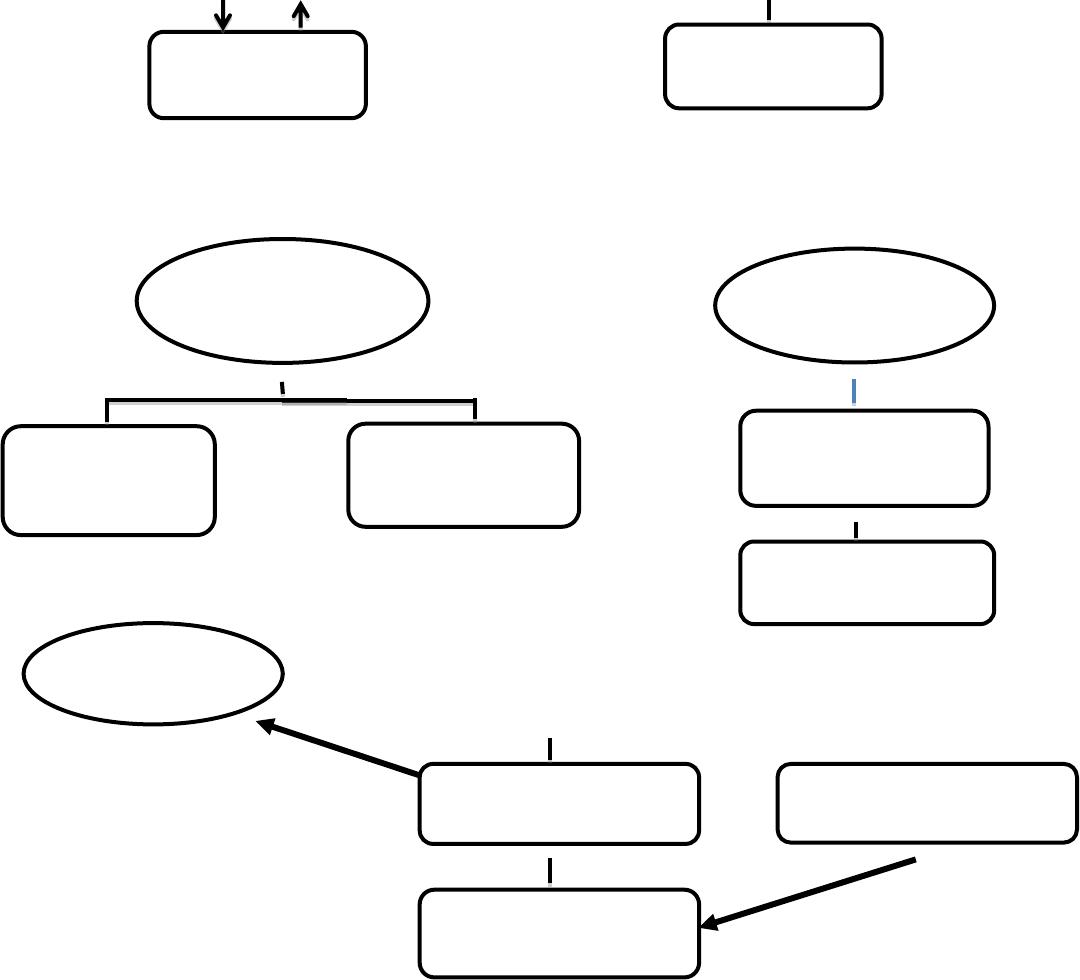
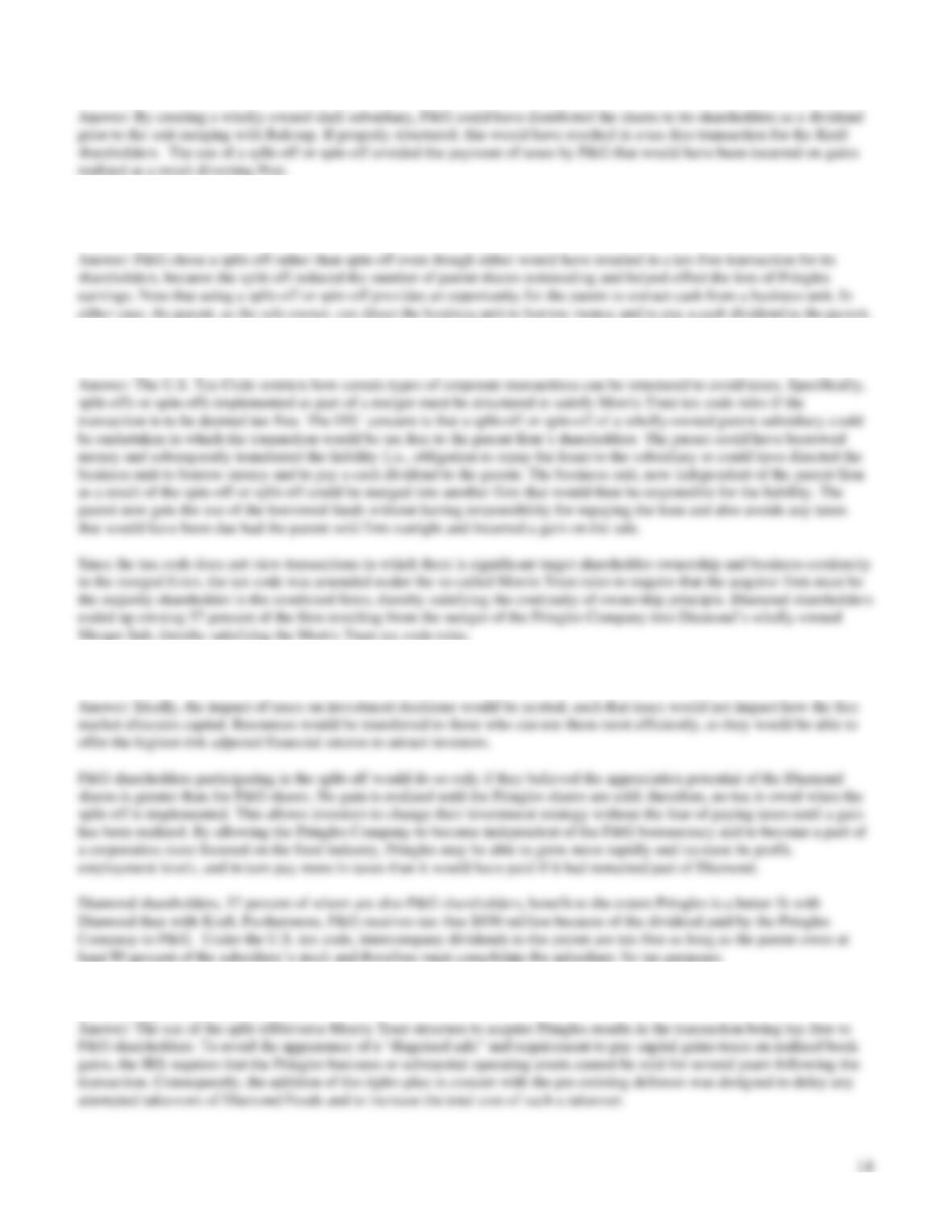
(see Figure 16.3).
Figure 16.3
Reverse Morris Trust.
P&G
Shareholders
Diamond
Shareholders
The Proctor &
Gamble Company
Diamond Foods
Pre-Merger Structure
Selected
Pringle
Pringles Common
Stock
13
Prior to the merger, Diamond already had formidable antitakeover defenses in place as part of its charter documents,
including a classified board of directors, a prohibition against stockholders’ taking action by written consent (i.e., consent
solicitation), and a requirement that stockholders give advance notice before raising matters at a stockholders’ meeting.
Following the merger, Diamond adopted a shareholder-rights plan. The plan entitled the holder of such rights to purchase 1/100
of a share of Diamond’s Series A Junior Participating Preferred Stock if a person or group acquires 15% or more of Diamond’s
outstanding common stock. Holders of this preferred stock (other than the person or group triggering their exercise) would be
able to purchase Diamond common shares (flip-in poison pill) or those of any company into which Diamond is merged (flip-
over poison pill) at a price of $60 per share. Such rights would expire in March 2015 unless extended by Diamond’s board of
directors.
Discussion Questions:
1. The merger of Pringles and Diamond Foods could have been achieved as a result of a P&G spin-off of
Pringles. Explain the details of how this might happen.
Pringles Company
Merger Sub
Separation Structure before Merger
P&G Shareholders
(incl. exchange offer
participants)
The Proctor &
Gamble Company
Pringle Company
(owns Pringle’s
assets and liabilities)
Diamond Foods
Merger Sub
(Acquisition Vehicle)
Diamond
Shareholders
Post-Merger Structure
Current & Former
P&G
Sharehold
Diamond Foods
Merger Sub
Pringle Company (owns
Pringles assets/liabilities)
Diamond
Common
Shares
2. Speculate as to why P&G chose to split-off rather than spin-off Pringles as part its plan to merge Post with Ralcorp.
Be specific.
3. Why was this transaction subject to the Morris Trust tax regulations?
4. How is value created for the P&G and Diamond shareholders in this type of transaction?
5. Why did the addition of the shareholder rights plan by Diamond Foods following the merger with Pringles make sense
given the type of deal structure used?

15
The Anatomy of a Spin-Off—Northrop Grumman Exits the Shipbuilding Business
_____________________________________________________________________________________________
Key Points
There are many ways a firm can choose to separate itself from one of its operations.
Which restructuring method is used reflects the firm’s objectives and circumstances.
______________________________________________________________________________
In an effort to focus on more attractive growth markets, Northrop Grumman Corporation (NGC), a global leader in aerospace,
communications, defense, and security systems, announced that it would exit its mature shipbuilding business on October 15,
2010. Huntington Ingalls Industries (HII), the largest military U.S. shipbuilder and a wholly owned subsidiary of NGC, had
been under pressure to cut costs amidst increased competition from competitors such as General Dynamics and a slowdown in
orders from the U.S. Navy. Nor did the outlook for the shipbuilding industry look like it would improve any time soon.
Given the limited synergy between shipbuilding and HII’s other businesses, HII’s operations were largely independent of
NGC’s other units. NGC’s management and board argued that their decision to separate from the shipbuilding business would
enable both NGC and HII to focus on those areas they knew best. Moreover, given the shipbuilding business’s greater ongoing
capital requirements, HII would find it easier to tap capital markets directly rather than to compete with other NGC operations
for financing. Finally, investors would be better able to value businesses (NGC and HII) whose operations were more focused.
After reviewing a range of options, NGC pursued a spin-off as the most efficient way to separate itself from its shipbuilding
operations. If properly structured, spin-offs are tax free to shareholders. Furthermore, management argued that they could be
completed in a timelier manner and were less disruptive to current operations than an outright sale of the business. The spin–off
represented about one-sixth of NGC’s $36 billion in 2010 revenue. Effective March 31, 2011, all of the outstanding stock of
HII was spun off to NGC shareholders through a pro rata distribution to shareholders of record on March 30, 2011. Each NGC
shareholder received one HII common share for every six shares of NGC common stock held.2
The spin-off process involved an internal reorganization of NGC businesses, a Separation and Distribution Agreement, and
finally the actual distribution of HII shares to NGC shareholders. The internal reorganization and subsequent spin-off is
illustrated in Figure 16.4. NGC (referred to as Current Northrop Grumman Corporation) first reorganized its businesses such
that the firm would become a holding company whose primary investments would include Huntington Ingalls Industries (HII)
and Northrop Grumman Systems Corporation (i.e., all other non-shipbuilding operations). HII was formed in anticipation of
the spin-off as a holding company for NGC’s shipbuilding business, which had been previously known as Northrop Grumman
Shipbuilding (NGSB). NGSB was changed to Huntington Ingalls Industries Company following the spin-off. Reflecting the
new organizational structure, Current Northrop Grumman common stock was exchanged for stock in New Northrop Grumman
Corporation. This internal reorganization was followed by the distribution of HII stock to NGC’s common shareholders.
Following the spin-off, HII became a separate company from NGC, with NGC having no ownership interest in HII.
Renamed Titan II, Current NGC became a direct, wholly owned subsidiary of HII and held no material assets or liabilities
other than Current NGC’s guarantees of HII performance under certain HII shipbuilding contracts (under way prior to the spin–
off and guaranteed by NGC) and HII’s obligations to repay intercompany loans owed to NGC. New NGC changed its name to
Northrop Grumman Corporation. The board of directors remained the same following the reorganization.
No gain or loss was incurred by common shareholders because the exchange of stock between the Current and New
Northrop Grumman corporations did not change the shareholders’ tax basis in the stock. Similarly, no gain or loss was incurred
by shareholders with the distribution of HII’s stock, since there was no change in the total value of their investment. That is,
the value of the HII shares were offset by a corresponding reduction in the value of NGC shares, reflecting the loss of HII’s
cash flows.
Before the spin-off, HII entered into a Separation and Distribution Agreement with NGC that governed the relationship
between HII and NGC after completion of the spin-off and provided for the allocation between the two firms of assets,
liabilities, and obligations (e.g., employee benefits, intellectual property, information technology, insurance, and tax-related
assets and liabilities). The agreement also provided that NGC and HII each would indemnify (compensate) the other against
any liabilities arising out of their respective businesses. As part of the agreement, HII agreed not to engage in any transactions,
such as mergers or acquisitions, involving share-for-share exchanges that would change the ownership of the firm by more than
50% for at least two years following the transaction. A change in control could violate the IRS’s “continuity of interest”
requirement and jeopardize the tax-free status of the spin-off. Consequently, HII put in place certain takeover defenses to make
takeovers difficult.
Discussion Questions
1. Speculate as to why Northrop Grumman used a spin-off rather than a divestiture, split-off or split up to separate
Huntington Ingalls from the rest of its operations? What were the advantages of the spin-off over the other restructuring
strategies.
2. What is the likely impact of the spin–off on Northrop Grumman’s share price immediately following the spin-off of
Huntington Ingalls assuming no other factors offset it?
3. Why do businesses that have been spun off from their parent often immediately put antitakeover defenses in place?
4. Why would the U.S. Internal Revenue Service be concerned about a change of control of the spun-off business such
that it might revoke its ruling that the spin-off satisfied the requirements to be tax-free?
.
5. Describe how you as an analyst would estimate the potential impact of the Huntington Ingalls Industries spin-off on
the long–term value of Northrop Grumman’s share price?


18
Kraft Foods Splits Up in Its Biggest Deal Yet
Current Northrop
Grumman Corp
(CNGC)
New Northrop
Grumman Corp
Northrop
Grumman
Systems
(NGSC)
Northrop
Grumman
Shipbuilding
(NGSB)
Huntington Ingalls
Industries (HII)
Northrop
Grumman
Systems Corp.
(NGSC)
Huntington Ingalls
Industries (HII)
New Northrop
Grumman
(New NGC)
Current
Northrop
Grumman
Northrop
Grumman
Shipbuilding
Public
Shareholders
Public
Shareholders
Northrop Grumman
(Formerly New NGC)
Northrop Grumman
Systems Corp.
(NGSC)
Titan II, Inc.
(Formerly Current
NGC)
Huntington Ingalls
Industries (HII)
Public
Shareholders
Public
Shareholders
NGC Post-Spin-Off HII Post-Spin-Off
Northrop Grumman
Shipbuilding Inc
(NGSB)

_____________________________________________________________________________________________________
Key Points
Investors often evaluate a firm’s performance in terms of how well it does as compared to its peers.
Activist investors can force an underperforming firm to change its strategy radically.
The Kraft decision to split its businesses is yet another example of the recent trend by highly diversified businesses to increase
their product focus.
_____________________________________________________________________________________________________
Following a successful career as CEO of PepsiCo’s Frito–Lay, Irene Rosenfeld became the CEO of Kraft Foods in 2006. As the
world’s second-largest packaged foods manufacturer, behind Nestlé, Kraft had stumbled in its efforts to increase its global
reach by growing in emerging markets. Its brands tended to be old, and the firm was having difficulty developing new, trendy
products. Rosenfeld was tasked by its board of directors with turning the firm around. She reasoned that it would take a
complete overhaul of Kraft, including organization, culture, operations, marketing, branding, and the product portfolio, to
transform the firm.
In 2010, the firm made what at the time was viewed by top management as its most transformational move by acquiring
British confectionery company Cadbury for $19 billion. While the firm became the world’s largest snack company with the
completion of the transaction, it was still entrenched in its traditional business, groceries. The company now owned two very
different product portfolios.
Between January 2010 and mid-2011, Kraft’s earnings steadily improved, powered by stronger sales. Kraft shares rose
almost 25%, more than twice the increase in the S&P 500 stock index. However, it continued to trade throughout this period at
a lower price–to-earnings multiple than such competitors as Nestlé and Groupe Danone. Some investors were concerned that
Kraft was not realizing the promised synergies from the Cadbury deal. Activist investors (Nelson Peltz’s Trian Fund and Bill
Ackman’s Pershing Square Capital Management) had discussions with Kraft’s management about splitting the firm. This plan
had the support of Warren Buffett, whose conglomerate, Berkshire Hathaway, was Kraft’s largest investor at that time, with a
6% ownership interest.
To avert a proxy fight, Kraft’s board and management announced on August 4, 2011, its intention to restructure the firm
radically by separating it into two distinct businesses. Coming just 18 months after the Cadbury deal, investors were initially
stunned by the announcement but appeared to avidly support the proposal avidly by driving up the firm’s share price by the end
of the day. The proposal entailed separating its faster-growing global snack food business from its slower–growing, more
United States–centered grocery business. The separation was completed through a tax-free spin-off to Kraft Food shareholders
of the grocery business on October 1, 2012. The global snack food business will be named Mondelez International, while the
North American grocery business will retain the Kraft name.
Management justified the proposed split-up of the firm as a means of increasing focus, providing greater opportunities, and
giving investors a choice between the faster-growing snack business and the slower-growing but more predictable grocery
operation. Management also argued that the Cadbury acquisition gave the snack business scale to compete against such
competitors as Nestlé and PepsiCo.
Discussion Questions
1. Speculate as to why Kraft chose not to divest its grocery business and use the proceeds to either reinvest in its faster
growing snack business, to buy back its stock, or a combination of the two?
20
2. How might a spin-off create shareholder value for Kraft Foods shareholders?
3. There is often a natural tension between so-called activist investors interested in short–term profits and a firm’s
management interested in pursuing a longer-term vision. When is this tension helpful to shareholders and when does it
destroy shareholder value?
The Warner Music Group is Sold at Auction
_____________________________________________________________________________________________________
Key Points
In selling a business, a firm may choose either to negotiate with a single potential buyer, to control the number of potential
bidders, or to engage in a public auction.
The auction process often is viewed as the most effective way to get the highest price for a business to be sold; however, far
from simple, an auction can be both a chaotic and a time–consuming procedure.
Auctions may be most suitable for businesses whose value is largely intangible or for “hard–to–value” businesses.
____________________________________________________________________________________________________
In early 2011, the Warner Music Group (WMG), the third largest of the “big four” recorded-music companies, consisted of two
separate businesses: one showing high growth potential and the other with declining revenues. Of WMG’s $3 billion in annual
revenue, 82% came from sales of recorded music, with the remainder attributed to royalty payments for the use of music
owned by the firm. Of the two, only recorded music has suffered revenue declines, due to piracy, aggressive pricing of online
music sales, and the bankruptcy of many record retailers and wholesalers. In contrast, music publishing has grown as a result of
diverse revenue streams from radio, television, advertising, and other sources. Music publishing also is benefiting from digital
music downloads and the proliferation of cellphone ringtones.
In 2004, Warner Music’s parent at the time, Time Warner Inc., agreed to sell the business to a consortium led by THL
Partners for $2.6 billion in cash. The group also included Edward Bronfman, Jr. (the Seagram’s heir, who also became the
CEO of WMG), Bain Capital, and Providence Equity Partners. Having held the firm for seven years, a long time for private
equity investors, its primary investors were seeking a way to cash out of the business, whose long-term fortunes appeared
problematic. WMG’s investors were also in a race with Terra Firma Capital Partners, owner of the venerable British record
company EMI, which was expected to take EMI public or to sell the business to a strategic buyer. WMG’s investors were
concerned that, if EMI were to be sold before WMG, the firm’s exit strategy would be compromised, because there was much
speculation that the only logical buyer for WMG was EMI.
By the end of January 2011, WMG had solicited about 70 potential bidders and attracted unsolicited indications of interest
from at least 20 others. As this group winnowed through the auction’s three rounds, alliances among the bidders continually
changed. In the ensuing auction, WMG’s stock price jumped by 75% from $4.72 per share on January 20 to $8.25 per share,
for a total market value of $3.3 billion on May 6, 2011.
In view of the differences between these two businesses, WMG was open to selling the firm in total or in pieces,
contributing to the extensive bidder interest. Risk takers were betting on an eventual recovery in recorded-music sales, while
risk-averse investors were more likely to focus on music publishing. Prior to the auction, WMG distributed confidentiality