Test Bank Questions, Chapter 15
1. Which of the following is not a financial planning objective associated with estate
planning?
a. To match the amount and type of assets to be distributed to circumstances and
our wishes
b. To match taxes outstanding with debt liability upon death
c. To leave other heirs with little or no conflict wherever possible
d. To protect ourselves while we are still alive
e. All of the above are financial planning objectives associated with state planning
2. What is the fourth step of estate planning?
a. Establish a will.
b. Consider other estate planning tools to meet objectives.
c. Evaluate obstacles and ways to overcome them.
d. Become familiar with all types of relevant taxes.
e. None of the above.
3. Can the estate planning process be the same for large and small estates?
a. Yes
b. No
c. Yes, though the amount of supervision varies
d. No, though the amount of supervision does not vary
e. None of the above
4. Which of the following is irrelevant to the outcome strategies associated with estate
planning?
a. Whether assets are joint or separately owned
b. The original cost
c. Current fair market value
d. All of the above are relevant
e. All of the above are irrelevant

5. The executor of a will is:
a. In charge of administering the estate, but is not in charge of complying with legal
requirements and liquidating its assets.
b. In charge of administering the estate and complying with legal requirements, but
is not in charge of liquidating its assets.
c. In charge of administering the estate, complying with legal requirements, and
liquidating its assets.
d. Is in charge of people unable to care for themselves.
e. None of the above.
6. Which of the following is not a factor for which a legally recognized will should be
evaluated?
a. Are your wishes unambiguously stated in the will?
b. Does the will comply with municipal law?
c. Are there overlooked assets?
d. Can the will cause conflict?
e. All of the above are factors.
7. What is intestate?
a. Dying without a will.
b. Preparing a will that applies to only a single state.
c. Preparing a will that applies across a number of states.
d. Dying with a will that you prepared without a lawyer.
e. None of the above.
8. Which of the following is not a reason to have a will?
a. You may want your spouse to receive all your assets.
b. States may mandate that assets be given to elderly parents only if they can
demonstrate that they need the money.
c. Important friends are entitled to nothing without a will.
d. The will can provide for tax advantaged trusts.
e. All of the above are reason for which to have a will.

9. Separate legal entities in which a third party manages property for the benefit of
another person are:
a. Trustees.
b. Trustor.
c. Trusts.
d. Grantor.
e. None of the above.
10. To bypass a bothersome, costly procedure that exposes assets to public scrutiny after
the individual’s death one should:
a. Prepare a will.
b. Identify a trustee.
c. Identify an executor.
d. Avoid placing assets in a trust.
e. None of the above.
11. Deviation from the grantor’s wishes is:
a. A disadvantage associated with a trust that comes about due to the considerable
leeway associated with interpreting the trust’s mandate.
b. An advantage associated with a trust that comes about due to the considerable
leeway associated with interpreting the trust’s mandate.
c. A disadvantage associated with a trust that comes about due to the lack of leeway
associated with interpreting the trust’s mandate.
d. An advantage associated with a trust that comes about due to the lack of leeway
associated with interpreting the trust’s mandate.
e. None of the above.
12. Which of the following is not an advantage associated with a trust?
a. Tax advantages.
b. Allows the bypassing of probate.
c. Lower cost.
d. Control advantages.

e. All of the above are advantages.
13. A testamentary trust:
a. Is not provided for in the will and comes about after death.
b. Is provided for in the will and comes about before death.
c. Is not provided for in the will and comes about before death.
d. Is provided for in the will and comes about after death.
e. None of the above.
14. A revocable trust:
a. Can be changed by the grantor for a short period following probate.
b. Can be revoked by the grantor for a short period following probate.
c. Usually has no impact on gift or estate taxes.
d. Usually has a large impact on gift and estate taxes.
e. None of the above.
15. In order for an item to be considered a gift:
a. It must be given without any characteristics of control left with the giftor.
b. The item cannot be exchanged for an agreement to provide a contra gift or
service.
c. It must represent a contract.
d. Both a and b are required for an item to be considered a gift.
e. Both a and c are required for an item to be considered a gift.
16. A gift must be less than what amount per person to avoid affecting the estate tax
exemption?
a. $10,000.
b. $10,500.
c. $14,000.
d. $14,500.
e. None of the above.

17. Which of the following is a difference between joint tenancy with right of
survivorship and tenancy by the entirety?
a. Whether available to married persons.
b. Whether available to singles.
c. Whether it can only be undone by consent of both parties.
d. Both a and b.
e. Both a and c.
18. For which of the following is life insurance in estate planning irrelevant?
a. Liquidity.
b. Relative assurance of payment.
c. Tax savings.
d. Only c is relevant.
e. All of the above are relevant.
19. Which of the following is incorrect?
a. The letter of instruction is a legal document.
b. The letter of instruction can indicate where the will and other important papers
are located.
c. The letter of instruction can discuss sensitive family matters that an executor
may find helpful.
d. The letter of instruction can include burial wishes.
e. All of the above are correct.
20. Which of the following assets do not bypass probate?
a. Those that are titled joint with right of survivorship.
b. Qualified pension plans such as IRA and 401.
c. Nonqualified deferred compensation plans.
d. Proceeds from life insurance on the decedent’s life payable to a named
beneficiary other than the decedent or the estate of the decedent.
e. All of the above bypass probate.
21. Which of the following is not a tax assessment that must be taken into consideration
during estate planning?
22. What is the maximum federal estate tax in 2014?
a. 30%.
b. 35%.
c. 40%.
d. 45%.
e. None of the above.
23. Which of the following is not an alternative name for a credit shelter trust?
a. Type B trust.
b. Type C trust.
c. Bypass trust.
d. Exemption-equivalent trust.
e. All of the above are alternative names.
24. Which of the following is an advantage of a bequest over a gift?
a. Bequests allow the grantor to maintain all assets for household use.
b. Bequests postpone providing assets to younger people.
c. Bequests allow you to observe the benefits of your bequest.
d. Both a and b.
e. Both b and c.
25. Fast growing assets:

a. Are often preferred gifting vehicles as they eliminate assets that can increase the
estate’s valuation.
b. Are not preferred gifting vehicles as they eliminate assets that can increase the
estate’s valuation.
c. Are often preferred gifting vehicles as they do not eliminate assets that can
increase the estate’s valuation.
d. Are not preferred gifting vehicles as they do not eliminate assets that can
increase the estate’s valuation.
e. None of the above.
26. Legal documents that allow one to plan for incapacity include:
a. Letter of instruction.
b. Medical powers of attorney.
c. Powers of attorney.
d. Both a and b.
e. Both b and c.
27. Which of the following does not take effect until a specific event stated in the
document?
a. Durable power of attorney.
b. Medical power of attorney.
c. Springing power of attorney.
d. All of the above.
e. None of the above.
28. When children are under 18,
a. The first $800 of income on investments owned is taxed at the child’s low tax
rate and the next $800 is not taxable.
b. The first $700 of income on investments owned is taxed at the child’s low tax
rate and the next $700 is not taxable.
c. The first $1,000 of income on investments owned is not taxable and the next
$1,000 is taxed at the child’s low tax rate.
d. The first $700 of income on investments owned is not taxable and the next $700
is taxed at the child’s low tax rate.
e. None of the above.
29. A bank account set up with the words “in trust for” or “trustee for” is:
a. A gift.
b. A trust.
c. Neither a gift nor a trust.
d. Both a gift and a trust.
e. None of the above.
Essay questions:
30. What are the fourteen steps of estate planning?
31. Please list and describe eight factors for which a legally recognized will should be
evaluated.
32. For each of the following estate planning tools, provide details regarding their
characteristics, material tax advantages, principal advantages, and principal
disadvantages.
• Will
• Gift
• Trust
• Durable Power of Attorney
• Medical Power of Attorney
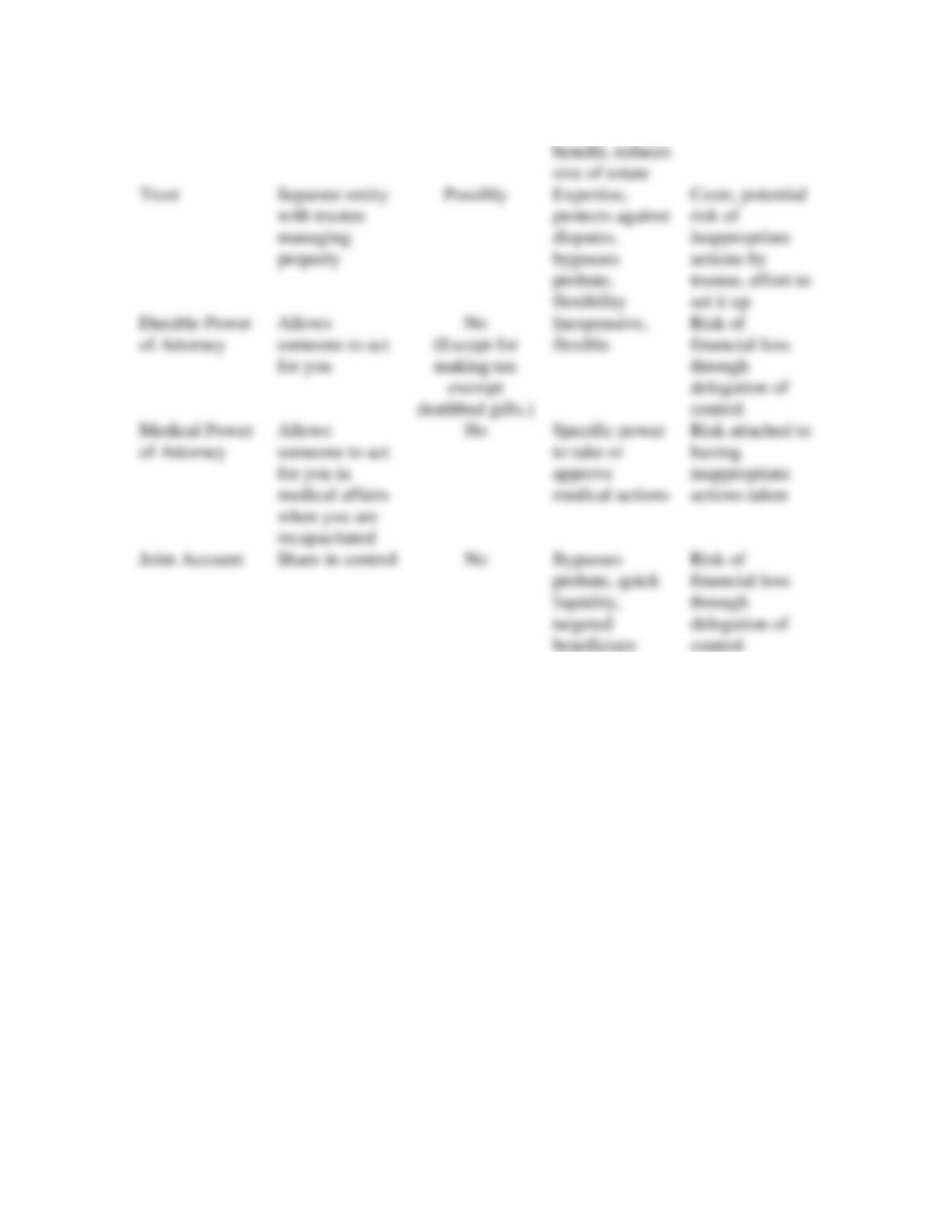
• Joint Account