22) If Flagstaff currently maintains a .5 debt to equity ratio, then Flagstaff’s after-tax WACC is closest to:
A) 10.00%
B) 10.25%
C) 9.50%
D) 8.75%
23) If Flagstaff currently maintains a .5 debt to equity ratio, then the value of Flagstaff as a levered firm
is closest to:
A) $114 million
B) $100 million
C) $111 million
D) $140 million
24) If Flagstaff currently maintains a .5 debt to equity ratio, then the value of Flagstaff’s interest tax
shield is closest to:
A) $11 million
B) $18 million
C) $10 million
D) $24 million
25) If Flagstaff maintains a debt to equity ratio of 1, then Flagstaff’s pre-tax WACC is closest to:
A) 11.0%
B) 10.5%
C) 10.0%
D) 9.0%
26) If Flagstaff currently maintains a debt to equity ratio of 1, then the value of Flagstaff as an all equity
firm would be closest to:
A) $73 million
B) $80 million
C) $115 million
D) $100 million
27) If Flagstaff currently maintains a debt to equity ratio of 1, then Flagstaff’s after–tax WACC is closest
to:
A) 10.25%
B) 10.00%
C) 9.50%
D) 8.75%
28) If Flagstaff currently maintains a debt to equity ratio of 1, then the value of Flagstaff as a levered
firm is closest to:
A) $114 million
B) $100 million
C) $111 million
D) $140 million
29) If Flagstaff currently maintains a debt to equity ratio of 1, then the value of Flagstaff’s interest tax
shield is closest to:
A) $10 million
B) $18 million
C) $11 million
D) $24 million
Use the information for the question(s) below.
LCMS Industries has $70 million in debt outstanding. The firm will pay only interest on this debt (the
debt is perpetual). LCMS’ marginal tax rate is 35% and the firm pays a rate of 8% interest on its debt.
30) LCMS’ annual interest tax shield is closest to:
A) $2.8 million
B) $2.0 million
C) $3.6 million
D) $5.6 million
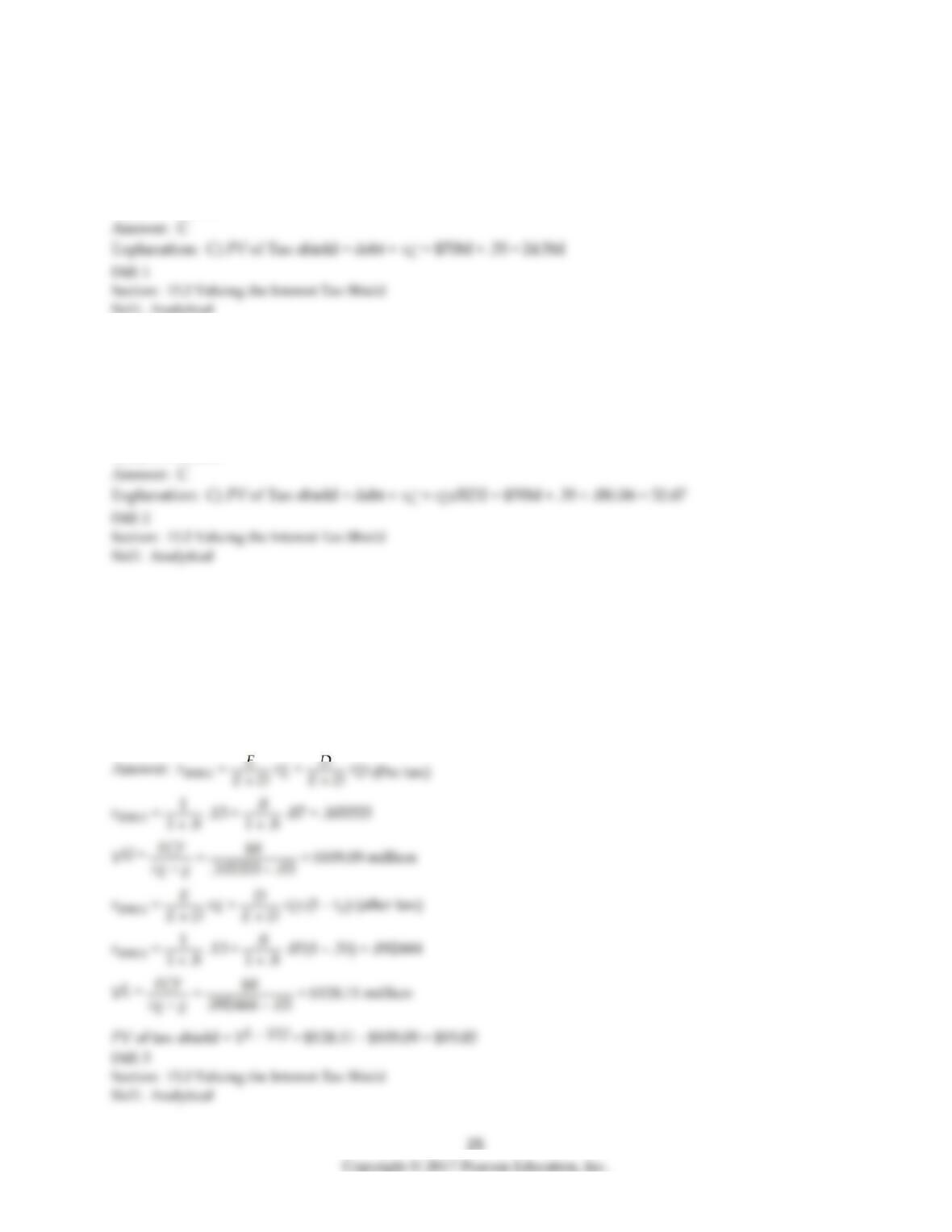
31) The present value of LCMS’ interest tax shield is closest to:
A) $45.5 million
B) $20.0 million
C) $24.5 million
D) $35.0 million
32) Assuming that the risk of the tax shield is only 6% even though the debt pays 8%, then the present
value of LCMS’ interest tax shield is closest to:
A) $24.5 million
B) $18 million
C) $33.0 million
D) $20.0 million
Use the information for the question(s) below.
Flagstaff Enterprises expected to have free cash flow in the coming year of $8 million, and this free cash
flow is expected to grow at a rate of 3% per year thereafter. Flagstaff has an equity cost of capital of
13%, a debt cost of capital of 7%, and it is in the 35% corporate tax bracket.
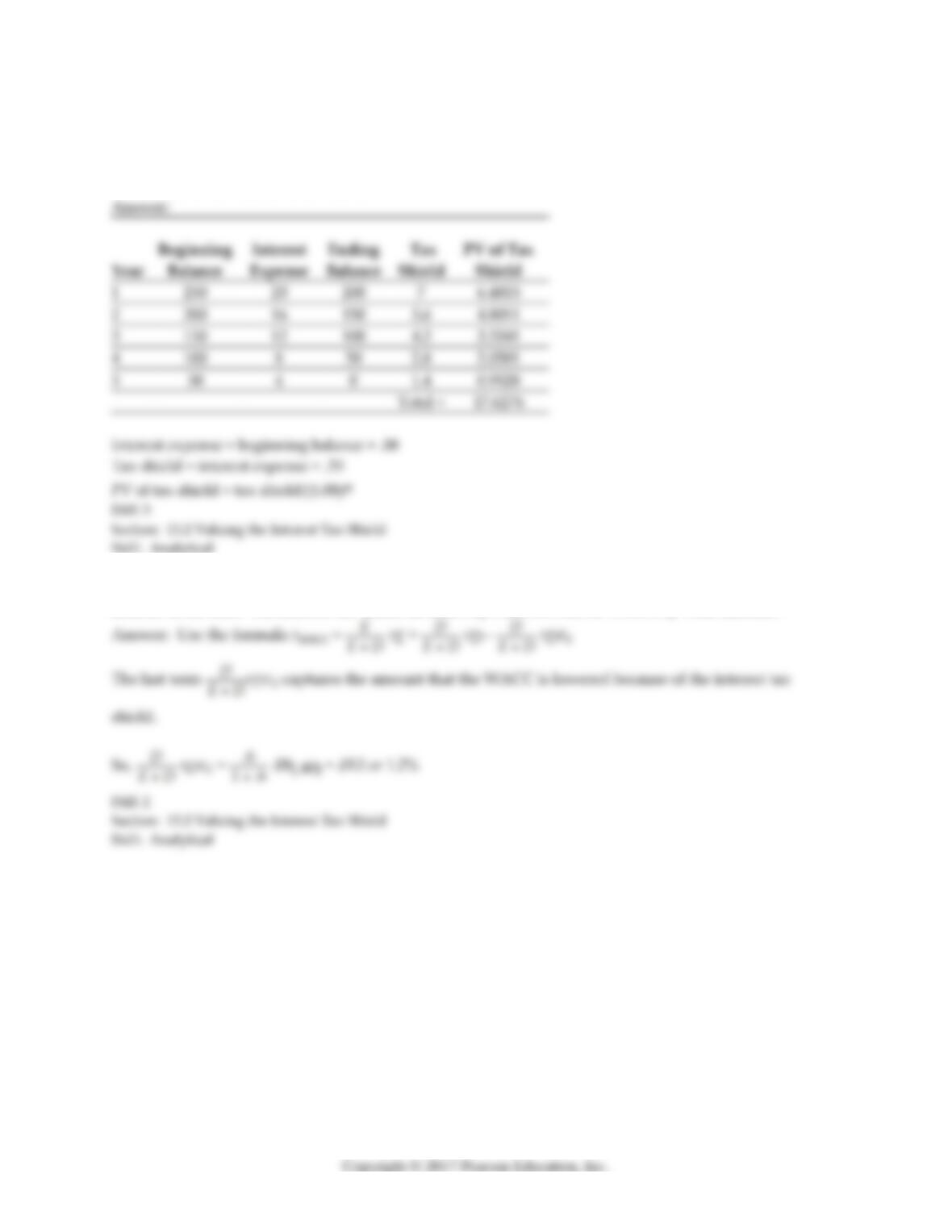
33) If Flagstaff currently maintains a .8 debt to equity ratio, then calculate the value of Flagstaff’s interest
tax shield.
26
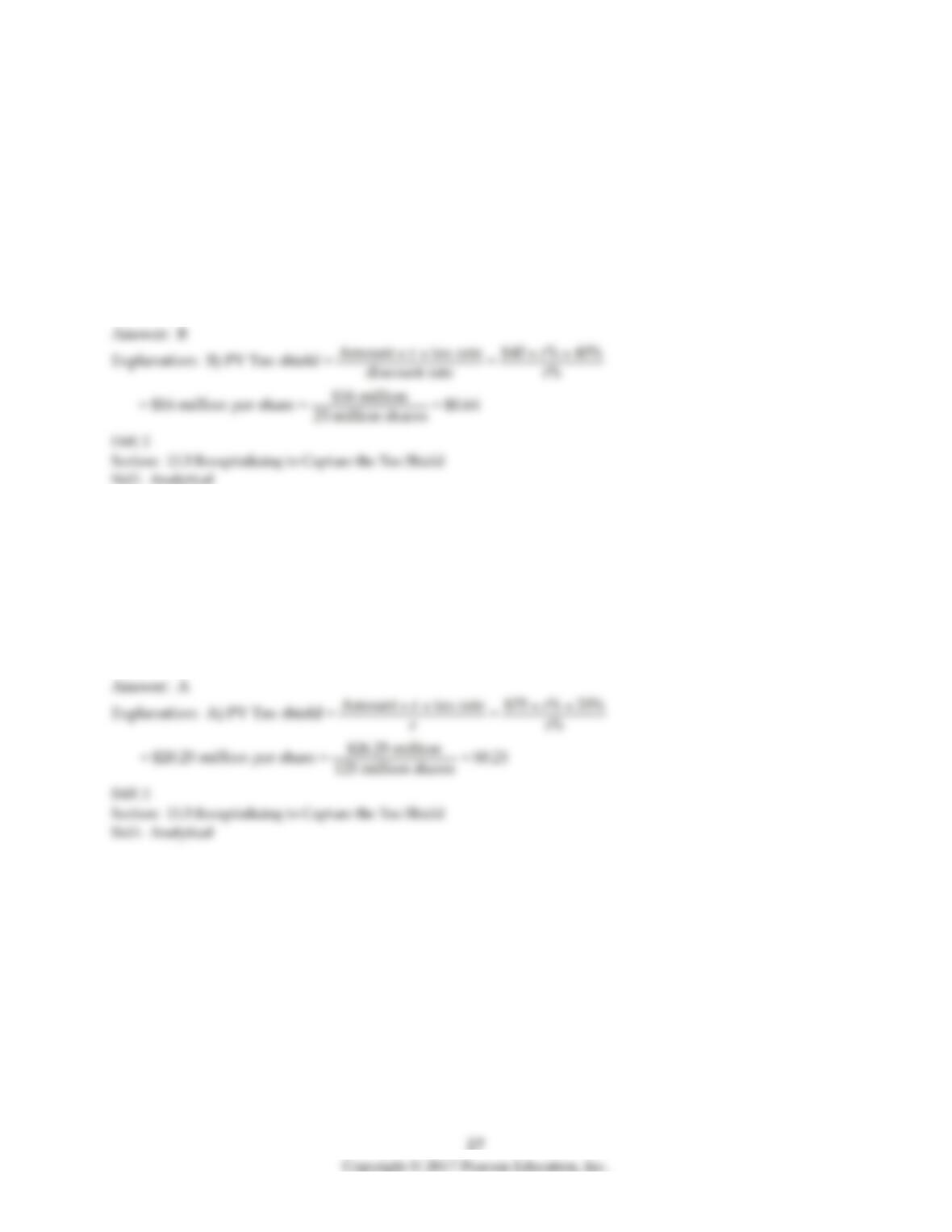
34) Your firm currently has $250 million in debt outstanding with an 8% interest rate. The terms of the
loan require the firm to repay $50 million of the balance each year. Suppose that the marginal corporate
tax rate is 35% and that the interest tax shields have the same risk as the loan. What is the present value
of the interest tax shields from this debt?
35) Raceway Products has a market debt-to-equity ratio of .60, a corporate tax rate of 40%, and pays 8%
interest on its debt. The interest tax shield on Raceway’s debt lowers its WACC by what amount?
15.3 Recapitalizing to Capture the Tax Shield
1) Wyatt Oil has 25 million shares outstanding and has a marginal corporate tax rate of 40%. Wyatt Oil
announces that it will payout $40 million in cash to investors through a special dividend. Shareholders
had previously assumed that Wyatt Oil would retain this excess cash permanently. The amount that
Wyatt Oil’s share price can be expected to change upon this announcement is closest to:
A) $0.56
B) $0.64
C) $0.96
D) $1.56
2) Galt Industries has 125 million shares outstanding and has a marginal corporate tax rate of 35%. Galt
announces that it will use $75 million in excess cash to repurchase shares. Shareholders had previously
assumed that Galt would retain this excess cash permanently. The amount Galt’s share price can be
expected to change upon this announcement is closest to:
A) $0.21
B) $0.24
C) $0.36
D) $0.39
3) Which of the following statements is FALSE?
A) Once investors know the recap will occur, the share price will rise immediately to a level that reflects
the value of the interest tax shield that the firm will receive from its recapitalization.
B) When securities are fairly priced, the original shareholders of a firm capture the full benefit of the
interest tax shield from an increase in leverage.
C) In the presence of corporate taxes, we do not include the interest tax shield as one of the firm’s assets
on its market value balance sheet.
D) We can analyze the recapitalization using the market value balance sheet; it states that the total
market value of a firm’s securities must equal the total market value of the firm‘s assets.
4) Which of the following statements regarding recapitalizations is FALSE?
A) With a recapitalization, even though leverage reduces the total value of equity, shareholders capture
the benefits of the interest tax shield up front.
B) The share price always rises after the completion of the recapitalization.
C) Leveraged recaps were especially popular in the mid- to late-1980s, when many firms found that
these transactions could reduce their tax payments.
D) When a firm makes a significant change to its capital structure, the transaction is called a
recapitalization.
Use the information for the question(s) below.
KD Industries has 30 million shares outstanding with a market price of $20 per share and no debt. KD
has had consistently stable earnings, and pays a 35% tax rate. Management plans to borrow $200
million on a permanent basis through a leveraged recapitalization in which they would use the
borrowed funds to repurchase outstanding shares.
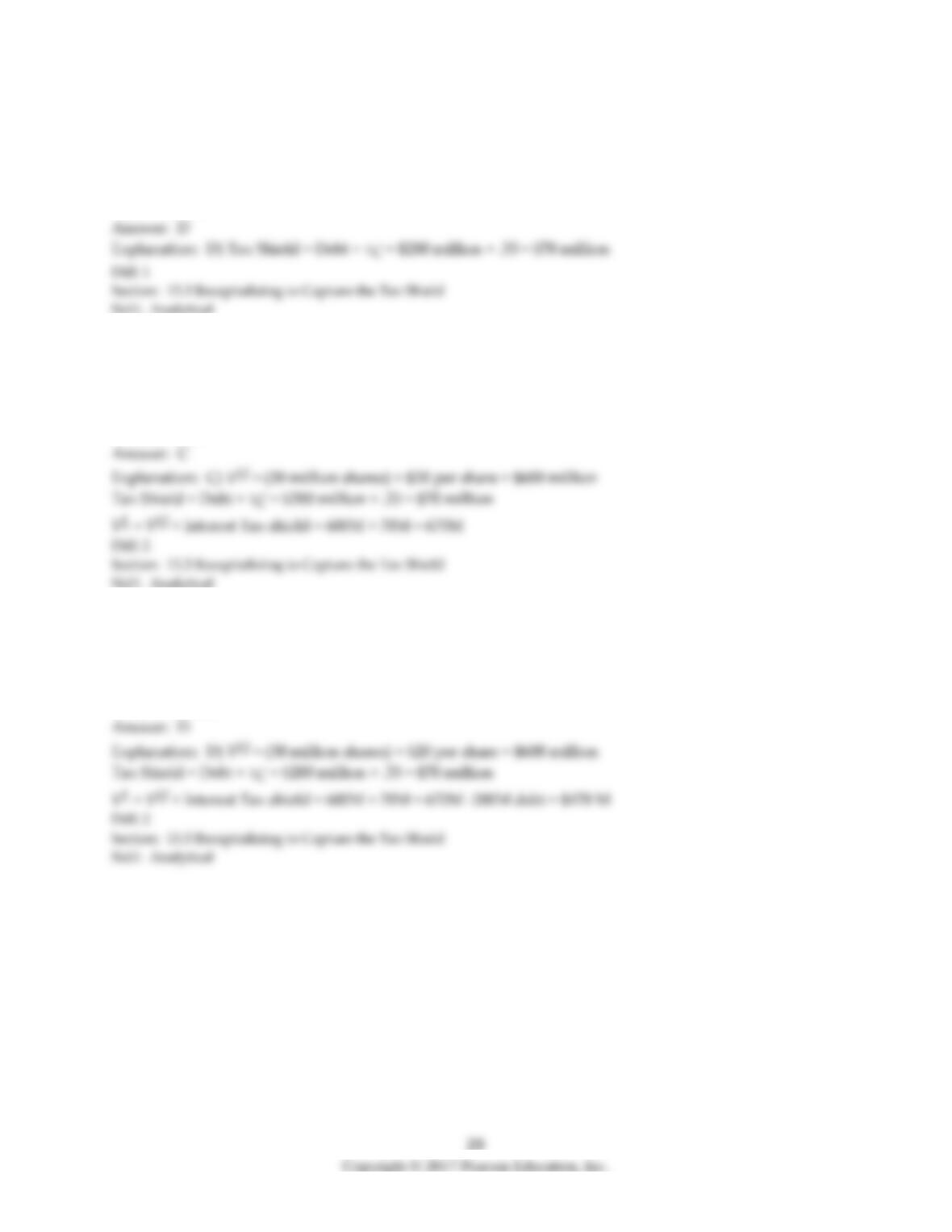
5) The value of KD’s unlevered equity is closest to:
A) $600 million
B) $470 million
C) $390 million
D) $400 million
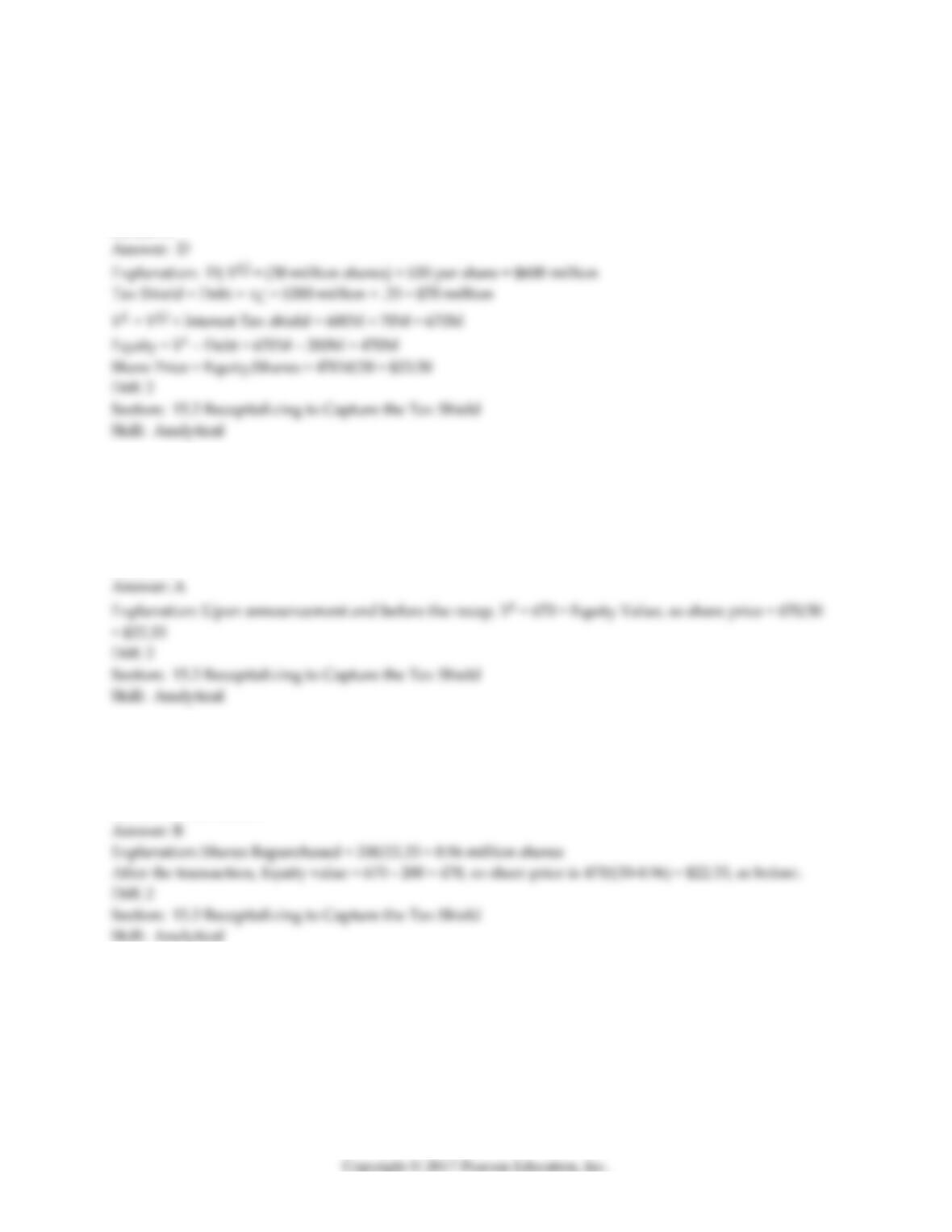
6) The preset value of KD’s interest tax shield is closest to:
A) $130 million
B) $200 million
C) $400 million
D) $70 million
7) After the recapitalization, the total value of KD as a levered firm is closest to:
A) $470 million
B) $730 million
C) $670 million
D) $530 million
8) After the recapitalization, the value of KD‘s levered equity is closest to:
A) $670 million
B) $400 million
C) $330 million
D) $470 million
30
9) i) If KD can repurchase its existing shares at $20 per share, what will the new share price be after the
transaction?
A) $22.35
B) $22.00
C) $22.65
D) $23.50
ii) In reality, we should expect the share price to increase on announcement of the transaction, before
the shares are repurchased. What will the new share price be after the announcement?
A) $22.33
B) $22.65
C) $22.00
D) $23.50
iii) How many shares will KD repurchase in the recapitalization?
A) 12.54 million shares
B) 8.96 million shares
C) 3.65 million shares
D) 9.45 million shares
Use the information for the question(s) below.
Shepard Industries expects free cash flow of $10 million each year. Shepard‘s corporate tax rate is 35%,
and its unlevered cost of equity is 10%. The firm also has outstanding debt of $40 million and it expects
to maintain amount of debt permanently.
10) The value of Shepard Industries without leverage is closest to:
A) $114 million
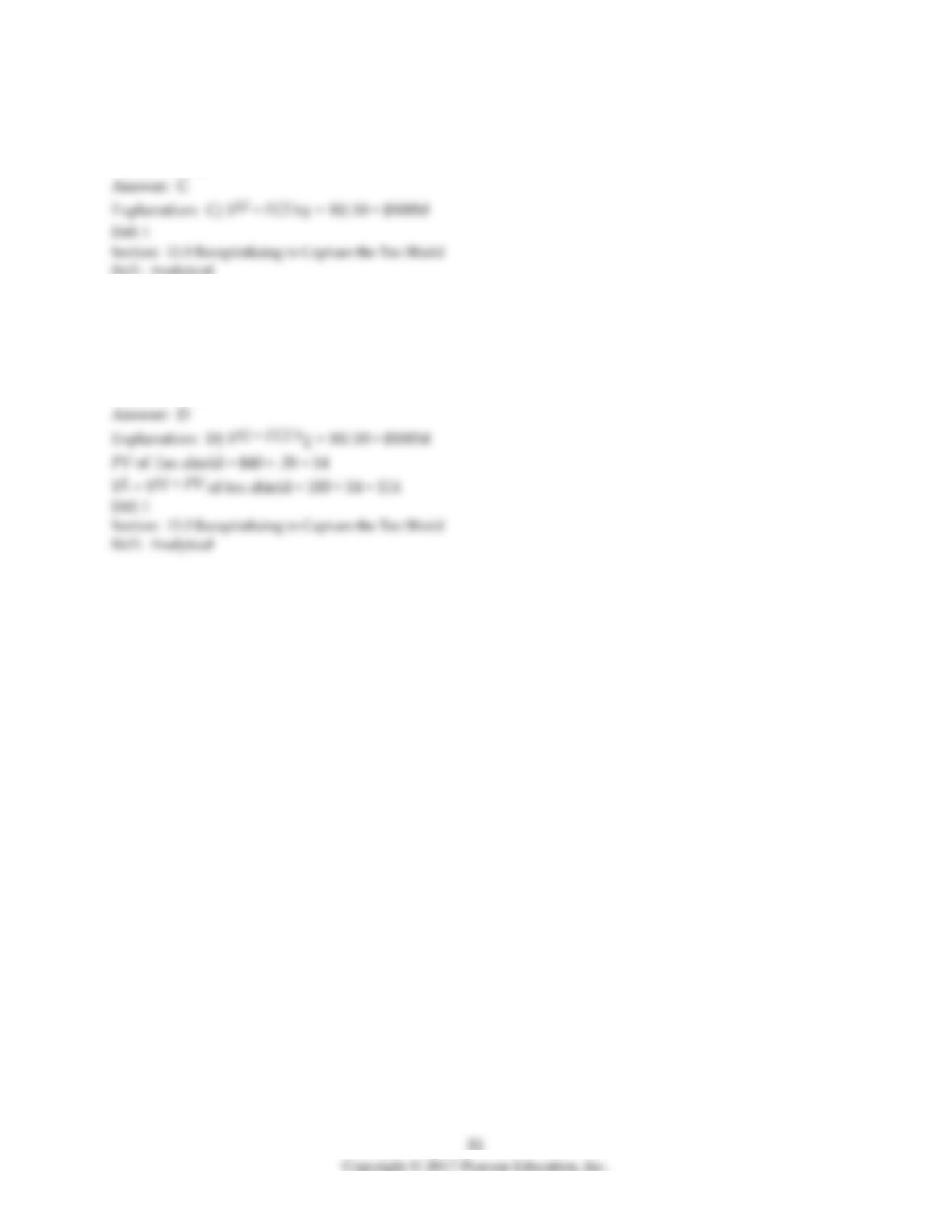
B) $50 million
C) $100 million
D) $64 million
11) The value of Shepard Industries with leverage is closest to:
A) $64 million
B) $100 million
C) $135 million
D) $114 million
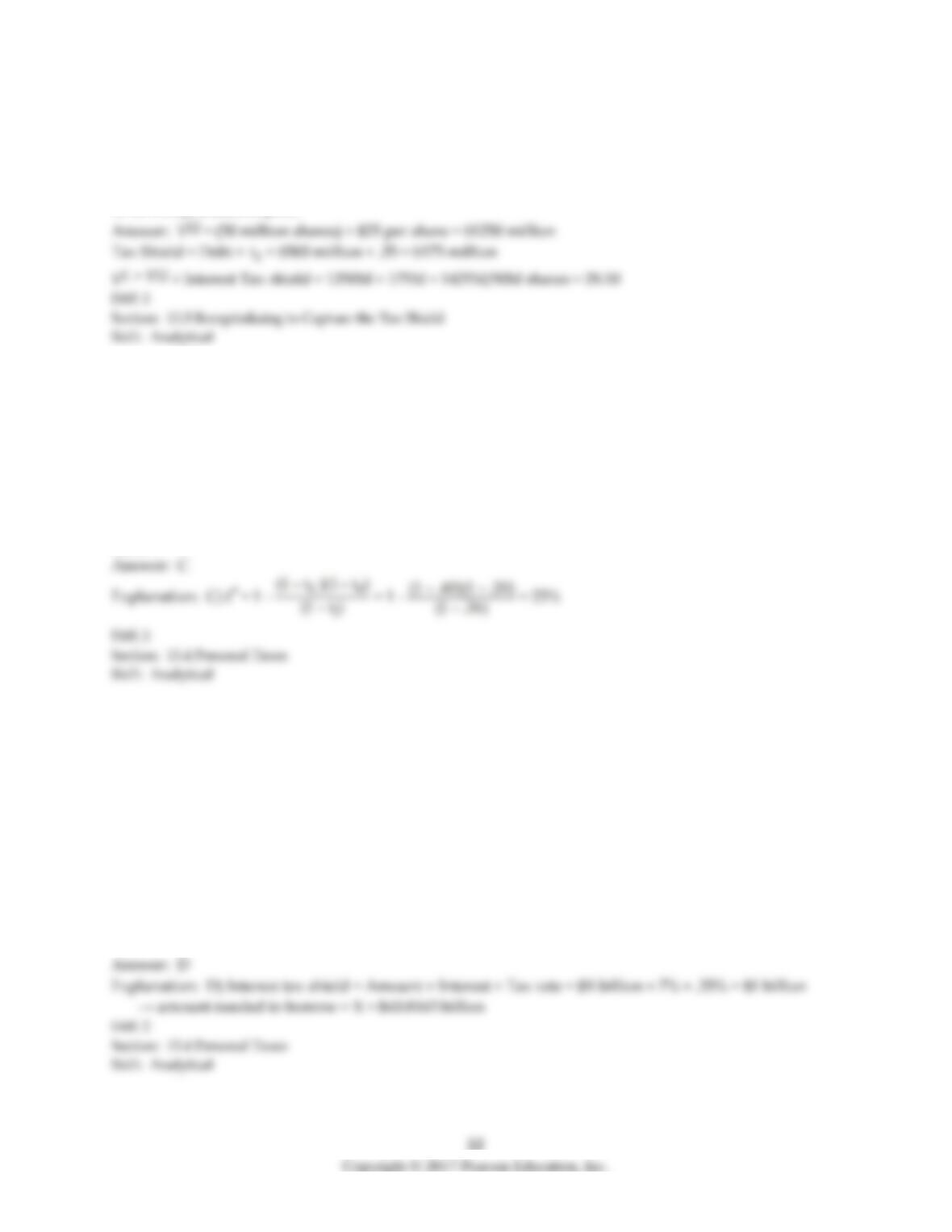
12) MJ Enterprises has 50 million shares outstanding with a market price of $25 per share and no debt.
MJ has had consistently stable earnings, and pays a 35% tax rate. Management plans to borrow $500
million on a permanent basis through a leveraged recapitalization in which they would use the
borrowed funds to repurchase outstanding shares. Calculate MJ’s share price following announcement
of the recapitalization plan.
15.4 Personal Taxes
1) Assume that the corporate tax rate is 40%, the personal tax rate on income from equity is 20% and the
personal rate on interest income is 36%. The effective tax advantage of a corporate issuing debt would
be closest to:
A) 10%
B) 15%
C) 25%
D) 28%
Use the following information to answer the question(s) below.
Google Corporation has no debt on its balance sheet in 2008, but paid $1.6 billion in taxes. Assume that
Google’s marginal tax rate is 35% and Google’s borrowing cost is 7%.
2) Assume that investors hold Google stock in retirement accounts that are free from personal taxes. If
Google were to issue sufficient debt to reduce its taxes by $1 billion per year permanently, then the
amount that Google needs to borrow is closest to:
A) $14.25 billion
B) $22.00 billion
C) $24.50 billion
D) $40.75 billion