Job Order Costing
15 – 55
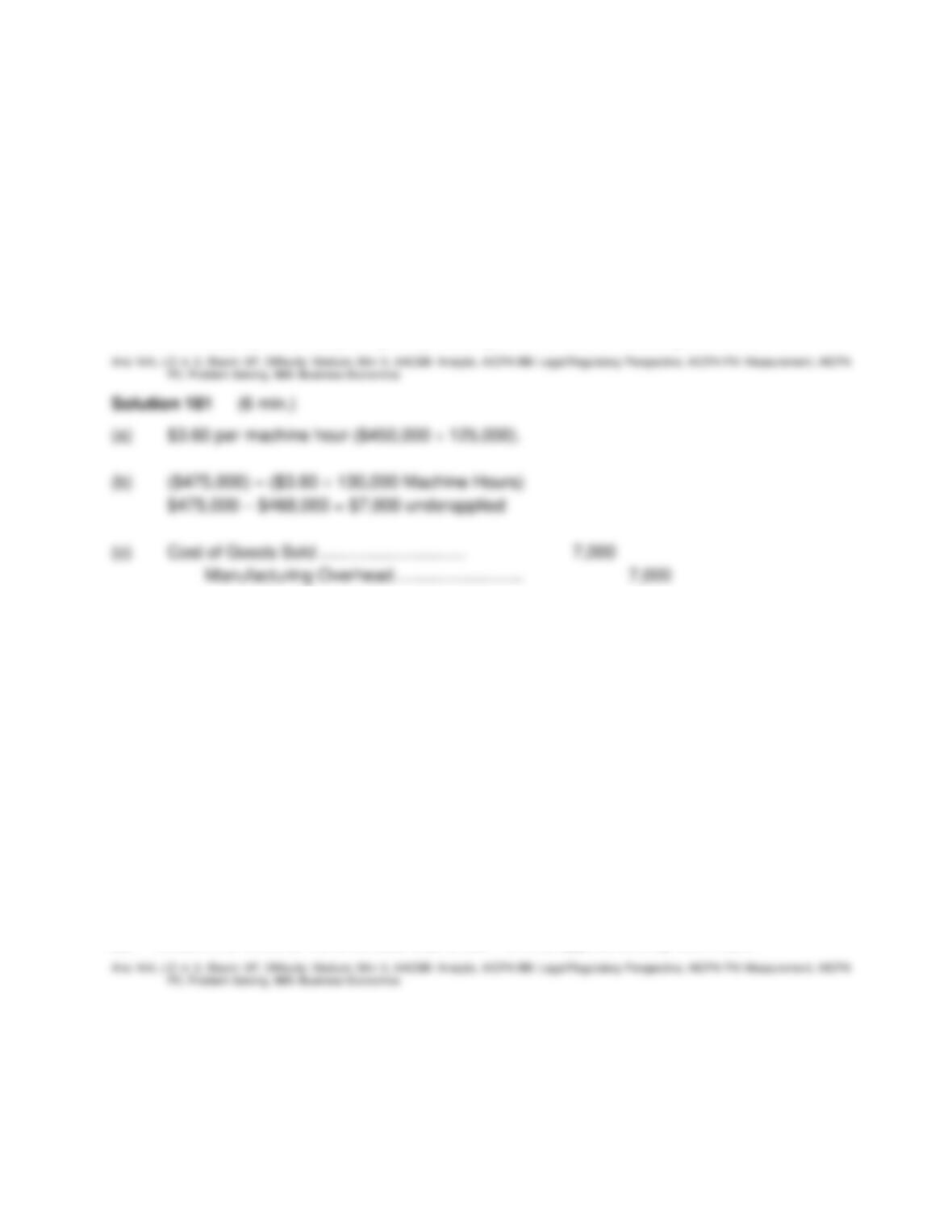
Ex. 181
Gallagher Company applies manufacturing overhead to jobs on the basis of machine hours used.
Overhead costs are expected to total $450,000 for the year, and machine usage is estimated at
125,000 hours.
For the year, $475,000 of overhead costs are incurred and 130,000 hours are used.
Instructions
(a) Compute the manufacturing overhead rate for the year.
(b) What is the amount of under – or overapplied overhead at December 31?
(c) Assuming the under – or overapplied overhead for the year is not allocated to inventory
accounts, prepare the adjusting entry to assign the amount to cost of goods sold
Ex. 182
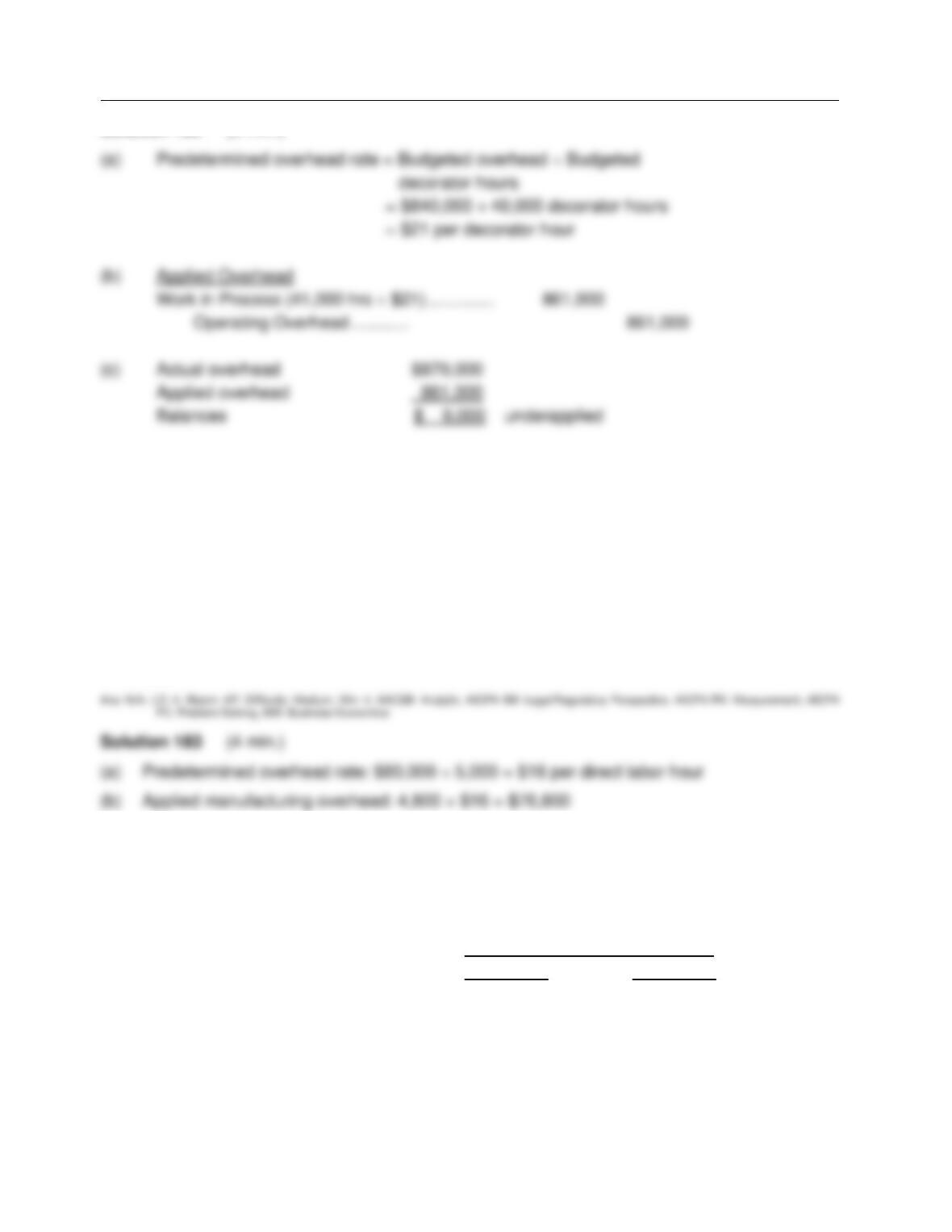
Fancy Decorating uses a job order costing system to collect the costs of its interior decorating
business. Each client’s consultation is treated as a separate job. Overhead is applied to each job
based on the number of decorator hours incurred. Listed below are data for the current year.
Budgeted overhead $840,000
Actual overhead $870,000
Budgeted decorator hours 40,000
Actual decorator hours 41,000
The company uses Operating Overhead in place of Manufacturing Overhead.
Instructions
(a) Compute the predetermined overhead rate.
(b) Prepare the entry to apply the overhead for the year.
(c) Determine whether the overhead was under – or overapplied and by how much.
Test Bank for Accounting, Tools for Business Decision Making Fifth Edition
15 – 56
Solution 182 (6 min.)
Ex. 183
Martin Company applies manufacturing overhead based on direct labor hours. Information
concerning manufacturing overhead and labor for the year follows:
Actual manufacturing overhead $86,000
Estimated manufacturing overhead $80,000
Direct labor hours incurred 4,800
Direct labor hours estimated 5,000
Instructions
Compute (a) the predetermined overhead rate and (b) the amount of applied manufacturing
overhead.
Ex. 184
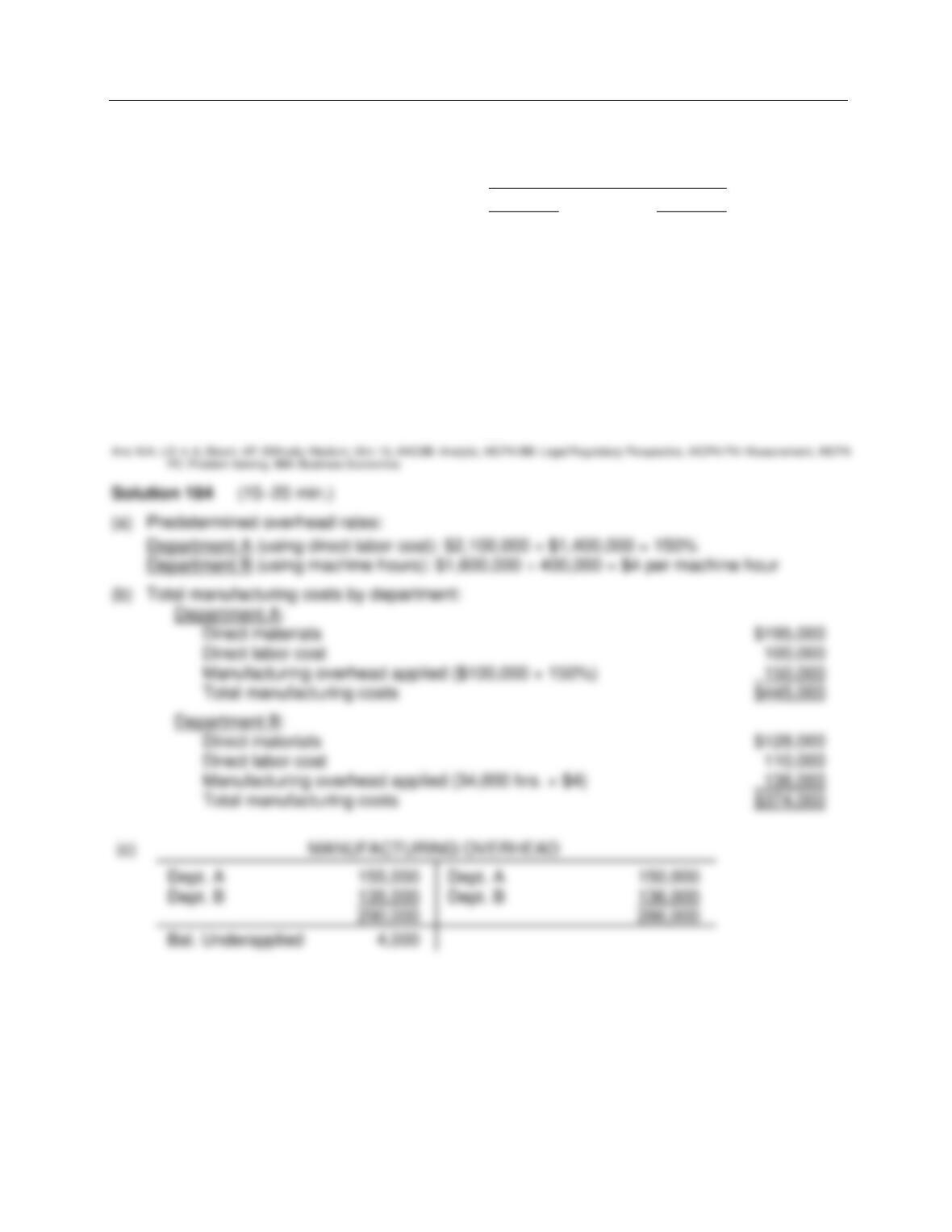
Landis Company uses a job order cost system in each of its two manufacturing departments.
Manufacturing overhead is applied to jobs on the basis of direct labor cost in Department A and
machine hours in Department B. In establishing the predetermined overhead rates for 2013, the
following estimates were made for the year:
Department
A B
Manufacturing overhead $2,100,000 $1,600,000
Direct labor cost 1,400,000 1,200,000
Direct labor hours 100,000 100,000
Machine hours 200,000 400,000
Job Order Costing
15 – 57
Ex. 184 (Cont.)
During January, the job cost sheet showed the following costs and production data:
Department
A B
Direct materials used $195,000 $128,000
Direct labor cost 100,000 110,000
Manufacturing overhead incurred 155,000 135,000
Direct labor hours 8,000 8,400
Machine hours 16,000 34,000
Instructions
(a) Compute the predetermined overhead rate for each department.
(b) Compute the total manufacturing cost assigned to jobs in January in each department.
(c) Compute the balance in the Manufacturing Overhead account at the end of January and
indicate whether overhead is over– or underapplied.
Test Bank for Accounting, Tools for Business Decision Making Fifth Edition
15 – 58
Ex. 185
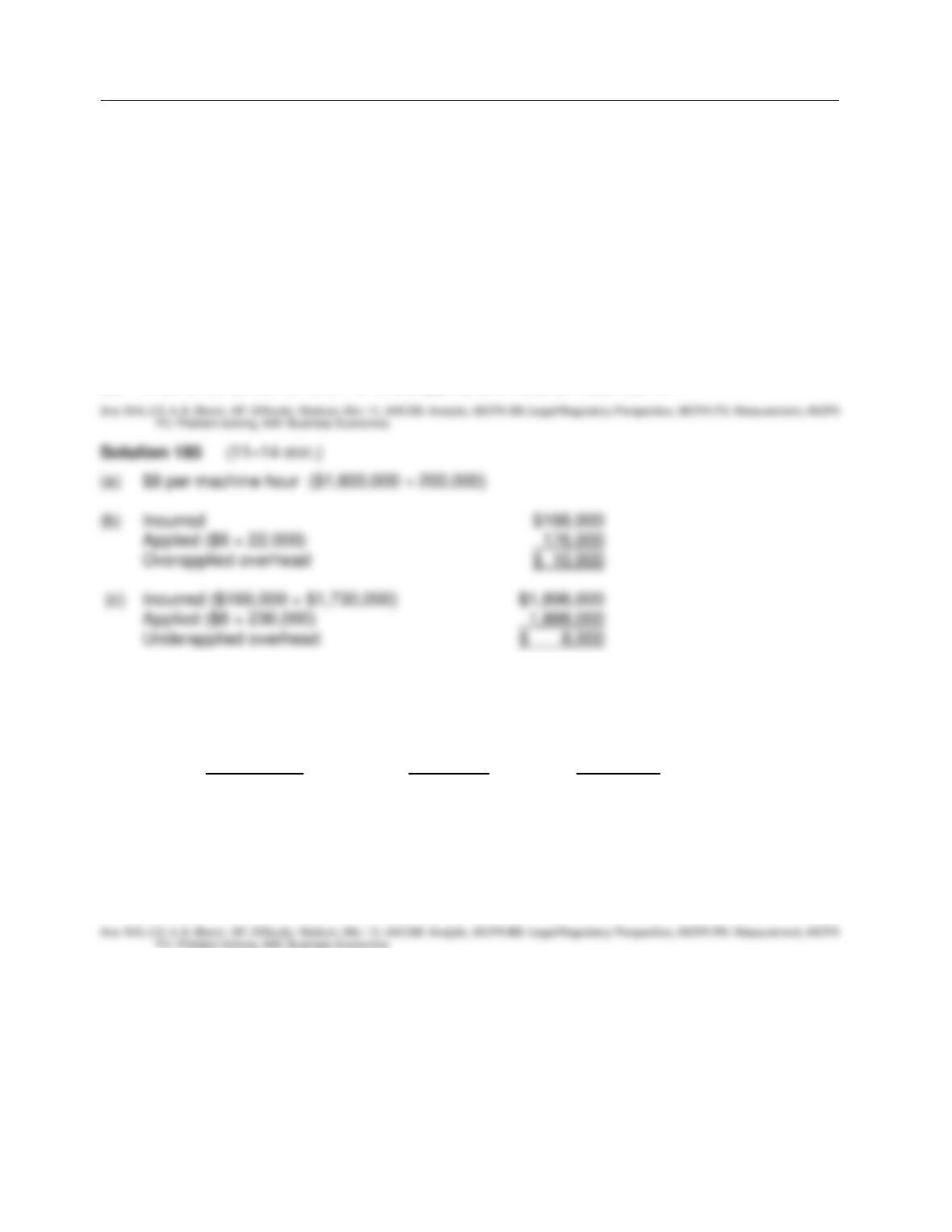
Edwards Company applies manufacturing overhead to jobs on the basis of machine hours used.
Overhead costs are expected to total $1,600,000 for the year, and machine usage is estimated at
200,000 hours.
In January, $166,000 of overhead costs are incurred and 22,000 machine hours are used. For the
remainder of the year, $1,730,000 of additional overhead costs are incurred and 214,000
additional machine hours are worked.
Instructions
(a) Compute the manufacturing overhead rate for the year.
(b) What is the amount of over– or underapplied overhead at January 31?
(c) What is the amount of over– or underapplied overhead at December 31?
Ex. 186
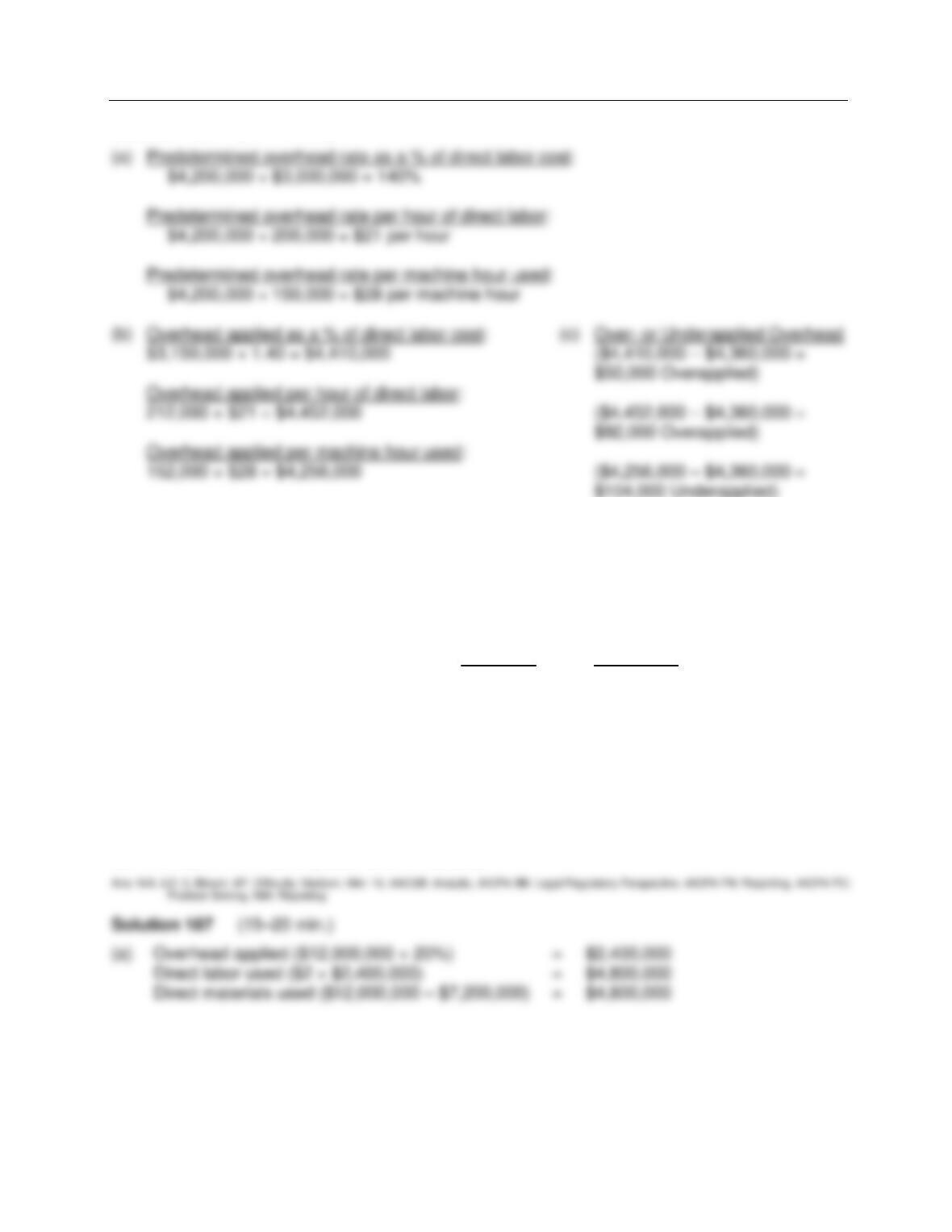
Klinger Company estimates that annual manufacturing overhead costs will be $4,200,000 for
2013. The actual overhead costs at the end of 2013 are $4,360,000. Activity base information for
2013 follows:
Activity Base Estimated Actual
Direct Labor Cost $3,000,000 $3,150,000
Direct Labor Hours 200,000 212,000
Machine Hours 150,000 152,000
Instructions
(a) Compute the predetermined overhead rate for each activity base.
(b) Compute the amount of overhead applied in 2013 for each activity base.
(c) Compute the amount of under– or overapplied overhead for 2013 for each activity base.
Job Order Costing
15 – 59
Solution 186 (12–16 min.)
Ex. 187
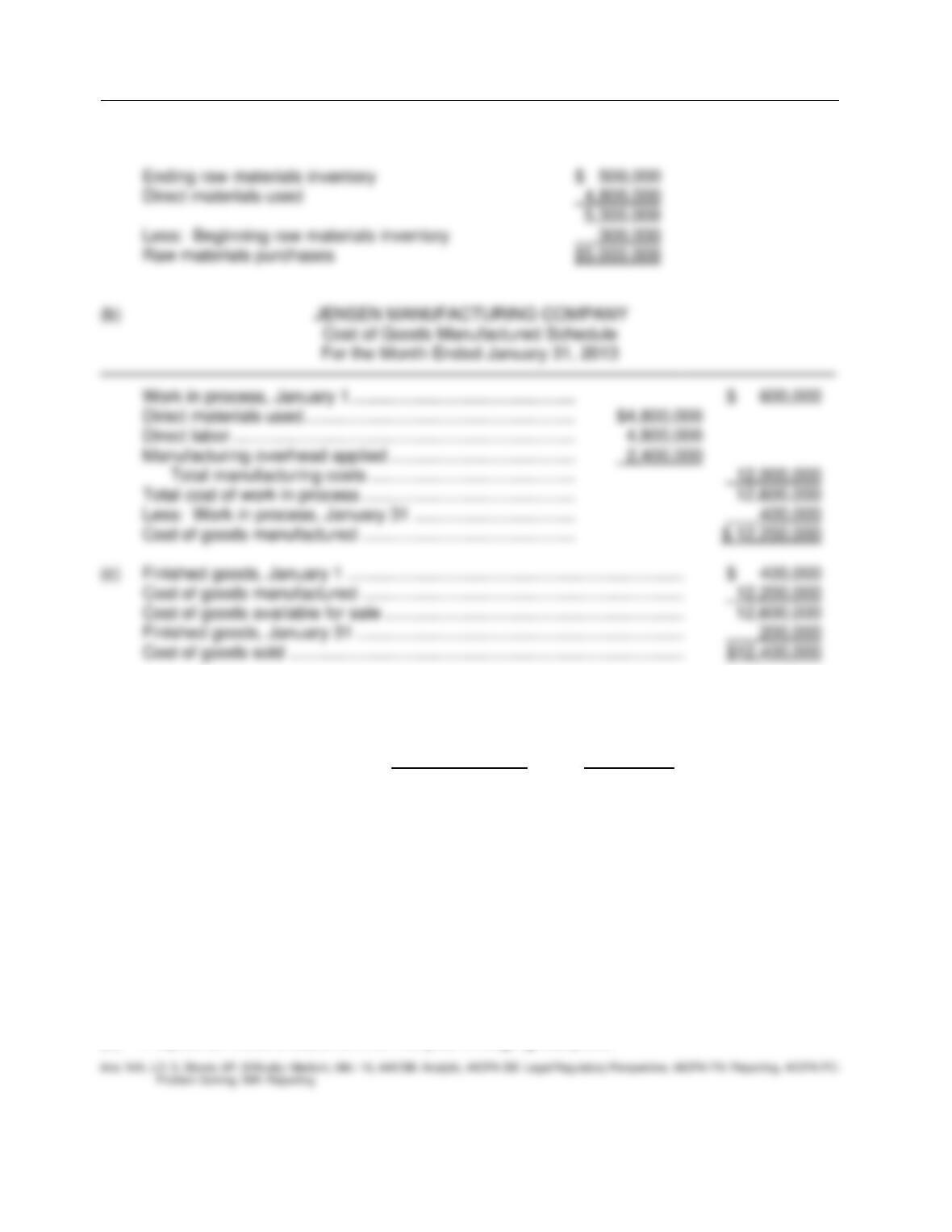
Jensen Manufacturing Company makes specialty tools. In January, Jensen incurs manufacturing
costs of $12,000,000 for direct materials, direct labor, and overhead. 20% of the total costs
represents overhead applied. The overhead rate is $1 for every $2 of direct labor costs incurred.
Inventory balances were:
January 1 January 31
Raw materials $300,000 $500,000
Work in process 600,000 400,000
Finished goods 400,000 200,000
At the end of January, there was $1,000 of overapplied overhead.
Instructions
(a) Determine the cost of raw materials purchased in January.
(b) Prepare a cost of goods manufactured schedule for January 2013.
(c) Compute the cost of goods sold for January.
Test Bank for Accounting, Tools for Business Decision Making Fifth Edition
15 – 60
Solution 187 (Cont.)
Ex. 188
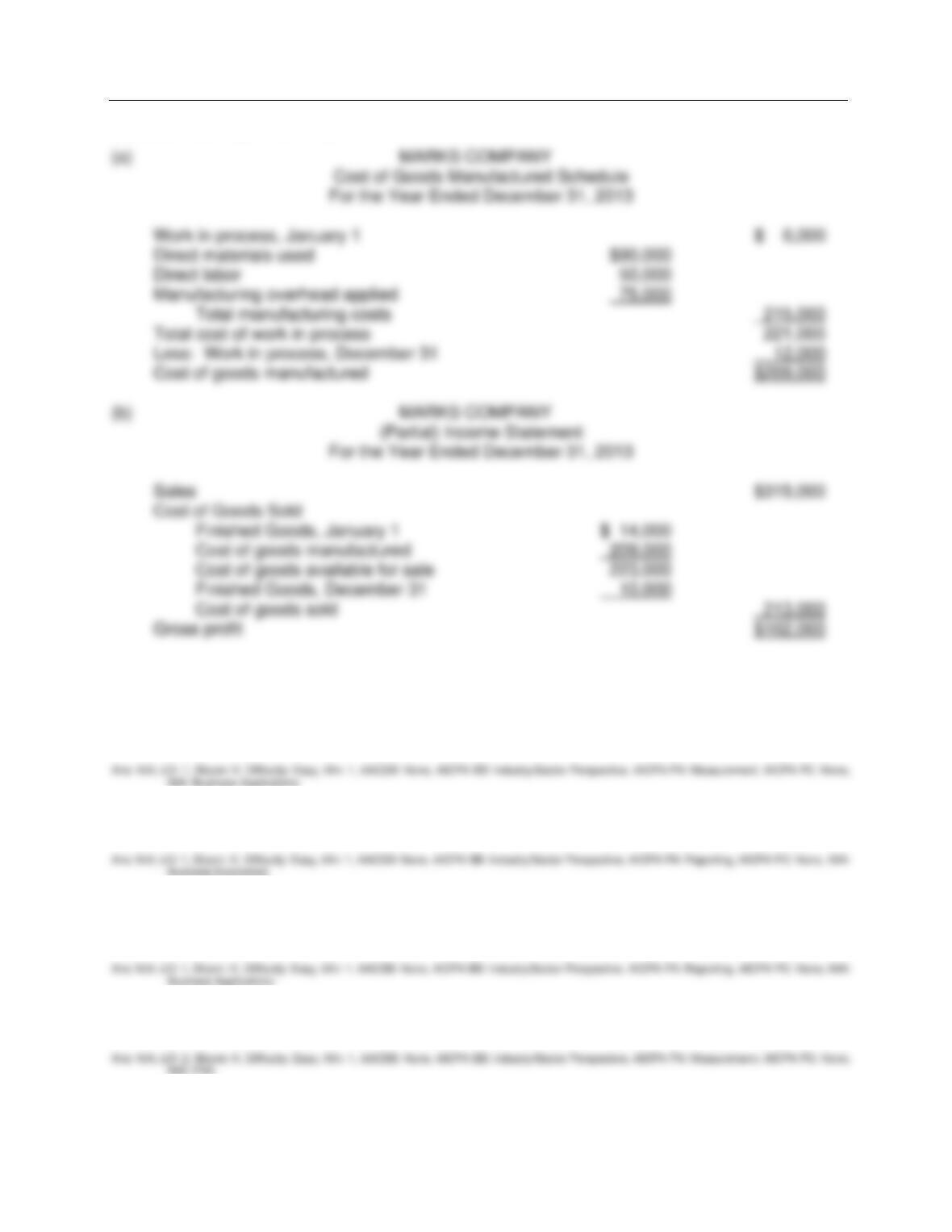
The following information is available for Marks Company at December 31, 2013:
1. Inventory balance Beginning of Year End of Year
Finished Goods $14,000 $10,000
Work in Process 6,000 12,000
Raw Materials 10,300 6,500
2. Debit postings to Work in Process Inventory during the year were:
Direct materials $90,000
Direct labor 50,000
Manufacturing overhead applied 75,000
3. Sales totaled $315,000 for the year.
Instructions
(a) Prepare a condensed cost of goods manufactured schedule.
(b) Prepare an income statement for the year through gross profit.
Job Order Costing
15 – 61
Solution 188 (14–18 min.)
COMPLETION STATEMENTS
189. Cost accounting involves the measuring, recording, and reporting of ______________
costs.
190. There are two basic types of cost accounting systems: (1)__________________ system,
and (2)__________________ system.
191. A ______________ cost system is appropriate when similar products are continuously
produced, whereas a ______________ cost system would be more appropriate if the
product is custom-made.
192. In a job order system, raw materials purchased are charged to the ______________
account.
Test Bank for Accounting, Tools for Business Decision Making Fifth Edition
15 – 62
193. Of these three accounts; Raw Materials Inventory, Factory Labor, and Manufacturing
Overhead, ______________ is not a control account.
194. If $20,000 direct materials are requisitioned for a job and $7,000 of indirect materials are
requisitioned for general use, the debit to Work In Process Inventory should be for
$______________.
195. The cost of producing a particular job under a job cost system is accumulated on a record
called a ___________________.
196. Manufacturing overhead is applied to jobs by means of a ___________________ rate.
197. If actual manufacturing overhead was greater than the amount of manufacturing overhead
applied to jobs, the Manufacturing Overhead account will have a ___________ balance
and overhead is said to be ______________.
198. At the end of the year, any balance in the Manufacturing Overhead account should be
eliminated as an adjustment to ___________________.
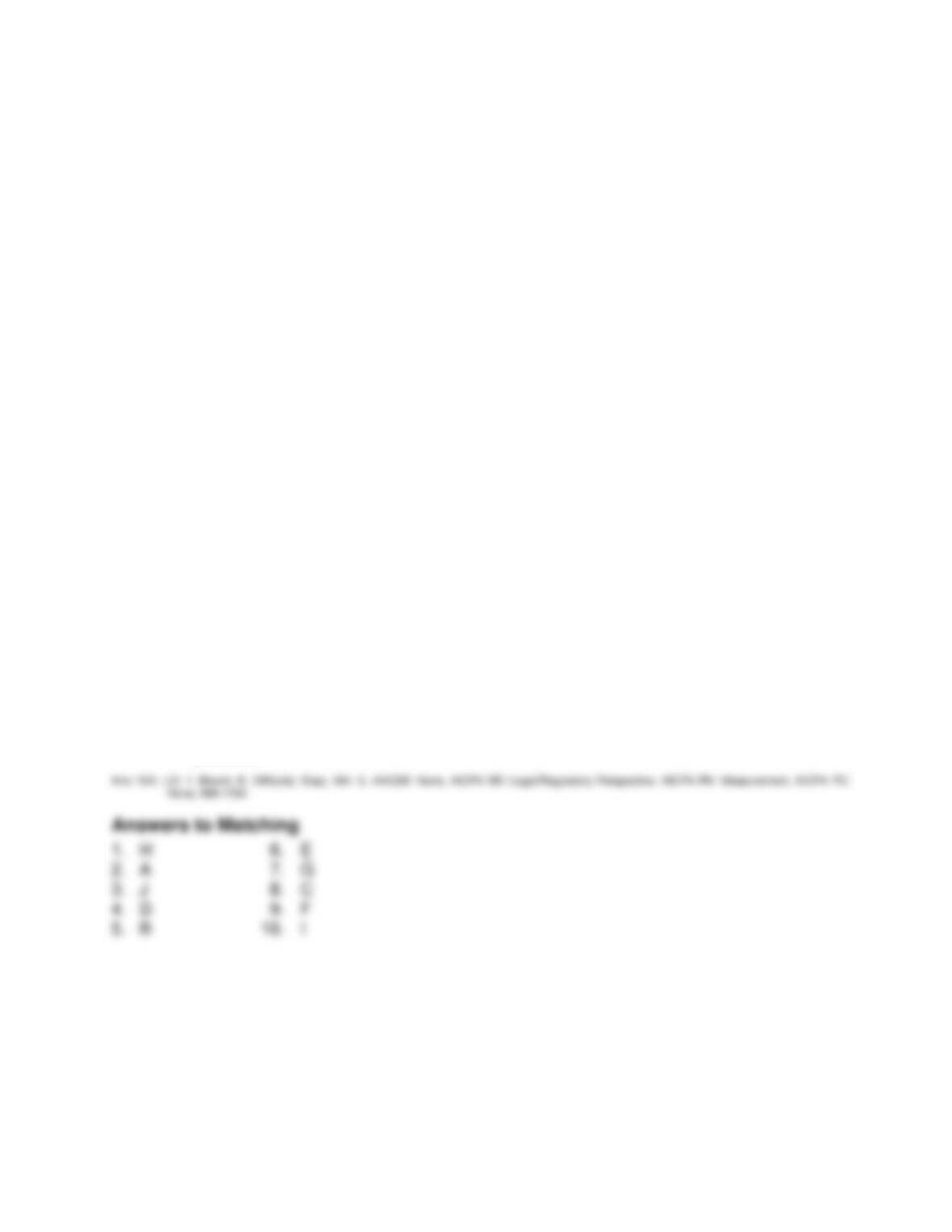
Answers to Completion Statements
Job Order Costing
15 – 63
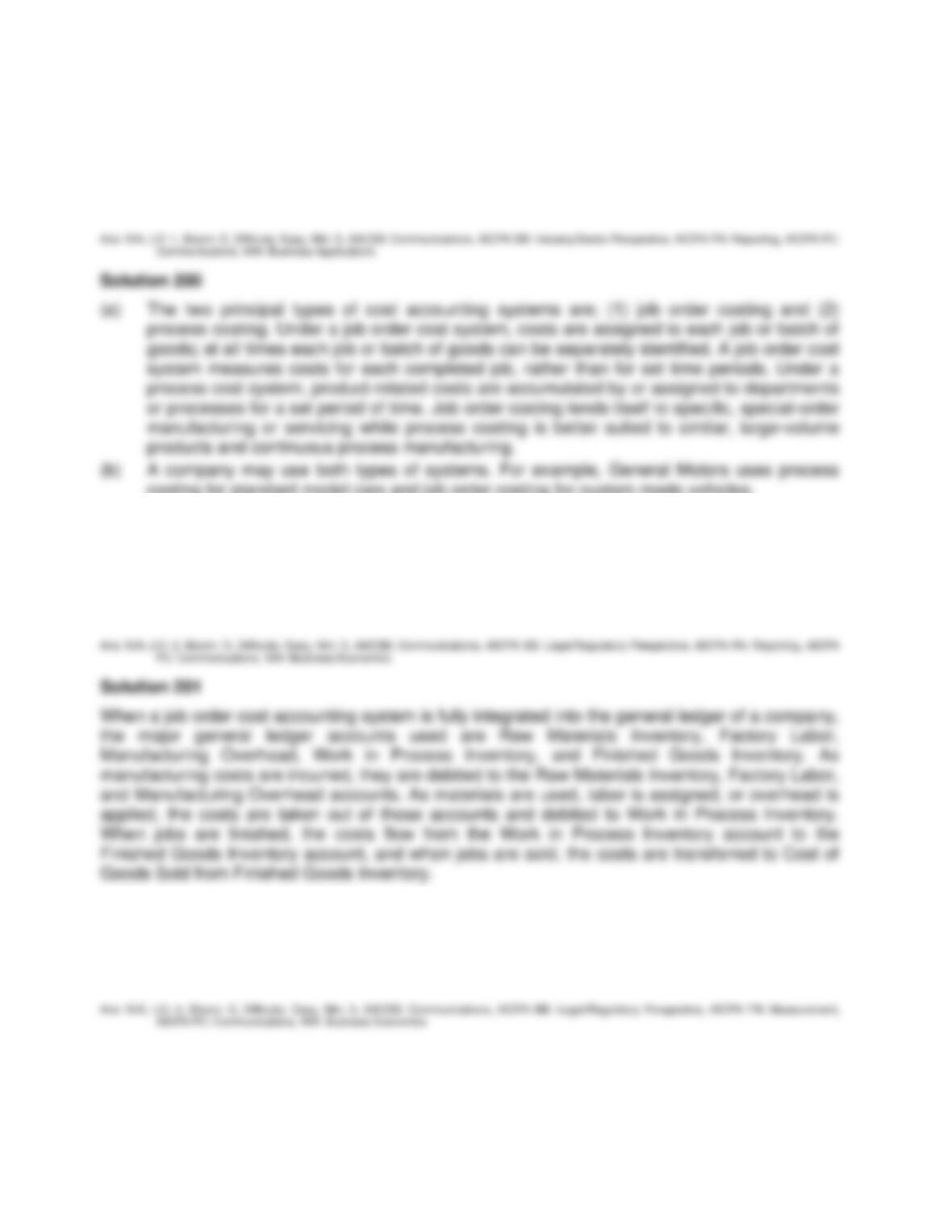
MATCHING
199. Match the items in the two columns below by entering the appropriate code letter in the
space provided.
A. Cost accounting F. Process cost system
B. Materials requisition slip G. Job cost sheets
C. Time ticket H. Predetermined overhead rate
D. Cost accounting system I. Overapplied overhead
E. Job order cost system J. Underapplied overhead
_____ 1. Used to apply manufacturing overhead to jobs.
_____ 2. Measures, records, and reports product costs.
_____ 3. When actual manufacturing overhead costs are greater than the overhead applied to
products.
_____ 4. Manufacturing cost accounts are fully integrated into the general ledger.
_____ 5. Source document which authorizes issuance of raw materials to production.
_____ 6. Appropriate when products have distinguishing and heterogeneous characteristics.
_____ 7. Constitute a subsidiary ledger for Work in Process Inventory.
_____ 8. Indicates number of hours that employees work and the account to be charged.
_____ 9. Appropriate when products are similar and are produced continuously.
_____ 10. When actual manufacturing overhead costs are less than the overhead applied to
products.
Test Bank for Accounting, Tools for Business Decision Making Fifth Edition
15 – 64
SHORT-ANSWER ESSAY QUESTIONS
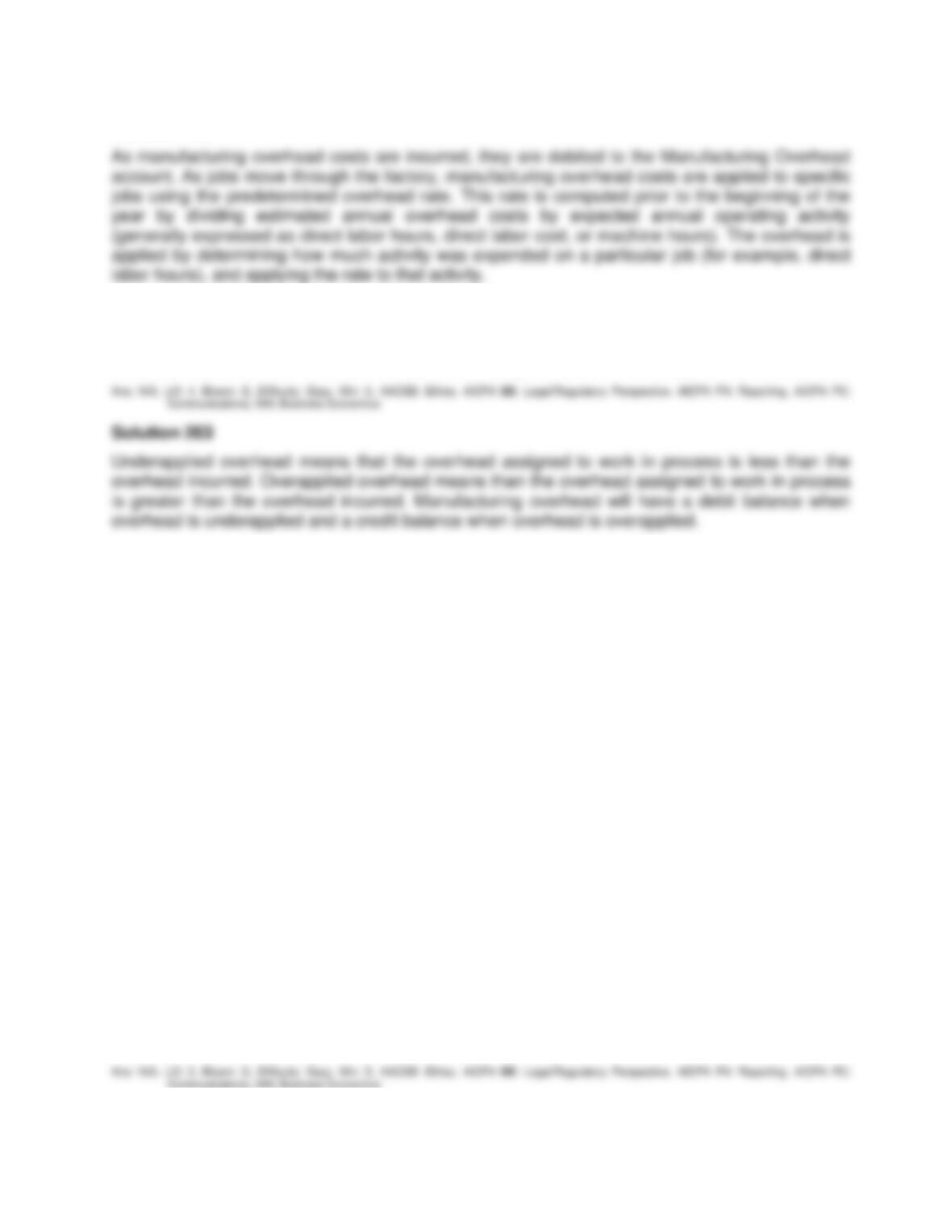
S-A E 200
(a) Distinguish between the two types of cost accounting systems. (b) May a company use both
types of cost accounting systems?
costing for standard model cars and job order costing for custom-made vehicles.
S-A E 201
A job order cost accounting system is fully integrated into the general ledger of a company.
Identify the major general ledger accounts used in a job order cost system. Explain how
manufacturing costs flow through these accounts so that inventories may be costed and income
determined when goods are sold.
S-A E 202
Manufacturing overhead items are indirect product costs that cannot be traced to individual
products. Explain how manufacturing overhead costs are accumulated and how they are
assigned to products in a job order cost system.
Job Order Costing
15 – 65
Solution 202
S-A E 203
Mike Hilyer is confused about under and overapplied manufacturing overhead. Define the terms
for Mike and indicate the balance in the manufacturing overhead account applicable to each term.
S-A E 204 (Ethics)
People Carrier Systems, Inc. (PCS) modifies vans that seat 15–20 people by adding additional
safety features or wheelchair ramps. Most of its customers are cities and counties, who use the
vans to transport school children, the elderly, or the handicapped. The company has specialized
in a no-frills approach, emphasizing safety, high quality, and low cost. The company’s president
was quoted as saying, “Let the other guys make a van pretty. We get people where they need to
go—faster, better, and cheaper than anybody else.”
The company obtains jobs by being the lowest bidder in a sealed bidding process. Recently, the
company was solicited by a top-10 college to submit a bid for a van to be used by its athletic
team. Some specialized items were required, such as the school’s logo on the outside of the van,
and the vinyl seats had to be covered in school colors. The company submitted a bid, and was
very surprised to obtain it.
When the job was being prepared, the job manager pointed out that several extra costs could
result in this job showing a loss. The boss, an ardent supporter of sports in general and this team
in particular, told the manager to just record the standard labor and overhead cost for this job. He
says that they could use the preset rate for specialized jobs, and increase the overhead
application rate (used in submitting bids) by 5% for future routine jobs. “After all,” he says,
“nobody else comes close to our price anyway. This could start a whole new line of business for
us.”
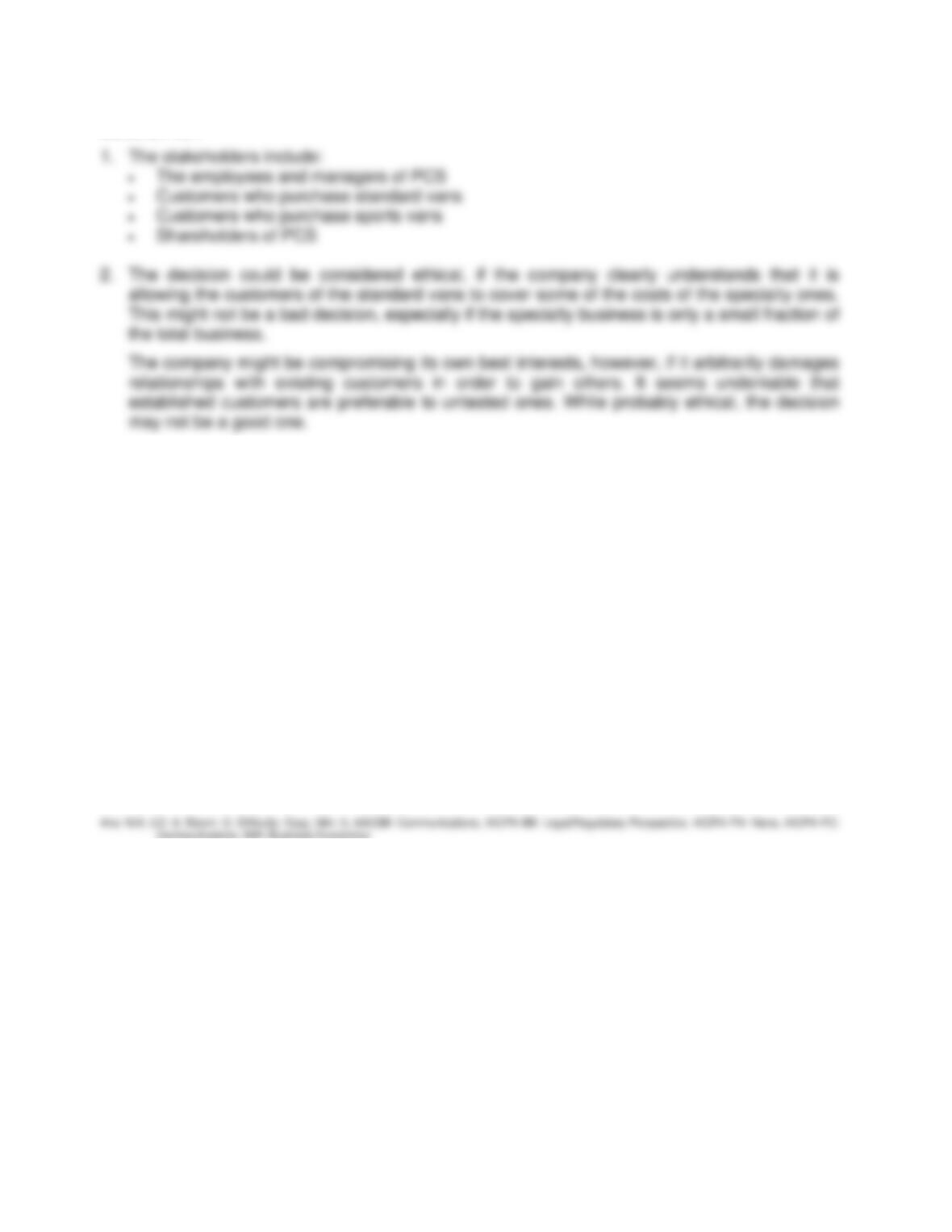
Required:
1. Who are the stakeholders in the decision to increase overhead for routine jobs?
2. Is the decision to subsidize special jobs by increasing the overhead rate on routine jobs
ethical? Briefly explain.
Test Bank for Accounting, Tools for Business Decision Making Fifth Edition
15 – 66
Solution 204
S-A E 205 (Communication)
Bridal Treasures, Inc. makes customized wedding gowns. The customer selects a pattern for the
basic gown, and then selects fabric and trim. Once the design and the materials have been
agreed upon, a Statement of Estimated Cost is signed by the company and by the customer.
Overhead is applied based on the number of days a gown is in process. Usually, five gowns are
being worked on at a time. Therefore, each gown is charged 1/5 of a daily estimated overhead
amount.
Customer Mary Landon’s wedding dress took four days to complete. However, after the first three
days had elapsed, Hanna Hunt, a movie personality, suddenly decided to get married, and
ordered a very lavish gown. All other work was suspended, and the work on Ms. Landon’s dress
was delayed six days. The final day of its construction was on the tenth day after it had been
begun.
Required:
You are the accounting manager for Bridal Treasures. Write a memo to the billing department.
Instruct them as to the appropriate number of overhead days to charge to Ms. Landon’s account.
Job Order Costing
15 – 67
Solution 205