Chapter 15: Capital Structure Decisions
Anson Jackson Court Company (AJC)
The Anson Jackson Court (AJC) currently has $150,000 market value (and book value) of perpetual debt outstanding
carrying a coupon rate of 6%. Its earnings before interest and taxes (EBIT) are $89,000, and it is a zero growth company.
AJC’s current cost of equity is 10%, and its tax rate is 25%. The firm has 10,000 shares of common stock outstanding
selling at a price per share of $60.00.
69. Refer to the data for the Anson Jackson Court Company (AJC). What is AJC’s current total market value and weighted
average cost of capital?
Total Market Value; WACC
a. $650,000; 8.9%
b. $650,000; 9.4%
c. $750,000; 8.4%
d. $750,000; 8.9%
e. $750,000; 9.4%
Chapter 15: Capital Structure Decisions
70. Refer to the data for Anson Jackson Court (AJC). AJC is considering moving to a capital structure that is comprised of
25% debt and 75% equity, based on market values. The new funds would be used to replace the old debt and to
repurchase stock. It is estimated that the increase in risk resulting from the additional leverage would cause the required
rate of return on debt to rise to 6.56%, while the required rate of return on equity would rise to 10.07%. If this plan were
carried out, what would be AJC’s new WACC and total value?
WACC; Total Market Value
a. 8.28%; $690,034
b. 8.78%; $760,034
c. 9.28%; $660,034
d. 9.28%; $820,034
Chapter 15: Capital Structure Decisions
71. Daylight Solutions is considering a recapitalization that would increase its debt ratio and increase its interest expense.
The company would issue new bonds and use the proceeds to buy back shares of its common stock. The company’s CFO
thinks the plan will not change total assets or operating income, but that it will increase earnings per share (EPS).
Assuming the CFO’s estimates are correct, which of the following statements is CORRECT?
a. If the plan reduces the WACC, the stock price is also likely to decline.
b. Since the plan is expected to increase EPS, this implies that net income is also expected to increase.
c. If the plan does increase the EPS, the stock price will automatically increase at the same rate.
d. Under the plan there will be more bonds outstanding, and that will increase their liquidity and thus lower the
interest rate on the currently outstanding bonds.
e. Since the proposed plan increases Daylight’s financial risk, the company’s stock price still might fall even if EPS
increases.
72. Which of the following statements is CORRECT?
a. The capital structure that maximizes the stock price is also the capital structure that maximizes earnings per share.
b. The capital structure that maximizes the stock price is also the capital structure that maximizes the firm’s times
interest earned (TIE) ratio.
c. Increasing a company’s debt ratio will typically reduce the marginal costs of both debt and equity financing;
however, this still may raise the company’s WACC.
d. If Congress were to pass legislation that increases the personal tax rate but decreases the corporate tax rate, this
would encourage companies to increase their debt ratios.
e. The capital structure that maximizes the stock price is also the capital structure that minimizes the weighted
average cost of capital (WACC).
Chapter 15: Capital Structure Decisions
73. Merriwether Building has operating income of $20 million, a tax rate of 25%, and no debt. It pays out all of its net
income as dividends and has a zero growth rate. The current stock price is $27 per share, and it has 5 million shares of
stock outstanding. If it moves to a capital structure that has 40% debt and 60% equity (based on market values), its
investment bankers believe its weighted average cost of capital would be 10%. What would its stock price be if it changes
to the new capital structure?
a. $28
b. $30
c. $33
d. $35
e. $40
Pennewell Publishing Inc. (PP)
Chapter 15: Capital Structure Decisions
Pennewell Publishing Inc. (PP) is a zero growth company. It currently has zero debt and its earnings before interest and
taxes (EBIT) are $80,000. PP’s current cost of equity is 10%, and its tax rate is 25%. The firm has 10,000 shares of
common stock outstanding selling at a price per share of $48.00.
74. Refer to the data for Pennewell Publishing Inc. (PP). Assume that PP is considering changing from its original capital
structure to a new capital structure with 35% debt and 65% equity. This results in a weighted average cost of capital equal
to 9.125% and a new value of operations of $657,534. Assume PP raises $230,137 in new debt and purchases T-bills to
hold until it makes the stock repurchase. What is the stock price per share immediately after issuing the debt but prior to
the repurchase?
a. $55.04
b. $61.15
c. $65.75
d. $71.01
e. $74.56
75. Refer to the data for Pennewell Publishing Inc. (PP). Assume that PP is considering changing from its original capital
structure to a new capital structure with 35% debt and 65% equity. This results in a weighted average cost of capital equal
to 9.125% and a new value of operations of $657,534. Assume PP raises $230,137 in new debt and purchases T-bills to
hold until it makes the stock repurchase. PP then sells the T-bills and uses the proceeds to repurchase stock. How many
shares remain after the repurchase, and what is the stock price per share immediately after the repurchase?
Remaining Shares; P Post
a. 7,500; $86.18
b. 7,000; $74.26
c. 6,500; $65.75
d. 6,649; $63.48
e. 6,959; $58.03
Chapter 15: Capital Structure Decisions
VanMannen Foundations, Inc. (VF)
VanMannen Foundations, Inc. (VF) is a zero-growth company that currently has zero debt, and it has the data shown
below.
EBIT = $80,000
Growth = 0%
Orig cost of equity, rs = 10.0%
No. of shares = 10,000
Price per share = $60.00
Tax rate = 25%
76. Refer to the data for VanMannen Foundations, Inc. (VF). Now assume that VF is considering changing from its
original zero debt capital structure to a new capital structure with even more debt. This results in changes in the cost of
debt and equity, and thus to a new WACC and a new value of operations. Assume VF raises the amount of new debt
indicated below and uses the funds to purchase and hold T-bills until it makes the stock repurchase. What is the stock
price per share immediately after issuing the debt but prior to the repurchase?
Chapter 15: Capital Structure Decisions
Debt/Value = 40% Value of new debt = $280,702
Equity/Value = 60% New WACC = 8.55%
a. $66.67
b. $70.18
c. $73.68
d. $77.37
e. $81.24
77. Refer to the data for VanMannen Foundations, Inc. (VF). What would the stock price be if VF issued the new debt and
immediately used the proceeds to repurchase stock?
a. $65.04
b. $66.71
c. $68.42
d. $70.18
e. $73.68
Chapter 15: Capital Structure Decisions
Best Bagels, Inc. (BB)
Best Bagels, Inc. (BB) currently has zero debt. Its earnings before interest and taxes (EBIT) are $130,000, and it is a zero
growth company. BB’s current cost of equity is 13%, and its tax rate is 25%. The firm has 30,000 shares of common
stock outstanding selling at a price per share of $25.
78. Refer to the data for Best Bagels, Inc. (BB). Now assume that BB is considering changing from its original capital
structure to a new capital structure with 40% debt and 60% equity. This results in a weighted average cost of capital equal
to 11.7% and a new value of operations of $833,333. Assume BB raises $333,333 in new debt and purchases T-bills to
hold until it makes the stock repurchase. BB then sells the T-bills and uses the proceeds to repurchase stock. How many
shares remain after the repurchase, and what is the stock price per share immediately after the repurchase?
Remaining shares; Stock price after repurchase
a. 18,000; $27.78
b. 19,400; $29.44
c. 20,800; $31.51
d. 21,800; $34.34
e. 23,500; $35.71
Chapter 15: Capital Structure Decisions
79. Refer to the data for Best Bagels, Inc. (BB). Now assume that BB is considering changing from its original capital
structure to a new capital structure with 40% debt and 60% equity. This results in a weighted average cost of capital equal
to 11.7% and a new value of operations of $833,333. Assume BB raises $333,333 in new debt and purchases T-bills to
hold until it makes the stock repurchase. What is the stock price per share immediately after issuing the debt but prior to
the repurchase?
a. $18.58
b. $20.65
c. $25.00
d. $27.78
e. $30.19
Chapter 15: Capital Structure Decisions
Anson Jackson Court Company (AJC)
The Anson Jackson Court (AJC) currently has $150,000 market value (and book value) of perpetual debt outstanding
carrying a coupon rate of 6%. Its earnings before interest and taxes (EBIT) are $89,000, and it is a zero growth company.
AJC’s current cost of equity is 10%, and its tax rate is 25%. The firm has 10,000 shares of common stock outstanding
selling at a price per share of $60.00.
80. Refer to the data for the Anson Jackson Court Company (AJC). Now assume that AJC is considering changing from
its original capital structure to a new capital structure with 40% debt and 60% equity. If it makes this change, its resulting
market value would be $791,667. What would be its new stock price per share?
a. $60.17
b. $61.17
c. $62.27
d. $63.27
e. $64.17
Chapter 15: Capital Structure Decisions
81. Refer to the data for the Anson Jackson Court Company (AJC). Now assume that AJC is considering changing from
its original capital structure to a new capital structure with 50% debt and 50% equity. If it makes this change, its resulting
market value would be $820,000. What would be its new stock price per share?
a. $58
b. $59
c. $60
d. $61
e. $62
82. Other things held constant, an increase in financial leverage will increase a firm’s market (or systematic) risk as
measured by its beta coefficient.
a. True
b. False
Chapter 15: Capital Structure Decisions
83. When a firm has risky debt, its equity can be viewed as an option on the total value of the firm with an exercise price
equal to the face value of the debt.
a. True
b. False
84. When a firm has risky debt, its debt can be viewed as an option on the total value of the firm with an exercise price
equal to the face value of the equity.
a. True
b. False
Wilson Dover Inc.
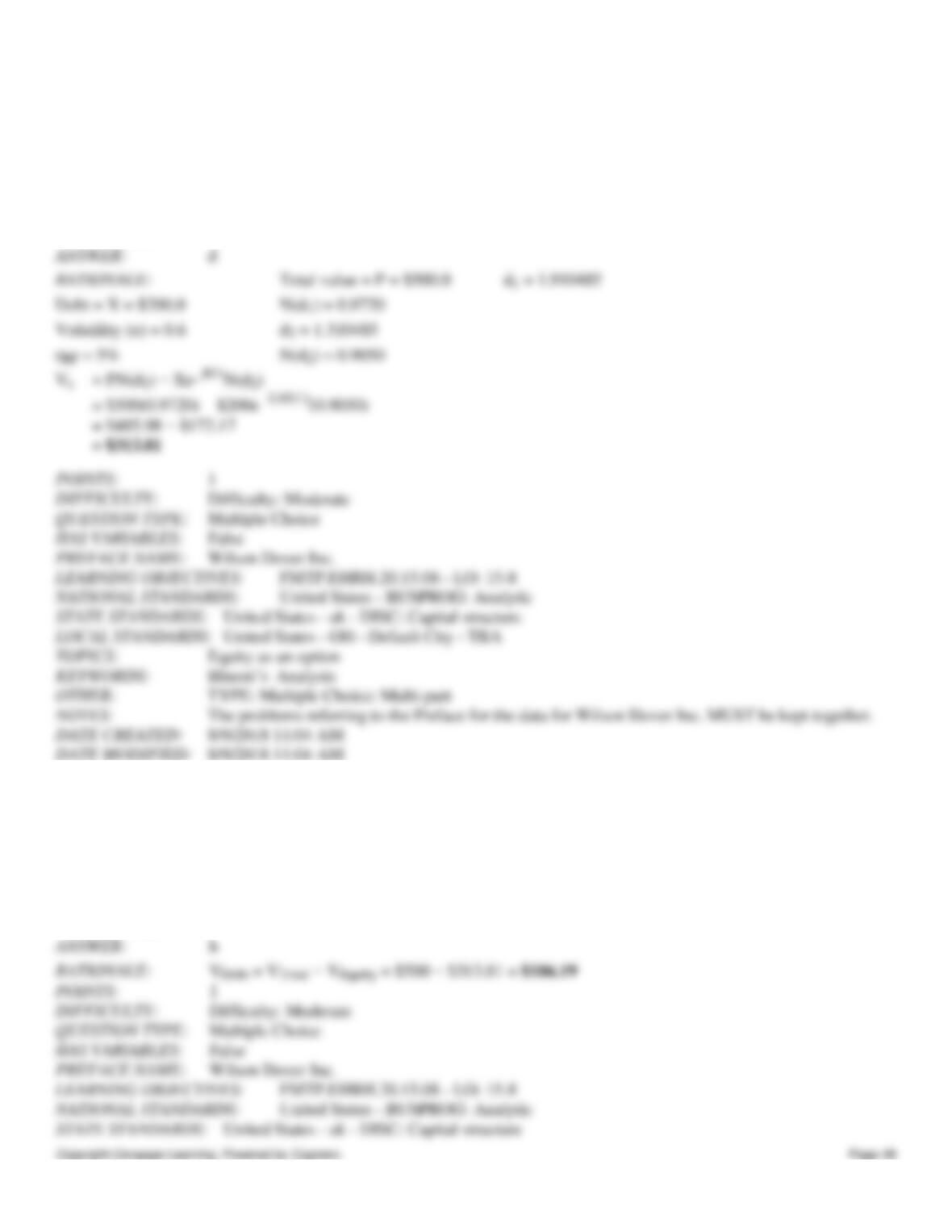
The total value (debt plus equity) of Wilson Dover Inc. is $500 million and the face value of its 1-year coupon debt is
$200 million. The volatility (σ) of Wilson Dover’s total value is 0.60, and the risk-free rate is 5%. Assume that N(d1) =
0.9720 and N(d2) = 0.9050.
Chapter 15: Capital Structure Decisions
85. Refer to the data for Wilson Dover Inc. What is the value (in millions) of Wilson Dover’s equity if it is viewed as an
option?
a. $228.77
b. $254.19
c. $282.43
d. $313.81
e. $345.19
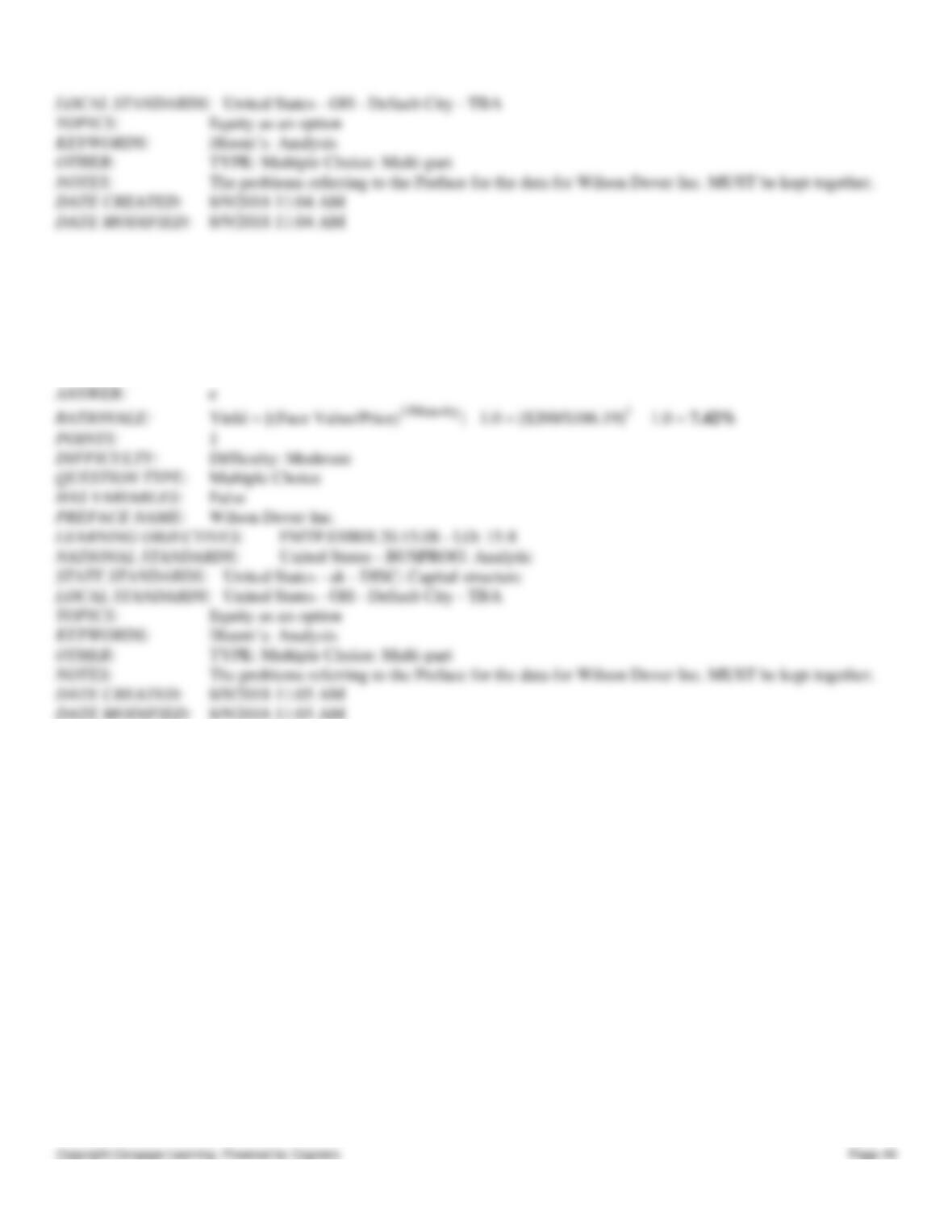
86. Refer to the data for Wilson Dover Inc. What is the value (in millions) of Wilson Dover’s debt if its equity is viewed
as an option?
a. $167.57
b. $186.19
c. $204.81
d. $225.29
e. $247.82
Chapter 15: Capital Structure Decisions
87. Refer to the data for Wilson Dover Inc. What is the yield on Wilson Dover’s debt?
a. 6.04%
b. 6.36%
c. 6.70%
d. 7.05%
e. 7.42%