18
Exxon-Mobil and Russia’s Rosneft Create Artic Oil and Gas Exploration Joint Venture
________________________________________________________________
Key Points
Contractual commitments in cross-border alliances are effective only to the extent they are enforced by
each country’s legal system.
The success of most alliances ultimately depends on the extent to which each partner needs the capabilities
and resources of the other.
______________________________________________________________________________
Exxon-Mobil (Exxon) finalized an agreement with the government-owned Russian oil and gas giant
Rosneft on April 16, 2012, to create a joint venture to explore for oil and gas in three designated areas in
the Russian portion of the Artic Ocean known as the Kara Sea. The agreement superseded a similar but
failed agreement with British Petroleum (BP) earlier in the year. Rosneft’s attempt to strike a similar pact
with BP in 2011 fell apart because the British company had a joint venture with a separate group of private
Russian investors, which blocked the Rosneft deal in an international court. While BP had planned to swap
stock, Exxon agreed to give Rosneft assets elsewhere in the world, including some that Exxon owns in the
deep waters of the Gulf of Mexico and in Texas. Future investments could total tens of billions of dollars.
The final agreement was contingent on Russia’s reducing taxes imposed on oil and gas companies.
The U.S. Geological Survey estimates that the Artic holds one–fifth of the world’s undiscovered,
recoverable oil and natural gas. The Kara Sea has an estimated 36 billion barrels of recoverable oil
reserves. Total oil and gas reserves are estimated to be 110 billion barrels of oil equivalent, four times
Exxon’s proven worldwide reserves. Drilling is expected to start in 2015, with Exxon shouldering most of
the costs. In exchange for access to these Rosneft properties, the agreement gives Rosneft an option to
invest in certain U.S. properties. Rosneft will own two-thirds and Exxon the remainder of the joint venture.
The initial commitment by the two companies is to invest $3.2 billion in exploration in the Kara Sea.
As a world leader in Artic exploration, Exxon is willing to share its expertise with Rosneft, as well as to
transfer technology, in exchange for access to Russia’s Artic region. The Russians are particularly
interested in learning the latest techniques employed in hydraulic fracturing (so–called “fracking”) of
underground oil and gas deposits trapped in shale rock. This deal also allows the Russian petroleum
industry to diversify internationally. While Russia currently pumps more oil than Saudi Arabia, its onshore
oil fields are in decline, threatening a major source of Russian export revenue. Furthermore, Rosneft
receives an option to acquire an equity interest in certain Exxon projects in North America, including deep–
water drilling in the Gulf of Mexico and fields in Texas. In addition, Rosneft will have an opportunity to
invest in Exxon properties and projects outside of the United States. Granting Rosneft options to invest in
certain Exxon assets was an important precondition for getting agreement on the joint venture.
The Russian government had long demanded reciprocity as part of any deal. This required that in
exchange for any ownership in Russian assets, the Russian partner should have the opportunity to invest in
assets owned by the other partner. The value of the assets Rosneft would own in the United States would be
in proportion to those Exxon would own in Russia. The agreement is risky, in view of Russia’s history of
reneging on deals with Western oil companies. For example, in 2006, it compelled Royal Dutch Shell to
sell 50% of a Sakhalin offshore property to state-owned Gazprom after Shell had spent more than $20
billion of its own money and that of other investors to build the project’s infrastructure.
British Petroleum and Russia’s Rosneft Swap Shares
Extending its already close ties with Russia, British Petroleum PLC announced an agreement to exchange
shares with Russia’s largest oil company, OAO Rosneft, on January 14, 2011. Rosneft is 75% owned by the
Russian government. BP and Rosneft also announced the formation of a JV to develop three massive
offshore exploration blocks that Rosneft owns in northern Russia. The two firms said they will jointly
19
explore three areas in the South Kara Sea in the Russian Arctic, spending between $1.4 and $2 billion on
seismic tests and drilling wells in the initial exploration phase. The JV will be two-thirds owned by
Rosneft, with the remainder owned by BP.
Reflecting Europe’s escalating dependence on Russia for an increasing share of its energy usage,
particularly for clean-burning natural gas, the agreement is backed by Britain’s prime minister, David
Cameron, and Russia’s prime minister, Vladimir Putin. Russia holds one–fifth of the world’s proven
reserves of natural gas, and, by some estimates, the South Kara Sea contains some of the largest reserves of
oil and gas in the world.
The deal comes in the wake of BP’s sale of assets to raise funds to cover the costs of the Gulf of Mexico
oil spill in mid-2010. Such costs are expected to eventually total $40 billion. Rosneft, which had announced
in late 2010 that it was seeking a partner for exploiting its Arctic leases, indicated that BP’s experience in
dealing with such problems gives it an edge over other potential partners. Rosneft also regards BP’s deep-
water drilling technology and experience as cutting edge. BP’s expertise received another vote of
confidence when Australia granted BP licenses to initiate extensive drilling activity off its coast several
days after the Rosneft announcement.
The share exchange gives Rosneft a 5% interest in BP’s voting shares, making it BP’s single largest
shareholder. In return, BP receives a 9.5% ownership stake in Rosneft. Each stake is valued at about $7.8
billion. Both firms agreed to hold each other’s equity for at least two years before selling any stock. BP’s
shares currently pay a dividend about twice that of Rosneft’s. BP and Rosneft have stated publicly that they
believe investors have significantly undervalued their firms. The Russian government has a particularly
strong interest in seeing the value of its holdings appreciate, since it announced plans to privatize a number
of largely state-owned enterprises, including Rosneft, in 2014 in order to raise funds.
At the time of the announcement, BP’s market capitalization was about $154 billion. With almost 90%
of its shares owned by the Russian government and Sherbank, Russia’s biggest retail savings bank, the
firm’s stock trading in public markets tends to be limited and not reflective of Rosneft’s true value.
However, the terms of the share exchange imply a market capitalization for Rosneft of about $81 billion.
The transaction represents the first time there has been a cross-shareholding between major international
oil firms and a major government-owned national oil company. Unlike more conventional oil and gas JVs,
the Rosneft JV will not own the oil leases but merely the right to develop them. This structure is similar to
Russian oil company Gazrpom’s agreement with France’s Total SA and Norway’s Statoil for the
development of the Shtokman gas field in early 2008.
Rosneft became Russia’s leading extraction and refining company after purchasing assets of former
privately owned oil giant Yukos at state-sponsored auctions, in which the global community decried what
appeared to be the Russian government expropriation of the privately owned assets. In 2006, Rosneft
conducted one of the largest IPOs in history by issuing nearly 15% of its shares on the Russian Trading
System and the London Stock Exchange. With the shares priced at $7.55 each, the offering raised about
$10.7 billion. Most of the proceeds went to the Russian government. BP began its relationship with Rosneft
by buying $1 billion in shares in the firm’s initial public offering, equivalent to 1.3%. Thus, the recent
agreement brings BP’s ownership interest in Rosneft to 10.8%.
Previous attempts to invest in Russia and to create partnerships between Russian state oil companies and
Western oil firms have failed due to outright expropriation by the Russian government or heavy-handed
tactics employed by certain Russian billionaires (so-called oligarchs) with close ties to the Russian
government. For example, Russian officials forced Shell Oil to sell control of its Sakhalin II oil and gas
development to state-owned Gazprom. BP and Gazprom signed a global joint venture in 2007 in which
each was to contribute assets valued at $1.5 billion, but it was later dissolved due to disagreements between
BP and large Russian investors. TNK–BP, BP’s 50 percent–owned JV with a group of Russian billionaire
business people, has also had a troubled history. The JV that contributes a quarter of BP’s global
production and nearly a fifth of its reserves was rocked by a shareholder dispute in 2008 that cost BP some
of its control. BP chief executive Bob Dudley had served as chief executive of that JV for five years until
he was expelled by BP’s Russian partners during the disagreement.
20
On news of the agreement, BP’s partners in the TNK-BP JV stated that BP had not notified them
adequately and that the Rosneft deal violated their “right of first refusal” as stated in the JV agreement. The
partners were successful in getting a court injunction in the United Kingdom to block the implementation
of the JV in February 2011. TNK-BP at the time of this writing is considering a legal claim against BP for
damages of up to $10 billion for allegedly reneging on its commitment to use TNK-BP as its main vehicle
for investment in Russia. These developments raise serious questions about the longer-term viability of the
BP-Rosneft JV.
Discussion Questions:
1. Speculate as to the purpose of the share swap between BP and Resnoft.
2. What is the purpose of the 2-year lockup period during which neither partner can sell its
stock? How might the lock–up period impact the value of each firm’s holdings?
3. Would you expect the share exchange to be dilutive to BP shareholders in the short-run? In
the long-run. Explain your answer.
4. Why would you expect the publicly traded Rosneft shares not to reflect the true value of the
firm?
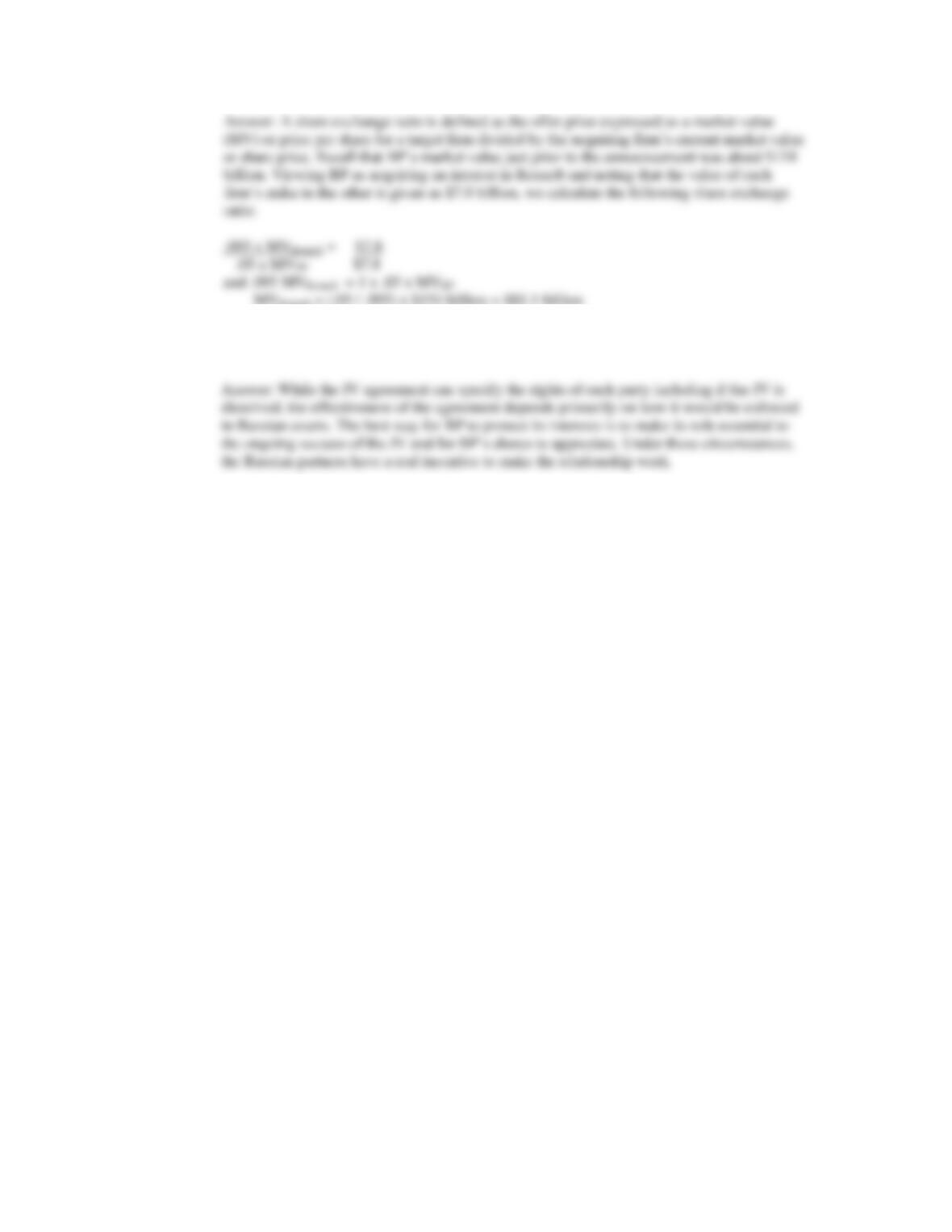
5. How would you estimate the market capitalization for Rosneft based on the terms of the share
exchange? Show your work.
21
6. How can BP best protect their interests in the JV with Rosneft in the highly uncertain political
and economic environment of Russia?
SABMiller in Joint Venture with Molson Coors
On October 10, 2007, SABMiller (SAB) and Molson Coors (Coors) agreed to combine their U.S. brewing
operations into a joint venture corporation. The stated objective was to create a rival capable of competing
with Anheuser-Busch, the maker of Budweiser beer. SAB and Coors, the second and third largest
breweries, respectively, in the United States in terms of market share, have equal voting rights in the newly
formed entity. Each firm has five representatives on the board. In terms of ownership, SAB, the larger of
the two in terms of sales and profits, has a 58-percent stake and Coors a 42-percent position. The combined
operation, named MillerCoors, has about a 30 percent market share versus Anheuser’s 48 percent. Leo
Kiely, chief executive at Coors, became the chief executive officer of MillerCoors and Tom Long, head of
the SAB business in the United States, became the president and chief commercial officer. Peter Coors,
vice chairman of Coors, was tapped as the chairman and Graham Mackey, SAB’s chief executive officer,
the vice chairman of MillerCoors. Both Coors and SAB continue to operate separate global businesses.
From its roots in South Africa, the former SAB PLC grew rapidly over the previous decade by
expanding into fast growing economies such as China, Eastern Europe, and Latin America. SAB acquired
Miller Brewing Company in 2002, but the U.S. business failed to gain significant market share in
competing with Anheuser-Busch’s pervasive brand awareness and distribution strength. Molson Coors was
formed by the 2005 merger of Colorado’s Adolph Coors Co. and Canada’s Molson Inc., both family–
controlled companies. The families were unwilling to sell their entire companies to another firm. The JV
allows them to keep some control. Molson Coors, with dual headquarters in Montreal and Denver, has
major operations in Canada and Britain that would remain independent of SABMiller. Reflecting its larger
market share, brand recognition, and negotiating clout with distributors, Anheuser-Busch has operating
profit margins of 23 percent, double SAB’s or Coors’s margins. SAB is larger in terms of both revenue and
profit than Coors.
The major U.S. breweries have been experiencing growing competition from wine, specialty beers,
spirits, and imported beers. Spirits companies have raised the pressure on beer giants to merge by rolling
out sweet cocktails and other drinks to lure younger consumers. Premixed bottled drinks such as Smirnoff
Ice have seen sales triple in the last decade. The U.S. beer market is largely mature, with consumption
growing at an annual rate of about 1.5 percent.
MillerCoors anticipated annual cost savings to reach $500 million by the third year of operation and be
accretive for both parent firms by the second full year of combined operations. The cost savings result from
streamlining production, reducing shipping distances between plants and distribution sites, and cutting
corporate staff. Shipping costs represent a significant cost, given the nature of the product. By producing
both firms’ products in the eight plants geographically distributed across the Midwestern and western
United States, MillerCoors should realize significant savings in meeting customer demand for both
products in the immediate proximity of each plant.
SAB and Coors hope to become one-stop shops for distributors, allowing them to save time and money
by dealing with one company instead of two. About 60 percent of Miller‘s volume is distributed by
wholesalers also selling Molson Coors brands. U.S. federal law dating back to the repeal of prohibition
requires beer to be sold in many states through wholesalers. The resulting savings to distributors could
increase MillerCoors overall market share.
By combining their U.S. advertising budgets, MillerCoors expects to have more clout at the bargaining
table with U.S. media outlets, enabling the combined firm to get lower prices and better sports marketing
deals. Such deals are viewed as critical to marketing beer in the United States. MillerCoors will find it
easier to negotiate for better placement for its ads and compete more effectively for ad rights to major
sporting events. The two firms are also geographically complementary. Miller is strong in the Midwest,
while Coors has large market share in the West.
Immediately following the joint venture announcement, Anheuser–Busch’s CEO August A. Busch IV
said in a message to employees that the brewer must capitalize on the significant transition confusion he
predicted would occur when Miller and Molson Coors blend their U.S. operations. Such confusion, he
predicted, would create great concern within the SABMiller/Coors field sales and wholesale organizations,
as people attempt to determine if they will have a role in this new structure.
Discussion Questions:
1. What tactics do you think Anheuser might employ to exploit the predicted confusion during
the integration of the SABMiller and Coors operations?
2. How did the combination of the U.S. operations of SABMiller and MolsonCoors meet the
needs of the two parties? Why was a JV viewed as preferable to a merger of the two firm’s
global operations?
3. How do you believe the ownership distribution for MillersCoors was determined?
23
4. Why do you believe that SAB and Coors agreed to equal board representation and voting
rights in the new JV? What types of governance issues might arise in view of the governance
structure of MillersCoors? What mechanisms might have been put in place by the partners
prior to closing to resolve possible governance issues? Be specific.
MICROSOFT PARTNERS WITH YAHOO!—AN ALTERNATIVE TO TAKEOVER?
Business alliances sometimes represent a less expensive alternative to mergers and acquisitions. This
notion may have motivated Microsoft when the firm first approached Yahoo! about a potential partnership
in November 2006 and again in mid-2007. Frustrated with their inability to partner with Yahoo!, Microsoft
initiated a hostile takeover bid in 2008 valued at almost $48 billion or $33 per share, only to be spurned by
Yahoo!. Following the withdrawal of Microsoft’s offer, Yahoo!’s share price fell into the low to mid-teens
and remained in that range throughout 2010.
Reflecting the slumping share price and a failed effort to create a search partnership with Google,
Yahoo!’s cofounder, Jerry Yang, was replaced by Carol Bartz in early 2009. The U.S. Justice Department
had threatened to sue to block the proposed partnership between Yahoo! and Google on antitrust grounds.
Microsoft again approached Yahoo! with a partnering proposal in mid-2009, which resulted in an
announcement on February 18, 2010, of an Internet search agreement between the two firms. As a result of
the agreement, Yahoo! transferred control of its Internet search technology to Microsoft. Microsoft is
relying on a ten-year arrangement with Yahoo! to help counter the dominance of Google in the Internet
search market. By gaining access to each other’s Internet users, both firms hope to be able to attract more
advertising dollars from companies willing to pay for links on Microsoft’s and Yahoo!’s websites. With
Microsoft’s search technology believed to be superior to Yahoo!’s, users requesting searches through
Yahoo!’s site will be implemented using Microsoft’s search software.
Regulatory agencies in both the United States and the European Union had no trouble approving the
proposal because the combined Yahoo! and Microsoft Internet search market share is dwarfed by Google’s.
Google is estimated to have about two-thirds of the search market, followed by Yahoo! at 7% and
Microsoft with about 3%.
Yahoo! could profit handsomely from the deal, since it will retain 88% of the revenue from search ads
on its website during the first five years of the ten-year contract. Microsoft will pay for most of the costs of
implementing the partnership by giving Yahoo! $150 million to defray its expenses. Microsoft also agreed
to absorb about 400 of Yahoo!’s nearly 14,000 employees. Ironically, Microsoft may get much of what it
wanted (namely Yahoo!’s user base) at a fraction of the cost it would have paid to acquire the entire
company.
Garmin Utilizes Supply Agreement as Alternative to Acquiring Tele Atlas
Following an aggressive bidding process, Garmin Ltd., the largest U.S. maker of car-navigation devices,
withdrew its bid for the Netherlands-based Tele Atlas NV on November 16, 2007. Tele Atlas provides
maps of 12 million miles of roads in 200 countries. The move cleared the way for TomTom NV to buy the
24
mapmaker for $4.25 billion. Both Garmin and TomTom are leading manufacturers of global positioning
systems (GPSs), which enable users to navigate more easily through unfamiliar territory. The most critical
component of such navigation systems is the map.
In lieu of acquiring Tele Atlas, Garmin entered into a six-year deal with an option to extend for an
additional four years to obtain maps from Tele Atlas‘s competitor Navteq Corp. In doing so, Garmin
avoided the EPS-dilutive effects of owning money-losing Tele Atlas. Garmin can focus on building traffic
information and business listings into its products without having to own the underlying maps. An
acquisition would have diluted Garmin’s profit until 2010. Building maps comparable to those owned by
Tele Atlas could take up to 10 years and cost $1 billion.
By owning the maps, TomTom is seeking to become more of a service provider than simply a
manufacturer of GPS devices. Such devices are widely used in the automotive industry, as well as aviation
and boating. The biggest growth opportunity is the increased use of GPS tracking capabilities in the market
for mobile phones. This application is expected to dwarf the transportation and sports markets for GPS
devices.
Because it will own the underlying maps, TomTom may be able to more easily combine the data with
navigation devices and add traffic, gas station, and restaurant information. In contrast, Garmin will have to
obtain proprietary data from others. Garmin may also have to pay more for maps or even lose access after
the contract (including the option to extend) expires.
Discussion Questions:
1. Describe the advantages of the supply agreement to Garmin compared to outright acquisition
of Tele Atlas?
2. Describe the disadvantages of the supply agreement to Garmin?
Pixar and Disney Part Company
The announcement on February 5, 2004, of the end of the wildly successful partnership between Walt
Disney Company (“Disney”) and Pixar Animation Studios (“Pixar”) rocked the investment and
entertainment world. While the partnership continued until the end of 2005, the split-up underscores the
nature of the rifts that can develop in business alliances of all types. The dissolution of the partnership ends
a relationship in existence since 1995 in which Disney produced and distributed the highly popular films
created by Pixar. Under the terms of the original partnership agreement, the two firms cofinanced each film
and split the profits evenly. Moreover, Disney received 12.5 percent of film revenues for distributing the
films. Negotiations to renew the partnership after 2005 foundered on Pixar’s desire to get a greater share of
the partnership’s profits. Disney CEO Michael Eisner refused to accept a significant reduction in
distribution fees and film royalties; while Steve Jobs, Pixar‘s CEO, criticized Disney’s creative capabilities
and noted that marketing alone does not make a poor film successful.
After 10 months of talks between Disney and Pixar, Disney rejected a deal that would have required it to
earn substantially less from future Pixar releases. Disney also would have had to relinquish potentially
lucrative copyrights to existing films such as Toy Story and Finding Nemo. Disney shares immediately fell
by almost 2 percent on the news of the announcement, while Pixar’s shares skyrocketed almost 4 percent by
the end of the day. Pixar contributed more than 50 percent of Disney Studio’s operating profits, and Disney
Studios accounted for about one fourth of Disney‘s total operating profits. While Disney now faces Pixar as
a competitor, it retains the rights to make video and theatrical sequels and TV shows to the movies covered
by the current partnership agreement. However, while Disney does retain the right to make sequels to Pixar
films, it does not own the underlying technology and must recreate the millions of lines of computer code
for each character.
The key challenge for Disney will be to fill the creative vacuum left by the loss of Pixar writers and
animators. Disney is particularly vulnerable in that it has severely cut back its own feature animation
department and stumbled in recent years with a variety of box office duds (e.g., Treasure Planet).
Reflecting concern that Disney would not be able to compete with Pixar, bond-rating service, Fitch Ratings
suggested a possible downgrade of Disney debt. Pixar announced that it was seeking another production
studio. Immediately following this announcement, Sony and others approached Pixar with proposals to
collaborate in making animated films.
Epilogue
In early 2006, Pixar agreed to be acquired by Disney.
Discussion Questions:
1. In your opinion, what were the motivations for forming the Disney-Pixar partnership in 1995? Which
partner do you believe had the greatest leverage in these negotiations? Explain your answer.
2. What happened since 1995 that might have contributed to the break–up? (Hint: Consider partner
objectives, perceived relative contribution and in-house capabilities.)
3. How does the dissolution of the partnership leave Disney vulnerable? What could Disney have done to
protect itself from these vulnerabilities in the original negotiations? (Hint: Consider scope of the
agreement, management and control, dispute resolution mechanisms, valuation of tangible and
intangible assets, ownership of partnership assets following dissolution, performance criteria)

26
4. What does the reaction of the stock market and credit rating agencies tell you about how investors
value the contribution of the two partners to the partnership? Do you think investors may have over–
reacted?
Coca-Cola and Procter & Gamble’s Aborted Effort to Create a Global Joint Venture Company
Coca-Cola (Coke), arguably the world’s best-known brand, manufactures and distributes Coca–Cola as well
as 230 other products in 200 countries through the world‘s largest distribution system. Procter & Gamble
(P&G) sells 300 brands to nearly 5 billion consumers in 140 countries and holds more food patents than the
three largest U.S. food companies combined. Moreover, P&G has a substantial number of new food and
beverage products under development. Both firms have been competing in the health and wellness segment
of the food market for years. P&G spends about 5 percent of its annual sales, about $1.9 billion, on R&D
and holds more than 27,000 patents. The firm employs about 6,000 scientists, including about 1,200 people
with PhDs.
Both firms have extensive distribution systems. P&G uses a centralized selling and warehouse
distribution system for servicing high-volume outlets, such as grocery store chains. With a warehouse
distribution system, the retailer is responsible for in-store presentations of the brands, including shelving,
display, and merchandising. The primary disadvantage of this type of distribution system is that it does not
reach many smaller outlets cost effectively, resulting in many lost opportunities. In contrast, Coke uses
three distinct systems. Direct store delivery consists of a network of independently operated bottlers, which
bottle and deliver the product directly to the outlet. The bottler also is responsible for in-store
merchandising. Coke’s warehouse distribution is similar to P&G’s and is used primarily to distribute Minute
Maid products. Coke also sells beverage concentrates to distributors and food service outlets.
On February 21, 2001, Coca-Cola and Procter & Gamble announced, amid great fanfare, plans to create
a stand-alone joint venture corporation focused on developing and marketing new juice and juice-based
beverages as well as snacks on a global basis. The new company expected to benefit from Coca–Cola’s
worldwide distribution, merchandising, and customer marketing skills and P&G’s R&D capabilities and
wide range of popular brands. The new company would focus on the health and wellness segment of the
food market. Less than nine months later, Coke and P&G released a one-sentence joint statement on
September 21, 2001, that they could achieve better returns for their respective shareholders if they pursued
this opportunity independently. Although it is unclear what may have derailed what initially had seemed to
the potential partners like such a good idea, it is instructive to examine the initial rationale for the proposed
joint effort.
Each parent would own 50 percent of the new company. Because of the businesses each partner was to
contribute to the JV, the firm would have annual sales of $4 billion. The new firm would be an LLC,
having its own board of directors consisting of two directors each from Coke and P&G. Moreover, the new
firm would have its own management and dedicated staff providing administrative and R&D services.
Coke was contributing a number of well-known brands including Minute Maid, Hi-C, Five Alive, Cappy,
Kapo, Sonfil, and Qoo; P&G contributed Pringles, Sunny Delight, and Punica beverages. The new
company would have had 15 manufacturing facilities and about 6,000 employees.
Although the new firm was to have access to all distribution systems of the parents, it would have been
free to choose the best route to market for each product. Although Minute Maid was to continue to use
Coke’s distribution channels, it also was to take advantage of existing refrigerated distribution systems built
for Sunny Delight. Pringles was to use a variety of distribution systems, including the existing warehouse
system. The Pringles brand was expected to take full advantage of Coke’s global distribution and
merchandising capabilities. Minute Maid was to gain access to new outlets through Coke’s fountain and
direct store distribution system.
The new company‘s sales were expected to grow from $4 billion during the first 12 months of operation
to more than $5 billion within two years. The combination of increasing revenue and cost savings was
expected to contribute about $200 million in pretax earnings annually by 2005. Specifically, Pringles’s
revenue growth as a result of enhanced distribution was expected to contribute about $120 million of this
projected improvement in pretax earnings. The importance of improved distribution is illustrated by noting
that Coke has access to 16 million outlets globally. In the United States alone, that represents a 10-fold
increase for Pringles, from its current 150,000 points of outlet. Similarly, improved merchandising and
distribution of Sunny Delight was expected to contribute an additional $30 million in pretax income. The
remaining $50 million in pretax earnings was to come from lower manufacturing, distribution, and
administrative expenses and through discounts received on bulk purchases of foodstuffs and ingredients.
P&G and Coke were hoping to stimulate innovation by combining global brands and distribution with
talent from both firms in what was hoped would be a highly entrepreneurial corporate culture. The parents
also hoped that the stand-alone firm would be able to achieve focus and economies of scale that could not
have been achieved by either firm separately.
The results of the LLC were not to be consolidated with those of the parents but rather shown using the
equity method of accounting. Under this method of accounting, each parent’s proportionate share of
earnings (or losses) is shown on its income statement, and its equity interest in the LLC is displayed on its
balance sheets. The new company was expected to be nondilutive of the earnings of the parents during its
first full year of operations and contribute to earnings per share in subsequent years. The incremental
earnings were expected to improve the market value of the parents by at least $1.5–2.0 billion (Bachman,
2001).
Some observers suggested that P&G would stand to benefit the most from the JV. It would have gained
substantially by obtaining access to the growing vending machine market. Historically, P&G’s penetration
in this market had been miniscule. This perceived disproportionate benefit accruing to P&G may have
contributed to the eventual demise of the joint venture effort. Coke may have sought additional benefits
from the JV that P&G was simply not willing to cede. Once again, we see that, no matter how attractive the
concept may seem to be on the surface, the devil is indeed in the details when comes to making it happen.
Discussion Questions:
1. In your opinion, what were the motivating factors for the Coke and P&G business alliance?
2. Why do you think the parents selected a limited liability company structure for the new company?
What are the advantages and disadvantages of this structure over alternative legal structures?
28
3. The parents estimate that the new company will add at least $1.5-$2.0 billion to their market
values. How do you think this estimated incremental value was determined?
4. Why do you think the parents opted to form a 50/50 distribution of ownership? What are some of
the possible challenges of operating the new company with this type of an ownership
arrangement? What can the parents do to overcome these challenges?
5. Do you think it is likely that the new company will become highly entrepreneurial and innovative?
Why? / Why not? What can the parents do to stimulate the development of this type of an
environment within the new company?
6. What factors may have contributed to the decision to discontinue efforts to implement the joint
venture? Consider control, scope, financial, and resource contribution issues.
Getting Wired: Wal-Mart–America Online and Other Internet Marketing Alliances
During the second half of 1999, the number of marketing alliances between major retailers and Internet
companies exploded. Wal-Mart Stores, the world’s biggest retailer, and Circuit City, a large consumer
electronics retailer, announced partnerships with America Online (AOL). Best Buy, the largest U.S.
consumer electronics chain, collaborated with Microsoft, which previously had joined with Tandy
Corporation’s RadioShack stores. Signaling its own strategy of bringing its service to anyone, anywhere,

29
AOL announced in March 2000 partnerships with Sprint PCS and Nokia to help move AOL’s service from
the desktop to phones, pagers, organizers, and even TVs.
Wal-Mart and AOL
Wal-Mart and AOL have agreed to create a low-cost Web service for consumers who lack access and to
promote each other’s services. Wal-Mart customers will get software that allows them to set up the service
through AOL’s CompuServe service. The retailer also will distribute AOL’s software with a link to Wal–
Mart’s Web site, Wal-Mart.com. The Internet access service will be geared to Wal-Mart customers in
smaller towns that currently do not have local numbers to dial for online connections. Wal-Mart wants to
funnel as many customers as possible to its revamped Web site, which contains a pharmacy, a photo center,
and travel services in addition to general merchandise. The alliance gives AOL access to the 90–100
million people who shop at Wal-Mart weekly.
Microsoft, Best Buy, and RadioShack
Through its alliance with Best Buy, Microsoft is selling its products—including Microsoft Network (MSN)
Internet access services and hand-held devices such as digital telephones, hand-held organizers, and
WebTV that connect to the Web—through kiosks in Best Buy’s 354 stores nationwide. In exchange,
Microsoft has invested $200 million in Best Buy. Microsoft has a similar arrangement with Tandy
Company’s RadioShack stores in which it agreed to invest $100 million in Tandy’s online sales site in
exchange for in-store displays promoting Microsoft products and services. Both Best Buy and RadioShack
are major advertisers on MSN and share in the monthly revenue from some of the Microsoft Internet access
services they sell through their stores. Best Buy has issued 4 million new shares of common stock to
Microsoft in exchange for its investment, giving Microsoft approximately a 2% ownership position in Best
Buy. The multiyear pact is nonexclusive.
Circuit City and America Online
AOL and Circuit City entered a strategic alliance to provide in-store promotion of AOL products and
services to Circuit City shoppers nationwide, to make AOL Circuit City’s preferred Internet online service,
and to feature Circuit City as an anchor tenant in AOL’s shopping mall. Under the agreement, AOL
products and services are displayed prominently in dedicated retail space in Circuit City’s 615 stores across
the nation. Access to the Internet is available via AOL through dial-up service and developing broadband
technologies, including digital subscriber line and satellite, as well as wireless interactive devices. Circuit
City is promoting AOL and its in-store offerings in its print and television advertising programs and in
other promotional and marketing campaigns. As an anchor tenant on AOL’s shopping mall, Circuit City
will have access to AOL’s more than 32 million subscribers.
Discussion Questions
1. What are the elements that each alliance has in common? Of these, which do you believe are the
most important?
2. In what way do these alliances represent a convergence of “bricks and clicks?”
30
3. In your judgment, do these alliances deliver real value to the consumer? Explain your answer.
GENERAL MOTORS BUYS 20% OF SUBARU
In late 1999, General Motors (GM), the world’s largest auto manufacturer, agreed to purchase 20% of
Japan’s Fuji Heavy Industries, Ltd., the manufacturer of Subaru vehicles, for $1.4 billion. GM’s objective
is to accelerate GM’s push into Asia. The investment gives GM an interest in an auto manufacturer known
for four-wheel drive vehicles. In combination with its current holdings, GM now has a position in every
segment of Japan’s auto market, including minivans, small and midsize cars, and trucks. GM already owns
10% of Suzuki Motor Corporation and 49% of Isuzu Motors Ltd. GM can now expand in Asia more
quickly and at a lower cost than if it developed products independently.
GM has been collaborating with Fuji on various products since 1995. The move underscores GM’s
commitment to expanding its current modest position in the Asian market, which is expected to be the
fastest growing market during the next decade. GM has sold less than 500,000 in the Asia-Pacific
region in 1999, including about 60,000 in Japan. In 2002, GM bought the remaining outstanding stock of
Subaru.
Discussion Questions:
1. What other motives may General Motors have had in making this investment?
2. Why do you believe that General Motors may have wanted to limit initially its investment to 20%?
Bridgestone Acquires Firestone’s Tire Assets
Bridgestone Tire, a Japanese company, lacking a source of retail distribution in the United States,
approached its competitor, Firestone, to create a JV whose formation involved two stages. In the first stage,
Firestone, which consisted of a tire manufacturing and distribution division and a diversified rubber
products division, agreed to transfer its tire manufacturing operations into a subsidiary. This subsidiary was
owned and operated by Firestone’s worldwide tire business. In the second stage, Firestone sold three–
fourths of its equity in the tire subsidiary to Bridgestone, making the subsidiary a JV corporation. Firestone
received $1.25 billion in cash, $750 million from Bridgestone, and $500 million from the JV. Firestone also
retained 100% ownership in the diversified products division and 25% of the tire JV corporation. For its
investment, Bridgestone acquired a 75% ownership interest in a worldwide tire manufacturing and
distribution system.
Case Study Discussion Questions
1. What other options for entering the United States could Bridgestone have considered?
31
2. Why do you believe Bridgestone chose to invest in Firestone rather than pursue another option?
Johnson & Johnson Sues Amgen
In 1999, Johnson & Johnson (J&J) sued Amgen over their 14-year alliance to sell a blood-enhancing
treatment called erythropoietin. The disagreement began when unforeseen competitive changes in the
marketplace and mistrust between the partners began to strain the relationship. The relationship had begun
in the mid–1980s with J&J helping to commercialize Amgen’s blood-enhancing treatment, but the partners
ended up squabbling over sales rights and a spin-off drug.
J&J booked most of the sales of its version of the $3.7 billion medicine by selling it for chemotherapy
and other broader uses, whereas Amgen was left with the relatively smaller dialysis market. Moreover, the
companies could not agree on future products for the JV. Amgen won the right in arbitration to sell a
chemically similar medicine that can be taken weekly rather than daily. Arbitrators ruled that the new
formulation was different enough to fall outside the licensing pact between Amgen and J&J.
Case Study Discussion Questions
1. What could these companies have done before forming the alliance to have mitigated the problems
that arose after the alliance was formed? Why do you believe they may have avoided addressing
these issues at the outset?
2. What types of mechanisms could be used other than litigation to resolve such differences once
they arise?
Conoco Phillips Buys a Stake in Russian Oil Giant Lukoil
In late 2004, Conoco Phillips (Conoco) announced the purchase of 7.6 percent of Lukoil’s (a largely
government owned Russian oil and gas company) stock for $2.36 billion during a government auction of
Lukoil’s stock. The deal gives Conoco access to Russia’s huge, but largely undeveloped, oil and natural
gas reserves. Conoco intends to boost its investment to 10 percent by yearend and to 20 percent within
two-to-three years. To help ensure that Conoco’s interests are protected, even though it has only a minority
position, Conoco will have one seat on Lukoil’s board and Lukoil changed its corporate charter to require
unanimous board approval for the most important decisions such as payment of dividends and major new
investments. Conoco will gain one additional seat once its ownership share climbs to 20 percent. Conoco
has also agreed to pay $370 million to Lukoil for a 30 percent stake in a joint venture to develop reserves in
32
northern Russia. The two firms will split operational responsibilities equally. Conoco’s stock fell more than
1 percent immediately following the announcement.
Discussion Questions:
1. Describe the operational and managerial challenges facing the two partners.
2. Do you believe that Conoco gained an effective say in Lukoil’s operations following its
investment? Explain your answer.
3. Why do you believe Conoco’s stock fell immediately following the announcement?
Strains Threaten Verizon and Vodafone Joint Venture
Vodafone Group, the U.K. based cell phone behemoth wanted to expand geographic coverage in the U.S.
In 2000, they teamed up with Verizon Communications to form Verizon Wireless. The profitable business
had annual revenues of $20 billion and a coast-to-coast network serving more U.S. customers than any
other carrier. However, Vodafone’s global ambitions and its buy-out option threatened to put the venture at
risk of breaking up.
Vodafone executives expressed frustration by the company’s lack of control in the U.S., because it owns
just 45 percent of the venture. Vodafone seeking to establish its own brand name has been unable to get its
name attached to a single product of the joint venture. Moreover, it has been unable to persuade the venture
to use a technology compatible with that used by Vodafone in most of the 28 other countries in which it
does business. This issue has proven to be particularly irksome since part of the Vodafone strategy is that
its European, Asian, and Middle Eastern customers would be able to travel to the U.S. and use their cell
phones on Vodafone’s network in the U.S. Vodafone also complains that Verizon Wireless has been slow
to push next-generation wireless services such as photo and text messaging. Verizon Wireless also receives
three times as many customer complaints as the average of Vodafone European units. Vodafone is reduced
to be a passive financial investor in the operation. The two partners are also at odds in their strategies for
owning wireless assets. Verizon Communications increasingly uses the venture to support its declining
land-line telephone business, by bundling wireless at a discount with other services. Vodafone considers
landlines as having no future for its strategy.
The cloud hanging over Verizon Wireless is the put that Vodafone received as part of its initial
investment which gives it the right to sell its interests to Verizon at certain points through 2006. Vodafone
can demand that Verizon pay it $10 billion in return for its stake. Mindful of the put, the partners have
discussed friendlier ways to alter their relationship. For example, Vodafone could swap part of its stake in
the venture for Verizon Communications’ interest in Italian wireless operation Omnitel. Anything that
reduced Vodafone’s interest in Verizon Wireless below 20 percent would free Vodafone from a non–
compete clause that precludes the firm from opening up its own operation in the U.S.
Discussion Questions:
1. What did Verizon Communications and Vodafone expect to get out of the business alliance?
2. To what extent are the problems plaguing the venture today a reflection of failure to?
communicate during the negotiations to form the joint venture? What should they have done
differently?
3. Give examples of how the partners’ objectives differ.
4. How could Verizon Communications have protected itself from the leverage Vodafone’s put
option provides? Explain your answer.