32) Penn Inc. needs to borrow $250,000 for the next 6 months. The company has a line of credit
with a bank that allows the company to borrow funds with an 8% interest rate subject to a 20%
of loan compensating balance. Currently, Penn Inc. has no funds on deposit with the bank and
will need the loan to cover the compensating balance as well as their other financing needs.
What is the annual percentage rate for this financing assuming discounted interest?
A) 14.29%
B) 12.98%
C) 11.67%
D) 10.53%
33) All of the following are potential advantages of commercial paper except:
A) flexible repayment terms.
B) lower interest rates than comparable sources of short-term financing.
C) no compensating balance requirements.
D) ability to borrow very large amounts.
34) Benkart Tool and Die Company plans to sell $50,000,000 of 120-day commercial paper, on
which it expects to pay discounted interest at a rate of 5% per year. Dealer fees are expected to
be $30,000. The effective cost of credit to Benkart Tool and Die Company is
A) 5.27%.
B) 5.64%.
C) 6.22%.
D) 7.53%.
35) Which of the following sources of short-term financing is likely to have the lowest interest
rate?
A) accounts receivable loan (pledging of accounts receivable)
B) line of credit
C) line of credit with a compensating balance
D) commercial paper
36) Mac Department Stores sell goods on terms of net 40. The store’s average monthly sales (all
on credit) are $70,000. Mac pledges all of its receivables to the bank, which advances 80% of
the face value of the receivables at a rate of 2.5% above prime. The bank also charges a 1%
processing fee on all receivables pledged. Mac borrows the full amount possible, and the current
prime rate is 5%. What is the annual percentage rate (APR) of using this source of financing for
one full year?
A) 23.5%
B) 22.5%
C) 21.8%
D) 19.1%
37) Which of the following sources of short-term financing is likely to have the highest interest
rate?
A) accounts receivable loan (pledging of accounts receivable)
B) line of credit
C) line of credit with a compensating balance
D) commercial paper
38) Which of the following is not an advantage of trade credit?
A) The amount of extended credit expands and contracts with the needs of the firm.
B) The cost of forgoing the discount is less than the prime rate.
C) Generally no formal agreements are involved in the extension of trade credit.
D) Trade credit is very flexible.
39) Which of the following statements regarding a line of credit is true?
A) The purpose for which the money is being borrowed must be stated by the borrower.
B) A line of credit agreement usually fixes the interest rate that will be applied to any extensions
of credit.
C) A line of credit agreement is a legal commitment on the part of the bank to provide the stated
credit.
D) Such agreements usually cover the borrower’s fiscal year.
40) Which item would constitute poor collateral for an inventory loan?
A) lumber
B) vegetables
C) grain
D) chemicals
41) The inventory loan arrangement in which all of the borrower’s inventories are used as
collateral is termed a
A) terminal warehouse agreement.
B) floating lien agreement.
C) chattel mortgage agreement.
D) field warehouse financial agreement.
42) The inventory loan agreement in which the lender can increase his or her security interest by
having specific items of inventory identified in the loan agreement is called
A) a floating lien agreement.
B) a chattel mortgage agreement.
C) a field warehouse agreement.
D) inventory identification agreement.
43) The prime rate of interest is
A) the rate the bank charges its most credit-worthy borrowers.
B) the rate the bank charges for money it borrows from the Federal Reserve Board.
C) the rate the bank charges its average borrower.
D) the rate the bank charges on home mortgages.
44) Terminal warehouse agreements
A) are particularly useful where large bulky items are used as collateral.
B) give the lender a lien against all inventories while only removing representative items.
C) remove control of the inventory from the borrower.
D) are less costly than field warehouse agreements.
45) An inventory loan agreement in which the inventories pledged as collateral are physically
separated from the firm’s other inventory and placed under the control of a third-party is called
A) a floating lien agreement.
B) a chattel mortgage agreement.
C) a field warehouse agreement.
D) a securitized inventory loan arrangement.
46) A company that forgoes the discount when credit terms are 2/10 net 60 is essentially
borrowing money from his supplier for an additional
A) 10 days.
B) 50 days.
C) 60 days.
D) 70 days.
47) Which of the following loans provide the least amount of security to the lender?
A) chattel mortgage
B) factoring
C) floating lien
D) terminal warehouse agreement
48) Which of the following is not a source of unsecured short-term credit?
A) trade credit
B) a line of credit
C) floating lien
D) commercial paper
49) The Stuart Glass Company established a line of credit with a local bank. The maximum
amount that can be borrowed under the terms of the agreement is $1,000,000 at an annual rate of
8 percent. A compensating balance averaging 25 percent of the amount borrowed is required.
Prior to the agreement, Stuart had no deposit with the bank. Shortly after signing the agreement,
Stuart needed $240,000 to pay off a note that was due. It borrowed the $240,000 from the bank
by drawing on the line of credit. What is the effective annual cost of credit?
A) 12.50%
B) 11.11%
C) 10.67%
D) 8.85%
50) The Stuart Glass Company established a line of credit with a local bank. The maximum
amount that can be borrowed under the terms of the agreement is $1,000,000 at an annual rate of
8 percent. A compensating balance averaging 25 percent of the amount borrowed is required.
Prior to the agreement, Stuart had no deposit with the bank. Shortly after signing the agreement,
Stuart needed $240,000 to pay off a note that was due. Stuart decides to borrow an amount
sufficient to pay the $240,000 note and also to cover the compensating balance. How much must
Stuart Glass borrow?
A) $300,000
B) $320,000
C) $375,000
D) $400,000
51) The Stuart Glass Company established a line of credit with a local bank. The maximum
amount that can be borrowed under the terms of the agreement is $1,000,000 at an annual rate of
8 percent. A compensating balance averaging 25 percent of the amount borrowed is required.
Prior to the agreement, Stuart had no deposit with the bank. Shortly after signing the agreement,
Stuart needed $240,000 to pay off a note that was due. Stuart decides to borrow an amount
sufficient to pay the $240,000 note and also to cover the compensating balance. What is the
effective annual cost of credit if the loan is made on a discount basis?
A) 11.94%
B) 11.00%
C) 10.83%
D) 10.57%
52) Wayne, Inc. has a line of credit with First National Bank that allows the company to borrow
up to $800,000 at an interest rate of 12 percent. However, Wayne, Inc. must keep a
compensating balance of 18 percent of any amount borrowed on deposit at the bank. Wayne,
Inc. does not normally keep a cash balance account with First National Bank. What is the
effective annual cost of credit?
A) 12.40%
B) 12.83%
C) 14.63%
D) 15.47%
53) Florida Grape Growers (FGG) has a line of credit with Trust Company Bank that allows
FGG to borrow up to $400,000 at an annual interest rate of 11 percent. However, FGG must keep
a compensating balance of 25 percent of any amount borrowed on deposit at the Trust Company.
FGG does not normally have a cash balance account with the Trust Company. What is the
effective annual cost of credit?
A) 11.45%
B) 12.59%
C) 14.67%
D) 16.00%
54) Which of the following is an unsecured short-term bank loan made for a specific purpose?
A) mortgage bond
B) line of credit
C) revolving credit agreement
D) transaction loan
55) The Stoney River Pennant Company uses commercial paper to satisfy part of its short-term
financing requirements. Next week, it intends to sell $18 million in 90-day maturity paper on
which it expects to have to pay discounted interest at an annual rate of 7 percent per annum. In
addition, Stoney River expects to incur a cost of approximately $25,000 in dealer placement fees
and other expenses of issuing the paper. What is the effective annual cost of credit to Stoney
River?
A) 7.7%
B) 7.5%
C) 7.3%
D) 7.1%
56) The Jubilee Manufacturing Company is going to issue 180-day commercial paper to raise
$25 million. It anticipates a discounted interest rate of 13 percent, and dealer placement costs of
approximately $60,000. What is the effective annual cost of credit to Jubilee?
A) 13.46%
B) 14.06%
C) 14.45%
D) 15.38%
57) The effective annual cost of not taking advantage of the 1/10, net 60 terms offered by a
supplier is
A) 1.50%.
B) 5.37%.
C) 6.69%.
D) 7.27%.
58) A floating lien, chattel mortgage, or terminal warehouse receipt have which of the following
in common?
A) They all pledge accounts receivables as security.
B) They have nothing in common.
C) They are all unsecured forms of financing.
D) They all use inventory to secure a loan.
59) The primary advantage that pledging accounts receivable provides is
A) the flexibility it gives to the borrower.
B) that the financial institution bears the risk of collection.
C) the low cost as compared with other sources of short-term financing.
D) that the financial institution services the accounts.
60) The terminal warehouse agreement differs from the field warehouse agreement in that
A) the cost of the terminal warehouse agreement is lower due to the lower degree of risk.
B) the borrower of the field warehouse agreement can sell the collateral without the consent of
the lender.
C) the warehouse procedure differs for both agreements.
D) the terminal agreement transports the collateral to a public warehouse.
61) What is the primary advantage of a firm that is able to issue commercial paper to finance its
short-term assets?
A) Commercial paper provides greater flexibility in terms of repayment.
B) Interest rates on commercial paper are generally lower than rates on bank loans.
C) Commercial paper does not need to be repaid.
D) Commercial paper is guaranteed by the Federal Government
62) Boeing Corp. buys on 3/10, net 30 days. What is the nominal cost of interest if Boeing does
not take advantage of the trade discount offered? Assume a 360-day year.
A) 12.0%
B) 22.3%
C) 55.7%
D) 66.3%
63) Which of the following statements about factoring is true?
A) The firm, not the factor, bears the risk of collecting bad receivables in a factoring
arrangement.
B) Factoring involves the outright sale of a firm’s accounts receivable to the factor.
C) The borrowing firm is able to obtain a greater advance against inventory in a factoring
arrangement than in a typical line of credit secured by accounts receivable.
D) Factoring firms sell the receivables of other firms.
64) All of the following are true except:
A) Trade credit represents inventories sold to customers.
B) Temporary investments are current assets that will be liquidated and not replaced within the
current year.
C) Permanent investments are assets a firm expects to hold for longer than one year.
D) Compensating balance requirements increase the cost of financing.
65) Calculate the effective cost of the following trade credit terms if the discount is forgone and
payment is made on the net due date.
a. 2/10 net 50
b. 2/15 net 60
c. 2/20 net 45
66) The Rosewood Corporation established a line of credit with a local bank. The maximum
amount that can be borrowed under the terms of the agreement is $500,000 at a rate of 10
percent. A compensating balance averaging 15 percent of the loan is required. Prior to the
agreement, Rosewood had maintained an account at the bank averaging $25,000. Any
additional funds needed for the compensating balance will also have to be borrowed at the 10
percent rate. If the firm needs $280,000 for 6 months, what is the annual cost of the loan?
67) Worthington, Inc. is planning to issue $7,500,000 in 120-day maturity notes carrying a rate
of 11 percent per year. Worthington’s commercial paper will be placed at a cost of $35,000.
What is the effective cost of credit to Worthington?
68) The Smith Corporation is a maker of fine stereo components and presently has finished
goods inventories of $800,000. They need a short-term bank loan of $400,000 for three months.
The bank has proposed two different financing arrangements. The first is a floating lien
arrangement at a rate of 22 percent. The second proposal is for a terminal warehouse
arrangement at 11 percent. Under the latter proposal, Smith will pay $1,000 a month plus round
trip shipping expense of $6,000. Which source of credit should be selected by the Smith
Corporation? Explain.
69) MovieTone, Inc. is a producer and distributor of specialty DVDs. It sells directly to large
retail firms on terms of net 60 and has average monthly sales of $350,000. It has recently decided
to pledge all of its accounts receivable to its bank. The bank advances up to 80 percent of the
face value of these receivables at a rate of 4 percent over the prime rate, while charging 2.5
percent on all receivables pledged for processing to cover billing and collection services. Prior to
this arrangement MovieTone was spending $50,000 a year on its credit department. The prime
rate is 6 percent.
a. What is the average level of accounts receivable?
b. What is the effective cost of using this short-term credit for one year?
70) The effective interest rate on short-term loans from Bank A is 12.5 percent per year. Bank B
claims that their interest rate is only 11 percent per year. However, Bank B charges interest on a
discount basis. Which bank is charging the lowest effective rate of interest on a one-year loan?
71) AAC, Inc. is planning to issue $5,000,000 in 180-day maturity notes paying a rate of 12
percent per annum. The company expects to incur costs of approximately $20,000 in dealer
placement fees and other expenses of issuing the commercial paper. The company plans to back
up their commercial paper offering with a line of credit from a bank for $5,000,000. The
compensating balance requirement is 10 percent of the line of credit. The company normally
maintains $450,000 in its accounts with the bank. What is the effective cost of the commercial
paper offering?
72) Your company needs to pay $10,000 for the overhaul of five trucks. A bank offers you a loan
at 18 percent per annum with a compensating balance requirement of 15 percent of the loan
amount. You plan to borrow the money for 9 months and currently do not have any account with
this bank. What is the effective cost of the loan?
73) Crenshaw Inc. has a $400,000 line of credit with a local bank. The bank requires a
compensating balance of 10% of the loan and extends credit to Crenshaw at 1% over the current
prime rate. Crenshaw needs the use of $200,000 for the three-month period. They currently have
no deposits with the lending bank.
a. What will the effective annual cost of this credit be? (Assume a 360-day year and a 9%
prime rate.)
b. Using the above information, what would be the effective interest rate if the firm
discounted the interest on the loan?
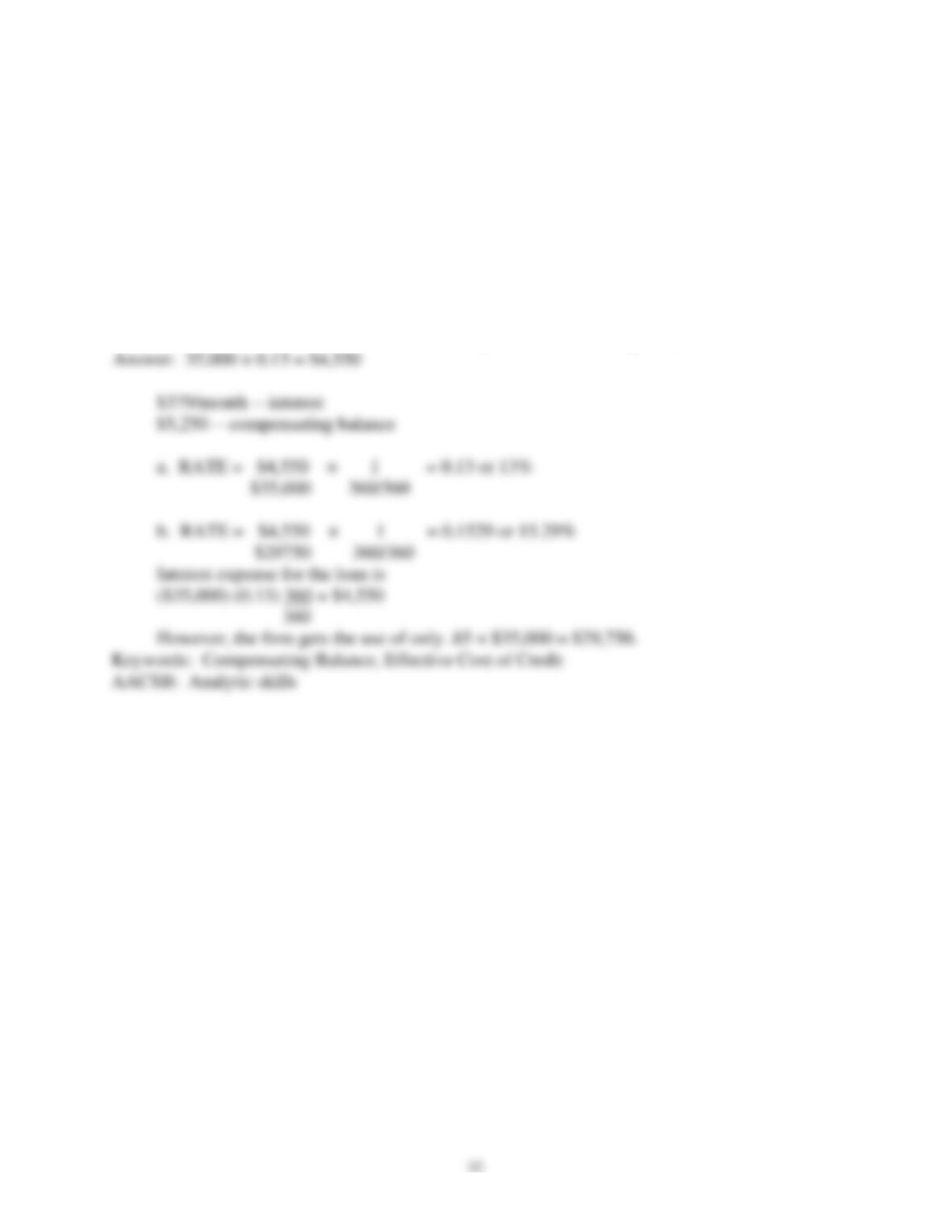
74) Dazzly Diamond Corp. called for credit at the Home Alone Bank of Paris, TX. The terms
included a $35,000 maximum loan with interest of 1 percent over prime, and the agreement also
requires a 15% compensating balance throughout the year. The prime rate is currently 12
percent.
a. If Dazzly Diamond Corp. maintains a balance in its account of $5,250 to $6,000, what is
the effective cost of credit through the line-of-credit agreement where the maximum amount of
the loan is used?
b. Recompute the effective cost of credit to Dazzly Diamond if it will have to borrow the
compensating balance and the maximum amount possible under the agreement.
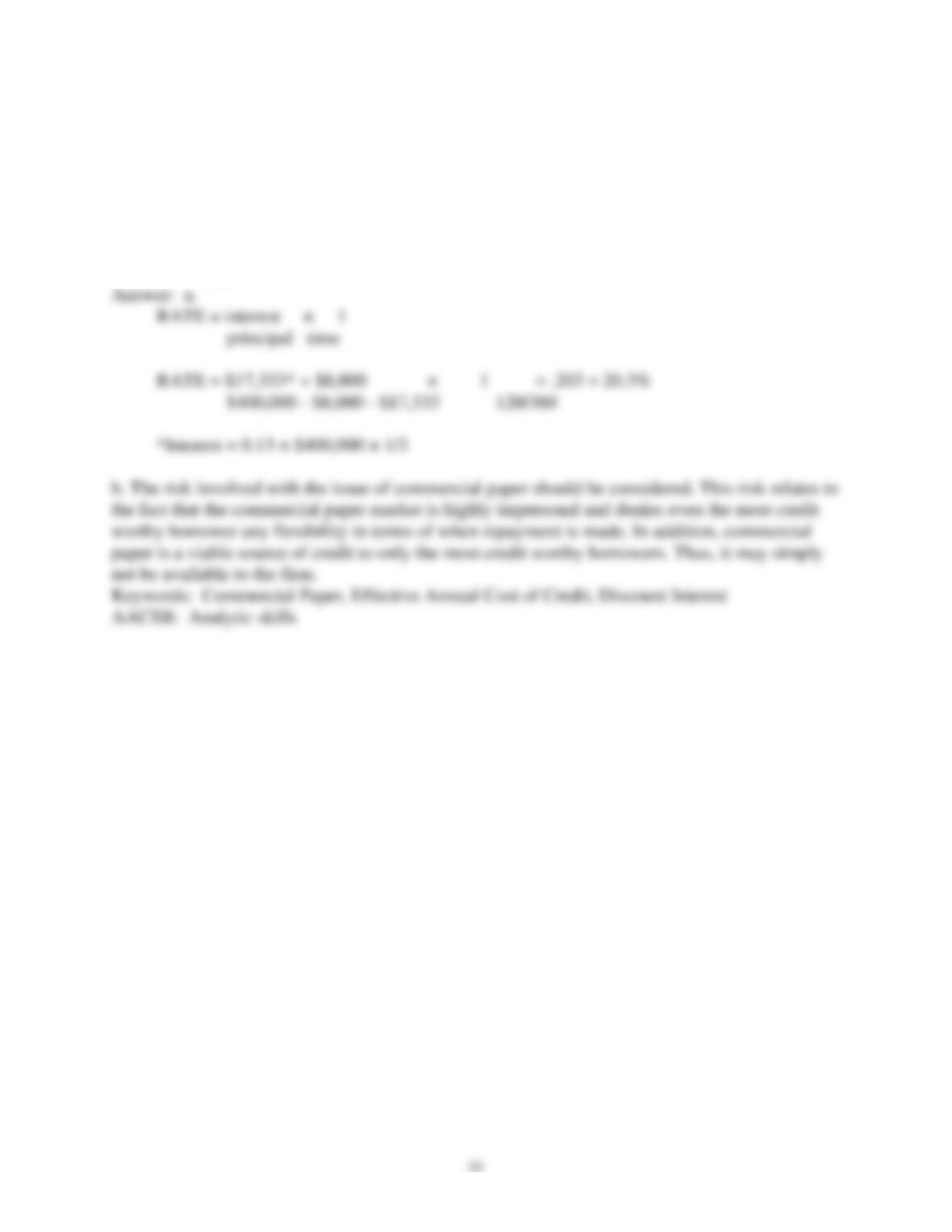
75) Quincy Fathows & Co. plans to issue commercial paper for the first time in its 85-year
history. The firm plans to issue $400,000 in 120-day maturity notes. The paper will carry a 13%
quarterly compounded rate with discounted interest and will cost Quincy Fathows $8,000 in
advance to issue.
a. What is the effective cost of credit to Quincy Fathows?
b. What other factors should the firm consider in analyzing whether or not to issue the
commercial paper?
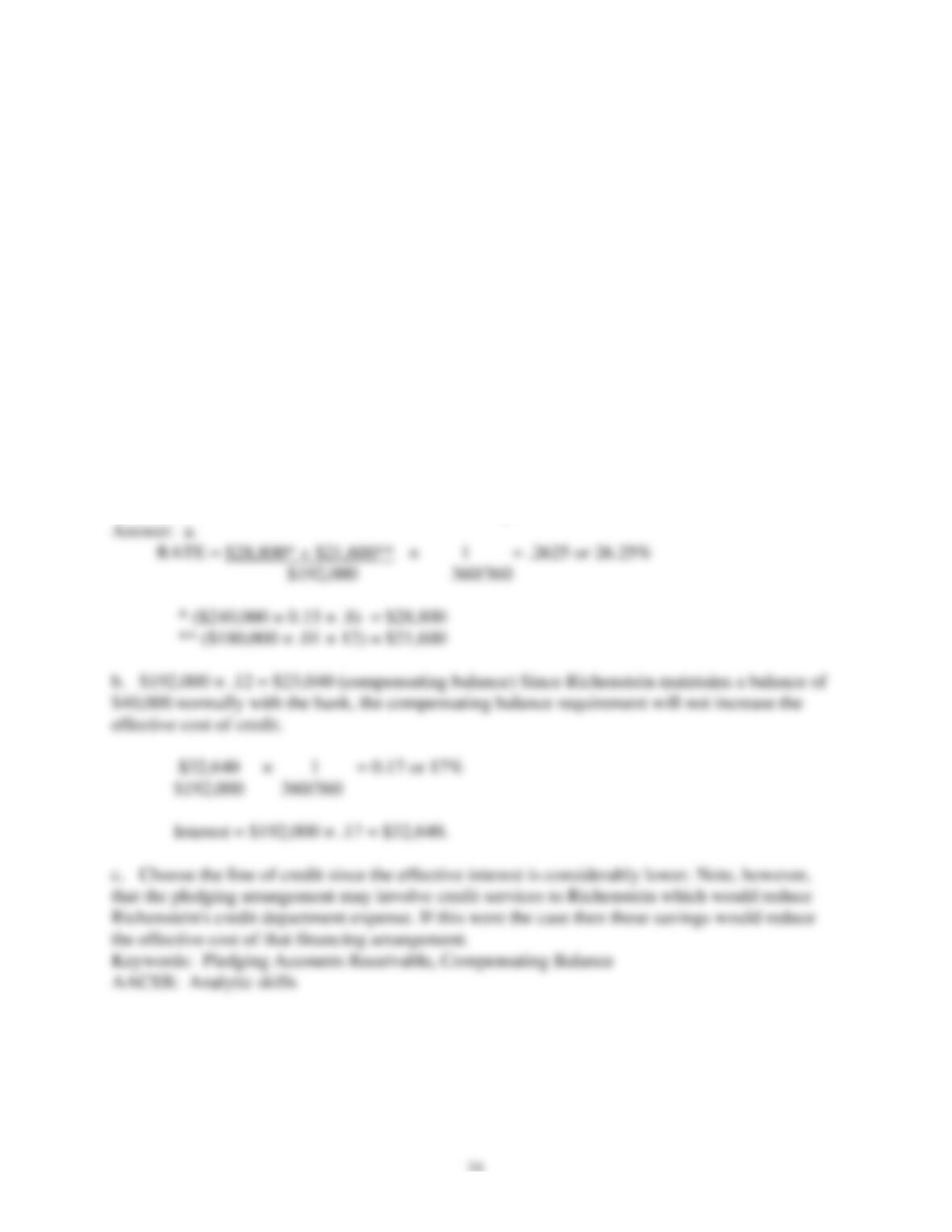
76) Richenstein Enterprises is in the business of selling dishwashers. The firm needs $192,000 to
finance an anticipated expansion in receivables due to increased sales. Richenstein’s credit terms
are net 40, and its average monthly credit sales are $180,000. In general, the firm’s customers
pay within the credit period; thus, the firm’s average accounts receivable balance is $240,000.
The comptroller of Richenstein Enterprises, Mr. Gee, approached their bank for the needed
capital, pledging the accounts receivable as collateral. The bank offered to make the loan at a rate
of 2 percent over prime plus a 1 percent processing charge on all receivables pledged. The bank
agreed to loan up to 80 percent of the face value of the receivables pledged.
a. Estimate the cost of the receivables loan to Richenstein where the firm borrows the $192,000.
The prime rate is currently 13%.
b. Gee also requested a line of credit for $192,000 from the bank. The bank agreed to grant the
necessary line of credit at a rate of 4% over prime and required a 12% compensating balance Gee
currently maintains an average demand deposit of $40,000. Estimate the cost of the line of credit
to Richenstein.
c. Which source of credit should Richenstein Enterprises select?
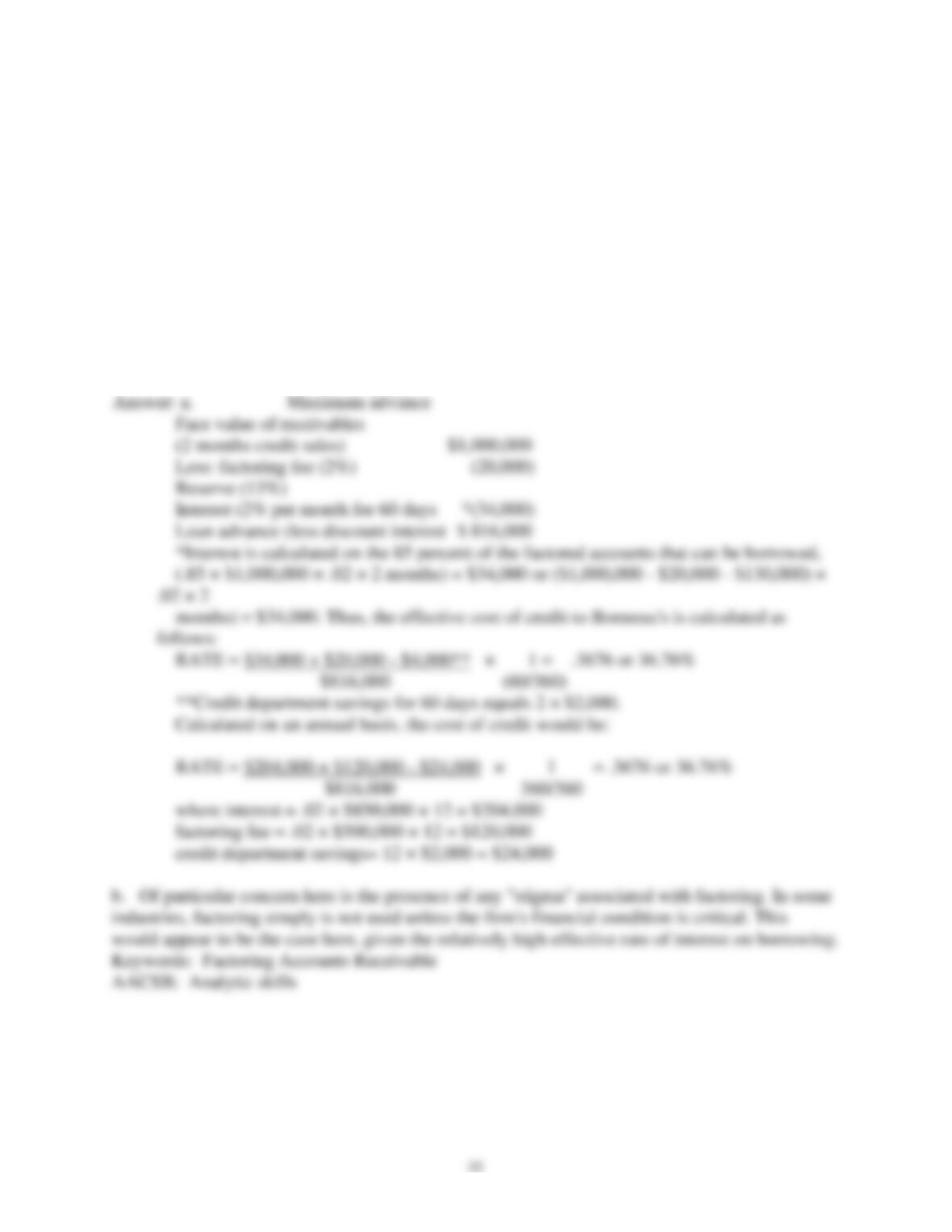
77) Bonneau Sunglass Co. is considering the factoring of its receivables. The firm has credit
sales of $500,000 per month and has an average receivables balance of $1,000,000 with 60-day
credit terms. The factor has offered to extend credit equal to 85% of the receivables factored less
interest on the loan at a rate of 2% per month. The 15% difference in the advance and face value
of all receivables factored consists of a 2% factoring fee plus a 13% reserve, which the factor
maintains. In addition, if Bonneau decides to factor its receivables, it will sell them all, so that it
can reduce its credit costs by $2,000 a month.
a. What is the cost of borrowing the maximum amount of credit available to Bonneau through
the factoring agreement?
b. What considerations other than cost should be accounted for by Bonneau in determining
whether or not to enter the factoring agreement?
78) Discuss the similarities and differences between a line of credit and a revolving credit
agreement.
79) Symco Corp. needs $500,000 for 90 days to get through a period of unexpectedly high oil
prices. Symco’s line of credit with the bank allows the company to borrow at 6% per year with a
compensating balance of 10% of the amount borrowed. Currently, Symco has no money on
deposit with the bank.
a. Calculate the amount Symco must borrow to meets its needs plus the compensating balance.
b. What is the annual percentage rate for this financing?
c. If the bank requires discount interest, what is the annual percentage rate for this financing?
80) AJAX Corp. needs $100,000 for the next 30 days. The company has $100,000 in cash it was
expecting to use to pay off accounts payable in order to take advantage of the 2/10 net 40 credit
terms. Another source of financing is a short-term bank loan with an interest rate of 20%.
Would you recommend AJAX borrow the $100,000 it needs from the bank and use the cash it
already has to pay its accounts payable and take the cash discount, or would you recommend the
company forgo the cash discount and use the $100,000 it has for its financing needs?
15.6 Learning Objective 6
1) Exchange rate risk may be handled by matching exposed assets with exposed liabilities.
2) A U.S. multinational corporation holds assets in Japan. Which of the following statements is
most correct if the value of the Japanese yen declines relative to the dollar?
A) The assets held in Japan will be worth more when expressed in dollar terms.
B) The multinational’s exchange rate exposure is determined by the assets held in Japan.
C) The multinational’s exchange rate exposure is determined by its net exposed position, which
is exposed assets minus exposed liabilities.
D) The multinational has no exchange rate risk because all reports are denominated in dollars.
3) Popular measures of foreign-exchange risk include all of the following except:
A) translation exposure.
B) economic exposure.
C) spontaneous risk.
D) transaction risk.
4) Define translation exposure, transaction exposure, and economic exposure.