Chapter 15: Capital Structure Decisions
45. Which of the following statements is CORRECT?
a. Since debt financing is cheaper than equity financing, raising a company’s debt ratio will always reduce its
WACC.
b. Increasing a company’s debt ratio will typically reduce the marginal cost of both debt and equity financing.
However, this action still may raise the company’s WACC.
c. Increasing a company’s debt ratio will typically increase the marginal cost of both debt and equity financing.
However, this action still may lower the company’s WACC.
d. Since a firm’s beta coefficient it not affected by its use of financial leverage, leverage does not affect the cost of
equity.
e. Since debt financing raises the firm’s financial risk, increasing a company’s debt ratio will always increase its
WACC.
46. Which of the following statements is CORRECT?
a. The capital structure that minimizes the interest rate on debt also maximizes the expected EPS.
b. The capital structure that minimizes the required return on equity also maximizes the stock price.
c. The capital structure that minimizes the WACC also maximizes the price per share of common stock.
d. The capital structure that gives the firm the best credit rating also maximizes the stock price.
e. The capital structure that maximizes expected EPS also maximizes the price per share of common stock.
Chapter 15: Capital Structure Decisions
47. Based on the information below for Benson Corporation, what is the optimal capital structure?
a. Debt = 50%; Equity = 50%; EPS = $3.05; Stock price = $28.90.
b. Debt = 60%; Equity = 40%; EPS = $3.18; Stock price = $31.20.
c. Debt = 80%; Equity = 20%; EPS = $3.42; Stock price = $30.40.
d. Debt = 70%; Equity = 30%; EPS = $3.31; Stock price = $30.00.
e. Debt = 40%; Equity = 60%; EPS = $2.95; Stock price = $26.50.
48. Which of the following statements best describes the optimal capital structure? The optimal capital structure is the mix
of debt, equity, and preferred stock that maximizes the company’s ____.
a. stock price.
b. cost of equity.
c. cost of debt.
d. cost of preferred stock.
e. earnings per share (EPS).
49. Which of the following statements is CORRECT?
a. The optimal capital structure simultaneously maximizes EPS and minimizes the WACC.
b. The optimal capital structure minimizes the cost of equity, which is a necessary condition for maximizing the
stock price.
c. The optimal capital structure simultaneously minimizes the cost of debt, the cost of equity, and the WACC.
d. The optimal capital structure simultaneously maximizes stock price and minimizes the WACC.
e. As a rule, the optimal capital structure is found by determining the debt-equity mix that maximizes expected EPS.
Chapter 15: Capital Structure Decisions
50. The firm’s target capital structure should be consistent with which of the following statements?
a. Minimize the cost of debt (rd).
b. Obtain the highest possible bond rating.
c. Minimize the cost of equity (rs).
d. Minimize the weighted average cost of capital (WACC).
e. Maximize the earnings per share (EPS).
51. Which of the following statements is CORRECT?
a. The factors that affect a firm’s business risk are affected by industry characteristics and economic conditions.
Unfortunately, these factors are generally beyond the control of the firm’s management.
b. One of the benefits to a firm of being at or near its target capital structure is that this eliminates any risk of
bankruptcy.
c. A firm’s financial risk can be minimized by diversification.
d. The amount of debt in its capital structure can under no circumstances affect a company’s business risk.
e. A firm’s business risk is determined solely by the financial characteristics of its industry.
Chapter 15: Capital Structure Decisions
52. Which of the following statements is CORRECT?
a. If a firm lowered its fixed costs while increasing its variable costs, holding total costs at the present level of sales
constant, this would decrease its operating leverage.
b. The debt ratio that maximizes EPS generally exceeds the debt ratio that maximizes share price.
c. If a company were to issue debt and use the money to repurchase common stock, this action would have no
impact on its return on invested capital. (Assume that the repurchase has no impact on the company’s operating income.)
d. If changes in the bankruptcy code made bankruptcy less costly to corporations, this would likely reduce the
average corporation’s debt ratio.
e. Increasing financial leverage is one way to increase a firm’s return on invested capital.
53. Companies HD and LD have identical tax rates, total assets, and return on invested capital (ROIC), and their ROIC
exceeds their after-tax cost of debt, (1–T) rd. However, Company HD has a higher debt ratio and thus more interest
expense than Company LD. Which of the following statements is CORRECT?
a. Company HD has a lower ROA than Company LD.
b. Company HD has a lower ROE than Company LD.
c. The two companies have the same ROA.
d. The two companies have the same ROE.
e. Company HD has a higher net income than Company LD.
Chapter 15: Capital Structure Decisions
54. Firms U and L both have a return on invested capital (ROIC) of 12% and each has the same amount of assets. Firm U
is unleveraged, i.e., it is 100% equity financed, while Firm L is financed with 50% debt and 50% equity. Firm L’s debt has
an after-tax cost of 4.8%. Both firms have positive net income. Which of the following statements is CORRECT?
a. Firm L has a lower ROA than Firm U.
b. Firm L has a lower ROE than Firm U.
c. Firm L has the higher times interest earned (TIE) ratio.
d. Firm L has a higher EBIT than Firm U.
e. The two companies have the same times interest earned (TIE) ratio.
55. Two operationally similar companies, HD and LD, have the same total assets, operating income (EBIT), tax rate, and
business risk. Company HD, however, has a much higher debt ratio than LD. Also HD‘s return on invested capital
(ROIC) exceeds its after-tax cost of debt, (1–T)rd. Which of the following statements is CORRECT?
a. HD should have a higher times interest earned (TIE) ratio than LD.
b. HD should have a higher return on equity (ROE) than LD, but its risk, as measured by the standard deviation of
ROE, should also be higher than LD’s.
c. Given that ROIC > (1–T) rd, HD’s stock price must exceed that of LD.
d. Given that ROIC > (1–T) rd, LD‘s stock price must exceed that of HD.
e. HD should have a higher return on assets (ROA) than LD.
Chapter 15: Capital Structure Decisions
56. Which of the following statements is CORRECT?
a. The capital structure that maximizes the stock price is generally the capital structure that also maximizes earnings
per share.
b. All else equal, an increase in the corporate tax rate would tend to encourage a company to increase its debt ratio.
c. Since debt financing raises the firm’s financial risk, increasing a company’s debt ratio will always increase its
WACC.
d. Since debt is cheaper than equity, increasing a company’s debt ratio will always reduce its WACC.
e. When a company increases its debt ratio, the costs of equity and debt both increase. Therefore, the WACC must
also increase.
57. Two operationally similar companies, HD and LD, have identical amounts of assets, operating income (EBIT), tax
rates, and business risk. Company HD, however, has a much higher debt ratio than LD. Company HD’s return on invested
capital (ROIC) exceeds its after-tax cost of debt, (1–T) rd. Which of the following statements is CORRECT?
a. Company HD has a higher times interest earned (TIE) ratio than Company LD.
b. Company HD has a higher return on equity (ROE) than Company LD, and its risk, as measured by the standard
deviation of ROE, is also higher than LD’s.
c. The two companies have the same ROE.
d. Company HD’s ROE would be higher if it had no debt.
e. Company HD has a higher return on assets (ROA) than Company LD.
58. Bailey and Sons has a levered beta of 1.10, its capital structure consists of 40% debt and 60% equity, and its tax rate is
25%. What would Bailey’s beta be if it used no debt, i.e., what is its unlevered beta?
a. 0.60
Chapter 15: Capital Structure Decisions
b. 0.63
c. 0.66
d. 0.70
e. 0.73
59. The following information has been presented to you about the Gibson Corporation.
Total assets $3,000 million Tax rate 25%
Operating income (EBIT) $800 million Debt ratio 0%
Interest expense $0 million WACC 10%
Net income $480 million M/B ratio 1.00×
Share price $32.00 EPS = DPS $3.20
The company has no growth opportunities (g = 0), so the company pays out all of its earnings as dividends (EPS = DPS).
The consultant believes that if the company moves to a capital structure financed with 20% debt and 80% equity (based
on market values) that the cost of equity will increase to 11% and that the pre-tax cost of debt will be 8%. If the company
makes this change, what would be the total market value (in millions) of the firm?
a. $4,400
b. $4,800
c. $5,200
d. $5,400
e. $6,000
Chapter 15: Capital Structure Decisions
60. Morales Publishing’s tax rate is 25%, its beta is 1.10, and it uses no debt. However, the CFO is considering moving to
a capital structure with 30% debt and 70% equity. If the risk-free rate is 5.0% and the market risk premium is 6.0%, by
how much would the capital structure shift change the firm’s cost of equity?
a. 1.91%
b. 2.12%
c. 2.33%
d. 2.57%
e. 2.82%
61. Serendipity Inc. is re-evaluating its debt level. Its current capital structure consists of 80% debt and 20% common
equity, its beta is 1.60, and its tax rate is 25%. However, the CFO thinks the company has too much debt, and he is
Chapter 15: Capital Structure Decisions
considering moving to a capital structure with 40% debt and 60% equity. The risk-free rate is 5.0% and the market risk
premium is 6.0%. By how much would the capital structure shift change the firm’s cost of equity?
a. −5.40%
b. −6.00%
c. −6.60%
d. −7.26%
e. −7.99%
62. Laramie Trucking’s CEO is considering a change to the company’s capital structure, which currently consists of 25%
debt and 75% equity. The CFO believes the firm should use more debt, but the CEO is reluctant to increase the debt ratio.
The risk-free rate, rRF, is 5.0%, the market risk premium, RPM, is 6.0%, and the firm’s tax rate is 25%. Currently, the cost
of equity, rs, is 11.5% as determined by the CAPM. What would be the estimated cost of equity if the firm used 60%
debt? (Hint: You must first find the current beta and then the unlevered beta to solve the problem.)
a. 11.50%
b. 12.50%
c. 13.58%
d. 14.77%
e. 16.05%
Chapter 15: Capital Structure Decisions
63. An all-equity firm with 200,000 shares outstanding, Antwerther Inc., has $2,000,000 of EBIT, which is expected to
remain constant in the future. The company pays out all of its earnings, so earnings per share (EPS) equal dividends per
shares (DPS). Its tax rate is 25%.
The company is considering issuing $5,000,000 of 10.0% bonds and using the proceeds to repurchase stock. The risk-free
rate is 6.5%, the market risk premium is 5.0%, and the beta is currently 0.90, but the CFO believes beta would rise to 1.10
if the recapitalization occurs.
Assuming that the shares can be repurchased at the price that existed prior to the recapitalization, what would the price be
following the recapitalization?
a. $70.31
b. $74.01
c. $77.71
d. $81.60
e. $85.68
Chapter 15: Capital Structure Decisions
64. Cartwright Communications is considering making a change to its capital structure to reduce its cost of capital and
increase firm value. Right now, Cartwright has a capital structure that consists of 20% debt and 80% equity, based on
market values. (Its D/S ratio is 0.25.) The risk-free rate is 6% and the market risk premium, rM − rRF, is 5%. Currently the
company’s cost of equity, which is based on the CAPM, is 12% and its tax rate is 25%. What would be Cartwright’s
estimated cost of equity if it were to change its capital structure to 50% debt and 50% equity?
a. 13.00%
b. 13.65%
c. 14.84%
d. 15.58%
e. 16.00%
Chapter 15: Capital Structure Decisions
65. LeCompte Learning Solutions is considering making a change to its capital structure in hopes of increasing its value.
The company’s capital structure consists of debt and common stock. In order to estimate the cost of debt, the company has
produced the following table:
Percent financed Percent financed Debt-to-equity Bond Before-tax
with debt (wd) with equity (ws) ratio = wd/ws = (D/S) Rating cost of debt
0.10 0.90 0.10/0.90 = 0.11 AAA 7.0%
0.20 0.80 0.20/0.80 = 0.25 AA 7.2
0.30 0.70 0.30/0.70 = 0.43 A 8.0
0.40 0.60 0.40/0.60 = 0.67 BBB 8.8
0.50 0.50 0.50/0.50 = 1.00 BB 9.6
The company uses the CAPM to estimate its cost of common equity, rs. The risk-free rate is 5% and the market risk
premium is 6%. LeCompte estimates that if it had no debt its beta would be 1.0. (Its “unlevered beta,” bU, equals 1.0.) The
company’s tax rate, T, is 25%.
On the basis of this information, what is LeCompte’s optimal capital structure, and what is the firm’s cost of capital at this
optimal capital structure?
a. ws = 0.9; wd = 0.1; WACC = 11.73%
b. ws = 0.8; wd = 0.2; WACC = 10.78%
c. ws = 0.7; wd = 0.3; WACC = 9.11%
d. ws = 0.6; wd = 0.4; WACC = 9.50%
e. ws = 0.5; wd = 0.5; WACC = 11.37%
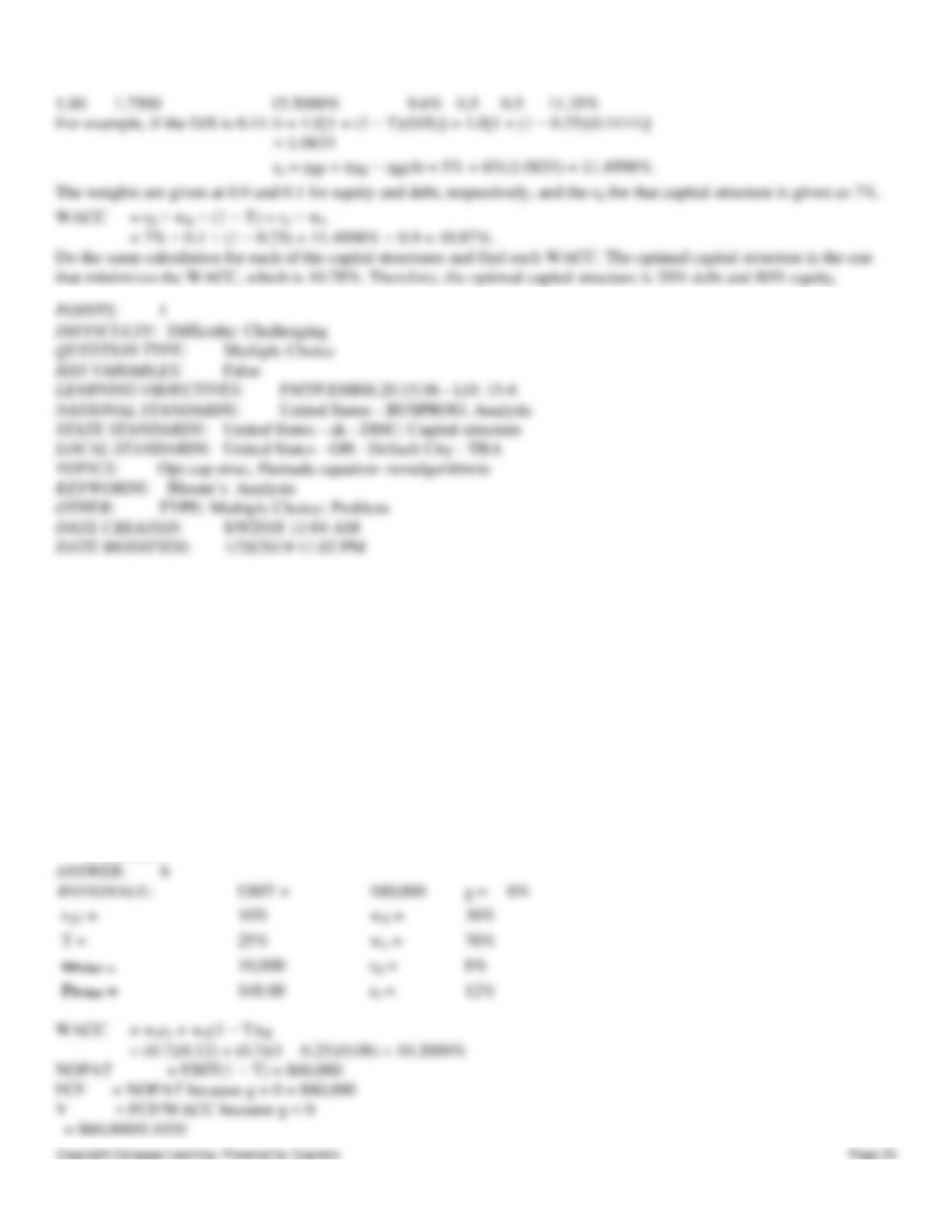
0.67 1.5000 14.0002% 8.8% 0.6 0.4 11.04%
Chapter 15: Capital Structure Decisions
Pennewell Publishing Inc. (PP)
Pennewell Publishing Inc. (PP) is a zero growth company. It currently has zero debt and its earnings before interest and
taxes (EBIT) are $80,000. PP’s current cost of equity is 10%, and its tax rate is 25%. The firm has 10,000 shares of
common stock outstanding selling at a price per share of $48.00.
66. Refer to the data for Pennewell Publishing Inc. (PP). PP is considering changing its capital structure to one with 30%
debt and 70% equity, based on market values. The debt would have an interest rate of 8%. The new funds would be used
to repurchase stock. It is estimated that the increase in risk resulting from the added leverage would cause the required rate
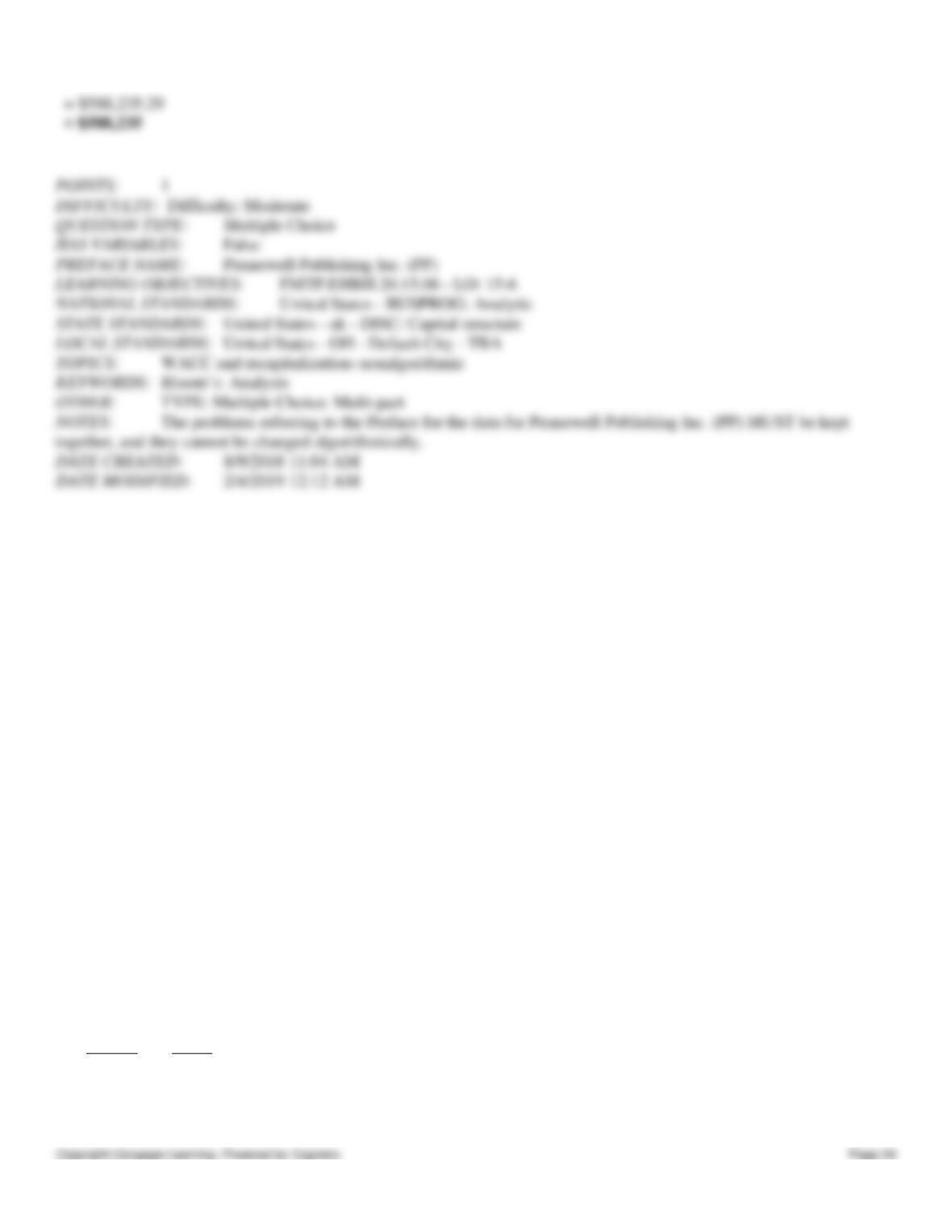
of return on equity to rise to 12%. If this plan were carried out, what would be PP’s new value of operations?
a. $552,941
b. $588,235
c. $617,647
d. $648,529
e. $680,956
Chapter 15: Capital Structure Decisions
VanMannen Foundations, Inc. (VF)
VanMannen Foundations, Inc. (VF) is a zero-growth company that currently has zero debt, and it has the data shown
below.
EBIT = $80,000
Growth = 0%
Orig cost of equity, rs = 10.0%
No. of shares = 10,000
Price per share = $60.00
Tax rate = 25%
67. Refer to the data for VanMannen Foundations, Inc. (VF). Now the company is considering using some debt, moving
to the market value capital structure indicated below. The money raised would be used to repurchase stock. It is
estimated that the increase in risk resulting from the additional leverage would cause the required rate of return on equity
to rise somewhat, as indicated below. If this plan were carried out, what would be VF’s new WACC and its new value of
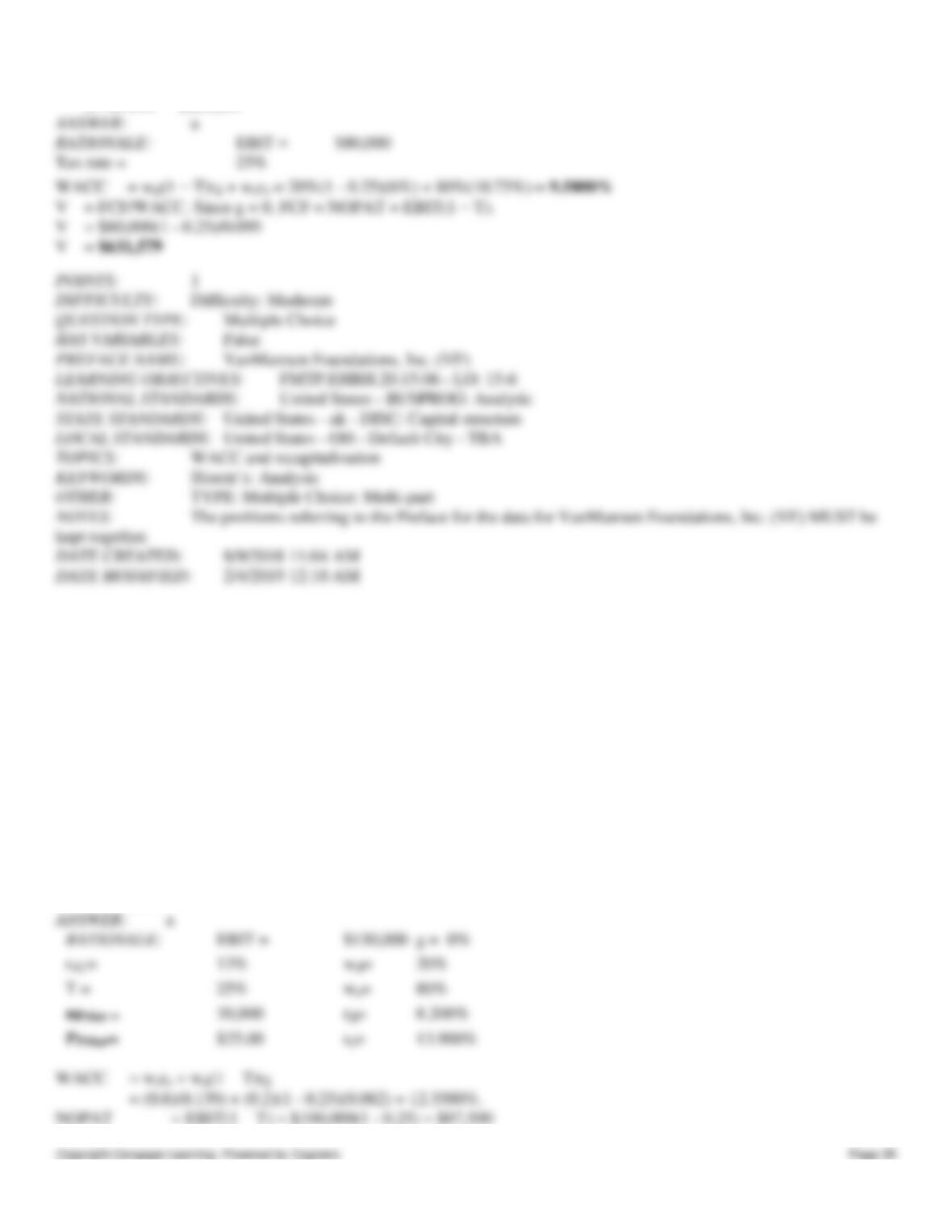
operations?
New interest rate = rd = 6.00%
New cost of equity = rs = 10.75%
New Debt/Value = wd = 20%
New Equity/Value = ws = 80%
WACC Value
a. 9.50% $631,579
b. 9.80% $644,211
c. 10.10% $657,095
d. 10.40% $670,237
Chapter 15: Capital Structure Decisions
e. 10.70% $683,641
Best Bagels, Inc. (BB)
Best Bagels, Inc. (BB) currently has zero debt. Its earnings before interest and taxes (EBIT) are $130,000, and it is a zero
growth company. BB’s current cost of equity is 13%, and its tax rate is 25%. The firm has 30,000 shares of common
stock outstanding selling at a price per share of $25.
68. Refer to the data for Best Bagels, Inc. (BB). BB is considering moving to a capital structure that is comprised of 20%
debt and 80% equity, based on market values. The debt would have an interest rate of 8.2%. The new funds would be
used to repurchase stock. It is estimated that the increase in risk resulting from the additional leverage would cause the
required rate of return on equity to rise to 13.9%. If this plan were carried out, what would BB’s new value of operations
be?
a. $789,474
b. $821,053
c. $853,895
d. $888,051
e. $923,573