Chapter 15: Web 15B Bond Refunding
1. Suppose a company issued 30-year bonds 4 years ago, when the yield curve was inverted. Since then long-term rates
(10 years or longer) have remained constant, but the yield curve has resumed its normal upward slope. Under such
conditions, a bond refunding would almost certainly be profitable.
a. True
b. False
2. The appropriate discount rate to use when analyzing a refunding decision is the after-tax cost of new debt, in part
because there is relatively little risk of not realizing the interest savings.
a. True
b. False
3. If the firm uses the after-tax cost of new debt as the discount rate when analyzing a refunding decision, and if the NPV
of refunding is positive, then the value of the firm will be maximized if it immediately calls the outstanding debt and
replaces it with an issue that has a lower coupon rate.
a. True
b. False
Chapter 15: Web 15B Bond Refunding
4. When a firm refunds a debt issue, the firm’s stockholders gain and its bondholders lose. This points out the risk of a call
provision to bondholders and explains why a non-callable bond will typically command a higher price than an otherwise
similar callable bond.
a. True
b. False
5. Which of the following factors would increase the likelihood that a company would call its outstanding bonds at this
time?
a. A provision in the bond indenture lowers the call price on specific dates, and yesterday was one of those dates.
b. The flotation costs associated with issuing new bonds rise.
c. The firm’s CFO believes that interest rates are likely to decline in the future.
d. The firm’s CFO believes that corporate tax rates are likely to be increased in the future.
e. The yield to maturity on the company’s outstanding bonds increases due to a weakening of the firm’s financial
situation.
Chapter 15: Web 15B Bond Refunding
6. 10 years ago, the City of Melrose issued $3,000,000 of 8% coupon, 30-year, semiannual payment, tax-exempt muni
bonds. The bonds had 10 years of call protection, but now the bonds can be called if the city chooses to do so. The call
premium would be 6% of the face amount. New 20-year, 6%, semiannual payment bonds can be sold at par, but flotation
costs on this issue would be 2% of the amount of bonds sold. What is the net present value of the refunding? Note that
cities pay no income taxes, hence taxes are not relevant.
a. $453,443
b. $476,115
c. $499,921
d. $524,917
e. $551,163
Chapter 15: Web 15B Bond Refunding
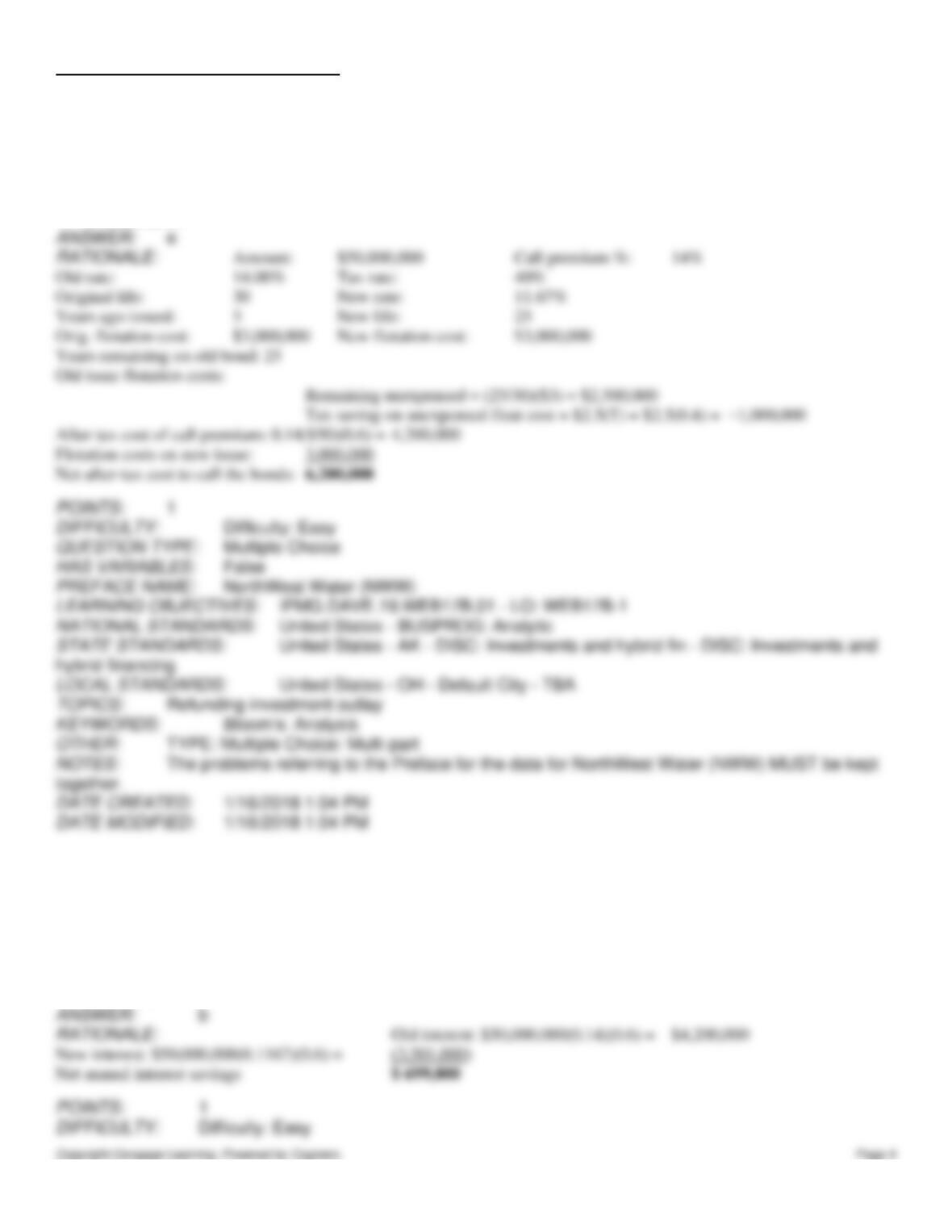
7. Refer to the data for NorthWest Water (NWW). What is the required after-tax refunding investment outlay, i.e., the
cash outlay at the time of the refunding?
a. $5,049,939
b. $5,315,725
c. $5,595,500
d. $5,890,000
e. $6,200,000
8. Refer to the data for NorthWest Water (NWW). What will the after-tax annual interest savings for NWW be if the
refunding takes place?
a. $664,050
b. $699,000
c. $768,900
d. $845,790
e. $930,369
Chapter 15: Web 15B Bond Refunding
9. Refer to the data for NorthWest Water (NWW). The amortization of flotation costs reduces taxes and thus provides an
annual cash flow. What will the net increase or decrease in the annual flotation cost tax savings be if refunding takes
place?
a. $6,480
b. $7,200
c. $8,000
d. $8,800
e. $9,680
10. Refer to the data for NorthWest Water (NWW). What is the NPV if NWW refunds its bonds today?
a. $1,746,987
b. $1,838,933
c. $1,935,719
d. $2,037,599
Chapter 15: Web 15B Bond Refunding
e. $2,241,359
11. Five years ago, the State of Oklahoma issued $2,000,000 of 7% coupon, 20-year semiannual payment, tax-exempt
bonds. The bonds had 5 years of call protection, but now the state can call the bonds if it chooses to do so. The call
premium would be 5% of the face amount. Today 15-year, 5%, semiannual payment bonds can be sold at par, but
flotation costs on this issue would be 2%. What is the net present value of the refunding? Because these are tax-exempt
bonds, taxes are not relevant.
a. $278,606
b. $292,536
c. $307,163
d. $322,521
e. $338,647
Chapter 15: Web 15B Bond Refunding
12. Which of the following statements is most CORRECT?
a. The key benefits associated with refunding debt are the reduction in the firm’s debt ratio and the creation of more
reserve borrowing capacity.
b. The mechanics of finding the NPV of a refunding decision are fairly straightforward. However, the decision of
when to refund is not always clear because it requires a forecast of future interest rates.
c. If a firm with a positive NPV refunding project delays refunding and interest rates rise, the firm can still obtain
the entire NPV by locking in a low coupon rate when the rates are low, even though it actually refunds the debt after rates
have risen.
d. Suppose a firm is considering refunding and interest rates rise during time when the analysis is being done. The
rise in rates would tend to lower the expected price of the new bonds, which would make them cheaper to the firm and
thus increase the expected interest savings.
e. If new debt is used to refund old debt, the correct discount rate to use in the refunding analysis is the before-tax
cost of new debt.
13. Palmer Company has $5,000,000 of 15-year maturity bonds outstanding. Each bond has a maturity value of $1,000, an
annual coupon of 12.0%. The bonds can be called at any time with a premium of $50 per bond. If the bonds are called, the
company must pay flotation costs of $10 per new refunding bond. Ignore tax considerations⎯assume that the firm’s tax
rate is zero.
The company’s decision of whether to call the bonds depends critically on the current interest rate on newly issued bonds.
What is the breakeven interest rate, the rate below which it would be profitable to call in the bonds?
a. 9.57%
b. 10.07%
c. 10.60%
d. 11.16%
Chapter 15: Web 15B Bond Refunding
e. 11.72%
14. Stanovich Enterprises has 10-year, 12.0% semiannual coupon bonds outstanding. Each bond is now eligible to be
called at a call price of $1,060. If the bonds are called, the company must replace them with new 10-year bonds. The
flotation cost of issuing new bonds is estimated to be $45 per bond. How low would the yield to maturity on the new
bonds have to be in order for it to be profitable to call the bonds today, i.e., what is the nominal annual “breakeven rate”?
a. 9.29%
b. 9.78%
c. 10.29%
d. 10.81%
e. 11.35%
Chapter 15: Web 15B Bond Refunding