Money, Banking, and the Financial System (Hubbard/O’Brien)
Chapter 15 Monetary Policy
15.1 The Goals of Monetary Policy
1) Which of the following is NOT considered to be a goal of monetary policy?
A) fair wages
B) high employment
C) economic growth
D) price stability
2) Which of the following is considered to be a goal of monetary policy?
A) a low federal budget deficit
B) fair wages
C) price stability
D) an end to poverty
3) Inflation is an economic problem because it
A) leads inevitably to unemployment.
B) makes prices less useful as signals for resource allocation.
C) leads to recession.
D) results in rapid increases in the money supply.
4) Rates of inflation in the hundreds or thousands of percent per year are known as
A) super inflation.
B) megainflation.
C) hyperinflation.
D) overinflation.
5) Which of the following countries experienced hyperinflation during the 1920s?
A) The United States
B) Canada
C) Germany
D) England
6) The Employment Act of 1946 codified the federal government’s commitment to
A) promote high employment consistent with price stability.
B) promote high employment irrespective of the effects on price stability.
C) guarantee a job to every unemployed person.
D) fine companies that engage in excessive layoffs during recessions.
7) Most economists believe that a zero rate of unemployment
A) is obtainable with the correct monetary policy.
B) would result in a better functioning economy.
C) is inconsistent with a well-functioning economy.
D) is obtainable only if the inflation rate is also zero.
8) John Smith leaves his job in New York to go to California in hopes of finding a better one. If
John Smith is unemployed while searching for a job in California, economists would consider
him to be
A) frictionally unemployed.
B) structurally unemployed.
C) cyclically unemployed.
D) naturally unemployed.
9) When all workers who want jobs have them and the demand for and supply of labor are in
equilibrium,
A) the unemployment rate will be zero.
B) unemployment is at its natural rate.
C) the economy will be experiencing high rates of inflation.
D) frictional unemployment will be zero.
10) Which of the following statements about the natural rate of unemployment is correct?
A) Currently, most economists think that the natural rate is between 5% and 6%.
B) Currently, most economists believe the natural rate is zero.
C) When unemployment is at its natural rate, then only frictional unemployment remains.
D) When unemployment is at its natural rate, then only structural unemployment remains.
11) The unemployment that is caused by changes in the economy, such as shifts in
manufacturing techniques, increased use of computers and electronic machines, and increases in
the production of services instead of goods, is called
A) frictional unemployment.
B) structural unemployment.
C) cyclical unemployment.
D) natural unemployment.
12) Sally Jones lost her job at a steel company because of a permanent decline in the demand for
steel. Sally Jones is considered by economists to be
A) naturally unemployed.
B) cyclically unemployed.
C) structurally unemployed.
D) frictionally unemployed.
13) High employment spurs economic growth because high employment
A) usually reduces inflation.
B) discourages foreign imports.
C) often leads to a high birth rate.
D) often leads to high rates of investment.
14) When financial markets and institutions are not efficient in matching savers and borrowers,
A) interest rates fall, which discourages saving even further.
B) interest rates fall, which discourages investment even further.
C) resources are lost.
D) investment rises.
15) Why did the Fed expand discount lending in the aftermath of the terrorist attacks in the fall
of 2001?
A) It feared that inflation was going to increase.
B) To ensure the smooth operation of banks in the affected areas.
C) It feared the effects on the U.S. economy of rising oil prices.
D) It was attempting to increase the chances that President Bush would be reelected.
16) The Fed was created
A) after financial panics in the late 1800s and early 1900s.
B) after the stock market crash of 1929.
C) to help finance government expenditures during World War II.
D) to help channel funds to the residential mortgage market.
17) Interest rate fluctuations
A) are usually not considered to be of much importance and are largely ignored by the Fed.
B) have the paradoxical effect of increasing the rate of economic growth.
C) make it difficult for households and firms to plan for the future.
D) have largely been eliminated by the Fed during the past two decades.
18) Increases in interest rates are often blamed on
A) Congress.
B) the President.
C) the Fed.
D) the U.S. Treasury.
19) The Fed’s goal of interest rate stability
A) was formally abandoned in 1998.
B) is motivated by political pressure as well as by a desire for a stable saving and investment
environment.
C) is undermined by actions the Fed takes to further its goal of stability in financial markets and
institutions.
D) is undermined by actions the Fed takes to further its goal of price stability.
20) A rising dollar makes U.S. goods
A) more expensive abroad and increases the volume of U.S. exports.
B) less expensive abroad and increases the volume of U.S. exports.
C) less expensive abroad and decreases the volume of U.S. exports.
D) more expensive abroad and decreases the volume of U.S. exports.
21) A falling dollar makes U.S. goods
A) more expensive abroad and increases the volume of U.S. exports.
B) less expensive abroad and increases the volume of U.S. exports.
C) less expensive abroad and decreases the volume of U.S. exports.
D) more expensive abroad and decreases the volume of U.S. exports.
22) Describe the three types of unemployment?
23) On which type of unemployment can monetary policy have the most effect? Why?
24) Which types of unemployment still occur even when the economy is considered to be
operating at full employment?
15.2 Monetary Policy Tools and the Federal Funds Rate
1) Reserve requirements are set by
A) the Secretary of Treasury.
B) the President.
C) Congress.
D) the Fed.
2) Reserve requirements are changed
A) more frequently than the discount rate is changed, but less frequently than open market
operations are conducted.
B) more frequently than the discount rate is changed and more frequently than open market
operations are conducted.
C) more frequently than open market operations are conducted, but less frequently than the
discount rate is changed.
D) less frequently than open market operations are conducted and less frequently than the
discount rate is changed.
3) How many times has the Fed has changed reserve requirements since 1995?
A) never.
B) about once a year.
C) only once.
D) only twice.
4) The Fed monitors reserve requirements
A) daily.
B) during two-week maintenance periods.
C) monthly.
D) annually.
5) In the federal funds market diagram, an open market sale by the Fed
A) shifts the reserve supply curve to the right.
B) shifts the reserve supply curve to the left.
C) decreases the federal funds rate.
D) increases the volume of federal funds traded.
6) In the federal funds market diagram, a decrease in the required reserve ratio
A) shifts the demand curve for reserves to the left.
B) increases the federal funds rate.
C) results in a multiple expansion of deposits, which increases the equilibrium level of reserves
held by banks.
D) shifts the supply curve for reserves to the right.
7) In order to increase its target for the federal funds rate, the Fed would normally
A) conduct open market sales.
B) conduct open market purchases.
C) increase the discount rate.
D) increase reserve requirements.
8) If the Fed desired to reduce the federal funds rate,
A) it would conduct an open market sale, reducing reserve supply.
B) it would conduct an open market purchase, increasing reserve supply.
C) it would conduct an open market sale, increasing reserve demand.
D) it would conduct an open market purchase, reducing reserve demand.
9) As a result of an open market purchase, bank reserves
A) rise and interest rates fall.
B) fall and interest rates rise.
C) and interest rates both rise.
D) and interest rates both fall.
10) What new policy tools for controlling reserve balances did the Fed introduce during the
Financial Crisis of 2007-2009?
11) How does the interest paid on reserves set a floor for the federal funds rate?
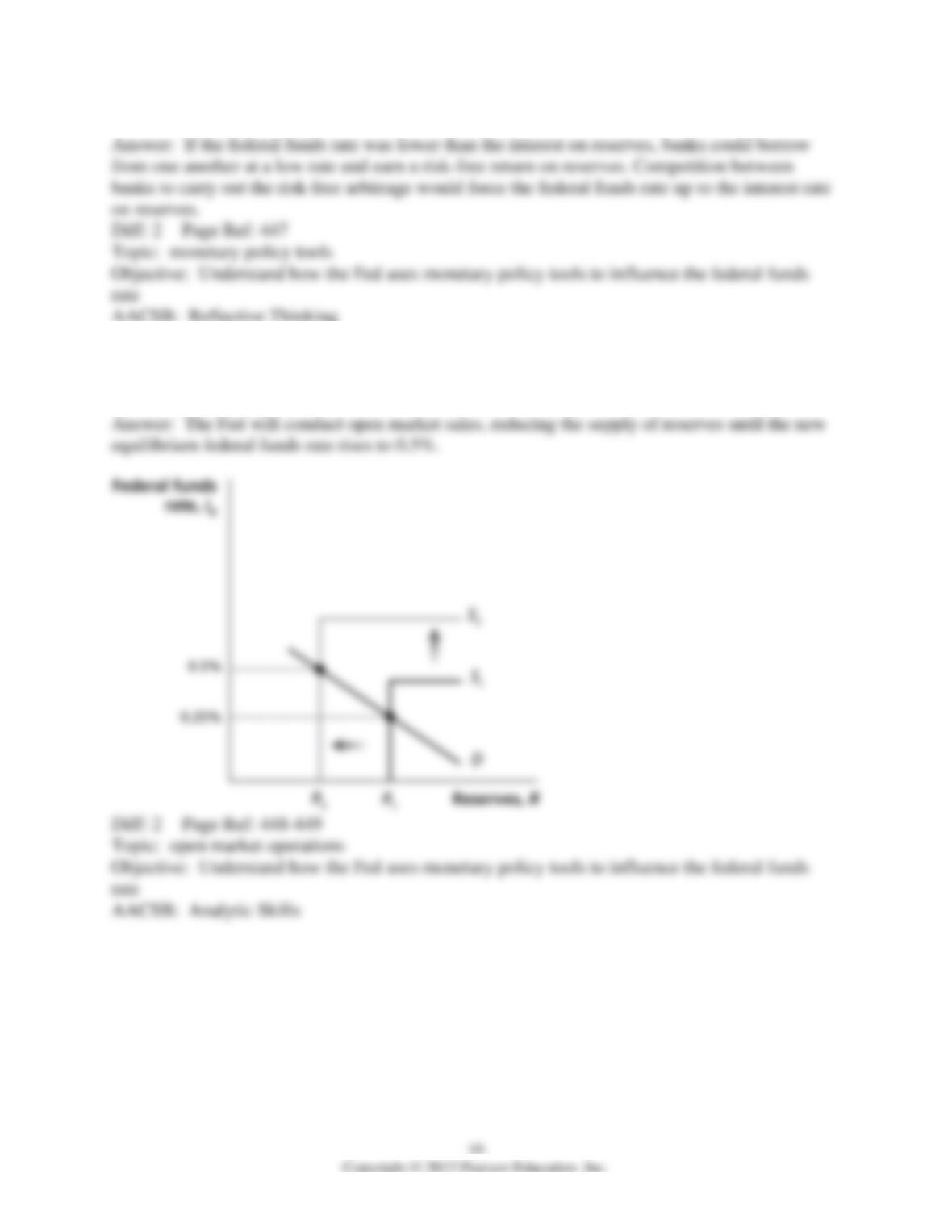
12) Suppose the current federal funds rate is 0.25% and the Fed chooses to raise its target to
0.5%. Make use of a graph of the federal funds market to show how it will use open market
operations to accomplish this.
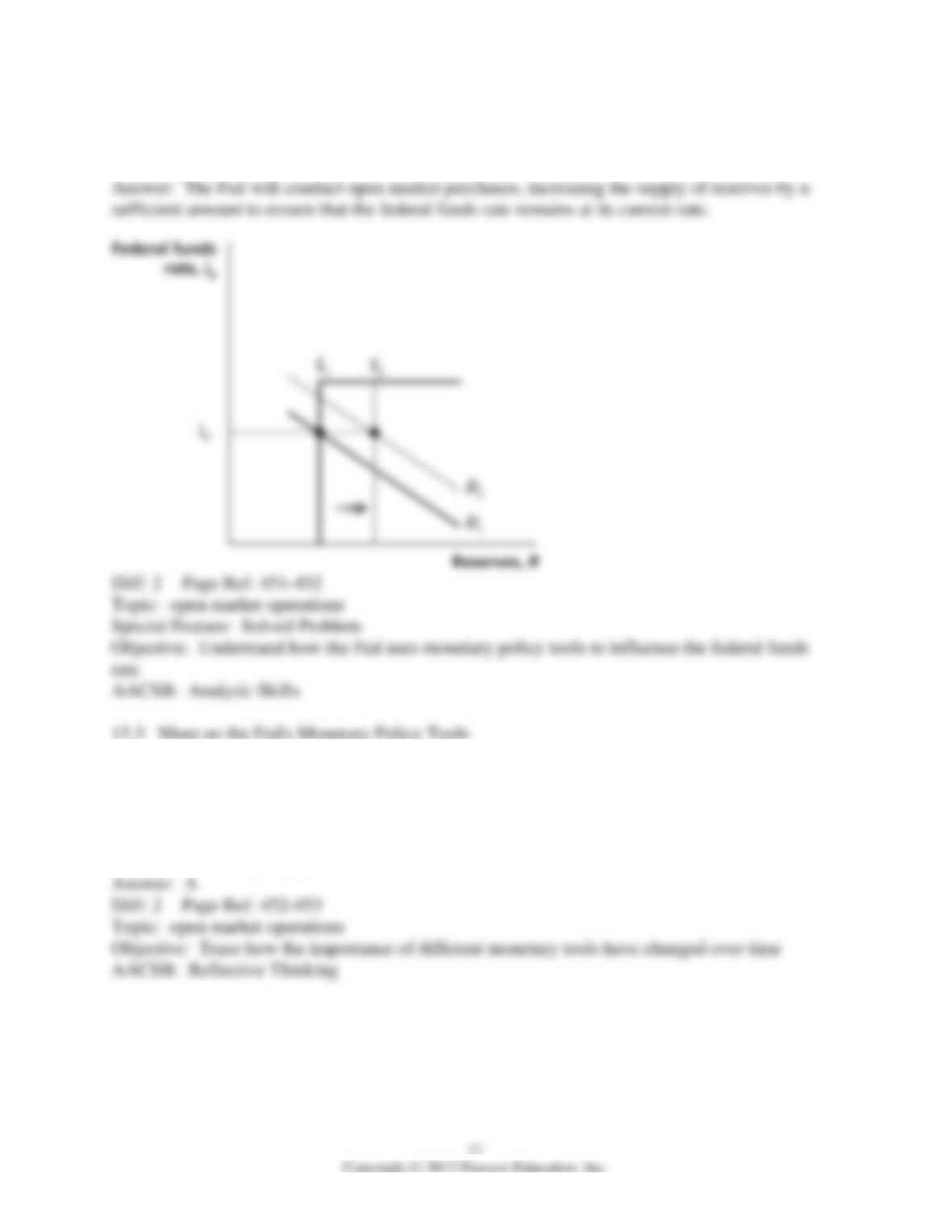
13) Suppose banks incur heavy losses and become more cautious, increasing their demand for
reserve. Make use of a graph of the loanable funds market to show how the Fed can use open
market operations to maintain the same federal funds rate.
1) Expansionary monetary policy consists of all of the following EXCEPT
A) open market sales.
B) lower interest rates.
C) increased monetary base.
D) increased money supply.
2) An open market purchase
A) increases the monetary base.
B) decreases the monetary base.
C) increases the federal funds rate.
D) is another name for a discount loan.
3) The original Federal Reserve Act
A) specified open market operations as the Fed’s main policy tool.
B) specified open market operations as one of several Fed policy tools.
C) specified that open market operations be employed by the Fed only in circumstances where
discount loans were ineffective.
D) did not specifically mention open market operations.
4) When did the Fed first begin to use open market operations as a policy tool?
A) The 1920s
B) The 1930s
C) The 1960s
D) The 1980s
5) How were open market operations conducted prior to 1935?
A) They were carried out by the Federal Open Market Committee.
B) They were carried out under the direction of the Secretary of the Treasury.
C) They were carried out by the district Federal Reserve banks.
D) They were carried out by the Banking Committee of the House of Representatives.
6) Congress established the FOMC because
A) a group was needed to set reserve requirements for member banks.
B) of a lack of coordination among district banks in carrying out open market operations.
C) Congress was attempting to expand its influence within the Federal Reserve System.
D) a group was needed to coordinate the setting of discount rates by the district banks.
7) The Fed generally conducts open market operations in
A) long-term corporate bond markets.
B) the federal funds market.
C) the Treasury securities market.
D) the commercial paper market.
8) An open market purchase
A) decreases the price of Treasury securities and also decreases their yield.
B) increases the price of Treasury securities and decreases their yield.
C) increases the price of Treasury securities and also increases their yield.
D) decreases the price of Treasury securities and increases their yield.
9) An open market sale
A) decreases the price of Treasury securities and also decreases their yield.
B) increases the price of Treasury securities and decreases their yield.
C) increases the price of Treasury securities and also increases their yield.
D) decreases the price of Treasury securities and increases their yield.
10) Which of the following statements is correct?
A) Open market purchases are expansionary and open market sales are contractionary.
B) Open market purchases are contractionary and open market sales are expansionary.
C) Both open market purchases and open market sales are expansionary.
D) Both open market purchases and open market sales are contractionary.
11) The FOMC states its overall objectives for interest rates in
A) the Governors’ Order.
B) the Policy Directive.
C) the Federal Reserve Bulletin.
D) the Chairman’s Order.
12) The policy directive from the FOMC is carried out by
A) the presidents of the district banks.
B) the presidents of commercial banks that are members of the Federal Reserve System.
C) the account manager at the Federal Reserve Bank of New York.
D) private dealers in the bond market.
13) The Open Market Trading Desk is
A) another name for the Federal Open Market Committee.
B) an organization of private traders in government securities.
C) the area on the floor of the New York Stock Exchange set aside for bond trading.
D) a group of private securities traders that the Fed has selected to participate in open market
operations.
14) How does the Open Market Trading Desk conduct its operations?
A) directly with private securities dealers on the floor of the New York Stock Exchange
B) directly with private securities dealers on the floor of the Federal Reserve Bank of New York
C) over-the-counter electronically with private securities dealers
D) by sending its buy and sell orders to the U.S. Treasury for execution
15) Primary dealers are those
A) permitted to trade directly with the Fed.
B) who work under the account manager at the Federal Reserve Bank of New York.
C) who specialize in selling bonds to small private investors.
D) responsible for assuring that interest rates do not decline unless the FOMC has given specific
instructions that they decline.
16) If the account manager finds that the current level of bank reserves is greater than the desired
level indicated in the most recent directive from the FOMC, he will
A) order banks to reduce their reserves.
B) order banks to raise their interest rates in an attempt to get them to loan out more of their
reserves.
C) conduct an open market purchase.
D) conduct an open market sale.
17) If the account manager does not use a Federal Reserve repurchase agreement or a matched
sale-purchase transaction in carrying out open market operations, he will use
A) an outright purchase or sale.
B) a limited-duration purchase or sale.
C) an indirect purchase or sale.
D) a reverse duration purchase or sale.