Chapter 15: Capital Structure Decisions
1. Different borrowers have different risks of bankruptcy, and bankruptcy is costly to lenders. Therefore, lenders charge
higher rates to borrowers judged to be more at risk of going bankrupt.
a. True
b. False
2. A firm’s business risk is largely determined by the financial characteristics of its industry, especially by the amount of
debt the average firm in the industry uses.
a. True
b. False
3. Financial risk refers to the extra risk stockholders bear as a result of using debt as compared with the risk they would
bear if no debt were used.
a. True
b. False
Chapter 15: Capital Structure Decisions
4. As the text indicates, a firm’s financial risk has identifiable market risk and diversifiable risk components.
a. True
b. False
5. A firm’s capital structure does not affect its calculated free cash flows, because FCF reflects only operating cash flows.
a. True
b. False
6. Whenever a firm borrows money, it is using financial leverage.
a. True
b. False

Chapter 15: Capital Structure Decisions
7. The graphical probability distribution of ROE for a firm that uses financial leverage would tend to be more peaked than
the distribution if the firm used no leverage, other things held constant.
a. True
b. False
8. Provided a firm does not use an extreme amount of debt, financial leverage typically affects both EPS and EBIT, while
operating leverage only affects EBIT.
a. True
b. False
9. If a firm utilizes debt financing, an X% decline in earnings before interest and taxes (EBIT) will result in a decline in
earnings per share that is larger than X.
a. True
b. False
Chapter 15: Capital Structure Decisions
10. Firm A has a higher degree of business risk than Firm B. Firm A can offset this by using less financial leverage.
Therefore, the variability of both firms’ expected EBITs could actually be identical.
a. True
b. False
11. Two firms, although they operate in different industries, have the same expected earnings per share and the same
standard deviation of expected EPS. Thus, the two firms must have the same business risk.
a. True
b. False
12. It is possible that two firms could have identical financial and operating leverage, yet have different degrees of risk as
measured by the variability of EPS.
a. True
b. False
Chapter 15: Capital Structure Decisions
13. Which of these items will not generally be affected by an increase in the debt ratio?
a. Total risk.
b. Financial risk.
c. Market risk.
d. The firm’s beta.
e. Business risk.
14. Which of the following is NOT associated with (or does not contribute to) business risk? Recall that business risk is
affected by a firm’s operations.
a. Sales price variability.
b. The extent to which operating costs are fixed.
c. The extent to which interest rates on the firm’s debt fluctuate.
d. Input price variability.
e. Demand variability.
Chapter 15: Capital Structure Decisions
15. Which of the following statements is CORRECT? As a firm increases the operating leverage used to produce a given
quantity of output, this will
a. normally lead to a decrease in its business risk.
b. normally lead to a decrease in the standard deviation of its expected EBIT.
c. normally lead to a decrease in the variability of its expected EPS.
d. normally lead to a reduction in its fixed assets turnover ratio.
e. normally lead to an increase in its fixed assets turnover ratio.
16. If debt financing is used, which of the following is CORRECT?
a. The percentage change in net operating income will be equal to a given percentage change in net income.
b. The percentage change in net income relative to the percentage change in net operating income will depend on the
interest rate charged on debt.
c. The percentage change in net income will be greater than the percentage change in net operating income.
d. The percentage change in sales will be greater than the percentage change in EBIT, which in turn will be greater
than the percentage change in net income.
e. The percentage change in net operating income will be greater than a given percentage change in net income.
17. Which of the following statements is CORRECT, holding other things constant?
a. An increase in the personal tax rate is likely to increase the debt ratio of the average corporation.
Chapter 15: Capital Structure Decisions
b. If changes in the bankruptcy code make bankruptcy less costly to corporations, then this would likely reduce the
debt ratio of the average corporation.
c. An increase in the company‘s degree of operating leverage is likely to encourage a company to use more debt in
its capital structure.
d. An increase in the corporate tax rate is likely to encourage a company to use more debt in its capital structure.
e. Firms whose assets are relatively liquid tend to have relatively low bankruptcy costs, hence they tend to use
relatively little debt.
18. Other things held constant, which of the following events is most likely to encourage a firm to increase the amount of
debt in its capital structure?
a. The costs that would be incurred in the event of bankruptcy increase.
b. Management believes that the firm’s stock has become overvalued.
c. Its degree of operating leverage increases.
d. The corporate tax rate increases.
e. Its sales become less stable over time.
19. Blueline Publishers is considering a recapitalization plan. It is currently 100% equity financed but under the plan it
would issue long-term debt with a yield of 9% and use the proceeds to repurchase common stock. The recapitalization
would not change the company’s total assets, nor would it affect the firm’s return on invested capital (ROIC), which is
currently 15%. The CFO believes that this recapitalization would reduce the WACC and increase stock price. Which of
the following would also be likely to occur if the company goes ahead with the recapitalization plan?
a. The company’s earnings per share would decline.
b. The company’s cost of equity would increase.
c. The company’s ROA would increase.
Chapter 15: Capital Structure Decisions
d. The company’s ROE would decline.
e. The company’s net income would increase.
20. Barette Consulting currently has no debt in its capital structure, has $500 million of total assets, and its return on
invested operating capital (ROIC) is 14.5%. The CFO is contemplating a recapitalization where it will issue debt at a cost
of 10% and use the proceeds to buy back shares of the company’s common stock, paying book value. If the company
proceeds with the recapitalization, its operating income, total assets, and tax rate will remain unchanged. Which of the
following is most likely to occur as a result of the recapitalization?
a. The ROA would remain unchanged.
b. The ROIC would decline.
c. The ROIC would increase.
d. The ROE would increase.
e. The ROA would increase.
21. Which of the following statements is CORRECT?
a. There is no reason to think that changes in the personal tax rate would affect firms’ capital structure decisions.
b. A firm with high business risk is more likely to increase its use of financial leverage than a firm with low business
risk, assuming all else equal.
c. If a firm’s after-tax cost of equity exceeds its after-tax cost of debt, it can always reduce its WACC by increasing
its use of debt.
d. Suppose a firm has less than its optimal amount of debt. Increasing its use of debt to the point where it is at its
optimal capital structure will decrease the costs of both debt and equity financing.
e. In general, a firm with low operating leverage also has a small proportion of its total costs in the form of fixed
costs.
Chapter 15: Capital Structure Decisions
22. Which of the following statements is CORRECT?
a. A change in the personal tax rate should not affect firms’ capital structure decisions.
b. “Business risk” is differentiated from “financial risk” by the fact that financial risk reflects only the use of debt,
while business risk reflects both the use of debt and such factors as sales variability, cost variability, and operating
leverage.
c. The optimal capital structure is the one that simultaneously (1) maximizes the price of the firm’s stock, (2)
minimizes its WACC, and (3) maximizes its EPS.
d. If changes in the bankruptcy code make bankruptcy less costly to corporations, then this would likely reduce the
debt ratio of the average corporation.
e. If corporate tax rates were decreased while other things were held constant, and if the Modigliani-Miller tax-
adjusted tradeoff theory of capital structure were correct, this would tend to cause corporations to decrease their use of
debt.
23. The world-famous discounter, Fernwood Booksellers, specializes in selling paperbacks for $7 each. The variable cost
per book is $5. At current annual sales of 200,000 books, the publisher is just breaking even. It is estimated that if the
authors’ royalties are reduced, the variable cost per book will drop by $1. Assume authors’ royalties are reduced and sales
remain constant; how much more money can the publisher put into advertising (a fixed cost) and still break even?
a. $600,000
b. $466,667
c. $333,333
d. $200,000
e. None of the above
Chapter 15: Capital Structure Decisions
24. Larsen Films’ is analyzing its cost structure. Its fixed operating costs are $470,000, its variable costs of $2.80 per unit
produced, and its products sell for $4.00 per unit. What is the company’s breakeven point, i.e., at what unit sales volume
would income equal costs?
a. 391,667
b. 411,250
c. 431,813
d. 453,403
e. 476,073
25. A new company to produce state-of-the-art car stereo systems is being considered by Jagger Enterprises. The sales
price would be set at 1.5 times the variable cost per unit; the VC/unit is estimated to be $2.50; and fixed costs are
estimated at $120,000. What sales volume would be required in order to break even, i.e., to have an EBIT of zero for the
stereo business?
a. 86,640
b. 91,200
c. 96,000
d. 100,800
Chapter 15: Capital Structure Decisions
e. 105,840
26. Hernandez Corporation expects to have the following data during the coming year. What is Hernandez’s expected
ROE?
Assets $200,000 Interest rate 8%
D/A 65% Tax rate 25%
EBIT $25,000
a. 15.64%
b. 16.43%
c. 17.25%
d. 18.11%
e. 19.01%
Chapter 15: Capital Structure Decisions
27. After an intensive research and development effort, two methods for producing playing cards have been identified by
the Turner Company. One method involves using a machine having a fixed cost of $10,000 and variable costs of $1.00 per
deck of cards. The other method would use a less expensive machine (fixed cost = $5,000), but it would require greater
variable costs ($1.50 per deck of cards). If the selling price per deck of cards will be the same under each method, at what
level of output will the two methods produce the same net operating income (EBIT)?
a. 5,000 decks
b. 10,000 decks
c. 15,000 decks
d. 20,000 decks
e. 25,000 decks
28. A venture capital investment group received a proposal from Wireless Solutions to produce a new smart phone. The
variable cost per unit is estimated at $250, the sales price would be set at twice the VC/unit, fixed costs are estimated at
$750,000, and the investors will put up the funds if the project is likely to have an operating income of $500,000 or more.
What sales volume would be required in order to meet this profit goal?
a. 4,513
b. 4,750
c. 5,000
d. 5,250
e. 5,513
Chapter 15: Capital Structure Decisions
29. Firms HD and LD are identical except for their level of debt and the interest rates they pay on debt⎯HD has more debt
and pays a higher interest rate on that debt. Based on the data given below, what is the difference between the two firms’
ROEs?
Applicable to Both Firms Firm HD‘s Data Firm LD’s Data
Assets $200 Debt ratio 50% Debt ratio 30%
EBIT $40 Interest rate 12% Interest rate 10%
Tax rate 25%
a. 2.51%
b. 2.65%
c. 2.79%
d. 2.93%
e. 3.07%
Chapter 15: Capital Structure Decisions
30. The trade-off theory states that the capital structure decision involves a tradeoff between the costs and benefits of debt
financing.
a. True
b. False
31. If Miller and Modigliani had incorporated the costs of bankruptcy into their model, it is unlikely that they would have
concluded that 100% debt financing is optimal.
a. True
b. False
32. Which of the following events is likely to encourage a company to raise its target debt ratio, other things held
constant?
a. An increase in the personal tax rate.
b. An increase in the company’s operating leverage.
c. The Federal Reserve tightens interest rates in an effort to fight inflation.
d. The company’s stock price hits a new high.
e. An increase in the corporate tax rate.
Chapter 15: Capital Structure Decisions
33. Which of the following would increase the likelihood that a company would increase its debt ratio, other things held
constant?
a. An increase in the corporate tax rate.
b. An increase in the personal tax rate.
c. The Federal Reserve tightens interest rates in an effort to fight inflation.
d. The company’s stock price hits a new low.
e. An increase in costs incurred when filing for bankruptcy.
34. Which of the following statements is CORRECT?
a. The capital structure that minimizes a firm’s weighted average cost of capital is also the capital structure that
maximizes its stock price.
b. The capital structure that minimizes the firm’s weighted average cost of capital is also the capital structure that
maximizes its earnings per share.
c. If a firm finds that the cost of debt is less than the cost of equity, increasing its debt ratio must reduce its WACC.
d. Other things held constant, if corporate tax rates declined, then the Modigliani-Miller tax-adjusted tradeoff theory
would suggest that firms should increase their use of debt.
e. A firm can use retained earnings without paying a flotation cost. Therefore, while the cost of retained earnings is
not zero, its cost is generally lower than the after-tax cost of debt.
Chapter 15: Capital Structure Decisions
35. The Miller model begins with the MM model with corporate taxes and then adds personal taxes.
a. True
b. False
36. The Miller model begins with the MM model without corporate taxes and then adds personal taxes.
a. True
b. False
37. The MM model with corporate taxes is the same as the Miller model, but with zero personal taxes.
a. True
b. False
Chapter 15: Capital Structure Decisions
38. The MM model is the same as the Miller model, but with zero corporate taxes.
a. True
b. False
39. The major contribution of the Miller model is that it demonstrates that
a. personal taxes decrease the value of using corporate debt.
b. financial distress and agency costs reduce the value of using corporate debt.
c. equity costs increase with financial leverage.
d. debt costs increase with financial leverage.
e. personal taxes increase the value of using corporate debt.
40. Which of the following statements concerning capital structure theory is NOT CORRECT?
a. Under MM with zero taxes, financial leverage has no effect on a firm’s value.
b. Under MM with corporate taxes, the value of a levered firm exceeds the value of the unlevered firm by the
product of the tax rate times the market value dollar amount of debt.
c. Under MM with corporate taxes, rs increases with leverage, and this increase exactly offsets the tax benefits of
debt financing.
Chapter 15: Capital Structure Decisions
d. Under MM with corporate taxes, the effect of business risk is automatically incorporated because rsL is a function
of rsU.
e. The major contribution of Miller’s theory is that it demonstrates that personal taxes decrease the value of using
corporate debt.
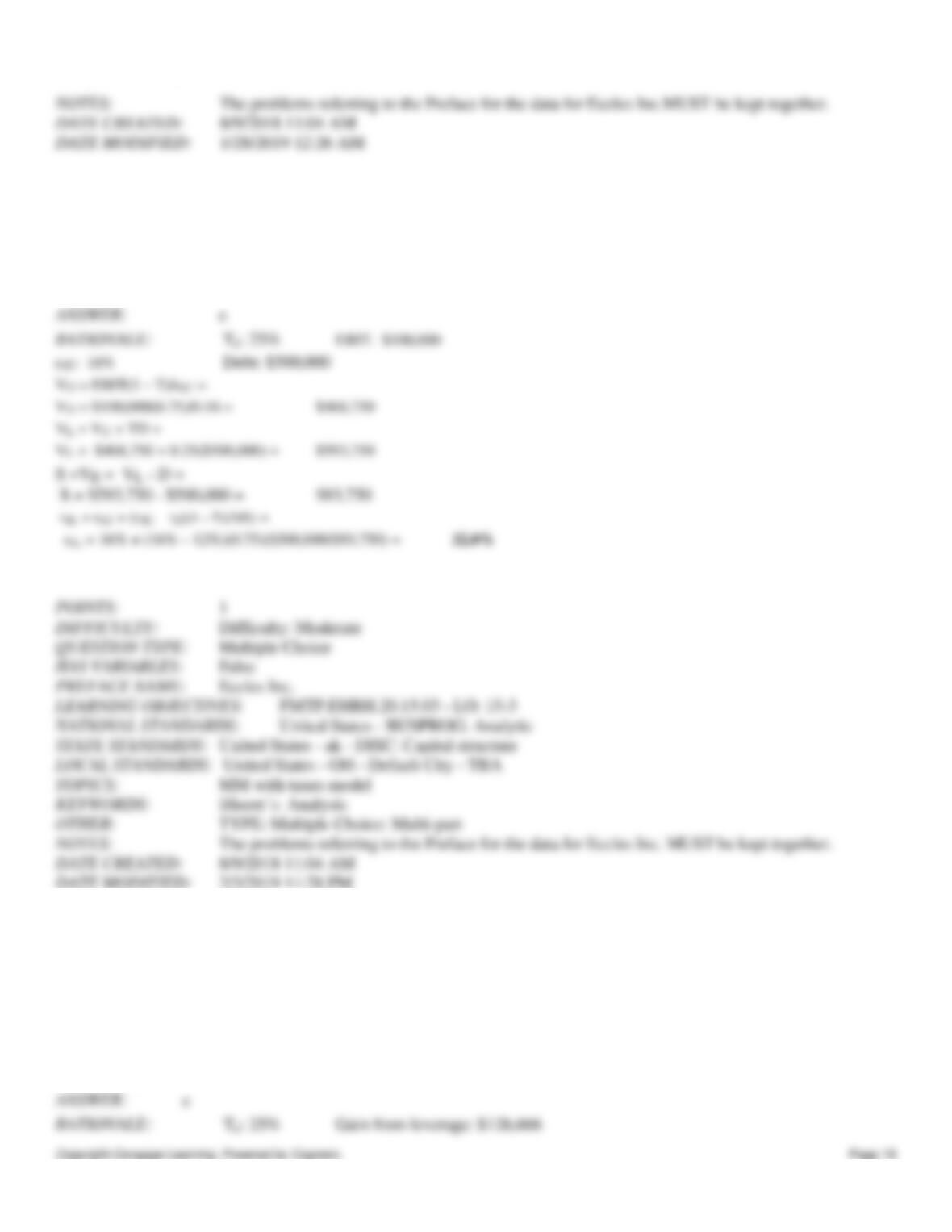
41. Refer to the data for Eccles Incorporated. What is the value of the firm according to MM with corporate taxes?
a. $480,938
b. $534,375
c. $593,750
d. $653,125
e. $718,438
Chapter 15: Capital Structure Decisions
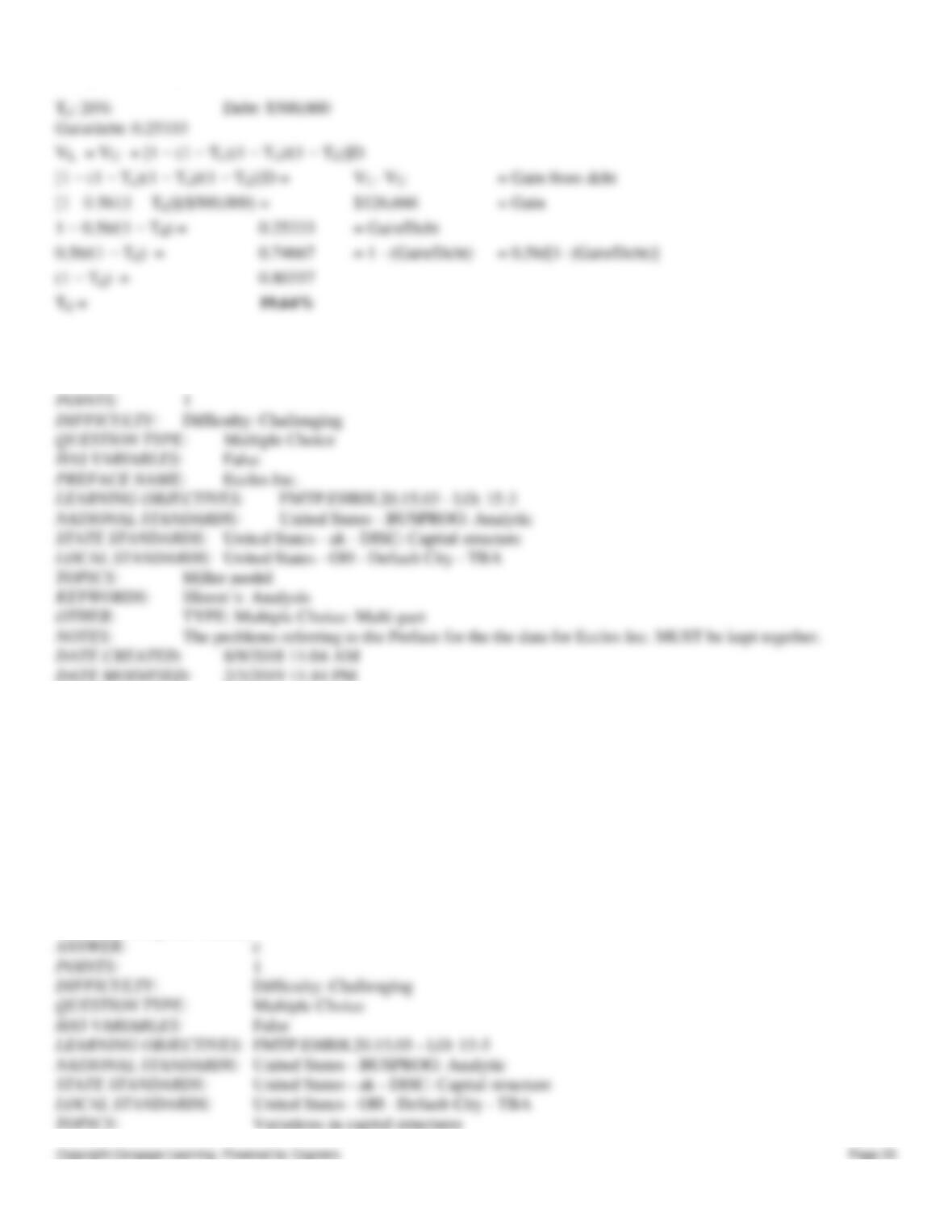
42. Refer to the data for Eccles Incorporated.What is the firm’s cost of equity according to MM with corporate taxes?
a. 21.0%
b. 23.3%
c. 25.9%
d. 28.8%
e. 32.0%
43. Refer to the data for Eccles Incorporated. Assume that the firm’s gain from leverage according to the Miller model is
$126,667. If the effective personal tax rate on stock income is TS = 20%, what is the implied personal tax rate on debt
income?
a. 12.8%
b. 14.2%
c. 15.8%
d. 17.6%
e. 19.6%
Chapter 15: Capital Structure Decisions
44. Which of the following statements is CORRECT?
a. Electric utilities generally have very high common equity ratios because their revenues are more volatile than
those of firms in most other industries.
b. Drug companies (prescription, not illegal!) generally have high debt-to-equity ratios because their earnings are
very stable and, thus, they can cover the high interest costs associated with high debt levels.
c. Wide variations in capital structures exist both between industries and among individual firms within given
industries. These differences are caused by differing business risks and also managerial attitudes.
d. Since most stocks sell at or very close to their book values, book value capital structures are almost always
adequate for use in estimating firms’ costs of capital.
e. Generally, debt-to-total-assets ratios do not vary much among different industries, although they do vary among
firms within a given industry.