Use the information for the question(s) below.
Consider two firms: firm Without has no debt, and firm With has debt of $10,000 on which it pays
interest of 5% per year. Both companies have identical projects that generate free cash flows of $1000 or
$2000 each year. Suppose that there are no taxes, and after paying any interest on debt, both companies
use all remaining cash free cash flows to pay dividends each year.
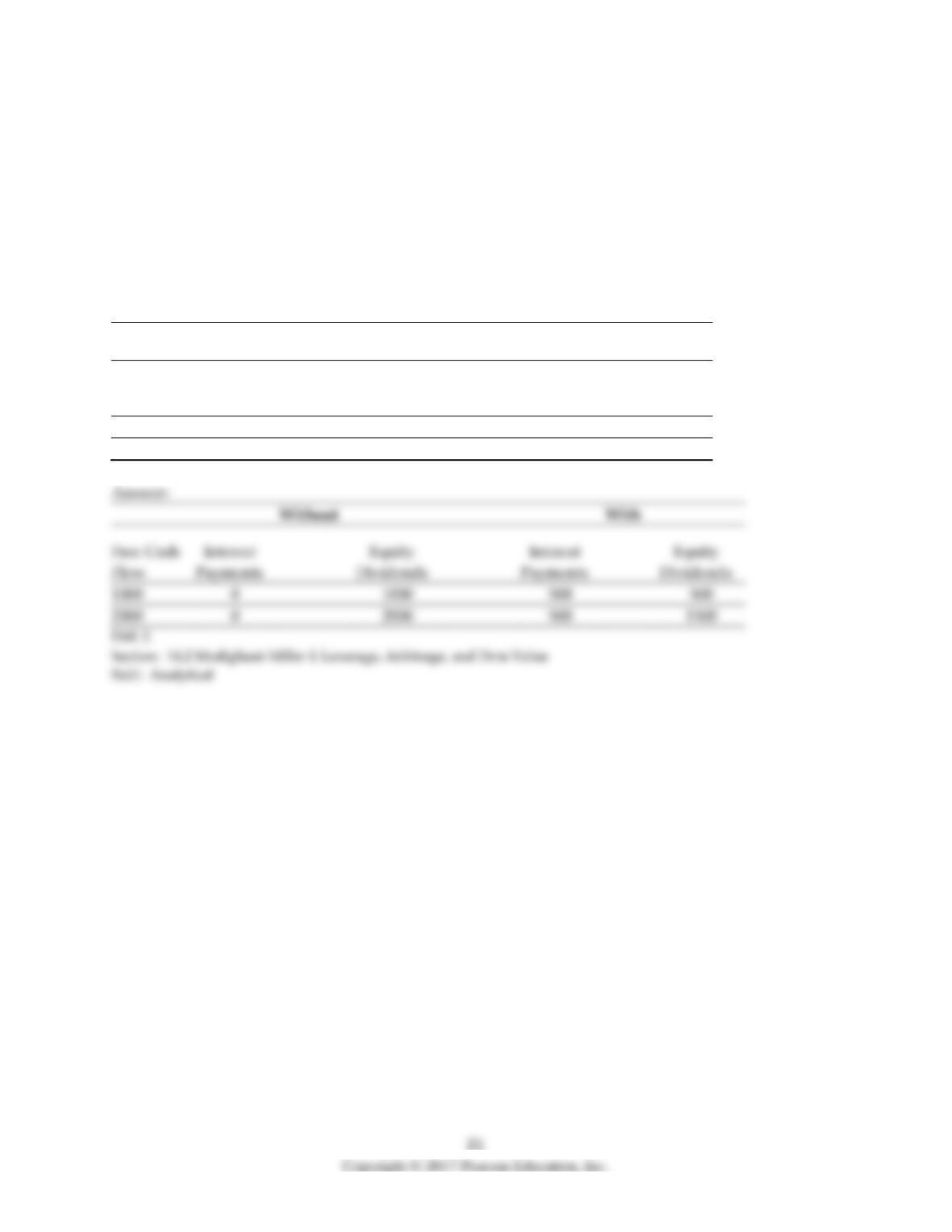
29) Fill in the table below showing the payments debt and equity holders of each firm will receive given
each of the two possible levels of free cash flows:
Without
With
Free Cash
Flow
Interest
Payments
Equity
Dividends
Interest
Payments
Equity
Dividends
1000
2000
Free Cash
Flow
Payments
Payments
1000
0
2000
0
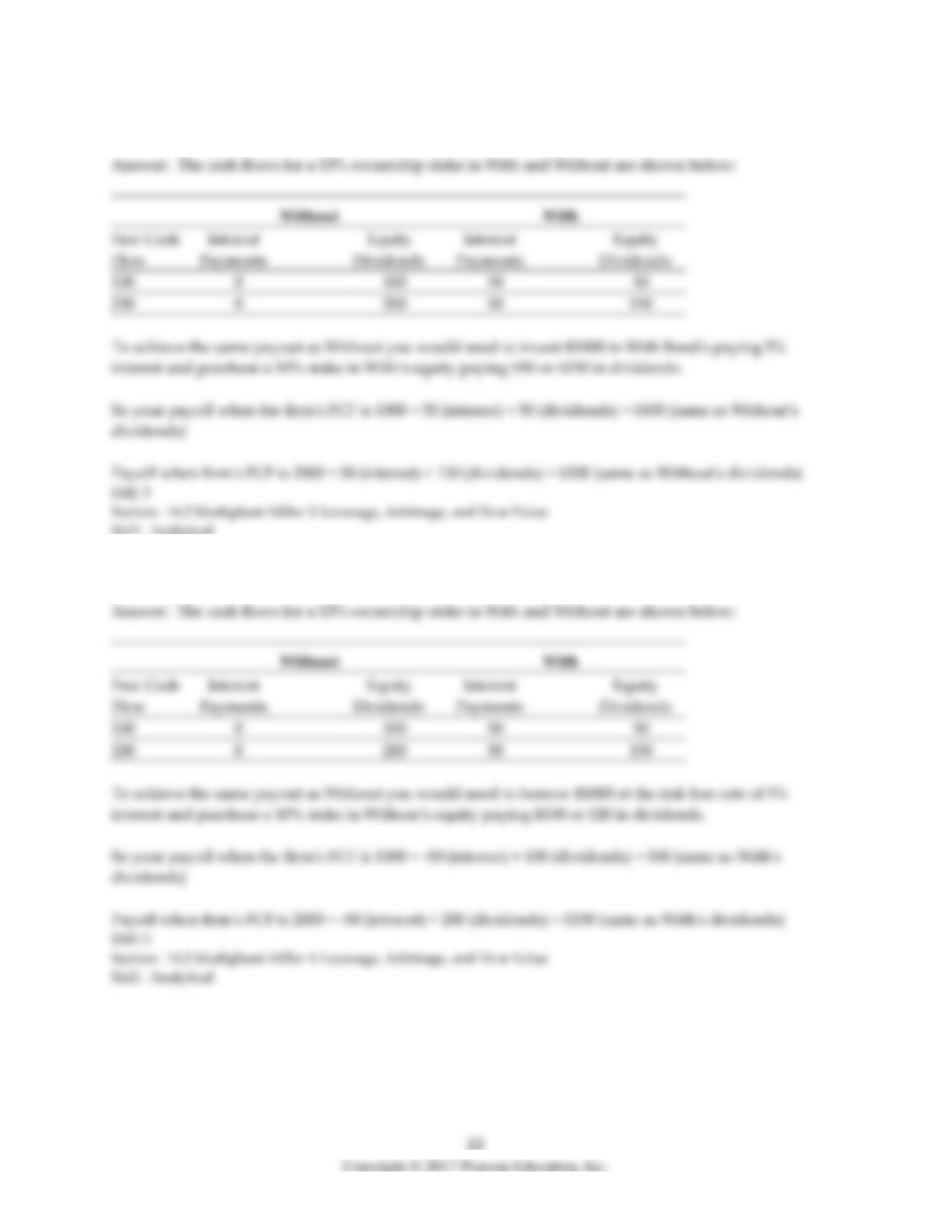
30) Suppose you own 10% of the equity of Without. What is another portfolio you could hold that
would provide you with the same exact cash flows?
31) Suppose you own 10% of the equity of With. What is another portfolio you could hold that would
provide you with the same exact cash flows?
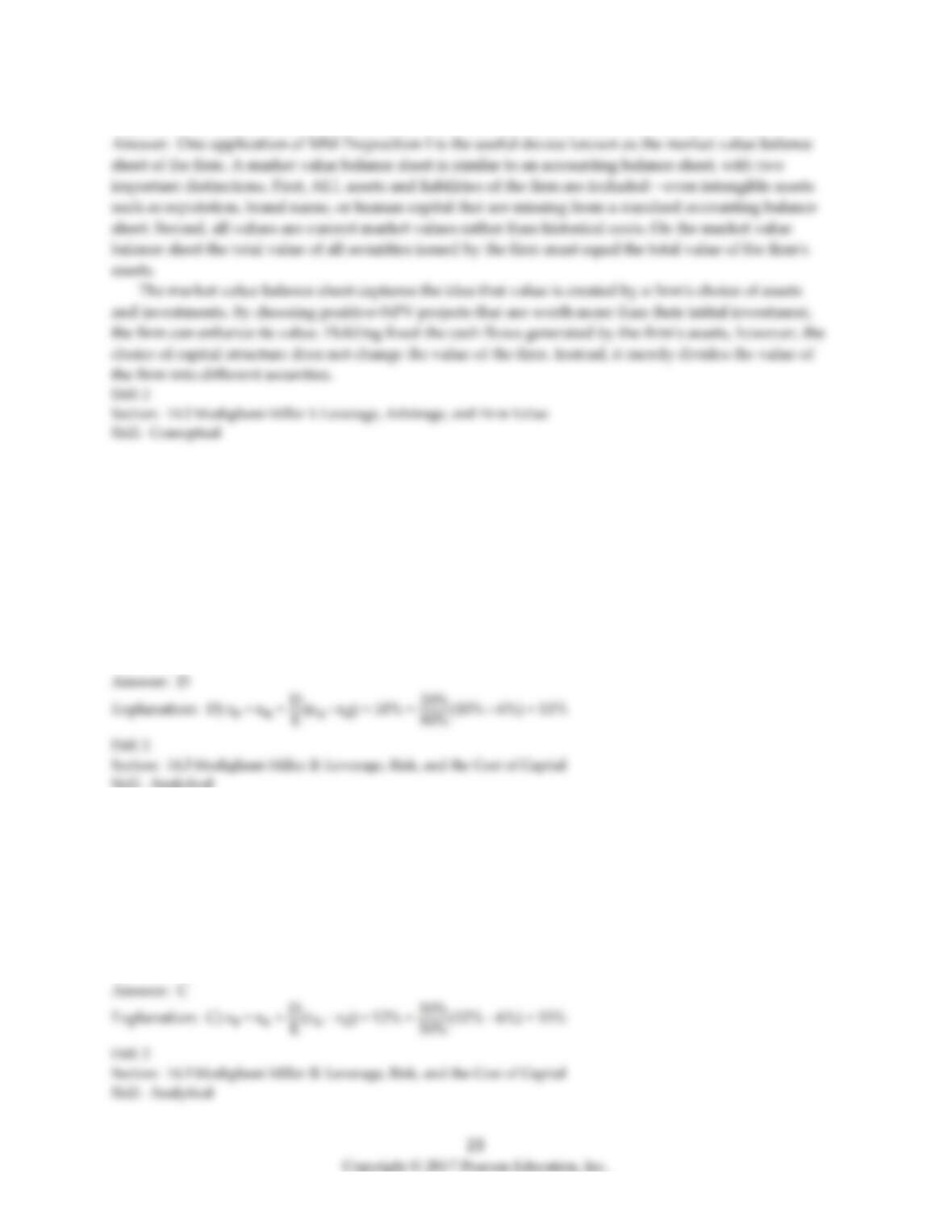
32) What is a market value balance sheet and how does it differ from a book value balance sheet?
14.3 Modigliani-Miller II: Leverage, Risk, and the Cost of Capital
1) Suppose that Taggart Transcontinental currently has no debt and has an equity cost of capital of 10%.
Taggart is considering borrowing funds at a cost of 6% and using these funds to repurchase existing
shares of stock. Assume perfect capital markets. If Taggart borrows until they achieved a debt–to-value
ratio of 20%, then Taggart’s levered cost of equity would be closest to:
A) 8.0%
B) 9.2%
C) 10.0%
D) 11.0%
2) Suppose that Rearden Metal currently has no debt and has an equity cost of capital of 12%. Rearden
is considering borrowing funds at a cost of 6% and using these funds to repurchase existing shares of
stock. Assume perfect capital markets. If Rearden borrows until they achieved a debt–to-equity ratio of
50%, then Rearden’s levered cost of equity would be closest to:
A) 10.0%
B) 12.0%
C) 15.0%
D) 16.0%
Use the following information to answer the question(s) below.
Galt Industries has no debt, total equity capitalization of $600 million, and an equity beta of 1.2.
Included in Galt’s assets is $90 million in cash and risk-free securities. Assume the risk-free rate is 4%
and the market risk premium is 6%.
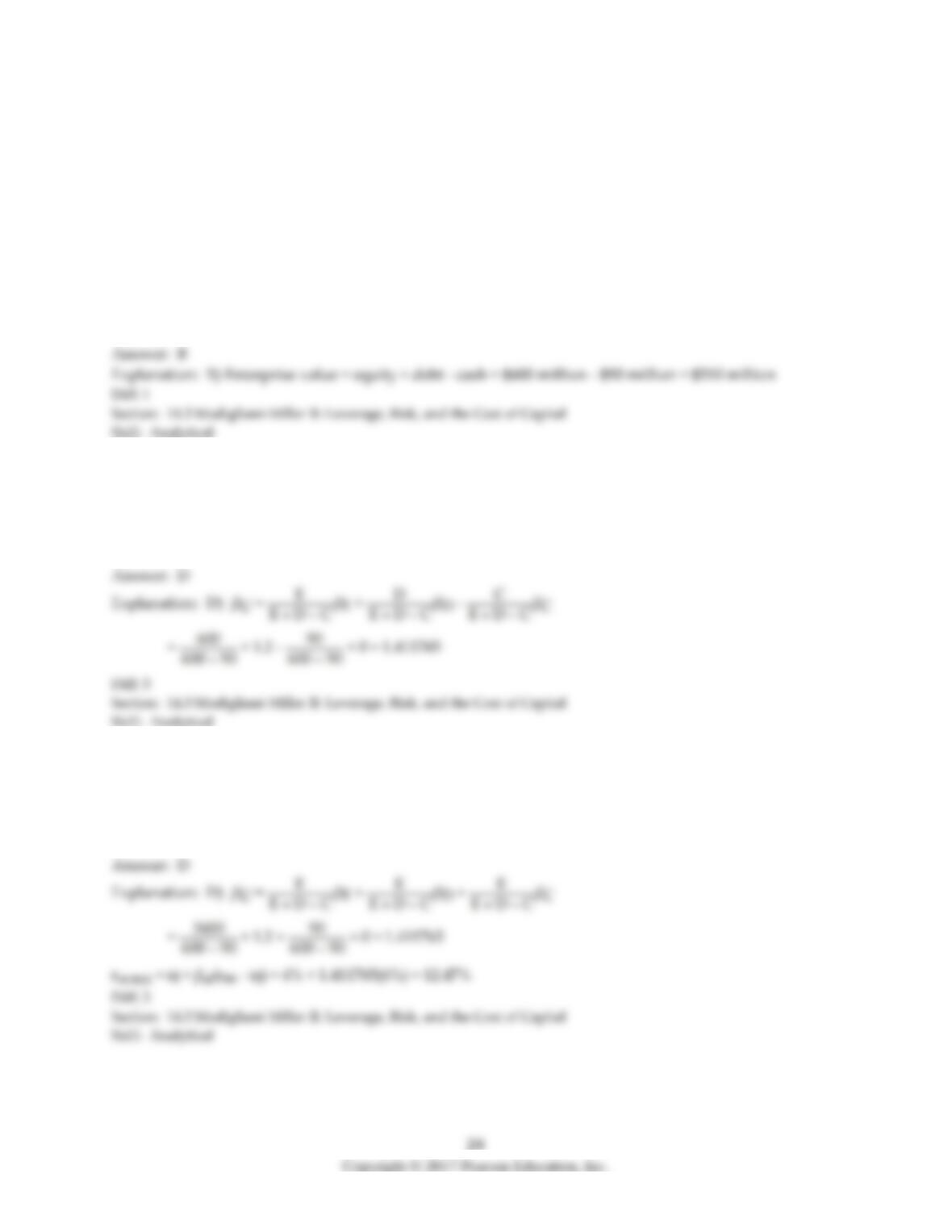
3) Galt’s enterprise value is closest to:
A) $90 million
B) $510 million
C) $600 million
D) $690 million
4) Galt’s asset beta (ie the beta of its operating assets) is closest to:
A) 1.1
B) 1.2
C) 1.3
D) 1.4
5) Galt’s WACC is closest to:
A) 10.6%
B) 11.2%
C) 11.8%
D) 12.5%
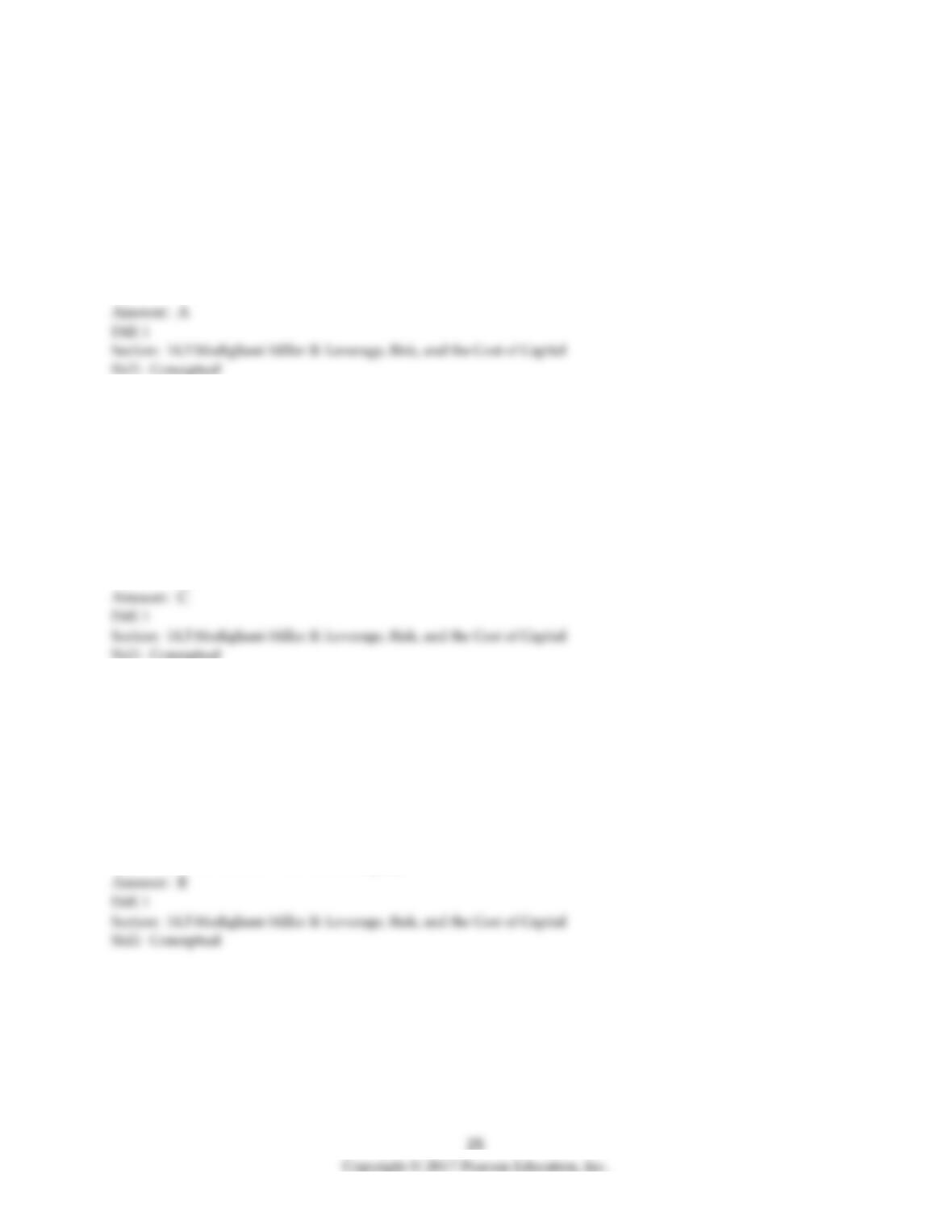
6) Consider the following equation:
E + D = U = A
The E in this equation represents:
A) the value of the firm’s equity.
B) the value of the firm’s debt.
C) the value of the firm’s unlevered equity.
D) the market value of the firm’s assets.
7) Consider the following equation:
E + D = U = A
The U in this equation represents:
A) the value of the firm’s equity.
B) the market value of the firm’s assets.
C) the value of the firm’s unlevered equity.
D) the value of the firm’s debt.
8) Consider the following equation:
E + D = U = A
The A in this equation represents:
A) the value of the firm’s debt.
B) the market value of the firm’s assets.
C) the value of the firm’s equity.
D) the value of the firm’s unlevered equity.
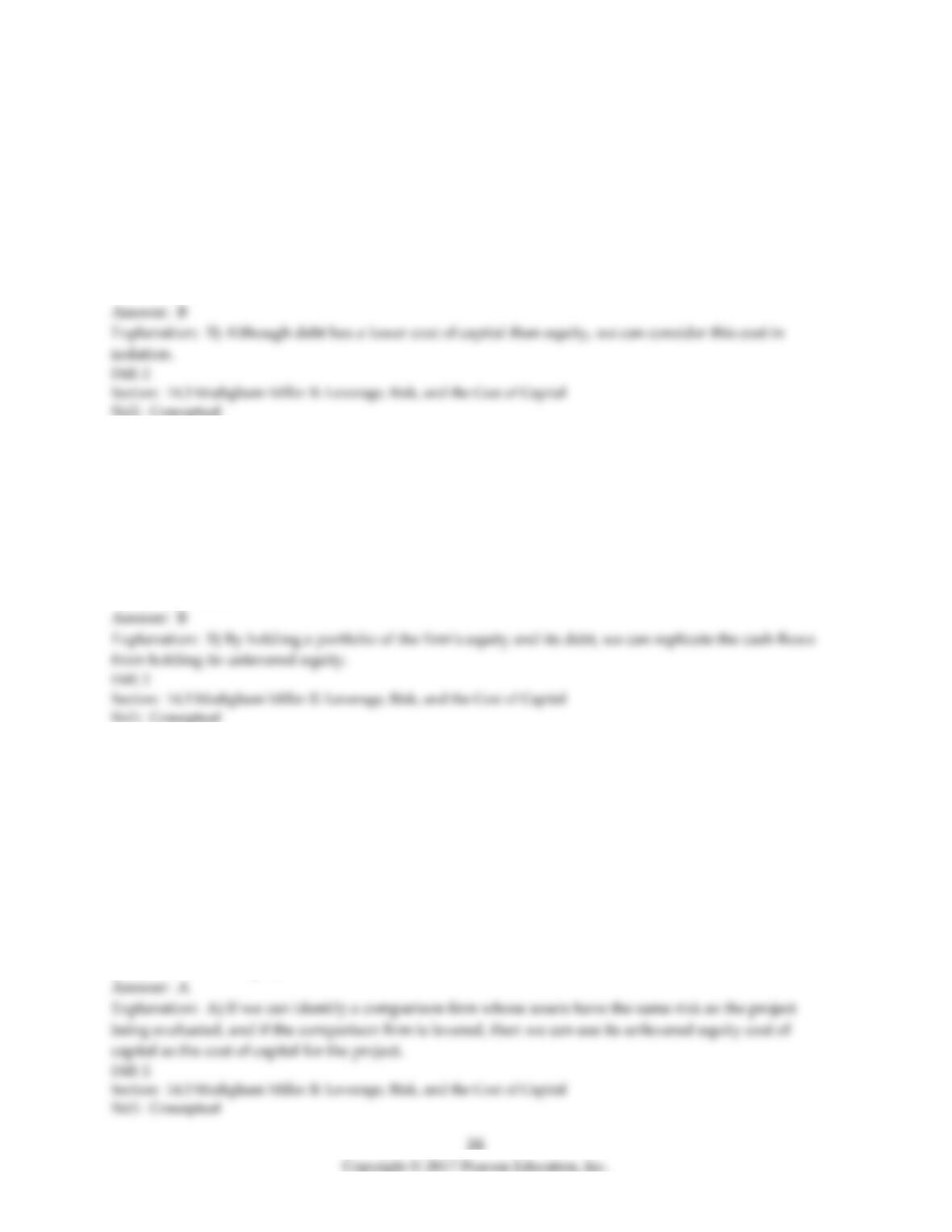
9) Which of the following statements is FALSE?
A) While debt itself may be cheap, it increases the risk and therefore the cost of capital of the firm’s
equity.
B) Although debt does not have a lower cost of capital than equity, we can consider this cost in
isolation.
C) We can use Modigliani and Miller’s first proposition to derive an explicit relationship between
leverage and the equity cost of capital.
D) The total market value of the firm’s securities is equal to the market value of its assets, whether the
firm is unlevered or levered.
10) Which of the following statements is FALSE?
A) The levered equity return equals the unlevered return, plus an extra “kick” due to leverage.
B) By holding a portfolio of the firm’s equity and its debt, we can replicate the cash flows from holding
its levered equity.
C) The cost of capital of levered equity is equal to the cost of capital of unlevered equity plus a premium
that is proportional to the market value debt-equity ratio.
D) If a firm is unlevered, all of the free cash flows generated by its assets are available to be paid out to
its equity holders.
11) Which of the following statements is FALSE?
A) If we can identify a comparison firm whose assets have the same risk as the project being evaluated,
and if the comparison firm is levered, then we can use its equity cost of capital as the cost of capital for
the project.
B) We can calculate the cost of capital of the firm’s assets by computing the weighted average of the
firm’s equity and debt cost of capital, which we refer to as the firm’s weighted average cost of capital
(WACC).
C) The portfolio of a firm’s equity and debt replicates the returns we would earn if the firm were
unlevered.
D) When evaluating any potential investment project, we must use a discount rate that is appropriate
given the risk of the project’s free cash flow.
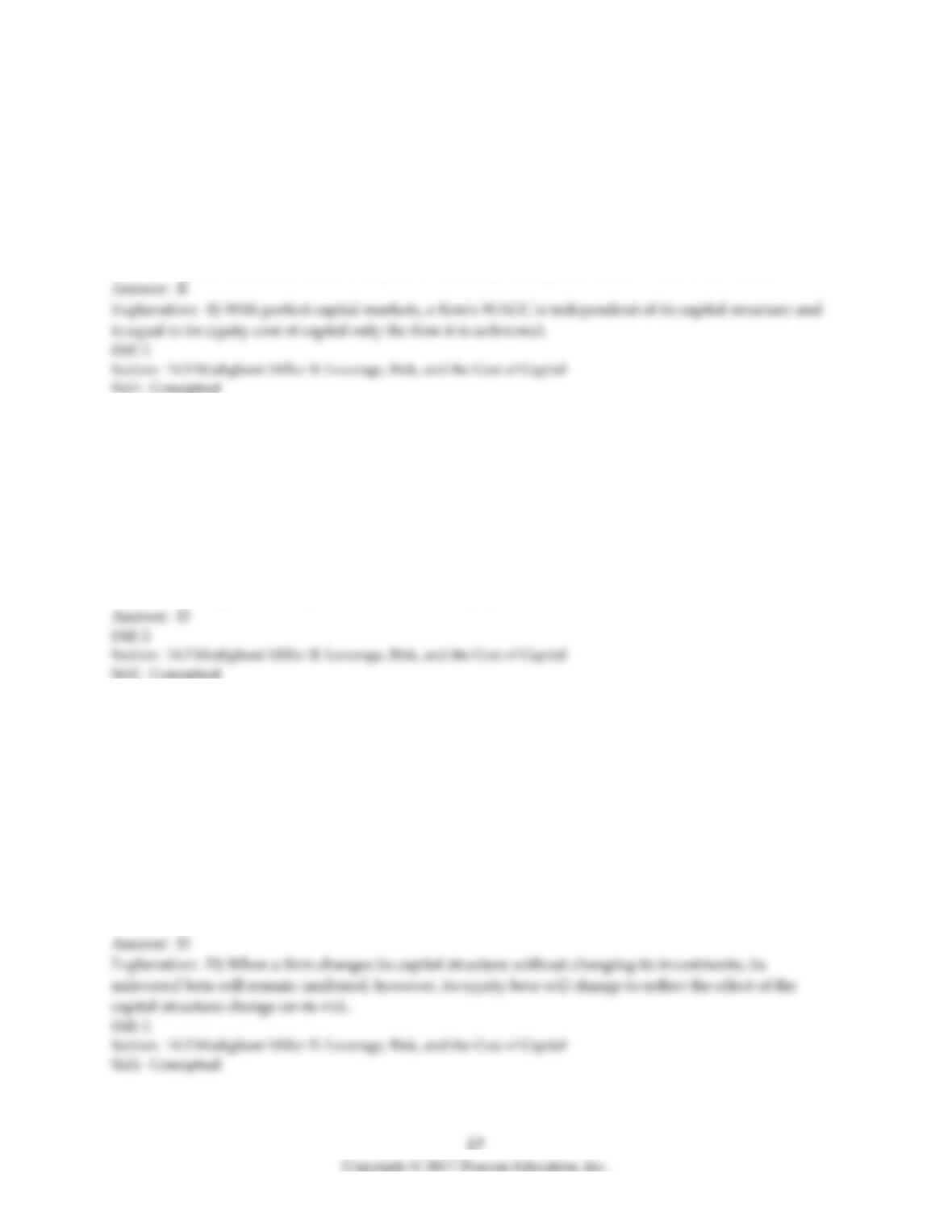
12) Which of the following statements is FALSE?
A) With no debt, the WACC is equal to the unlevered equity cost of capital.
B) With perfect capital markets, a firm’s WACC is dependent of its capital structure and is equal to its
equity cost of capital only the firm it is unlevered.
C) As the firm borrows at the low cost of capital for debt, its equity cost of capital rises, but the net effect
is that the firm’s WACC is unchanged.
D) Although debt has a lower cost of capital than equity, leverage does not lower a firm’s WACC.
13) Which of the following statements is FALSE?
A) Holding cash has the opposite effect of leverage on risk and return.
B) We use the market value of the firm’s net debt when computing its WACC and unlevered beta to
measure the cost of capital and market risk of the firm’s business assets.
C) Since the WACC does not change with the use of leverage, the value of the firm’s free cash flow
evaluated using the WACC does not change, and so the enterprise value of the firm does not depend on
its financing choices.
D) Even if the firm’s capital structure is more complex, the WACC is calculated by computing the
weighted average cost of only the firm’s debt and equity.
14) Which of the following statements is FALSE?
A) The unlevered beta measures the market risk of the firm’s business activities, ignoring any additional
risk due to leverage.
B) If a firm holds $1 in cash and has $1 of risk-free debt, then the interest earned on the cash will equal
the interest paid on the debt. The cash flows from each source cancel each other, just as if the firm held
no cash and no debt.
C) The unlevered beta measures the market risk of the firm without leverage, which is equivalent to the
beta of the firm’s assets.
D) When a firm changes its capital structure without changing its investments, its levered beta will
remain unaltered, however, its asset beta will change to reflect the effect of the capital structure change
on its risk.
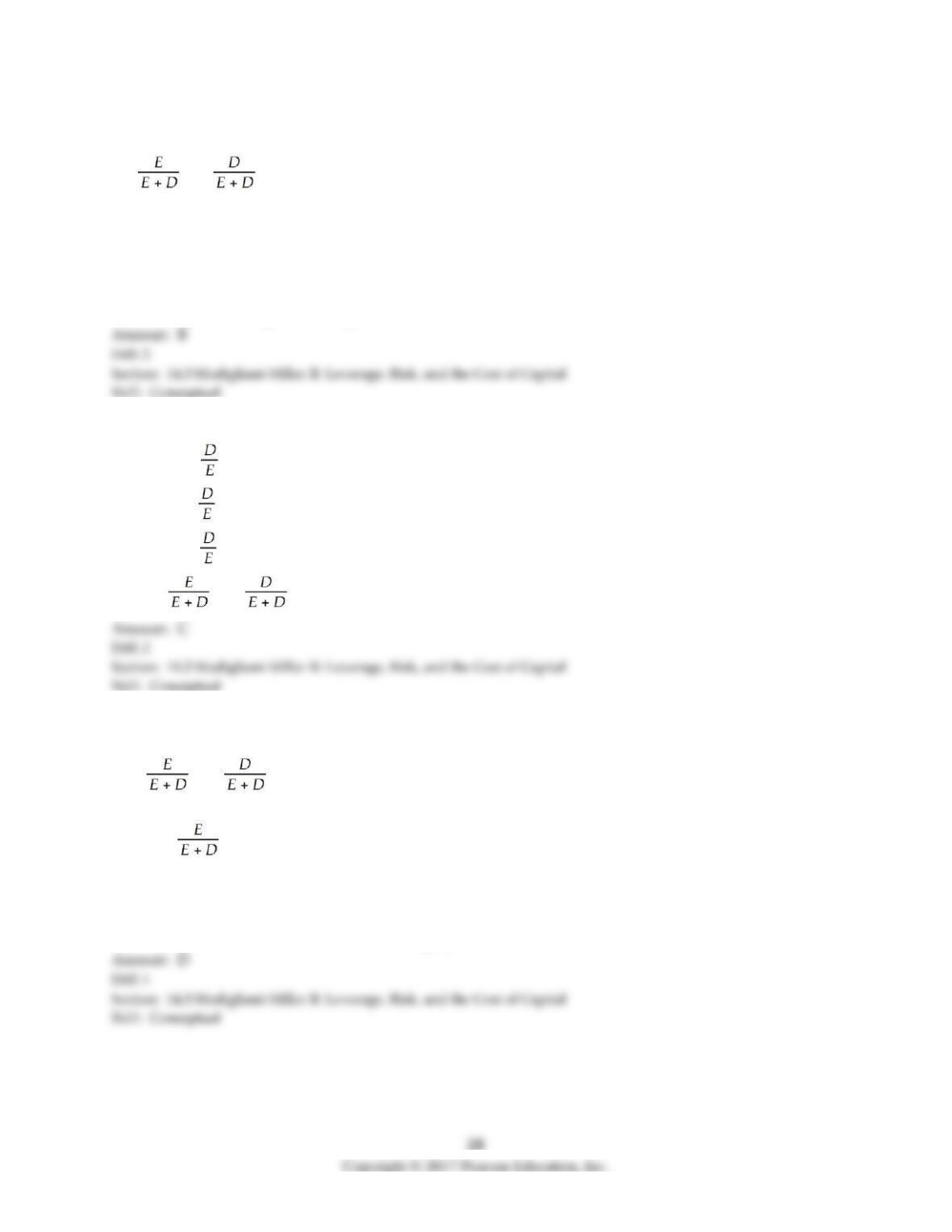
15) The following equation:
X = rE + rD
can be used to calculate all of the following EXCEPT:
A) the cost of capital for the firm’s assets.
B) the levered cost of equity.
C) the unlevered cost of equity.
D) the weighted average cost of capital.
16) Which of the following equations would NOT be appropriate to use in a firm with risky debt?
A) βE = βU + (βU – βD)
B) βU = βE + (βU – βD)
C) βE = βU + βU
D) βU = βE + βD
17) Consider the following equation:
βU = βE + βD
The term in the equation is:
A) the required return on the firm’s equity.
B) the same as the beta of the firm’s assets.
C) equal to zero if the firm’s debt is riskless.
D) the proportion of the firm financed with equity.
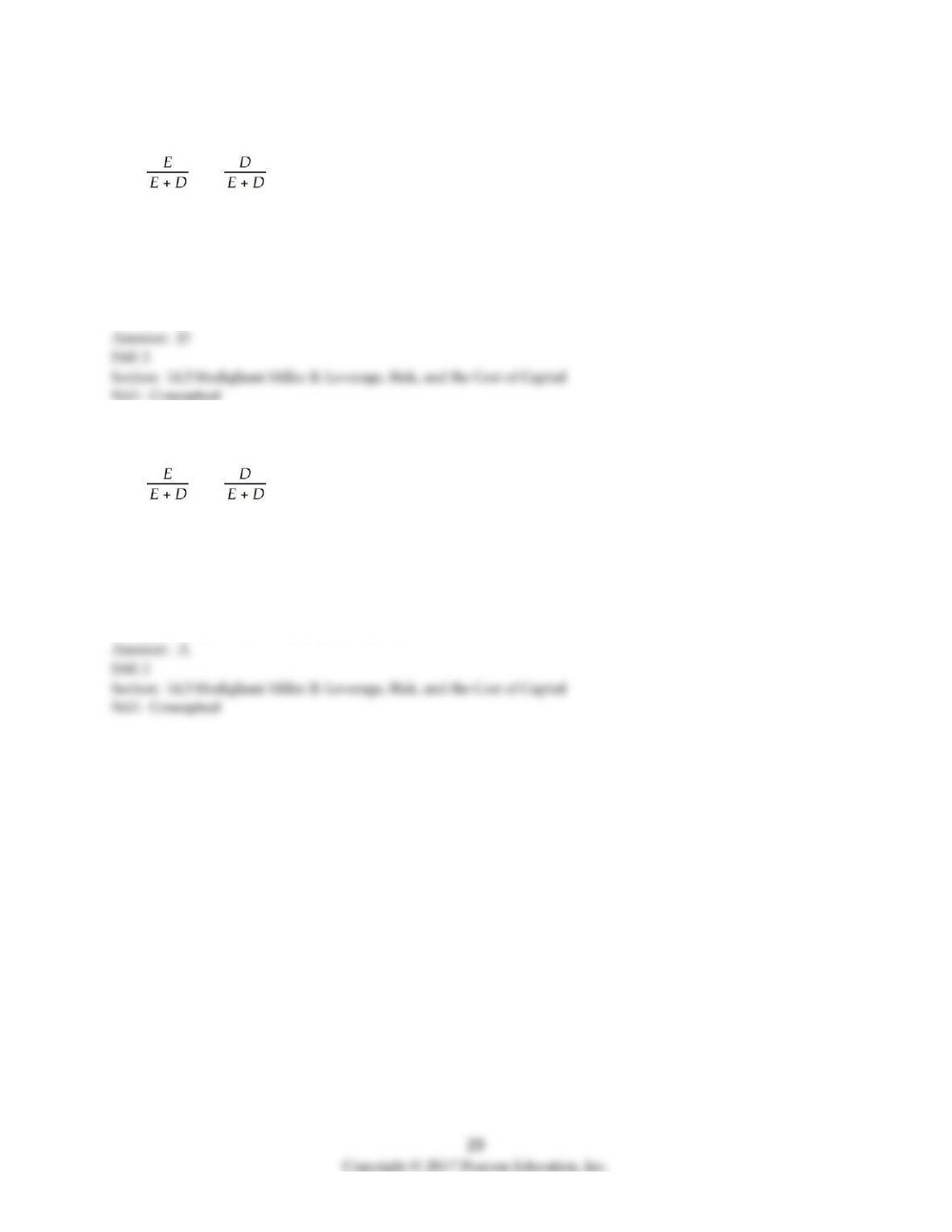
18) Consider the following equation:
βU = βE + βD
The term βD in the equation is:
A) the same as the beta of the firm’s assets.
B) the required return on the firm’s equity.
C) the proportion of the firm financed with equity.
D) equal to zero if the firm’s debt is riskless.
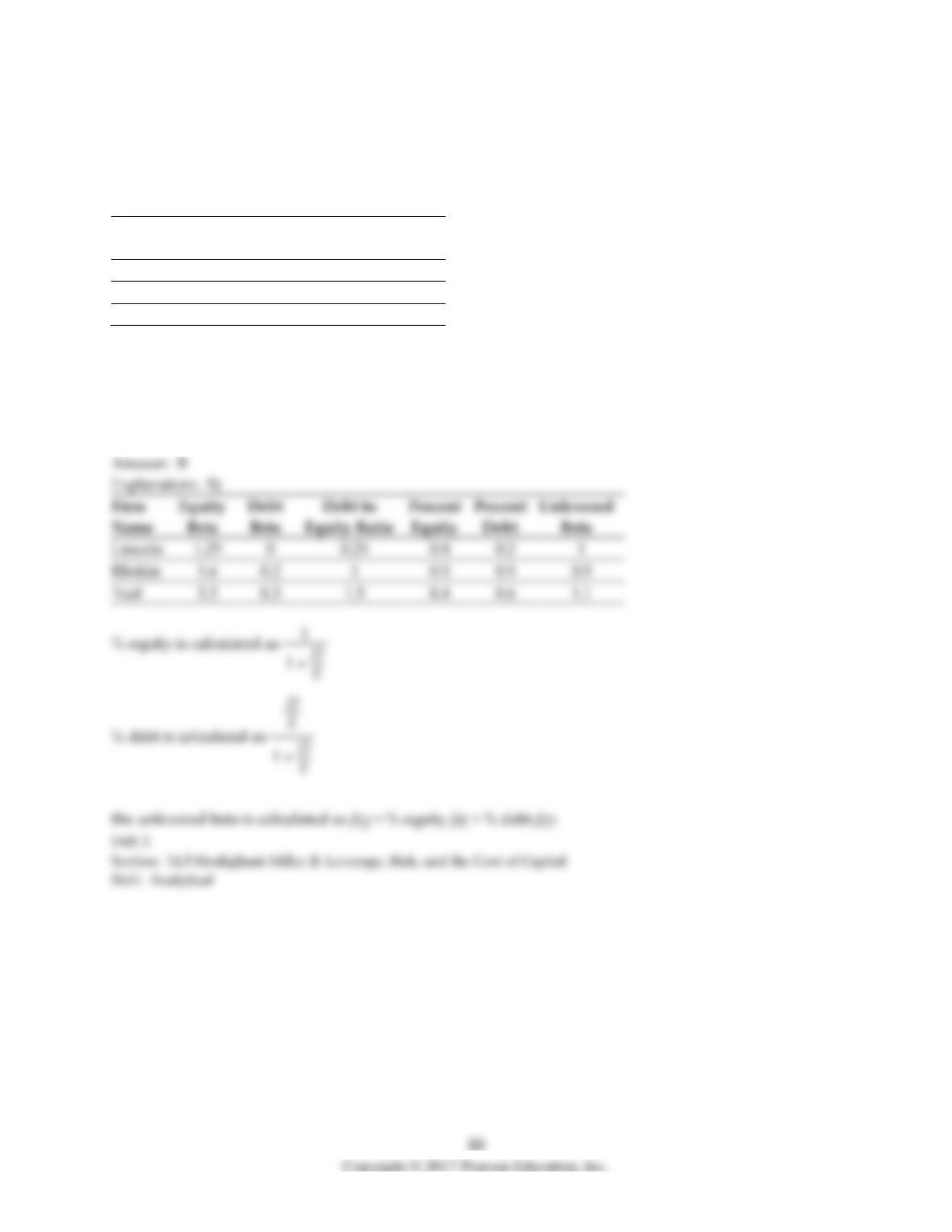
19) Consider the following equation:
βU = βE + βD
The term βU in the equation is:
A) the same as the beta of the firm’s assets.
B) the required return on the firm’s equity.
C) the proportion of the firm financed with equity.
D) equal to zero if the firm’s debt is riskless.
Use the information for the question(s) below.
You are evaluating a new project and need an estimate for your project’s beta. You have identified the
following information about three firms with comparable projects:
Firm
Name
Equity
Beta
Debt
Beta
Debt to
Equity Ratio
Lincoln
1.25
0
0.25
Blinkin
1.6
0.2
1
Nod
2.3
0.3
1.5
20) The unlevered beta for Lincoln is closest to:
A) 0.95
B) 1.00
C) 1.05
D) 0.90
Firm
Debt to
Unlevered
Lincoln
0
Blinkin
Nod
0.3
1.1
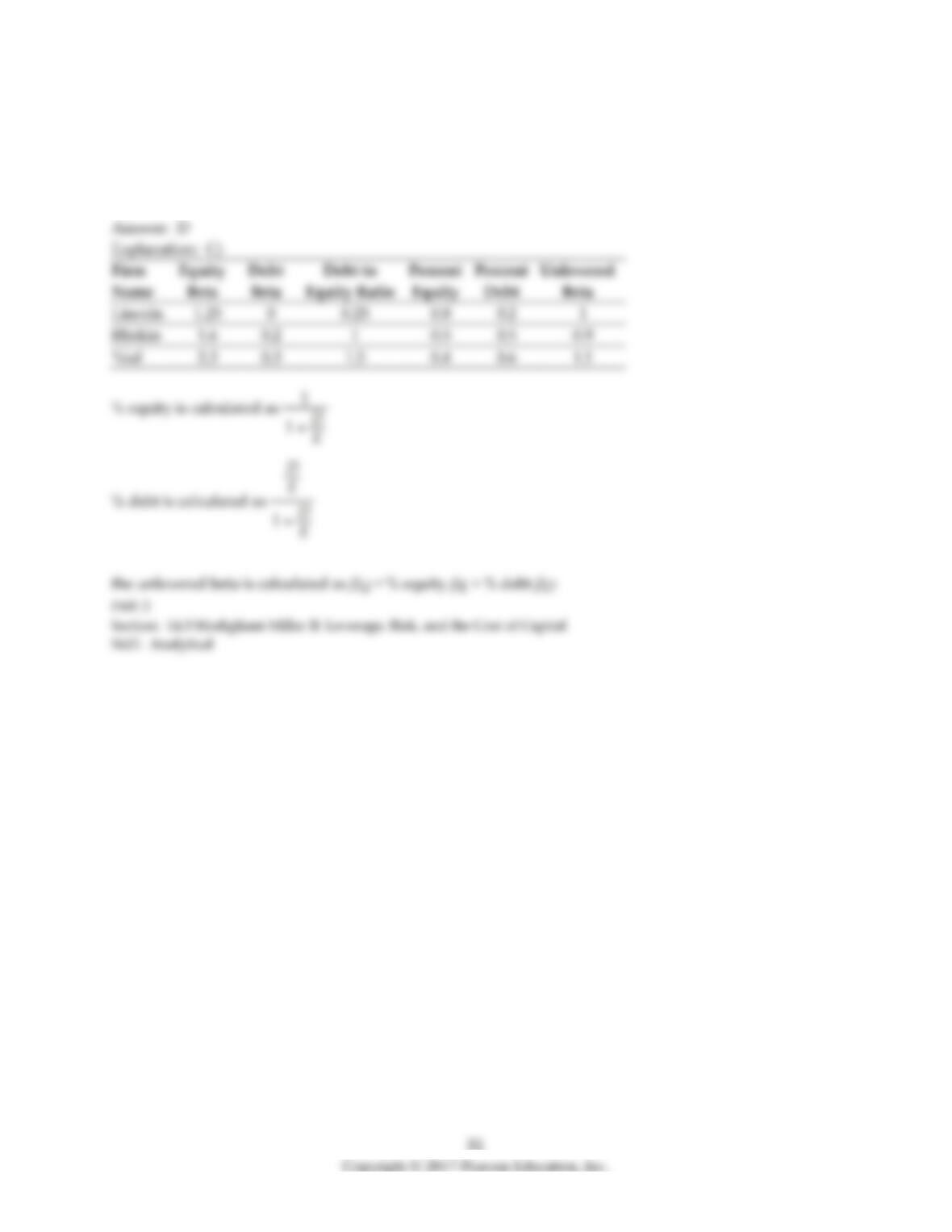
21) The unlevered beta for Blinkin is closest to:
A) 0.95
B) 1.10
C) 1.00
D) 0.90
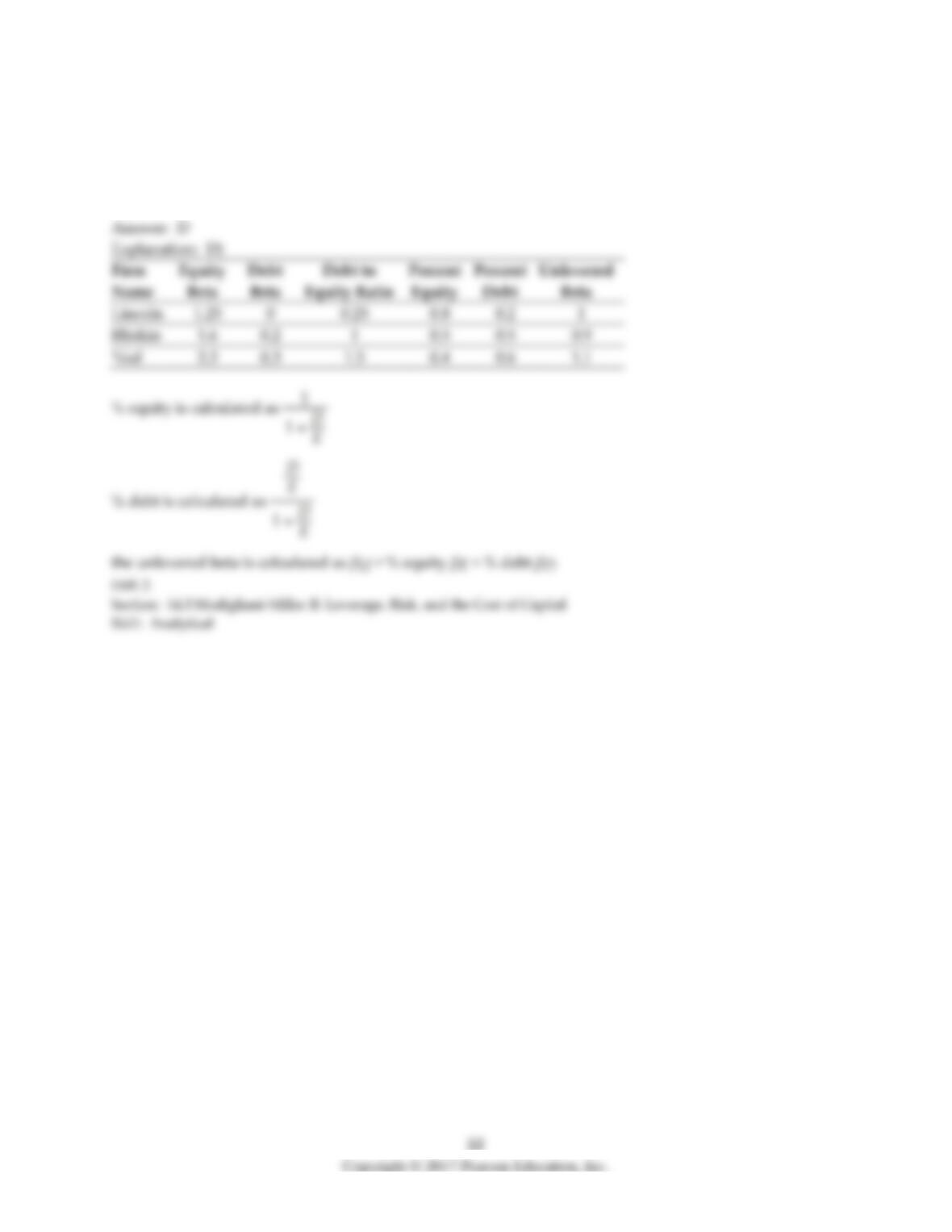
22) The unlevered beta for Nod is closest to:
A) 1.00
B) 0.90
C) 0.95
D) 1.10