14 – 39 Test Bank for Introduction to Corporate Finance, Fourth Canadian Edition
96. Which of the following are ways that inflation impacts the capital budgeting process?
I. Inflation affects future expected cash flows.
II. Inflation is reflected in the firm’s discount rate.
III. Inflation increases the general price level.
a) III only.
b) I and II only.
c) I and III only.
d) I, II, and III.
97. Use the following statements to answer this question:
I. Using real cash flows with a real discount rate yields the correct result.
II. Tax savings for CCA are normally reported in a given year dollars, so they are real values.
a) I and II are correct.
b) I and II are incorrect.
c) I is correct and II is incorrect.
d) I is incorrect and II is correct.
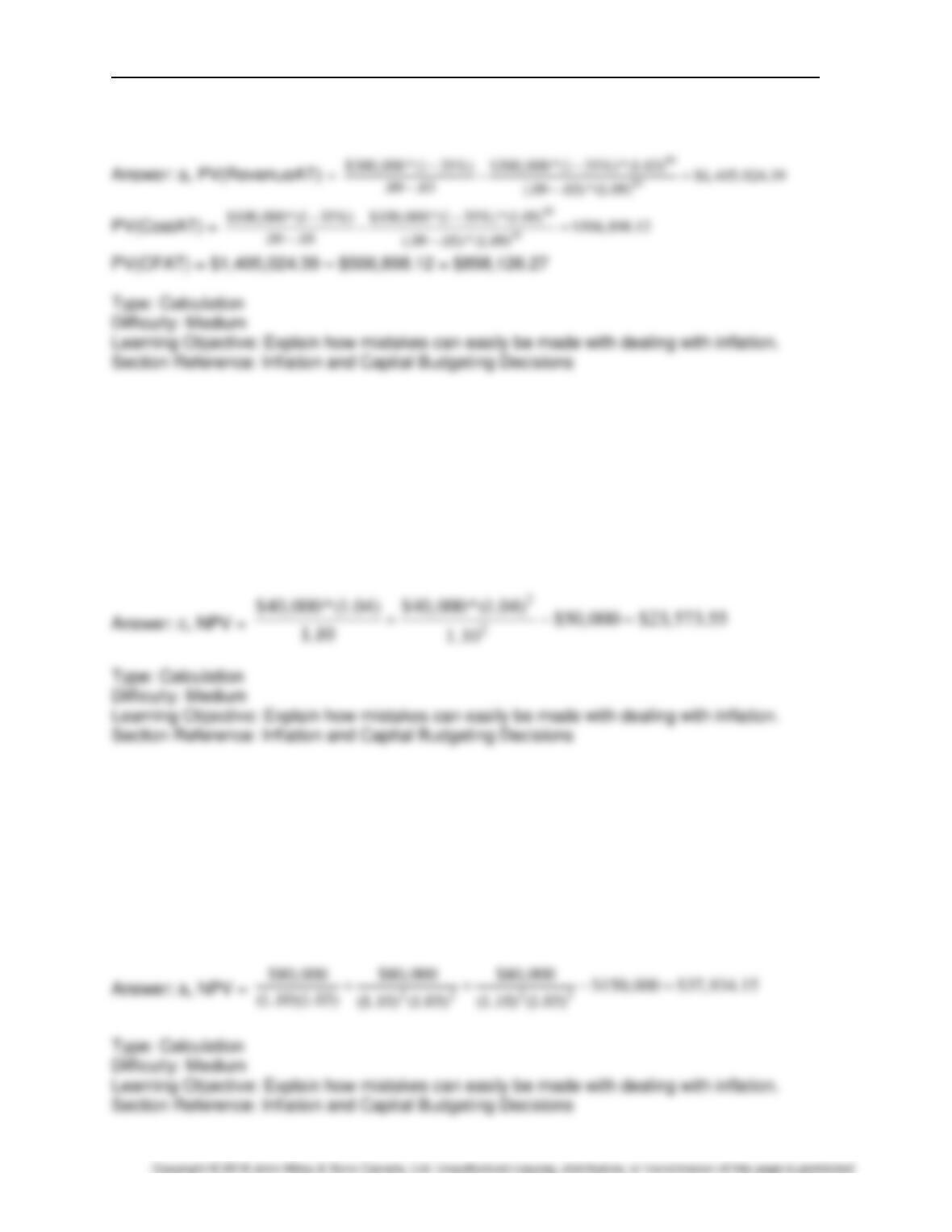
98. A proposed ten-year project has the first year sales revenue and cost projected at $300,000
and $100,000, respectively. Sales revenue is expected to grow at 3 percent per year, while the
costs will grow at 5 percent per year. The firm’s marginal tax rate is 35 percent and required return
is 9 percent. What is the present value of the after-tax operating cash flows generated by the
project?
a) $898,126
b) $914,932
c) $1,625,000
Cash Flow Estimations and Capital Budgeting Decisions 14 – 40
d) $1,641,250
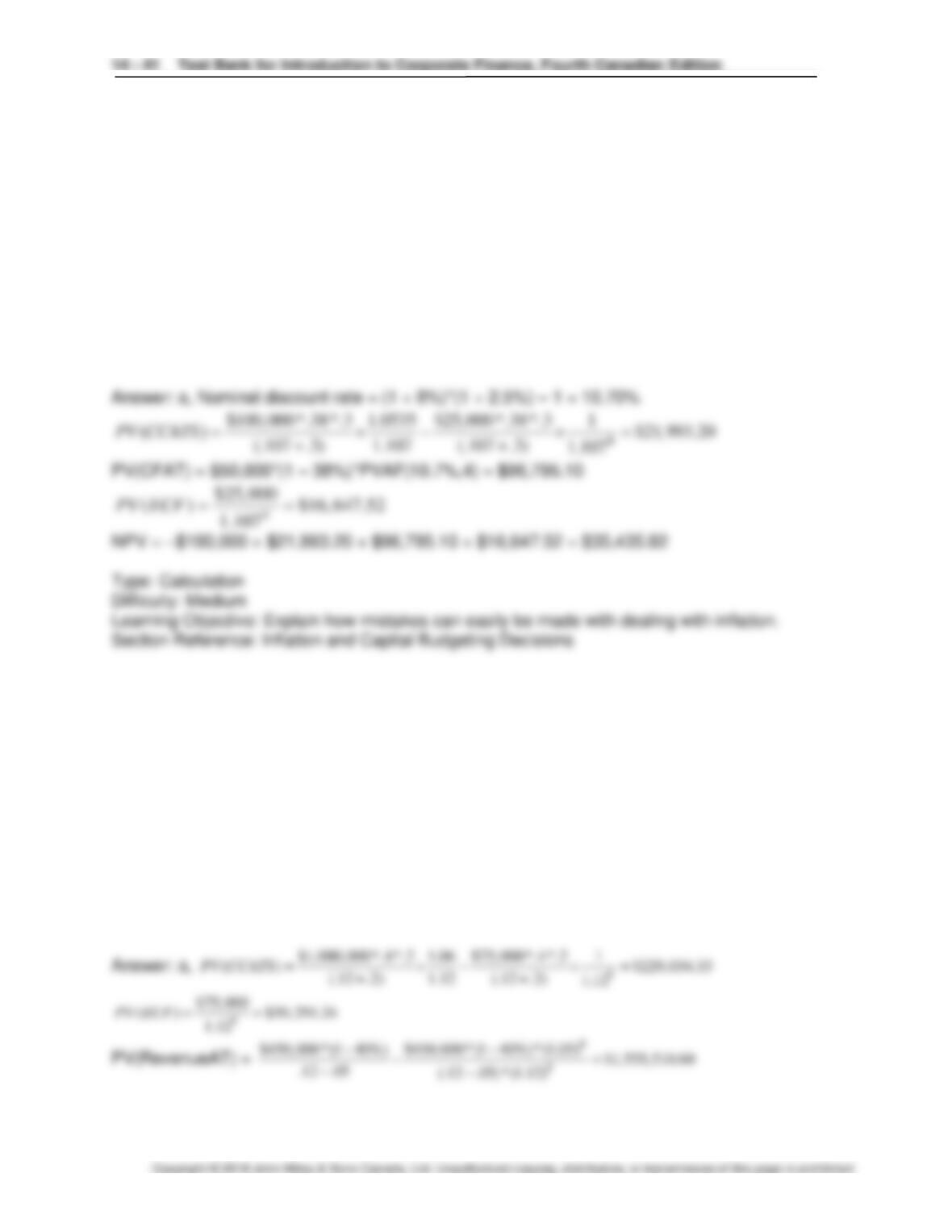
99. A project will cost $50,000 to initiate and will generate real cash flows of $40,000 in each of the
next two years. The nominal discount rate has been estimated to be 10 percent per year. Expected
inflation is 4 percent over the next two years. What is the NPV of the project?
a) $19,421.49
b) $21,573.55
c) $23,573.55
d) $25,496.63
100. A project will cost $150,000 to initiate and will generate nominal cash flows of $80,000 in each
of the next three years. The real discount rate has been estimated to be 10 percent per year.
Expected inflation is 3 percent over the next three years. What is the NPV of the project?
a) $37,934.15
b) $42,303.08
c) $48,948.16
d) $76,288.91
101. Suppose a new machine costs $100,000 and will provide nominal operating income of
$50,000 in each of the next four years. The machine belongs to asset class 9, which has a CCA
rate of 30 percent. The machine is expected to be sold for $25,000 at the end of four years. The
real discount rate has been estimated to be 8 percent per year. Expected inflation is 2.5 percent
over the next four years. The firm’s marginal tax rate is 38%. Assume there are other assets in the
asset class when the machine is sold. What is the NPV of the project?
a) $35,435.83
b) $44,427.84
c) $94,761.86
d) $107,358.25
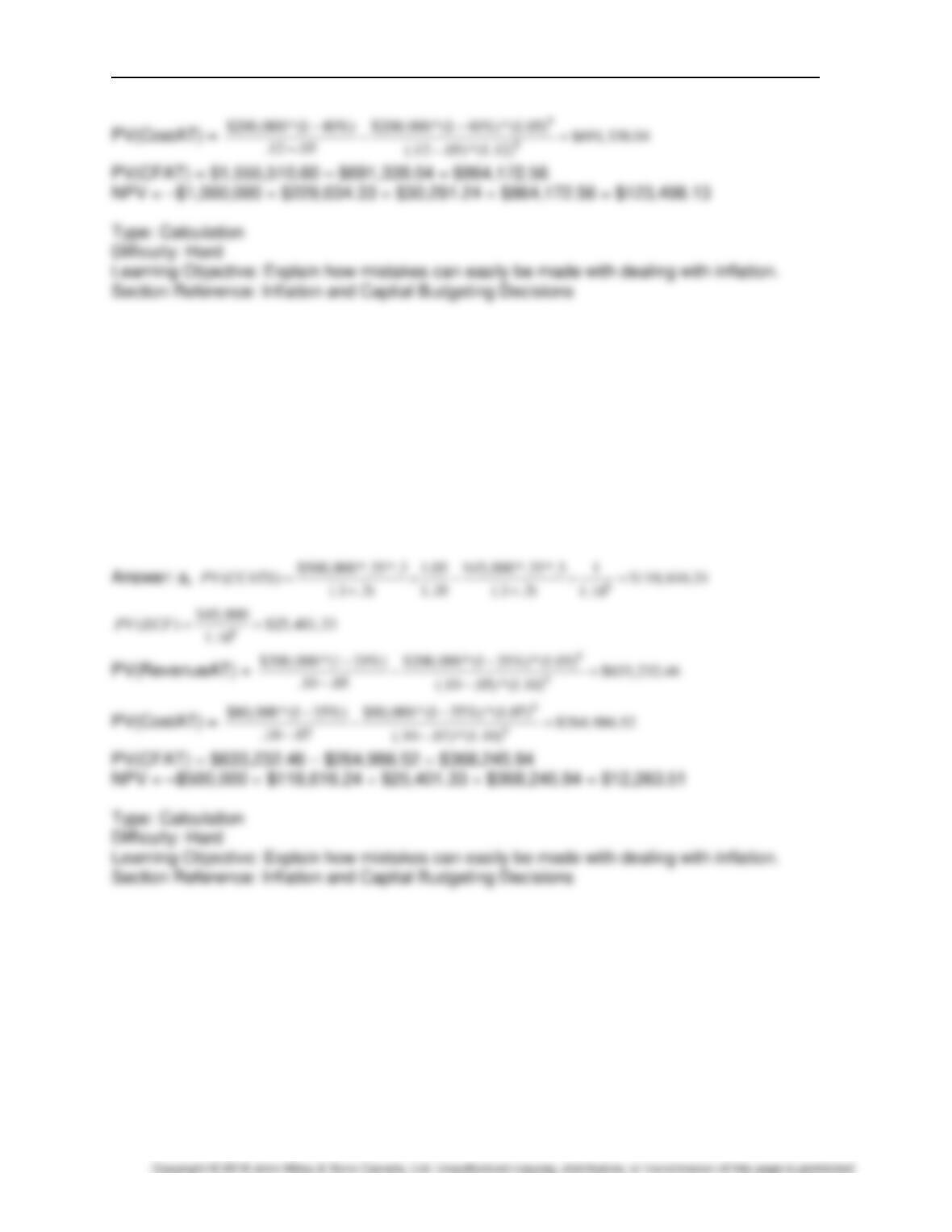
102. A firm is considering a project that requires an initial cash outflow of $1,000,000 for the
purchase of a capital asset, which has an eight-year life and a CCA rate of 20 percent, with the
asset class remaining open. The expected salvage value of the asset is $75,000 at the end of eight
years. The project will generate sales revenue of $450,000 in the first year, which will grow at 5
percent per year in the subsequent years. Variable costs will be $200,000 for the first year, which
will also grow at 5 percent per year. The firm’s marginal tax rate is 40 percent and required return
is 12 percent. What is the project’s NPV?
a) $123,498
b) $166,707
c) $1,402,183
d) $1,509,326
Cash Flow Estimations and Capital Budgeting Decisions 14 – 42
103. A firm is considering purchasing a new machine, which costs $500,000 and has a six-year
life, a CCA rate of 30 percent, and an expected salvage value of $45,000. The project will generate
sales revenue of $200,000 in the first year, which will grow at 5 percent per year in the subsequent
years. Variable costs will be $80,000 for the first year, which will grow at 7 percent per year. The
firm’s marginal tax rate is 35 percent and required return is 10 percent. What is the project’s NPV?
a) $12,264
b) $25,376
c) $497,546
d) $519,351
104. Use the following statements to answer this question:
I. Discount real cash flows with a real discount rate.
II. Discount nominal cash flows with a real discount rate.
III. Discount real cash flows with a nominal discount rate.
IV. Discount nominal cash flows with a nominal discount rate.
a) I and II are correct.
b) III and IV are incorrect.
c) I and IV are correct.
14 – 43 Test Bank for Introduction to Corporate Finance, Fourth Canadian Edition
d) II is incorrect and III is correct.
Cash Flow Estimations and Capital Budgeting Decisions 14 – 44
PRACTICE PROBLEMS
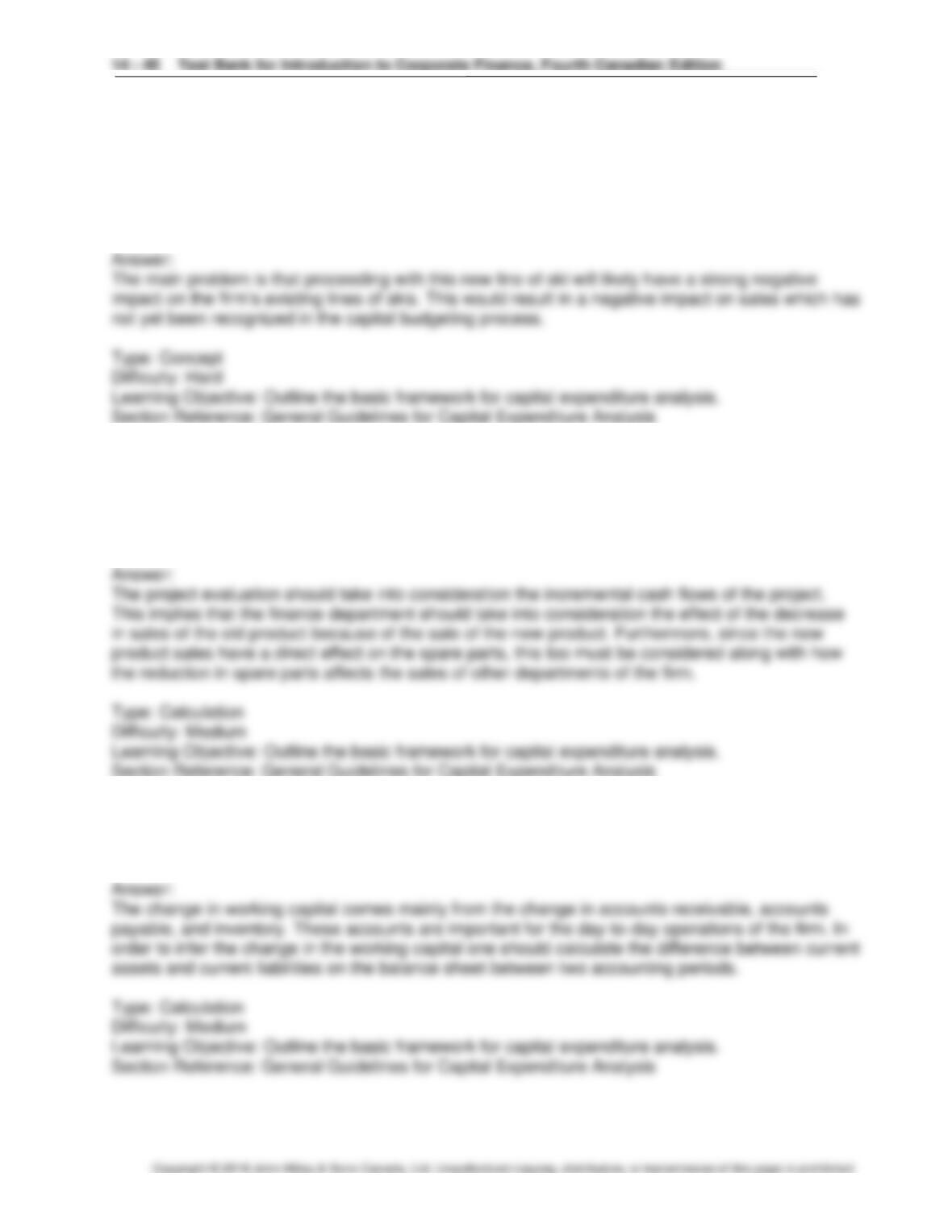
105. Explain what externalities are and give an example.
106. A piece of land outside of Toronto was purchased ten years ago for $100,000 by a real estate
development corporation. The company later spent $150,000 to clear and level the property. The
company has two options: the land can be sold today for $600,000, or the land can be converted
into a strip mall. In evaluating the capital budget for the strip mall, what price should the land be
valued at?
107. A project requires an initial investment of $300,000 and is expected to produce a cash flow
before taxes and depreciation of $120,000 per year for the next three years. The corporate tax rate
is 40%. The assets will be depreciated using straight-line depreciation for tax purposes. The
opportunity cost of capital is 10%. Calculate the NPV of the project.
108. A Bromont ski equipment manufacturer is thinking about developing and producing a new line
of super-side-cut skis. The finance department has estimated that the NPV of this standalone
project would be significantly positive relative to the initial investment. However, the CFO has
serious concerns about the NPV analysis because it fails to take into account the significant
negative interdependencies. What is the most likely issue here and how should it be accounted
for?
109. A firm is considering launching a new product into the market. The research and development
team showed that the new product is superior to the existing product and would not need the many
spare parts currently required that the company must provide. How should the finance department
evaluate this project?
110. Explain how you would estimate the change in working capital in a firm by using financial
statements.
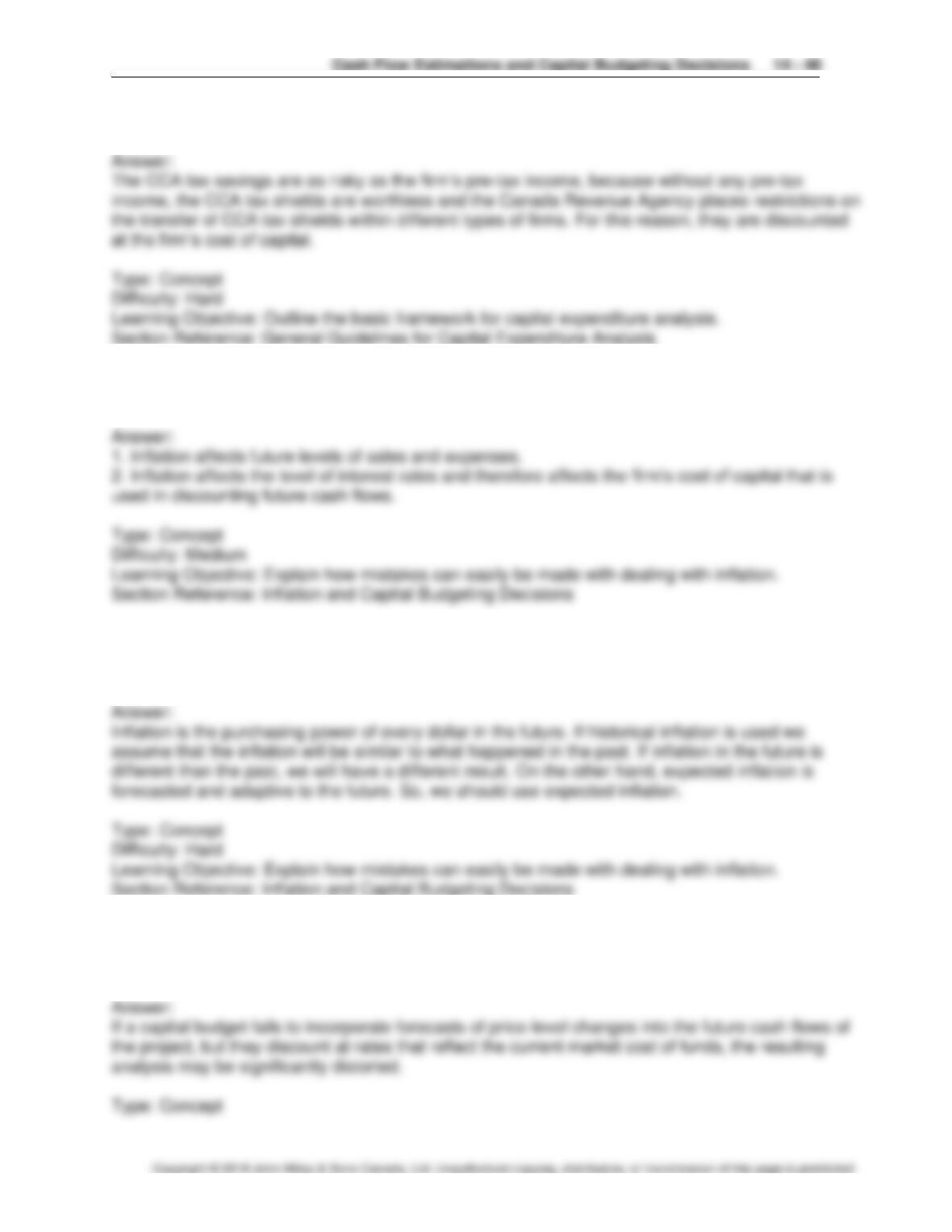
111. Explain why the CCA tax savings are discounted at the firm’s cost of capital.
112. Discuss the two ways inflation impacts capital budgeting.
113. Which measure of inflation do you think should be used in capital budgeting: historical
inflation or expected inflation. Explain why.
114. Why do cash flows need to be projected in nominal terms when market discount rates are
used?
14 – 47 Test Bank for Introduction to Corporate Finance, Fourth Canadian Edition
115. Explain the importance of scenario analysis in capital budgeting.
116. Explain the difference between break-even analysis and scenario analysis and the role each
plays in decision making.
117. How does the capital budgeting analysis of a new project differ from the replacement of a
project in terms of their calculations?
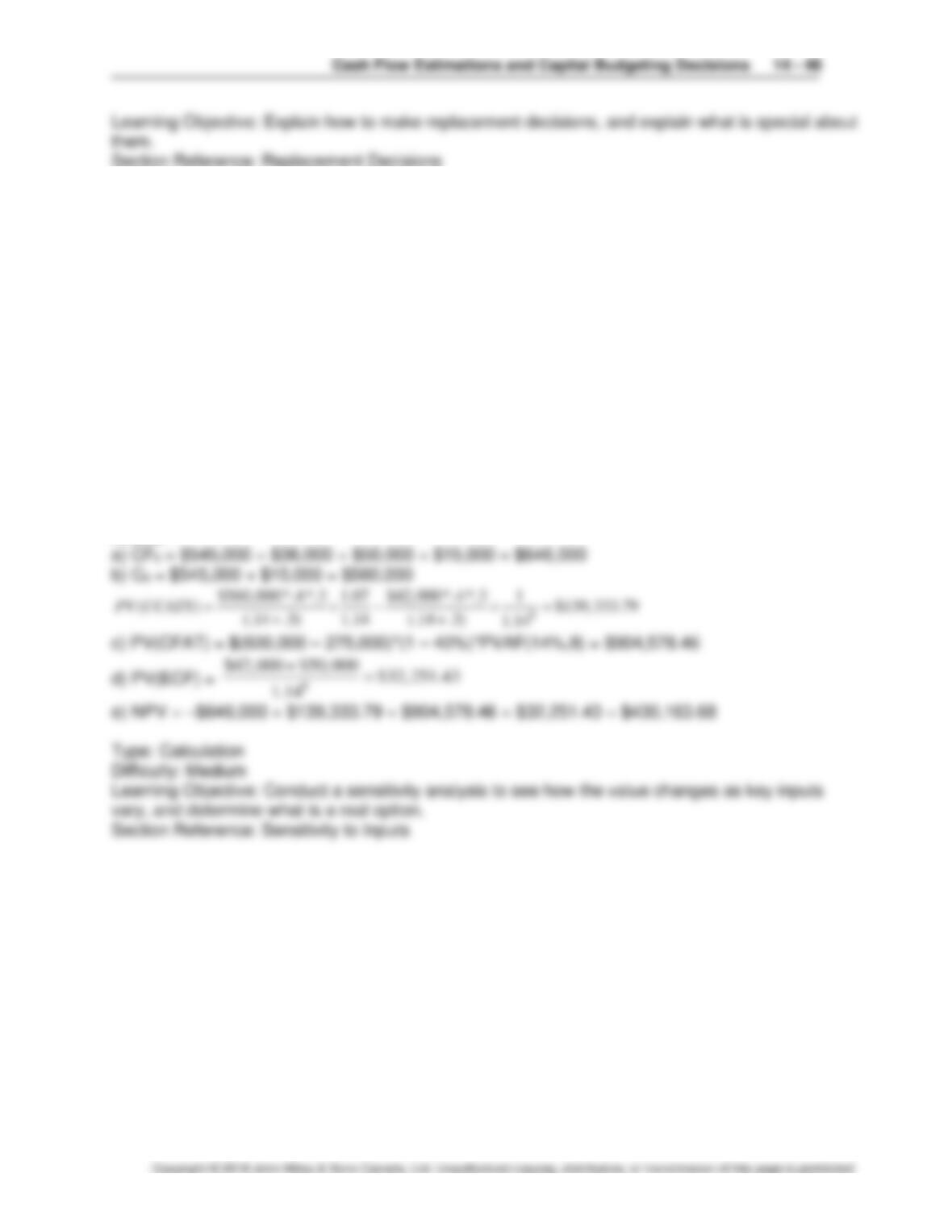
118. HMS Corporation is considering an expansion project that requires investment in capital
assets of $545,000, costs of $15,000 to modify the assets before they can be put into operation,
and additional raw materials inventory of $50,000 to support the project. In addition, HMS had
spent $25,000 to study the viability of this project. The one-time after-tax opportunity costs
associated with this project are $36,000. The project is expected to generate operating revenue of
$600,000 per year, and the associated operating expenses are estimated at $275,000 per year.
The capital assets belong to asset class 9, which has a CCA rate of 30 percent. The assets are
expected to sell for $42,000 when the project terminates in eight years. Assume the asset class
remains open after the project terminates. The firm’s cost of capital is 14 percent and marginal tax
rate is 40 percent.
a) What is the initial after-tax cash flow?
b) What is the present value of the CCA tax savings?
c) What is the present value of the after-tax operating cash flows?
d) What is the ending after-tax cash flow?
e) What is the NPV of the project?
Answer:
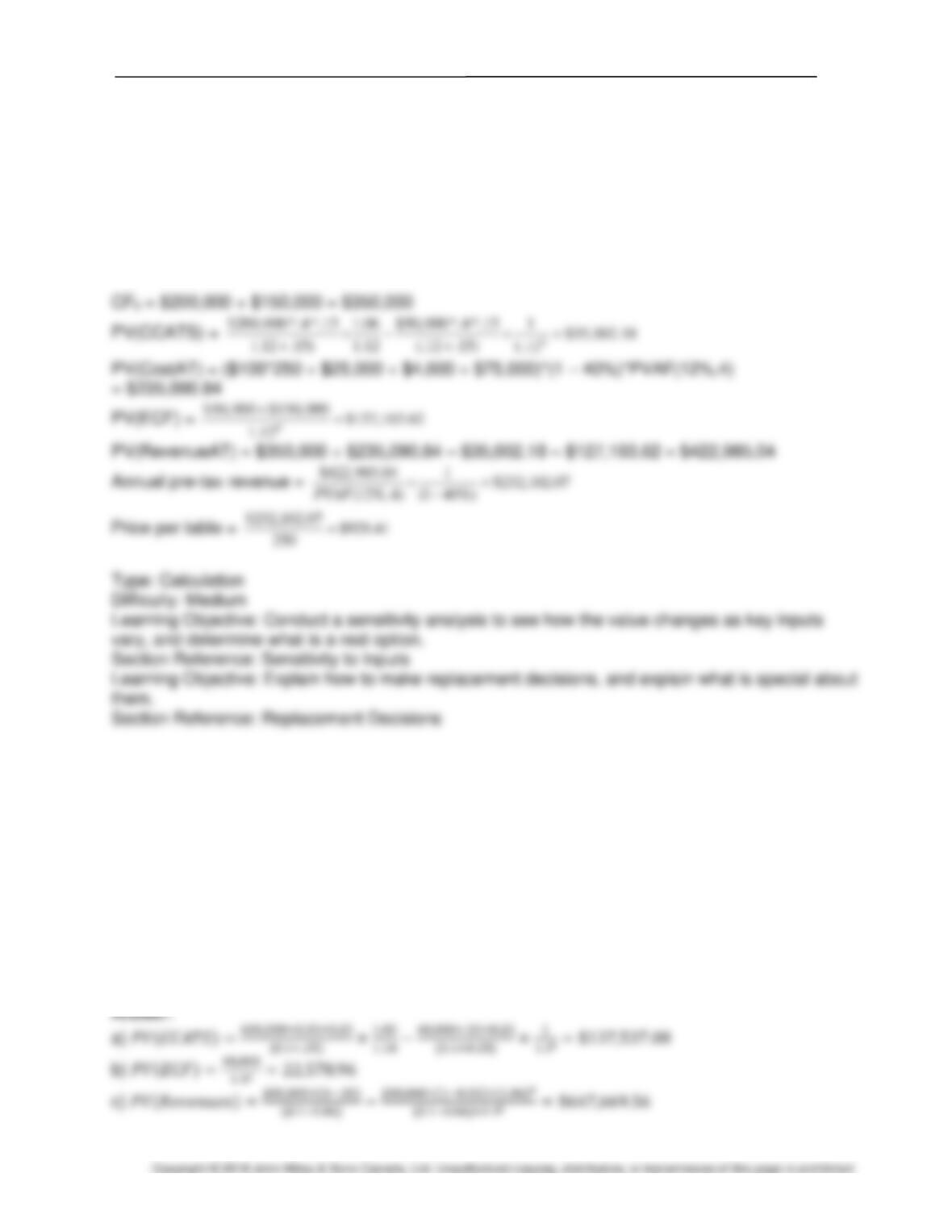
119. Abitibi Pulp Ltd. is considering a new product line for its existing table business. It has
developed a new type of computer table that will protect the computer during an earthquake. It
would like you to analyze the feasibility of the venture and suggests a break-even bid price. It
provides you with the following details:
• Marketing analysis indicates technology companies in Silicon Valley will buy 250 tables
each year for four years.
• The consultant who did the marketing research charged a fee of $15,000.
• The firm estimates that the variable cost per table is $100. For this project the firm would
require extra factory space at a cost of $25,000 per year, overhead costs such as heating
and lighting would amount to $4,000 per year, and wages and salaries would total $75,000
per year.
14 – 49 Test Bank for Introduction to Corporate Finance, Fourth Canadian Edition
• The machinery required for the new product line would cost $200,000, and have a salvage
value of $50,000 at the end of 4 years. The machinery belongs to CCA class 16 and has a
15 percent declining balance rate. The asset class will remain open.
• Additional working capital of $150,000 would be required to get the project started.
• The corporate tax rate is 40 percent and the required rate of return is 12 percent.
What price should Abitibi charge for each table?
Answer:
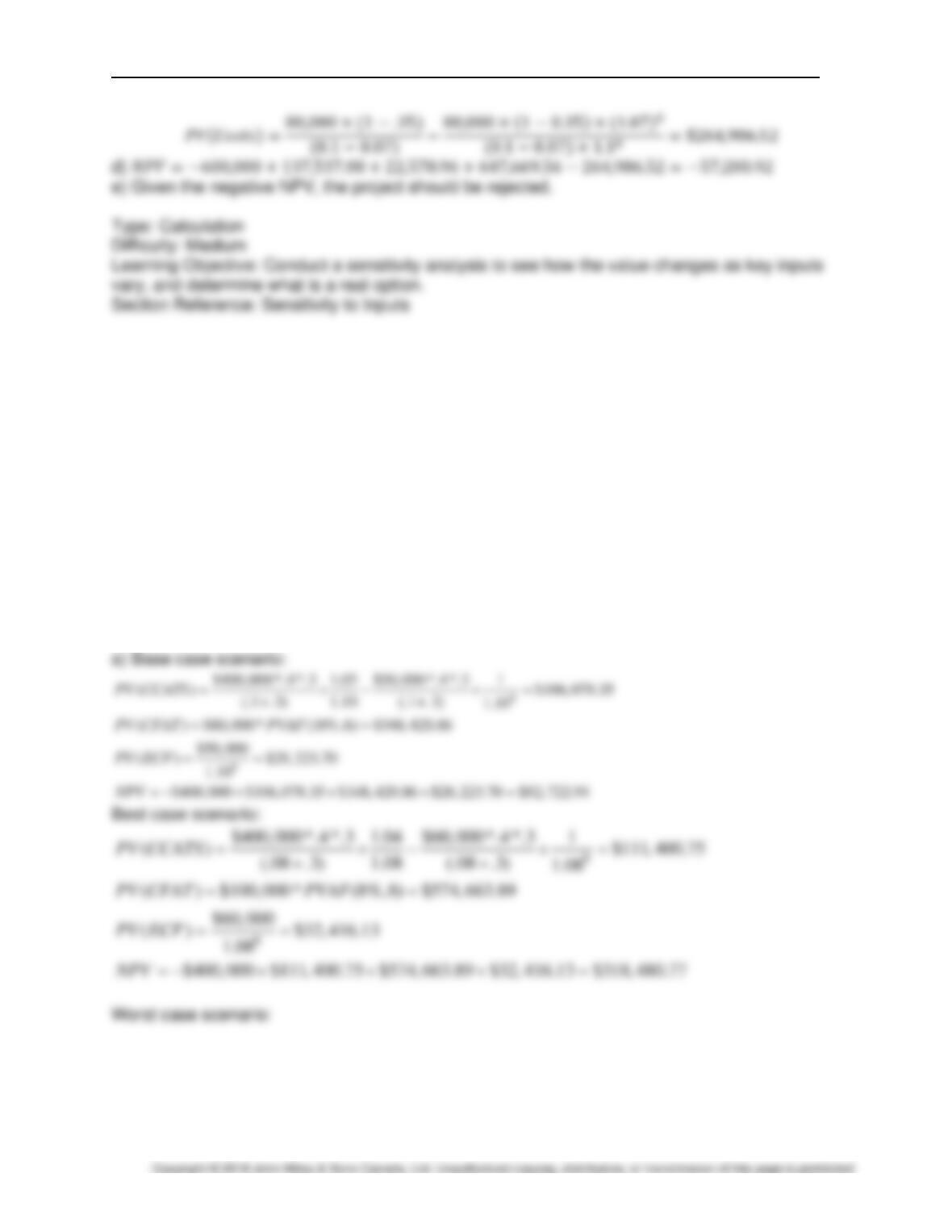
120. A firm is considering purchasing a new machine, which costs $600,000 and has a six-year
life, a CCA rate of 25 percent, and an expected salvage value of $40,000. The asset class will
remain open. The project will generate sales revenue of $200,000 in the first year, which will grow
at 6 percent per year in the subsequent years. Variable costs will be $80,000 for the first year,
which will grow at 7 percent per year. The firm’s marginal tax rate is 35 percent and required return
is 10 percent.
a) Calculate the present value of CCA.
b) Calculate the present value of ending cash flow.
c) Calculate the present value of after-tax cost and revenue.
d) Calculate the NPV.
e) Should the project be accepted?
Cash Flow Estimations and Capital Budgeting Decisions 14 – 50
121. Delta Corporation is considering an investment of $400,000 in a new machine, which belongs
to asset class 43 with a CCA rate of 30 percent. The machine is not the only asset in the asset
class. The firm‘s effective tax rate is 40 percent. The company has the following estimates:
Base case Best case Worst case
Project life 6 years 8 years 4 years
Discount rate (k) 10% 8% 12%
Salvage value $50,000 $60,000 $40,000
Annual after-tax operating cash flows $80,000 $100,000 $60,000
a) Determine the NPV for each scenario.
b) Would you recommend the company to undertake the project if each scenario is equally likely?
Why?
Answer:
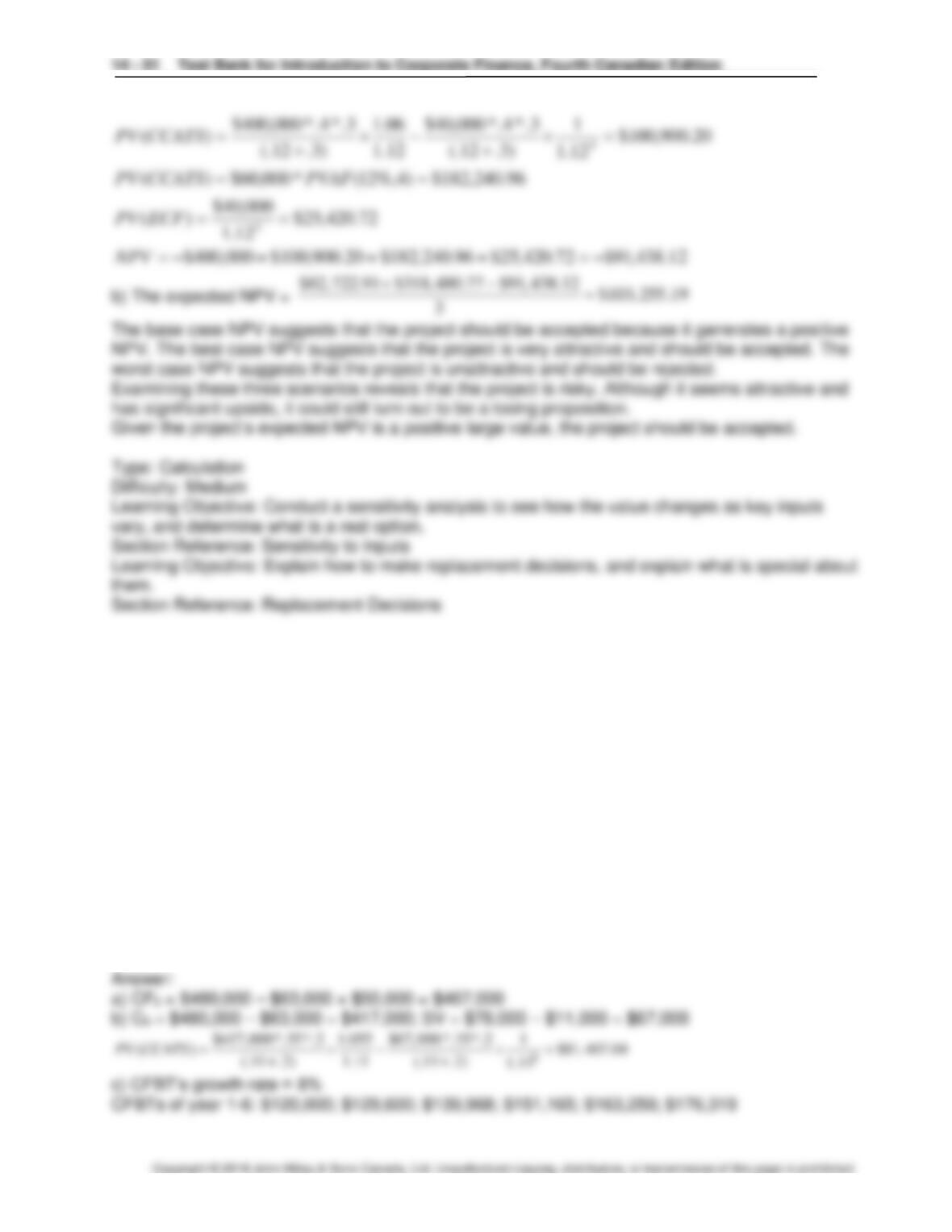
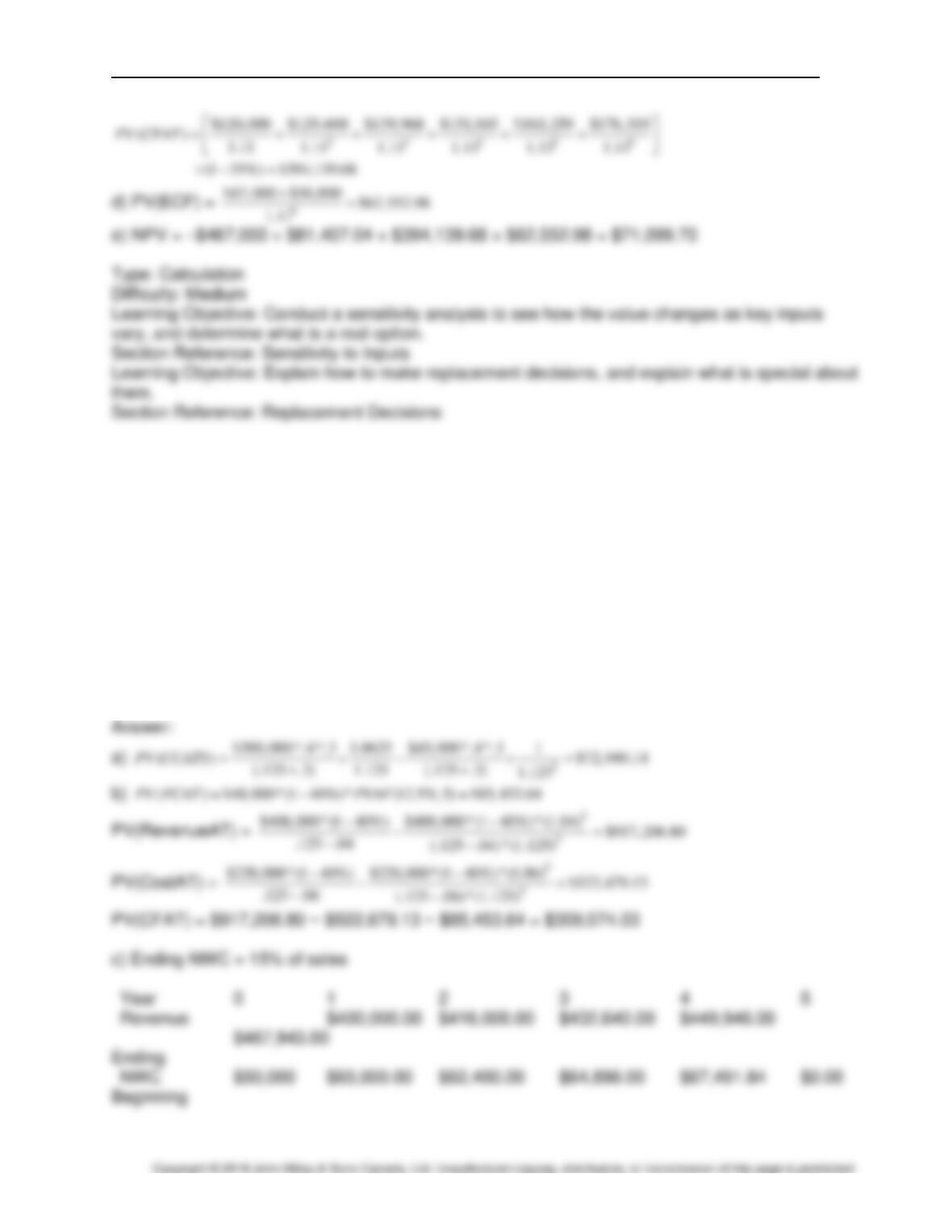
122. A firm is considering an investment of $480,000 in new equipment to replace old equipment
with a book value of $95,000 and a market value of $63,000. If the firm replaces the old equipment
with new equipment, it expects to save $120,000 in operating costs the first year. The amount of
savings will grow at a rate of 8 percent per year for each of the following five years. Both pieces of
equipment belong to asset class 8, which has a CCA rate of 20 percent. The salvage values of
both the old equipment and the new equipment at the end of six years are $11,000 and $78,000,
respectively. There are other assets in the asset class when the project terminates. In addition,
replacement of the old equipment with the new equipment requires an immediate increase in net
working capital of $50,000. The firm’s marginal tax rate is 35 percent and cost of capital is 11
percent.
a) What is the initial after-tax cash flow?
b) What is the present value of the incremental CCA tax savings?
c) What is the present value of the incremental after-tax operating cash flows?
d) What is the present value of the incremental ending after-tax cash flow?
e) What is the NPV of the replacement project?
Cash Flow Estimations and Capital Budgeting Decisions 14 – 52
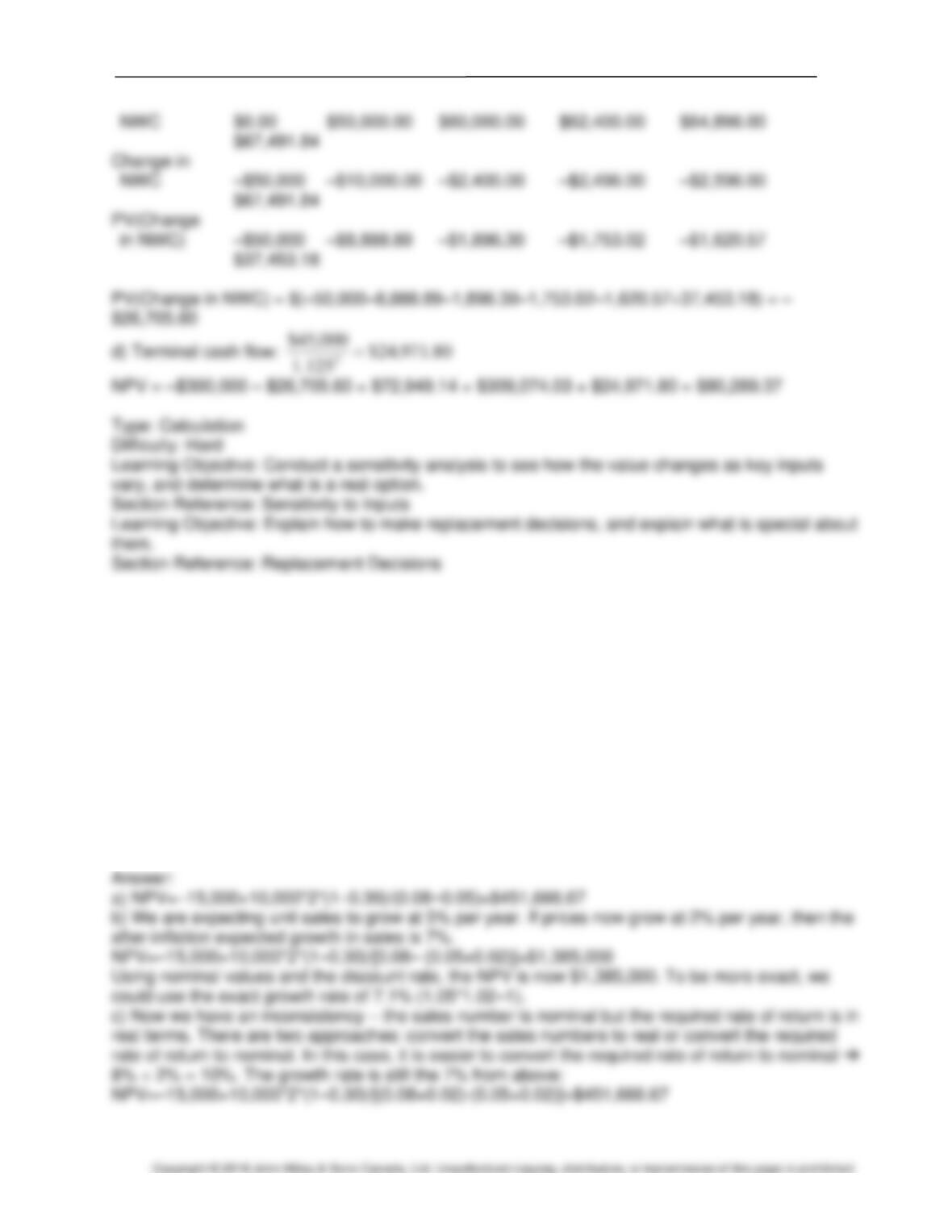
123. A firm is considering a project that requires an initial investment of $300,000 in new
equipment, which has a five-year life and a CCA rate of 30 percent. An initial investment in raw
materials inventory of $50,000 is also required to support the project, which will rise to 15 percent
of sales. The project will generate sales revenue of $400,000 in the first year, which will grow at 4
percent per year. Variable costs will be $220,000 for the first year, which will grow at 6 percent per
year. The project’s fixed costs are $40,000 per year. The expected salvage value of the asset is
$45,000 at the end of five years. The firm’s marginal tax rate is 40 percent and required return is
12.5 percent. Assume the asset class remains open after the project terminates.
a) What is the present value of the CCA tax savings?
b) What is the present value of the after-tax operating cash flow?
c) What is the present value of the change in net working capital?
d) What is the NPV of the project?
14 – 53 Test Bank for Introduction to Corporate Finance, Fourth Canadian Edition
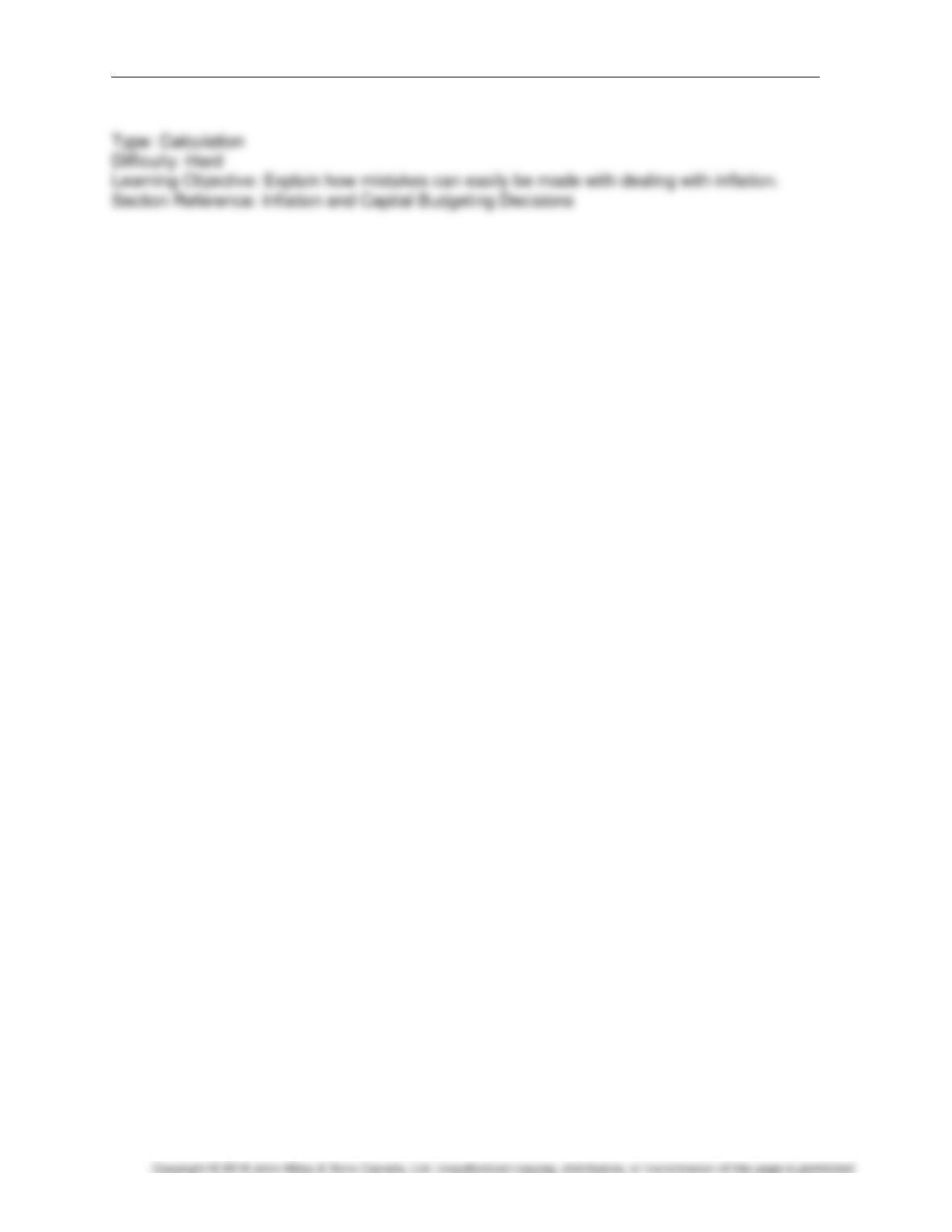
124. BathGate Group has just completed its analysis of a project. The CFO has presented the
following information to the Board of Directors:
The initial cost of the project is $15,000. Sales are expected to be 10,000 units in year one and are
expected to grow by 5 percent per year forever. In year one, they expect to sell units for $2 each
and foresee no real change in unit price. Variable and fixed costs are zero.
The firm’s required rate of return is 8 percent. The corporate tax rate is 30 percent. Assume the
CCA rate is zero.
a) Calculate the NPV of this project if there is zero inflation forecast.
b) Calculate the NPV of this project if inflation is forecasted to be 2 percent per year. Assume the
required rate of return is nominal at 8 percent.
c) Calculate the NPV of this project if inflation is forecasted to be 2 percent per year and the firm
requires a real rate of return of 8 percent.
Cash Flow Estimations and Capital Budgeting Decisions 14 – 54
14 – 55 Test Bank for Introduction to Corporate Finance, Fourth Canadian Edition
LEGAL NOTICE