
CHAPTER 14—REAL OPTIONS
1. Real options exist when managers have the opportunity, after a project has been implemented, to make operating
changes in response to changed conditions that modify the project’s cash flows.
a.
True
b.
False
True
1
2. Real options are options to buy real assets, like stocks, rather than interest-bearing assets, like bonds.
a.
True
b.
False
False
1
3. The option to abandon a project is a real option, but a call option on a stock is not a real option.
a.
True
b.
False
True
1
4. Real options are most valuable when the underlying source of risk is very low.
a.
True
b.
False
False

CHAPTER 14—REAL OPTIONS
5. Real options affect the size, but not the risk, of a project’s expected cash flows.
a.
True
b.
False
False
1
Difficulty: Easy
INTE.GENE.16.92 – LO: 14-2
United States – BUSPROG: Reflective Thinking
United States – AK – DISC: Capital structure
United States – OH – Default City – TBA
Real options
6. Whether to invest in a project today or to postpone the decision until next year is a decision facing the CEO of the
Aaron Co. The project has a positive expected NPV, but its cash flows could be less than expected, in which case the NPV
could be negative. No competitors are likely to invest in a similar project if Aaron decides to wait. Which of the following
statements best describes the issues that Aaron faces when considering this investment timing option?
a.
The more uncertainty about the future cash flows, the more logical it is for Aaron to go ahead with this project
today.
b.
Since the project has a positive expected NPV today, this means that its expected NPV will be even higher if it
chooses to wait a year.
c.
Since the project has a positive expected NPV today, this means that it should be accepted in order to lock in
that NPV.
d.
Waiting would probably reduce the project’s risk.
e.
The investment timing option does not affect the cash flows and will therefore have no impact on the project’s
risk.
d
1
Difficulty: Easy
INTE.GENE.16.92 – LO: 14-2
United States – BUSPROG: Analytic
1
Difficulty: Easy
INTE.GENE.16.92 – LO: 14-2
United States – BUSPROG: Reflective Thinking
United States – AK – DISC: Capital structure
United States – OH – Default City – TBA
Real options

CHAPTER 14—REAL OPTIONS
7. Which one of the following is an example of a “flexibility” option?
a.
A company has an option to close down an operation if it turns out to be unprofitable.
b.
A company agrees to pay more to build a plant in order to be able to change the plant’s inputs and/or outputs at
a later date if conditions change.
c.
A company invests in a project today to gain knowledge that may enable it to expand into different markets at
a later date.
d.
A company invests in a jet aircraft so that its CEO, who must travel frequently, can arrive for distant meetings
feeling less tired than if he had to fly commercial.
e.
A company has an option to invest in a project today or to wait a year.
b
1
Difficulty: Easy
INTE.GENE.16.93 – LO: 14-4
United States – BUSPROG: Analytic
United States – AK – DISC: Capital structure
United States – OH – Default City – TBA
Real options
TYPE: Multiple Choice: Conceptual
8. Which of the following is NOT a real option?
a.
The option to buy shares of stock if its price goes up.
b.
The option to expand into a new geographic region.
c.
The option to abandon a project.
d.
The option to switch the type of fuel used in an industrial furnace.
e.
The option to expand production if the product is successful.
1
Difficulty: Moderate
INTE.GENE.16.91 – LO: 14-1
United States – BUSPROG: Analytic
United States – AK – DISC: Capital structure
United States – OH – Default City – TBA
United States – AK – DISC: Capital structure
United States – OH – Default City – TBA
Investment timing option
TYPE: Multiple Choice: Conceptual

CHAPTER 14—REAL OPTIONS
9. Which of the following will NOT increase the value of a real option?
a.
An increase in the volatility of the underlying source of risk.
b.
An increase in the risk-free rate.
c.
An increase in the cost of obtaining the real option.
d.
A decrease in the probability that a competitor will enter the market of the project in question.
e.
Lengthening the time in which a real option must be exercised.
c
1
Difficulty: Moderate
INTE.GENE.16.92 – LO: 14-2
United States – BUSPROG: Analytic
United States – AK – DISC: Capital structure
United States – OH – Default City – TBA
Real options
TYPE: Multiple Choice: Conceptual
10. Which of the following is most CORRECT?
a.
Real options change the risk, but not the size, of projects’ expected cash flows.
b.
Real options are likely to reduce the cost of capital that should be used to discount a project’s expected cash
flows.
c.
Very few projects actually have real options.
d.
Real options are less valuable when there is a lot of uncertainty about the true values future sales and costs.
e.
Real options change the size, but not the risk, of projects’ expected cash flows.
b
1
Difficulty: Moderate
INTE.GENE.16.92 – LO: 14-2
United States – BUSPROG: Analytic
United States – AK – DISC: Capital structure
United States – OH – Default City – TBA
Real options
TYPE: Multiple Choice: Conceptual
11. Ashgate Enterprises uses the NPV method for selecting projects, and it does a reasonably good job of estimating
projects’ sales and costs. However, it never considers real options that might be associated with projects. Which of the
following statements is most likely to describe its situation?
a.
Its estimated capital budget is probably too large due to its failure to consider abandonment and growth
options.
b.
Failing to consider abandonment and flexibility options probably makes the optimal capital budget too large,
Real options
TYPE: Multiple Choice: Conceptual
CHAPTER 14—REAL OPTIONS
but failing to consider growth and timing options probably makes the optimal capital budget too small, so it is
unclear what impact not considering real options has on the overall capital budget.
c.
Failing to consider abandonment and flexibility options probably makes the optimal capital budget too small,
but failing to consider growth and timing options probably makes the optimal capital budget too large, so it is
unclear what impact not considering real options has on the overall capital budget.
d.
Real options should not have any effect on the size of the optimal capital budget.
e.
Its estimated capital budget is probably too small, because projects’ NPVs are often larger when real options
are taken into account.
e
1
Difficulty: Moderate
INTE.GENE.16.93 – LO: 14-4
United States – BUSPROG: Analytic
United States – AK – DISC: Capital structure
United States – OH – Default City – TBA
Real options
TYPE: Multiple Choice: Conceptual
A $400 feasibility study would be conducted at t = 0. The results of this study would
investment and abandon the project.
t = 1.
exploratory wells would indicate good potential and thus that further work would be
abandoned.
obtain an accurate estimate of the amount of oil in the field at t = 2. The best estimate
now is that there is a 60% probability that the results would be very good and a 40%
probability that results would be poor and the field would be abandoned.
oil and then only receiving a $10,000 inflow.
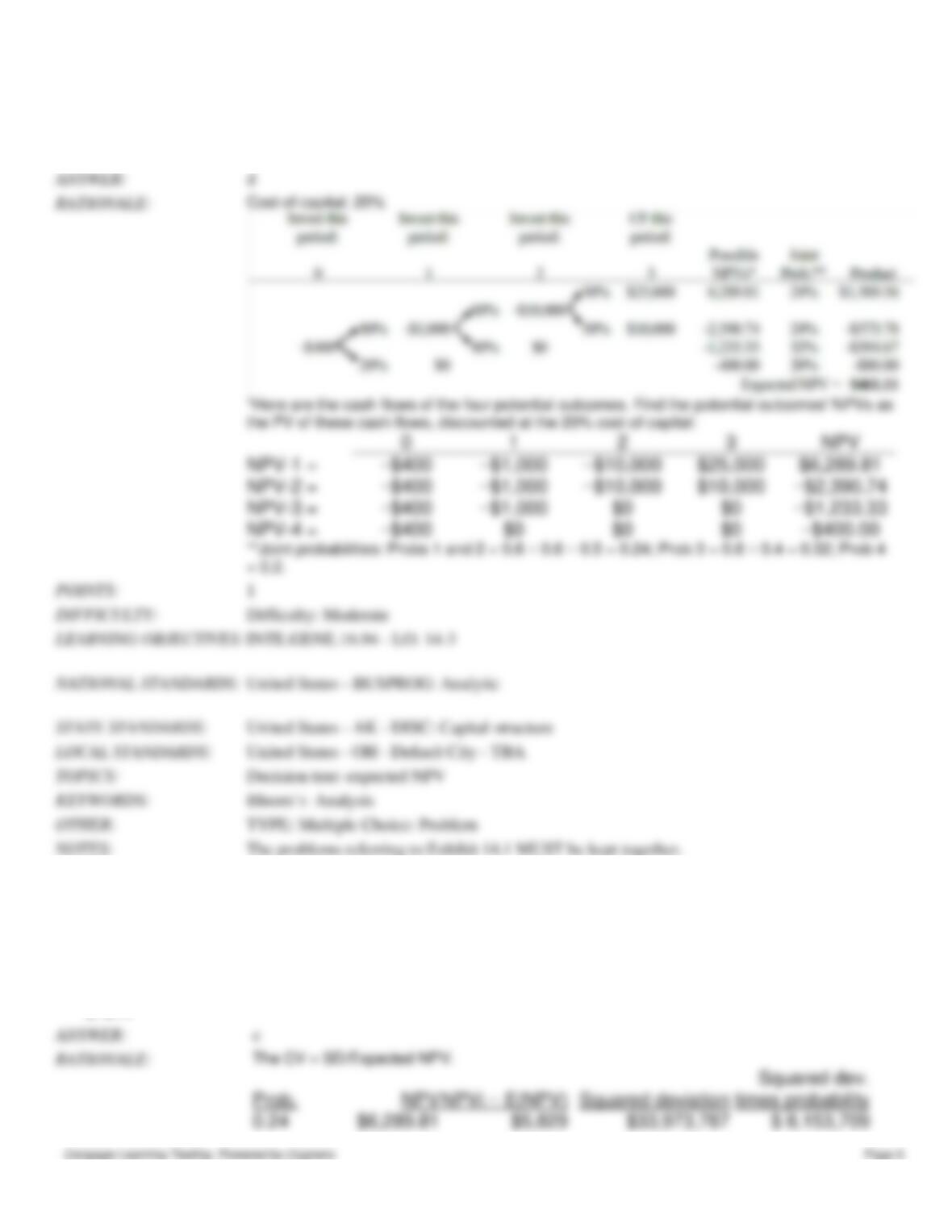
12. Refer to Exhibit 14.1. Since the project is considered to be quite risky, a 20% cost of capital is used. What is the
project’s expected NPV, in thousands of dollars?
a.
$336.15
b.
$373.50
CHAPTER 14—REAL OPTIONS
c.
$415.00
d.
$461.11
e.
$507.22
d
1
13. Refer to Exhibit 14.1. Calculate the project’s coefficient of variation. (Hint: Use the expected NPV.)
a.
5.87
b.
6.52
c.
7.25
d.
7.97
e.
8.77
c

CHAPTER 14—REAL OPTIONS
Exhibit 14.2
A project with an up-front cost at t = 0 of $1500 is being considered by Nationwide Pharmaceutical Corporation (NPC).
(All dollars in this problem are in thousands.) The project’s subsequent cash flows are critically dependent on whether a
competitor’s product is approved by the Food and Drug Administration. If the FDA rejects the competitive product, NPC’s
product will have high sales and cash flows, but if the competitive product is approved, that will negatively impact NPC.
There is a 75% chance that the competitive product will be rejected, in which case NPC’s expected cash flows will be
$500 at the end of each of the next seven years (t = 1 to 7). There is a 25% chance that the competitor’s product will be
approved, in which case the expected cash flows will be only $25 at the end of each of the next seven years (t = 1 to 7).
NPC will know for sure one year from today whether the competitor’s product has been approved.
NPC is considering whether to make the investment today or to wait a year to find out about the FDA’s decision. If it
waits a year, the project’s up-front cost at t = 1 will remain at $1,500, the subsequent cash flows will remain at $500 per
year if the competitor’s product is rejected and $25 per year if the alternative product is approved. However, if NPC
decides to wait, the subsequent cash flows will be received only for six years (t = 2 … 7).
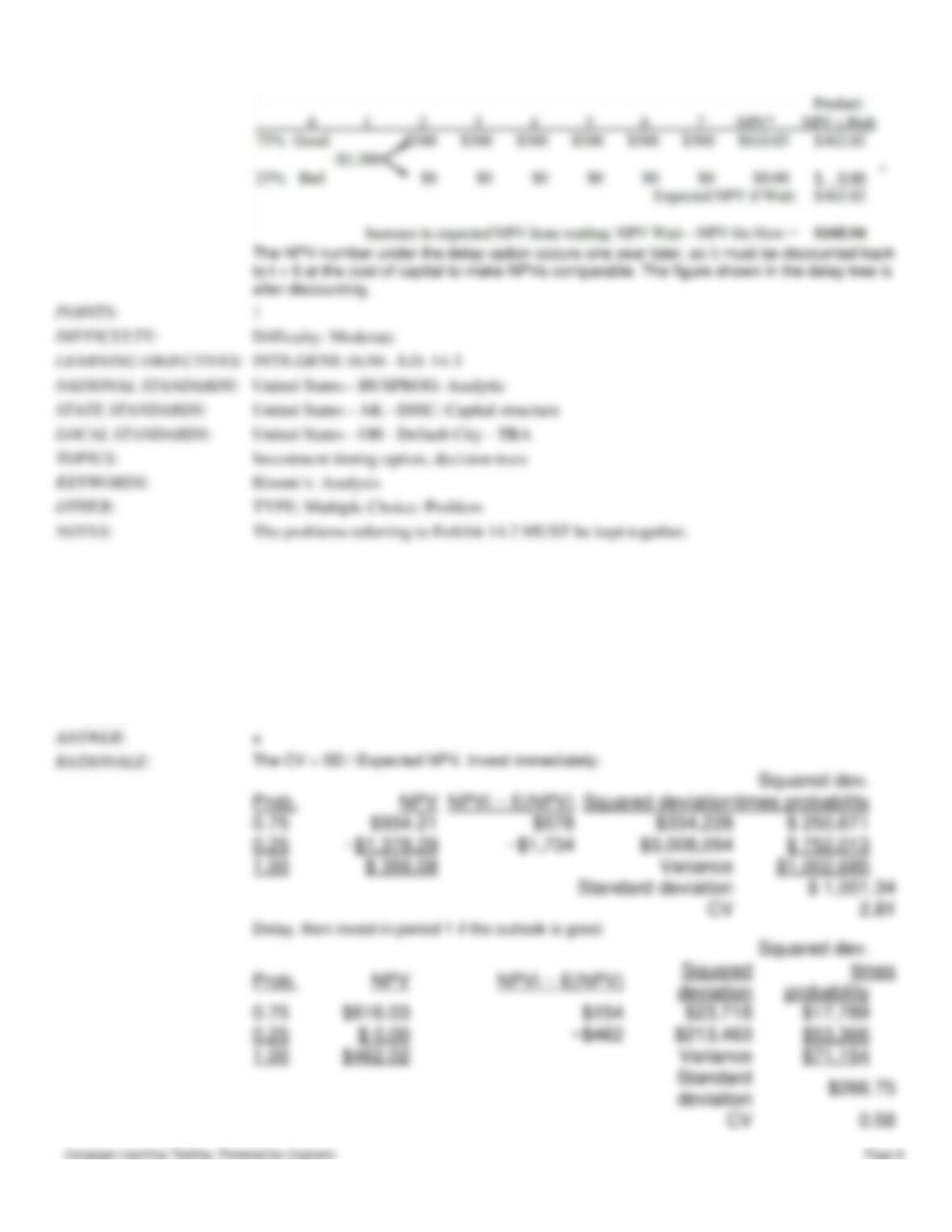
14. Refer to Exhibit 14.2. Assuming that all cash flows are discounted at 10%, if NPC chooses to wait a year before
proceeding, how much will this increase or decrease the project’s expected NPV in today’s dollars (i.e., at t = 0), relative to
the NPV if it proceeds today?
a.
$77.23
b.
$85.81
c.
$95.34
d.
$105.94
e.
$116.53
d
1
Difficulty: Moderate
INTE.GENE.16.94 – LO: 14-3
United States – BUSPROG: Analytic
United States – AK – DISC: Capital structure
United States – OH – Default City – TBA
Decision tree: SD and CV
TYPE: Multiple Choice: Problem
The problems referring to Exhibit 14.1 MUST be kept together.
CHAPTER 14—REAL OPTIONS
15. Refer to Exhibit 14.2. Calculate the effect of waiting on the project’s risk, using the same data. By how much will
delaying reduce the project’s coefficient of variation? (Hint: Use the expected NPV.)
a.
2.23
b.
2.46
c.
2.70
d.
2.97
e.
3.27
a
1

CHAPTER 14—REAL OPTIONS
1
Difficulty: Moderate
INTE.GENE.16.94 – LO: 14-3
United States – BUSPROG: Analytic
United States – AK – DISC: Capital structure
United States – OH – Default City – TBA
Timing option, effect of delay on CV
TYPE: Multiple Choice: Problem
The problems referring to Exhibit 14.2 MUST be kept together.
Exhibit 14.3
The executives of Garner-Wagner Inc. are considering a project that has an up-front cost of $3 million and is expected to
produce a cash flow of $500,000 at the end of each of the next 5 years. The project’s cost of capital is 10%.
16. Refer to Exhibit 14.3. Based on the above data, what is the project’s net present value?
a.
−$1,312,456
b.
−$1,104,607
c.
−$875,203
d.
$105,999
e.
$321,788
b
1
Difficulty: Easy
INTE.GENE.16.94 – LO: 14-3
United States – BUSPROG: Analytic
United States – AK – DISC: Capital structure
United States – OH – Default City – TBA
Project NPV–nonalgorithmic
TYPE: Multiple Choice: Multi-part
The problems referring to Exhibit 14.3 MUST be kept together.
17. Refer to Exhibit 14.3. If Garner-Wagner goes ahead with this project today, it will obtain knowledge that will give rise
to additional opportunities 5 years from now (at t = 5). The company can decide at t = 5 whether or not it wants to pursue
these additional opportunities. Based on the best information available today, there is a 35% probability that the outlook
will be favorable, in which case the future investment opportunity will have a net present value of $6 million at t = 5.

CHAPTER 14—REAL OPTIONS
There is a 65% probability that the outlook will be unfavorable, in which case the future investment opportunity will have
a net present value of −$6 million at t = 5. Garner-Wagner does not have to decide today whether it wants to pursue the
additional opportunity. Instead, it can wait to see what the outlook is. However, the company cannot pursue the future
opportunity unless it makes the $3 million investment today. What is the estimated net present value of the project, after
consideration of the potential future opportunity?
a.
−$1,104,607
b.
−$875,203
c.
$199,328
d.
$561,947
e.
$898,205
c
1

CHAPTER 14—REAL OPTIONS
Exhibit 14.4
The Z−90 project being considered by Steppingstone Inc. (SI) has an up-front cost of $250,000. The project’s subsequent
cash flows are critically dependent on whether another of its products, Z−45, becomes an industry standard. There is a
50% chance that the Z−45 will become the industry standard, in which case the Z−90’s expected cash flows will be
$110,000 at the end of each of the next 5 years. There is a 50% chance that the Z−45 will not become the industry
standard, in which case the Z−90’s expected cash flows will be $25,000 at the end of each of the next 5 years. Assume that
the cost of capital is 12%.
18. Refer to Exhibit 14.4. Based on the above information, what is the Z−90’s expected net present value?
a.
−$6,678
b.
−$3,251
c.
$15,303
d.
$20,004
e.
$45,965
a
1
Difficulty: Easy
INTE.GENE.16.94 – LO: 14-3
United States – BUSPROG: Analytic
United States – AK – DISC: Capital structure
United States – OH – Default City – TBA
Project NPV–nonalgorithmic
TYPE: Multiple Choice: Multi-part
The problems referring to Exhibit 14.4 MUST be kept together.
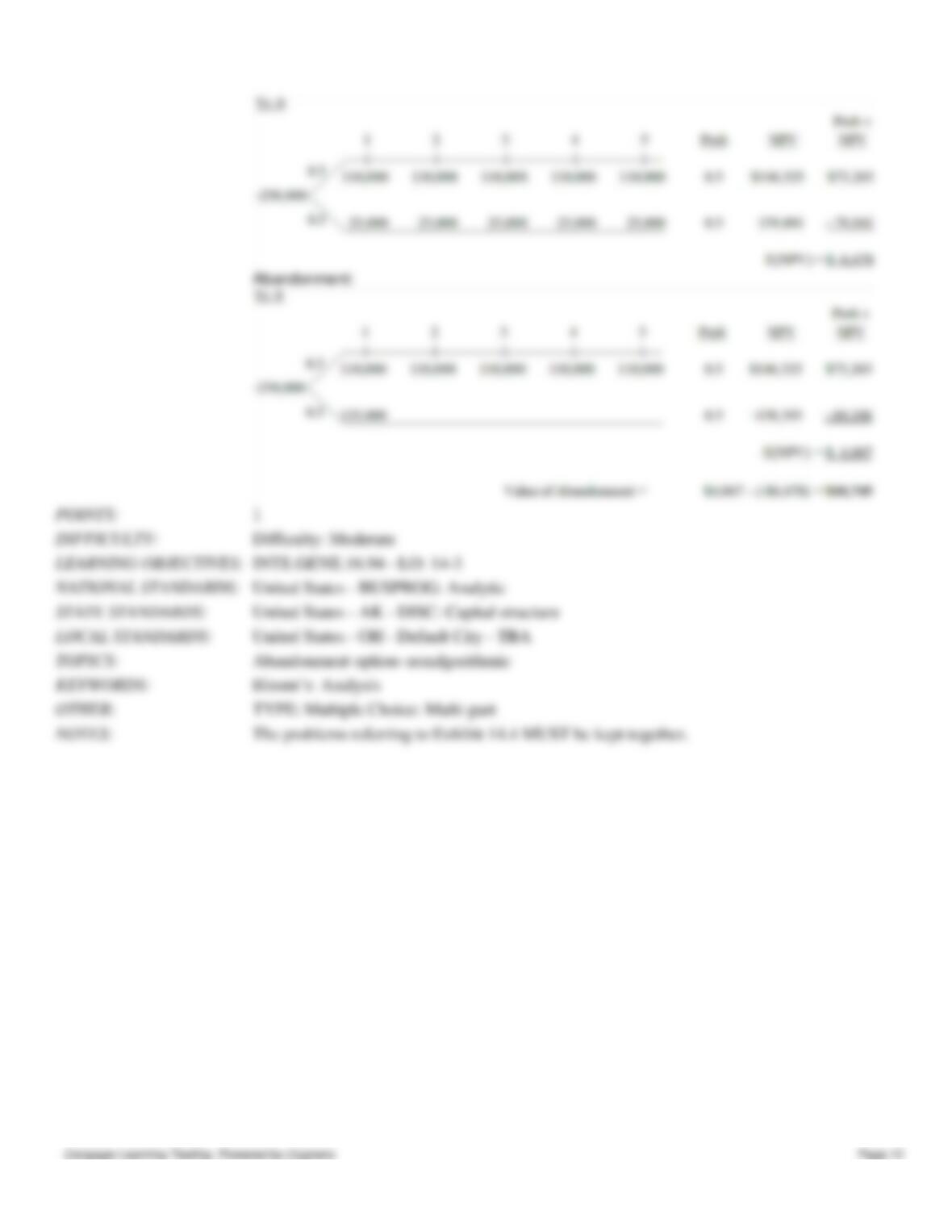
19. Refer to Exhibit 14.4. Now assume that one year from now SI will know if the Z−45 has become the industry
standard. Also assume that after receiving the cash flows at t = 1, SI has the option to abandon the project, in which case it
will receive an additional $100,000 at t = 1 but no cash flows after t = 1. Assuming that the cost of capital remains at 12%,
what is the estimated value of the abandonment option?
a.
$0
b.
$2,075
c.
$4,067
d.
$8,945
e.
$10,745
e
CHAPTER 14—REAL OPTIONS