Ch 14 Distributions to Shareholders: Dividends and Repurchases
8/26/2015 10:46 AM
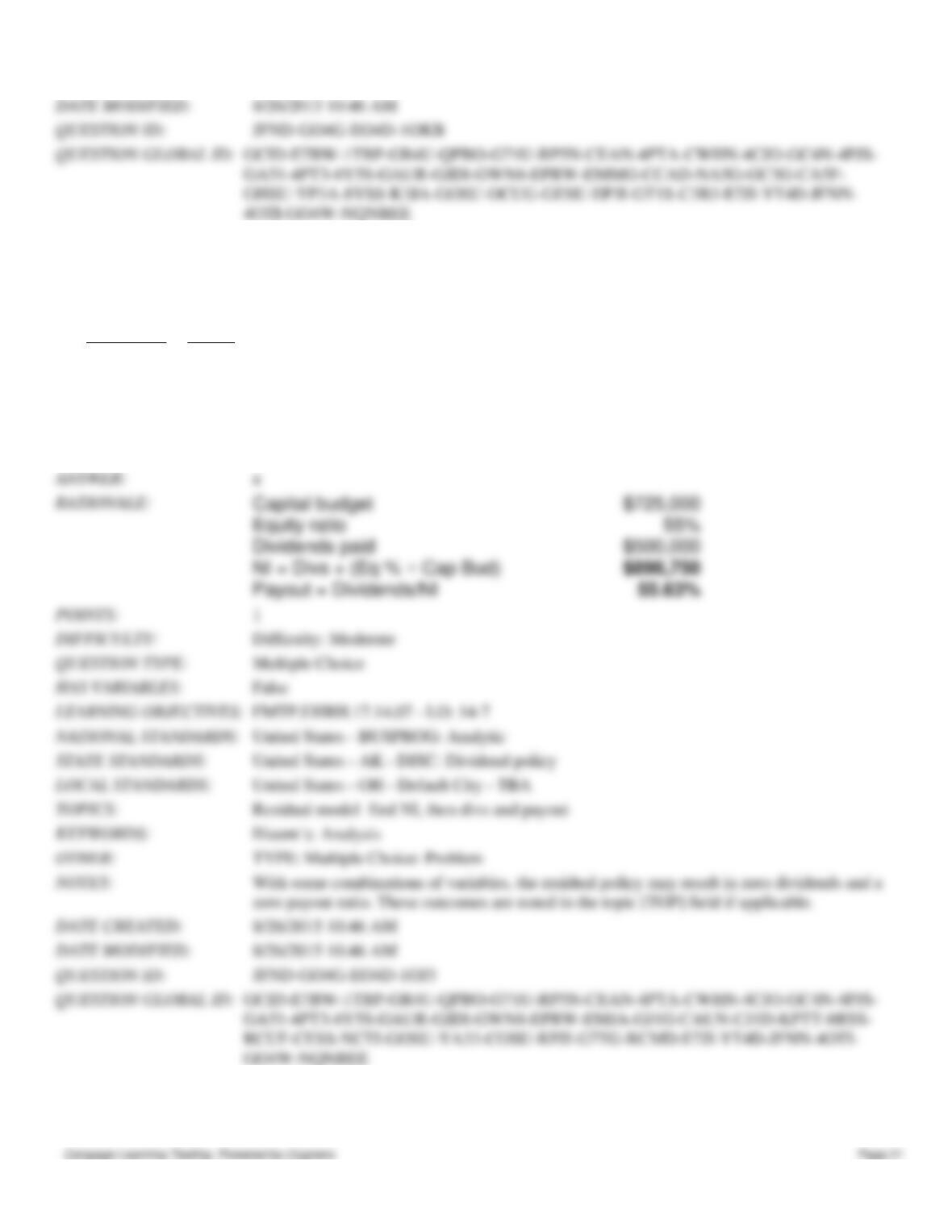
32. The capital budget forecast for the Santano Company is $725,000. The CFO wants to maintain a target capital
structure of 45% debt and 55% equity, and it also wants to pay dividends of $500,000. If the company follows the residual
dividend policy, how much income must it earn, and what will its dividend payout ratio be?
Net Income Payout
a.
$ 898,750 55.63%
b.
$ 943,688 58.41%
c.
$ 990,872 61.34%
d.
$1,040,415 64.40%
e.
$1,092,436 67.62%
1
Difficulty: Moderate
Multiple Choice
FMTP.EHRH.17.14.07 – LO: 14-7
United States – BUSPROG: Analytic
United States – AK – DISC: Dividend policy
United States – OH – Default City – TBA
Residual model–find NI, then divs and payout
TYPE: Multiple Choice: Problem
8/26/2015 10:46 AM
8/26/2015 10:46 AM
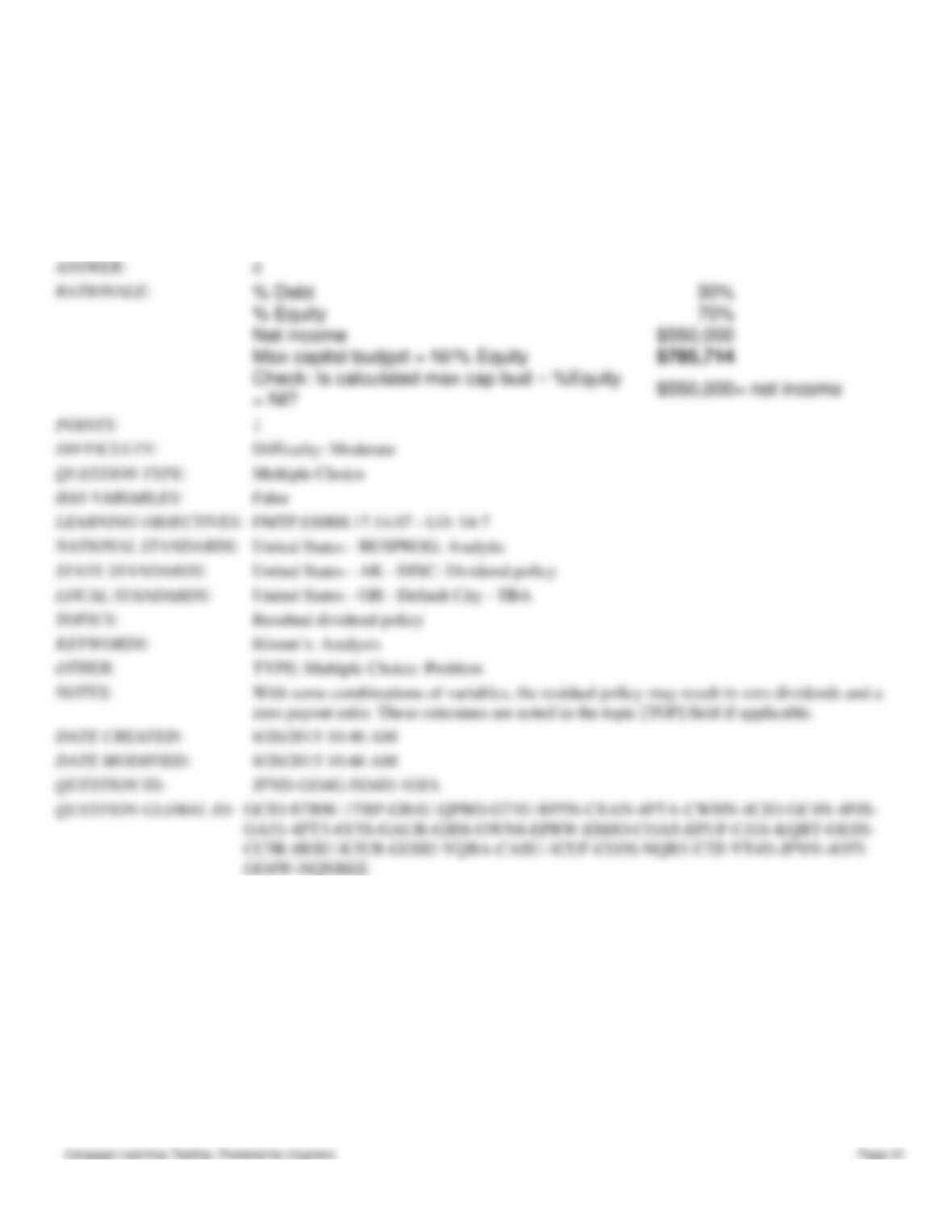
33. United Builders wants to maintain a target capital structure with 30% debt and 70% equity. Its forecasted net income
is $550,000, and because of market conditions, the company will not issue any new stock during the coming year. If the
Ch 14 Distributions to Shareholders: Dividends and Repurchases
firm follows the residual dividend policy, what is the maximum capital budget that is consistent with maintaining the
target capital structure?
a.
$673,652
b.
$709,107
c.
$746,429
d.
$785,714
e.
$825,000
Difficulty: Moderate
Multiple Choice
False
FMTP.EHRH.17.14.07 – LO: 14-7
United States – BUSPROG: Analytic
United States – AK – DISC: Dividend policy
United States – OH – Default City – TBA
Residual dividend policy
TYPE: Multiple Choice: Problem
zero payout ratio. These outcomes are noted in the topic [TOP] field if applicable.
8/26/2015 10:46 AM
8/26/2015 10:46 AM
JFND-GO4G-EO4D-1OJA
GO4W-NQNBEE
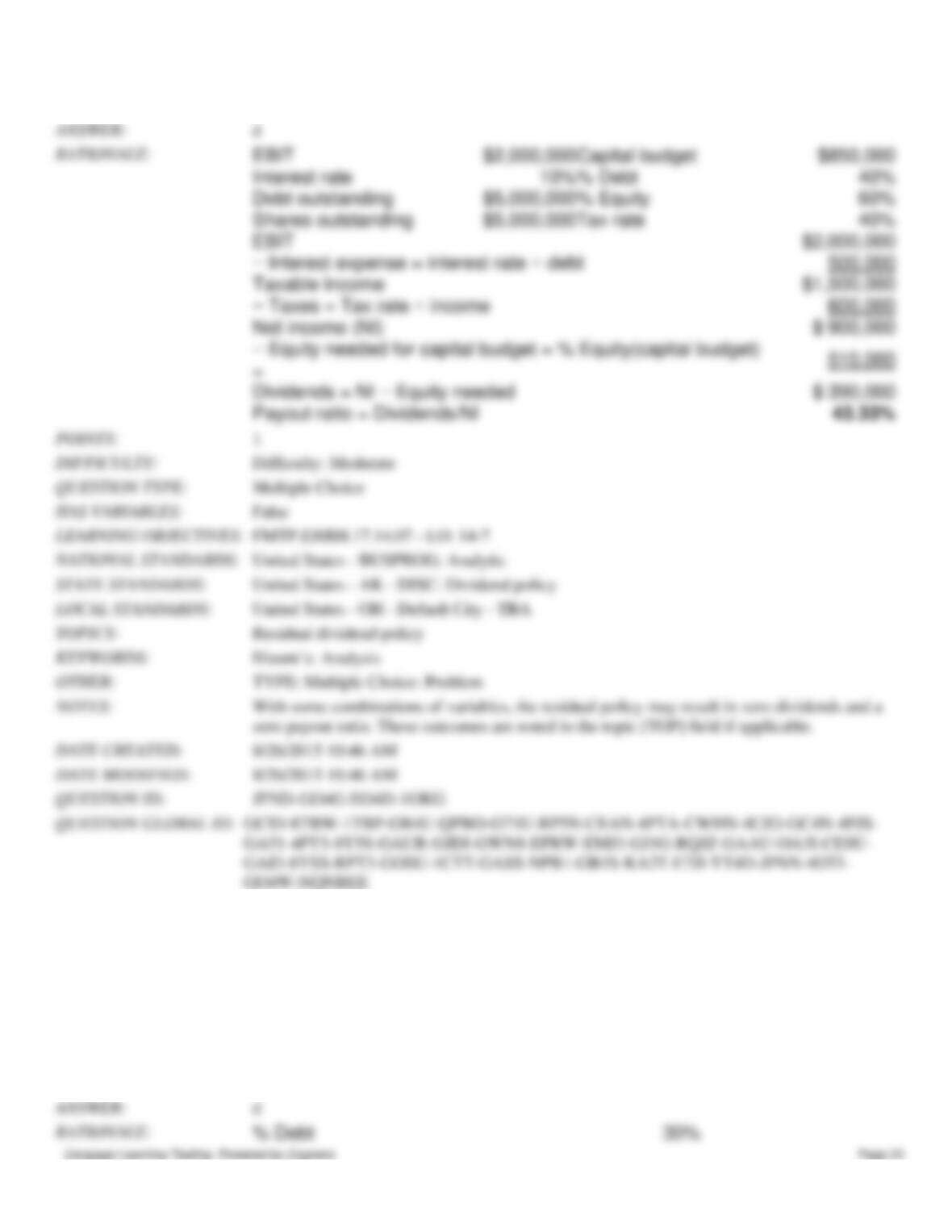
34. Silvana Inc. projects the following data for the coming year. If the firm follows the residual dividend policy and also
maintains its target capital structure, what will its payout ratio be?
EBIT
$2,000,000
Capital budget
$850,000
Interest rate
10%
% Debt
40%
Debt outstanding
$5,000,000
% Equity
60%
Shares outstanding
$5,000,000
Tax rate
40%
a.
37.2%
b.
39.1%
c.
41.2%
d.
43.3%
Ch 14 Distributions to Shareholders: Dividends and Repurchases
e.
45.5%
False
JFND-GO4G-EO4D-1OKG
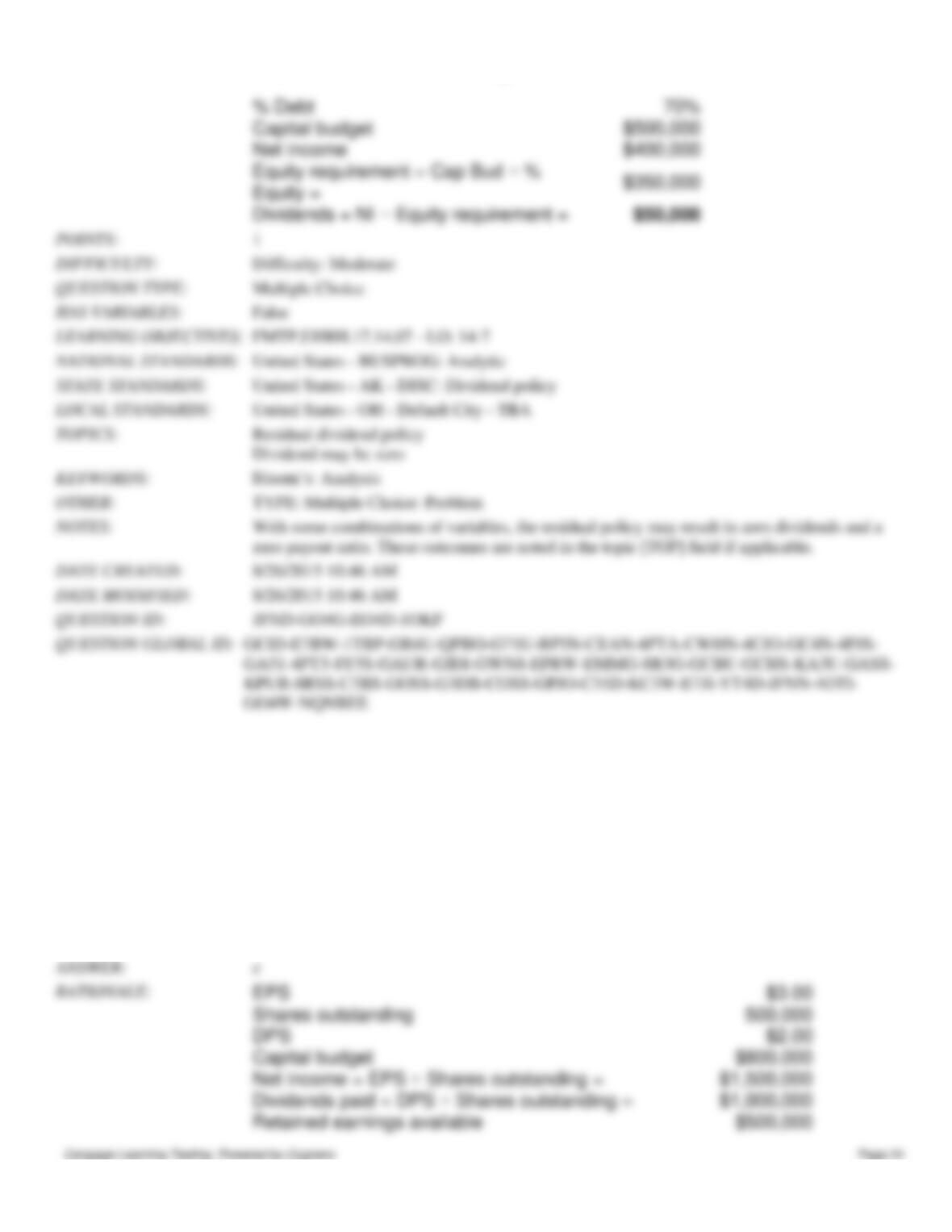
35. David Rose Inc. forecasts a capital budget of $500,000 next year with forecasted net income of $400,000. The
company wants to maintain a target capital structure of 30% debt and 70% equity. If the company follows the residual
dividend policy, how much in dividends, if any, will it pay?
a.
$42,869
b.
$45,125
c.
$47,500
d.
$50,000
e.
$52,500
Ch 14 Distributions to Shareholders: Dividends and Repurchases
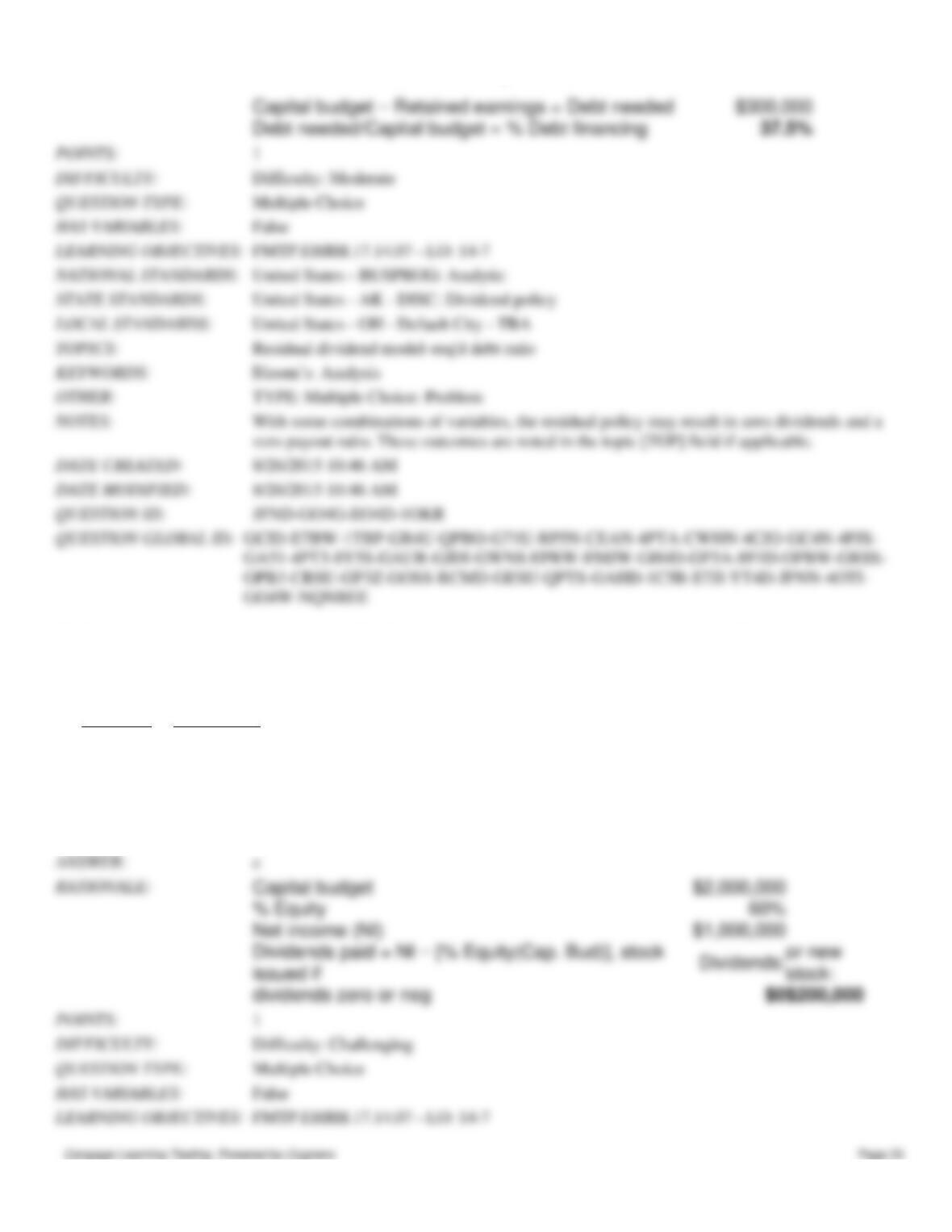
36. Warren Supply Inc. is evaluating its capital budget. The company finances with debt and common equity, but because
of market conditions, wants to avoid issuing any new common stock during the coming year. It is forecasting an EPS of
$3.00 for the coming year on its 500,000 outstanding shares of stock. Its capital budget is forecasted at $800,000, and it is
committed to maintaining a $2.00 dividend per share. Given these constraints, what percentage of the capital budget must
be financed with debt?
a.
30.54%
b.
32.15%
c.
33.84%
d.
35.63%
e.
37.50%
e
False
JFND-GO4G-EO4D-1OKF
Ch 14 Distributions to Shareholders: Dividends and Repurchases
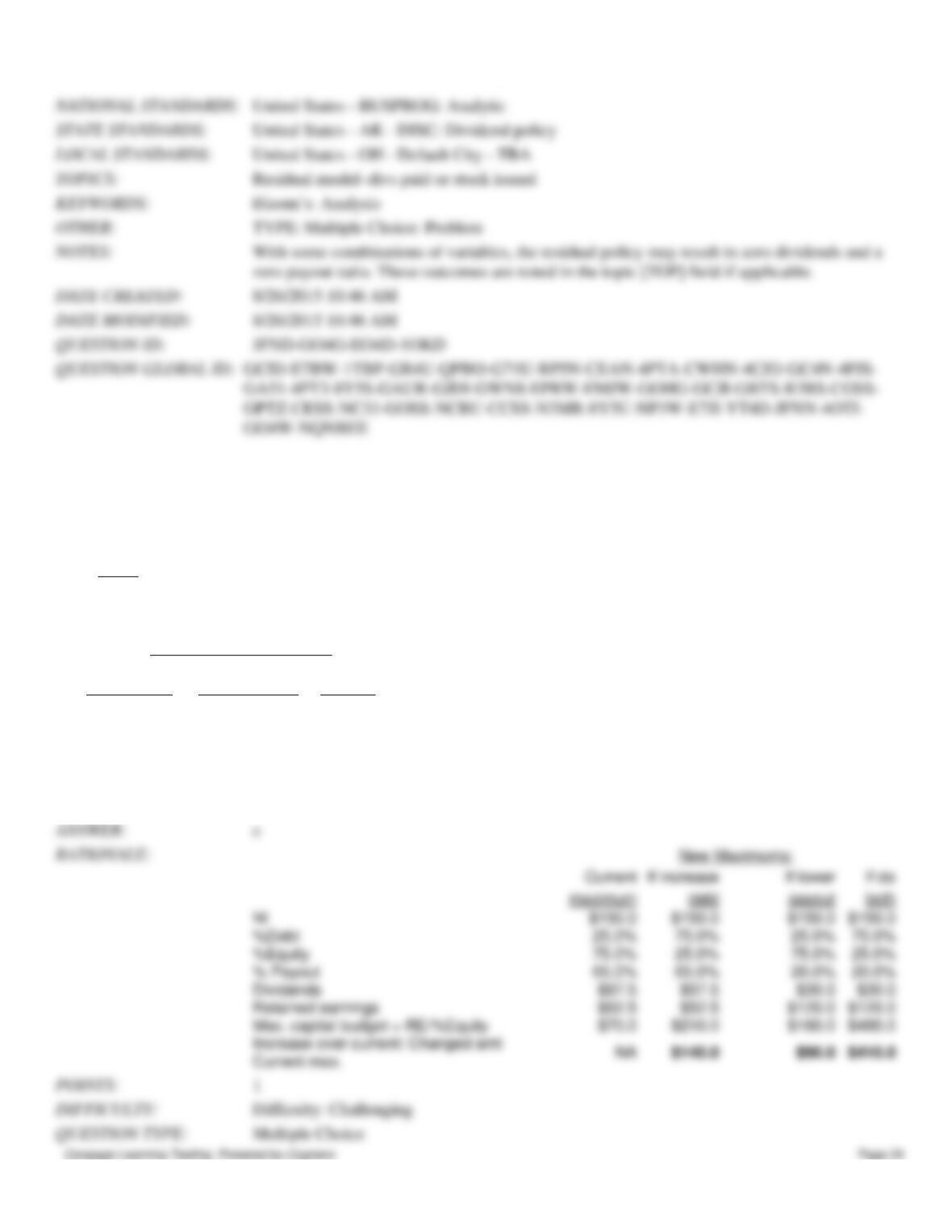
37. Getler Inc.’s projected capital budget is $2,000,000, its target capital structure is 40% debt and 60% equity, and its
forecasted net income is $1,000,000. If the company follows a residual dividend policy, how much dividends will it pay
or, alternatively, how much new stock must it issue?
Dividends Stock Issued
a.
$514,425 $162,901
b.
$541,500 $171,475
c.
$570,000 $180,500
d.
$600,000 $190,000
e.
$ 0 $200,000
e
Difficulty: Challenging
False
FMTP.EHRH.17.14.07 – LO: 14-7
Difficulty: Moderate
Multiple Choice
False
FMTP.EHRH.17.14.07 – LO: 14-7
United States – BUSPROG: Analytic
United States – AK – DISC: Dividend policy
United States – OH – Default City – TBA
Residual dividend model–req’d debt ratio
TYPE: Multiple Choice: Problem
8/26/2015 10:46 AM
8/26/2015 10:46 AM
JFND-GO4G-EO4D-1OKR
Ch 14 Distributions to Shareholders: Dividends and Repurchases
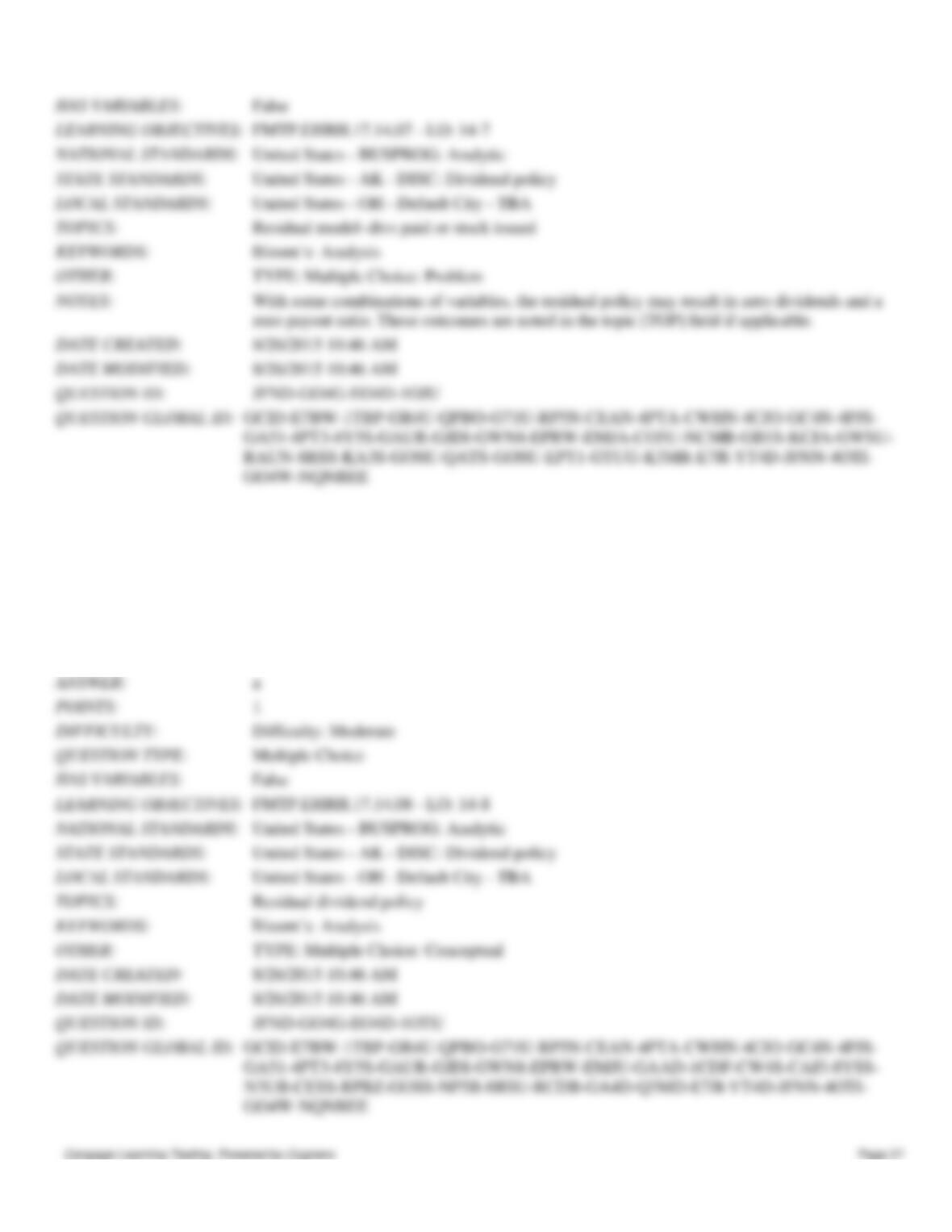
38. Norton Electrical has quite a few positive NPV projects from which to choose. The problem is that it has more of
these projects than it can finance without issuing new stock and the board of directors refuses to issue any new shares in
the foreseeable future. Norton‘s projected net income is $150.0 million, its target capital structure is 25% debt and 75%
equity, and its target payout ratio is 65%. The CFO now wants to determine how the maximum capital budget would be
affected by changes in capital structure policy and/or the target dividend payout policy. Versus the current policy, how
much larger could the capital budget be if (1) the target debt ratio were raised to 75%, other things held constant, (2) the
target payout ratio were lowered to 20%, other things held constant, and (3) the debt ratio and payout were both changed
by the indicated amounts.
Increase in Capital Budget
Increase Lower
Debt to 75% Payout to 20% Do both
a.
$114.0 $73.3 $333.9
b.
$120.0 $77.2 $351.5
c.
$126.4 $81.2 $370.0
d.
$133.0 $85.5 $389.5
e.
$140.0 $90.0 $410.0
Difficulty: Challenging
Multiple Choice
United States – BUSPROG: Analytic
United States – AK – DISC: Dividend policy
United States – OH – Default City – TBA
Residual model–divs paid or stock issued
TYPE: Multiple Choice: Problem
8/26/2015 10:46 AM
8/26/2015 10:46 AM
Ch 14 Distributions to Shareholders: Dividends and Repurchases
39. If a firm adheres strictly to the residual dividend policy, then if its optimal capital budget requires the use of all
earnings for a given year (along with new debt according to the optimal debt/total assets ratio), then the firm should pay
a.
no dividends to common stockholders.
b.
dividends only out of funds raised by the sale of new common stock.
c.
dividends only out of funds raised by borrowing money (i.e., issue debt).
d.
dividends only out of funds raised by selling off fixed assets.
e.
no dividends except out of past retained earnings.
Difficulty: Moderate
Multiple Choice
FMTP.EHRH.17.14.08 – LO: 14-8
United States – BUSPROG: Analytic
United States – AK – DISC: Dividend policy
United States – OH – Default City – TBA
Residual dividend policy
TYPE: Multiple Choice: Conceptual
8/26/2015 10:46 AM
8/26/2015 10:46 AM
FMTP.EHRH.17.14.07 – LO: 14-7
United States – BUSPROG: Analytic
United States – AK – DISC: Dividend policy
United States – OH – Default City – TBA
Residual model–divs paid or stock issued
TYPE: Multiple Choice: Problem
8/26/2015 10:46 AM
8/26/2015 10:46 AM
Ch 14 Distributions to Shareholders: Dividends and Repurchases
40. If a firm adheres strictly to the residual dividend policy, the issuance of new common stock would suggest that
a.
the dividend payout ratio is increasing.
b.
no dividends were paid during the year.
c.
the dividend payout ratio is decreasing.
d.
the dollar amount of investments has decreased.
e.
the dividend payout ratio has remained constant.
Difficulty: Moderate
Multiple Choice
FMTP.EHRH.17.14.08 – LO: 14-8
United States – BUSPROG: Analytic
United States – AK – DISC: Dividend policy
United States – OH – Default City – TBA
Residual dividend policy
TYPE: Multiple Choice: Conceptual
8/26/2015 10:46 AM
8/26/2015 10:46 AM
41. Which of the following statements is correct?
a.
One advantage of the residual dividend policy is that it leads to a stable dividend payout, which investors like.
b.
An increase in the stock price when a company decreases its dividend is consistent with signaling theory as
postulated by MM.
c.
If the “clientele effect” is correct, then for a company whose earnings fluctuate, a policy of paying a constant
percentage of net income will probably maximize the stock price.
d.
Stock repurchases make the most sense at times when a company believes its stock is undervalued.
e.
Firms with a lot of good investment opportunities and a relatively small amount of cash tend to have above
average payout ratios.
Difficulty: Moderate
Multiple Choice
FMTP.EHRH.17.14.12 – LO: 14–12
United States – BUSPROG: Analytic
United States – AK – DISC: Dividend policy
United States – OH – Default City – TBA
Ch 14 Distributions to Shareholders: Dividends and Repurchases
42. Which of the following statements is correct?
a.
If a company has an established clientele of investors who prefer a high dividend payout, and if management
wants to keep stockholders happy, it should not follow the strict residual dividend policy.
b.
If a firm follows a strict residual dividend policy, then, holding all else constant, its dividend payout ratio will
tend to rise whenever the firm’s investment opportunities improve.
c.
If Congress eliminates taxes on capital gains but leaves the personal tax rate on dividends unchanged, this
would motivate companies to increase their dividend payout ratios.
d.
Despite its drawbacks, following the residual dividend policy will tend to stabilize actual cash dividends, and
this will make it easier for firms to attract a clientele that prefers high dividends, such as retirees.
e.
One advantage of dividend reinvestment plans is that they enable investors to avoid paying taxes on the
dividends they receive.
Multiple Choice
FMTP.EHRH.17.14.12 – LO: 14–12
United States – BUSPROG: Analytic
United States – AK – DISC: Dividend policy
United States – OH – Default City – TBA
Dividend policy
TYPE: Multiple Choice: Conceptual
8/26/2015 10:46 AM
8/26/2015 10:46 AM
43. Consider two very different firms, M and N. Firm M is a mature firm in a mature industry. Its annual net income and
net cash flows are both consistently high and stable. However, M’s growth prospects are quite limited, so its capital budget
is small relative to its net income. Firm N is a relatively new firm in a new and growing industry. Its markets and products
have not stabilized, so its annual operating income fluctuates considerably. However, N has substantial growth
Dividend theories
TYPE: Multiple Choice: Conceptual
8/26/2015 10:46 AM
8/26/2015 10:46 AM
Ch 14 Distributions to Shareholders: Dividends and Repurchases
opportunities, and its capital budget is expected to be large relative to its net income for the foreseeable future. Which of
the following statements is correct?
a.
Firm M probably has a higher dividend payout ratio than Firm N.
b.
If the corporate tax rate increases, the debt ratio of both firms is likely to decline.
c.
The two firms are equally likely to pay high dividends.
d.
Firm N is likely to have a clientele of shareholders who want to receive consistent, stable dividend income.
e.
Firm M probably has a lower debt ratio than Firm N.
Difficulty: Moderate
Multiple Choice
FMTP.EHRH.17.14.12 – LO: 14–12
United States – BUSPROG: Analytic
United States – AK – DISC: Dividend policy
United States – OH – Default City – TBA
Miscellaneous dividend concepts
TYPE: Multiple Choice: Conceptual
8/26/2015 10:46 AM
8/26/2015 10:46 AM
44. Which of the following statements is correct?
a.
The clientele effect can explain why so many firms change their dividend policies so often.
b.
One advantage of adopting the residual dividend policy is that this policy makes it easier for corporations to
develop a specific and well-identified dividend clientele.
c.
New-stock dividend reinvestment plans are similar to stock dividends because they both increase the number
of shares outstanding but don’t change the firm’s total amount of book equity.
d.
Investors who receive stock dividends must pay taxes on the value of the new shares in the year the stock
dividends are received.
e.
If a firm follows the residual dividend policy, then a sudden increase in the number of profitable projects is
likely to reduce the firm’s dividend payout.
Difficulty: Challenging
Multiple Choice
United States – BUSPROG: Analytic
United States – AK – DISC: Dividend policy
Ch 14 Distributions to Shareholders: Dividends and Repurchases
45. Stock dividends and stock splits should, at least conceptually, have the same effect on shareholders’ wealth.
a.
True
b.
False
True
False
JFND-GO4G-EO4D-1OJ1
GO4W-NQNBEE
46. A reverse split reduces the number of shares outstanding.
a.
True
b.
False
True
False
JFND-GO4G-EO4D-1QBA
4OTI-GO4W-NQNBEE
Ch 14 Distributions to Shareholders: Dividends and Repurchases
47. Even if a stock split has no information content, and even if the dividend per share adjusted for the split is not
increased, there can still be a real benefit (i.e., a higher value for shareholders) from such a split, but any such benefit is
probably small.
a.
True
b.
False
True
Difficulty: Moderate
True / False
False
FMTP.EHRH.17.14.13 – LO: 14–13
United States – BUSPROG: Reflective Thinking
United States – AK – DISC: Dividend policy
United States – OH – Default City – TBA
Stock splits
8/26/2015 10:46 AM
8/26/2015 10:46 AM
JFND-GO4G-EO4D-1OJO
GO4W-NQNBEE
48. Poff Industries’ stock currently sells for $120 a share. You own 100 shares of the stock. The company is contemplating
a 2-for-1 stock split. Which of the following best describes what your position will be after such a split takes place?
a.
You will have 200 shares of stock, and the stock will trade at or near $60 a share.
b.
You will have 100 shares of stock, and the stock will trade at or near $60 a share.
c.
You will have 50 shares of stock, and the stock will trade at or near $120 a share.
d.
You will have 50 shares of stock, and the stock will trade at or near $60 a share.
e.
You will have 200 shares of stock, and the stock will trade at or near $120 a share.
Difficulty: Easy
United States – OH – Default City – TBA
Reverse split
8/26/2015 10:46 AM
8/26/2015 10:46 AM
JFND-GO4G-EO4D-1OJT
Ch 14 Distributions to Shareholders: Dividends and Repurchases
49. Which of the following statements is CORRECT?
a.
Back before the SEC was created in the 1930s, companies would declare reverse splits in order to boost their
stock prices. However, this was determined to be a deceptive practice, and it is illegal today.
b.
Stock splits create more administrative problems for investors than stock dividends, especially determining the
tax basis of their shares when they decide to sell them, so today stock dividends are used far more often than
stock splits.
c.
When a company declares a stock split, the price of the stock typically declines⎯by about 50% after a 2-for-1
split⎯and this necessarily reduces the total market value of the equity.
d.
If a firm’s stock price is quite high relative to most stocks⎯say $500 per share⎯then it can declare a stock split
of say 10-for-1 so as to bring the price down to something close to $50. Moreover, if the price is relatively
low⎯say $2 per share⎯then it can declare a “reverse split” of say 1-for-25 so as to bring the price up to
somewhere around $50 per share.
e.
When firms are deciding on the size of stock splits⎯say whether to declare a 2-for-1 split or a 3-for-1 split, it is
best to declare the smaller one, in this case the 2-for-1 split, because then the after-split price will be higher
than if the 3-for-1 split had been used.
Difficulty: Moderate
Multiple Choice
FMTP.EHRH.17.14.13 – LO: 14–13
United States – BUSPROG: Analytic
United States – AK – DISC: Dividend policy
United States – OH – Default City – TBA
Stock dividends and stock splits
TYPE: Multiple Choice: Conceptual
8/26/2015 10:46 AM
Multiple Choice
FMTP.EHRH.17.14.13 – LO: 14–13
United States – BUSPROG: Analytic
United States – AK – DISC: Dividend policy
United States – OH – Default City – TBA
Stock splits
TYPE: Multiple Choice: Conceptual
8/26/2015 10:46 AM
8/26/2015 10:46 AM
Ch 14 Distributions to Shareholders: Dividends and Repurchases
50. Which of the following statements is correct?
a.
An open-market dividend reinvestment plan will be most attractive to companies that need new equity and
would otherwise have to issue additional shares of common stock through investment bankers.
b.
Stock repurchases tend to reduce financial leverage.
c.
If a company declares a 2-for-1 stock split, its stock price should roughly double.
d.
One advantage of adopting the residual dividend policy is that this makes it easier for corporations to meet the
requirements of Modigliani and Miller’s dividend clientele theory.
e.
If a firm repurchases some of its stock in the open market, then shareholders who sell their stock for more than
they paid for it will be subject to capital gains taxes.
e
Difficulty: Moderate
Multiple Choice
False
FMTP.EHRH.17.14.13 – LO: 14–13
United States – BUSPROG: Analytic
United States – AK – DISC: Dividend policy
United States – OH – Default City – TBA
Miscellaneous dividend concepts
TYPE: Multiple Choice: Conceptual
8/26/2015 10:46 AM
8/26/2015 10:46 AM
JFND-GO4G-EO4D-1OJI
GO4W-NQNBEE
51. Yesterday, Berryman Investments was selling for $90 per share. Today, the company completed a 7-for-2 stock split.
If the total market value was unchanged by the split, what is the price of the stock today?
a.
$23.21
b.
$24.43
c.
$25.71
d.
$27.00
e.
$28.35
c
8/26/2015 10:46 AM
JFND-GO4G-EO4D-1OJS
Ch 14 Distributions to Shareholders: Dividends and Repurchases
52. Last week, Weschler Paint Corp. completed a 3-for-1 stock split. Immediately prior to the split, its stock sold for $150
per share. The firm’s total market value was unchanged by the split. Other things held constant, what is the best estimate
of the stock’s post-split price?
a.
$50.00
b.
$52.50
c.
$55.13
d.
$57.88
e.
$60.78
a
False
False
JFND-GO4G-EO4D-1OJW
Ch 14 Distributions to Shareholders: Dividends and Repurchases
53. In recent years Constable Inc. has suffered losses, and its stock currently sells for only $0.50 per share. Management
wants to use a reverse split to get the price up to a more “reasonable” level, which it thinks is $25 per share. How many of
the old shares must be given up for one new share to achieve the $25 price, assuming this transaction has no effect on total
market value?
a.
47.50
b.
49.88
c.
50.00
d.
52.50
e.
55.13
c
False
JFND-GO4G-EO4D-1O1B
GCID-E7BW-1TBP-GR4U-QPBO-G71U-RP5N-CEAN-4PTA-CWHN-4CJO-GC4N-4PJS–
JFND-GO4G-EO4D-1O1N
GO4W-NQNBEE
Ch 14 Distributions to Shareholders: Dividends and Repurchases
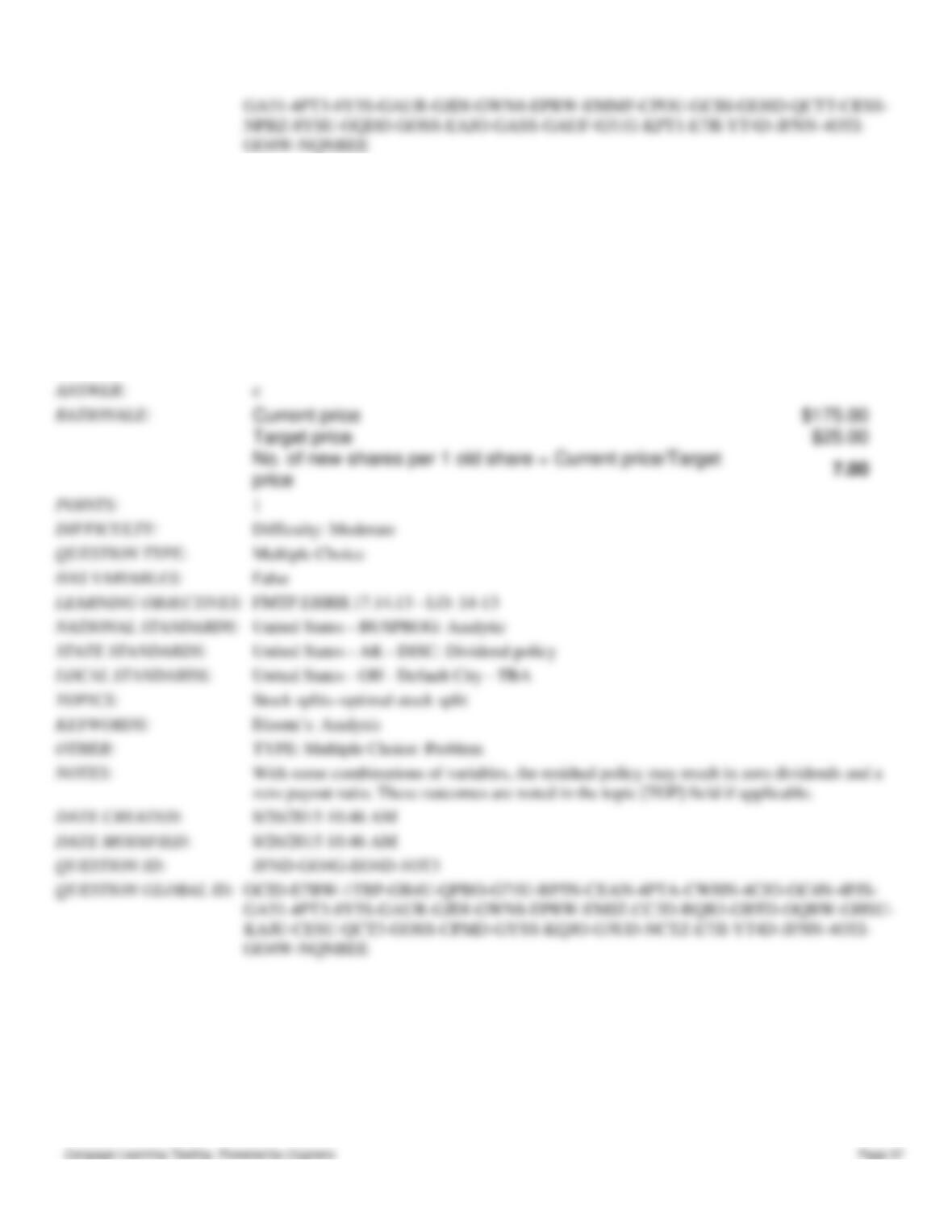
54. Brinkley Resources stock has increased significantly over the last five years, selling now for $175 per share.
Management feels this price is too high for the average investor and wants to get the price down to a more typical level,
which it thinks is $25 per share. What stock split would be required to get to this price, assuming the transaction has no
effect on the total market value? Put another way, how many new shares should be given per one old share?
a.
6.65
b.
6.98
c.
7.00
d.
7.35
e.
7.72
c
False
JFND-GO4G-EO4D-1OT3
GO4W-NQNBEE
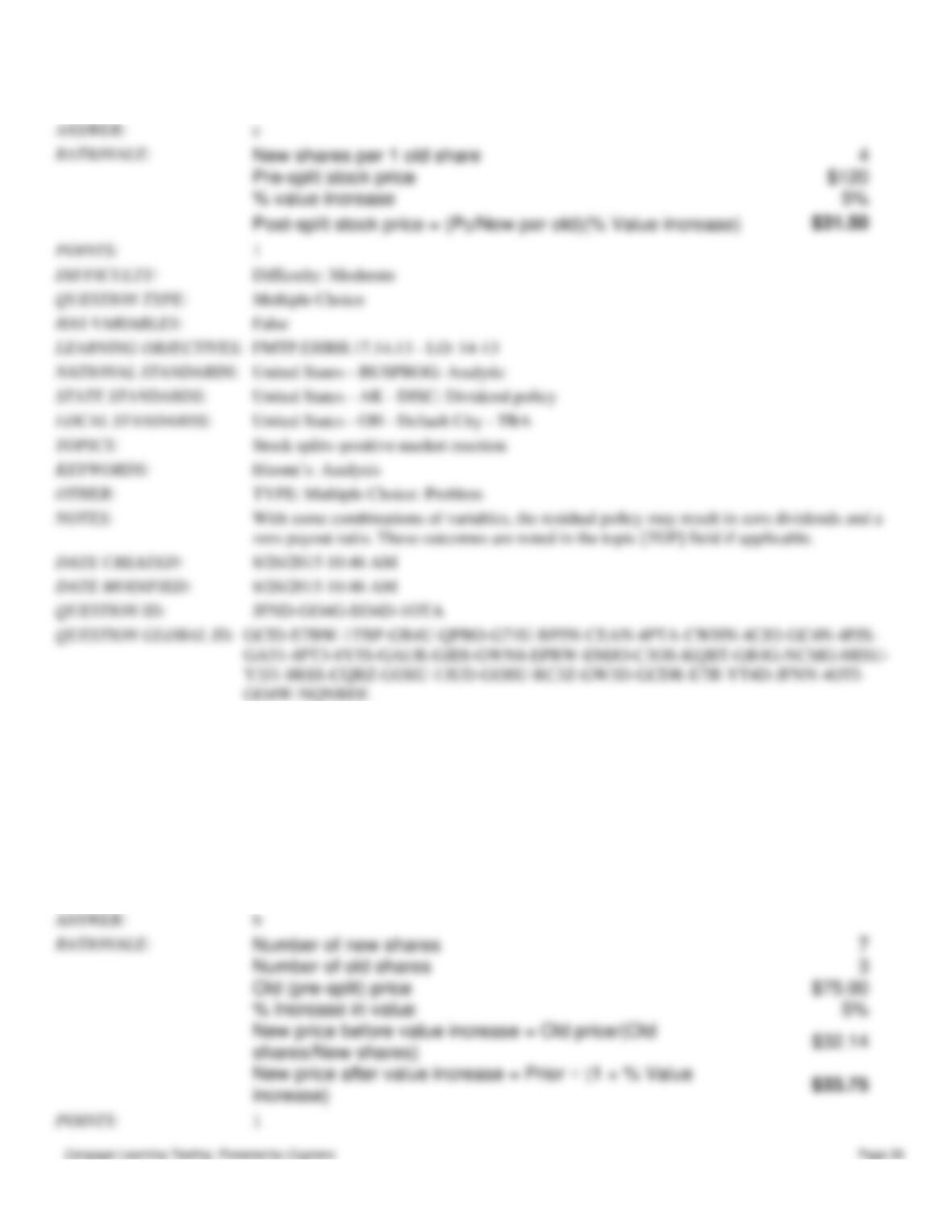
55. Downie Foods recently completed a 4-for-1 stock split. Prior to the split, its stock sold for $120 per share. If the firm’s
total market value increased by 5% as a result of increased liquidity caused by the split, what was the stock price
following the split?
a.
$28.43
b.
$29.93
c.
$31.50
d.
$33.08
GO4W-NQNBEE
Ch 14 Distributions to Shareholders: Dividends and Repurchases
e.
$34.73
c
False
JFND-GO4G-EO4D-1OTA
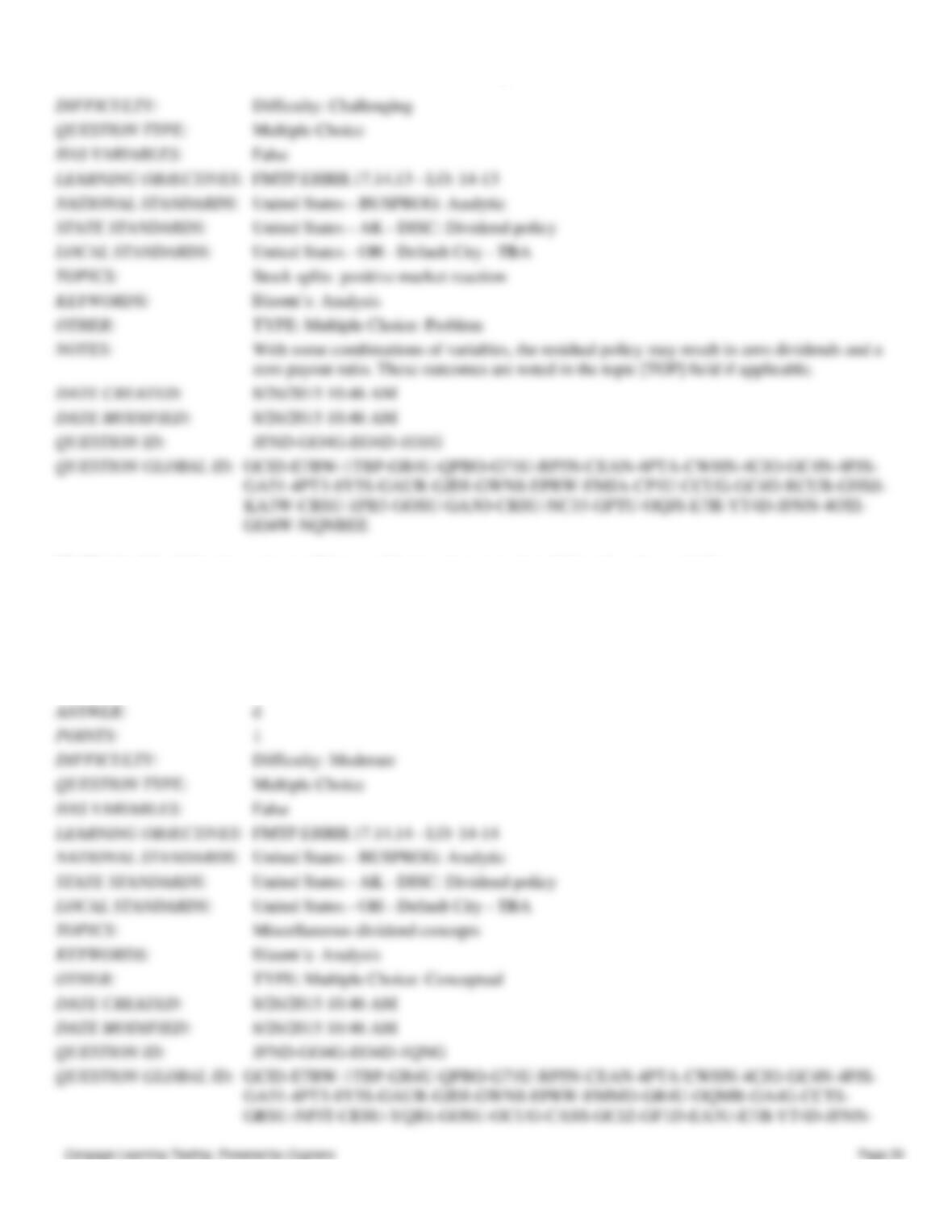
56. The Meltzer Corporation is contemplating a 7-for-3 stock split. The current stock price is $75.00 per share, and the
firm believes that its total market value would increase by 5% as a result of the improved liquidity that it thinks would
follow the split. What is the stock’s expected price following the split?
a.
$32.06
b.
$33.75
c.
$35.44
d.
$37.21
e.
$39.07
Ch 14 Distributions to Shareholders: Dividends and Repurchases
57. Which of the following actions will best enable a company to raise additional equity capital?
a.
Declare a stock split.
b.
Begin an open-market purchase dividend reinvestment plan.
c.
Initiate a stock repurchase program.
d.
Begin a new-stock dividend reinvestment plan.
e.
Refund long-term debt with lower cost short-term debt.
Difficulty: Moderate
Multiple Choice
FMTP.EHRH.17.14.14 – LO: 14–14
United States – BUSPROG: Analytic
United States – AK – DISC: Dividend policy
United States – OH – Default City – TBA
Miscellaneous dividend concepts
TYPE: Multiple Choice: Conceptual
8/26/2015 10:46 AM
8/26/2015 10:46 AM
Difficulty: Challenging
Multiple Choice
FMTP.EHRH.17.14.13 – LO: 14–13
United States – BUSPROG: Analytic
United States – AK – DISC: Dividend policy
United States – OH – Default City – TBA
Stock splits–positive market reaction
TYPE: Multiple Choice: Problem
8/26/2015 10:46 AM
8/26/2015 10:46 AM
Ch 14 Distributions to Shareholders: Dividends and Repurchases
58. Which of the following statements is NOT correct?
a.
After a 3-for-1 stock split, a company’s price per share should fall, but the number of shares outstanding will
rise.
b.
Investors can interpret a stock repurchase program as a signal that the firm’s managers believe the stock is
undervalued.
c.
Companies can repurchase shares to distribute large inflows of cash, say from the sale of a division, to
stockholders without paying cash dividends.
d.
Stockholders pay no income tax on dividends if the dividends are used to purchase stock through a dividend
reinvestment plan.
e.
Stock repurchases can be used by a firm as part of a plan to change its capital structure.
Difficulty: Moderate
Multiple Choice
FMTP.EHRH.17.14.14 – LO: 14–14
United States – BUSPROG: Analytic
United States – AK – DISC: Dividend policy
United States – OH – Default City – TBA
Stock repurchases and stock splits
TYPE: Multiple Choice: Conceptual
8/26/2015 10:46 AM
8/26/2015 10:46 AM