59. Banana Split Co. has had six 2-for 1 splits since you purchased one share for $2 seven years ago. If the
current price per share is $20, what it the value of your investment?
a.
$2,560
b.
$1,280
c.
$640
d.
none of the above
60. If a firm is wanting to repurchase some of its shares from the market and wants to pay a uniform price
for all of the shares, then what method would it most likely use?
a.
open-market share repurchase
b.
tender offer
c.
executive option repurchase
d.
none of the above
61. Which of the following firms is most likely to pay out a larger portion of their earnings to
shareholders?
a.
a small company
b.
a mature company
c.
a young company
d.
a growth company
62. Which of the following is true concerning publicly traded companies?
a.
the number of companies that pay dividends has been declining over time
b.
the aggregate payout (dividend payout) of companies has increased over time
c.
the aggregate payout (dividend payout) of companies has decreased over time
d.
a and b
63. Two identical companies with identical share prices (and identical numbers of shares outstanding)
change their quarterly dividend by the same amount. However, Company A is increasing its dividend
while Company B is decreasing its dividend. Choose the correct description of what should follow
given the empirical evidence.
a.
Company A’s price should increase by more than the decrease in Company B’s price
b.
Company A’s price should increase by less than the decrease in Company B’s price
c.
Company B’s price should increase by more than the decrease in Company A’s price
d.
Company B’s price should increase by less than the decrease in Company A’s price
64. The agency cost model of dividend payments assumes that
a.
agency problems are distinct from the amount of cash paid out to shareholders.
b.
dividend payments arise as an attempt to overcome the agency problems that result
between bondholders and management.
c.
dividend payments arise as an attempt to overcome the agency problems that result when
there is a separation of corporate ownership and control.
d.
none of the above.
65. The fictitious widget industry is composed of two firms. One firm is a quality firm and the other is a
less-than-quality firm. Given the signaling model of dividends, how might the quality firm convey to
the market that it is the quality firm?
a.
tell the market (through analysts) that it is the quality firm
b.
cut its dividend payment to signal that it has a large number of quality projects on the
horizon
c.
increase its dividend payment beyond what the less-than-quality firm could afford
d.
there is nothing that the firm could do to address the situation
66. Bilbao Vizgaggins owns shares in a company that does not pay dividends. Unfortunately, Vizgaggins
requires a $100,000 dividend this period. If Vizgaggins owns 10,000 shares in the company and they
are worth $200 per share, what can he do to produce the effect of the required dividend (ignore all tax
effects)?
a.
sell 500 shares of his stock
b.
sell 5000 shares of his stock
c.
buy 500 more shares of the stock
d.
there is nothing that he can do
67. The result that dividend policy is irrelevant can be critiqued if we consider
a.
differential tax rates between dividends and capital gains.
b.
that certain shareholders would rather receive dividends instead of capital gains.
c.
that shareholders do not have the ability to produce their own dividends.
d.
all of the above.
68. If we start with the frictionless markets concerning the irrelevance of dividend policy and then we
introduce personal taxes that are higher for dividends than capital gains then we would expect
a.
for dividends to be less popular.
b.
for dividends to become even more popular.
c.
for dividend policy to become even more irrelevant.
d.
none of the above.
69. The empirical observation that stock prices fall on ex-dividend days by significantly less than the
amount of the dividend has been often interpreted
a.
as completely unexplainable by researchers.
b.
as evidence that dividends are more highly valued than capital gains.
c.
as evidence of a tax effect in dividend valuation.
d.
none of the above.
70. You purchased a stock 6 months ago for $30 and the current price is $33. The firm is about to pay its
first dividend (ever) of $3 in a few days. You will pay a 40% tax rate on dividends and a 20% tax rate
on capital gains. What must the share price fall in order for you to be indifferent between selling the
shares before or after the ex-dividend date?
a.
$.75
b.
$1.00
c.
$2.25
d.
none of the above
71. If you are a stock trader and your trading proceeds are not subject to taxes, what strategy below would
work best if you expected that the drop in share price after the ex-dividend date is less than the amount
of the dividend?
a.
buy the shares immediately before the ex-dividend date and then sell them immediately
after the ex-dividend date
b.
sell the shares immediately before the ex-dividend date and then buy them back
immediately after the ex-dividend date
c.
buy the shares immediately before the ex-dividend date and then buy more of them
immediately after the ex-dividend date
d.
none of the above
72. If you are a company that has a very large amount of cash in its treasury and the IRS is concerned that
you have been hoarding cash to prevent your shareholders from having to pay dividend taxes, which of
the following would be your most likely method of getting cash into your shareholders hands?
a.
repurchase shares
b.
pay a cash dividend
c.
repurchase debt
d.
none of the above
73. If transaction costs are significant, then which of the following might be the effect on cash dividends
and share repurchases?
a.
dividends might be more likely to be paid from the investors preference argument
b.
dividends might be less likely to be paid from the firm’s perspective of raising capital
c.
dividend choices are always relevant
d.
none of the above
74. A firm has just instituted a regular dividend for the first time in its history. That action might be
interpreted in the market as
a.
a signal the it believes that it will be able to permanently sustain the future dividends
b.
a signal that its growth opportunity set might be slowing
c.
a signal that it is a high quality firm
d.
all of the above
75. The free cash flow hypothesis predicts that
a.
dividend increases should be viewed as good news by investors.
b.
firms in industries that generate large amount of cash flow should also have the highest
dividend payout ratios.
c.
managerial compensation should be designed to pursue value-maximizing dividend
policies.
d.
all of the above.
76. Which of the following statements is (are) true?
a.
Shareholders have a legal right to receive dividends.
b.
A firm’s board of directors must decide whether to pay dividends.
c.
Most U.S. firms that pay cash dividends do so only once every year.
d.
All of the above are true.
e.
Only (a) and (c) are true.
77. Which type of firm is more likely to follow a low-regular-and-extra-policy of dividend payout?
a.
One in a stable industry with stable earnings.
b.
One that recently experienced higher-than-normal earnings that are expected to be
temporary.
c.
One that recently experienced a downswing in earnings that is expected to be temporary.
d.
none of the above
78. Which of the following is not a practical motive for stock repurchases?
a.
The desire to reduce the amount of the firm’s outstanding debt.
b.
Having shares available for employee stock-option plans.
c.
Retiring shares of common stock.
d.
Obtaining shares to be used in acquisitions.
e.
All of the above are practical motives for stock repurchases.
79. Which of the following statements is true regarding trading and transactions costs?
a.
As long as share issues are costless, investors are indifferent about whether to receive
returns in the form of capital gains or as cash dividends on shares.
b.
If issuing securities entails large costs, both corporations and stockholders should prefer a
full-retention strategy regarding dividends.
c.
If investors find creating homemade dividends too costly, they would not be willing to pay
a premium for stocks that habitually pay dividends.
d.
All of the above statements are true.
e.
Only statements (a) and (b) are true.
80. Which of the following statements is true?
a.
Dividend initiations send a weak signal to the market about management’s assessment of
the firm’s long-run ability to general cash.
b.
Dividend initiations send a strong signal to the market about management’s assessment of
the firm’s long-run ability to general cash.
c.
Dividend cuts rarely impact a firm’s stock price.
d.
Dividend increases suggest a temporary increase in a firm’s normal level of profitability.
e.
All of the above statements are false.
81. Which of the following statements is (are) true?
a.
Small, rapidly-growing firms usually have excess cash and are likely to pay cash
dividends.
b.
Managers of firms with free cash flow should retain the cash and invest in new projects,
regardless of the projects’ NPVs, as the transaction costs associated with paying dividends
is too costly.
c.
Managers of firms with free cash flow should begin to pay dividends to ensure that they
will not invest the free cash flow in negative-NPV projects.
d.
All of the above statements are false.
82. The central predictions of the agency cost/contracting model of dividend payments include:
a.
Dividend initiations and increases should lead to increases in the firm’s stock price when
announced.
b.
Firms and industries that generate the largest amounts of free cash flow should have the
highest dividend payout ratios.
c.
Managerial compensation contracts will be designed to entice managers to pursue a
value-maximizing dividend policy.
d.
All of the above
e.
Only (a) and (b)
83. A firm’s investment opportunity set is a function of a firm’s:
a.
size
b.
industry
c.
capital intensity of the firm’s production process
d.
the free cash flow generated
e.
all of the above
84. Which of the following factors do not have an impact upon a firm’s dividend policy?
a.
transactions costs
b.
taxes
c.
the legal system in the firm’s home country
d.
the stability of a firm’s earnings
e.
All of the above have an impact on a firm’s dividend policy.
85. An increase in which of the following variables is likely to lead to an increase in a firm’s dividend
payout?
a.
Positive-NPV investment opportunities
b.
Personal tax rates on dividend income
c.
Asset growth rate
d.
Free cash flow generated
86. Emma International has earnings per share of $3.29; just paid dividend $1.25 and expects a ROI next
year (and the foreseeable future) of 14% What is the dividend payout ratio?
a.
37.99%
b.
14.00%
c.
62.01%
d.
23.99%
87. Emma International has earnings per share of $3.29; just paid dividend $1.25 and expects a ROI next
year (and the foreseeable future) of 14% What is the retention ratio?
a.
37.99%
b.
14.00%
c.
62.01%
d.
23.99%
88. Emma International has earnings per share of $3.29; just paid dividend $1.25 and expects a ROI next
year (and the foreseeable future) of 14% What is the expected growth rate?
a.
1.22%
b.
5.32%
c.
23.56%
d.
8.68%
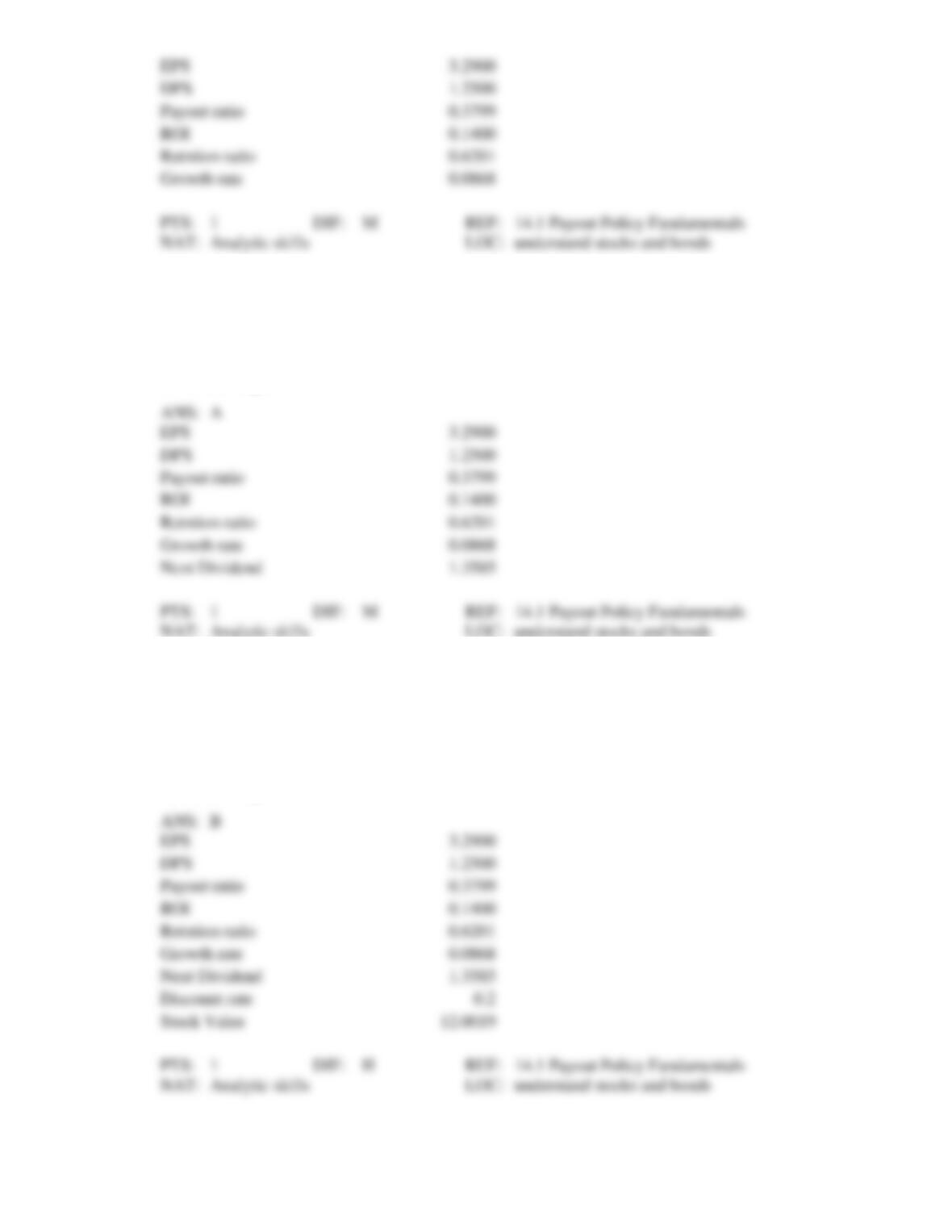
89. Emma International has earnings per share of $3.29; just paid dividend $1.25 and expects a ROI next
year (and the foreseeable future) of 14% What is the expected next year dividend?
a.
$1.359
b.
$1.316
c.
$1.259
d.
Not enough information
NAT: Analytic skills LOC: understand stocks and bonds
90. Emma International has earnings per share of $3.29; just paid dividend $1.25 and expects a ROI next
year (and the foreseeable future) of 14%. If the appropriate discount rate is 20% what is the intrinsic
value of the stock?
a.
$25.540
b.
$12.002
c.
$11.043
d.
Not enough information
91. Emma International has earnings per share of $3.29; just paid dividend $1.25 and expects a ROI next
year (and the foreseeable future) of 14%. If the stock has a beta of 1.2, and the current risk -free
and market premium is 4% and 5% respectively, what is the intrinsic value of the stock?
a.
$ 90.567
b.
$ 94.758
c.
$ 102.984
d.
Not enough information
92. Roxy International has earnings per share of $4.05; just paid dividend $2.03 and expects a ROI next
year (and the foreseeable future) of 15% What is the dividend payout ratio?
a.
50.12%
b.
15.00%
c.
49.88%
d.
35.12%
93. Roxy International has earnings per share of $4.05; just paid dividend $2.03 and expects a ROI next
year (and the foreseeable future) of 15% What is the retention ratio?
a.
50.12%
b.
64.88%
c.
49.88%
d.
35.12%
94. Roxy International has earnings per share of $4.05; just paid dividend $2.03 and expects a ROI next
year (and the foreseeable future) of 15% What is the expected growth rate?
a.
1.12%
b.
7.52%
c.
25.00%
d.
7.48%
95. Roxy International has earnings per share of $4.05; just paid dividend $2.03 and expects a ROI next
year (and the foreseeable future) of 15% What is the expected next year dividend?
a.
$2.182
b.
$2.183
c.
$2.041
d.
Not enough information
96. Roxy International has earnings per share of $4.05; just paid dividend $2.03 and expects a ROI next
year (and the foreseeable future) of 15%. If the appropriate discount rate is 20% what is the intrinsic
value of the stock?
a.
$29.020
b.
$16.216
c.
$17.429
d.
Not enough information
97. Roxy International has earnings per share of $4.05; just paid dividend $2.03 and expects a ROI next
year (and the foreseeable future) of 15%. If the stock has a beta of 1.1, and the current risk -free
and market premium is 4% and 5% respectively, what is the intrinsic value of the stock?
a.
$108.093
b.
$100.569
c.
$72.729
d.
Not enough information
98. Louis International has earnings per share of $2.25; just paid dividend $1.05 and expects a ROI next
year (and the foreseeable future) of 16% What is the dividend payout ratio?
a.
46.67%
b.
16.00%
c.
53.33%
d.
30.67%
99. Louis International has earnings per share of $2.25; just paid dividend $1.05 and expects a ROI next
year (and the foreseeable future) of 16% What is the dividend payout ratio?
a.
46.67%
b.
16.00%
c.
53.33%
d.
30.67%
100. Louis International has earnings per share of $2.25; just paid dividend $1.05 and expects a ROI next
year (and the foreseeable future) of 16% What is the expected growth rate?
a.
1.37%
b.
8.53%
c.
7.47%
d.
24.89%
101. Louis International has earnings per share of $2.25; just paid dividend $1.05 and expects a ROI next
year (and the foreseeable future) of 16% What is the expected next year dividend?
a.
$1.140
b.
$1.128
c.
$1.058
d.
Not enough information
102. Louis International has earnings per share of $2.25; just paid dividend $1.05 and expects a ROI next
year (and the foreseeable future) of 16%. If the appropriate discount rate is 20% what is the intrinsic
value of the stock?
a.
$9.157
b.
$9.938
c.
$15.263
d.
Not enough information
103. Louis International has earnings per share of $2.25; just paid dividend $1.05 and expects a ROI next
year (and the foreseeable future) of 16%. If the stock has a beta of 1.8, and the current risk -free
and market premium is 2% and 5% respectively, what is the intrinsic value of the stock?
a.
$46.200
b.
$42.568
c.
$45.584
d.
Not enough information