14 – 21 Test Bank for Introduction to Corporate Finance, Fourth Canadian Edition
55. Suppose a project requires a capital investment of $300,000. The project will last for six years,
at which time the asset will be sold for $90,000. The asset will be depreciated on a declining
balance basis at a CCA rate of 20 percent. The firm’s marginal tax rate is 40 percent. The firm’s
required rate of return is 8 percent. Assume the asset class remains open after the asset is sold.
What is the present value of the CCA tax savings for the project?
a) $63,472.64
b) $65,950.56
c) $66,335.32
d) $66,720.08
56. Ontario Courier Service is considering investing in a capital asset that costs $64,000. The
project also requires an investment in net working capital of $8,000. The project will generate
annual after-tax operating income of $20,800 for the next four years. The asset has a CCA rate of
20 percent and is expected to sell for $7,200 at the end of four years. The firm’s cost of capital is
15 percent and marginal tax rate is 35 percent. Assume the asset class remains open after the
asset is sold. What is the ending after-tax cash flow?
a) $7,398
b) $15,200
c) $21,855
d) $23,002
57. Amazing Lace has an opportunity to invest in a ten-year project that requires an initial
investment of $2 million in a capital asset with a CCA rate of 20 percent. The initial net working
capital requirement is $200,000, which will remain unchanged throughout the life of the project.
The capital asset is expected to sell for $75,000 when the project terminates. Assume the asset
class is closed upon termination of the project. The firm’s cost of capital is 10.5 percent and
marginal tax rate is 40 percent. What is the ending after-tax cash flow?
a) $208,363.24
b) $275,000.00
Cash Flow Estimations and Capital Budgeting Decisions 14 – 22
c) $330,899.35
d) $341,636.76
58. Queue de Castor Foods is considering the purchase of a new capital asset for $35,000. The
asset has an economic life of three years, a CCA rate of 20 percent, and expected salvage value
of $5,000. The project also requires an investment in net working capital of $4,500. Assume the
asset class remains open after the asset is sold. The firm’s cost of capital is 14 percent and
marginal tax rate is 40 percent. What is the present value of the terminal after-tax cash flow?
a) $2,319.20
b) $6,412.23
c) $9,900.48
d) $10,505.26
59. Bugs Buster is considering investing in a new risky project that requires $100,000 for the
purchase of new equipment and $20,000 for additional net working capital. The equipment has a
five-year life and a CCA rate of 30 percent. The equipment is expected to sell for $8,500 at the end
of the project. Assume the asset class remains open after the asset is sold. The firm’s cost of
capital is 12 percent and marginal tax rate is 35 percent. The risk premium for the project is 3
percent. What is the present value of the terminal after-tax cash flow?
a) $14,169.54
b) $16,171.67
c) $16,241.76
d) $18,536.69
14 – 23 Test Bank for Introduction to Corporate Finance, Fourth Canadian Edition
60. Canadian Auto Shop Services has an opportunity to invest $550,000 in a new project that will
generate additional operating profit of $200,000 per year. The asset has a six-year life, a CCA rate
of 30 percent, and an expected salvage value of $60,000. The project has a beta of 1.5. The
company’s cost of capital is 12 percent and marginal tax rate is 35 percent. The risk-free rate is 4.5
percent and the market risk premium is 6 percent. Assume the asset class remains open after the
asset is sold. What is the project’s NPV?
a) $108,680
b) $137,415
c) $384,655
d) $425,214
61. Toronto Skaters is considering the purchase of a new computer system for $150,000. The
asset has an economic life of four years, a CCA rate of 45 percent, and expected salvage value of
$10,000. The project also requires an investment in net working capital of $7,500, which will be
recovered at the end of the project. The project is expected to generate after-tax operating income
of $80,000 per year. Assume the asset class remains open after the asset is sold. The firm’s cost
of capital is 18 percent and marginal tax rate is 40 percent. What is the NPV of the project?
a) $104,845.95
b) $18,763.97
c) $105,330.16
d) $108,477.53
Cash Flow Estimations and Capital Budgeting Decisions 14 – 24
62. Mont Royal Lighting Corporation is considering investing $100,000 in machinery that would
generate operating cash flows of $30,000 in year 1, $60,000 in year 2, $10,000 in year 3, $50,000
in year 4, and $40,000 in year 5. The equipment has a CCA rate of 30 percent and is expected to
have no salvage value at the end of five years. Assume the asset class remains open after the
asset is sold. The firm’s marginal tax rate is 38 percent. If the appropriate discount rate is 10
percent, what is the project’s NPV?
a) $16,087.86
b) $20,903.24
c) $70,564.72
d) $75,380.11
63. Which of the following cash flows should be treated as incremental flows when deciding
whether to go ahead with a new pharmaceutical drug?
a) The cost of research and development undertaken for developing the new drug in the past five
years
b) The annual accounting depreciation charge
c) The increase in taxes resulting from the depreciation charges
d) None of the above
64. Maritimes Toy Corporation (MTC) is considering investing in a piece of new equipment worth
$50,000. The equipment will increase operating revenue by $10,000 per year for ten years. The
equipment is expected to have no salvage value at the end of ten years, and capital cost
allowance is claimed at 20 percent on a declining balance. The corporate tax rate is 38 percent,
and MTC’s opportunity cost of capital is 9 percent. Assume the asset class remains open after the
asset is sold. The project’s NPV is closest to:
a) $2,351.96
b) $3,321.44
c) $26,739.06
d) $27,708.54
65. Investment in net working capital is included in the cash flows:
a) to reflect the cash flows from buying and selling on credit
b) to reflect the financing decisions
c) to reflect opportunity costs
d) all of the above
66. Use the following two statements to answer this question:
I. Expansion projects are projects that would add something extra to the firm in terms of sales or
cost savings. The incremental cash flows arising from such investment decisions are the new cash
flows.
II. Replacement projects are projects that involve the replacement of an existing asset with a new
one. The incremental cash flows arising from such investment decisions are the new operating
expenses.
a) I and II are correct.
b) I and II are incorrect.
c) I is correct, II is incorrect.
d) I is incorrect, II is correct.
Cash Flow Estimations and Capital Budgeting Decisions 14 – 26
67. Replace the old machine with a new machine if:
a) the cash flows of the old machine are greater than the cash flows of the new machine.
b) the cash flows of the new machine are greater than the cash flows of the old machine.
c) the NPV of replacement is negative.
d) none of the above.
68. Use the following statements to answer this question:
I. Replacement projects are projects that involve the replacement of an existing project. The
incremental cash flows are the difference between the costs and the revenues of the two projects.
II. The discount rate of the two projects must be the same.
a) I and II are correct.
b) I and II are incorrect.
c) I is correct, II is incorrect.
d) I is incorrect, II is correct.
69. A firm is considering the purchase of a new computer system at $180,000 to replace the
existing system. The existing system has a market value of $50,000 today and an expected
salvage value of $10,000 at the end of five years. The new system will have a life of five years and
is expected to sell for $50,000 at the end of five years. The new system will save the firm $60,000
per year in operating expenses over the life of the system. Both computer systems belong to asset
14 – 27 Test Bank for Introduction to Corporate Finance, Fourth Canadian Edition
class 45, which has a CCA rate of 45 percent, and the asset class will remain open. The firm’s
marginal tax rate is 40 percent and its cost of capital is 10 percent. What is the NPV of the
replacement decision?
a) $63,788.32
b) $69,997.54
c) $77,376.05
d) $83,585.26
70. A large printing company is considering purchasing a new printing press to replace the existing
one that cost the company $1 million five years ago. The new machine will cost the company $1.8
million, has an economic life of ten years, and an expected salvage value of $150,000. The old
machine can be sold for $200,000 today or could be sold for $10,000 in ten years. Both machines
have a CCA rate of 30 percent and the asset class will remain open. The company projects that
operating profit will increase by $400,000 per year. The company’s tax rate is 40 percent and the
cost of capital is 12 percent. What is the NPV of the replacement decision?
a) $220,903.91
b) $224,123.64
c) $274,065.62
d) $277,285.35
71. A manufacturing company is considering purchasing a new machine to replace the existing
one to improve production efficiency. The new machine will cost the company $200,000 and is
expected to sell for $15,000 in ten years. The old machine has a market value of $50,000 today
and could be sold for $5,000 in ten years. Both machines have a CCA rate of 30 percent and the
asset class will remain open. With the new machine, the company expects $50,000 savings in
operating expenses per year. The company’s tax rate is 40 percent and the cost of capital is 15
percent. What is the present value of the incremental CCA tax savings generated by the
replacement decision?
a) $36,402.57
b) $36,732.15
c) $48,866.33
d) $49,195.91
72. You are looking to replace an old machine X with a new machine Y.
The two machines, X and Y, which perform the same functions, have the following costs and lives.
PV Costs Life
Machine X $10,000 5
Machine Y $11,500 7
Which machine would you choose? Assume an opportunity cost of capital of 15%.
a) Keep the old machine X.
b) Buy the new machine Y.
c) Indifferent
73. Use the following two statements to answer this question:
I. Sensitivity analysis examines how an investment’s NPV changes as we change the values of
more than one input variable at a time.
II. Scenario analysis examines how an investment’s NPV changes as we change the value of one
input variable at a time.
a) I and II are correct.
b) I and II are incorrect.
c) I is correct, II is incorrect.
d) I is incorrect, II is correct.
74. Which of the following is FALSE about scenario analysis?
a) It can provide important information because estimates will rarely be completely accurate and
can often be very wrong.
b) It is often conducted in the form of a “what if” analysis.
c) It allows firms to determine which of their estimates is the most critical in the final decision.
d) It allows firms to account for interactions among the variables and for the fact that many
variables can be related to external variables.
75. Which of the following is the purpose of providing a sensitivity analysis?
a) To determine which variable is most critical to the success or failure of a project.
b) To develop a probability distribution for a project.
c) To evaluate the worst-case scenarios.
d) To examine all possible outcomes of a project.
76. Break-even sales based on NPV is:
a) higher than the accounting break-even sales.
b) lower than the accounting break-even sales.
c) equal to the accounting break-even sales.
d) none of the above.
77. In which of the following do we change one variable while holding the other variables constant
to examine the impact on the NPV of a project?
a) NPV break-even analysis
b) Real option valuation
c) Scenario analysis
d) Sensitivity analysis
78. Use the following statements to answer this question:
I. The break-even NPV is the same as finding the IRR of the project
II. By assessing the break-even NPV, managers estimate the break-even level of operating cash
flows required for the project.
a) I and II are correct.
b) I and II are incorrect.
c) I is correct, II is incorrect.
d) I is incorrect, II is correct.
79. A manager is considering taking a project this fiscal year or waiting for a few years before
committing. What method should she use to take this decision?
a) Break-even analysis
b) Scenario analysis
c) Real option analysis
d) Sensitivity analysis
80. Which of the following is (are) useful in examining the relationship between the sales and
profitability of an investment project?
I. Scenario analysis
II. Sensitivity analysis
III. Real option analysis
a) II only.
b) I and II only.
c) I and III only.
d) II and III only.
81. An analysis of the degree to which a project’s NPV depends on the underlying variables is
called:
a) a scenario analysis
b) a sensitivity analysis
c) an optimality analysis
d) a break-even analysis
Cash Flow Estimations and Capital Budgeting Decisions 14 – 32
82. Use the following two statements to answer this question:
I. Real option valuation takes into account that a firm responds to different circumstances and
changes its operating characteristics.
II. Real option valuation places great weight on the flexibility involved in a firm’s operations.
a) I and II are correct.
b) I and II are incorrect.
c) I is correct, II is incorrect.
d) I is incorrect, II is correct.
83. Use the following two statements to answer this question:
I. The break-even discount rate is the capital cost of the project.
II. The NPV break-even operating cash flow is the level of annual operating cash flow required for
a project to produce an NPV of zero.
a) I and II are correct.
b) I and II are incorrect.
c) I is correct, II is incorrect.
d) I is incorrect, II is correct.
84. The NPV break-even operating cash flow is:
a) the level of annual operating cash flow required for a project to produce an operating profit of
zero.
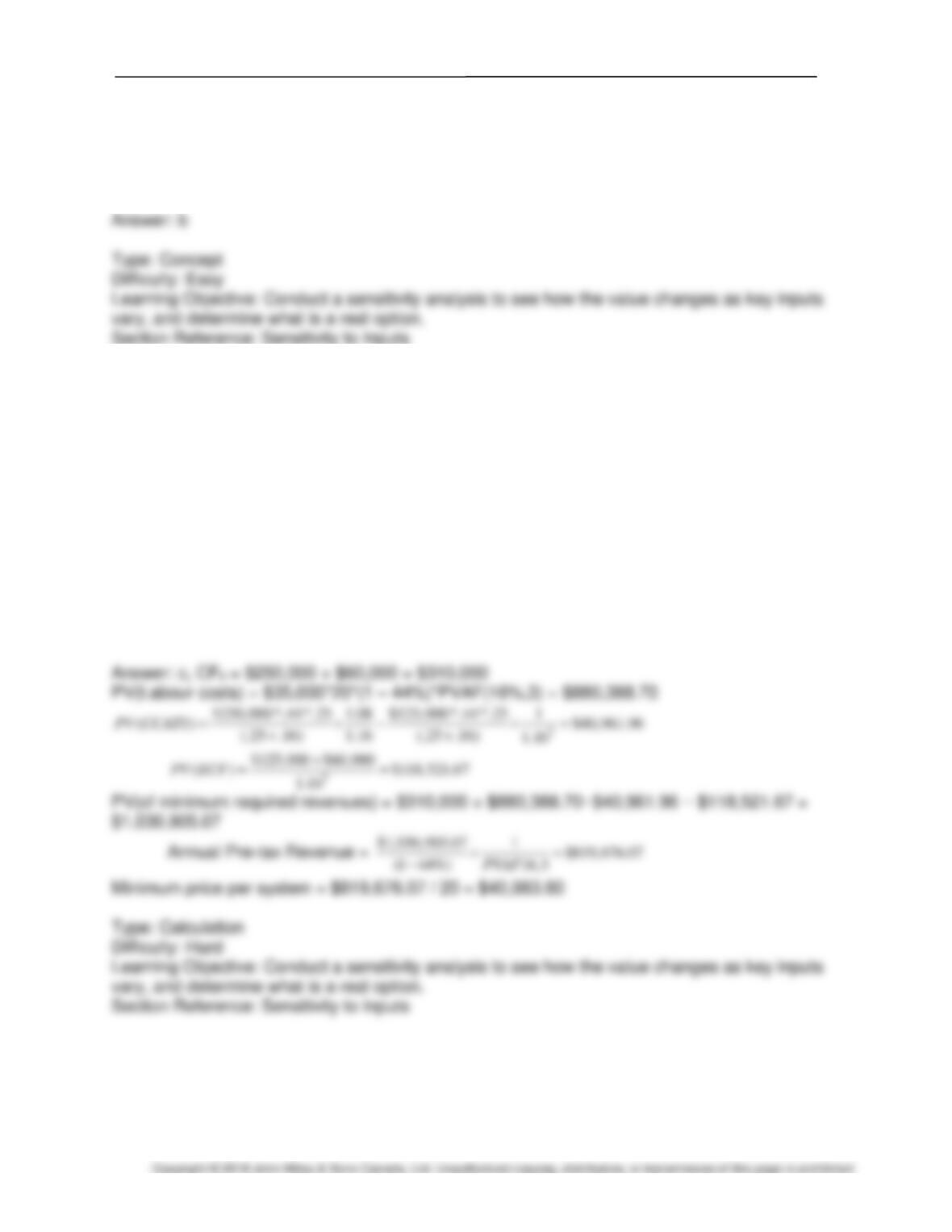
14 – 33 Test Bank for Introduction to Corporate Finance, Fourth Canadian Edition
b) the level of annual operating cash flow required for a project to produce an NPV of zero.
c) the level of annual operating cash flow required for a project to produce an NPV close to zero.
d) the level of annual operating cash flow required for a project to produce an accounting profit of
zero.
85. The Bits’n Bytes Computer Company has been requested by a large brokerage firm to submit
a bid for a new computer system. The system would be installed in 20 branch offices per year for
the next three years. Bits’n Bytes would need to purchase $250,000 worth of specialized
equipment. The CCA rate would be 25 percent. Bits’n Bytes will be able to sell the equipment in
three years for $125,000. Labour and material costs would be $35,000 per site. The company
would need to invest $60,000 in net working capital. The relevant tax rate is 44 percent. Assume
the asset class remains open after the asset is sold. If Bits’n Bytes requires a 16% return on
investment, their minimum bid (price per system) should be:
a) $22,950.93
b) $38,350.93
c) $40,983.80
d) $68,483.80
86. Suppose a five-year project requires an initial capital investment of $600,000 and an initial net
working capital investment of $30,000. The project is expected to provide operating revenue of
$400,000 per year. The associated operating costs are expected to be $175,000 per year. The
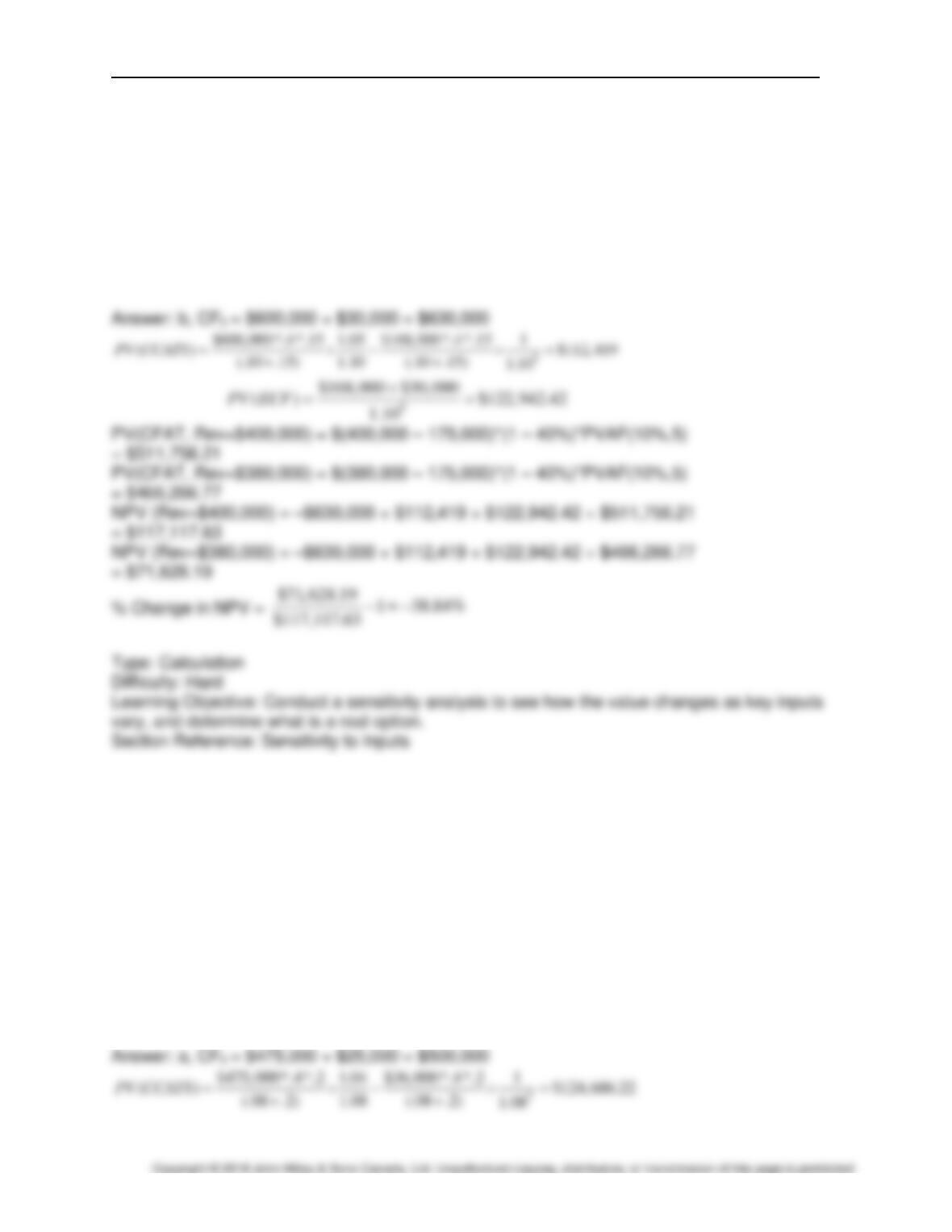
Cash Flow Estimations and Capital Budgeting Decisions 14 – 34
capital asset belongs to Class 7 and has a CCA rate of 15 percent. The asset is expected to sell
for $168,000 when the project terminates. Assume the asset class remains open after the project
ends. The firm’s marginal tax rate is 40 percent and cost of capital is 10 percent. What impact
would it have on the project’s NPV if the operating revenue falls by 5 percent?
a) NPV decreases by 21.85%
b) NPV decreases by 38.84%
c) NPV decreases by 46.19%
d) NPV decreases by 63.51%
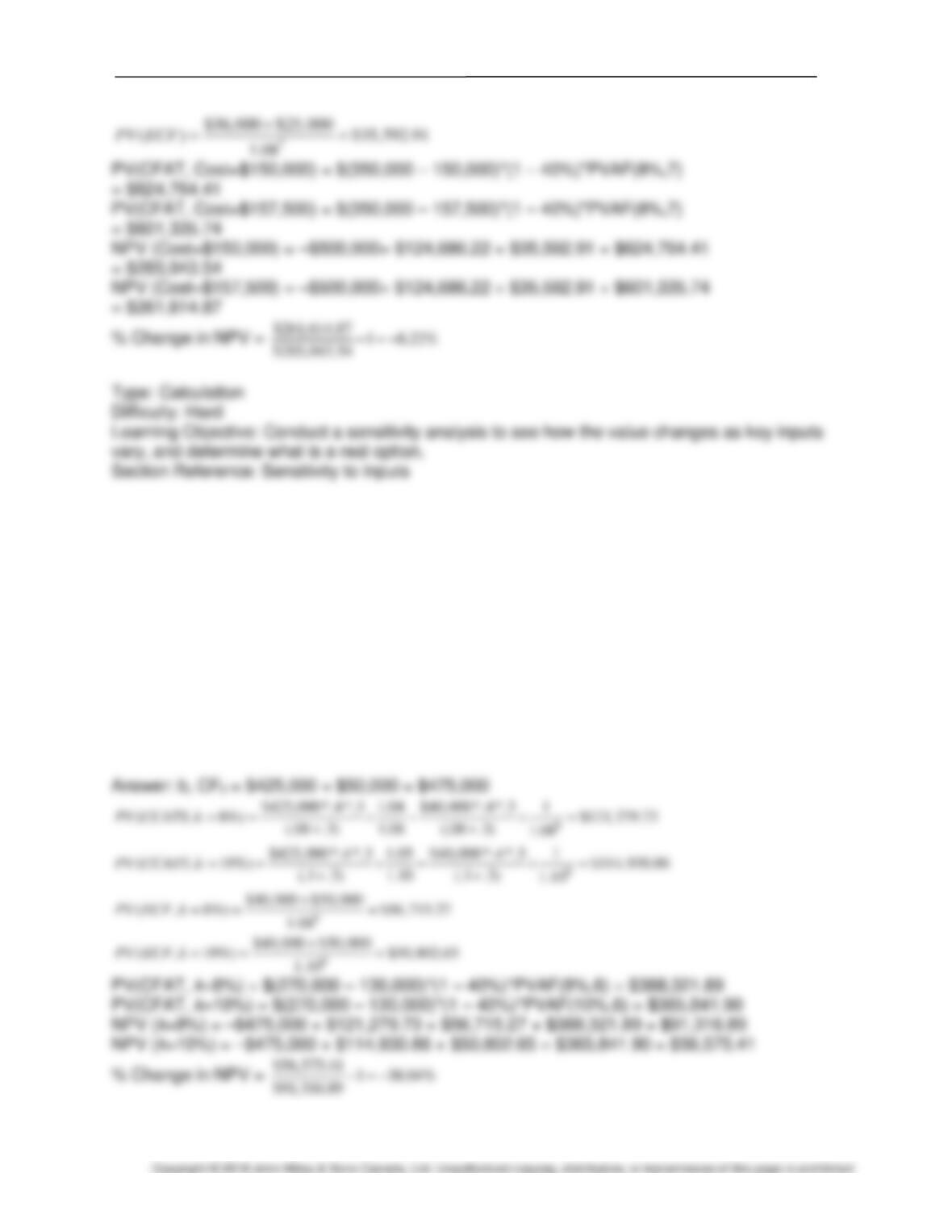
87. Suppose a seven-year project requires an initial capital investment of $475,000 and an initial
net working capital investment of $25,000. The project is expected to provide operating revenue of
$350,000 per year. The associated operating costs are expected to be $150,000 per year. The
capital asset belongs to Class 8 and has a CCA rate of 20 percent. The asset is expected to sell
for $36,000 when the project ends. Assume the asset class remains open after the asset is sold.
The firm’s marginal tax rate is 40 percent and cost of capital is 8 percent. What impact would it
have on the project’s NPV if the operating costs increase by 5 percent?
a) NPV decreases by 8.22%
b) NPV decreases by 8.66%
c) NPV decreases by 8.96%
d) NPV decreases by 10.96%
14 – 35 Test Bank for Introduction to Corporate Finance, Fourth Canadian Edition
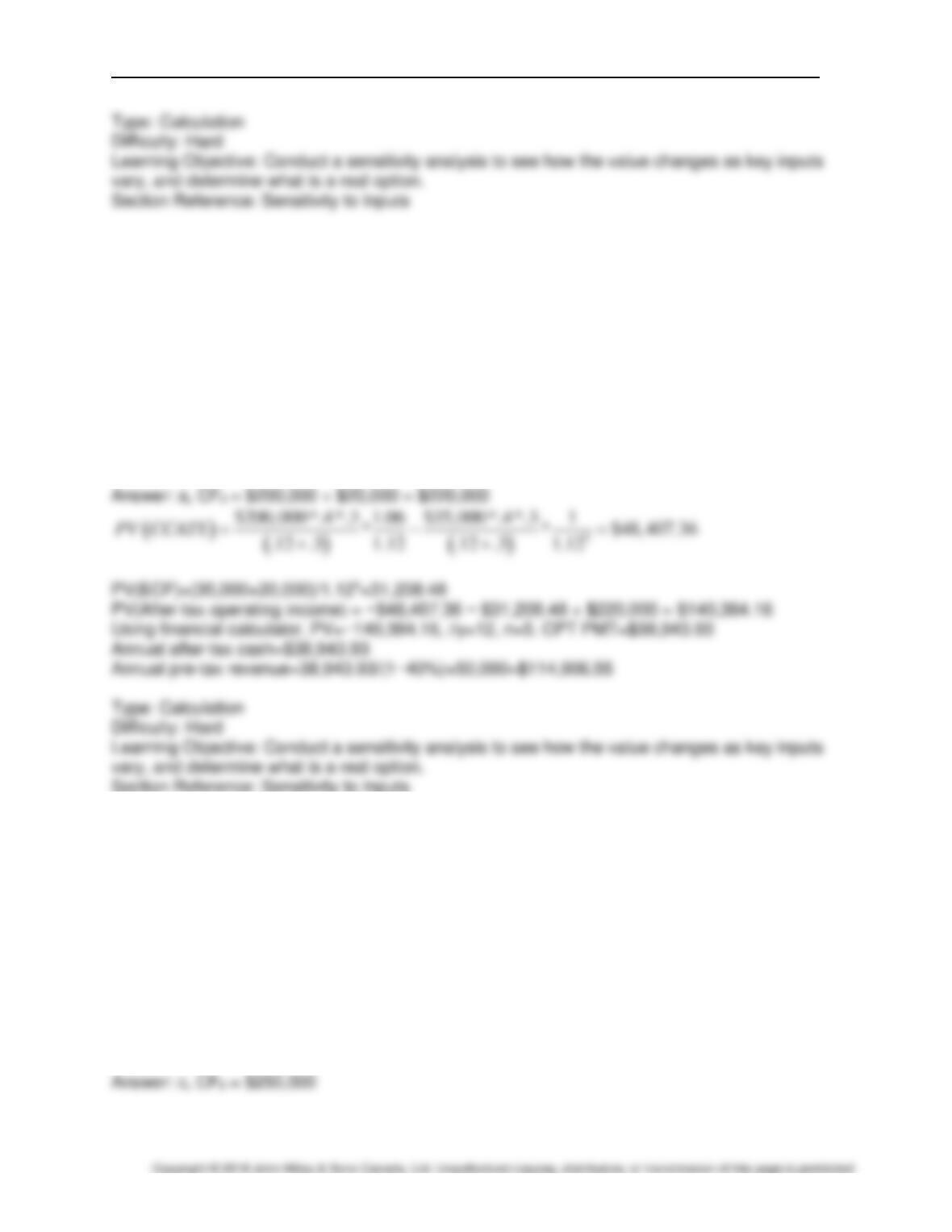
88. Suppose a six-year project requires an initial capital investment of $425,000 and an initial net
working capital investment of $50,000. The project is expected to provide operating revenue of
$270,000 per year. The associated operating costs are expected to be $130,000 per year. The
capital asset belongs to Class 9 and has a CCA rate of 30 percent. The asset is expected to sell
for $40,000 when the project terminates. Assume the asset class remains open when the asset is
sold. The firm’s marginal tax rate is 40 percent and cost of capital is 8 percent. What impact would
it have on the project’s NPV if the cost of capital were 10 percent?
a) NPV decreases by 23.14%
b) NPV decreases by 38.04%
c) NPV decreases by 48.20%
d) NPV decreases by 61.41%
Cash Flow Estimations and Capital Budgeting Decisions 14 – 36
89. A company is planning to invest in a project, which requires the purchase of capital assets of
$200,000 and additional net working capital of $20,000. The assets have a five-year life, a CCA
rate of 30 percent, and an expected salvage value of $35,000. The annual costs for the project’s
operations are $50,000. The company’s effective tax rate is 40 percent and the cost of capital is 12
percent. Assume the asset class remains open after the assets are sold. What is the break-even
pre-tax annual operating revenue?
a) $114,907
b) $38,944
c) $64,907
d) $140,384
90. A company is considering investing in a project, which requires the purchase of a new machine
for $250,000. The asset has a six-year life, a CCA rate of 30 percent, and an expected salvage
value of $30,000. The selling price of the product is $40 per unit, while the variable cost is $18 per
unit and the fixed costs are $50,000 per year. The company’s effective tax rate is 40 percent and
cost of capital is 10 percent. Assume the asset class remains open after the asset is sold. At what
level of sales will the company break even?
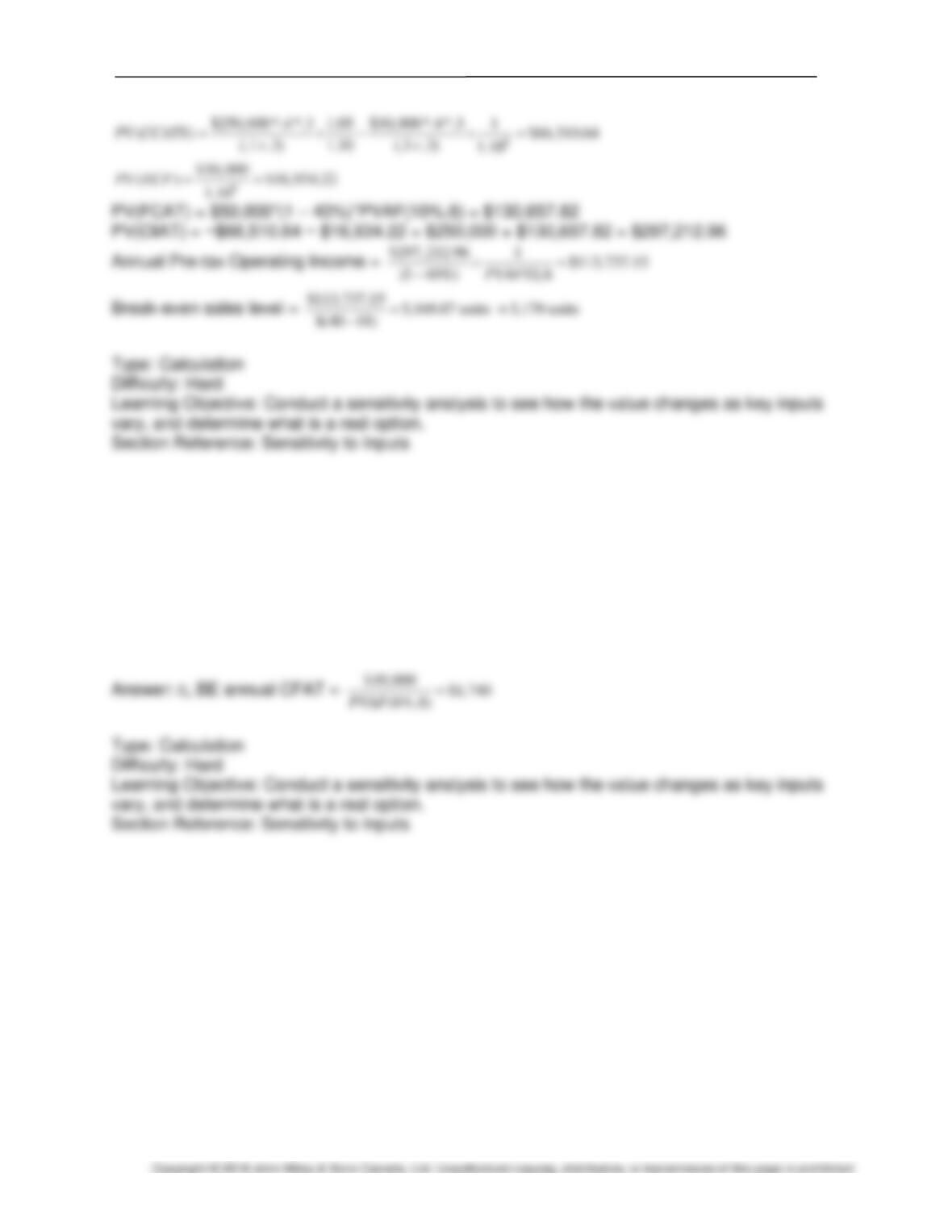
a) 3,102 units
b) 4,011 units
c) 5,170 units
d) 6,685 units
14 – 37 Test Bank for Introduction to Corporate Finance, Fourth Canadian Edition
91. Suppose an investment with an initial cost of $10,000 is estimated to produce after-tax cash
flows of $3,000 per year for 8 years. How low can the annual after-tax cash flows be before the
NPV of the investment equals zero? Assume that the appropriate discount rate is 8 percent.
a) $1,250
b) $1,260
c) $1,740
d) $2,262
92. A software firm is considering developing a new financial planning software package. This new
project is expected to sell 5,000 units per year and generate net operating cash flow of $100 per
unit for the next five years. The relevant discount rate is 15 percent and the initial investment is
$1.25 million. At what annual level of sales would it make sense to abandon the project if the
project can be sold for $150,000 after the first year? Ignore taxes.
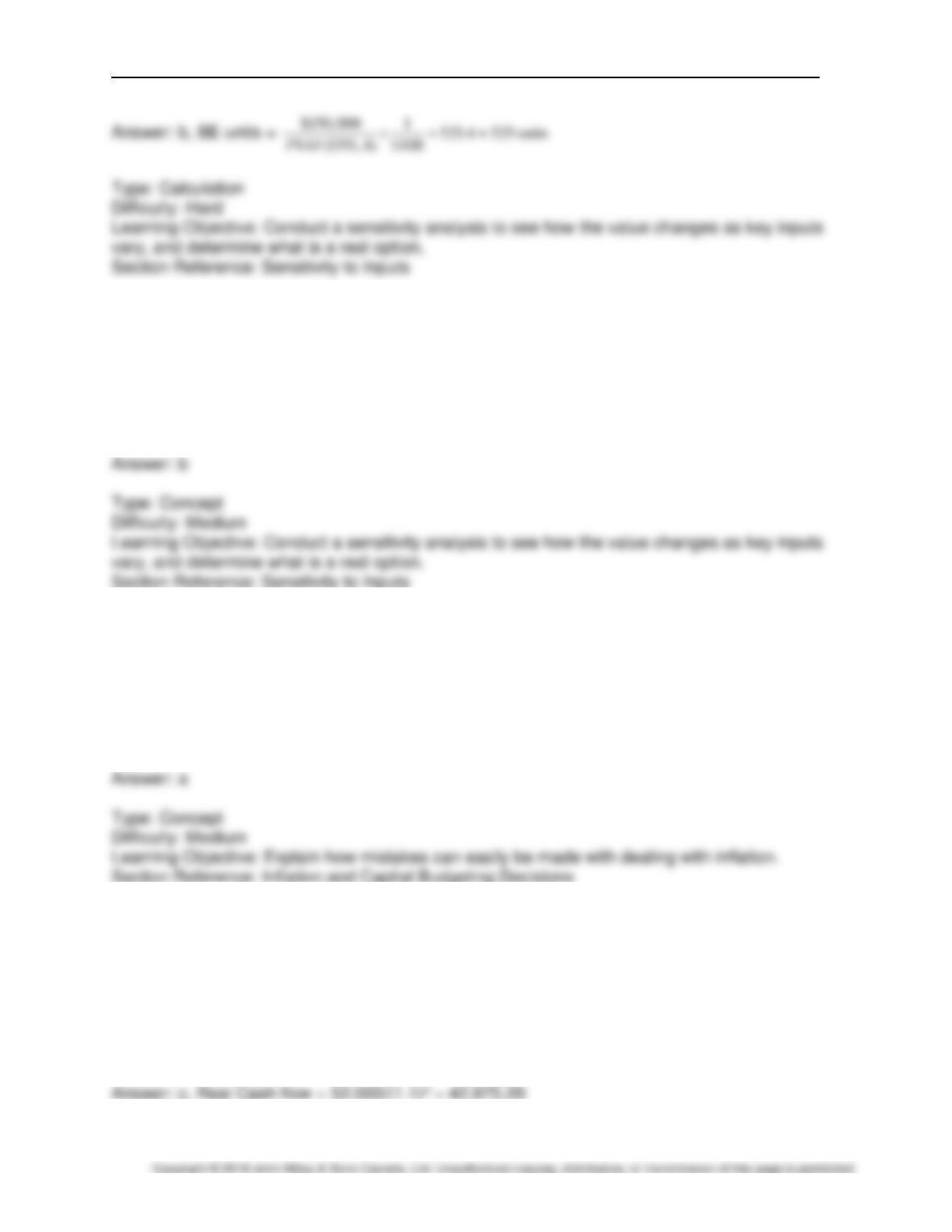
a) Less than 447 units
b) Less than 525 units
c) More than 3,340 units
d) Less than 3,729 units
Cash Flow Estimations and Capital Budgeting Decisions 14 – 38
93. Scenario analysis is a tool:
a) to test the effect of changing one estimate on the NPV of the project.
b) to test the effect of changing several estimates on the NPV of the project.
c) to assess taking a project this fiscal year or waiting for a few years before committing.
d) none of the above.
94. Which of the following is NOT a true statement?
a) Inflation always affects future levels of sales and expenses equally.
b) Inflation affects the firm’s cost of capital.
c) Actual cash flows should be discounted with nominal discount rates.
d) Inflation-adjusted cash flows should be discounted with real discount rates.
95. Nominal cash flow occurring in year 2 is 52,000. If the inflation rate has been 10% per year,
calculate real cash flow for year-2.
a) $60,800
b) $50,000
c) $42,975.20
d) None of the above