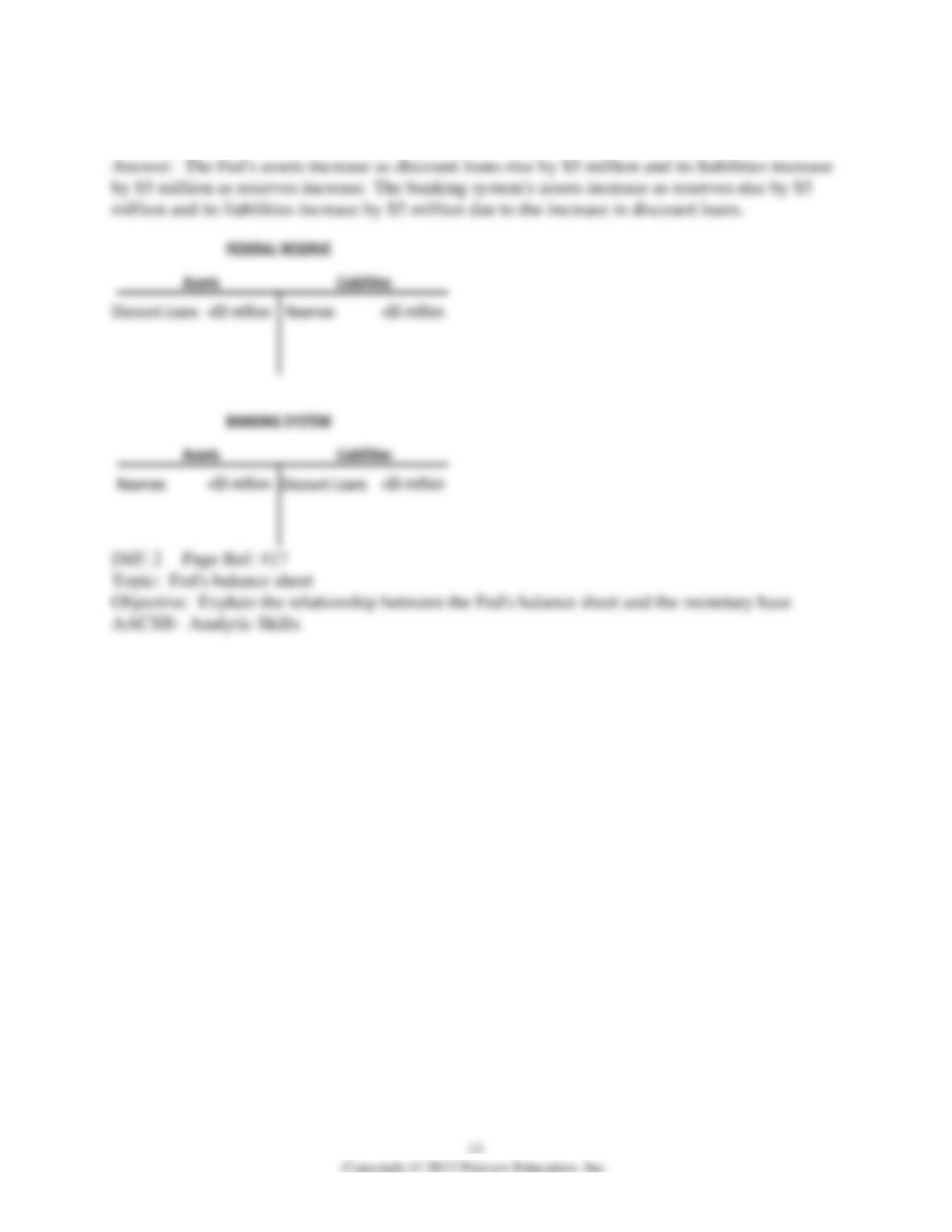
40) Suppose the Fed makes a $5 million discount loan to a bank. Illustrate how this affects the
balance sheets of the Fed and the banking system.
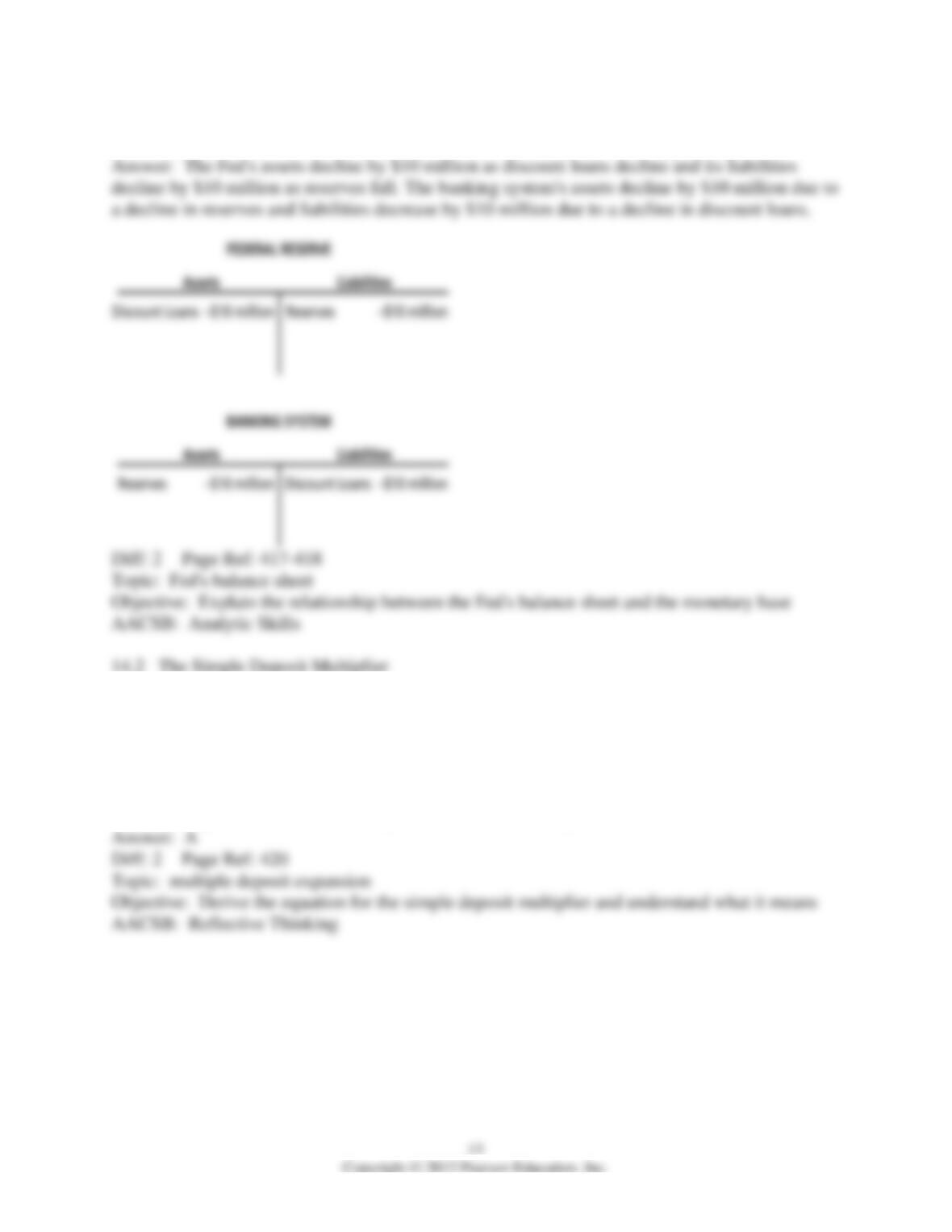
41) Suppose a bank repays a $10 million discount loan that it had previously borrowed from the
Fed. Illustrate how this affects the balance sheets of the Fed and the banking system.
1) If the Fed purchases $50,000 in T-bills from a bank, by how much will the bank’s excess
reserves increase?
A) by $50,000
B) by $50,000 times the required reserve ratio
C) by $50,000 divided by the required reserve ratio
D) not enough information has been provided to answer the question.
2) What is the maximum amount a bank can lend?
A) its total reserves
B) its excess reserves
C) its excess reserves divided by the required reserve ratio
D) the value of its checkable deposits times the required reserve ratio
3) The aggregate M1 consists of
A) currency plus all deposits in financial institutions.
B) currency plus all deposits in all institutions.
C) currency plus checkable deposits in financial institutions.
D) currency plus all checkable deposits.
4) Suppose that a bank with no excess reserves receives a deposit into a checking account of
$10,000 in currency. If the required reserve ratio is 0.20, what is the maximum amount that the
bank can lend out?
A) $2,000
B) $8,000
C) $10,000
D) $50,000
5) Suppose that the banking system currency has no excess reserves and that a bank receives a
deposit into a checking account of $10,000 in currency. If the required reserve ratio is 0.20, what
is the maximum amount that the banking system can lend out?
A) $8000
B) $10,000
C) $40,000
D) $50,000
6) If the Fed purchases $1 million worth of securities and the required reserve ratio is 8%, by
how much will deposits increase (assuming no change in excess reserves or the public’s currency
holdings)?
A) rise by $1 million
B) decline by $1 million
C) rise by $8 million
D) rise by $12.5 million
7) If the required reserve ratio is 5%, what is the value of the simple deposit multiplier?
A) 0.05
B) 0.20
C) 5
D) 20
8) Briefly explain the process of multiple deposit creation.
9) Suppose the required reserve ratio is 8% and that banks hold no excess reserves and the public
does not change its currency holdings. If the Fed sells $5 million worth of securities, what
happens to the amount of deposits in the banking system?
10) If the required reserve ratio is 10% and the Fed purchases $20 million worth of securities,
what is the simple deposit multiplier and what happens to the amount of deposits in the banking
system? Assume that banks do not hold excess reserves and the public does not change its
currency holdings.
11) Suppose the Fed sells $500,000 worth of securities to First National Bank. Illustrate the
immediate effect on the bank’s balance sheet.
12) Suppose the required reserve ratio is 8% and banks do not hold excess reserves. Illustrate on
a bank’s balance sheet what happens if the Fed buys $250,000 worth of securities from a bank.
14.3 Banks, the Nonbank Public, and the Money Multiplier
1) Which of the following assumptions made in deriving the simple deposit multiplier is
unrealistic?
A) The Fed sets the required reserve ratio.
B) The Fed is able to affect the level of reserves in the banking system.
C) Banks loan out all of their excess reserves.
D) The simple deposit multiplier is equal to 1 divided by the required reserve ratio.
2) When banks hold excess reserves, the size of the money multiplier
A) is less than the simple deposit multiplier would suggest.
B) is greater than the simple deposit multiplier would suggest.
C) is equal to the size of the simple deposit multiplier.
D) becomes infinite.
3) The money multiplier
A) equals 1 over the required reserve ratio.
B) is an expression that converts the monetary base to the money supply.
C) is larger than the simple deposit multiplier.
D) is completely controlled by the Fed.
4) Required reserves are equal to
A) the required reserve ratio divided by checkable deposits.
B) checkable deposits divided by the required reserve ratio.
C) excess reserves divided by total reserves.
D) the required reserve ratio times checkable deposits.
5) The money supply process focuses on the monetary base rather than on bank reserves because
A) bank reserves have little connection to the money supply.
B) the Fed has better control of the monetary base than it has on bank reserves.
C) bank reserves are difficult to measure.
D) banks are not required to report the level of their reserves, which makes it difficult for the Fed
to use them to control the money supply.
6) If banks hold no excess reserves, checkable deposits total $1.5 billion, currency totals $400
million, and the required reserve ratio is 10%, then the monetary base equals
A) $550 million.
B) $1.54 billion.
C) $1.9 billion
D) $15 billion.
7) If currency outstanding equals $200 million, checkable deposits equal $1 billion, reserves
equal $150 million, and the required reserve ratio is 0.10, the money multiplier equals
A) 0.86.
B) 3.14.
C) 3.43.
D) 4.
8) If currency outstanding equals $500 million, checkable deposits equal $2 billion, reserves
equal $200 million, and the required reserve ratio is 0.10, the money multiplier equals
A) 1.14.
B) 3.57.
C) 4.35.
D) 5.
9) The size of the money multiplier depends upon all of the following EXCEPT
A) the required reserve ratio.
B) the currency-deposit ratio.
C) excess reserves relative to deposits.
D) the discount rate.
10) Which of the following equations is correct?
A) B = Bnon + BR
B) B = Bnon + ER
C) B = ER + BR
D) B = C + D
11) Which of the following equations is correct?
A) M = m(Bnon + ER)
B) M = m(Bnon + BR)
C) M = m(C + BR)
D) M = C + R
12) The Fed has the greatest control over which of the following?
A) the money multiplier
B) discount loans
C) the amount of excess reserves
D) the nonborrowed monetary base
13) Suppose the required reserve ratio is 8%, excess reserve-to-deposit ratio is 2%, and the
currency-to-deposit ratio is 10%. What is the value of the money multiplier?
14) Suppose the required reserve ratio is 10%, excess-to-deposit ratio is 10%, and the currency-
to-deposit ratio is 20%. If the Fed buys $50 million worth of securities, what will happen to the
money supply?
15) Suppose the banking system holds no excess reserves. If the required reserve ratio is 0.10
and the money multiplier is 2.5, what is the value of the currency-deposit ratio?
16) During the Financial Crisis of 2007-2009, banks significantly increased their holdings of
excess reserves. What impact did this have on the money multiplier? How would the Fed change
the monetary base if it wanted to maintain a stable money supply?